The 2016 elections confuse and dumbfound me.

me-sanantonio
I think I may have predicted the wrong winner in every presidential election since Goldwater in 1964. I was pretty sure Dukakis would beat Reagan because “people just aren’t that dumb,” as I used to say.

A year ago, I’d have bet money that the 2016 race would be between Hillary and Jeb Bush, so certain was I that we live in a plutocracy. Jimmy Carter said we live in a plutocracy, so it made sense that the plutocrats would be picking both candidates.

Today, I don’t think that corporate America picked Donald Trump. I don’t even think that the Koch brothers right-wing fascist trend of the Republican party picked Trump. When I was certain it would be Jeb Bush,  I underestimated the extent of America’s limited democracy.

Two days ago, when the newspaper ran side-by-side articles with scandals against Clinton and Trump, I thought that Clinton’s close association with Wall Street billionaires would weigh more heavily against her than Trump’s dumbass sexism would hurt him, but I’m apparently wrong about that, too. I don’t think anybody even remembers, two days later, that Clinton made all those cozy statements to the bankers, but the news is full of Trump’s groping women.

Today, while high-profile Republicans are abandoning Trump everywhere, the polls and pundits all say that Hillary Clinton will be our next president. I’m afraid to agree with them for fear I might put a hex on labor’s candidate. It’s been demonstrated over and over that I am usually wrong. Don’t listen to me, friends!

I Actually Do Know One Thing

I know which side I’m on.

Even though I may not be so smart, I am at least persistent. I’ve been on the side of working people all my life and quite consciously for almost 50 years. Reagan may have beat the workers black and blue, but some of us constantly worked against him. Right now I’m working for labor’s candidates and causes, win or lose.

Sooner or later, all of us will have a choice to make. We will either lapse into fascism and court the destruction of the planet or we will give up superstition and idealism and form a rational society for ourselves and our children. Average people, maybe some but not a lot smarter than me, will choose the same side I chose.

–Gene Lantz

Click here for more of these ideas
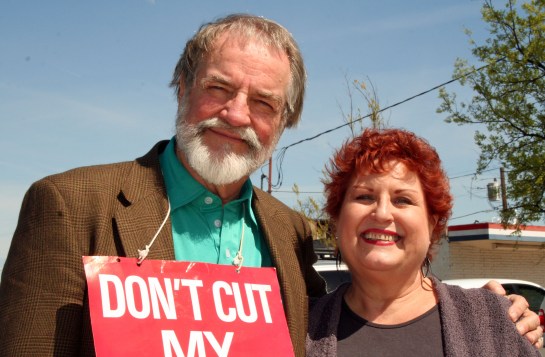
 

A caller on my radio show on KNON.org at 9AM this Saturday morning paid us a great compliment.

me-bonniemathias

Bonnie Mathias and I are on knon.org, 89.3FM, every Saturday at 9AM Central Time

He said that we were passing on worthwhile knowledge, just a little drop at a time. He compared the “drip drip drip” of our contribution to water eroding away a big hard rock of ignorance.

The “Workers Beat” program has been on KNON since it started in Dallas 30 or so years ago as a part of the ACORN community organizing group. When it had to go independent, and even after the government cut all funding for community talk radio, KNON managed to keep “Workers Beat” on the air.

It is one of three pro-labor radio shows in the entire southern half of the United States! As I put on the KNON web site, “Almost everything you see and hear comes from the bosses, or was approved by them. Employees don’t control the movies, the book publishers, TV, or the radio stations. Bosses do. The outlook and opinions of the bosses are expressed, everywhere and all the time. The outlook and opinions of workers get almost no expression. KNON “Workers Beat” talk show is an exception.”

Should We be Proud?

I guess that Bonnie Mathias and I can be proud that we prepare for the program and show up every Saturday without getting paid, but we can’t take credit for the wisdom in today’s caller’s compliment. The truth is that we don’t say a lot. KNON wants us to run an open mike talk show, not spout off our own opinions.

Even though today’s topic was the way that the City of Dallas is joining in the international game of sacrificing the right to retire, and even though I have very strong feelings about our losing the right to retire, I didn’t actually say “Vote NO on Proposition One on the Dallas ballot.” I just outlined what Proposition One would do and asked the radio audience for their opinions.

Callers were against Proposition One, by the way.

But the point is that the wisdom that working people get from the “Workers Beat” radio program isn’t coming from the hosts. It’s coming from the workers themselves! KNON just provides the forum, and working people call in, each with their own wise observations. Their observations are the “drip drip drip” of knowledge that is eroding away the rock of mass ignorance.

We’re just proud we could help!

–Gene Lantz

Click here for more of these idea

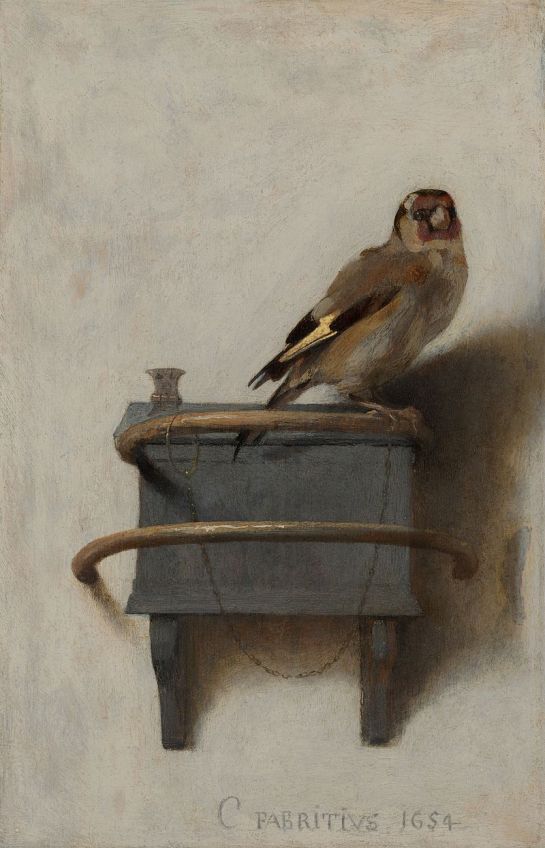
Tartt, Donna, “The Goldfinch.” Little Brown, New York, 2013

goldfinch

The old story goes that a guy sought the meaning of life. So he had to climb the highest mountain to ask the Great Guru “What is the meaning of life?”

It wasn’t easy climbing the mountain. There were a rock slide, an avalanche, and several mountain lions before, exhausted, he climbed up to the Great Guru. With all the breath he could still muster, he finally got to ask his question, “Oh Great Guru, what is the meaning of life?”

The Guru answered solemnly, “Spinach.”

The guy went berserk. He screamed, “I climbed this high mountain, I faced mountain lions and a rock slide and an avalanche to get up here, and now you tell me that the meaning of life is spinach?”

Distraught, and with tears beginning to form in his old eyes, the Guru said, “You mean it’s not spinach?”

***

“The Goldfinch” comes highly recommended. Wikipedia says it was a big hit when it first came out in Dutch, and the English version took the Pulitzer prize for 2014. In it, Theo Decker ages from 13 to mid-twenties and interprets the meaning of life as he experiences it, particularly from his love of the fine arts. One particular painting, of a small bird chained to its perch, becomes the axis around which the rest of his experiences revolve.

It’s not the same as climbing a mountain, but it seems like a very very long book to try to figure out Theo’s ideas on the meaning of life, especially because there were so many references to the fine points of fine art of which he seems to know just about everything and I know almost nothing.  I had to look up “aesthete”: es-theet or, esp. British, ees-] noun.

1. a person who has or professes to have refined sensitivity toward the beauties of art or nature.

  1. a person who affects great love of art, music, poetry, etc., and indifference to practical matters.

I decided that Theo, or at least author Donna Tartt, may be an aesthete and I’m not.

In my thinking, an aesthete is someone who would go ga-ga over a painting of a bird for decades, but would walk right by a dozen mockingbirds without looking nor listening. Without all the painted beauty that he describes so exquisitely, life would be pretty meaningless, or at least that’s what Theo seems to think.

I like paintings ok, but real birds are terrific, too. What I really like is everyday living. I like fixing oatmeal in the mornings for my wife. I sing a little song sometime, as I slice the apples and pour on the cinnamon, “Fixin’ breakfast for you!”

My wife has never once complained about my oatmeal. She always eats it. When I brag that I have some special talent and refer to myself grandly as the “Oatmeal King of the South,” she never contradicts me. In fact, she’s told other people that I make really good oatmeal.

So “The Goldfinch” book may be a good way to learn how to comment on some of the fine arts, and maybe it will interest people searching for the meaning of life. But it’s a long uphill climb to find out.

It’s like the guy who climbed up the mountain and was disappointed at the end. I could have told him that the meaning of life is not to be found in “The Goldfinch.” It’s not spinach, either.

It’s oatmeal.

–Gene Lantz

Click here for more of these ideas
I’ve been raving about this book for months, but it has a giant hole in it. There’s no treatment of what’s happening to the right to retire!

emmettseniorcrowd

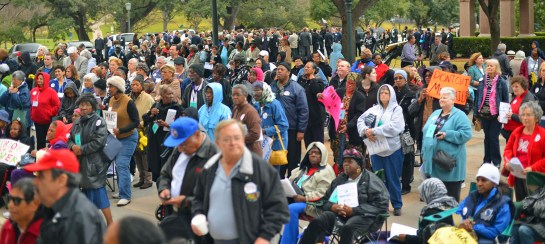
Senior Day at the Texas Capitol

I’ll put some of my notes about his fine book at the end. In a nutshell it explains that inequality went wild once the American workers movement — especially the unions — allowed themselves to be isolated and neutralized. Around 1980 — after the unions had chased away all the communists and all the international friends and all the progressive movement and, finally, each other — the corporations and their government lackeys were able to privatize, deregulate, un-tax themselves, attack progressive organizations and subvert democracy at will. They’re still doing it even though the weakened unions started wising up in 1995.

Conquerors attack their enemies at their weakest point. That means that the general attack against all working Americans tended to focus on the most vulnerable. In our case, the most vulnerable are the children and the seniors. The book talks a little about the corporate onslaught against public schools, but it doesn’t mention seniors at all!

Fight for the Right to Retire

The right to retire was put on firm footing in America with the passing of the Social Security Act in 1935. Medicare/Medicaid was added before 1980 Reaganomics became policy. In the 1960s, Americans could look forward to resting their “golden years” on a three-legged stool of personal savings, pensions, and Social Security. Now in 2016, the first two have been decimated and Social Security is under multiple threats every time Congress is in session.

In 2002, the new and progressive AFL-CIO leadership put together the Alliance for Retired Americans. It consists of a lobbying office in Washington DC and far-flung supporters here and there around the nation. We usually meet in union halls and most of our initial supporters are union retirees, but we reach out to all seniors and, for that matter, anybody and everybody who wants to save the right to retire in America before it’s too late!

In 2006, we faced a major challenge because President Bush made it his top priority to privatize Social Security. He came close, but we stopped him. Since 1980, there have been a succession of crazy proposals to do this and do that with retiree benefits. All of them are obscured in language, but in the final analysis they all mean cuts for seniors.

Around 1986, it became possible for corporations to disregard their responsibility for pensions in bankruptcy proceedings. In 2015 Congress decided that trustees of multi-employer pensions could solve their budget problems by cutting retiree benefits. The budget for administering Social Security has been cut so severely that many offices had to be shut down and many counselors laid off. Corporations and anti-worker politicians come up with some new attack every few weeks.

Here in Dallas, voters will find on their November 8 ballot a proposal to slash the pensions of City employees. The Dallas newspaper already endorsed it as sound policy!

It’s fight or die!

–Gene Lantz

Click here for more of these ideas
Some notes from the book:

Leopold, Les, “Runaway Inequality. An Activist’s Guide to Economic Justice.” Foreword by Chris Shelton, President of CWA. Labor Institute Press, 817 Broadway, NY NY 10003, 2015

I think I put 3 references to this book on genelantz.org. I found it very exciting that CWA was holding classes and giving away copies of a book on more-or-less radical economics.

pg2 (shelton) “We’ll see data showing that elected officials rarely act on the agenda most Americans support.”

pg4: “Most of all, the media turns a blind eye to the fact that we live in a capitalist system.”

pg4: “…there is, in fact, a fundamental conflict between employees and owners, between the rich and the rest of us.”

pg5 “Economic elites will only give up power and wealth when they’re forced to do so by a powerful social movement.”

pg29-30 (Leopold) list of reasons for economic crisis of late 1970s, including competition from industrialized countries.

pg194 “…American public actually have little influence over the policies our government adopts.”

pg204 “This policy of military Keynesianism led to an unofficial partnership between the government, large corporations and labor unions. These groups worked together (more or less) to prosecute the Cold War.”

pg 288 “…Wealth inequality and unionization levels are intertwined.”

pg288: List of “what happened to unions” begins, “The decline of unionism started when unions started cooperating with the government ‘anti-red’ efforts during the McCarthy era.”

The book doesn’t actually generalize, but it does show that the entire process of rising  inequality was a result of union isolation —  first from the world movement, then from the domestic progressive movements here at home (anti-war, civil rights, etc) and finally, with the merger of the AFL and the CIO, from one another. “Solidarity” was still a good song, but it wasn’t really practiced 1947-1995 in the American union movement.

pg 289: “…Unions and the rest of us are on the losing side of a gigantic class war — a war that we have to recognize, discuss and address if unions are to grow again.”


Leave a Reply


Two big questions are in the news: Should mega-whistleblower Edward Snowden be pardoned? Should 9/11 victims be allowed to sue Saudi Arabia?

snowden

Both questions have to do with the nature of the state. By “state” I mean what most people call “nation” or “government,” not the kind of state we say when we talk about the sorry state we’re in.

Do You Love Snowden?

The new Oliver Stone movie “Snowden” makes a strong case for national hero status. In it, the central actor talks to journalists and directly into a TV camera. The earlier movie, “Citizen Four” was a documentary consisting almost entirely of those recordings that Snowden actually made with the journalists while all of them hid in his Hong Kong hotel room. Of the two films, the documentary is the better movie and makes the stronger case for hero status because Snowden explains, in his own words, why he did it.

It was for love and respect. He says he loves and respects himself and thus has the same regard for all others. We are, in plain truth, all pretty much alike. If we care about anybody, we have no excuse for not caring for everybody. Snowden realizes that. He explains it well to the camera. When he did, I was in love!

It’s Harder to Love the Saudis

A bill to allow 9/11 victims to sue any country that they think was involved in the attack on the Twin Towers in New York sailed through both houses of Congress. Then President Obama vetoed it. Then the congresspersons, whose collective wisdom has earned them the lowest regard of any Congress in American history, decided to override the veto. They did it, too, just today! (Click here).

Their argument was that the victims should get more compensation. The President’s argument was that they’re opening a can of worms that will end up with the United States being sued all the time by foreigners. The real question is whether or not individuals in a given state should be allowed to conduct negotiations with other states.

In Snowden’s case, the real question is whether or not an individual can reveal state secrets.

Unions Prohibit Individual Negotiations

If one were a union member, he/she would be discouraged from negotiating with any entity outside the union — especially not with management. Union members are also expected to keep silent about union business. If one were helping negotiate a contract, for example, one would be sworn to secrecy until negotiations had concluded and formal announcements were made. There’s really no other way to run a union!

So, if the analogy between a union and the United States holds up, citizens shouldn’t be suing Saudi Arabia and Brother Snowden should have kept his mouth shut.

It Depends on the State

Socialists believe that states will eventually wither away because they won’t be necessary once class divisions are finally behind us. So far, that has never happened, but it’s still the general idea. Socialists may be all in favor of unions, but not in favor of states.

So, if you love your state the way I love my union, Congress and Snowden are both wrong. But if you don’t think so much of this government, the opposite opinions prevail.

Let ’em sue anybody they want to! Let’s join the movement to pardon Edward Snowden! I wouldn’t call him a “national” hero, but definitely a world hero!

–Gene Lantz

Click here for more of these ideas

 

I’ve known a few union staffers and a few union officers. I’ve also known exes.

me-swearinafl

Union Officers are elected and sworn in. Staffers are just hired.

The exes might tell you that their union job worked them to death, made them travel a lot more than they wanted to, and wasn’t even close to their ideal of fighting for social justice. Union staffers and even union officers will almost certainly tell you that union members don’t appreciate them. It’s almost impossible to help one union member without making another one furious. A wise old Chairman of my local used to say, “If you helped one member and only made two angry, then you’ve had a good day.”

Union staff members, like first-year school teachers, get their romantic notions crushed pretty early in the game. A novice history teacher might really want to teach American history as it really happened, but he/she better not say so in the classroom! A union staffer may really want to encourage the members to agitate for militant action, but he/she better keep quiet about it unless his/her boss wants it done.

Union staffers pretty much check their own principles and ideals at the door when they hire in, just as anybody does when they go to work for somebody else. Maybe more so, because unions are by nature political and political people really have to be careful what they say!

What About Me?

I’ve never had a union job. I’ve been elected to office many times, and I eagerly accept any assignment having to do with communications — webmaster, editor, etc. But when I write for union publication, I’m writing for the union’s needs, not necessarily my own. I have this blog for my own opinions, but the opinions I write for my union local leaders is supposed to be theirs.

What’s The Best Course of Action?

If you want to join in the great strength and potential of the union movement, I recommend getting a union job, then prove your value through union activism and take office or committee assignments. If you can’t get a union job, try getting a job that could be unionized. Whenever young people ask me about working for a union, I tell them they would probably make a bigger social justice contribution by hiring on at Walmart!

–Gene Lantz

Click here for more of these ideas

Those who want significant change have to fight every day in the short run. We fight for things like democracy, better wages, more rights, and fair treatment. Incidentally, nearly all of those battles are defensive. We rarely pick a fight. The bosses initiate nearly all battles.

peopleracing

In all these short run battles, we have had victories in the past. But as long as the bosses remain in power, we can lose everything we have gained.

What we have to do is win the long-run battle as to who is in charge. We have to overcome the bosses if any of our gains, short or long run, are to last.

So the short term is our battles, nearly always defensive battles, on immediate problems. The long term fight is for power.

How Are Long-term and Short-term Battles Related?

Most people don’t see the long term, and you can’t blame them. The short-term problems are too pressing. Union organizers like to joke that “When you’re up to your ass in alligators, it’s hard to remember that your original intention was to drain the swamp.”

But nearly everybody nowadays is painfully aware of their particular part of the short-term battles. Those who hope to win in the long-term have to join everybody else in the short term battles.

Think about it. If some radical person or organization won’t help you with your pressing immediate problem, will you trust them enough to join them on something else? Thinking activists have to take the progressive side of every short-term battle.

Losing Doesn’t Motivate, Only Winning Motivates

Another important reason for joining short-term battles is to win them. Contrary to what a lot of people may think, people are not motivated by losing. The school of “hard knocks” may have academic value, but it doesn’t encourage people to “try, try again.” People are motivated by winning, and all the statistics in history prove it.

By winning smaller, short term battles, we educate and inspire people to win further battles. If we can do this long enough, everybody will be ready for bigger battles, and we can win them!

–Gene Lantz

Click here for more of these ideas

Yesterday, I was given the opportunity to help striking workers.

symfrenchhorn

The Fort Worth Symphony Musicians are on strike. A couple of the leaders were on my radio show, then I went over to Ft Worth for their rally, march, and picket last evening. I was so proud of them for their courage!

The number of important labor strikes diminished after Reagan was elected in 1980, and has almost disappeared today. They are all tangled up with government supervision and extremely difficult to carry off.

Withholding Our Labor Is Our Weapon

The truth is, all we have is our labor, and almost the only real economic power we have is to withhold our labor. That doesn’t always mean striking. It might mean some kind of slowdown or “work to rule.” it might mean a sickout or “blue flu” day.

There are laws closely regulating what you can and can’t do on any kind of concerted action. That’s because our enemies, the bosses and their government lackeys, already know that withholding our labor is about all we can do — and they intend to limit it as much as they can!

Despite everything, we can still win strikes. Our slogan is “One Day Longer!”

Boycotts, too, are Highly Regulated

The same is true of boycotts, which are much less effective weapons, but we can use them because  workers are also consumers.

We Have One Greater Power

Solidarity is our greatest strength. The Musicians Union might not be able to shut down the city of Fort Worth because they don’t occupy a vital economic center. But they could hit the economy hard if they had enough friends and allies. Suppose the taxi and bus drivers committed to helping, for example!

With enough friends and allies, labor could apply all kinds of economic pressures. Further, by pooling our financial resources to make sure strikers’ families keep eating, we could make a strike last indefinitely. The Musicians, by the way, have already thought of that. They have an on-line donation site.

If we were really pulling together. workers could win everything we want. That has to be the goal. The isolated strikes of today, like the musicians in Fort Worth, are good practice for us all!

–Gene Lantz

Click here for more of these ideas


I appreciate everybody in the progressive movement for anything they say or do.

ppreflex

But the “armchair socialists,” who don’t actually do anything, and the “knee-jerk activists,” who try to do everything imaginable, worry me.

The main problem with the knee-jerkers is that they won’t last long. A lot of the things they try won’t work out, and they will tend to get discouraged early. Burnout. Years later, we’ll hear them saying, “Oh I used to be full of piss and vinegar, but…”

As they don’t think through any plan nor program, they just grab anything that comes up. In fact, if something seems pretty outrageous, then they figure it’s more “anti-establishment” and consequently even more attractive to them.

If we don’t think through what we’re doing, we’re leading other people down wrong paths. Some of those paths are dangerous and some of them are just wastes of time. That’s why I keep arguing for people to make up their minds what strategies they like and how those strategies relate to what they are actually doing.

If you think the next president is going to set everything right, then why are you spending all your time on something else? If you think organizing is the key, why would you go “rabbit chasing” all over the political spectrum? If you agree with me that single purpose coalitions (click here) are far stronger than those that try to do everything, why would you try to turn every meeting into a convention of a New Communist Party that will solve all ills?

The best activists are those that take action, then re-evaluate in terms of an overall strategy for what they want to accomplish, then take more action. Action and thinking have to combine. The knee jerkers will be whatever help they may be, do whatever damage they’re going to do, and will be seen no more — unless we can convert them into rational activists before they burn out!

–Gene Lantz

Click here for more of these ideas