Archive

unions

On the day after the election, small groups of demonstrators hit the streets in a number of American cities. I just got a request that I join a call for a general strike — a national work stoppage — on Inaugural Day. I call this kind of non-thinking acting-out “knee jerk activism.” It’s more traditionally called “ultra-leftism” and has been correctly labeled, “the infantile disorder.”

strike1877

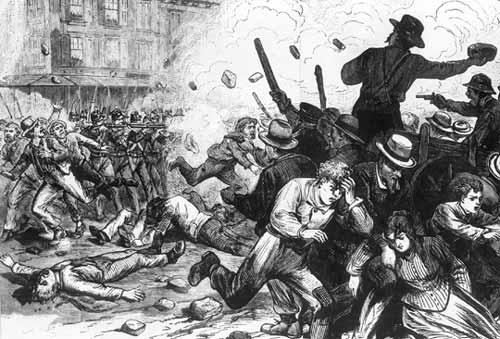
We had a tremendous general strike in 1877

Union activists are used to hearing people call “strike!” when they have no idea whether or not the tactic would work. A lot of them don’t care. If a union called a strike every time some hothead wanted one, we’d get a lot of people fired for nothing. When my union ran a successful 15-month “work to rule” contract fight, there were people calling “strike” instead of doing the hard work of a long struggle. The three of them that I knew personally were all promoted to foreman immediately after the union won. They were company stooges, as it turned out. The company knew that the union might win the long battle, but we would almost certainly have lost a strike.

If you’re reading along in Facebook, you’ve seen lots of responses to the Trump election victory, and nearly all of them are way less than helpful. Some are silly, and some are outright dangerous!

First, Figure Out What Happened

Nearly all the pollsters were wrong about the election results. The best single explanation I’ve seen was in a “letter to editor” in today’s Dallas newspaper. A guy named, I think, Roland Young wrote that when the pollsters called, “We lied!” Some of Trump’s voters may have been too ashamed to confess.

But the best explanation of the pollsters’ failure is that their approaches are based on previous history, and the 2016 presidential race was, to state it modestly, unique.

Are Americans Mostly Chauvinists?

Elections are the best evidence we have of the national character. If the Electoral College puts Donald Trump in office, does that mean we’re mostly chauvinists like him? Actually, more than half the electorate voted against him, and only 56% of all eligible voters went to the polls at all. The ones that went voted for marijuana and higher minimum wages by much better margins than they voted for Trump.

Everyone who voted for Trump did not do so because they wanted to express their chauvinism. They surely didn’t vote for him because they think his far-flung ideas are actually going to solve America’s problems.

What They Wanted Was Change

I think it is fair to say that they voted for change. We see this in the unions all the time. Members who haven’t taken the time to investigate the candidates in union elections will nevertheless vote to “throw the bums out” against whoever is in office. Next election, you can’t find anyone who admits they voted for the incumbents and it’s “throw the bums out” again. After a lifetime in the public eye, and because of the outright duplicity of the national Democratic Party, Hillary Clinton was a perfect target for that kind of sentiment.

People voted for Trump over Clinton for the same reason that they had voted, in 2008, for Obama over Clinton. Change.

People voted for Donald Trump because they are dissatisfied with life in America and they don’t know what else to do about it.

I don’t exactly blame them. I’m dissatisfied too, but I know what to do about it.

Educate and Organize the Working People

Media pundits are blaming “white blue-collar workers” for electing Donald Trump. His voters were probably Anglos all right, but they didn’t represent the working class. The working class is the solution, not the problem. The progressive leadership of the AFL-CIO is head and shoulders above any Democratic or Republican Party politician. For now, it’s better to follow them than Bernie Sanders, too.

If we’re willing to do the long hard work of educating and organizing America’s workers, we could win elections. We could win strikes, even general strikes!

But it will take some work.

–Gene Lantz

Click here if you want to know what I really think!


tpp-TARA

Unions are doing so many things right nowadays that one hesitates to make any suggestions. I enjoyed a recent posting by the International President of the AFSCME (American Federation of State, County, and Municipal) union. He outlines some of the positive changes they have made.

I’d go so far as to say that the main labor federation, AFL-CIO, has made great strides since the “palace coup” changed the leadership in 1995. I love working with them.

Unions are inherently revolutionary, even though they do everything in their power to not be. They can’t help but oppose capitalism, even though they are solely defensive organizations, because capitalists can’t stop attacking them. Unions will never take power anywhere, but they can’t help trying.

But Unions Face Tremendous Problems

In my opinion, America’s unions could go a long way toward solving their problems if they’d just start with an historical analysis. As long as they continue to ignore the great mistakes they made between 1947 and 1995, they’ll find it harder to go forward. That’s one important thing.

Another one is that unions need to free themselves from being chained to the worst part of their members. Any union official can tell you that they spend most of their time handling petty grievances. The best union members rarely file a grievance, because they are not only the best union members but also the best workers. The worst workers, the ones who can’t show up half the time, the ones who are drunk on the job, the ones who abuse one another — those are the ones that file most of the grievances and , consequently, take up most of the union officers’ time.

In fact the biggest time consumer of all is the termination grievance. Somebody gets fired and the union feels obligated to try to get their job back. Management is not likely to take them back before all options are exhausted — and there are a lot of options in labor/management relations. The best union members, the best workers, rarely get fired.

That’s just the way the job works and nobody is actually complaining. If you don’t take care of the worst workers, you can’t take care of all the workers. If management can get away with abusing some workers, they’ll try to abuse all. So it’s not a waste of time, just a big consumer of time, to deal with grievances.

Union officers would like to spend time organizing, educating, and strengthening the union movement — but they usually don’t because they don’t have time.

There Are Tremendous Solutions

I believe that progressive union leaders are finding and applying solutions to these problems. I heard once that the Service Employees have some kind of centralized national grievance-handling process where grievances are called in by phone. I have no idea if this is true, nor do I know how it works.

But I imagine a big round table with grievance experts sitting at computers all around. Each of them has a headset. Each computer has access to labor law and, more importantly, every pertinent union contract. Members from all over the country call in their grievances. The expert types up a proper report and offers immediate advice. Then they contact management and begin to “handle” the grievance. They use three-way calling when appropriate.

When contracts expire, a complete digital record of the old contract and all grievance settlements is available to the negotiators. One of the experts from the round table I described might even sit in on negotiations to make sure everything is done properly and legally.

 What Is Needed?

Unions need cooperation. The utopian grievance handling proposal I outlined above could be used by the AFL-CIO to handle ALL grievances, not just those of a single union. Or maybe we could have one “grievance center” for public workerfs and one for private workrers. Maybe another one for private workers under the Railway Labor Law, as opposed to the National Labor Relations Law.

Unions are cooperating now more than anytime since 1947. They are not only cooperating with one another, they are even merging with one another. That’s good, but it could go a whole lot further. They could, for example, centralize their organizing departments, their education departments, and maybe some other departments.

Unions need organizers. The best organizers nowadays work with entire communities. The union man standing in front of a plant handing out leaflets, they say, has already lost. People get organized from their homes and communities. I’d go further to say that the best union members are going to be organized through a series of meaningful activities like the “Fight for Fifteen” effort to raise the minimum wage.

The internet, and, especially, social media need to be harnessed in labor’s campaign. We can organize that way and we can educate that way. Unions need educators.

Unions need activists. Every time a union man or woman assists in a community problem, they advertise the importance of joining the union.

None of these ideas is exactly new, except insofar as new technology is applied. My own union, the Autoworkers, wasn’t organized in the plants. It was organized during the frequent periods of plant shut downs in the auto industry. It was organized by the great Unemployed Councils, by marches, rallies, and protests.

And that seems like a good place to stop because it brings me back to my original point: unions need to assess our own history and learn from it!

Leave a Reply


A caller on my radio show on KNON.org at 9AM this Saturday morning paid us a great compliment.

me-bonniemathias

Bonnie Mathias and I are on knon.org, 89.3FM, every Saturday at 9AM Central Time

He said that we were passing on worthwhile knowledge, just a little drop at a time. He compared the “drip drip drip” of our contribution to water eroding away a big hard rock of ignorance.

The “Workers Beat” program has been on KNON since it started in Dallas 30 or so years ago as a part of the ACORN community organizing group. When it had to go independent, and even after the government cut all funding for community talk radio, KNON managed to keep “Workers Beat” on the air.

It is one of three pro-labor radio shows in the entire southern half of the United States! As I put on the KNON web site, “Almost everything you see and hear comes from the bosses, or was approved by them. Employees don’t control the movies, the book publishers, TV, or the radio stations. Bosses do. The outlook and opinions of the bosses are expressed, everywhere and all the time. The outlook and opinions of workers get almost no expression. KNON “Workers Beat” talk show is an exception.”

Should We be Proud?

I guess that Bonnie Mathias and I can be proud that we prepare for the program and show up every Saturday without getting paid, but we can’t take credit for the wisdom in today’s caller’s compliment. The truth is that we don’t say a lot. KNON wants us to run an open mike talk show, not spout off our own opinions.

Even though today’s topic was the way that the City of Dallas is joining in the international game of sacrificing the right to retire, and even though I have very strong feelings about our losing the right to retire, I didn’t actually say “Vote NO on Proposition One on the Dallas ballot.” I just outlined what Proposition One would do and asked the radio audience for their opinions.

Callers were against Proposition One, by the way.

But the point is that the wisdom that working people get from the “Workers Beat” radio program isn’t coming from the hosts. It’s coming from the workers themselves! KNON just provides the forum, and working people call in, each with their own wise observations. Their observations are the “drip drip drip” of knowledge that is eroding away the rock of mass ignorance.

We’re just proud we could help!

–Gene Lantz

Click here for more of these idea

I’ve been raving about this book for months, but it has a giant hole in it. There’s no treatment of what’s happening to the right to retire!

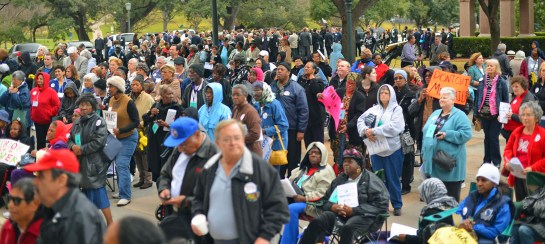
emmettseniorcrowd

Senior Day at the Texas Capitol

I’ll put some of my notes about his fine book at the end. In a nutshell it explains that inequality went wild once the American workers movement — especially the unions — allowed themselves to be isolated and neutralized. Around 1980 — after the unions had chased away all the communists and all the international friends and all the progressive movement and, finally, each other — the corporations and their government lackeys were able to privatize, deregulate, un-tax themselves, attack progressive organizations and subvert democracy at will. They’re still doing it even though the weakened unions started wising up in 1995.

Conquerors attack their enemies at their weakest point. That means that the general attack against all working Americans tended to focus on the most vulnerable. In our case, the most vulnerable are the children and the seniors. The book talks a little about the corporate onslaught against public schools, but it doesn’t mention seniors at all!

Fight for the Right to Retire

The right to retire was put on firm footing in America with the passing of the Social Security Act in 1935. Medicare/Medicaid was added before 1980 Reaganomics became policy. In the 1960s, Americans could look forward to resting their “golden years” on a three-legged stool of personal savings, pensions, and Social Security. Now in 2016, the first two have been decimated and Social Security is under multiple threats every time Congress is in session.

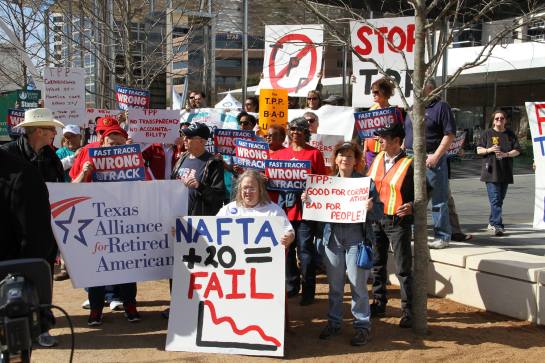
In 2002, the new and progressive AFL-CIO leadership put together the Alliance for Retired Americans. It consists of a lobbying office in Washington DC and far-flung supporters here and there around the nation. We usually meet in union halls and most of our initial supporters are union retirees, but we reach out to all seniors and, for that matter, anybody and everybody who wants to save the right to retire in America before it’s too late!

In 2006, we faced a major challenge because President Bush made it his top priority to privatize Social Security. He came close, but we stopped him. Since 1980, there have been a succession of crazy proposals to do this and do that with retiree benefits. All of them are obscured in language, but in the final analysis they all mean cuts for seniors.

Around 1986, it became possible for corporations to disregard their responsibility for pensions in bankruptcy proceedings. In 2015 Congress decided that trustees of multi-employer pensions could solve their budget problems by cutting retiree benefits. The budget for administering Social Security has been cut so severely that many offices had to be shut down and many counselors laid off. Corporations and anti-worker politicians come up with some new attack every few weeks.

Here in Dallas, voters will find on their November 8 ballot a proposal to slash the pensions of City employees. The Dallas newspaper already endorsed it as sound policy!

It’s fight or die!

–Gene Lantz

Click here for more of these ideas

Some notes from the book:

Leopold, Les, “Runaway Inequality. An Activist’s Guide to Economic Justice.” Foreword by Chris Shelton, President of CWA. Labor Institute Press, 817 Broadway, NY NY 10003, 2015

I think I put 3 references to this book on genelantz.org. I found it very exciting that CWA was holding classes and giving away copies of a book on more-or-less radical economics.

pg2 (shelton) “We’ll see data showing that elected officials rarely act on the agenda most Americans support.”

pg4: “Most of all, the media turns a blind eye to the fact that we live in a capitalist system.”

pg4: “…there is, in fact, a fundamental conflict between employees and owners, between the rich and the rest of us.”

pg5 “Economic elites will only give up power and wealth when they’re forced to do so by a powerful social movement.”

pg29-30 (Leopold) list of reasons for economic crisis of late 1970s, including competition from industrialized countries.

pg194 “…American public actually have little influence over the policies our government adopts.”

pg204 “This policy of military Keynesianism led to an unofficial partnership between the government, large corporations and labor unions. These groups worked together (more or less) to prosecute the Cold War.”

pg 288 “…Wealth inequality and unionization levels are intertwined.”

pg288: List of “what happened to unions” begins, “The decline of unionism started when unions started cooperating with the government ‘anti-red’ efforts during the McCarthy era.”

The book doesn’t actually generalize, but it does show that the entire process of rising  inequality was a result of union isolation —  first from the world movement, then from the domestic progressive movements here at home (anti-war, civil rights, etc) and finally, with the merger of the AFL and the CIO, from one another. “Solidarity” was still a good song, but it wasn’t really practiced 1947-1995 in the American union movement.

pg 289: “…Unions and the rest of us are on the losing side of a gigantic class war — a war that we have to recognize, discuss and address if unions are to grow again.”


Leave a Reply


Two big questions are in the news: Should mega-whistleblower Edward Snowden be pardoned? Should 9/11 victims be allowed to sue Saudi Arabia?

snowden

Both questions have to do with the nature of the state. By “state” I mean what most people call “nation” or “government,” not the kind of state we say when we talk about the sorry state we’re in.

Do You Love Snowden?

The new Oliver Stone movie “Snowden” makes a strong case for national hero status. In it, the central actor talks to journalists and directly into a TV camera. The earlier movie, “Citizen Four” was a documentary consisting almost entirely of those recordings that Snowden actually made with the journalists while all of them hid in his Hong Kong hotel room. Of the two films, the documentary is the better movie and makes the stronger case for hero status because Snowden explains, in his own words, why he did it.

It was for love and respect. He says he loves and respects himself and thus has the same regard for all others. We are, in plain truth, all pretty much alike. If we care about anybody, we have no excuse for not caring for everybody. Snowden realizes that. He explains it well to the camera. When he did, I was in love!

It’s Harder to Love the Saudis

A bill to allow 9/11 victims to sue any country that they think was involved in the attack on the Twin Towers in New York sailed through both houses of Congress. Then President Obama vetoed it. Then the congresspersons, whose collective wisdom has earned them the lowest regard of any Congress in American history, decided to override the veto. They did it, too, just today! (Click here).

Their argument was that the victims should get more compensation. The President’s argument was that they’re opening a can of worms that will end up with the United States being sued all the time by foreigners. The real question is whether or not individuals in a given state should be allowed to conduct negotiations with other states.

In Snowden’s case, the real question is whether or not an individual can reveal state secrets.

Unions Prohibit Individual Negotiations

If one were a union member, he/she would be discouraged from negotiating with any entity outside the union — especially not with management. Union members are also expected to keep silent about union business. If one were helping negotiate a contract, for example, one would be sworn to secrecy until negotiations had concluded and formal announcements were made. There’s really no other way to run a union!

So, if the analogy between a union and the United States holds up, citizens shouldn’t be suing Saudi Arabia and Brother Snowden should have kept his mouth shut.

It Depends on the State

Socialists believe that states will eventually wither away because they won’t be necessary once class divisions are finally behind us. So far, that has never happened, but it’s still the general idea. Socialists may be all in favor of unions, but not in favor of states.

So, if you love your state the way I love my union, Congress and Snowden are both wrong. But if you don’t think so much of this government, the opposite opinions prevail.

Let ’em sue anybody they want to! Let’s join the movement to pardon Edward Snowden! I wouldn’t call him a “national” hero, but definitely a world hero!

–Gene Lantz

Click here for more of these ideas


I’ve known a few union staffers and a few union officers. I’ve also known exes.

me-swearinafl

Union Officers are elected and sworn in. Staffers are just hired.

The exes might tell you that their union job worked them to death, made them travel a lot more than they wanted to, and wasn’t even close to their ideal of fighting for social justice. Union staffers and even union officers will almost certainly tell you that union members don’t appreciate them. It’s almost impossible to help one union member without making another one furious. A wise old Chairman of my local used to say, “If you helped one member and only made two angry, then you’ve had a good day.”

Union staff members, like first-year school teachers, get their romantic notions crushed pretty early in the game. A novice history teacher might really want to teach American history as it really happened, but he/she better not say so in the classroom! A union staffer may really want to encourage the members to agitate for militant action, but he/she better keep quiet about it unless his/her boss wants it done.

Union staffers pretty much check their own principles and ideals at the door when they hire in, just as anybody does when they go to work for somebody else. Maybe more so, because unions are by nature political and political people really have to be careful what they say!

What About Me?

I’ve never had a union job. I’ve been elected to office many times, and I eagerly accept any assignment having to do with communications — webmaster, editor, etc. But when I write for union publication, I’m writing for the union’s needs, not necessarily my own. I have this blog for my own opinions, but the opinions I write for my union local leaders is supposed to be theirs.

What’s The Best Course of Action?

If you want to join in the great strength and potential of the union movement, I recommend getting a union job, then prove your value through union activism and take office or committee assignments. If you can’t get a union job, try getting a job that could be unionized. Whenever young people ask me about working for a union, I tell them they would probably make a bigger social justice contribution by hiring on at Walmart!

–Gene Lantz

Click here for more of these ideas

Yesterday, I was given the opportunity to help striking workers.

symfrenchhorn

The Fort Worth Symphony Musicians are on strike. A couple of the leaders were on my radio show, then I went over to Ft Worth for their rally, march, and picket last evening. I was so proud of them for their courage!

The number of important labor strikes diminished after Reagan was elected in 1980, and has almost disappeared today. They are all tangled up with government supervision and extremely difficult to carry off.

Withholding Our Labor Is Our Weapon

The truth is, all we have is our labor, and almost the only real economic power we have is to withhold our labor. That doesn’t always mean striking. It might mean some kind of slowdown or “work to rule.” it might mean a sickout or “blue flu” day.

There are laws closely regulating what you can and can’t do on any kind of concerted action. That’s because our enemies, the bosses and their government lackeys, already know that withholding our labor is about all we can do — and they intend to limit it as much as they can!

Despite everything, we can still win strikes. Our slogan is “One Day Longer!

Boycotts, too, are Highly Regulated

The same is true of boycotts, which are much less effective weapons, but we can use them because  workers are also consumers.

We Have One Greater Power

Solidarity is our greatest strength. The Musicians Union might not be able to shut down the city of Fort Worth because they don’t occupy a vital economic center. But they could hit the economy hard if they had enough friends and allies. Suppose the taxi and bus drivers committed to helping, for example!

With enough friends and allies, labor could apply all kinds of economic pressures. Further, by pooling our financial resources to make sure strikers’ families keep eating, we could make a strike last indefinitely. The Musicians, by the way, have already thought of that. They have an on-line donation site.

If we were really pulling together. workers could win everything we want. That has to be the goal. The isolated strikes of today, like the musicians in Fort Worth, are good practice for us all!

–Gene Lantz

Click here for more of these ideas


The best part of my Labor Day weekend was when City Councilman Phillip Kingston told the AFL-CIO Labor Day Breakfast crowd that Dallas is experiencing a “progressive upsurge!”

ldkingstonphillip

Councilman Kingston at the Breakfast. More photos at Gene Lantz Facebook

He’s absolutely right, I’m proud to have been part of it over the last decades and proud of how it’s all coming about. I’d also like to tell him and all, “You ain’t seen nothing yet!”

My weekend

I can’t separate everything that happened from my own experiences, so I’ll just tell it from a personal point of view. Labor Day weekend started at 9 AM on Saturday, Sep 3, for me. That’s when my radio show “Workers Beat” proudly hosted Arthur C Fleming, President of the Dallas NAACP, on the air. Fleming talked about some of the things the great civil rights organization is doing here. He sounded very practical, very businesslike.

It started getting really good when he talked about taking Confederate monuments off taxpayer-provided property. Now that’s a subject that I love! But I had to leave the show with my buddy Bonnie Mathias while I ran for the Martin Luther King Jr center in South Dallas.

Reverend Ed Middleton and Lauren Tenney had organized the annual Workers Rights Board Forum and march at the King Center. They let me host the show because I guaranteed them that I am the most strict chairman in all the progressive movement. Overstated as usual, but I’m pretty strict.

All the speakers were great. The high point, for me, was when Herb Keener of CWA 6215 gave a short summary of the wonderful new book, “Runaway Inequality,” which I’ve been raving about on this blog. Herb announced that he and I were organizing a class on the book. Later, we decided to call it for noon on Saturday, September 17, at 1408 N Washington.

After all 4 speakers and a short Q&A, we marched. Lauren led us about 4 blocks away and then back. All on the sidewalk. We’re scared of the Dallas police of course, but not really that scared. I carried my guitar and led “Solidarity Forever” as we marched. Lots of passersby honked and waved their approval!

The AFL-CIO breakfast was the best ever. They sold out of tickets! They honored women in labor and came up with the Linda Bridges award. Bridges led the Texas teachers union until she died. My dear friend Sherron Molina won the award.

Next came the Democrats’ picnic. It was great big, extremely diverse, and confusing all around, just like the Democrats. County Judge Clay Jenkins got a tremendous ovation when he was introduced, but the biggest ovation of all came for my friend Sheriff Valdez.

What’s It Mean to Me?

There really is a progressive upsurge in Dallas. I’ve been there watching it grow. When Sheriff Valdez first ran for office, I was the one who made the motion that the AFL-CIO support her. She got the support and is now one of the most famous sheriffs in America.

The Democrats didn’t always have a picnic on Labor Day. Long before they turned Dallas County blue, Dr Theresa Daniels organized the first picnic. She asked me to lead “Solidarity Forever,” and I did. The Democrats actually took over the idea from a much smaller one in Kiest Park run by the Jobs with Justice group which Elaine Lantz and I had started and run.

The Dallas AFL-CIO didn’t always have a Labor Day Breakfast. There were a couple of years in the 1990s when the unionists just didn’t think it was worth doing. During those years, Jobs with Justice put on Labor Day events just to make sure something happened. The AFL-CIO started it up again and it’s been a growing success since then.

Dallas didn’t always have a Workers Rights Board hearing and a march on the Saturday before Labor Day. Jobs with Justice started that, too.

What’s the Progressive Upsurge in Dallas?

There are several good reasons that Dallas is now a blue county with a successful labor movement. One small contributor is the 25 or so years of steady solidarity work by North Texas Jobs with Justice. Another one is the Texas Organizing Committee, which started as ACORN even before JwJ. Another one is the recent addition of the Workers Defense Project to the Dallas progressive milieu. Another is the great organizing work done by the Dallas Democratic Party. Another is the big change in the national labor movement that came in the leadership elections of 1995. Another one is the three-year-old local leadership of Mark York of the Dallas AFL-CIO.

Put them all together, you get a progressive upsurge!

What’s Next?

Elaine Lantz has proposed, and Mark York has agreed, that Dallas needs some kind of labor/community mobilization committee. We need to consult with a lot of people to decide exactly how it should work, but I’ve found a darned good place to start that discussion: Herb Keener’s class on the book, “Runaway Inequality” by Les Leopold at noon on Saturday, September 17, at 1408 N Washington in East Dallas.

Be there, and let’s keep up the momentum of the progressive upsurge in Dallas!

–Gene Lantz

Click here for more of these ideas


I’m completely optimistic in believing that fundamental change will come to world societies. Further, I believe it will happen before the present rulers destroy us and the planet. It’s because I realize that I’m not any smarter than others, and I’m not stupid. So they’re not stupid either, so we’ll get together and win some day.

Once I was sure that we will be victorious, I began to speculate as to how our victory might come about.

I think there are basically three versions:

torches-pitchforks

  1. People will gather their torches and pitchforks and force the misleaders out
  2. We’ll elect better and better candidates until we actually have a set of good ones
  3. We’ll carry out a worldwide general strike

Torches and Pitchforks

Probably the idea of some kind of violent overthrow of the existing powers is the oldest scenario. It sounds the easiest and the fastest. It’s also the most dangerous, because it’s easy to start thinking that the rest of the world’s villagers only need some kind of a “spark,” — one heroic act of an individual or small group — and then they’ll grab their weapons.

So they try one ultraleftist act of terrorism after another, hoping to get the right “spark.” But it never happens and they just get a lot of people killed or jailed.

Electing Our Way to Power

When President Obama was elected, some people thought we had done all we had to do. He would take care of the rest. Other people thought electing Obama was good and that he could take us part way, then we’d elect somebody even better the next time. In the course of a few elections, we would end up with Judges, Legislators, and Administrators who would save us.

I imagine they felt the same way in 1931 when they elected Franklin Roosevelt. Maybe also in 1859 when Abraham Lincoln took the White House. George Washington?

I think it’s the most popular idea because one doesn’t really have to do much besides vote and a little bit, maybe, of phone banking or neighborhood canvassing. No risk in any of that, and it’s not too hard. If it doesn’t work, then they’ve still earned the right to gripe about everything until the next election.

Stopping the Economy Until We Get What We Want

The idea of a worldwide general strike isn’t as un-historical as it might sound. Workers actually tried it, with considerable success, in 1886. Railroad workers practically shut the nation down in 1877. They might have won their strike if the soldiers hadn’t started killing them. There have been successful city-wide general strikes in several cities, including Seattle and even Houston!

The Industrial Workers of the World was once a big organization that terrified the bosses. Their idea was to organize all workers at their worksites — in every industry — and then shut down the economy. Hundreds of them were deported, arrested, or killed in the bosses’ backlash.

I don’t want to pretend to know more than they did, but they might have done better if they had gone in for organizing communities, civil rights organizations, church groups, and other kinds of affinity groups instead of just workers at worksites. They might also have done better if they hadn’t been so hell-bent on not participating in politics and not forming alliances with other progressives.

The downside of this “stop the economy” idea is that a substantial number of workers and working families would have to be organized. There would have to be unions in critical work places, plus community groups and a lot of other kinds of organizations. And they’d have to work toward co-ordination with the others. It would take political work as well as organizing. That’s a tremendous amount of hard work.

The upside to all that hard work is that leadership would develop. Leadership would also be tested along the way, and we’d end up with the kind of leaders who could actually run a new, better society. Neither of the other two scenarios has that advantage.

What’s the Catch?

There are players on the other side.

It’s easy to think that everybody wants social progress just because we do and almost everybody we know does. But we don’t hang around with the Koch brothers, do we? We don’t hold memberships in the National Chamber of Commerce or the National Association of Manufacturers or the National Right to Work Committee. We’re not listed in the Forbes 500, but other people are, and they don’t want change just as much as we do want it.

If we were to grab our pitchforks, they’d grab their bombs and drones.

If we were to elect good candidates, they’d pour billions into electing bad ones.

The wealthy people clinging to the status quo know what they’re doing. Do we?

2 comments