Archive

economy

I urge all progressives to fight reactionaries on every front, but the main one is going to be the battle to save basic democracy in America.

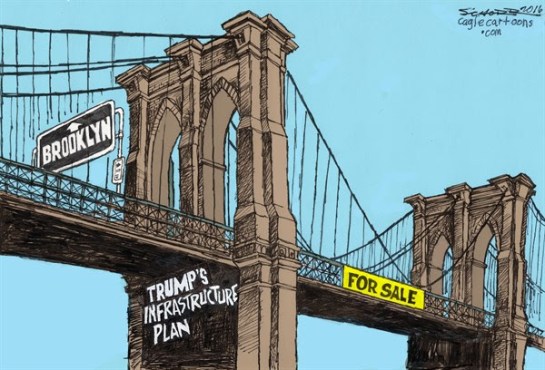
trumpinfrastructure

Simple logic:

  1. The idea that Trump’s policies are going to make life better for Americans is laughable
  2. Given the present system of American politics, the Republicans will not maintain power through the 2018 mid-term elections
  3. They know it
  4. The only way for the anti-worker forces to maintain power is by scrapping democracy
  5. Therefore, progressives must fight for basic democracy now

Will Trump Improve Life for Americans?

Economist Josh Bivens has a good summary of expected Trump policies on line. It doesn’t look good.

Mr. Hitler made immediate improvements in the German economy by massive infrastructure programs and by going to war. Will Mr Trump be able to do the same?

The U.S. Congress has blocked infrastructure programs all the way through the Obama Administration, even though they would have greatly shortened the long recession. It is unlikely that they would allow Mr Trump to implement anything good along those lines, because their main commitment is to the barons of finance, not construction businesses and certainly not to the American workers. Actually, I’d love to be proven wrong on this.

Mr Hitler had tremendous early successes in his war-making, but that was largely because the Great Powers did nothing to rein him in. They thought he would put an end to communism before he struck at any major capitalist countries. It is doubtful that Mr Trump will be able to use war to improve the American economy in any meaningful sense, and it is unlikely that he will receive cooperation from the other major capitalist countries in whatever adventures he undertakes.

The world wars that resulted from the economic crises of the 20th century are not considered available as a “solution” to economic and political crisis today, because of the imminent destruction of the planet.

Capitalist economies have always suffered from phases of “ups” and “downs.” “Down” is already overdue after the long recovery during the Obama Administration. The current expectation of new “tight money” policies, combined with Mr Trump’s new tax cuts for the rich and deregulation policies will create an immediate and painful crisis for working people.

Hard Times Will Likely Dominate the Mid-Term Elections

If one assumes that our American levels of partial democracy continue, it is unlikely that the party in power will fare well in 2018. In fact, the party in power usually does very poorly in mid-term elections.

None of this is a secret, neither to progressives nor to reactionaries.

What Can We Expect about Democracy?

Since around 1980, American democracy has already taken hard knocks at the hands of Republicans. Unions were assailed in every imaginable way. The Voting Rights Act was gutted, big money was sanctified by the Supreme Court, Republican redistricting largely overcame the popular vote, and voter suppression schemes were put into effect all over the nation.

The Obama Administration fought to maintain democracy, but does anyone think the Trump Administration will? If Mr Trump were to make outlandish anti-democratic Executive Orders, for example, who in government would oppose him? Not the legislative branch that is already in the hands of Republicans, and not the judiciary which will return to a reactionary anti-worker majority as soon as Mr Trump makes his first appointment.

Mr Hitler, it is often pointed out, won an election without winning the popular vote. How did he stay in power? How will today’s reactionaries try to stay in power?

Get ready to organize and fight!

–Gene Lantz

Listen to “Workers Beat” at 9 CST every Saturday morning on 89.3FM and http://knon.org

If you want to know what I really think, look at my life’s lessons site

On the day after the election, small groups of demonstrators hit the streets in a number of American cities. I just got a request that I join a call for a general strike — a national work stoppage — on Inaugural Day. I call this kind of non-thinking acting-out “knee jerk activism.” It’s more traditionally called “ultra-leftism” and has been correctly labeled, “the infantile disorder.”

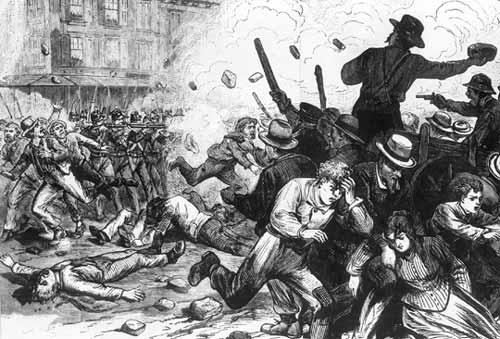
strike1877

We had a tremendous general strike in 1877

Union activists are used to hearing people call “strike!” when they have no idea whether or not the tactic would work. A lot of them don’t care. If a union called a strike every time some hothead wanted one, we’d get a lot of people fired for nothing. When my union ran a successful 15-month “work to rule” contract fight, there were people calling “strike” instead of doing the hard work of a long struggle. The three of them that I knew personally were all promoted to foreman immediately after the union won. They were company stooges, as it turned out. The company knew that the union might win the long battle, but we would almost certainly have lost a strike.

If you’re reading along in Facebook, you’ve seen lots of responses to the Trump election victory, and nearly all of them are way less than helpful. Some are silly, and some are outright dangerous!

First, Figure Out What Happened

Nearly all the pollsters were wrong about the election results. The best single explanation I’ve seen was in a “letter to editor” in today’s Dallas newspaper. A guy named, I think, Roland Young wrote that when the pollsters called, “We lied!” Some of Trump’s voters may have been too ashamed to confess.

But the best explanation of the pollsters’ failure is that their approaches are based on previous history, and the 2016 presidential race was, to state it modestly, unique.

Are Americans Mostly Chauvinists?

Elections are the best evidence we have of the national character. If the Electoral College puts Donald Trump in office, does that mean we’re mostly chauvinists like him? Actually, more than half the electorate voted against him, and only 56% of all eligible voters went to the polls at all. The ones that went voted for marijuana and higher minimum wages by much better margins than they voted for Trump.

Everyone who voted for Trump did not do so because they wanted to express their chauvinism. They surely didn’t vote for him because they think his far-flung ideas are actually going to solve America’s problems.

What They Wanted Was Change

I think it is fair to say that they voted for change. We see this in the unions all the time. Members who haven’t taken the time to investigate the candidates in union elections will nevertheless vote to “throw the bums out” against whoever is in office. Next election, you can’t find anyone who admits they voted for the incumbents and it’s “throw the bums out” again. After a lifetime in the public eye, and because of the outright duplicity of the national Democratic Party, Hillary Clinton was a perfect target for that kind of sentiment.

People voted for Trump over Clinton for the same reason that they had voted, in 2008, for Obama over Clinton. Change.

People voted for Donald Trump because they are dissatisfied with life in America and they don’t know what else to do about it.

I don’t exactly blame them. I’m dissatisfied too, but I know what to do about it.

Educate and Organize the Working People

Media pundits are blaming “white blue-collar workers” for electing Donald Trump. His voters were probably Anglos all right, but they didn’t represent the working class. The working class is the solution, not the problem. The progressive leadership of the AFL-CIO is head and shoulders above any Democratic or Republican Party politician. For now, it’s better to follow them than Bernie Sanders, too.

If we’re willing to do the long hard work of educating and organizing America’s workers, we could win elections. We could win strikes, even general strikes!

But it will take some work.

–Gene Lantz

Click here if you want to know what I really think!


I’ve been raving about this book for months, but it has a giant hole in it. There’s no treatment of what’s happening to the right to retire!

emmettseniorcrowd

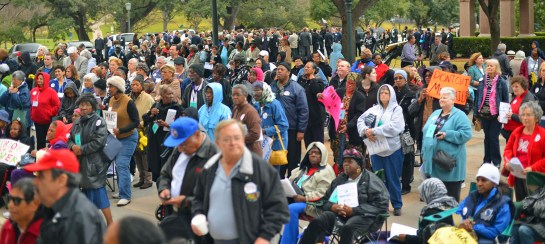
Senior Day at the Texas Capitol

I’ll put some of my notes about his fine book at the end. In a nutshell it explains that inequality went wild once the American workers movement — especially the unions — allowed themselves to be isolated and neutralized. Around 1980 — after the unions had chased away all the communists and all the international friends and all the progressive movement and, finally, each other — the corporations and their government lackeys were able to privatize, deregulate, un-tax themselves, attack progressive organizations and subvert democracy at will. They’re still doing it even though the weakened unions started wising up in 1995.

Conquerors attack their enemies at their weakest point. That means that the general attack against all working Americans tended to focus on the most vulnerable. In our case, the most vulnerable are the children and the seniors. The book talks a little about the corporate onslaught against public schools, but it doesn’t mention seniors at all!

Fight for the Right to Retire

The right to retire was put on firm footing in America with the passing of the Social Security Act in 1935. Medicare/Medicaid was added before 1980 Reaganomics became policy. In the 1960s, Americans could look forward to resting their “golden years” on a three-legged stool of personal savings, pensions, and Social Security. Now in 2016, the first two have been decimated and Social Security is under multiple threats every time Congress is in session.

In 2002, the new and progressive AFL-CIO leadership put together the Alliance for Retired Americans. It consists of a lobbying office in Washington DC and far-flung supporters here and there around the nation. We usually meet in union halls and most of our initial supporters are union retirees, but we reach out to all seniors and, for that matter, anybody and everybody who wants to save the right to retire in America before it’s too late!

In 2006, we faced a major challenge because President Bush made it his top priority to privatize Social Security. He came close, but we stopped him. Since 1980, there have been a succession of crazy proposals to do this and do that with retiree benefits. All of them are obscured in language, but in the final analysis they all mean cuts for seniors.

Around 1986, it became possible for corporations to disregard their responsibility for pensions in bankruptcy proceedings. In 2015 Congress decided that trustees of multi-employer pensions could solve their budget problems by cutting retiree benefits. The budget for administering Social Security has been cut so severely that many offices had to be shut down and many counselors laid off. Corporations and anti-worker politicians come up with some new attack every few weeks.

Here in Dallas, voters will find on their November 8 ballot a proposal to slash the pensions of City employees. The Dallas newspaper already endorsed it as sound policy!

It’s fight or die!

–Gene Lantz

Click here for more of these ideas

Some notes from the book:

Leopold, Les, “Runaway Inequality. An Activist’s Guide to Economic Justice.” Foreword by Chris Shelton, President of CWA. Labor Institute Press, 817 Broadway, NY NY 10003, 2015

I think I put 3 references to this book on genelantz.org. I found it very exciting that CWA was holding classes and giving away copies of a book on more-or-less radical economics.

pg2 (shelton) “We’ll see data showing that elected officials rarely act on the agenda most Americans support.”

pg4: “Most of all, the media turns a blind eye to the fact that we live in a capitalist system.”

pg4: “…there is, in fact, a fundamental conflict between employees and owners, between the rich and the rest of us.”

pg5 “Economic elites will only give up power and wealth when they’re forced to do so by a powerful social movement.”

pg29-30 (Leopold) list of reasons for economic crisis of late 1970s, including competition from industrialized countries.

pg194 “…American public actually have little influence over the policies our government adopts.”

pg204 “This policy of military Keynesianism led to an unofficial partnership between the government, large corporations and labor unions. These groups worked together (more or less) to prosecute the Cold War.”

pg 288 “…Wealth inequality and unionization levels are intertwined.”

pg288: List of “what happened to unions” begins, “The decline of unionism started when unions started cooperating with the government ‘anti-red’ efforts during the McCarthy era.”

The book doesn’t actually generalize, but it does show that the entire process of rising  inequality was a result of union isolation —  first from the world movement, then from the domestic progressive movements here at home (anti-war, civil rights, etc) and finally, with the merger of the AFL and the CIO, from one another. “Solidarity” was still a good song, but it wasn’t really practiced 1947-1995 in the American union movement.

pg 289: “…Unions and the rest of us are on the losing side of a gigantic class war — a war that we have to recognize, discuss and address if unions are to grow again.”


Leave a Reply


Yesterday, I was given the opportunity to help striking workers.

symfrenchhorn

The Fort Worth Symphony Musicians are on strike. A couple of the leaders were on my radio show, then I went over to Ft Worth for their rally, march, and picket last evening. I was so proud of them for their courage!

The number of important labor strikes diminished after Reagan was elected in 1980, and has almost disappeared today. They are all tangled up with government supervision and extremely difficult to carry off.

Withholding Our Labor Is Our Weapon

The truth is, all we have is our labor, and almost the only real economic power we have is to withhold our labor. That doesn’t always mean striking. It might mean some kind of slowdown or “work to rule.” it might mean a sickout or “blue flu” day.

There are laws closely regulating what you can and can’t do on any kind of concerted action. That’s because our enemies, the bosses and their government lackeys, already know that withholding our labor is about all we can do — and they intend to limit it as much as they can!

Despite everything, we can still win strikes. Our slogan is “One Day Longer!

Boycotts, too, are Highly Regulated

The same is true of boycotts, which are much less effective weapons, but we can use them because  workers are also consumers.

We Have One Greater Power

Solidarity is our greatest strength. The Musicians Union might not be able to shut down the city of Fort Worth because they don’t occupy a vital economic center. But they could hit the economy hard if they had enough friends and allies. Suppose the taxi and bus drivers committed to helping, for example!

With enough friends and allies, labor could apply all kinds of economic pressures. Further, by pooling our financial resources to make sure strikers’ families keep eating, we could make a strike last indefinitely. The Musicians, by the way, have already thought of that. They have an on-line donation site.

If we were really pulling together. workers could win everything we want. That has to be the goal. The isolated strikes of today, like the musicians in Fort Worth, are good practice for us all!

–Gene Lantz

Click here for more of these ideas


Why has inflation been so low in the past few years?

money

If interest rates are near zero, and they have been for some years, doesn’t that mean that corporations can borrow pretty much all the money they want? Since the lenders only keep a small “reserve” of what they lend, wouldn’t all this borrowing result in a big increase in the total supply of money?

If we have more or less the same things to buy, and there’s a lot more money floating around, wouldn’t that mean high inflation?

The Money Supply Is Increasing

The Federal Reserve publishes their estimate of the total amount of money in the U.S. They call it “M2” and it includes everything, bank accounts as  well as currency. In July of 2011 it was $9,232.6 trillion, or $9,232,600,000,000. At the end of June 2013, it was $10598.4 trillion. That’s an increase of $1,365.8 trillion in 2 years. I didn’t pick the years, they were just the first ones I found. Probably, the money supply increased a lot more in the 2007-2009 recession period, so the change would be even more dramatic than this recent 15% increase.

That’s Monetary Policy

The operations of the federal reserve are usually made to sound pretty dark and unfathomable, but essentially all they do is increase the money supply in hard times. They have a number of ways to do it, but it’s still just about all they do. I don’t think they can even constrict the money supply — they can just make it grow faster or slower.

Fiscal policy is actually a lot more important. That’s government spending. If the people running the American government had really wanted to get out of the 2006 recession quickly, they would have turned on the spigots of government spending. They didn’t because they didn’t want to. That left the entire problem up to the Federal Reserve and the expansion of the money supply. They fell to their task mightily.

They lowered interest rates to near zero so that businesses could basically get all the money they might want. They started “buying” treasury bonds with money they basically manufactured. Trillions of dollars went into the economy and the goods and services didn’t actually change that much. If something was worth $10 when there were $5 trillion in the economy, it makes sense that its price would inflate to $20 when the money supply doubled. But it didn’t.

So, why no inflation?

Money Has to Move

The velocity of money is how fast it moves through the economy. If it doesn’t move through the economy, it has practically no effect on prices. If the government gives trillions of dollars to fat cats who just sit on it, store it in overseas accounts, or just use it to buy back their own stock, which is what they did, prices don’t change much.

If the government had fought the recession with fiscal policy, inflation would likely have been more of a problem. If the government had hired some of the many unemployed to fix some of the infrastructure, teach the children, or prepare for the future, the new money would have gone into wages — and those wages would have been quickly spent. More money and more velocity at the same time would have resolved the recession more quickly, but there would have been more inflation.

So, the short answer to “why no inflation?” is that the new trillions of dollars went to very wealthy people who just kept it.

Why is Economics so Dark and Illogical?

In olden days, a “philosopher” was someone who generalized from a great deal of knowledge. Today, we divide up all knowledge into various “disciplines” with geniuses in one field completely ignorant of any other field. We divided politics from economics for Heaven knows what reason, and neither one of them makes any sense without the other. The Polysci grads don’t know beans about economics and the Econ grads don’t know politics.

The Polysci profs snow everybody with statistics because they don’t really want anybody to know their arcane secrets. The Econ profs do the same thing. My friend Jorge Rieger compared them to the secretive priests of old, and it’s a pretty good comparison. If you’re interested in a simpler explanation of economics, click here for the Little School.

–Gene Lantz

Click here for more of these ideas


I’m completely optimistic in believing that fundamental change will come to world societies. Further, I believe it will happen before the present rulers destroy us and the planet. It’s because I realize that I’m not any smarter than others, and I’m not stupid. So they’re not stupid either, so we’ll get together and win some day.

Once I was sure that we will be victorious, I began to speculate as to how our victory might come about.

I think there are basically three versions:

torches-pitchforks

  1. People will gather their torches and pitchforks and force the misleaders out
  2. We’ll elect better and better candidates until we actually have a set of good ones
  3. We’ll carry out a worldwide general strike

Torches and Pitchforks

Probably the idea of some kind of violent overthrow of the existing powers is the oldest scenario. It sounds the easiest and the fastest. It’s also the most dangerous, because it’s easy to start thinking that the rest of the world’s villagers only need some kind of a “spark,” — one heroic act of an individual or small group — and then they’ll grab their weapons.

So they try one ultraleftist act of terrorism after another, hoping to get the right “spark.” But it never happens and they just get a lot of people killed or jailed.

Electing Our Way to Power

When President Obama was elected, some people thought we had done all we had to do. He would take care of the rest. Other people thought electing Obama was good and that he could take us part way, then we’d elect somebody even better the next time. In the course of a few elections, we would end up with Judges, Legislators, and Administrators who would save us.

I imagine they felt the same way in 1931 when they elected Franklin Roosevelt. Maybe also in 1859 when Abraham Lincoln took the White House. George Washington?

I think it’s the most popular idea because one doesn’t really have to do much besides vote and a little bit, maybe, of phone banking or neighborhood canvassing. No risk in any of that, and it’s not too hard. If it doesn’t work, then they’ve still earned the right to gripe about everything until the next election.

Stopping the Economy Until We Get What We Want

The idea of a worldwide general strike isn’t as un-historical as it might sound. Workers actually tried it, with considerable success, in 1886. Railroad workers practically shut the nation down in 1877. They might have won their strike if the soldiers hadn’t started killing them. There have been successful city-wide general strikes in several cities, including Seattle and even Houston!

The Industrial Workers of the World was once a big organization that terrified the bosses. Their idea was to organize all workers at their worksites — in every industry — and then shut down the economy. Hundreds of them were deported, arrested, or killed in the bosses’ backlash.

I don’t want to pretend to know more than they did, but they might have done better if they had gone in for organizing communities, civil rights organizations, church groups, and other kinds of affinity groups instead of just workers at worksites. They might also have done better if they hadn’t been so hell-bent on not participating in politics and not forming alliances with other progressives.

The downside of this “stop the economy” idea is that a substantial number of workers and working families would have to be organized. There would have to be unions in critical work places, plus community groups and a lot of other kinds of organizations. And they’d have to work toward co-ordination with the others. It would take political work as well as organizing. That’s a tremendous amount of hard work.

The upside to all that hard work is that leadership would develop. Leadership would also be tested along the way, and we’d end up with the kind of leaders who could actually run a new, better society. Neither of the other two scenarios has that advantage.

What’s the Catch?

There are players on the other side.

It’s easy to think that everybody wants social progress just because we do and almost everybody we know does. But we don’t hang around with the Koch brothers, do we? We don’t hold memberships in the National Chamber of Commerce or the National Association of Manufacturers or the National Right to Work Committee. We’re not listed in the Forbes 500, but other people are, and they don’t want change just as much as we do want it.

If we were to grab our pitchforks, they’d grab their bombs and drones.

If we were to elect good candidates, they’d pour billions into electing bad ones.

The wealthy people clinging to the status quo know what they’re doing. Do we?

2 comments

Everybody should read “Runaway Inequality” by Les Leopold. Don’t wait for somebody from the Communications Workers of America to invite you to one of their classes on it.

runawayinequalitybook

Some of the best stuff is in the beginning. The forward is by Chris Shelton, President of the CWA. The middle parts of the book are mostly statistics about how inequality rose after America selected a new business friendly government policy in 1980. The other really great stuff is near the end

I particularly like Chapter 22: “When unions decline, inequality soars and we all lose.” On page 288 Leopold says, “Wealth inequality and unionization levels are intertwined.” You probably knew that but it’s good to see it in print.

What happened?

Then he goes into the reasons for the great union decline from its heady power of 1946, when Americans won strikes more than ever before or since. Leopold apparently doesn’t have the nerve to say it outright, but he lists, in a dispassionate way, several “theories” about how union leadership could have done better. I’ll shorten them and make them more blunt:

  • The decline started in 1947 when unions cooperated with the anti-communist witch hunt and expelled some of their best leaders.
  • Unions shouldn’t have worked closely with the CIA
  • The merger of the AFL and the CIO didn’t work out for the members
  • Unions shouldn’t have supported the War in Vietnam
  • Unions became bureaucratic and undemocratic
  • All unions haven’t learned community organizing techniques
  • Unions aren’t linking up with unions in other countries

Even though Leopold didn’t really commit to it, I thought it was a pretty good list. It probably should have included something about how unions largely ignored and still ignore the civil rights movement, but it’s still a pretty good list.

Right after the list, the author gives the underlying reason for all the problems: “Unions and the rest of us are on the losing side of a gigantic class war — a war that we have to recognize, discuss and address if unions are to grow again.”

In other words, we can list the things union leaders did wrong all we want, but the underlying reason for the decline was aggressive anti-worker policies of the boss class. Even if we’d had the best leadership in the world 1947-1995, it would have been very very hard to withstand the combination of government/boss aggression and the post war “good time” prosperity that allowed opportunist labor leaders to get pretty good contracts for their members — while slowly sinking into isolation from everybody else.

By 1979, unionized American workers were the envy of the world, even though our numbers were dwindling fast. In 1980, the party was over. I don’t think many union leaders figured it out, and some of them still haven’t. They still expect the bosses to act “reasonably.”

The essence of the problem

What it boils down to is this: From 1947 to 1995, the bosses were able to isolate the organized sector of the American working class from the rest of us. I picked this up from an earlier book by a prof in California named Lipschitz, “Rainbow at Midnight,” and from talking to people who lived through it. The new book, with CWA backing, will force unionists to look at the problem and see what we did wrong. Even if it did nothing else, the book would be worth the $20.

But Les Leopold actually does a lot more in “Runaway Inequality.” He makes serious suggestions as to how we can turn the situation around and return to the kind of militant union progressivism that succeeded for the CIO 1935-1947. The progressive leadership of the AFL-CIO, 1995 to present, can and probably will implement these ideas.

I can’t wait!

–Gene Lantz

Click here for more of these ideas


During the fight against NAFTA and every trade deal ever created, we like to say, “We’re not against ‘free trade,’ but we want ‘fair trade.'” It’s true, too, but there are good reasons why our government will never negotiate a fair trade treaty.

tpp-TARA

The current unfair trade proposal is the “Trans Pacific Partnership” — TPP

It’s fairly easy to see why a certain amount of confusion would be generated. Xenophobia, a paranoid fear of people in other countries, characterizes a lot of our campaigns. Xenophobia disguises itself as patriotism. Racism isn’t far behind it.

It’s confusing because we characterize the people negotiating the treaties as misguided rather than malevolent. It’s hard to believe that big corporations could be as rotten and crazy mean as they really are.

It’s confusing because some of our not-so-bad political leaders support these rotten trade deals. NAFTA could never have been passed without President Bill Clinton, and good old President Obama is currently pushing hard for TPP.

THE TRADE SITUATION IS ACTUALLY QUITE CLEAR

A fair treaty would be one that gives decent treatment to the workers in all the signing countries. But all of the trade treaties so far have been negotiated in secret by a few political representatives from the different countries and an absolute horde of corporate lobbyists.

Corporations don’t want fair treatment for workers. It would cost them money. Corporations don’t want to preserve the environment. It would cost them money. NAFTA, TPP, and all the treaties in between were bad news for workers and for the environment. Corporations have virtually all of the money, way more than enough to buy out the political representatives, up to and including the President.

CORPORATIONS MUST CUT EXPENSES ON WAGES AND THE ENVIRONMENT

Globalization (I call it “gobblelization”) today is characterized by intense competition between major capitalist countries. One of the main purposes of the TPP, mentioned often by President Obama, is to give U.S. corporations advantages over the growing Chinese economy. The companies compete primarily by holding down labor costs and not spending any money on environmental protection.

As long as we live under a system dominated by big corporations, as ours is now, every trade deal will be bad for workers and the environment. There is not and there will not be a “fair trade” deal!

–Gene Lantz

Click here for more of these ideas

The whole point of this blog is to help people work out our strategies for a better world. In any battle against any enemy, it’s wise to try to figure out how things look from their point of view.

me-realjobsrealwages

Suppose you were a wealthy capitalist intent on hanging on to your vast wealth and adding to it.What problems would you see and how would you over come them?

Here are some problems for big capital:

  • Other nations are under-selling our products and pushing us out of markets
  • Some of the under-developed countries are slipping out from under our domination
  • Environmentalists are gaining the initiative in proposals that might cost us money
  • Another financial crisis would really undermine people’s confidence in us
  • More and more, people seem eager to organize, and they are finding new ways to do it
  • There’s a growing level of activism among the people
  • The internet has improve communications among individual people & groups
  • There is a trend toward growing international solidarity
  • A number of our secret methods are being exposed to the people
  • There’s a real danger that our political system could be reformed

Whatever shall we rich people do?

Our biggest problem, new since the 1970s, is that other industrial nations are competing with us more and more successfully. More of our “free trade” agreements would put us in a better competitive position. Also, they would help us tighten the screws on the underdeveloped world. We can spare no resources to make sure that these bills get through Congress.

Print money

Being able to print money and make sure it stays in our own hands is a big help. The people are starting to catch on, but so far they haven’t figured out anything they can do about it. Most of them still think that some of the wealth is going to trickle down to them, and we have to do everything we can to keep them thinking that way.

Stop the unions

Unionization is not compatible with good business practices. We have to keep up the pressure on all political and legal entities under our control to discredit and ruin American unions before they cause us some real damage!

Tame the internet

We have to extend our grip over the internet. “Net neutrality” has to be overcome with a strong campaign claiming that it’s un-American. Maybe we can get some of our religious spokespersons to come out against it.

Invade, baby, invade!

The only sure thing that works when our underdeveloped markets begin to rebel against us is invasion. We overcame a lot of the domestic opposition to our wars by switching to a professional army with maximum use of substitute soldiers and deadly machinery, but more and more propaganda is needed to convince the people to allow us to continue. We already have troops on extended missions in three countries, but there will likely be need for more in the near future.

Control information

We can continue beating the environmentalists with our control over the information sources. We can continue characterizing them as kooks and malcontents as long as we keep the “high ground” with our purchased army of intellectuals and professional spin doctors. Even at that, it may be necessary before long to take the gloves off and start some serious repression.

Divide and conquer

Our biggest domestic problem is the minorities. They won’t stay sidelined and they won’t remain isolated. Isolating them and discrediting them is our best defense, only we need a lot more of it. Our efforts to undermine democracy have only had modest success, and a backlash is already underway. Unfettered police and military forces may be needed.

–Gene Lantz

Click here for more of these ideas