Archive

economy

Did You Shift To the Right?

Fascist_OK

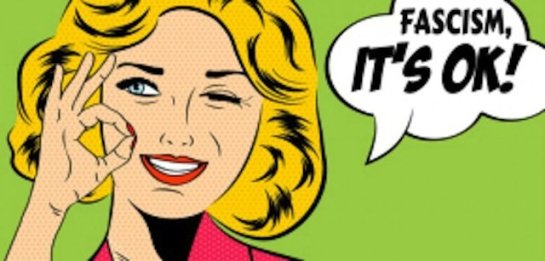
The reactionary candidate in the Dutch elections didn’t do as well as predicted. Maybe the fascists won’t win in France, either, but Donald Trump will still be President of the United States and the talking heads of the news will still be saying that there’s a “shift to the right”

They don’t say that somebody else shifted to the right, they say that the electorate did. We’re the electorate, so they mean us. Did you shift to the right? I doubt it.

In fact, a “shift to the right” by the electorate is not what is happening at all. If the electorate were becoming more reactionary, we wouldn’t have seen the liberal election results on marijuana and minimum wage. What we’re seeing is something else.

What Are We Seeing?

We are seeing a shift in tactics by the rich.

Throughout written history, the more-or-less propertyless have fought against the propertied for basic sustenance, for rights, and for freedom. We have done pretty well for ourselves, especially under capitalism. Once workers freed themselves from slavery and serfdom, we went on to get better living conditions, a little bit of dignity for workers, and limited democracy.

Limited Democracy?

We’ve always fought for more democracy, more control over our lives, and in generally we’ve been winning. Winning at least until lately. American workers did particularly well during the golden days from the end of World War II to the late 1970s. That’s when American industry completely dominated the world. We got rid of all-white primaries, poll taxes, English-only ballots, fake literacy tests for Black voters, prohibitions on voting for 18-year-olds, and we made other great accomplishments during that period. But our democracy was always limited.

We never won the right to vote on wars, on plant closures, on layoffs, on hiring policies, and lots of other things that are exclusively done by the propertied class. Only recently, most of us realized that we’ve never had the right to vote on Federal Reserve officers. So our democracy has grown, but it was always limited.

After 1982, when the government started coming down on our right to unionize, our democracy began to erode. When the Supreme Court opened our election process to unlimited financial intervention, when they gutted the Voting Rights Act, and when unfair redistricting and voter suppression laws became common, we began to realize that the long-term trend toward more democracy was being reversed.

Why The Reverse in Democracy?

Around 1980, the propertied class changed their tactics. Instead of kidding us along with limited democracy, they decided on an all-out war against our rights. What changed for them was international competition. The United States no longer had the only functioning factories in the world and had to compete with countries who could make better products cheaper. The squeeze was on.

One can validate this with any account of inequality. From 1945 to the late 1970s, American workers constantly improved our lot. After that, it’s been downhill economically. One good book about it is “Runaway Inequality” by Les Leopold. Leopold shows what happened, but he is a little skimpy on “why” and “what the heck do we do about it?”

The owning class changed their tactics, and we have to fight them! That’s the why and what.


March 8, 2017, could be gigantic!

me-aug31marchlaborday

Good strategies and tactics only come from understanding the situation we’re in. If one overestimates people’s willingness to take action, one tends to try things that can’t be done and make other “ultraleft” errors. If we underestimate people, we end up settling for petty reforms when we could get bigger changes.

For most of my political life, I’ve tended to think people would do a lot more than they actually did. I thought, for example, that voters would really turn out to defeat the Orange Menace last November.

Afterward, when individuals and small groups began to call for militant political action, I fell on the timid side of evaluation. I never imagined that the January 21 marches and rallies would be the biggest in American history, but they were.

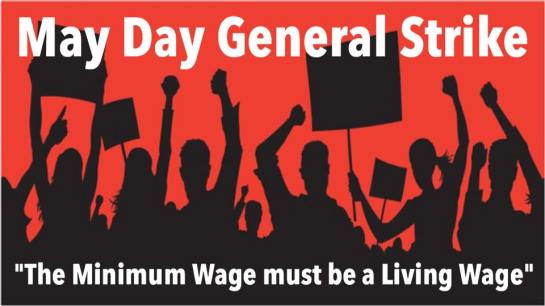
Now, to my surprise, I’m seeing some actual results from calls for a “general strike.” Even in my town, some small businesses shut down and a lot of students — of all ages — stayed out of school on February 16. For my entire political life, and all of almost everybody else’s, the call for a “general strike” was just a foolish dream of ultralefts and knee-jerk activists who weren’t even interested in whether it would work or not.

Even a broken clock is right twice a day

Now, calls for a general strike are beginning to get some traction. People are discussing the idea and beginning to talk about what it would take to be successful. I imagine that some people are looking at the general strikes in American history. The years 1877, 1886, and 1919 would be good ones to look at, but general strikes occurred in limited geographical areas right up to the big government attacks on workers that began in 1946. None were effective since then that I know of, until February 16, 2017.

To really make a difference, a general strike needs to be organized. Leadership needs to agree on the demands. They need to make those demands clearly understood, and they need to call off the action if the demands are met. It is hardly fair, and certainly not smart to ask people to make sacrifices without knowing what they are fighting for.

Leadership also needs to figure out how the strike should be conducted and how people’s needs can be met during the action. I have always loved reading about the successful strike in Seattle in 1919 where Rob Rosenthal wrote this poem:

“Nothing moves in the city,

Without our say-so

Let the bosses curse,

Let the papers cry

This morning

I saw it happen, with these ancient eyes of mine

Without our say-so

Nothing moves but the tide!”

March 8 is Coming. Look Out!

As I understand it, the February 16 activities were largely organized on social media. A lot of people didn’t know about “A Day Without An Immigrant,” but a significant number of the ones who knew about it went ahead and participated. That’s the times we live in.

As I understand it, the leaders that organized the biggest demonstrations in American history on January 21 have called for actions on March 8 — International Women’s Day. If “A Day Without  A Woman” goes anything like “A Day Without An Immigrant” –given that more people will know about it, that the leadership has already made itself credible and somewhat seasoned, and that there are more women in America than immigrants — a general strike on March 8 could be the most important political event in America since World War II.

That is, if I understand the times.

–Gene Lantz

I’m on the “Workers Beat” talk show ever Saturday at 9AM. 89.3fm in Dallas and http://knon.org everywhere. If you’re interested in what I really think, click here.

To go on strike basically means to stop working until some particular demand is met.

strikelondon

Since Trump was elected, I have received two calls for a general strike. One was for January 21, the other is pending, February 17.  No exact demands accompanied on either one. I think it’s dangerous business, but must be considered.

What Is a Strike?

The word comes from British sailors who would “strike sails” and refuse to take their ships to sea. A “general strike” in a given area means that everybody, not just one particular organization or category of people, stops working until their demands are met. General strikes may not be over economic issues, but political.

Since the U.S. government moved against the union movement in 1947, the only union strikes we have seen were limited to one union, the few other unions legally able and willing to participate, and whatever community support a local union could get. Usually since 1947, American union locals have faced their employers virtually alone.

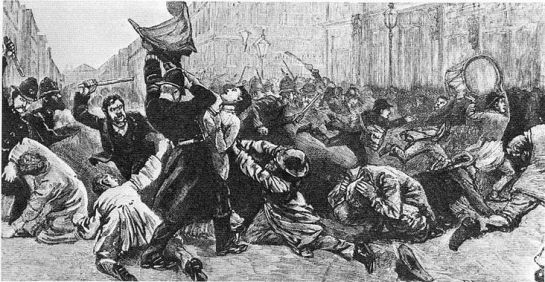
Prior to 1947, in fact in 1946 in Houston, there were general strikes in America. Probably the most dramatic and best-remembered was the strike for the 8-hour day, worldwide, May 1, 1886. Like most general strikes with potential for change, it was met with armed violence from the employers and their government.

We hear of general strikes in other countries from time to time. Over there, unions are involved but it is unlikely, given their legal situation, that organized labor would call any  general strike in America today. That doesn’t mean somebody else couldn’t!

Strikes Are Part of Economic Struggle

A strike is not the only form of economic struggle, as differentiated from armed struggle or electoral struggle. Any kind of refusal to cooperate with the employers’ system of production fits the description. Workers might, for example, try a “slowdown.” Lately, union leaders call it “work to rule” and ask employees to do only what they are required to do legally and by contract, nothing more. In modern strikes, especially since Reagan, people sometimes lose their jobs. With slowdowns, there’s less risk of job loss. But a slowdown is a harder to organize and carry out.

Economic boycotts are economic struggles. The United Farm Workers carried out an effective one in the early 1970s against grape growers. Economic boycotts, like general strikes are very easily called by some unthinking hothead, but extremely difficult to carry out.

The employers and the government may be counted on to team up quickly against any kind of economic struggle by workers.

Who Wins? Who Loses?

According to the employers, workers always lose every strike. Even if the strike has short duration, the workers at minimum have to go some time without income. The strain on families and friendships is terrific. Nowadays, when many workers are carrying heavy loads of debt, the thought of a strike, even for a few days, terrifies everybody.

According to the workers, we win pretty much every strike. Even if our demands weren’t met, we feel that we’ve stood up for our dignity and for the dignity of all working people.

But putting points of view aside, the actual winner of a strike is generally the side that holds out one day longer than the other side. “One Day Longer” makes a good workers’ slogan and is the title of one of my songs.

“Winning” for us means getting whatever we wanted. “Winning” for the bosses means getting whatever they wanted plus the ability to take retaliatory action against every worker that crossed them.

A Strike Is Serious Business

A successful strike is one that grew out of careful analysis of the situation and had good planning and strong leadership. A good example was the three-month strike recently carried out by the Fort Worth Symphony Musicians. Somebody needs to write a book about that one.

Calling a strike without careful analysis, good planning and strong leadership is irresponsible and likely to get lose and get people fired. It isn’t much better than calling “fire” in a crowded movie theater.

But We Need Economic Struggle, and We Need It Now

I can only think of one thing worse right now than an irresponsible call for economic struggle — and that is no call for economic struggle.

Every American who is not a fool knows we need to resist the attacks underway. Economic struggle is, right now, our best option.

Don’t Go Off Half-Cocked

We need careful study and careful planning to win any economic struggle. Fortunately, we have the ability to do that thanks to modern communications. We could, for example, call for a “virtual strike” over a certain demand and for a certain day. We could make our preparations virtually. We could sign up the people willing to participate and, afterward, evaluate the results. Then we could call another one and see how it goes.

Study up, think it through, and share your thoughts.

–Gene Lantz

I talk about these things on KNON.org’s “Workers Beat” program at 9 Central Time every Saturday. 89.3FM in Dallas. If you want to know what I really think, click here.

At the beginning of the 20th century, there was a popular theory that the capitalists of the Earth had reached some sort of detente and would have no further use for war.

earthdivided

Another theory said that the capitalists were no different from gangsters fighting over their “turf.” Creating world wars was an intrinsic part of their very nature.

World War I and then World War II validated the second theory and completely discredited the first. Modern monopolistic capitalists were willing to kill millions in wars to establish their financial control over different parts of the planet. Their national armies were basically at the service of the bankers. Each “nation” was in fact a separate military operation, each opposed to the others.

This was explained in 1916 in a very important booklet named “Imperialism” by V.I. Lenin. There’s a short version on-line.

The big wars temporarily worked out great for the victorious bankers, despite having been hard on the millions killed, imprisoned, or maimed and on the nations who lost.

The New Theory Was Really the Old

Then in the 1980s, a new version of capitalist peace on Earth began to circulate. It was especially boosted when the Soviet Union failed. Opponents of the new theory called it “neoliberalism” rather than the classic name “imperialism.” Those who promoted the idea, which included virtually all the information sources in the rich countries, called it “globalization.” (I called it “gobblelization”).

The new theory, like the old one, held that the capitalists of the world had brought about a new world order based on extending the benefits of the “invisible hand” of capitalist markets to all the world through “free trade.”

Is It “Free?” Is It “Trade?”

The name “free trade” was a tremendous publicity success. Who’s against freedom? Who’s against trade?

Through long hard work, a few workers’ organizations, particularly unions of the world, explained that these so-called trade deals were nothing but agreements between capitalists at the expense of the workers in their respective territories. Time and a flood of actual data proved we were right. The capitalists were only agreeing among themselves that they would move their operations around to obtain the lowest possible wages and the fewest possible pollution controls.

Just as they had previously used their government’s armies to obtain their wishes, the bankers were now using their respective government’s negotiations. The ends were the same. The bankers from the countries with the biggest armies obtained more advantages over the countries with less clout. Only the 1% of any country benefited.

A Lot of People Bought Into the “New” Theory

Nevertheless, the idea that capitalism had established a new and lasting peaceful relationship persisted, and a lot of people thought it was true. Then, in 2016, came super nationalism, came Brexit, came Donald Trump.

The British poked a hole in the European Union from which it may not recover. The Scots tried to leave the British. Polls showed that near-Nazi nationalists were gaining electoral power in several major capitalist states. President Trump declared “America first” and spit in the faces of several other nations.

Will Capitalism Ever Bring Peace?

People must now review the two theories of international relations. We have to ask ourselves, “Are the bankers who control the major capitalist countries creating a peaceful world, or are they actually no different from gangsters fighting over turf?”

–Gene Lantz

I’m on KNON.org and 89.3FM in Dallas every Saturday at 9 Central Time. If you want to know what I really think, click here.

Trump is blasting his prevarication machine, and most people think he is “out of control.”

mad-hatter

The pundits and columnists seem confused by all the “alternate facts” blasting out. See, for example,

Trump’s disregard for the truth threatens his ability to govern
Dallas Morning News

But there is method to his madness

As I’ve said before on this blog, watch out for major attacks against democracy during this political period. They can’t fix the economy for the voters, so their only alternative is to make sure the voters’ power is diminished BEFORE the 2018 Mid-Term elections.

Trump and his minions are repeating this nonsense about millions of undocumented workers voting because he is building a case for more voter suppression. 

As Nazi propagandist Josef Goebbels taught us long ago, the most outlandish lies will be believed if they are repeated often enough. From his “bully pulpit” the presidency, Trump can repeat a lie many many times.

Liars are blaming liars

The “responsible” journalists, of course, are doing what they should do today and calling him a liar. But who will believe them in these days of failing trust? Who will believe newspersons who basically echo the beliefs of their six giant corporate employers? The most popular television news service, Fox, is by far the least honest.

The newspersons are already largely discredited, they largely did it to themselves. And Trump is discrediting them more and more by repeating, more and more, that they aren’t to be trusted. That’s the second part of Trump’s conspiracy against democracy.

Will it work?

One is tempted to say that a national prevarication campaign won’t work because the people have their own access to information, particularly through the internet and particularly through social media. One is tempted to say that even the discredited newspersons, if they stick to their guns, will be believed by a significant part of the population. BTW, I wouldn’t count on their sticking to their guns. People work for whoever signs their paycheck.

The big lie technique worked for Goebbels. It worked for Hitler. Millions died for their lies. Whether or not it will work now and here in America depends on us.

–Gene Lantz

I’m still on knon.org radio and 89.3 FM every Saturday at 9 in North Texas. If you want to know what I really think, click here.


Book review: Cowie, Jefferson, Stayin’ Alive. The 1970s and the Last Days of the Working Class. New Press, New York, 2010.

travolta

According to this author, the American working class met its death in the 1970s. Some of it was suicide, some of it was homicide, some of it was chronic depression.

He goes to great length to talk about how America’s powerful labor unions lost their clout, but he spends a lot more time and energy talking about the culture of the 1970s. “Saturday Night Fever” gets about as much play as the Hardhat attack against anti-war protestors.

Combining political and cultural changes isn’t a new approach. One of my favorite books is George Lipsitz, Rainbow at Midnight. Labor and Culture in the 1940s. University of Illinois Press, Chicago, 1994. Lipsitz explains where labor went wrong, 1940s and 1950s, while Cowie merely comments at length on the resulting shipwreck in the 1970s. Of the two books, Lipsitz’s is by far the stronger and more informative.

Cowie weaves a fascinating tale with very few heroes, but some stunning villains. One of the biggest reasons given for labor’s downfall is AFL-CIO President George Meany, who deliberately split the Democratic Party and destroyed the hopes of presidential candidate George McGovern in 1972. The vivid description of these events is the strength of Cowie’s book, but its weakness is that he doesn’t explain why. He says that Meany hurt the union movement very substantially because he was a “cold warrior” who didn’t want a peace candidate to carry the Democratic Party standard. But he doesn’t explain why Meany was such a “cold warrior.” Maybe Cowie didn’t know.

Back in those days, and for some time before and after, the AFL-CIO got a lot of money from the CIA. That’s why Meany was a cold warrior.

Cowie also explains that a lot of labor’s strength disappeared when steel plants were shuttered and when other American industries went overseas. He doesn’t say why. He doesn’t explain that international competition had recovered from World War II by the early 1970s and American corporations were forced to compete with excellent German and Japanese imports.  Maybe he didn’t know.

Cowie explains that labor was blindsided by clever politicians like Richard Nixon and Ronald Reagan. He explains that they made mistakes of commission and omission and they just weren’t farsighted leaders. He didn’t say why. He didn’t explain what Lipsitz’s book had explained so well, that the militant leadership of the American union movement had been expelled and blacklisted during the post war witch hunt. Maybe he didn’t know.

The unions may have squandered their basic strength and their political clout in the 1970s, or at least they may have done better than they did. But the inference that the American working class just evaporated is just wrong. People still work, nearly all of us still work, and the working class is just what it was and has always been — the only people who can stand up to capitalism.

Cowie’s great strength is in vivid description. Whether you lived through the 1970s or are just curious about how things got as bad as they did for working people, this is a good book to read. The AFL-CIO promotes it through Union Communications Service. That’s how I found it and I’m glad I did.

–Gene Lantz

you can hear me on knon.org or 89.3fm at 9AM Central Time every Saturday. If you want to know what I really think, click here.


I’ve been investigating the various strategies for dealing with the upcoming Trump government.

williamskennethmlk

Rowlett activist Kenneth Williams

The best was the simplest: “Get active, because leadership will emerge from the struggle!” Kenneth Williams said that on my radio show, “Workers Beat” Saturday at 9.

Another guest on the show, historian Max Krochmal who was talking about his new book, Blue Texas,  offered a lot of encouragement when he pointed out that Texans have organized successfully under much more difficult circumstances than we face today.

Here’s what Franklin Delano Roosevelt advised in the depths of the Great Depression, “Do something. If it turns out to be wrong, do something else. But, above all, do something!”

Several Strategies Are Being Offered

So far, I’ve had opportunities to check out strategies offered by the Communications Workers of America, Our Revolution, Indivisible, Democratic Socialists of America, Communist Party USA, and just about everybody I know. I like all of them and none.

A Union Idea

The CWA held a webinar on the topic of the upcoming Senate confirmations of Mr Trump’s cabinet nominees. They explained how terrible they are, of course, but we knew that. Their idea is to get the Democrats to delay the confirmation while we use our union networks, social media, and informal communications to rouse the population. In the short term, it sounded pretty good.

The Bernie Sandinistas

For over the weekend of January 7, I sat through about 7 hours of education, planning, and organization with Our Revolution in Dallas. I missed the first 5 hours. I was a little bit surprised to hear them talking almost exclusively about winning elections and conducting successful lobbying campaigns. Only one person mentioned street actions, and I actually had whispered the idea to him before he spoke.

I don’t think it’s because they were excluding street actions, I think it’s because lobbying and election work are what originally brought them together and, for many of these young activists, it’s the only kind of political work they’ve ever had.

At the end of the second day, I asked if I could make a proposal. I proposed that we support activities around the coming MLK birthday. It passed unanimously, enthusiastically, and with no discussion. Then they went right back to talking about elections and lobbying.

The Bernie people, where I live, are the largest, youngest, and most optimistic group in local politics. I was delighted to see them setting up a regional structure and electing officers. I understand that we’re going to be something of a model for organizing Our Revolution nationwide. I have high hopes.

“Indivisible” Plans to Copy the Tea Party

I saw some of this on Rachel Madow, and there were two guys at the Our Revolution meeting promoting a pamphlet and web page called “Indivisible.” It is apparently made up of former congressional staffers who had firsthand experience with the obstructionist tactics of the Tea Party during the Obama years. They recommend that Democrats do the same thing to Mr Trump.

One of the presenters said, “If we want to preserve what we are used to, our top priority needs to be… Use obstruction and delay to minimize the damage that we know is coming.” He explained that the one thing the Tea Party had going for them was the fact that they were organized.

One could drive a truck through the hole in this argument: Tea Party success came from their access to big money, not their organizational genius.

Our role in this strategy is to lobby the Democrats to get them to act like Tea Partiers. I’d  say it’s a whole lot better than doing nothing.

Democratic Socialists Are Fired Up

The Democratic Socialists of America, an offshoot from the old Socialist Party during the Vietnam War, have always wanted to take over the Democratic Party. They still do. Bernie Sanders got them close in 2016, so they are growing in numbers and enthusiasm today. If Bernie’s, and labor’s, candidate to lead the Democratic National Committee, Keith Ellison, gets the job, it will add even more credibility to this venerable political strategy.

Meanwhile, DSA activists are moving faster and with more certainty than just about anybody. Whether or not one agrees, long term, that the Democratic Party is going to transform into a working people’s party, anybody who craves action would do well to follow DSA.

Communist Party, USA Has Been Changing

I read a series of articles on People’s World, which is “sort of” associated with CPUSA, and sort of not. The writer recommended fighting the Trump government on all fronts and with all strategies. That makes a tremendous amount of sense, but doesn’t winnow down the opportunities very much. If you recommend everything, is it very much different from recommending nothing?

But CPUSA and its worldwide network justly claim to have more experience fighting fascism than anybody. Their basic text, Dmitrov’s “Against War and Fascism,” is the best exposition of what fascism is and how to put together a united front against it. Those are lessons from the 1930s, of course, and not directly applicable to today. I don’t think CPUSA thinks fascism has come to America, but they point out that there are certainly trends in that direction.

Historically, the communists would have put a lot more emphasis on workers and the working class. They would have had a clear aim of eventually taking power through class struggle. Nowadays, it’s pretty hard to tell the difference between them and the larger, more socially acceptable, less red-baited, legitimized-by-Bernie, DSA. Both of them say what Kenneth Williams said at the beginning of this article: “get busy!”

My Two Cents

I’ve been thinking through this strategy thing a lot. It’s the reason I started this blog.

I think there are things missing from all of the suggestions above. They don’t start with a solid analysis of what’s wrong, they are basically short-term solutions, and they tend to pine for the “good old days.”

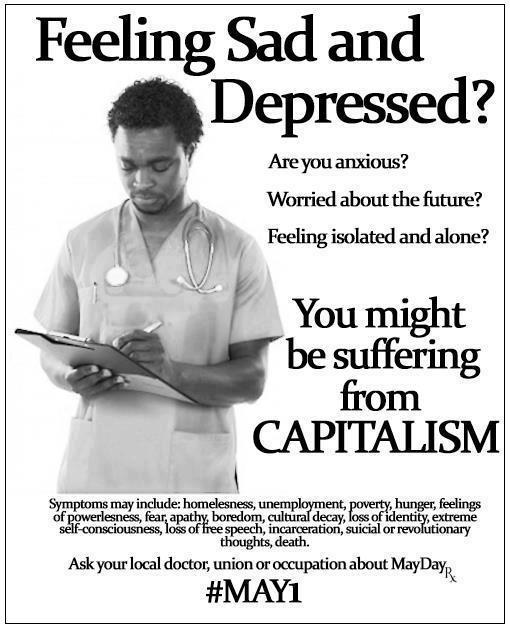
What’s actually wrong is that American capitalism is at the end of its rope. It can’t deliver the goods any more, hasn’t been able to for some time. It isn’t fascist yet, but it’s going that way and the only thing that can stop the process is you and me.

The good old days weren’t that good, and nobody but nobody wants to go back to them. Americans want to go ahead to something better and they won’t settle for anything less.

Voters haven’t turned racist or backward, they’re just desperate. A lot of them voted for Trump for the same reason they voted for Obama — anything other than what we have!

As I said in an earlier article, there are no long term solutions for those of us caught in this system.

That’s why we need long-term plans for fundamental change. The goals are in Bernie’s book — things like free education, decent health care, democracy, and all the many fine things he explained so well. I think Bernie has set the goals very well, the argument should be over how to achieve them. For that, we have to organize everybody, and we organize through successful struggles.

Each of us need to adopt long term goals like those Bernie set down. We need to recognize that elections and lobbying are not the only way to struggle and that, in fact, real change is more likely to come from organized economic activity than from generous politicians. That means that fundamental fights over economic benefits weigh more heavily than purely social questions. It means that workplace organizations mean more than idealistic social groupings.

We have to analyze our own resources and opportunities so we can pick the struggles we join, even if we have to skip some of them.

Then we have to get busy and organize. Leadership will emerge from struggle.

–Gene Lantz

KNON hasn’t fired me yet, so I’m still on the radio at 9 AM every Saturday. 89.3FM and knon.org. If you are curious about what I really think, click here.

We can better understand the system we live in by taking a long historical view.

rottenapple

Our economic and government system, while a great improvement over its predecessors, rotted to its core by early in the last century.

After that time, there were no solutions for the society as a whole. There were, however, solutions for certain wealthy people.

World War I and World War II, although they cost millions of workers’ lives and reversed a great deal of progress, turned out pretty good for the wealthy people of the United States. They enjoyed a prosperous, though temporary, period after each successful war. The people in the nations that lost suffered terribly, of course, but as I said, there were solutions for certain wealthy people after the 20th century began.

That so-called “solution,” world war, isn’t available to them any more because of nuclear proliferation.

Some time during the 1970s, the “American Century” of post war prosperity began to wane. Working Americans haven’t done particularly well since then, and have in fact begun to slide backward. The temporary economic “solutions” worked only for the very wealthy, and they continue that way today. Some people call this a crisis of capitalism.

The Crisis is Natural

If an economic system has to sell its products for more than they cost, and if the workers of a given nation do not have the resources to pay, then the products have to be sold somewhere else. The wealthy owners have to compete for that “somewhere else.” Since the 1970s, the wealthy owners of the United States have stopped winning that competition. It shows in all the statistics. Their only way to beat out their competitors is to reduce the wages, benefits, and social benefits of poorer people. That’s what they have been doing and what they continue to do.

Deregulation, Privatization, Corporate Welfare and Outsourcing are Necessary Props

To prop up the wealthy, to provide a “solution” for the wealthy (not for us), they cause their government to deregulate their businesses, privatize the socially-owned sector, hand out tax breaks and outright gifts to corporations, and outsource work to countries where wages and environmental regulations are more advantageous to them.

It’s Temporary

Even though the wealthy people are able to get their government to cooperate in their economic “solutions,” the results are only temporary, because the wealthy people in other countries are doing the same thing. It’s a competition usually, nowadays, called, “the race to the bottom.” That’s what we call it. They probably call it “good business.”

Things get temporarily better for the wealthy class while everybody else suffers.

Comes the Trump Government

President-elect Donald J Trump will accelerate all of the “solutions” listed above, solutions only for the wealthy and not for us, and they will be, if anything, temporary fixes. The crisis will continue, there is no way to turn it around because the international competition will still be there.

No matter what reforms we may attempt, the overall competitive system will remain rotten and will continue to get rottener.

We need a new system.

–Gene Lantz

I’m on knon.org and 89.3FM in Dallas at 9 AM every Saturday. If you want to know what I really think, look at my life’s lessons

Bernie Sanders, “Our Revolution—A Future to Believe In.” St Martin’s Press ebook, September 26, 2016. Available from Amazon Books and on Kindle

sandersberniefragmented

S’Wonderful, S’Marvelous!

This must-read book details two important political contributions:

  1. A blow-by-blow account of the miraculous Bernie presidential campaign
  2. Detailed explanation of legislation needed to rescue and advance the people of our nation

The account of the campaign answers the question about how they managed to get so far toward the Democratic Party nomination when they started with virtually nothing and refused to sell out to big contributors. Most of America and even Bernie seem to be surprised at how well people responded to a truthful, direct, approach to America’s actual needs. It’s an inspiring story that needs to be studied.

Part Two, “An Agenda for a New America: How We Transform Our Country” details the problems we face and proposes practical solutions in the form of legislation needed. In many cases, Bernie Sanders had already proposed proper legislation in Congress. In general, his proposals are designed to:

  • Restore and advance democracy
  • Remedy injustices, including racial injustices
  • Restore equality
  • Fix the economy

But It’s No Good

The big problem with Bernie’s wonderful book is the last line, “September 26, 2016.” He completed the book before Donald Trump’s upset victory for the presidency and before Republicans completed their take-over of all three branches of the federal government plus the majority of state governments.

So what do you do with wonderful proposals for legislation when progressive legislation has almost no possibility of passage? What do you do with an inspirational story of a hopeful electoral campaign when our foundation of democracy is crumbling?

Apparently, Bernie thought, on September 26, 2016, what most Americans thought – that the Democrats would have a big victory on November 8. The glaring fact that they didn’t, and the anti-democratic trends already underway, put new perspective on politics in 2017. Bernie’s thoughts of September 2016 are certainly good to know, and actually kind of miraculous to behold, but not much actual use, are they?

We’re going to have to do some thinking of our own.

Some Positive Suggestions

Rather than leave off on such a negative note, let me make a couple of general proposals that might be helpful in 2017

  1. Electoral politics is not the only form of struggle. The most important power that working people have is our ability to withhold our economic cooperation. It is essential, therefore, to dedicate ourselves to organizing workers – to vote, yes, but to work together in other ways too.
  2. We may think that history only repeats itself, but it doesn’t. Bernie Sanders (and also Donald Trump) campaigned on the idea of re-setting the calendar to some earlier date, but we can’t go backward even if we tried. We have an entirely new situation that needs entirely new proposals. For example, we don’t need to fix the Electoral College or even the electoral system as it exists. We need direct participation in government decisions, and for the first time in human history, direct participation is now possible!
  3. Economies can’t be re-set to earlier times. Sanders, and other writers, seem to want to move us backward to pre-Reagan days. Trump apparently wants us some time before the Civil War. We actually need proposals that account for our present situation and then advance into a better future. For example, if certain financial institutions are “too big to fail,” Bernie Sanders suggests that they are “too big to exist” and need to be downsized to the levels of the 1990s. With our present technological abilities, we don’t need them in the downsized version either. If they are “too big to fail,” certain banks and insurance companies need to be taken over and run for the public good.

We must be grateful to Bernie Sanders and others who have taught us so much. A great future awaits!

–Gene Lantz

Hear “Workers Beat” on KNON radio, 89.3FM and knon.org every Saturday at 9 CST

Click here if you want to know what I really think