Archive

Tag Archives: unions

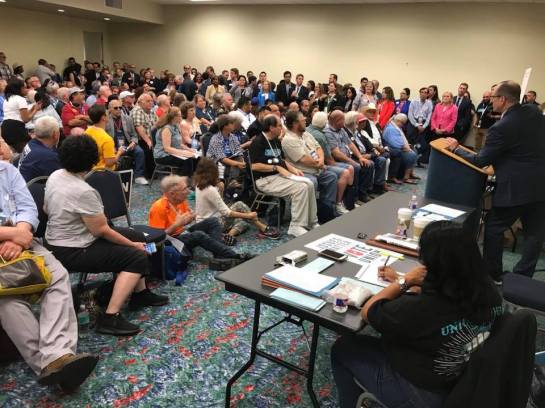
Several socialist groups came together on April 29, 2018, in Lake Cliff Park in Dallas to celebrate MayDay. They were kind enough to allow the oldest person in attendance to remind them of the long workers’ tradition by leading singing of “The International.”

Another Mayday celebration, by another group of socialists, takes place at Kidd Springs Park at 5:30PM on May 1st. One cannot help but observe that the progressive movement, even the activists who supposedly have the highest levels of consciousness, continues to be disunited. It’s like Will Rogers used to say about the weather: “Everybody talks about unity, but nobody does anything about it!” I believe the trend, though, is positive.

The trend toward celebrating the International Workers Day is a very positive sign. I can remember reserving that very same Lake Cliff Park pavilion May 1, 1984, and doing all the preparations and publicizing myself. Then I sat there, alone, for two hours hoping somebody would come, but they didn’t! This year, we have two of them. The first one had about 40 people, and I imagine the second will be at least as big.

I’ll be doing a talk about “MayDay Then and Now” at Roma’s Pizza, 7402 Greenville Avenue, beginning at 6 pm on Saturday, May 5th. I’d like to count that as a third MayDay celebration. Every year, I publicize MayDay on my radio show.

MayDay Has a History

The workers’ movement, of course, goes back at least to Moses and the slaves of Egypt, and workers probably celebrated the vernal equinox around MayDay long before they had calendars. But the year 1886 marks the close association of the workers’ movement with May 1.

That year, the word went out from Chicago for a worldwide general strike to demand the 8-hour day. There were protests everywhere. Strikers were killed in Chicago. A police riot erupted on May 4th during another rally in Haymarket square. Authorities came down hard on the Chicago movement and, in 1887, hanged four of the main leaders. Since then, the world remembers “Chicago, 1886” on May 1st.

The repression from the bosses combined with the opportunism of many American labor leaders separated the Americans from the International Workers Day; consequently there have been few celebrations here until recently.

Was Labor Stronger Before?

Almost any reading of labor history will bring out the romantic in us. We long for the great general strike of 1874, or the worldwide struggle of 1886, or the organizing frenzy of 1935-1947. In 1980, when the American government decisively teamed up with the bosses to suppress the labor movement, unions began a numerical free fall that continues today. We had 35% of the workforce organized into unions, and we have only 11% now. People dream about the good old days.

No, We’re Stronger Now!

But despite the decline in union numbers, American labor is actually stronger today than ever. Part of the reason is productivity, but most of it is education. One worker today is four times as productive as those who organized in 1935-47. If one worker walks off the job today, it’s like four workers striking in the old days.

We have more unity than ever. In 1935-47, remember that the American Federation of Labor and the Congress of Industrial Organizations were two separate and competing organizations. Remember also that racism and other kinds of chauvinism were far more divisive in the “old days” than they are today. The AFL-CIO didn’t even try to organize the millions of undocumented workers before 1999 — they joined the government in calling for deportation!

Today, the AFL-CIO bends over backward to work with church, civil rights, and community organizations. In 1987, unions were so totally isolated that five of the more progressive ones had to create a separate organization, Jobs with Justice, to try to build solidarity outside the official labor movement. Today, virtually all unions have gone past their initial hostility and regularly work with Jobs with Justice and other solidarity efforts.

In the old days, many workers were barely literate. Today, we command more information than they could have imagined. With our phones and computers, workers have the ability to function as almost a single worldwide unit. That’s power! We’re only at the first stages of using it, but today we have the power!

–Gene Lantz

I’m on KNON radio at 9AM Central Time every Saturday. Podcasts can be found from the “events’ tab. If you are interested in what I really think, look at my personal web site.


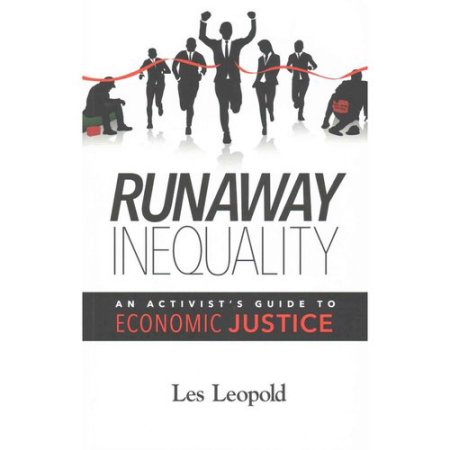
It is absolutely wonderful that the Communications Workers of America are buying books and teaching classes on “Runaway Inequality” by Les Leopold. It stirs a lot of thinking.

runawayinequalitybook

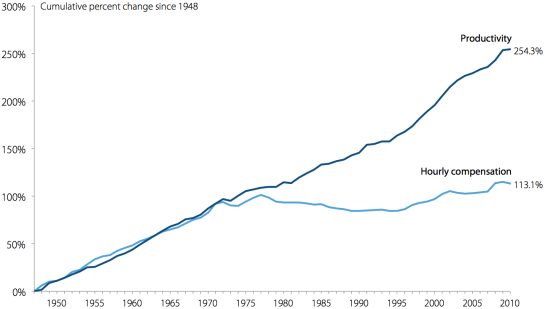
The core argument is that something has been seriously wrong in America since the mid 1970s, when wages stopped rising at a rate similar to the increasing productivity. Productivity is the amount of wealth that one average worker creates in one average working hour.

productivity-wages

As the graph shows clearly, wages and productivity seemed to rise together from the late 1940s to the mid-1970s, then productivity continued rising with the same upward slope, but wages flattened out. Profits rose, but wages didn’t. The change, Les Leopold says, came about because of deliberate policy changes. The book is full of other graphs showing the policies that changed, the resulting inequality, and the amazing effects of this incredible rise in inequality. Leopold then concludes by saying that ordinary Americans must band together and change those policies. In other words, wage-earners have to do what the bosses have been doing. It’s a “must read” book, and the classes (I’ve taken them twice) are inspiring!

There are further questions

  1. Is the period 1947-2016 a representative period of history, or is it unusual?
  2. Is the problem local or systemic?;
  3. Given the situation described in the book, is there really a solution for wage-earners?

What period of economic history is “normal?”

The entire book and all its conclusions come from the hypothesis that something went wrong in the 1970s. I have my doubts. The unusual period in American history was not 1974-2016, as Leopold suggests, but 1947-1974, the first part of the graph. In other words, there is nothing unusual about wages being suppressed in a capitalist economy. The unusual period was 1947-1974.

Take a quick look at how unusual was the post-war world:

  • Europe and Asian were bombed flat. American had virtually no competitors in the capitalist world
  • American unions were far stronger than in any time in history
  • The United States set the terms for all economic transactions in the capitalist world
  • The United States had almost all of the world’s gold

Then look at how things changed: By 1974, German and Japanese automobiles were flooding the world. President Nixon had given up America’s control over gold. Unionism had peaked around 1957 and was clearly slipping. The Chinese were having tea with Nixon and had broken up their alliance with the Soviet Union. Economic competition between nations was getting back to “normal.” What every nation had to do, to compete, was lower their costs. Their costs are our wages and benefits.

Is the problem local or systemic?

Our problems derive from the system we live in. American working families are having pretty much the same problems that other capitalist nations are facing. We have probably lost more than the families in other nations since the mid 1970s, but we had more to lose. The lords of American industry and finance have been able to hold on to their hegemony in the world only by sacrificing our wages and benefits.

Even worse, the long-term process of robbing working families entails destroying our democracy. The end of World War II was a triumph of democracy, and nowhere was democracy stronger than here, in the land of the winners. Several of Les Leopold’s graphs show how democracy is diminished. A very striking one is the graph showing that the United States has more people incarcerated than any nation of any size in the world! Today, many people are saying that we live under a plutocracy and that democracy is dead and gone.

It isn’t true. The absence of democracy is fascism, and we don’t have fascism in America. Even in 1947, our democracy was not complete. It was partial. Since the mid-1970s, our democracy has faded, but not disappeared. If the process continues as it is going now, it would be fair to say that fascism is the logical outcome. But it hasn’t happened yet.

Is there a solution?

Given the system we live in as described in “Runaway Inequality,” are we likely to be able to reverse the policies that have brought disaster for working families since the mid 1970s? No. What happened since 1974 is not unusual, it’s part of the ordinary process of world capitalist economics.

If there is a solution for American working families. it will come from a different system.

Gene Lantz

I’m still on KNON radio, 89.3FM, every Saturday at 9AM Central Time. If you’re interested in what I really think, check out http://lilleskole.us


On the “Workers Beat” radio show this morning, I interviewed advocates for Dallas County Schools, a public service that provides transportation and safety for children going to North Texas schools. We are experiencing a propaganda blitz calling for us to vote “against” them in the November 7, 2017, election. How we came to this little historical intersection is an interesting story, and it illustrates a much larger problem for our world under capitalism.

privatization-stop

Today’s radio program was the third time I’ve had advocates for Dallas County Schools. The first ones were bus drivers organized by an independent union. They complained that somebody was out to smear their driving records but, when one considers that they log 106,000 miles per day, their driving record was pretty good. Co-Host Bonnie Mathias and I smelled a rat even then. We decided, without any explanation or prompting, that somebody was out to privatize Dallas County Schools.

When I interviewed the interim superintendent and the organizer for National Education Association later on, I was convinced that privatization was indeed the issue. They said that Texas Senator Don Huffines had originated the entire process with legislation calling for the vote. Although the “remedy” he proposed was complicated, it was skewed toward privatization, said my interviewees.

A Board member who hasn’t been on my radio show had contacted the Dallas AFL-CIO for help a few weeks ago. I sat in on the meeting. Later on, she and I corresponded as I tried to get to the bottom of what was going on.

Today I talked with a Board member and another union official. They went over the charges listed on the three expensive 4-color mailings I have received. They refuted them one by one. Mistakes had been made in the past, they said, but the superintendent and most of the Board had been replaced since then and rectification was under way. Further, the charges against them were overstated or even out right lies!

Nobody mentioned it on the radio, but they said there have been at least 5 robo-calls urging the voters to vote against them. Who paid for five robo calls and 3 big mailings? They said that the mysterious “Protect Dallas Kids” organization that opposed them had filed the required legal reports. They received money from the Dallas Citizens’ Alliance and one of the biggest corporation in North Texas, AT&T. A great deal more had been spent than had been reported, they said.

The Dallas Citizens Committee’s involvement was no surprise. Their main front is the Dallas Morning News, which has editorialized against the Dallas County Schools.

Other than Senator Huffines, I could only find one name associated with the propaganda blitz. The Treasurer, which is required to be listed on political propaganda, is also the Treasurer of the Dallas Republican Party. The address given is right outside Dallas County, but is in Huffines’ Senate District.

As I wrote in the Dallas AFL-CIO newsletter, the anti-worker credentials of Senator Don Huffines, the Dallas Morning News, and the Dallas Republican Party are well established. We stand with the workers!

There’s a Much Larger Lesson

In general, capitalists want to privatize everything. They have already privatized many of the prisons, much of the space program, and a great deal of America’s war machine. They argue that business can do everything cheaper and more efficiently than government, even though even the most shallow thinker can see why they can’t — to every expense they have to add profits.

Almost any form of economic activity can be used to generate profits. That’s why they keep trying to privatize everything. It’s a major issue in so-called trade negotiations as the big transnational corporations try to crate more profit centers all over the world.

The Speaker of the House, Paul Ryan, has been trying to privatize Medicare for years. So far, the Senate has stopped him, but that doesn’t mean he won’t keep trying. They also want to provide everything having to do with veterans’ care.

Unions generally oppose privatizing. We argue that it leads to fewer services and more costs.  On the other side, the bosses look for any kind of problem that a public service may have, then they use that to argue for destroying the public entity and substituting themselves. That’s what’s going on with the Dallas County Schools, and it’s going on all over the world.

When we have a public service, there is always a possibility of corruption; but when we privatize, corruption is guaranteed!

–Gene Lantz

I’m on http://knon.org/workers-beat/ every Saturday at 9 Central Time. If you’re interested in what I really think, try http://lilleskole.us


Everybody should read “Runaway Inequality” by Les Leopold. Don’t wait for somebody from the Communications Workers of America to invite you to one of their classes on it.

runawayinequalitybook

Some of the best stuff is in the beginning. The forward is by Chris Shelton, President of the CWA. The middle parts of the book are mostly statistics about how inequality rose after America selected a new business friendly government policy in 1980. The other really great stuff is near the end

I particularly like Chapter 22: “When unions decline, inequality soars and we all lose.” On page 288 Leopold says, “Wealth inequality and unionization levels are intertwined.” You probably knew that but it’s good to see it in print.

What happened?

Then he goes into the reasons for the great union decline from its heady power of 1946, when Americans won strikes more than ever before or since. Leopold apparently doesn’t have the nerve to say it outright, but he lists, in a dispassionate way, several “theories” about how union leadership could have done better. I’ll shorten them and make them more blunt:

  • The decline started in 1947 when unions cooperated with the anti-communist witch hunt and expelled some of their best leaders.
  • Unions shouldn’t have worked closely with the CIA
  • The merger of the AFL and the CIO didn’t work out for the members
  • Unions shouldn’t have supported the War in Vietnam
  • Unions became bureaucratic and undemocratic
  • All unions haven’t learned community organizing techniques
  • Unions aren’t linking up with unions in other countries

Even though Leopold didn’t really commit to it, I thought it was a pretty good list. It probably should have included something about how unions largely ignored and still ignore the civil rights movement, but it’s still a pretty good list.

Right after the list, the author gives the underlying reason for all the problems: “Unions and the rest of us are on the losing side of a gigantic class war — a war that we have to recognize, discuss and address if unions are to grow again.”

In other words, we can list the things union leaders did wrong all we want, but the underlying reason for the decline was aggressive anti-worker policies of the boss class. Even if we’d had the best leadership in the world 1947-1995, it would have been very very hard to withstand the combination of government/boss aggression and the post war “good time” prosperity that allowed opportunist labor leaders to get pretty good contracts for their members — while slowly sinking into isolation from everybody else.

By 1979, unionized American workers were the envy of the world, even though our numbers were dwindling fast. In 1980, the party was over. I don’t think many union leaders figured it out, and some of them still haven’t. They still expect the bosses to act “reasonably.”

The essence of the problem

What it boils down to is this: From 1947 to 1995, the bosses were able to isolate the organized sector of the American working class from the rest of us. I picked this up from an earlier book by a prof in California named Lipschitz, “Rainbow at Midnight,” and from talking to people who lived through it. The new book, with CWA backing, will force unionists to look at the problem and see what we did wrong. Even if it did nothing else, the book would be worth the $20.

But Les Leopold actually does a lot more in “Runaway Inequality.” He makes serious suggestions as to how we can turn the situation around and return to the kind of militant union progressivism that succeeded for the CIO 1935-1947. The progressive leadership of the AFL-CIO, 1995 to present, can and probably will implement these ideas.

I can’t wait!

–Gene Lantz

Click here for more of these ideas


The Communications Workers of America is doing what unions almost never do — studying the actual mechanics of American capitalism and figuring out how to fight it! They are distributing and studying a book by Les Leopold of the Labor Institute.

runawayinequalitybook

Leopold, Les: Runaway Inequality. An Activists Guide to Economic Justice, Labor Institute Press, New York, 2015. (click for a review)

The foreword by CWA President Chris Shelton urges all union members to read the book. Shelton is also quite specific in recommending an electoral strategy: “…we need to build our own, independent, anti-corporate, pro-union, political organizations! Wall Street has two parties. We need one of our own.”

He recommends the Working Families Party, (click here) which already exists in 10 states. Could this be the labor party that American progressives have been begging for since forever?

The fact that one of America’s largest, best distributed geographically, and most vibrantly active unions is putting this body of information out is significant. It’s also a timely prescription for the national illness. The negative images of Donald Trump and Hillary Clinton are moving people away from the traditional two-pronged capitalist political system while the hopes aroused by the Bernie campaign are still not settled on a program and course of action.

It’s the Economy

Most of the book consists of graphs and explanations of the wealth gap and income gap that have become deep chasms since around 1980. Most of us have seen some of this striking data before, but nowhere is it presented so thoroughly and connected so well to an underlying cause. Around 1980, when Reagan was elected, America’s ruling elite adopted an extreme anti-worker and pro-corporate program that included deregulation, tax cuts for the wealthy, service cuts for the poor, and attacks on unions and democracy in general.

We have all felt parts of this ugly program firsthand, but Leopold’s book connects the parts into a whole, then begins an optimistic discussion on what we can do about it.

Let’s Get Behind It!

One could make an intellectual discussion about the better or worse aspects of Leopold’s book, but doing so would be frittering away an opportunity that the Communications Workers are giving us. Here’s a chance to join in an educational process that can give immediate direction to the progressive movement. We can’t afford to miss it!

–Gene Lantz

Click here for more of these ideas

People were shocked recently when French President Francois Hollande, head of the Socialist Party, forced legislation through that would make it easier for bosses to lay people off, make them work longer hours, cut their pay and cut into some of their special leaves — such as maternity leave. Click here for BBC version. Protests were very large. I read that 70% of the people were against the new labor rules. But they passed!

lincolnlabor

How could that be?

The simple answer is that Hollande is a SINO — Socialist in Name Only. But simple name calling doesn’t really provide any answers. Undoubtedly, France is a capitalist nation with a president who calls himself a socialist and leads a party that calls itself socialist. They got elected, but they didn’t overcome the bosses and, probably, never intended to.

As long as the bosses are in power, workers will never win any permanent gains. Everything we can win, even the 35-hour week that they enjoy(ed) in France, can still be taken away.

France is a capitalist nation and subject to the same economic laws that govern all the capitalist nations. All of them function in competition with one another. When the competition gets rough, as it is worldwide right now, the employers turn like vicious cannibals against their own people in order to drive down costs. Most costs are labor costs, so capitalist governments, including ours, are in the process of competing with one another by chopping away our standards of living.

Even nations that actually have overcome the employers have to compete with other nations within a world capitalist system. Did the Soviet workers ever win a 35-hour week? I don’t think so.

It doesn’t matter much what the government calls itself as long as it is still capitalist and still operating under the capitalist rules.

–Gene Lantz

Click here for more of these ideas

In a casual discussion group I participate in, somebody asked, “Where are we in the swing of the historical pendulum? Are we close to revolution?”

Che

I didn’t try to answer at all, because I couldn’t deal with the way the question was framed. There is no “historical pendulum.” It’s common to believe that history just swings back and forth or goes around in circles, but it doesn’t. The general movement of history is forward and progressive. We aren’t savages any more, most of us, and we aren’t serfs nor slaves. Over the centuries, progress is being made.

But later, I wished I had answered the question, because my analysis may seem unusual to some people: Revolution in the United States and in most of the world may be just around the corner!

Doom and Gloom

OK, there are a lot of naysayers and former radicals among us today. The implosion of the Soviet Union hit hard. The rapid change in Eastern Europe devastated some folks, and the difficulties they’re having in Venezuela and Brazil today are squeezing the optimism away. Add to that the tremendous success that dark money has enjoyed in turning our American democracy backward during the last 4 decades. It’s enough to get some people down. Some people. But they aren’t taking the long view.

The Long View Looks Great!

What are the requirements for a qualitatively better society? A well informed and well organized public with leadership from among the workers. We have that, more than ever!

Nowadays, I am in awe of the millennials. They grew up understanding more about using new technology than I will ever learn. Technology extends their knowledge and their capabilities.

The millennials also grew up without all the anticommunism that crippled the thinking of my generation. When I was young, we were afraid to even look to the left, much less think in that direction. The Bernie campaign has made “capitalism” and “socialism” everyday words. People are thinking thoughts that used to be taboo.

Today’s young people have the entire world at their fingertips. Most of my generation would never have left home if it hadn’t been for the military draft.

Don’t Overlook the Unions

Unions are the organized sector of the working class. It’s true that there aren’t as many union members per capita as there were in 1957, but that’s misleading. One worker today is doing the work of 4 pre-war workers. And he/she is likely to be highly skilled and hard to replace. Workers are just as central to the progressive movement as they were in Russia in 1917 and every year since! Nobody else can stand up to the bosses eyeball to eyeball, but workers can!

Older people think that the 1960s and 1970s were the revolutionary times. Long hair and marijuana do not a revolution make! Ask them how much union support they enjoyed in their anti-war marches, their feminist causes, their environmental rallies, or anything they look back on with smug satisfaction of revolutionary activity. Unions barely participated in those days, but things have turned around now. It’s hard to find a street action that isn’t supported by AFL-CIO members. In fact, they originate a lot of them!

Furthermore, it is now possible for everybody to work with America’s unions. From 1947 to 1995, that was impossible. The unions in the post war years grew more and more isolated, but today they are reaching out with both arms!

Communications Are Already Revolutionized

There were a number of revolutions in the 20th century. They did it with clandestine meetings, secret leaflets, and a tiny few underground newspapers. One person might “spread the word” to a few dozen on a very good day. Today, we can reach thousands, maybe tens of thousands, without leaving home!

The possibilities are amazing!

–Gene Lantz

Click here if you’re interested in more such ideas

Organizing Gets Easier and Easier

I’m flattered when somebody introduces me as an organizer. They sometimes say I’m a “union organizer,” which is not actually true. A real union organizer is a paid professional with a strong background in labor law. I consider myself a “worker organizer.” But everybody is an organizer.

We organize every time we meet somebody for lunch. It’s all organizing. But what’s critical is organizing on the job.

organiz9

A Short History of Organizing, Starting with Slave Labor

Looking back through history, we can see that organizing was really hard to do when most work was done by slaves. Nat Turner, John Brown and Spartacus all found out how hard. They all failed, and were executed for trying. The only successful slave organizer I know of was Toussaint L’Ouverture in Haiti around 1800. The reason it was so difficult was probably because slaves were pretty much interchangeable. When one was worked to death, another could be easily substituted.

Serfs and sharecroppers, who mostly replaced slaves, were a little more organizable. I think that’s because they had to know a little bit more about their jobs and weren’t so easy to switch around. The Southern Tenant Farmers Union of the 1930s was one of the more successful efforts. I actually met H.L. Mitchell once. Their gigantic accomplishment was to fight racial barriers that have always made organizing in the American South so difficult. Even back in those days, there were a few small guilds of workers who could be organized because they had special skills and tools.

The Bosses Do Most of Our Organizing

Modern unions came about because of the industrial revolution. England was the first capitalist nation, the first to industrialize, and of course the first to have organized unions. In America, the first successful unions were people who made shoes. It wasn’t everybody in a shoe factory. It was only the most skilled workers. For the next couple of centuries, the more skilled workers tended to organize around their special skills and tools. We call that craft unionism, and it was the model for the American Federation of Labor (AF of L) during its century of dominating organized workers in America. In steel production, for example, the molders and machinists might be organized, but not the people shoveling coal and ore. In textile, the cutters would be organized but not the women doing the sewing.

Modern Industrial Organizing Finally Developed

Labor’s Giant Step (free book on Amazon) can trace its development to the beginning of the 20th century, when the Industrial Workers of the World set out to organize everybody who worked, skilled and unskilled, men or women, Black, Brown, or white. By then, industrialization had made just about every job in America into a somewhat skilled position. It was difficult to replace one worker with another. General education and training were involved. The IWW ran into a minor obstacle because the AF of L undermined them, but their major obstacle was the U.S. government. IWW’ers were arrested, deported, horsewhiped, and murdered.

The saying goes that you can kill revolutionaries but you can’t kill revolutionary ideas. So industrial unionism eventually triumphed when the AF of L started the Committee for Industrial Organization (CIO) in 1935. Three years later, they thought better of it and expelled them, but by then the CIO was strong enough to survive and thrive on its own. After 1935, the biggest and most successful unions were those who organized “wall-to-wall,” everybody in a given industry from the most skilled computer operator to the lady sweeping the floors. AF of L unions adopted industrial organizing.

The best known pioneer and most successful union of the CIO was the auto workers. You can see why they organized so well, because auto manufacturing, more than most other work, was done by assembly line. If you could get three or four people on strike, you could shut down the line! Once again, the bosses had done most of what was necessary to organize workers!

Organizing Gets Easier and Easier

American industry became so well organized that the anti-worker bosses had to get the U.S. government to help them keep wages and benefits down by outsourcing the work to other countries. The same process of organizing is taking place in those other countries, so the bosses won’t benefit from outsourcing forever, but it works for them as an interim solution.

Meanwhile, Americans are better informed and more skillful than ever. The internet is making a qualitative jump in people’s access to information. It would be possible, in my estimation, to organize a national shutdown in only a few days. A worldwide shutdown could be organized in a matter of weeks. After that, everything is possible.

–Gene Lantz

Click here if you’re interested in more such ideas

walnolangeorgebusted Traditionally, it’s easiest to organize economic units working under the same employer in more or less the same vicinity. It’s even better, as the auto workers showed us, if they work on assembly lines, so that just a few missing workers can stop production.

People who are scattered out, working under multiple employers, aren’t so easy. Until recently, they were considered pretty well impossible to organize. But some groups, such as For Respect at Walmart, are organizing the impossible. In the photo, right to left, there’s a retiree activist, a preacher, a Teamster, then a housewife. The rest are low-paid part-time Walmart workers. They’re all in handcuffs waiting to be taken to a police station.

Once I rode a bus to a Farm Workers action in California. The other occupants were home health care workers. If there were 50 of them, then they had 50 employers, most of whom were old people with limited money. And yet, they were organized! The Service Employees organized them by targeting the state agency controlling their working conditions rather than the 50 employers!

All over America today, low-paid part-time food service employees are being signed up for the “Fight for $15” minimum wage movement. They’re also signing up members of more substantial unions, students, and a whole lot of well-intentioned, high-intelligence people who don’t otherwise have anything to do with food service.

The new progressive leadership of the AFL-CIO is emphasizing its constituency groups. In most cases, people don’t have to be union members to join. The connection to organized labor makes them much more powerful.

Our traditional methods of organizing are way out of date. Revolutions are being organized today with social media, and American organizers are learning how it’s done. The internet changes the very nature of organizing.

If we are going to save the planet and ourselves, every worker needs to be organized. Every worker can be organized.

–Gene Lantz