Archive

Tag Archives: #1u

The answer is “yes,” but there are powerful caveats.

Why Do Unions Tend to Avoid Commercial Media?

American law protects a union’s right to communicate fully and openly with their members. Unions can even publish their candidate recommendations – but only to their members. Unions have to be much more careful when talking to  any audience that may include people who are not their members. Some unions don’t talk to them at all.

For unions, there are good reasons to avoid the commercial media. The laws are stacked against us, and the “news” sources virtually all belong to giant corporations who are, after all, our worst enemies. Try Googling “Who owns America’s news?”

And you will find that it’s 15 billionaires in 6 mega corporations. Every one of them would fight to the death to keep their own employees and those of their corporate advertisers from organizing.

“Just 37 years ago, there were 50 companies in charge of most American media. Now, 90% of the media in the United States is controlled by just six corporations: AT&T, CBS, Comcast, Disney, Newscorp and Viacom”

Economics and Foreign Policy

Our “news” is most shamefully dishonest when it comes to economic and foreign policy news. They literally sing from the exact same hymnbook, and that hymnbook is written by corporations with no input from working families. One would like to exclude “public” media such as NPR or the BCC, but it would be a mistake. Compare any news item on the economy or on foreign policy over the full spectrum of what is available. Even the phrasing is practically identical!

Exceptions like the all-volunteer community radio station KNON in Dallas are so small as to be almost negligible. The hour-long talk show, “Workers Beat,” which I have proudly hosted for decades, is the only worker-friendly program on the Texas airwaves and one of only 3 or 4 in the entire South!

When labor takes actions big enough to affect the economy, we sometimes get news coverage. But the bosses’ “other side” version generally gets more.

Consider the Vietnam War

In the 1960s, tiny newspapers sprang up with the truth about the war in Vietnam. While the commercial media went on, as they always do on foreign policy questions, raving about the wonderful work that America was doing in Southeast Asia. tiny newspapers like “Space City News,” “Abraxis,” and “Mockingbird” (I worked on Mockingbird) in Houston and many cities were publishing actual accounts from soldiers’ letters.

Consider the pacifists. They carried out dramatic anti-war actions time and again, but could not get favorable news coverage anywhere except in the “underground” press. Singer Joan Baez was arrested almost daily for trying to stop young men from going overseas. Her commercial news coverage consisted of being denigrated as “Joannie Phoney” in one of the most popular comic strips.

The truth, years later, giant demonstrations and the underground press eventually eroded the truth through. After that, it wasn’t the glorified accounts of Vietnam’s battlefields that swayed the public. It was the scenes of coffins and body bags landing at American airports. Since Vietnam, America has preferred to fight its wars with machines and proxy combatants. Journalists are vetted and “embedded” by the military.

Does my condemnation mean that all commercial “news” must be disregarded as untruthful? Certainly not. Corporate bosses insist that their commercial journalists be scrupulously honest on all the smaller issues, the better to fool us on the big ones.

 Public Actions Can Get Good News Coverage

Even though giant corporations monopolize virtually everything we read, hear, or see, democracy still gives us opportunities. The American people believe in democracy and think they have it, even in their news sources. The print trades that once ran the great newspapers may have been broken years ago, but journalists are now joining writers’ unions, especially The Writers Guild formed by the Communication Workers of America. The internet and social media may be spreading innumerable lies, but truth also finds it accessible – and commercial news sources are made wary. More than anything else, handy mobile phones give Americans access to friends and sources they can trust.

The larger and more public our actions are, the more likely they are to get honest coverage. The better that our news conferences and news releases are, the more likely they are to be covered accurately. The more adroitly we use quasi-democratic platforms like talk shows and letters-to-editors, the more likely we are to get our message out.

It is good to understand the corporate media with all its anti-labor proclivities, but it is even more important to take advantage of every possible avenue to reach working families with the truth. We can do that. More and more, we ARE doing it!

–Gene Lantz

I’m on KNON.org’s “Workers Beat” radio talk show every Saturday at 9AM Central time. My “Workers Beat Extra” podcasts are usually published on Wednesdays on KNON and Soundcloud. If you are curious about what I really think, check out my old personal web site.
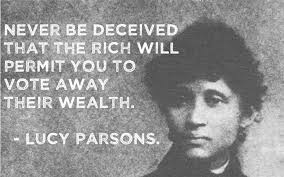
As long as I have been around the progressive movement, well over 50 years, we have expected to see some kind of American Worker’s Party break the two-party stranglehold over politics. Working families, then, would have a real alternative at the polls, we imagined. But it didn’t happen and isn’t closer to happening today. Maybe it’s time to give up on it!

Take a quick look at the history of 3rd parties. The last successful one was the Republican Party around 1859. What a thrill it must have been for the progressives of those days, most of them abolitionists, to have a new political party that offered real hope of ending the very worst of all ingrained American practices, slavery!

Then, let’s see, there were the Populists, mostly farmers, of the 1890s. They died when they endorsed the Democratic Party candidate for president. Gene Debs and the Socialists were able to get 1 million votes while their candidate was in prison, and it was sensational but not threatening to the system. President Theodore Roosevelt tried to get his career restarted with the Bull Moose Party before WWI, but didn’t get far. In 1947, former Vice President Henry Wallace tried to save the Franklin Roosevelt “New Deal” program. I recently read that he received a paltry 2.8% of the popular vote. Billionaire Ross Perot was effective enough in getting Republican voters to make sure that Democrat Bill Clinton won the presidency. The Greens have made some small inroads on Democrat voters, but were embarrassed when people learned that they were taking money from the Republicans.

In 2016 and 2020, lots and lots of American young people thought Bernie Sanders would either take over the Democratic Party from inside or create a powerful new progressive party, but Bernie has already endorsed Biden/Harris and I don’t know what those young revolutionaries may be thinking. Today, the Democrats are worrying that the “No Label” Party, financed by mysterious dark money, will take some of their votes and throw the 2024 election to Trump. But nobody is worried that we’ll end up with three viable parties nor that one of the two “main” parties will get replaced.

Side note: There is a party in existence called the “Working Families” party. They are interesting in states where they are allowed to endorse Democrats or Republicans, but not so much when they have to run on their own.

When I first heard of it, a Workers Party made sense. The unions still had over 20% of the workforce organized and were much stronger in politics than they are today. There were labor (or labour) parties here and there in other countries that were in and out of power from time to time. It just seemed like a natural intermediate step. But there are several reasons, today, to consider giving up the idea.

For one thing, we were just wrong about labor parties. We didn’t analyze the “winner-take-all” aspect of American politics. Other nations generally have parliamentary systems that allow proportional representation in governing bodies based on their percentage of the popular vote. They might win a few seats one year, add a few the next year, and eventually rise to power.

Not us. With America, nobody cares anything about proportions. It’s winner take all! If a party wins 49.9% of every vote in America, they still get nothing. The party with 50.1% gets everything.

For another thing, the organized unions that we were expecting to move up to the next stage of political power have diminished. We had about 35% of the workforce organized in the early 1950s, and we have about 10.1% now. Even if they wanted to launch a workers party, they might not have the strength.

The Bright Side

The positive way of looking at American electoral politics is to consider that progressives may not need any kind of political party to win power. Stages may not matter. With modern technology, especially mobile phones, smart people with a good program and a winning organizational model could organize almost anything in a matter of days. That’s what happened in the “Arab Spring” countries. They had no need for an interim political stage, but went straight from powerless to empowered!

Did the Labor Party Idea Just Wear Away?

Not so many years ago, I can remember top labor leaders saying that they, too, wanted a workers party. They said that building our political strength year by year within the two-party system would eventually give us the power to move off on our own. Now, I wonder if they were serious. I also wonder if the hope for a labor party is still alive among the top union leaders. I tried to find out this morning (June 16, 2023) when they were getting ready to vote, by a big margin, to endorse the Democratic ticket earlier than ever before in history. I was watching them on a webinar, so I asked innocently in the chat box, “Does this mean we’re giving up on the workers party idea?”

I didn’t get an answer. I was kicked out of the meeting and couldn’t get back in. It might have been an error. People make errors in webinars.

–Gene Lantz

I’m on KNON’s “Workers Beat” radio talk show every Saturday at 9 AM Central Time. They post my podcasts on Soundcloud.com, usually on Wednesdays. If you are curious about what I really think, check out my old personal web site.

Book Review:

Hochschild, Adam, “American Midnight. The Great War, a Violent Peace, and America’s Great Crisis.” Mariner Books, 2022

I found a free Kindle copy through the Dallas public library’s “Libby” service. Now I wish I had a hard copy because of the facts in this history of America from 1917 to around 1924. You could call it the Red Scare. You could call it the most shameful period after the Civil War. Or you could call it a warning about today and tomorrow.

This book changed my view of the period. Previously, I thought that government had simply allowed vigilantes to run amok — arresting, assaulting, and lynching just about anybody they chose. That was bad enough. Having reach Hochschild, I now realize that government was not just standing aside, they were actually fomenting, cooperating, and leading the nastiest gangs of racists they could find. Nearly all the spying was done by government hires. The worst of the mass acts of repression came directly from government agencies.

One might think that the Justice Department would have stood for justice, but they were probably the worst perpetrators. A lot of the worst assaults were called the Palmer raids, after Attorney General Palmer. After them came, probably, the armed forces; but many government offices were in on it, including the post office! J. Edgar Hoover, notorious race baiter, union hater, and all around sociopath, made his chops in the period. We were stuck with him for another 50 years!

Near the end of the book, Hochschild tries to tote up the numbers of people killed, horsewhipped, imprisoned, deported or otherwise deprived of life and liberty, but it’s a hopeless task. Besides, he’s basically talking only of federal cases. All the nasty things that happened at state and local levels would probably have doubled or tripled the size of the book. Then there’s the non-government participation of anti-union bosses and ideologically-driven racists and nativists to consider!

The rationale for the horrors began when Woodrow “He Kept Us Out of War” Wilson was re-elected in 1916. A lot of Americans, including the growing Socialist Party and some of the members of the Industrial Workers of the World, strongly opposed the war. The repression was originally released against anybody who did not want to join the bloodfest. But why, anyone might ask, did it continue after the end of the war and well into the 1920s? The excuse used most was Bolshevism, but the targets were American working people.

There are a couple of things I would have liked to have found in this account. The Greencorn Rebellion in Southeastern Oklahoma was an early expression of anti-war feelings among sharecroppers, including whites, Blacks, and Natives. I would also have appreciated an attempt to go beyond tallying assaults, deportations, imprisonments, and murders just to find out how many workers lost their jobs during this awful period. Of all the terrible things that government and employers do to workers, the most widely applied, and thus the most effective, is to deprive us of the ability to earn a living.

Hochschild clearly condemns certain government officials. He leaves the final judgement of President Wilson open to debate. He gives some credit to “good guys” such as Emma Goldman, Kate Richards O’Hare and of course Eugene Victor Debs. He mentions Frank Little, one of the first anti-war spokespersons lynched. William Z. Foster, who worked through the whole period to try to bring the labor movement together and develop its fighting potential, remains hidden in our histories.

I have always found it interesting to speculate what might have happened in America if different leaders had headed the Socialist Party, the IWW, or the AFofL. Worldwide, the many socialists capitulated early and supported their governments in World War I. There were only two that didn’t. The other one was Russia.

–Gene Lantz

I’m on KNON.org’s “Workers Beat” radio talk show every Saturday at 9AM Central Time. I have about 150 podcasts under the name “Workers Beat Extra” there, too. If you are curious about what I really think, check out my personal web site

Book Review:

Pearson, Chad E., “Capital’s Terrorists. Klansmen, Lawmen and Employers in the Long Nineteenth Century.” University of North Carolina Press, 2022

Pearson brings us a new understanding of America’s terrorists. From April 9, 1865 to January 6, 2022, our terrorists were not primarily motivated by race hatred or stupidity, as we are usually told. Instead, they were instruments organized, and often physically led, by America’s employer class. Big capital used the most shameful events in all of American history to one end: keeping working families down.

Pearson starts with the Ku Klux Klan. They weren’t just random racists. They were deliberately organized and carefully led to force former slaves to work for little or nothing. They still are. Later organizations may have been called “Law and Order Leagues,” or “Citizens’ Alliances,” but they continued to use vigilantes when it suited them. Their purpose was exactly the same: making sure that working families could not successfully organize.

Even though employers could usually county on judges, local police, national guards and even the U.S. Army to side with them, they also found it expedient to organize illegal terrorist activities. That’s what the book is about.

Pearson organizes his explanation with biographical information on the main ideologues for employer terrorism. One of the worst was a newspaper owner; another was a best-selling author of fiction. Both were expert propagandists justifying all legal and extralegal means available to keep workers down.

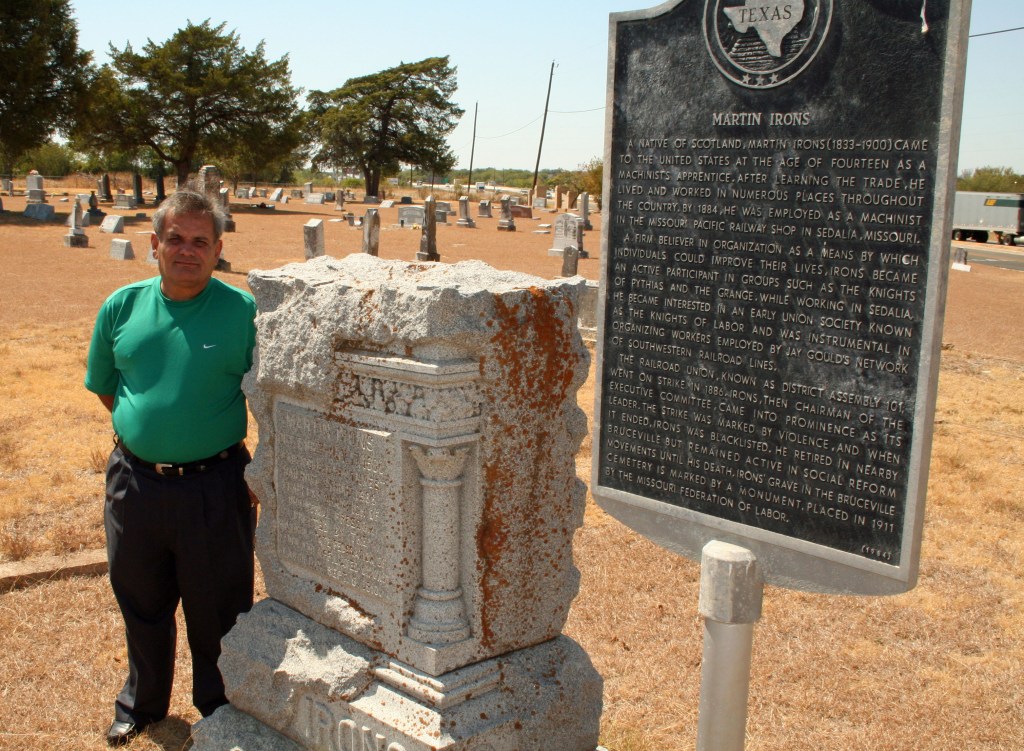
For us in Dallas, there are some local angles to the story. Martin Irons was a great union man who was ruined and martyred by the terrorists. He called the 1885 Southwest Railroad Strike during a convention in nearby Sherman. His grave is in Bruceville, halfway to Austin, where he died in poverty.

Except for some very good analysis of the January 6 attack on the nation’s capitol, the book limits itself to the 19th century. If it were brought a few years closer to today, it might have talked about Henry Ford’s “Service Department” of goons and criminals that maimed and murdered union supporters on behalf of the company.  

There are several accounts of Harry Bennett and Henry Ford’s “Service Department” of goons, criminals and murderers. https://www.salon.com/2014/06/01/henry_fords_reign_of_terror_greed_and_murder_in_depression_era_detroit/

Another account mentions a ex-wrestler named Fats Perry in the late 1930s. https://books.google.com/books?id=MJJOl7SMWIoC&pg=PA172&lpg=PA172&dq=Fats+Perry&source=bl&ots=7WajZJonOm&sig=ACfU3U3_OvtR3dgVWul8wuROQxLia1vfBQ&hl=en&sa=X&ved=2ahUKEwiK7bjN5Zz7AhV2lGoFHUs6CZQQ6AF6BAhTEAM#v=onepage&q=Fats%20Perry&f=false.

Perry and a handful of other gangsters were fired from Ford’s East Dallas assembly plant on suspicion of theft. They complained to the newly-formed National Labor Relations Board, where a young attorney named Nat Wells wrote down their testimony. They told Wells about kidnapping, tar and feathering, and whipping suspected union organizers on behalf of Ford. They indicated that they had plenty of help from local police and the Dallas Morning News. Wells wrote it all down and it became part of the United Auto Workers’ legal action against Ford Motor Company – and that played a big role in the UAW’s successful organizing drive in 1941, four years after their triumph at General Motors. Thanks to Joe Wells and Dr George Green for keeping this story in our histories.

Dr Chad Pearson teaches history at University of North Texas in Denton. I intend to interview him for my podcast as soon as I can get his contact information.

–Gene Lantz

I’m on KNON.ORG’s “Workers Beat” talk show at 9AM Central Time every Saturday. If you are curious about what I really think, you might look at my personal web site

Book Review:

Windham, Lane, “Knocking on Labor’s Door. Union Organizing in the 1970s and the Roots of a New Economic Divide.” University of North Carolina Press, Chapel Hill, 2017

Capitalism is said to have begun in the middle of the 17th century in England. Workers and bosses have been fighting since then. Any period in that great long battle for democracy, dignity and a living wage would be an interesting period.

picketing

This author chose the 1970s in the United States. Certain underlying economic and social developments made it a period of interesting class warfare.

  • The civil rights movement and the women’s movement had created a more diversified, and more militant bunch of activists into organizable workplaces
  • The “American Century” of economic domination over the war-weary victims of World War II was noticeably beginning to end
  • America’s most devoted and seasoned labor activists had been driven away by the great witch hunt that began in 1946. Union militancy had turned into “business unionism.”

Union density peaked at about 35% of the workforce earlier, but unions still had about 20% of the workforce in the early 1970s. Union members had far better wages, better benefits, better pensions, and better jobs than the workforce at large. Part of the consequence of getting more for union members while ignoring other workers was increasing isolation for the unions.

Nevertheless, young people wanted to unionize. They fought hard. For the most part in the 1970s, they lost. One could argue that the events from 1947’s Taft Hartley law to 1970 had foreordained that labor would lose, but that isn’t Mr. Lane’s argument. It’s mine.

Lane argues that companies simply worked harder at union busting. They increasingly won government over to their side. By the end of the 1970s, when Ronald Reagan was elected, the downhill slide was evident to everyone. In 1995, maybe a little late, the AFL-CIO started trying to adjust to the new situation.

One shining light in Lane’s book is the early success of an organization called “9 to 5.” They organized women to fight for the workplace rights that the larger women’s movement had won through federal legislation. The idea of organizing outside the control of government authorities like the National Labor Relations Board was a good one, and they had some early successes. However, it didn’t last.

In fact, most of the hopes that young activists may have had for union organizing in the 1970s were crushed. This is not a happy book to read. I wish he had chosen the 1990s, when American labor began to show some real promise.

–Gene Lantz

I’m on KNON’s “Workers Beat” talk show every Saturday at 9AM Central Time. We podcast it and “Workers Beat Extra” dialogue on Wednesdays on Soundcloud.com. If you are curious about what I really think, check out my old personal site.

Labor needs an advanced program to meet today’s extreme challenges:

  • Six-hour day!
  • No corporate bailouts!
  • Democracy first!
  • Infrastructure!
  • Organize Everybody!

Nobody is prouder than I of the improvements in the AFL-CIO since the leadership change of 1995. We have reached new peaks this year with our May 1 celebrations and our taking sides with the movement for racial justice.

But the situation is changing so quickly and so dramatically that I believe the American labor movement needs very advanced thinking if we expect to be able to say that we truly represent the needs of all working families. There is little danger, in this extreme situation, of overreaching.

Six Hour Day!

Because of the ongoing unemployment crisis, now is the time to re-implement our old demand for shorter working hours. A six-hour day would help with unemployment and, most likely, increase labor productivity just as it did when the Fair Labor Standards Act came.

During the heyday of the CIO and for a while afterward, American unions demanded “30 for 40 with no cut in pay!” We wanted a 30-hour work week with the same pay we were making in 40 hours. I once checked the resolutions at conventions of the UAW and found that “30 for 40” was there every convention until 1957. That same year was also the peak of U.S. labor organizing. We had 37% of the workforce organized in America!

After 1957, shorter working hours was forgotten and it’s hard to find a union leader today that even knows about it. One exception is a former officer of a local of the United Transportation Union. The UTU is a railroad union. Tom Berry actually negotiated a contract with a 6 hour work day in it, and he will still talk to you about it any Saturday evening when his free speech forum takes place in Dallas. I’m proud he’s my friend.

Somewhere in my moldy pile of old books, I have one about the struggle for shorter working hours. I think it might be named “It’s About Time.” Just as one could make a case for the age old class struggle being a fight for democracy, one could also say it was about time.

Prior to the industrial revolution, most people worked from dawn to dusk. They were outdoors, varying their tasks, and doing their own pacing, so it may not have been nearly as hard for them as it was for factory workers after the industrial revolution. From the industrial revolution forward, working families have fought their bosses over working hours.

In 1886, we had worldwide strikes to try to win an 8-hour day. The main leaders of that movement in Chicago were rounded up and hanged, so we didn’t hear a lot more about it until the Great Depression. When unemployment soared, the Roosevelt Administration pushed for the Fair Labor Standards Act. It was finally passed on June 25, 1938.

The FLSA doesn’t guarantee an 8-hour day. It just mandates overtime pay for working over 40 hours in a given workweek. Bosses don’t like to pay overtime, so 40 hours became something of a norm on many worksites.

America’s overtime problem today rivals that of 1938, so everybody should be able to understand and get behind the demand for shorter working hours now.

Jobs and Infrastructure

Now is the time to demand trillions of dollars for infrastructure repair and advancement. Truly terrible unemployment may be with us for a long time if strong progressive action is not taken. Among the many pressing infrastructure problems is the need for fast internet everywhere.

Democracy Comes First!

Our political demands must be improved in the direction of defending and strengthening democracy, because working families need it most and the wealthy employers of today are not going to provide it. Our usual demands for fair wages, benefits and the right to organize, of course, must be pursued.

No More Corporate Bailouts!

Since 2007, most of the economic action of the government has been directed toward propping up employers with little regard for working families. It needs to stop. If a corporation can only survive by getting a government bailout, it doesn’t need to survive. If workers are displaced by corporate failure, they should be employed directly by government. Their efforts should go toward meeting human needs, not profits.

Corporations have shown and are showing that they cannot be trusted “middle men” to distribute corporate welfare as wages to their suffering employees. In the last crisis and the current one, corporations hid their windfalls from the public and, as soon as they could, redistributed the money to themselves!

They are in that same process with pandemic bailout money right now!

Organize Everybody!

American labor has done is doing a valiant job, especially considering our dwindling resources. In order to bring forward a truly progressive agenda, we are going to have to redouble our efforts to win over the general American population. Our on-line arm, Working America, is perfectly suited to doing this work, especially during the pandemic.

With a progressive program and a digital approach, American labor can organize everybody!

–Gene Lantz

I’m on KNON’s “Workers Beat” radio talk who every Saturday at 9 AM Central Time. We podcast it, and some of my other talks, on Soundcloud. If you are curious about what I really think, check out my personal web site

What Do You Have to Lose?

Today, while Corporate America, dark money, and an even darker government are trying to destroy the United Auto Workers, it would be good to consider what it means for all of us. To do that, look back in American history to a time before the UAW became the first great success of the Committee for Industrial Organization.

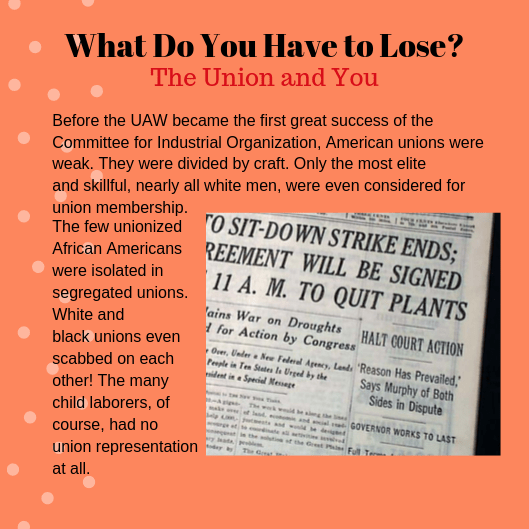
In 1935, nearly all American unions were weak. They were divided by craft. Only the most elite and skillful, nearly all white men, were even considered for union membership. The few unionized African Americans were isolated in segregated unions. White and black unions in the same workplace even scabbed on each other! The many child laborers, of course, had no union representation at all.

Color and gender lines were broken once and forever in the union. The UAW organized industrially. That is, everybody who worked in the industry was a candidate for membership. Their anti-discrimination pattern and their militant action were followed in the great upsurge that followed, and working people in America gained unprecedented power.

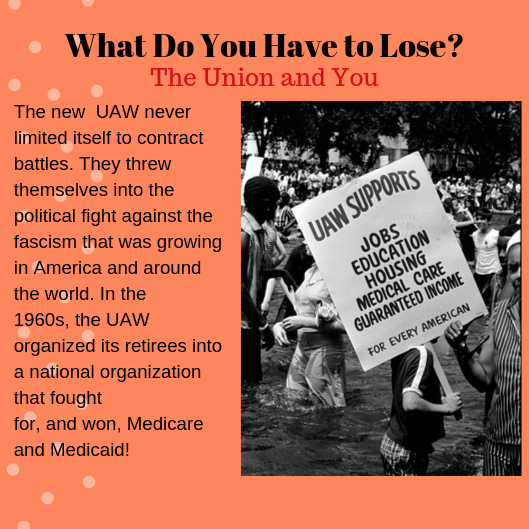
The UAW never limited itself to contract battles. They threw themselves into the political fight against the fascism that was growing in America and around the world. In the 1960s, the UAW organized its retirees into a national organization that fought for, and won, Medicare and Medicaid!

The explosion of worker power went far beyond improving wages and benefits. America’s civil rights also surged forward, and the UAW was more than just a great example to follow.

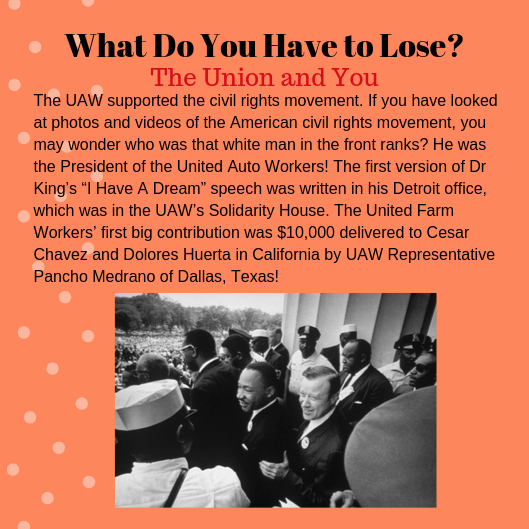
The UAW supported the civil rights movement. If you have looked at photos and videos of the American civil rights movement that began in 1954, you may wonder who was that white man in the front ranks? He was the President of the United Auto Workers! The first version of Dr King’s “I Have A Dream” speech was written in his Detroit office, which was in the UAW’s Solidarity House. The United Farm Workers’ first big contribution was $10,000 delivered to Cesar Chavez and Dolores Huerta in California by UAW Representative Pancho Medrano of Dallas, Texas!

Before the UAW, most American workers were no better off than day laborers. Corporate America has never forgiven the union for its part in bringing dignity into our workplaces. They would like nothing better than to destroy the UAW and the entire American labor movement. That’s why we have to fight!

–Gene Lantz

I’m on KNON radio’s “Workers Beat” at 9 AM Central Time every Saturday. They podcast on http://knon.org. If you are curious about what I really think, check out my personal web site

Reverend L. Charles Stovall needed a ride home from the Dallas Labor Day Breakfast, and I was happy to get to spend time with him.

Stovall and Hickman at the Labor Day Breakfast in 2011

Almost as soon as he got in the car, he called Reverend Holsey Hickman to tell him that the annual breakfast is getting better and better. I wholeheartedly agreed.

The hard data showed that ticket sales were way over the 500 mark that we strived for over the last decade. Participation from labor, political, religious, and community leaders was far better. The three of us could remember when area unions had to scramble to even find even one religious leader to open the ceremonies. There were no community groups. Civil rights and immigrant rights weren’t mentioned.

National Unions Are Watching Dallas

This year, we had two national union leaders speaking: UFCW International President Marc Perrone and ATU International Secretary-Treasurer Oscar Owens. Perrone told the crowd, “We are the labor movement. We are the last and only hope for America.” He also said, “The fight for justice will go on forever as long as there are greedy bastards out there!” My favorite quote was one word repeated three times, “Organize! Organize! Organize!”

Texas AFL-CIO President Rick Levy was in the audience and trying to listen while admirers hustled him into one photo opportunity after another. Louis Malfaro, leader of Texas’ biggest union, the Federation of Teachers, presented the Linda Bridges award for outstanding union women to the Dallas AFL-CIO Political Director, Lorraine Montemayor. The applause showed how much everyone agreed with the choice. Montemayor said, “You are the backbone of this country!” Then, true to form, she began outlining some of the hard work planned for this election season.

The award for “Hero of Labor” deservedly went to DJ Garza of the UAW. As an organizer for the Workers’ Defense Project, Garza has made a difference in winning rights for Dallas workers. The “Community Champion” award went to Faith in Texas. They turned out many volunteers for the recent petitioning campaign to win paid sick time.

Political Leaders Know the Value of Union Support

I don’t know if Mark York, principal officer of the Dallas AFL-CIO and emcee for the breakfast, was able to mention every office holder and candidate in the audience. It seemed to me that they were all there. Texas governor candidate Lupe Valdez put it this way: “I work with unions because we want to do the right thing for every working Texan.”

Colin Allred, candidate for Congress in District 32 — one of the most closely watched races in America — wowed the crowd. Like many candidates this year, he is also a union member. Also on the dais were Congresspersons Eddie Bernice Johnson and Marc Veasey. The Texas Democratic Party Chair, Gilberto Hinojosa, came to speak, as did  Senator Royce West, State Rep Victoria Neave, County Judge Clay Jenkins, Commissioner John Wiley Price, and Councilman Scott Griggs. Out in the audience, there were many more.

Look Back, Look Forward!

Us old timers can remember when the annual breakfast petered out for a couple of years. It was expensive back in the 1990s, and sometimes it just didn’t seem like it was worth the trouble. During those two years without the annual AFL-CIO breakfast, our little Jobs with Justice group seized the opportunity. We didn’t have the money for a banquet, so we fell back on time-tested labor tactics. We did car caravans to labor’s “hot spots” around North Texas. News reporters liked it, and we more than kept up the Labor Day tradition.

When the breakfast started again, Jobs with Justice worked to get faith leaders, especially Stovall and Hickman — because they were also major civil rights leaders — to come. We had to raise the money, but we soon had a table of ten religious and community leaders. Stovall and Hickman reflected the new, broader and more inclusive AFL-CIO that would extend its influence throughout the progressive movement.

This trend is extending. In 1999, the AFL-CIO began to reach out to undocumented workers for the first time in its history. Today, there are no barriers between the Dallas AFL-CIO and every aspect of the progressive movement. The Labor Day breakfast showed that we have made tremendous progress, and it points the way toward a future in which the progressive movement is truly focused on working families. In that future, nothing can stop us!

–Gene Lantz

I’m on KNON radio’s “Workers Beat” program at 9AM Central Time every Saturday. They podcast it on Itunes. If you are curious about what I really think, check out my personal web site.

On this 125th Labor Day, there’s good news for our side:

winning-kid

The statistics recently shared by the AFL-CIO are pretty good:

  • 48% of unorganized Americans would join a union if they could. If you add the ones that already have a union, we’re a majority!
  • 262,000 new members joined last year
  • Union approval is at 62%, an all-time high

And you can add some local things that are impressive:

  • The Dallas Labor Day Breakfast has already sold more tickets than ever
  • The Dallas AFL-CIO has more staff and more participation than I’ve ever seen, and I’ve been watching for a long, long time
  • The Dallas AFL-CIO is playing a central role in several critical coalitions
  • My own local union has about 375 new members!

Look at the Trend

To really understand anything, don’t just look at what it is. Look at what it was, and look at what it is becoming. If you go back to the period between 1947 and 1995, you’ll see an American labor movement that was conservative, timid, and isolated. It was also losing two-thirds of its membership and most of its political clout.

The ice began to break in 1987 when five of the more progressive industrial unions formed Jobs with Justice to consolidate the movement and take new initiatives. In 1992, as part of Jobs with Justice, I attended a special conference on low-wage workers. In 1995, for the first time in 100 years, there was a disruption in the succession of leadership. The outgoing leaders of the AFL-CIO did not get to pick their own successors.

After 1995, things really began to happen. In 1997, they removed the anti-communist clause from their constitution and started trying to work with more people. In 1999, they stopped calling for deportations of immigrants and committed themselves to organizing everybody that works.  Since then they’ve greatly improved their outreach to women, to minorities, to gays, to environmentalists, to retirees, to workers in other nations, and anybody else that might help American working people.

And through that period, from 1995 to now, the progressive leadership from the top has sifted down into the affiliated unions, the Central Labor Councils, the rank and file, and the many other kinds of organizations that can make up a united progressive movement.

We’re Not Done

There’s a lot more to do. Way to many union members still think of themselves as superior because they have better jobs than ordinary Americans. Way too many ordinary Americans still think that the labor movement doesn’t share their interests. Way too many people don’t see the crisis we’re in and don’t see that organizing is the only way out of it. Way too many old habits persist.

But if you think of employers and employees as two different sides of a war, and if you realize that you belong on the employee side, you begin to appreciate the fact that our side is better informed and better organized than ever in American history. The employer side may have the option of destroying the world, that may be in their power to do.

But defeating our side is not one of their options.

–Gene Lantz

I’m on KNON radio’s “Workers Beat” program in Dallas 89.3 FM at 9 AM Central Time every Saturday. If you are curious about what I really think, check out my personal web site