Book Review: Rosenblum, Jonathan “Beyond $15. Immigrant workers, faith activists, and the revival of the labor movement.” Beacon Press, Boston, 2017

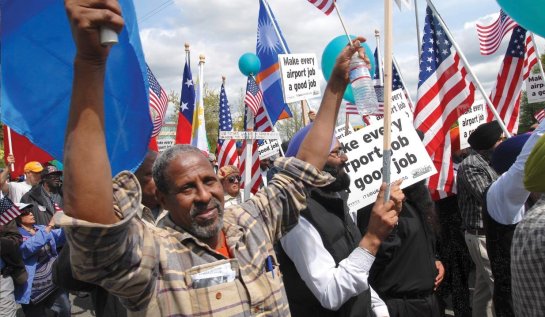
Jonathan Rosenblum led the long campaign that ended when Sea-Tac, Washington, won a $15/hour minimum wage. Even if he had never done anything else, everyone should read his book.

VB jonathan rosenblum_1

But he actually did a lot of other things in thirty-odd years as an organizer. He’s on Wikipedia at https://en.wikipedia.org/wiki/Jonathan_Rosenblum_(activist).


I knew Jonathan when we both headed local Jobs with Justice chapters. As I recall, his statewide group included five successful chapters fighting for justice along with unions, churches, civil rights organizations, and community groups. Both of us were at the Battle in Seattle.

Jonathan was working for the Service Employees Union (SEIU) when he helped bring about the ground-breaking miracle in Sea-Tac. But his success came from the Jobs with Justice approach of bringing everyone together, union or not, to focus on a common problem. It’s something that almost all organizers talk about, many of us try, and very few have actually found their way to victories. On the other hand, traditional union organizing drives have been failing for decades.

During my own 25 years with Jobs with Justice, I joined many many union campaigns. All of them welcomed my help and the help of the diverse organizations and spokespersons that I worked with. I can’t think of a single union, though, that significantly accepted our input in the process. We were always helpers, and willing helpers at that, but never partners. That’s the difference in the Rosenblum approach.

Without going into historical reasons for it, Rosenblum blames the “business unionism” that took over in the United States in 1947 and continues today, for our failures and our diminishing union density. He doesn’t overlook the all-out anti-worker government initiatives that have prevailed since 1980, in fact he describes the assault concerning the airline industry in detail, but he thinks that today’s unions could cope a lot better than we have.

sea-tacdemo

Coping with the joint business/government offensive against working people is not just a matter of making a few adaptations. Rosenblum believes that present union structures are doomed to failure and must be rebuilt on a new basis of solidarity with all workers. He doesn’t comment on the present efforts of the main labor federation, the AFL-CIO, in a strong progressive direction, and that is possibly because his SEIU union had split away.

Value of Union Bargaining

I don’t know if my own endorsement would mean anything, but I 100% agree with the following quote about our complete misunderstanding of the bargaining process:

Page 164: “In my experience bargaining union contracts and negotiating with politicians, I found that labor negotiators – both paid union staff and also union members – nearly always overestimate the importance of what happens at the bargaining table. The process of negotiating can become all-consuming. In that environment it becomes natural for participants to overvalue factors like the strength of the spokespeople, the authority of facts and data, the logic of the argument, or your relationship with your management counterpart. You begin to believe that the bargaining room is the center of the struggle. But it’s not. It’s just the place where workers reap the rewards of the pressure that they’ve been able to imposer on an adversary through collective workplace or street action, economic or political leverage, and media coverage. And the bargaining rewards will be in direct relationship to the amount of power that workers have been able to exert away from the table.”

Finding Answers

Leadership is knowing what to do next. Unfortunately, Rosenblum can’t offer a “cookbook” for success in all campaigns. He offers a lot of inspiration and some very general guidelines on his last page:

Pg191 (last page summary): “Big change won’t come from the brilliance of individual leaders or a political masterstroke, but rather by combining the thousands of acts of simple courage and grace that on their own may seem inconsequential, but together make for wholesale transformation. From these daily lessons, from the wreckage of our present circumstances, we can create a new labor movement, win back power for working people, and build a just society.”

Don’t miss this book!

–Gene Lantz

I’m still on knon.org at 9 AM Central Time every Saturday. Podcasts for the last two weeks are available from the “events” tab on KNON’s home page. If you want to know what I really think, check out my personal web site.

Book Review:

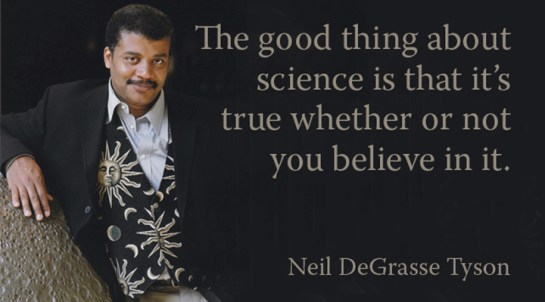
Tyson, Neil DeGrasse, “Astrophysics for People in a Hurry.” W.W. Norton and Company, New York, 2017

I waited in line to get this at the public library.  How’s this for a stunning first sentence: “In the beginning, nearly fourteen billion years ago, all the space and all the matter and all the energy of the known universe was contained in a volume less than one-trillionth the size of the period that ends this sentence.”

science-true

He goes on to attempt to explain the incredible knowledge gained over the ages about our universe. There are some giant numbers involved, and he tries to make them understandable, or at least acceptable, with folksy comparisons, as in the opening sentence.

He doesn’t directly answer the question “What’s outside outer space,” nor “What happened before time began,” but I didn’t expect him to. They are trick questions.

I was disappointed that he did not mention the idea that the expanding universe has no center or starting point. I think I heard him say that once on television. I can’t understand how everything could have derived from a “big bang,” if there is no central point from which everything is expanding away. But then, there are a lot of things I didn’t really understand as I read through Tyson’s short book.

Tyson’s ruminations on how humans are affected by an understanding of our place in the universe are worth the whole book. Tyson once did a television series in 2014 on Fox called “Cosmos, a Space Time Odyssey.” Earlier, in 1980, Carl Sagan had done “Cosmos: A Personal Voyage” on PBS. One might learn more from them. The best details I found just by clicking the links around Wikipedia’s “Astrophysics” entry.

Astrophysics is a topic of interest to anyone interested in religion. The obvious contradiction between Tyson’s entire book and the first lines of the Holy Bible causes a scramble for some kind of resolution. Tyson doesn’t concern himself with it at all, but he makes his attitude clear on page 206, near the end, when he is listing attributes of a “cosmic perspective:” “The cosmic perspective is spiritual –even redemptive – but not religious.”

-Gene Lantz

I talk about the world from a worker’s view on KNON radio at 9 AM Central Time every Saturday. Click the “events” tab to find the last two hourlong programs. If you want to know what I really think, check out my personal web site.

While they are common in Europe, most of us have never seen a big political strike in our lifetimes, until now.

okla-teacher3

The strikes in West Virginia, Oklahoma, Kentucky, and Arizona represent a big step up for the American working class. Newspersons are treating the phenomena as something angry teachers are doing, but it is much more than that. It’s a giant step upward for  American workers.

What Is a Political Strike?

Almost all we know about strikes in America since 1947 is limited to actions against a single employer. The austerity oppressing American workers since 1980 has not been met with the kind of united class action we commonly see in Europe. The French railway workers, for example, are just about shutting down the nation right now, and it’s not so they can get a raise. It’s a political strike against government! So are the school employees’ actions in the United States!

If we organized for it, we could be conducting concerted action everywhere to get an increase in the minimum wage. The “Fight for Fifteen” could be a political strike, and I believe that, sooner rather than later, it will be.

It’s Not Just Teachers

Teacher aides, bus drivers, cafeteria workers, and all kinds of school employees are doing picket duty. They are joined by students, parents, and the public at large. School administrators, in many cases, are helping by shutting down the schools so that strikers can make up the pay they’re losing with extra school days in the summer. Many politicians and high-profile personalities such as sports figures are on our side. Just about every progressive person is spreading the word on social media.

The demands are not limited to teacher raises. The strikers are demanding an end to the steady starvation of public education and full funding for everything the students need.

It’s Not Just Unions

In fact, I’m not even sure that the unions are directly involved. If one looks at the web site for the Oklahoma Education Association or the Oklahoma American Federation of Teachers, it’s hard to tell what’s going on. Both of their Facebook Pages have some good photos, but very little to show that the biggest unions are backing the strike. I have a theory about that.

One of the leaders from West Virginia told me that their strike was “wildcat.” It means that the official unions did not call it and did not officially support it. It also means that the official unions were not legally nor financially responsible for it. My theory is that America’s unions are so constrained, so hogtied, that they dare not push the legal limits with such an action. I’m guessing that all the strikes today are “wildcat.”

I don’t exactly blame them. Unions represent their members and that’s all, no more no less. If they go out on a limb, they may be risking their entire existence. They could be fined every cent they have and then some. Officers could be put in jail. It would not be the first time that the government has punished organized workers. Would that be the responsible thing for a union that represents all its members?

CHEERS to the AFL-CIO Labor Federation

The American Federation of Labor/Congress of Industrial Organizations is not a labor union. It is a federation and consequently has a different legal and political situation. In my opinion, the present AFL-CIO leadership is far in advance of most of their constituent unions. That’s why I emphasize that all progressives should be working with them.

President Rich Trumka has given the national AFL-CIO position on teacher strikes: “When working people dutifully play by the rules and still can’t get ahead, they’re going to upend those rules. That’s exactly what’s happening today. Teachers, from West Virginia and Kentucky to Oklahoma and Arizona, are fighting to overturn a rigged system that has left them behind for decades. They’re inspiring a resurgence of collective action among all working people who are hungry for real change to improve our lives. The 12.5 million members of the AFL-CIO are proud to stand with all those marching to secure a brighter future for our teachers, students and families”

The only part of Trumka’s statement I disagree with is where he said it was “teachers.” Teachers may be spearheading it, but we are witnessing a giant working class process. Conditions, meaning low unemployment and high discontent, are ripe for it to spread throughout the nation.

–Gene Lantz

I discuss these things on KNON’s “Workers Beat” program at 9 AM Central Time every Saturday. From the “events” tab, you can see the last two programs. If you want to know what I really think, check out my personal web site


Book Review: Hedges, Chris, “American Fascists. The Christian Right and the War on America.” Free Press, New York, 2006

Flag&Cross_01

“When Fascism comes to America, it will be wrapped in the flag and carrying a cross”

sometimes attributed to the author Sinclair Lewis and sometimes to Louisiana Governor Huey Long

I appreciated this Dallas Public Library book more than I enjoyed it. I really liked his examination of the underlying precepts of radical right evangelism and his historical comparisons to the thinking and strategies of earlier fascists. On the downside, I think he credited televangelists like Jerry Falwell and Pat Robertson too much and blamed fascist financiers like the Koch brothers too little. I think Hedges understands a lot more about the ideology of fascism than he does about the reasons for it.

Hedges was a top-level foreign correspondent. He really knows how to do research and how to present it. He focused his research on the section of protestant evangelism in the United States that he names “dominionism.”

From page 11: “Dominionism, born out of a theology known as Christian reconstructionism, seeks to politicize faith. It has, like all fascist movements, a belief in magic along with leadership adoration and a strident call for moral and physical supremacy of a master race, in this case American Christians.”

I was interested in faith and fascism because of callers to my radio talk show “Workers Beat” today, March 31, 2018. One of them said that the current pastor of the First Baptist Church of Dallas, Robert Jeffress had said that everything President Trump does is okay because it is “ordained by God.” Another caller said that Jeffress, a few years ago, had called President Obama “the anti-christ.”

Another book, “’White Metropolis” charges First Baptist with far-right racist politics in the past. Hedges doesn’t mention Jeffress in his 2006 book, but he hits hard against Pat Robertson and Jerry Falwell, both of whom are presumably in Heaven now.

Long-time unionists know that Americanism is often evoked against its own people. Labor writer Len DeCaux tells us about a 1913 strike organized by the Industrial Workers of the World, employers tried to use the American flag as a strike breaking device. Declaring March 17 “Flag Day,” they draped flags over mill gates with signs calling for a return to work. The silk workers, makers of flags themselves, retorted with a huge American flag across Main Street bearing these words: “We wove the flag; we dyed the flag. We live under the flag; but we won’t scab under the flag!” –Excerpted “The Living Spirit of the Wobblies”

During a speech delivered in 1918, labor leader Eugene Victor Debs made a similar statement: 3No wonder Jackson said that ‘Patriotism is the last refuge of scoundrels.’ He had the Wall Street gentry in mind or their prototypes, at least; for in every age it has been the tyrant, who has wrapped himself in the cloak of patriotism, or religion, or both.”

Can They Be Stopped?

Author Chris Hedges thinks that the radical Christian Right should be repressed. He thinks that the liberal approach of extreme tolerance for varying points of view will lead to the destruction of America. He points out that Hitler could have been stopped if Germans had been less pathologically tolerant. On page 202, Hedges says, “Debate with the radical Christian Right is useless. We cannot reach this movement. It does not want a dialogue. It is a movement based on emotion and cares nothing for rational thought and discussion…. This movement is bent on our destruction. The attempts by many liberals to make peace would be humorous if the stakes were not so deadly.”

I agree with Hedges. Tolerance cannot be extended to include intolerance. Where the book goes wrong, though, is in implying that these unscrupulous and opportunistic evangelists can, on their own hook, bring fascism to America. Hitler, working alone or with his ideological compatriots, couldn’t have done it either. The ideologists are not that powerful nor persuasive. Fascism is a form of rule chosen deliberately by rulers. That’s the danger.

–Gene Lantz

I’m still on KNON radio 89.3 FM in Dallas 9-10AM Central Time every Saturday. From the home page, hit the “events” tab to hear the last two programs. If you are interested in what I really think, check out my personal site

Republicans continue the countdown on democracy with their plans for the 2020 census. African American and Latino organizations are trying to stop them.

count2

The NAACP’s lawsuit says that the last census seriously undercounted African Americans, and preparations, or lack of preparations, for the 2020 census threatens to do the same. Latinos are especially upset by the Trump Administration’s plan to ask if they are citizens or not.

If the Republicans get away with it, they will be able to seriously diminish Black and Brown representation in government. Their anti-democratic redistricting would be made even easier for them.

Historical Context

This is not the first time that the parties in power have used counting as a way to undermine democracy. Bear in mind that the first constitution counted slaves as 3/5’s of a person so that slaveholders could amass more electoral clout, even though the slaves had no say about anything.

Political Context

The fight for a fair census is another part of the larger fight for democracy and against incipient fascism. Voter suppression laws from state governments are rampant. Redistricting has undercut the “minority” vote. Big money has won Supreme Court backing and is now free  to dominate all elections without even revealing who they are. The Voting Rights Act has already been eviscerated.

Working families have to fight on every front to preserve the partial democracy that we have won over the centuries. Every front includes economic struggles as well as electoral.

— Gene Lantz 

I’m still on KNON radio 89.3FM in Dallas at 9 AM Central Time every Saturday. If you look in the “events” tab of knon.org, you can find programs from the last two weeks. If you want to know what I really think, check out my personal web site

A big change is coming in international relations.

war2

It may seem that the whacky international news is only being caused by our whacky president and his whacky ways, but there are several underlying real trends pointing the United States toward starting a new war.

The most obvious one, which I have written about before, is that the Republicans and Donald Trump are looking at some major election losses in November unless they do something drastic. The most recent shifting of posts in the White House is definitely in that direction.

Another reason is more long-term and has to do with trade balances and history.

Looking Back

Nearly all of us living today are products of post-World-War-Two thinking. The “American Century” that began in 1945 put the United States at the head of all nations both militarily and economically. Historically, it was a most unusual situation for the world and for America, but most of us think of it as “normal” because it’s the only situation we have ever experienced. It isn’t normal at all, and it can’t last.

U.S. military domination continues, but is severely challenged right now in Afghanistan, Iraq, Syria, and Yemen. U.S. economic domination continues but is severely challenged by the European Union, new alliances in South America, and, most of all, by China.

U.S. economic domination is no longer based on our industrial productivity. A great deal of our industry has been shut down. Our agricultural production is still very strong, but also faces challenges. If anything, U.S. economic domination is based on finance, especially on borrowing.

An interesting article from CBS News says, “Why China won’t dump its huge U.S. Treasury bond Hoard.” They say it won’t happen, but they wouldn’t have written the article if people weren’t worried about it. Apparently, China holds about $1.2 trillion in U.S. Treasury bonds. They buy them every year, but they slowed down their purchases last year, the article says. It was just an incremental change, the article says.

The Nature of Change

Most change is incremental. It happens so slowly that we hardly notice it until some statistician points it out. These are quantitative changes. But quantitative changes can accumulate and, eventually, create giant qualitative changes that seem to happen all at once and come out of nowhere. Think of a stock market collapse, an earthquake, or a sinkhole. Think of a war.

Why Have a War?

Competition, not cooperation, is the natural behavior of capitalist economies. War is a natural consequence of capitalism. Even in the “American Century” so far, U.S. armies have been engaged over and over again. Even when the armies were not engaged, the U.S. has employed proxy armies such as the “Contras” in Nicaragua, the Kurds in Syria, or the Saudis in Yemen.

What passes for “diplomacy” is actually based on war or the threat of war. Witness the current expulsion of diplomats from Russian embassies, for example.

Why NOT Have a War?

Like any other enterprise, war depends on the cooperation of the people carrying it out. If we refuse, if we mobilize against it, no one can force us into the next big war. But we need to get started.

-Gene Lantz

I’m still on KNON.org 89.3 FM in Dallas at 9 AM Central Time every Saturday. Programs are podcast for two weeks and can be found under the “events” tab of the home page. If you are interested in what I really think, check out my personal web site.


The Economic Policy Institute recently ran a couple of good studies about wages.

hitlerquote

Factory Workers Earn More Money

EPI says, “…manufacturing workers still earn 13.0 percent more in hourly compensation than comparable private-sector workers. This manufacturing premium, however, has declined by about one-fourth (3.9 percentage points) since the 1980s, when it was 16.9 percent.” So why do manufacturing workers make more money than “comparable” people? And why is the margin diminishing?

Here’s another question that bugs the heck out of my friends who work in aerospace but are members of the Auto Workers Union: “Why do auto workers get much better contracts than aerospace workers?” We work just as hard and have had as much or more training. We have the same national union leaders, the same history, and the same intentions, but our wages and conditions have never been as good as theirs. Why?

It’s Not the Work, It’s the Organizing

Manufacturing workers are easier to organize than other workers. There are more of them in one place. They work closer together. They live closer together, They have more of the same interests. Contrast, for example, techies. Techies are notoriously hard to organize, even though they may really want a union. They live all over the place. They work almost entirely alone. Some of them actually work at home. They tend to travel for work. They don’t usually advance within the same company, but move from one company to another for advancement. It is very hard to organize techies.

The easier we are to organize, the more likely we are to have a union and thus get better wages.

Aerospace workers can cuss the auto workers all they want, but the fact is that auto workers were easier to organize. Assembly line production calls for the highest levels of cooperation among workers. Take just a few of the workers off an assembly line, and it has to shut down!

Airplanes, for the most part, aren’t made on assembly lines. It’s hard to win a strike in aerospace, but it’s much easier in auto. Better organizing, better contracts!

Why Is the Gap Decreasing?

EPI says that the gap between [organized] factory workers and everybody else is decreasing since 1980. I almost laughed when I saw that date. 1980 is the year that American government set new anti-worker policies and elected its best enforcer —
Ronald Reagan. So the question answers itself.

Unionism in America has atrophied beneath the government assault, and the advantage of unionism is not nearly as widespread as it was pre-Reagan. We fell from 35% of the workforce to the present 11%. Union workers still make way more money than non-union workers doing comparable work, but there just aren’t that many union workers left to bring up the statistics.

Whose Wages Are Rising?

The other interesting article from EPI said, “States with minimum wage increases between 2013 and 2017 saw faster wage growth for low-wage workers compared with states without any minimum wage increases (5.2 percent vs. 2.2 percent).”

Last month, Wall Street had a minor panic when it was announced that wages were rising for the first time in recent history. They were barely rising, but they were slightly higher than inflation for that same period. Since then, economists and political pundits have been saying that wages will continue to rise and that the government will have to take steps, such as raising interest rates, against the trend.

Capitalists may say otherwise, in fact they do, but they do not want wages to rise.

But wages did, statistically, rise a little bit in February, 2018. The reason was that some local and state governments, responding to political pressure from working people, were beginning to raise their minimum wages. An increase for low-wage workers has a profound effect on statistics, because there are so many low-wages workers. Also, all wages tend to rise when they are pushed up from the bottom.

Nineteenth century writers Karl Marx and Frederich Engels noted that workers would tend to benefit themselves more by organizing politically than they would by fighting the bosses one company at a time. It’s not a new idea; it’s just a true one.

Crossing the Line

There are a lot of references to “the line” in literature. There’s the “red line,” there’s the “line in the sand,” and there’s the “picket line.” If you want to get someone to answer the question “Which side [of the line] are you on?” just ask them if they support increasing the minimum wage. It cuts through a lot of verbiage.

Even though unemployment is statistically low, and the time is ripe for organizing, your own wages aren’t likely to rise much until you actually organize. Either organize a union on the job or organize politically to raise wages. That’s the road to success!

–Gene Lantz

I’m still on KNON.org 89.3FM in Dallas every Saturday at 9 AM Central /Time. If you want to know what I really think, check out my personal web site.


In between activities, I write science fiction. In my world, the obstacles to progress are temporarily removed from power. People can actually solve their problems. But that means I have to describe some of those problems and, much harder, come up with some solutions. For example: What would people do if they had more free time?

boredom-tolstoy

Our allotted time is all we have, when you think about it. One may pile up wealth and fame while another languishes in a never-ending rut, but they both get about the same length of time. At their funerals, who can actually say which one of them spent their time better or enjoyed it more?

What’s the value of leisure?

In the system we live in, everybody wants more free time. Or at least they say they do, but it isn’t always true. For example, I did a quick study of union grievances at my factory job and found that “overtime” grievances were far and away the most numerous. I assumed it meant that everybody was like me and trying to get out of working longer hours. WRONG! Those grievances were all, every one, about people trying to get more overtime hours!

Normal work weeks in the oil field are 56 hours. But most of my fellow workers would tell me that they tried to get at least one or two “doubles” (16 hour days) every week. I did it myself, whenever I got the chance. What’s the value of leisure measured against time-and-a-half overtime pay?

Increasing Productivity Should Result in More Leisure

If you add up the accumulated productivity as measured by the Bureau of Labor Statistics, you will see that the average worker today creates more than four times as much wealth per hour than he did at during World War II. He didn’t get four times as much salary, and he darned sure didn’t get his his working hours reduced to 2 hours/day!

BTW, unions used to demand cuts in working hours as a way of fighting unemployment. “30 [hours] for 40 with no cut in pay” was the slogan of the CIO from around 1938 to around 1957.

But in my sci-fi world, they do reduce working hours and maintain full employment. Or, they can. If people create 4 times as much product, they could and should cut their working hours by a factor of 4. Here’s where I’m having my writing problem: What would they do with their extra time?

Under Today’s System, I Know

Under today’s system of alienation and every-man-for-himself capitalism, people who were only required to work two hours a day would likely sign up for four jobs! Our greed is endless when we’re scared, and workers in America are always scared. The bosses want it that way.

But the world I’m creating is solving problems. It will solve the problem of unemployment by shortening the working day (which we should be doing in the present world, but the bosses won’t let us). It will solve the problem of boredom and what to do with leisure time, too.

There Are Wonderful Examples

I have known people who work at traditional jobs as little as possible. Instead, they spend their time trying to improve the human condition. They are environmentalists, feminists, civil rights activists, socialists, and my neighbor down the street who picks up everybody’s loose trash after the truck goes by. Are they the people of the future? Are they the “new persons” that Che Guevara speculated about?

Compared to the general population, there aren’t very many of them. As far as I know, that type of people didn’t come to dominate Cuba, China, South Africa, or the Soviet Union. Why expect them to dominate here?

So far, the best I’ve come up with is this: revolution is a long process. People make changes, but changes also make people. In my new world, working hours will be shortened at the same time that people are figuring out how to best spend their leisure time. They won’t all have the same answer, but I’m hoping that many of them will take up the cause of improving the human condition. Actually, I’m hoping that real people will start now.

–Gene Lantz

I’m still on KNON radio 89.3 FM in Dallas at 9AM Central Time every Saturday. If you want to know what I really think, check out my personal web site


The West Virginia teachers strike of 2018 was one of the most dramatically successful labor events of recent times. After striking for 9 days, they won a freeze on new health care costs and a 5% general wage increase for themselves and for all state workers! In addition, it was basically a wildcat strike, which means that it was not officially called by any of the three major unions involved and, thus, did not have their official backing. Official backing usually means strike benefits such as a small weekly stipend and, sometimes, health care for the duration of the strike. They didn’t have that.

teacherstrike

On March 10, I had an organizer from one of the West Virginia support groups on KNON radio. Steven Noble Smith said that the preparations had begun last December. Here is how he described the overall characteristic of the strike: “It was rooted and grounded deeply in the everyday pain of working people!”

Smith’s group was one of several that joined in backing the school employees as their movement grew. “Everybody was welcome in this movement,” he told the KNON audience. At least one of the supporting organizations was political, the Working Families Party. Others had been inspired, perhaps, by the Bernie Sanders movement, or perhaps by their disgust with the current government.

One of the contributions of Smith’s group was raising funds for some of the workers who were striking without any remuneration. The money raised in a short period, over $300,000, was impressive. I also found out from Smith some of the other elements of a successful labor action such as training, regular public action, social media, and interacting with commercial newspersons. But what, I asked him pointedly, was the key?

Smith explained, “What matters… is mass action!” Beginning last December, school employees had been holding public actions. The group planning and the individual contributions, Smith said, were very innovative. Many of the actions took place in the state capitol.

Responses Not So Hot

The total victory in West Virginia was announced around March 6, which was primary election day here in Texas. There was news coverage, especially from national sources, but it was dwarfed by local election news. That’s not the worst of it.

I also went around and asked some of my union friends about their responses to West Virginia. They were pleased and a little bit awed. But any suggestion of seeing what we could do here at home brought exactly the response I had been dreading. “I wish my own union had members like West Virginia!”

It’s not just lately, I’ve been hearing this from union leaders for forty years! “Our members are chicken,” “Our members are Republicans,” “Our members would never take action,” etc etc etc. Excuses!

My Big Gripe

I can understand why unions seldom go on strike. Nobody wants to. There’s a lot of pain and a lot of risk involved. The government pretends to be neutral, but it isn’t. Even easier forms of concerted action such as boycotts, petitioning campaigns, and slowdowns are perilous for unions and for the individuals involved. That’s not my complaint.

My complaint is that unions and, especially, union staffers, don’t try. Undoubtedly, the West Virginia school employees were not ready to strike last December. It took three months for them to get ready, and that three months of preparation paid off for them in March.

That’s what we ought to be learning from West Virginia — that preparations for concerted action should under way. Otherwise, how do we expect to survive the present onslaught?

-Gene Lantz

I’m still on KNON radio 89.3FM every Saturday from 9 AM to 10AM. If you want to know what I really think, check out my personal web site