President Trump is the champion of fair trade for American workers. Or is he destroying the hopes of all workers for a peaceful and beneficial world? Or does he even know what he’s doing?

me-nonafta

A lot of working families were won over by Trump’s promise to renegotiate so-called “trade” agreements and restore American jobs. People, including a lot of union people, are still hoping he will. Yesterday, he poked his finger into the eyes of several world leaders at the G7 meeting in Canada. He said he was representing American workers.

What’s “Fair,” What’s “Free?”

For decades, since the Clinton Administration at least, American unions have been campaigning on the slogan “Fair trade, not free trade.” We always say “We’re not against trade — we just want it fair.” But it’s been very hard for union leaders to resist xenophobia and isolationism, because those “isms,” — right along with nationalism and racism — are also against the trade deals that America negotiated since Clinton.

The people that knew what they were talking about presented the argument that the so-called “free trade” deals were only “free” for big transnational corporations — not for the working families in America or any other country. Big corporations received “freedom” to pay low wages and pollute, nobody else got anything. That’s why we opposed NAFTA and all the others leading up to the “Trans Pacific Partnership” that was still an issue in the 2016 presidential campaign.

The people that knew what they were talking about actually favored trade deals if they included wage and environmental protection. But not everybody is so sophisticated. They hate the trade deals anyway. That’s why so many of them voted for Trump.

There’s a History to “Free Trade”

I recently read a complete history of Britain and found an interesting reference. When Britain “ruled the waves” and ruled the world, their slogan was “free trade.” From the time they defeated Napolean until World War I, the English favored what they called “free trade.” They didn’t , at least not immediately, necessarily open their own markets, but they wanted everybody else, especially their many colonies in Asia and Africa, to open theirs.

In other words, “free trade” meant, then and now, the “freedom” of one country’s corporate rulers to exploit everybody else. Another word for it is modern imperialism.

After World War I, and especially after World War II, when the United States took over world trade, corporations wanted “free trade” for the exact same reasons. But the “freedom” was always for the exploiters and never for the exploited, then and now.

Everything Ends

There are different ways to look at the Trump program on trade issues. Economists and pundits are arguing that he’s destroying the world and setting us back centuries. Trump and his supporters say he is restoring fairness. Xenophobes and racists are rooting for him, as they have all along.

But there’s another, more interesting way to look at Trump’s trade wars. American economic domination is coming to an end. It actually ended in the 1970s, according to some. Since then, international leaders have simply agreed to keep the system in place even though the United States is living on credit and has been for decades. The post-war system put in place by the United States after WWII has actually fallen apart. Donald Trump is just an opportunist trying to turn the situation to his own benefit.

A Real Solution to the Trade Wars

Modern nations were created by capitalism. Each nation is run by and for the bosses. Their economic and political decisions are made for the benefit of the dominant class — the capitalist class. That includes much more than trade deals and treaties. It also includes global pollution, war and genocide.

It is theoretically possible that the various governments, as presently constituted, could cooperate on trade in a way that would benefit the inhabitants of the various nations. But that’s only in theory. It has never worked that way because the inhabitants, us, were never in charge. We still aren’t, and there will be no solution until we are.

–Gene Lantz

I’m still on KNON radio 89.3FM in Dallas at 9 AM Central Time every Saturday. The “events” tab on the web site leads to recent podcasts. If you want to know what I really think, check out my personal web site.


Last night I listened to an outstanding report from a participant of the 1960s-70s American student anti-war movement. The reporter really knew his stuff, and his analysis was superb.

communist-dead

At the end, though, I disagreed. It wasn’t that I don’t concede that the guy knows twice as much about the student movement as I do. It isn’t that I don’t agree that the student movement shook the world, refashioned people’s thinking, and contributed greatly to ending the Vietnam War. He’s absolutely right on that.

What I disagreed with was the emphasis. The progressive movement that we are experimenting with right now is the biggest, most important, and most potentially effective people’s movement since the American Civil War. Maybe even better than that. The student movement was nearly all college students, and mostly white draft-age males at that. Even the civil rights movement of 1954-1968 was limited to a relatively small sector of the population. The labor upsurge of 1935-1947 was great, but the union movement was split between the AFL and CIO then. The Industrial Workers of the World exceeds everything in pure romanticism, but I don’t think there were ever more than 100,000 actual members. The populist movement of the late 19th century was limited to farmers and, for the most part, didn’t even include landless farm workers. Outside Texas, the populists were infamous for their racism.

No, now is better.

Communists and Fascists Today

We had communists and fascists in the old days. We have them now.  People understand them both better now than they did when they were just “hot button” emotional topics. It is true that fascism is inching forward in America, but it is also true that people know what to do about it. More importantly, the fascists can’t use anti-communism as effectively as they did before. Anti-communism is dying out among America’s youth.

Just Look At Us!

I looked around the room while my friend was talking about our student movement. The crowd was mostly young, but not all young. In gender and race, it was diverse. When my friend talked about making leaflets for anti-war demonstrations, I realized that the people at the meeting had, in their purses and pockets, more thinking and communicating power than we ever dreamed of as students. They could make leaflets in minutes if they wanted to, but they don’t even need leaflets. They are experts at communicating. This small group could have easily reached thousands of co-thinkers before they left the room!

Labor Is Getting Past Its Isolation

Speaking of the room, it was the auditorium of the local school employees’ union, American Federation of Teachers. The president of the local union walked through and said hello to a few of us. Could you imagine, in your wildest dreams, that the student anti-war movement could have met in an AFT union hall? Albert Shanker was President of that union in those days, and he was, next to the president of the American Federation of Labor, the most fanatical supporter of the war in Vietnam.

Labor isolated itself from the progressive movement in most instances between 1947 and 1995, then they made a gigantic change toward standing for all workers.

Today’s progressive movement is warmly accepted in union halls. The Dallas AFL-CIO welcomes radical Bernie-Sanders-socialists several times a month! The AFL-CIO banner regularly appears at anti-war, civil rights, gay rights, environmentalist, and immigrants’ rights rallies. If anything, the national and state leaderships of the labor federation are even more integrated into the general progressive movement than Dallas unions.

I like studying the history of other progressive movements. There are many good things to learn, and we learned some of them last night. But don’t get carried away with the past. Now is better.

All We Have Is Now

I welcome discourse when I publish. Disagreements are welcome. But bear in mind that today’s situation is the only one we have. Romanticizing earlier situations may be fun or interesting, but all our efforts can’t go into “then.” They have to go into now! On that, last night’s reporter, and everyone else, agrees!

–Gene Lantz

I’m still on KNON radio 89.3FM in Dallas at 9 Central Time every Saturday. Podcasts can be found under the “events” tab. If you are curious about what I really think, check out my personal web site.

Let’s do a Woody Guthrie festival on his birthday this year! Are you in?

woodyquot-hateasong

If he had survived, he would have been 106 on July 14. It’s a Saturday and a good day for a cookout and a singalong. The incredible Gerardo Contreras of UAW 848 is willing to do the cooking. I believe that both KNON’s “Workers Beat” program and Dallas AFL-CIO would sponsor and benefit from any money we raise.

My idea is to assemble a small choir to perform and lead audience participation songs, just as Woody or Pete Seeger would have done. Individuals or groups might want to do their own performances, but some songs, like “This Land Is Your Land” cry out to have everybody sing.

There are hundreds of songs to choose from, but here are some of the best-known ones.

All You Fascists Bound to Lose  https://www.youtube.com/watch?v=VwcKwGS7OSQ (choir- singalong)

Biggest Thing that Man Has Ever Done https://www.youtube.com/watch?v=qB-YnV0e3Lc

Deportee (Anthony Esparza)  https://www.youtube.com/watch?v=qu-duTWccy

Do Re Mi https://www.youtube.com/watch?v=46mO7jx3JEw

Hard traveling https://www.youtube.com/watch?v=kfq5b1bppJQ

I Ain’t Got No Home / Old Man Trump https://www.youtube.com/watch?v=jANuVKeYezs

I’ve Got to Know https://www.youtube.com/watch?v=lyo_Hilxlj0

Jesus Christ  https://www.youtube.com/watch?v=EDS00Pnhkqk

“Talking Unions” https://www.youtube.com/watch?v=WU2RUoakYIM

Oklahoma Hills https://www.youtube.com/watch?v=IYFUUxxn6Vk

Philadelphia Lawyer https://www.youtube.com/watch?v=bjeen-Hl8uc

Pretty Boy Floyd https://www.youtube.com/watch?v=fBF3aXvquHs

Ranger’s Command https://www.youtube.com/watch?v=FznriVNbWCI

This Land Is Your Land (choir-singalong) https://www.youtube.com/watch?v=wxiMrvDbq3s

Tom Joad https://www.youtube.com/watch?v=dimhKln0KBg

Union Maid  https://www.youtube.com/watch?v=S1g4ddaXRs0

You Gotta Go Down  and Join the Union https://www.youtube.com/watch?v=zN8kGzHH00I

Labor’s musical tradition tends to get lost every now and then. Let’s re-discover some of it!

–Gene Lantz

I’m on KNON radio 89.3 FM in Dallas at 9 AM central time every Saturday. Podcasts are available from the “events” tab. If you want to know what I really think, check out my personal web site

There’s so much complaining about unions, especially our own! But our radio program on the Communications Workers of America revealed some very positive aspects of the American union movement.

cwa6171travispirotte-tonyschaffer2

My co-host, Bonnie Mathias is an outspoken member of two CWA locals, including the Dallas dominating CWA 6215. Our guests were from CWA 6171, headquartered in Krum, Texas. Travis Pirotte is the elected president, and Tony Schaeffer is the professional representative from CWA District 6, a five-state region. Tony is the big guy on your left in the photo.

Right now, CWA 6171 is negotiating a new contract with Frontier. A couple of callers wanted to know if they were expecting the company to want big pay cuts. They also wanted to know if the union was doing anything about the national problem of companies’ outsourcing work from union members to low-paid subcontractors. Another caller wanted to know if their union was trying to organize any of the many low-paid, no-benefits workers in the “gig” economy. These were really good questions.

Tony is the expert on negotiations. He said that the company had not made any economic proposals yet. Unions negotiate “economic” and “non-economic” issues separately, with the non-economics usually first, he said. As for the sub-contractors stealing work from the union, Tony said that the CWA has been fighting this nationwide all along.

The Good Part

For me, the good part was when Bonnie and our guests started talking about all the socially responsible things that their union is doing. I knew that Herb Keener from CWA 6215 speaks up for the Blue/Green Alliance between labor and environmentalists. I also know that Claude Cummings, District 6 leader, is a major figure in civil rights activities — whether they concern union members or not. It was good to hear the guests confirm these things.

exxonherb2

–Gene Lantz

I’m on KNON radio 89.3 FM in Dallas at 9 AM central time every Saturday. Podcasts are available from the “events” tab. If you want to know what I really think, check out my personal web site

I love this union cause.

— William H. Sylvis, founder of the National Labor Union

I had to hurry with the Dallas Labor Newsletter today because I didn’t want to miss picketing with Communications Workers Local 6150 over at the AT&T building.

sherron-legacyT

There was a national walkout concerning around 20 unions today, according to CWA 6150 President Scott Wilson. Here in Dallas, workers expected to stay out only four hours. Wilson was careful to let me know that this was an Unfair Labor Practices (ULP) strike, not an economic strike.

Legally speaking, and unions have to be scrupulously legal under the watchdog eyes of a hostile government, there’s a lot of difference between a ULP and an ordinary strike. One of the main differences is that companies can’t just replace everybody that goes on strike if it’s ULP.

Today’s strike will be examined by the National Labor Relations Board. I imagine that the company will claim that they committed no unfair labor practices, and of course the union already said that they did. According to Scott Wilson, the company started contacting each union member individually to try to convince them to take whatever the company wanted them to take. That’s illegal.

Unions elect their bargaining committees. It’s supervised by the government and done very carefully. Then company representatives and union representatives sit down together and work something out — or that’s the way it’s supposed to work. If the company went around the process and started approaching individual members, that’s illegal. AT&T surely knows that.

The trouble is, they also know that the Labor Board isn’t likely to penalize them much, if at all. Companies are getting more and more aggressive against their workers because the government is so completely and savagely against us this days. The Supreme Court just ruled that employers can take away our right to sue them when they misbehave. The President just passed three anti-union executive orders. Another Supreme Court case, “Janus Versus AFSCME,” may impose anti-union “right to work/scab” rules on all federal employees. We’re holding our breath on that one.

If you think about it for a minute, you realize that an attack on the right to organize is an attack on democracy. Organizing is just about the only way that ordinary people can defend their democratic rights. Take that away and you have fascism.

Hitler knew that. That’s why one of his earliest moves was to outlaw all unions and seize their assets.

There’s a solution

The solution for saving the right to organize lies in solidarity with one another. In the last couple of decades, unions have gotten better and better about helping other progressive organizations and individuals. Take for example the environmentalists who picketed Exxon/Mobil last week. Three of us local union members spoke at it, and then, best of all, we heard from one of Exxon’s victims in — believe it or not — Australia! I recorded the Australian oil worker’s comments on Facebook, and it’s had 1,400 views so far.

But other progressive organizations do not ordinarily rally to help unions. At the CWA 6201 picket today, only union members were there. In fact, I was the only one who wasn’t a member of that local. Part of the problem is that unions haven’t learned to ask for help, but part of it is sectarianism and anti-worker sentiment on the part of some other activists.

When we get together, we will win.

–Gene Lantz

I’m on KNON radio FM 89.3 in Dallas every Saturday at 9AM central time. Podcasts are available on the “events” tab. If you are curious about what I really think, check out my personal web site.

Book Review: Barlett, Donald L, and Steele, James B. “The Betrayal of the American Dream.” Public Affairs, NY, 2012 Dallas library 330.973 B289B 2012

mlk-quot-capitalism

If recent economic developments have not already terrified you, this might be a good book to absorb. It is very much like “Runaway Inequality,” the book promoted by the Communications Workers of America that I reviewed earlier.  It has some of the same dire warnings and suggested solutions as the classes that the AFL-CIO conducted under the name “Common Sense Economics.”

The authors really hate “free trade,” tax giveaways to the rich, deregulation, or capitalist-directed globalization.

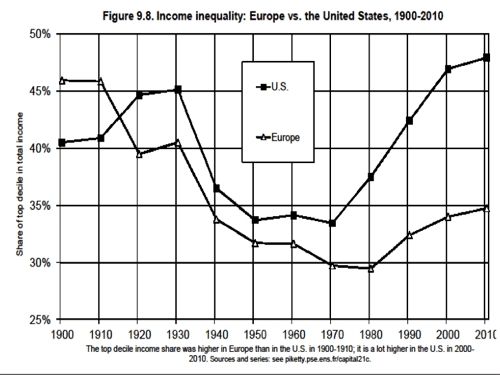
Here is the message in a nutshell: “Something terrible happened in America in the 1970s. Since then, virtually all new economic developments have been bad for the working people and crazy good for the very rich. Inequality is rampant. We need to bring back some of the more reasonable practices that were in place before the disaster struck.”

In my review of “Runaway Inequality,” I pointed out that our recent period isn’t the odd one. The odd one was the third quarter of the 20th century. The reasonably good times when some of the productivity gains streamed into workers’ paychecks were not normal. They were just weird.

Today, when the capitalists grab everything in a runaway train ride to oblivion, that’s what’s normal. Trying to go back to the practices of the 1950s is a lot harder than it looks, because the ruling rich are dead-set against it.

Why weren’t the rich dead set against equitable economic practices in 1950? I can think of at least three good explanations. 1) They ruled the world. They had almost no international competition because they had destroyed every other country during the war. 2) American labor was very strong after a tremendous upsurge 1935-1947. 3) The Soviet Union was still seen as a viable alternative to capitalism, and it was important to buy and/or destroy any pro-Soviet sentiment. None of those things were true in America by the time Ronald Reagan was elected.

Even though this book has great reporting on economic events, and even though it has very intelligent prescriptions for making economic things the way they used to be, I don’t think their hopes for the future are likely to happen. The book is great at explaining, but not so useful as a guide to action.

Actually, I began to be skeptical in the introductory pages when they said, “…we define the ‘middle class’ strictly by income….” They could have just said “middle income” instead of “middle class.” The problem with trying to rally middle-income people is that they aren’t really a class. A class is defined by political interests, and middle-income people are all over the map in their interests. Some of them are workers, some of them are lawyers, some of them are trust fund babies, some of them are shopkeepers. 

If someone is serious about making change, they need to start thinking about the working class.

–Gene Lantz

I’m on radio KNON FM89.3 in Dallas at 9 AM central time every Saturday. Podcasts can be found from the “events’ tab on the web site. If you are curious about what I really think, check out my personal web site.

About 25 people from all over Texas and three guys from Australia protested Exxon/Mobil’s shareholder meeting in Dallas on May 30.

exxon-australia

The sometime biggest, and sometime second biggest, corporation in the world has its headquarters right outside Dallas. They hold their annual shareholders’ meetings in the luxurious Meyerson Symphony Hall downtown. Across the street, labor and environmental activists revealed corporate crimes to newspersons and the world at large.

The surprise group came from Victoria’s Gippsland Basin, Australia, where Exxon has 23 offshore installations. Their spokesperson, Troy Carter, spoke on Facebook Live for seven minutes. He said that 230 members of the Australian Workers Union and the Electrical Trades Union were terminated 343 days earlier. The next day, they were offered their jobs with a 40% pay cut! They have been protesting every day since.

The Australian’s printed materials were meant to explain to Exxon stockholders that the corporation was spending a lot more on union busting than it would have cost them to keep their well-trained workforce. But the corporation would not let them into the symphony hall; consequently they had to disseminate their message broadly.

In the United States, the Australian’s tour is being helped by the United Steelworkers of America. The Australians plan to meet with Dallas AFL-CIO leader Mark York before heading to Austin to talk with Texas AFL-CIO leaders. Their Texas tour will end in Houston, where there are many petrochemical workers.

Speakers talked about the danger to our planet from fossil fuels. A woman from Corpus Christi, on the Texas coast, said that her organization was trying to stop Exxon from building the biggest plastics factory in the world. “Do you want more plastic in your oceans?” “Do you want more plastic in your air?” “Do you want more plastic in your bodies?” she asked.

A man from Waco, in Central Texas, talked about special environmental problems caused by Exxon in his hometown.

Herb Keener of Communications Workers 6215 and Gene Lantz of United Auto Workers Local 848 spoke for the “blue” section of the “blue/green” (labor/environmental) alliance. Keener’s talk was captured on Facebook Live. He mentioned that he expected Exxon to follow other major corporations in spending their windfall from last December’s giant tax giveaway by purchasing their own stock. These financial maneuvers enrich stockholders without any benefit to employees nor to the general economy.

The protest had a long list of sponsors: 350 Dallas, Society of Native Nations, Dallas Peace and Justice Center, CodePink Dallas, Communications Workers of America/CWA Local 6215, Dallas Sierra Club, Downwinders At Risk, Dallas Palestine Coalition, Pax Christi Dallas, Our Revolution North Texas, Texas Drought Project, Texas Environmental Justice Advocacy Services (TEJAS), Solidarity Texas – Dallas Chapter, System Change Not Climate Change, Veterans For Peace North Texas, Waco Friends of Peace and Climate, Texas Coalition for Environmental Awareness, and more.

-Gene Lantz

I’m still on KNON radio 89.3 FM in Dallas at 9 AM Central Time every Saturday. Podcasts are available from the “events” tab on the site. If you are curious about what I really think, check out my personal web site.

The main players in today’s economy aren’t “rational men” as assumed in classical economics. They are “sociopathic men.” It’s the first and most important lesson.

keynes-quot2

What crippled economics as a science was its separation, in the late 19th century, from other disciplines, especially politics. At the same time, it was decided that economies work because “rational men” (sorry ladies) cause the supply and demand for commodities to balance out at a fair market price.

It’s like the Holy Bible of economics: nobody actually believes it but everybody quotes it.

If we still studied politics and economics together, as we did before economist Alfred Marshall, we would see that it isn’t rationality that makes the world go around, it’s antagonism. Our economy is vastly different from their economy.

Bad Is Good

All these “rational men” do not have identical interests. In fact, our interests are extremely disparate. While ordinary working people like you and me want high employment, good wages, and low prices; our employers usually want the opposite. What is good for us, especially high wages, is bad for them.

Back in Alfred Marshall’s time, this opposition may not have seemed so important to people studying single economic data in a single market. But two great changes have occurred since then that make oppositional understanding vital: world war and governmental economic policy.

National “Good” is International “Bad”

Nations exploit one another. The First World War was fought to determine which industrialized nations were going to do the exploiting. That wasn’t a decision made by rational men within a single economy. “War is politics by other means,” as we say. Politicians made the decisions to carry out world wars, and the winners reaped the benefit. War determined international economics, but it certainly wasn’t because of rational men.

“Whose Economy” Depends on “Whose Government”

Capitalism has a built-in propensity for crisis. Early in the 20th century, and especially during the Great Depression, governments began to take affirmative action to save capitalism from itself. They recognized that monetary policy and fiscal policy could be used to heat up or cool down an economy to some extent.

The biggest problem was oppositional interests. Governments generally interceded in the economy on behalf of the richest capitalists and not for the majority.

But another big problem was created by all this government intervention. Instruments of debt and other purely financial instruments were floating around everywhere, and they became an obsession. A major part of economics was no longer concerned with commodities at all.

Government tried to regulate financial institutions, but they gave that up in 1999 when Texas Senator Phil Gramm got the “Financial Services Modernization Act” passed.

Without regulation, banks and other financial institutions began to use the tremendous resources that they could mobilize in high-stakes gambling. They particularly liked bundles of low-quality mortgage debt and its various crazy derivatives. The bust that followed was called the “Great Recession.” After that, the government re-regulated to some extent, but they are presently disassembling regulations again for the same reason — amazing profits for the very rich.

It’s not in the interest of the people, and it’s not rational. That’s the first lesson.

–Gene Lantz

I’m on KNON radio at 9 AM Central Time every Saturday. Podcasts can be found from the “events” tab on their website. If you are curious about what I really think, check out my personal web site.