Archive

history

tpp-TARA

Unions are doing so many things right nowadays that one hesitates to make any suggestions. I enjoyed a recent posting by the International President of the AFSCME (American Federation of State, County, and Municipal) union. He outlines some of the positive changes they have made.

I’d go so far as to say that the main labor federation, AFL-CIO, has made great strides since the “palace coup” changed the leadership in 1995. I love working with them.

Unions are inherently revolutionary, even though they do everything in their power to not be. They can’t help but oppose capitalism, even though they are solely defensive organizations, because capitalists can’t stop attacking them. Unions will never take power anywhere, but they can’t help trying.

But Unions Face Tremendous Problems

In my opinion, America’s unions could go a long way toward solving their problems if they’d just start with an historical analysis. As long as they continue to ignore the great mistakes they made between 1947 and 1995, they’ll find it harder to go forward. That’s one important thing.

Another one is that unions need to free themselves from being chained to the worst part of their members. Any union official can tell you that they spend most of their time handling petty grievances. The best union members rarely file a grievance, because they are not only the best union members but also the best workers. The worst workers, the ones who can’t show up half the time, the ones who are drunk on the job, the ones who abuse one another — those are the ones that file most of the grievances and , consequently, take up most of the union officers’ time.

In fact the biggest time consumer of all is the termination grievance. Somebody gets fired and the union feels obligated to try to get their job back. Management is not likely to take them back before all options are exhausted — and there are a lot of options in labor/management relations. The best union members, the best workers, rarely get fired.

That’s just the way the job works and nobody is actually complaining. If you don’t take care of the worst workers, you can’t take care of all the workers. If management can get away with abusing some workers, they’ll try to abuse all. So it’s not a waste of time, just a big consumer of time, to deal with grievances.

Union officers would like to spend time organizing, educating, and strengthening the union movement — but they usually don’t because they don’t have time.

There Are Tremendous Solutions

I believe that progressive union leaders are finding and applying solutions to these problems. I heard once that the Service Employees have some kind of centralized national grievance-handling process where grievances are called in by phone. I have no idea if this is true, nor do I know how it works.

But I imagine a big round table with grievance experts sitting at computers all around. Each of them has a headset. Each computer has access to labor law and, more importantly, every pertinent union contract. Members from all over the country call in their grievances. The expert types up a proper report and offers immediate advice. Then they contact management and begin to “handle” the grievance. They use three-way calling when appropriate.

When contracts expire, a complete digital record of the old contract and all grievance settlements is available to the negotiators. One of the experts from the round table I described might even sit in on negotiations to make sure everything is done properly and legally.

 What Is Needed?

Unions need cooperation. The utopian grievance handling proposal I outlined above could be used by the AFL-CIO to handle ALL grievances, not just those of a single union. Or maybe we could have one “grievance center” for public workerfs and one for private workrers. Maybe another one for private workers under the Railway Labor Law, as opposed to the National Labor Relations Law.

Unions are cooperating now more than anytime since 1947. They are not only cooperating with one another, they are even merging with one another. That’s good, but it could go a whole lot further. They could, for example, centralize their organizing departments, their education departments, and maybe some other departments.

Unions need organizers. The best organizers nowadays work with entire communities. The union man standing in front of a plant handing out leaflets, they say, has already lost. People get organized from their homes and communities. I’d go further to say that the best union members are going to be organized through a series of meaningful activities like the “Fight for Fifteen” effort to raise the minimum wage.

The internet, and, especially, social media need to be harnessed in labor’s campaign. We can organize that way and we can educate that way. Unions need educators.

Unions need activists. Every time a union man or woman assists in a community problem, they advertise the importance of joining the union.

None of these ideas is exactly new, except insofar as new technology is applied. My own union, the Autoworkers, wasn’t organized in the plants. It was organized during the frequent periods of plant shut downs in the auto industry. It was organized by the great Unemployed Councils, by marches, rallies, and protests.

And that seems like a good place to stop because it brings me back to my original point: unions need to assess our own history and learn from it!

Leave a Reply


Movie review: “Birth of a Nation,” Directed by Nate Parker, Written by Nate Parker, Starring Nate Parker. 2 hours

natturner

Everybody in America needs to know about slavery. If right were right, we’d probably be required to attend a showing of Nate Parker’s new movie. Unfortunately, that may be the only way it would get a wide viewing. We don’t necessarily WANT to know what we NEED to know.

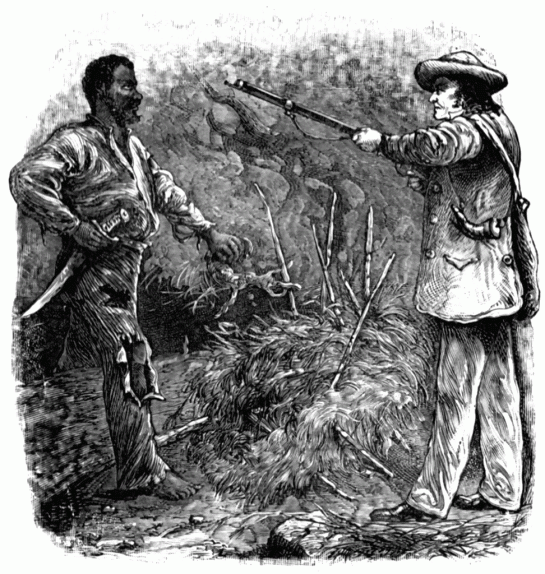
Nat Turner was a preacher who led an important slave rebellion in 1831. It led to a panic in the Old South. When white people panic, black people die. The title “Birth of a Nation” is famous in America because a silent movie long ago laid the emotional foundation for a re-birth of the Ku Klux Klan. If a person knew why Parker chose this title, one might also understand why audiences may not like his movie.

I don’t think anybody will complain about the technical aspects. Audiences feel right there with the slaves when they are shot, raped, tortured, humiliated and confined. They won’t complain that the actor wrote and directed himself, because the movie doesn’t fall victim to the self-indulgence of so many artists. But I don’t think people are going to come out of the theater feeling uplifted or enlightened the way they do when they come out of a really great art experience.

I think people will feel that they’ve been through an ordeal. It might be good for us, but so is going to the dentist. I’m not sure why the movie doesn’t make the connection it needs to make. The Pulitzer winning book by William Styron did. It’s possibly because it seems that the filmmaker took the Hollywood route of made-up romances, personal entanglements, and emotions that aren’t likely part of the record.  Maybe viewers couldn’t connect because they felt manipulated?

There were only 6 of us in the theater when we saw a matinee performance. I saw 4 go in for the next showing. I hope it does a lot better than that.

–Gene Lantz

Click here for more of these ideas


I’ve been raving about this book for months, but it has a giant hole in it. There’s no treatment of what’s happening to the right to retire!

emmettseniorcrowd

Senior Day at the Texas Capitol

I’ll put some of my notes about his fine book at the end. In a nutshell it explains that inequality went wild once the American workers movement — especially the unions — allowed themselves to be isolated and neutralized. Around 1980 — after the unions had chased away all the communists and all the international friends and all the progressive movement and, finally, each other — the corporations and their government lackeys were able to privatize, deregulate, un-tax themselves, attack progressive organizations and subvert democracy at will. They’re still doing it even though the weakened unions started wising up in 1995.

Conquerors attack their enemies at their weakest point. That means that the general attack against all working Americans tended to focus on the most vulnerable. In our case, the most vulnerable are the children and the seniors. The book talks a little about the corporate onslaught against public schools, but it doesn’t mention seniors at all!

Fight for the Right to Retire

The right to retire was put on firm footing in America with the passing of the Social Security Act in 1935. Medicare/Medicaid was added before 1980 Reaganomics became policy. In the 1960s, Americans could look forward to resting their “golden years” on a three-legged stool of personal savings, pensions, and Social Security. Now in 2016, the first two have been decimated and Social Security is under multiple threats every time Congress is in session.

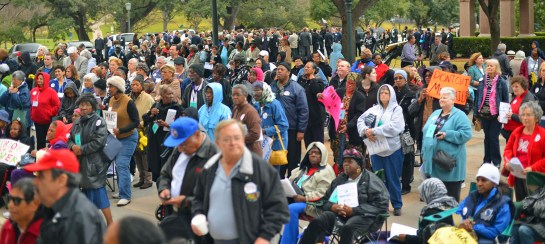
In 2002, the new and progressive AFL-CIO leadership put together the Alliance for Retired Americans. It consists of a lobbying office in Washington DC and far-flung supporters here and there around the nation. We usually meet in union halls and most of our initial supporters are union retirees, but we reach out to all seniors and, for that matter, anybody and everybody who wants to save the right to retire in America before it’s too late!

In 2006, we faced a major challenge because President Bush made it his top priority to privatize Social Security. He came close, but we stopped him. Since 1980, there have been a succession of crazy proposals to do this and do that with retiree benefits. All of them are obscured in language, but in the final analysis they all mean cuts for seniors.

Around 1986, it became possible for corporations to disregard their responsibility for pensions in bankruptcy proceedings. In 2015 Congress decided that trustees of multi-employer pensions could solve their budget problems by cutting retiree benefits. The budget for administering Social Security has been cut so severely that many offices had to be shut down and many counselors laid off. Corporations and anti-worker politicians come up with some new attack every few weeks.

Here in Dallas, voters will find on their November 8 ballot a proposal to slash the pensions of City employees. The Dallas newspaper already endorsed it as sound policy!

It’s fight or die!

–Gene Lantz

Click here for more of these ideas

Some notes from the book:

Leopold, Les, “Runaway Inequality. An Activist’s Guide to Economic Justice.” Foreword by Chris Shelton, President of CWA. Labor Institute Press, 817 Broadway, NY NY 10003, 2015

I think I put 3 references to this book on genelantz.org. I found it very exciting that CWA was holding classes and giving away copies of a book on more-or-less radical economics.

pg2 (shelton) “We’ll see data showing that elected officials rarely act on the agenda most Americans support.”

pg4: “Most of all, the media turns a blind eye to the fact that we live in a capitalist system.”

pg4: “…there is, in fact, a fundamental conflict between employees and owners, between the rich and the rest of us.”

pg5 “Economic elites will only give up power and wealth when they’re forced to do so by a powerful social movement.”

pg29-30 (Leopold) list of reasons for economic crisis of late 1970s, including competition from industrialized countries.

pg194 “…American public actually have little influence over the policies our government adopts.”

pg204 “This policy of military Keynesianism led to an unofficial partnership between the government, large corporations and labor unions. These groups worked together (more or less) to prosecute the Cold War.”

pg 288 “…Wealth inequality and unionization levels are intertwined.”

pg288: List of “what happened to unions” begins, “The decline of unionism started when unions started cooperating with the government ‘anti-red’ efforts during the McCarthy era.”

The book doesn’t actually generalize, but it does show that the entire process of rising  inequality was a result of union isolation —  first from the world movement, then from the domestic progressive movements here at home (anti-war, civil rights, etc) and finally, with the merger of the AFL and the CIO, from one another. “Solidarity” was still a good song, but it wasn’t really practiced 1947-1995 in the American union movement.

pg 289: “…Unions and the rest of us are on the losing side of a gigantic class war — a war that we have to recognize, discuss and address if unions are to grow again.”


Leave a Reply


Like a lot of unionists, like all materialists, I’m not really so crazy about the Democrats nor the Republicans. So why not vote Green Party?

exxon-me-nytimes

After all, they’re a progressive party on environmental issues and environmental issues really matter. Since I don’t know much of anything about their candidates, I don’t know anything bad — and the 2016 campaign is smearing both of the major party candidates terribly.

It’s not because, not exactly because, the Green Party took enough votes away from Al Gore in Florida to make George Bush president. It’s not exactly because Texas Greens took half a million dollars under the table from the  Republicans in 2010. By the way, I ran across a good old friend the other day who didn’t even believe it, or maybe he couldn’t remember back that far, so I had to look up a bunch of references for him. I’ll put them down below.

So What’s My Problem?

More than anything else, my whole purpose in doing this blog is to get people to think through their strategy for progressive change. What’s your theory?

My theory is that the entire progressive battle can be boiled down to employers against employees. The employers are what’s holding us back, and the employees are what’s impelling us forward. It’s a matter of choosing sides and sticking with it.

Voting for the Green Party in 2016 is not going to help the employee side. If it means anything at all in this awful two-party system we’re straddled with, it means some help for the wrong side.

People are confused because they don’t know the difference between the American two-party (ugh) system and the parliamentary systems of Europe and other countries. In those other countries. one votes for the party that one loves, and that party gets offices roughly in proportion to the votes they get. In the American system, that isn’t what happens. One of the two parties takes power; the other loses out. Everybody that votes their heart (or their stomach or their endocrine glands) instead of their brain has, at best, wasted their time and everybody else’s. Actually, it’s worse than that.

You’re a leader, even when you don’t want to be. Please realize that whatever you decide is going to affect others. We’re all listening to one another. People are listening to you.So — think!


  1. We’re in a two party system
  2. One, just one, of those two parties is going to take the critical offices
  3. Other people are watching what you do and are influenced by it
  4. Therefore, the right vote is the vote that will advance your theory of progressive change

As I’ve said before in this blog, it isn’t the candidates and it isn’t the parties that matter. It’s the progressive movement. It’s the workers.

–Gene Lantz

Click here for more of these ideas

Some old articles about how the Republicans financed the Greens in Texas

http://www.dallasnews.com/news/politics/state-politics/20100610-Texas-Democrats-take-Green-Party-to-8824.ece

Texas Democrats take Green Party to court over ballot funding

http://www.dallasnews.com/news/politics/state-politics/20100625-Judge-blocks-Green-Party-candidates-from-4442.ece

Judge blocks Green Party candidates from Texas ballot

  • By WAYNE SLATER / The Dallas Morning News

Published: 25 June 2010 06:33 AM

Updated: 26 November 2010 02:41 PM

A state judge blocked Green Party candidates from Texas’ general election ballot Thursday, ruling that illegal corporate money was used in a Republican attempt to put them there to benefit Gov. Rick Perry.

District Judge John Dietz said he expected his injunction would be stayed by a higher court.

He issued the injunction after a day of testimony in Austin that implicated a former top Perry aide in efforts to field Green Party candidates in November.

https://en.wikipedia.org/wiki/Green_Party_of_Texas

The Green Party’s efforts to get its candidates on the ballot for the 2010 elections was challenged when it was revealed that the Green Party’s petition drive had been funded by corporate interests linked to Republican operatives.[1] Republican operatives linked to the reelection campaign of Governor Rick Perry helped to fund the signature drive for ballot access.[2][3] A court challenge resulted in the Green Party candidates being allowed to remain on the ballot, and the near 92,000 signatures gathered in support of the Green Party from registered Texas voters were validated.[4][5]

GOP ties bind Green Party candidates in Texas case

GARY SCHARRER , AUSTIN BUREAU

Published 5:30 am, Tuesday, June 29, 2010

http://www.chron.com/news/houston-texas/article/GOP-ties-bind-Green-Party-candidates-in-Texas-case-1702618.php 

AUSTIN — Even if allegations about an illegal petition drive are true, knocking Green Party candidates off the November general election ballot before they can be proven imposes “a death penalty,” lawyers for the party argued Monday in a written appeal to the Texas Supreme Court.

The party has until Friday to certify its candidates for the fall election, but a judge last Friday ordered it not to proceed because of an “unauthorized illegal contribution” by a corporation with Republican links.

“This case matters because voters should have an alternative to entrenched career politicians. Despite the signatures of over 90,000 Texans, entrenched career politicians and their lawyers want to deny voters the right to choose in November,” said David Rogers, one of the Green Party lawyers.

A GOP front group — with help from Texas Republicans — raised $532,500 in anonymous contributions to help the Green Party get enough signatures to make the ballot. Democrats assume the liberal Green Party gubernatorial candidate, Deb Shafto, would siphon votes from Democrat Bill White and help GOP incumbent Rick Perry.


I’m completely optimistic in believing that fundamental change will come to world societies. Further, I believe it will happen before the present rulers destroy us and the planet. It’s because I realize that I’m not any smarter than others, and I’m not stupid. So they’re not stupid either, so we’ll get together and win some day.

Once I was sure that we will be victorious, I began to speculate as to how our victory might come about.

I think there are basically three versions:

torches-pitchforks

  1. People will gather their torches and pitchforks and force the misleaders out
  2. We’ll elect better and better candidates until we actually have a set of good ones
  3. We’ll carry out a worldwide general strike

Torches and Pitchforks

Probably the idea of some kind of violent overthrow of the existing powers is the oldest scenario. It sounds the easiest and the fastest. It’s also the most dangerous, because it’s easy to start thinking that the rest of the world’s villagers only need some kind of a “spark,” — one heroic act of an individual or small group — and then they’ll grab their weapons.

So they try one ultraleftist act of terrorism after another, hoping to get the right “spark.” But it never happens and they just get a lot of people killed or jailed.

Electing Our Way to Power

When President Obama was elected, some people thought we had done all we had to do. He would take care of the rest. Other people thought electing Obama was good and that he could take us part way, then we’d elect somebody even better the next time. In the course of a few elections, we would end up with Judges, Legislators, and Administrators who would save us.

I imagine they felt the same way in 1931 when they elected Franklin Roosevelt. Maybe also in 1859 when Abraham Lincoln took the White House. George Washington?

I think it’s the most popular idea because one doesn’t really have to do much besides vote and a little bit, maybe, of phone banking or neighborhood canvassing. No risk in any of that, and it’s not too hard. If it doesn’t work, then they’ve still earned the right to gripe about everything until the next election.

Stopping the Economy Until We Get What We Want

The idea of a worldwide general strike isn’t as un-historical as it might sound. Workers actually tried it, with considerable success, in 1886. Railroad workers practically shut the nation down in 1877. They might have won their strike if the soldiers hadn’t started killing them. There have been successful city-wide general strikes in several cities, including Seattle and even Houston!

The Industrial Workers of the World was once a big organization that terrified the bosses. Their idea was to organize all workers at their worksites — in every industry — and then shut down the economy. Hundreds of them were deported, arrested, or killed in the bosses’ backlash.

I don’t want to pretend to know more than they did, but they might have done better if they had gone in for organizing communities, civil rights organizations, church groups, and other kinds of affinity groups instead of just workers at worksites. They might also have done better if they hadn’t been so hell-bent on not participating in politics and not forming alliances with other progressives.

The downside of this “stop the economy” idea is that a substantial number of workers and working families would have to be organized. There would have to be unions in critical work places, plus community groups and a lot of other kinds of organizations. And they’d have to work toward co-ordination with the others. It would take political work as well as organizing. That’s a tremendous amount of hard work.

The upside to all that hard work is that leadership would develop. Leadership would also be tested along the way, and we’d end up with the kind of leaders who could actually run a new, better society. Neither of the other two scenarios has that advantage.

What’s the Catch?

There are players on the other side.

It’s easy to think that everybody wants social progress just because we do and almost everybody we know does. But we don’t hang around with the Koch brothers, do we? We don’t hold memberships in the National Chamber of Commerce or the National Association of Manufacturers or the National Right to Work Committee. We’re not listed in the Forbes 500, but other people are, and they don’t want change just as much as we do want it.

If we were to grab our pitchforks, they’d grab their bombs and drones.

If we were to elect good candidates, they’d pour billions into electing bad ones.

The wealthy people clinging to the status quo know what they’re doing. Do we?

2 comments

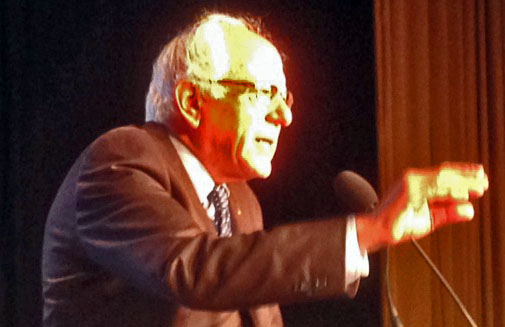
There’s no denying the tremendous effect that the Bernie Sanders movement has had on the body politic. Will it continue? Will the various aspects of Sanders’ progressive program be won?

ara-bernie

Gotta love the guy!

A couple of factual observations: Sanders mentioned doing political actions outside the sphere of electoral politics. I could see petitioning campaigns, possibly boycotts, some strike support, and street heat actions being carried out by enthusiastic young activists and I really like the idea.

Sanders didn’t mention “Brand New Congress” at all. Click here for my article on them. This organization started a couple of months ago with a scheme to elect 400 “corruption proof” congresspersons in 2018. I’d love to see that happen, but I was a little skeptical when they said they were the heirs of the Bernie movement. I was waiting for Bernie to say so, and he didn’t.

Sanders did mention organized labor in a positive way, and many of his proposals are also the proposals of the AFL-CIO.

One last factual observation: We’ve seen this before. Going all the way back to the “Deniacs” of Howard Dean, we’ve seen progressive presidential candidates try to extend their movement beyond their candidacy. The worst one, in my own opinion, was Organizing for America, which was supposed to harness the amazing power behind the Obama 2008 campaign. I call it the worst one just because of my local experience here in Dallas, where OFA completely ignored every organization and movement in existence and put on separate, isolated, events that didn’t necessarily relate to the local situation.

WHAT CAN WE EXPECT?

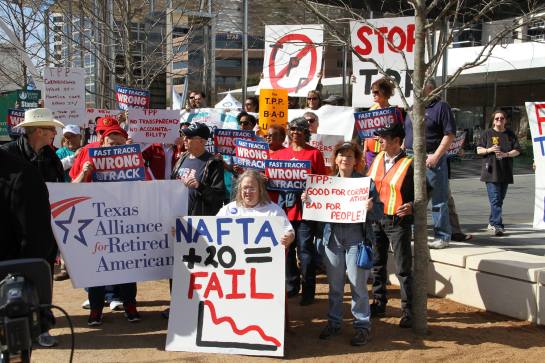
I think the Bernie movement has tremendous potential because of its youth support. We’ll probably see the first test of the movement right after Labor Day, when the “lame duck” congress tries to pass the Trans Pacific Partnership (TPP) unfair trade deal. (Click here for my piece on trade). It’s well established that most Americans and both presidential campaigns oppose it, but the corporations want it, so don’t be too surprised at what happens.

If the Bernie forces mobilize and get past the TPP test, they may come up with a winning formula for continuing. But there are a lot of obstacles to holding the movement together without Bernie at the helm. The movement started fragmenting as soon as the presidential campaign ended, and it’s still degenerating with little splits and big. I suspect the Brand New Congress people weren’t very happy with the August 24 performance, for example.

HOW CAN WE BUILD MOVEMENT THAT CAN WIN?

There aren’t really any charismatic leaders or ambitious programs that can stand up to corporate money power. I love them and I support them, but I don’t count on them. The essential problem in modern society is the conflict between the bosses and the employees. If we stick with the employees’ side, we won’t go wrong.

–Gene Lantz

Click here for more of these ideas

1 comment

Humorists are having a good time with the 2016 elections because never in our history have we had two candidates with such negative approval ratings.

voteclass

Remember that terrific episode of “Rosanne” when Dan’s bowling team came in next to last and celebrated by chanting “We’re not the worst! We’re not the worst!”?

Some of my friends tell me that they’ll launch some kind of a protest vote, possibly for one of the growing “other” parties. They think about Trump, they think about Clinton, then they stop thinking.

How does positive change come about?

If you want positive change, then you owe it to yourself to think through how that positive change could come about.  If you believe, as I do, that the basic conflict in the world today is between employees and bosses, then strengthening the employees’ side is the road to progress. So how the election is going to affect working people is the key to understanding the election and making the most use of it. The perfections and imperfections in the candidates aren’t what matters. What matters is what’s going to happen.

There are lots of other theories

I’ve known people, actually quite a few, who believe that bad is good. If something really terrible happens in the 2016 elections, then people will “wake up” and stop being so lackadaisical about progressive change. So they’ll pick the worst candidate. They loved it when Reagan was elected. I once heard a speaker call this the “vulture theory” of politics. We’ll wait around until all hope is lost, then we’ll pick up the carrion pieces. It’s not a good theory and there are absolutely no historical precedents to justify it.

I’ve known people who say that elections don’t matter because the capitalists are just going to do whatever they want anyway. So the upcoming Supreme Court appointments, the unfair trade deals, austerity proposals, and immigration reform won’t matter at all to the oppressed people. It’s not a good theory and it’s sad.

There are people who don’t believe in trying to win a majority. They actually believe that some small, dedicated group is going to make positive historical change. It’s utter nonsense and tends to lead them, in their constant frustration, toward violence as a strategy. Besides, even if they could effect change with a handful of conspirators, they couldn’t make it stick. How would they get the great unlearned people to support them?

Then there are the “revolution right now” people. They don’t need theories. They just sit around sanctimoniously and wait for everybody else to become as smart as they are. Then there will be a revolution and then we’ll be happy. Until then, they can take their joy by saying, “I told you so!”

I’m afraid to say it, but it’s possible that many voters don’t care about outcomes at all. They only care about their own feelings!

Working people make positive change

Working people have a big stake in the 2016 elections because we have a big stake in all political struggles. It makes a big difference who wins, both for working people and for prospects for change. Look at that, not the imperfections of the candidates.

Leave a Reply


For weeks now, I’ve been raving about “Raging Inequality” by Les Leopold. Not so much because it’s a great book, which it is, but because the powerful Communications Workers of America (CWA) union is promoting it, teaching classes, and giving away copies. But I’ve been holding something back.

abevigoda

In essence, the book uses economic data and graphs to show how rotten things have been in America since 1980 in contrast to the period 1945-1980. Then it goes on to suggest how we can return fairness to our nation.

What’s wrong with that?

We’re looking at the wrong end of the graphs. The right side of each graph, the period 1980-2016, isn’t the period that’s out of kilter. It’s 1945-1980, the left side of each graph, that was un-historical. That “American century” of 35 years was downright peculiar in the entire 400-year old history of capitalism. It was the only time in history when the working class of any capitalist country ever held its own against the bosses! All the other periods, including the present one, were just business as usual.

Business as usual means constantly increasing the exploitation of the workers. It’s not anybody’s fault, it’s just the only way that capitalism can work. The only thing that can even slow the process down is resistance from the working class.

The post war period in America began with over 1/3 of all American workers in unions. There were more successful strikes in 1946 than in any year before or since. The unions, especially those led by the Congress of Industrial Organizations (CIO), were integrated, practicing solidarity with one another and with the community at large, and even internationalist in their outlook! They were a real force to be reckoned with, and their power took decades to dwindle down to the skeleton that the new progressive AFL-CIO leadership picked up in 1995.

Shouldn’t we be fighting?

Of course we should be fighting every day. That’s why I tout the book so much. It shows where we are now and some of the steps we could make that would take us forward. My objection to it is that we don’t really want to return to 1945-1980, nor can we. We must bear in mind that we are fighting for something entirely new: an end to boss rule.

Until then, every advance that working people make can be taken away, because the bosses are still in power.

Read the book, please!

Let’s do our best to expand this marvelous educational project that the Communications Workers have begun. Let’s read the book and get everyone else to read it.

–Gene Lantz

Click here for more of these ideas


Everybody should read “Runaway Inequality” by Les Leopold. Don’t wait for somebody from the Communications Workers of America to invite you to one of their classes on it.

runawayinequalitybook

Some of the best stuff is in the beginning. The forward is by Chris Shelton, President of the CWA. The middle parts of the book are mostly statistics about how inequality rose after America selected a new business friendly government policy in 1980. The other really great stuff is near the end

I particularly like Chapter 22: “When unions decline, inequality soars and we all lose.” On page 288 Leopold says, “Wealth inequality and unionization levels are intertwined.” You probably knew that but it’s good to see it in print.

What happened?

Then he goes into the reasons for the great union decline from its heady power of 1946, when Americans won strikes more than ever before or since. Leopold apparently doesn’t have the nerve to say it outright, but he lists, in a dispassionate way, several “theories” about how union leadership could have done better. I’ll shorten them and make them more blunt:

  • The decline started in 1947 when unions cooperated with the anti-communist witch hunt and expelled some of their best leaders.
  • Unions shouldn’t have worked closely with the CIA
  • The merger of the AFL and the CIO didn’t work out for the members
  • Unions shouldn’t have supported the War in Vietnam
  • Unions became bureaucratic and undemocratic
  • All unions haven’t learned community organizing techniques
  • Unions aren’t linking up with unions in other countries

Even though Leopold didn’t really commit to it, I thought it was a pretty good list. It probably should have included something about how unions largely ignored and still ignore the civil rights movement, but it’s still a pretty good list.

Right after the list, the author gives the underlying reason for all the problems: “Unions and the rest of us are on the losing side of a gigantic class war — a war that we have to recognize, discuss and address if unions are to grow again.”

In other words, we can list the things union leaders did wrong all we want, but the underlying reason for the decline was aggressive anti-worker policies of the boss class. Even if we’d had the best leadership in the world 1947-1995, it would have been very very hard to withstand the combination of government/boss aggression and the post war “good time” prosperity that allowed opportunist labor leaders to get pretty good contracts for their members — while slowly sinking into isolation from everybody else.

By 1979, unionized American workers were the envy of the world, even though our numbers were dwindling fast. In 1980, the party was over. I don’t think many union leaders figured it out, and some of them still haven’t. They still expect the bosses to act “reasonably.”

The essence of the problem

What it boils down to is this: From 1947 to 1995, the bosses were able to isolate the organized sector of the American working class from the rest of us. I picked this up from an earlier book by a prof in California named Lipschitz, “Rainbow at Midnight,” and from talking to people who lived through it. The new book, with CWA backing, will force unionists to look at the problem and see what we did wrong. Even if it did nothing else, the book would be worth the $20.

But Les Leopold actually does a lot more in “Runaway Inequality.” He makes serious suggestions as to how we can turn the situation around and return to the kind of militant union progressivism that succeeded for the CIO 1935-1947. The progressive leadership of the AFL-CIO, 1995 to present, can and probably will implement these ideas.

I can’t wait!

–Gene Lantz

Click here for more of these ideas