Archive

civil rights

I feel that I should explain, especially to those people who avoid me. It’s true that I’m incapable of cordial conversation. In no time, I turn almost every conversation into an “ask” for this or that. Sometimes I’m after contributions to the retiree cause, sometimes I want people to come to something, sometimes I ask them to “make a few calls.”

me-sanantonio

Here’s my excuse: I have an urgent sense of history unfolding.

We Think We’re in Normal Times

In normal times, things go on pretty much as they have. There are no sharp changes in normal times. We think it’s “just the way things are,” and the inference is that they have always been that way.

But there are no normal times. Nothing is static, everything is constantly changing. When little, barely noticeable, changes start to accumulate, then giant, sudden changes occur. I saw one of those little changes in my e-mail today. It said that Republicans are proposing another $492 million cut in the Social Security Administration’s budget. It’s just one of many relatively “little” changes that undermine the American standard of living. It’s been going on since 1980.

I also saw, today, that the latest Texas Voter Suppression law is going into effect. I saw that President Trump is saber-rattling, again, against North Korea. He added Iran this past week.

These little changes undermining our standard of living and taking away our democracy so that we can’t fight back, are likely to add up to a big change. It’s impossible to predict when, but it’s foolish to ignore the truth that the big change is looming more likely.

Two Big Changes Ahead

If the coalition of big-money funders and ignorant reactionary pawns continues to get its way, America is going fascist. Who would deny that incipient fascism is already upon us? Who would fail to admit the direction they are taking us? Who would fail to notice that fascism, the total extinction of democracy with working people completely under the thumbs of corporate masters, is exactly what they intend?

The other big change that might occur is a defeat of the big money funders and ignorant reactionary pawns. An enlightened and activated populace may yet join together into an irresistible progressive force that will regain the upper hand for democracy and begin a new path to peace and progress.

Pick One

Those with an urgent sense of history know that one of those big changes is coming. You can have one or the other but you can’t have neither. You can’t have “normal times.”

That’s why I ask people to study and to get active in the most meaningful way. That’s why I’m such a pain in the butt.

–Gene Lantz

I’m still on KNON radio 89.3 FM in Dallas every Saturday at 9 Central Time. If you want to know what I really think, check out http://lilleskole.org

 

Book Review:

Schrecker, Ellen: Many Are the Crimes. McCarthyism in America. Little Brown and Company, Boston, 1998.

whitebread

I remember the 1950s like white bread: bland, not nourishing, and an important part of every meal. Books, movies, and all things cultural talked about “the American way” as if it were the best of all worlds and the best ever created or imagined. Socialism was never mentioned, except in a pejorative way in movies like “I Married a Communist” or “I Was a Communist for the FBI!” We did not smoke dope in Muscogee, or anywhere else as far as I knew. We kept our hair short and our minds shorter.

It has taken many years for me to realize that the wasteland of the 1950s was created deliberately. Too bad I didn’t have Ellen Schrecker’s book in 1953! It would have saved me a lot of personal anguish.

communist-dead

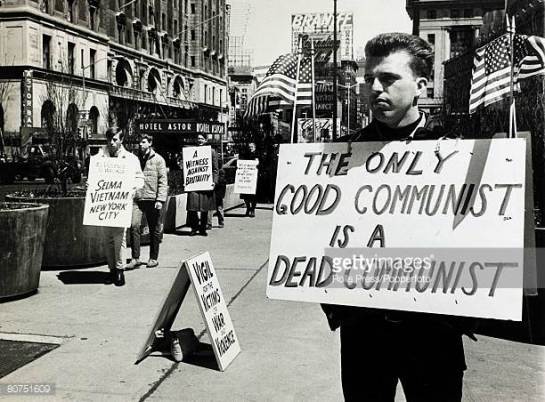
Schrecker details important aspects of the anti-communist crusade from World War I to modern times. Except for a brief period during World War II, when the United States and the Soviet Union were wary allies, the crusade was relentless.

Schrecker is an academic, so don’t expect her to take sides. She’s just reporting what happened. Academics are afraid to take sides. However, the sheer immensity of the government-run effort to destroy civil rights, civil liberties, and any kind of resistance speaks for itself.

The author reminds us often that she doesn’t sympathize with the communists. She stands on the high ground of impartiality, and, in a way, that makes the facts about the  FBI and the other zealots even stronger.

Schrecker doesn’t shrink from pointing out that a great many of the tactics implemented by the FBI and taken up by other government entities were illegal. A great deal of the testimony against communists and liberal thinkers consisted of FBI-solicited lies. J. Edgar Hoover is hardly the only guilty party. Schrecker doesn’t spare the intellectuals and liberals who all-too-easily jumped on the anti-communist bandwagon. She also doesn’t spare the right-wing union officials who cashed in when, with government help, they drove the militants out of the American union movement.

I’m particularly interested in what happened to the American unions after 1947, when the anti-communist and anti-union Taft-Hartley law was passed. Unions resisted it at first, but here’s what Schrecker says on page 380: “…by the early 1950s, most of the nation’s unions had adjusted to the law and abandoned their struggle against it. It was a serious mistake. Taft-Hartley created an unfavorable legal environment that forced the entire labor movement onto the defensive. Unable to employ the aggressive organizing tactics that had been successful in the 1930s, unions found it difficult to expand. As a result, by the 1970s, when the postwar boom began to falter and the well-paid blue-collar jobs of the members began to disappear, labor was unable to mobilize either the political or the economic clout to protect its earlier gains. It’s numbers dropped… Instead of reaching beyond its traditional white male constituency in the heavy industry and skilled trades of the Northeast, Midwest, and West, the labor movement turned inward and raided its own left wing.”

On page 382: “Its rupture with the left hastened its transformation from a movement to a bureaucracy…. Once the left-wingers were gone, organized labor lost its dynamism….”

The saddest of the tragedies throughout this long, detailed book comes on the last page when the author considers “Can it happen again?” “…the process through which McCarthyism came to dominate American politics is infinitely replicable.” In less academic language: Yes, it can happen again.

–Gene Lantz

I’m still on KNON radio at 9 AM Central Time every Saturday. If you’re interested in what I really think, look at http://lilleskole.us.


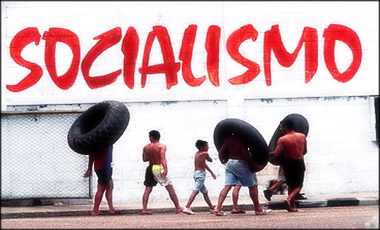
Socialism has become a popular topic for liberal discussion. Thousands of young people are joining moderate socialist organizations such as SP, DSA, or one of the Bernie-ite electoral groups.

socialismo

It is wonderful to see so many people committing to a better world, but I’m not sure how serious they are. It would be good to take a look backward to see how this discussion was conducted over the ages.

Socialism was a suitable subject for tea parties and Utopian literature for a couple of centuries before the 20th. There were even some harmless experiments, including one here in North Texas in the 1850s. The draft law of the Confederacy ended the Texas experiments with guns and terror.

The hippies of the 1960s recapitulated that early period and did some more harmless experimenting with communal living, counter-cultural institutions and what they called the “land trip.” Almost all of them either gave it up or moved to Costa Rica or both.

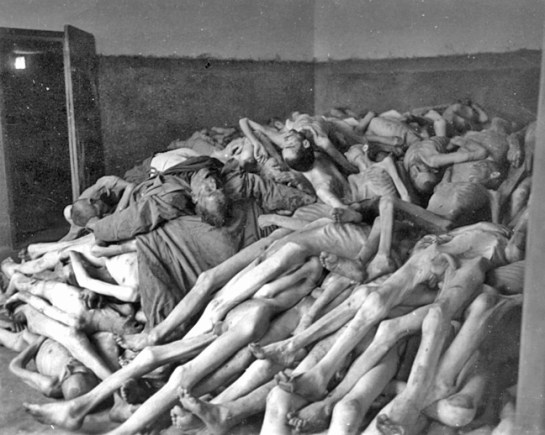
In 1917, though, the talk got serious. Since then, serious advocates of socialism have realized that an opposition exists and it’s not just arguing politely. Millions died in the civil war after that first socialist economy was established.

deadpeople2

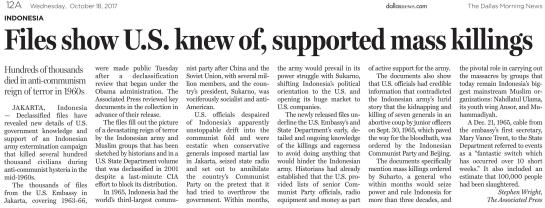
The “arguments” of the opposition then took the form of fascism. In Italy, Germany, and Spain, the socialists were put down with guns and terror.  No sooner had the Nazis been defeated than the “arguments” of the opposition began killing millions in Korea, Vietnam, Guatemala, Iran, Chile, South Africa, Angola, and Indonesia. Sorry if I left some out.

clipping

Here in the United States, only a few of the advocates of socialism actually died and a few, not a whole lot, were imprisoned. But an awful lot of them lost their jobs and suffered blacklisting. Many Americans are still terrified of socialism because the terror that began in 1947 worked rather well for the anti-socialists. If it hadn’t, they would have gone much further, as they did in other nations.

Socialism is serious business. It’s not enough to discuss and advocate it. We need a plan.

–Gene Lantz

I’m on http://knon.org/workers-beat at 9 AM Central Time every Saturday. If you’re interested in what I really think, look at http://lilleskole.us


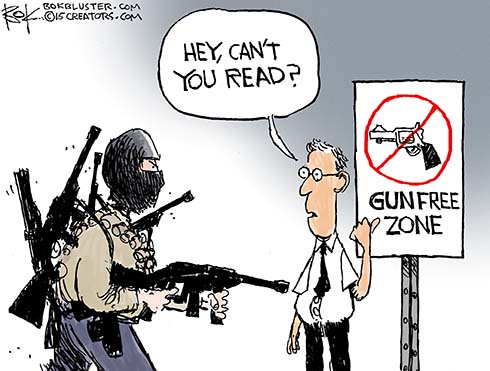
Mass shootings are regular events in America. In today’s newspaper, I just read that Americans have ten times as many guns as anybody else, and that’s the fundamental reason for all the killing.

guncontrol

My own view may surprise you. When it’s all said and done, I am not for taking guns away from the citizenry.

Are Criminals and Terrorists the Issue?

The popular logic is that taking away a lot of people’s guns will also take a lot of guns away from screwballs, criminals, and terrorists. The NRA and the gun-nuts argue that the people who shouldn’t have guns will find a way to get them anyway, and the rest of us will be defenseless after we’ve given up our own. There’s a lot of heat in that argument, on both sides, but neither one deals with the essence of the question.

Let’s Start From Another Angle

If the citizenry gives up our weapons, then only the police will have weapons. That’s what worries me. I don’t know what percentage of the umpteen gun-caused maimings and deaths in America came out of police gun barrels, but I know that there are too many of them. Police shootings are treated as a separate controversy, but they actually go right to the heart of the matter.

The question of the proliferation of guns and the proliferation of police shootings are related. One can’t be solved without the other.

Community Organization is the Answer to Both Problems

If we had effective community organization, we’d have less crime, less need for protection, and a lot fewer police. Neighborhood watches, consisting of the neighbors themselves, could watch out for and report crimes. We would still need professional investigators similar to the ones we see on British BBC television, but we would no longer need armed and dangerous policemen on patrol. In the BBC murder mysteries, the investigators can call out armed units when necessary, and our militias should be able to do the same.

What is the Obstacle?

I can imagine people laughing as they read the preceding paragraph. They’re right, The police in America are not going to be disarmed. Our employers aren’t going to get us organized for self-protection either. But that’s not because it wouldn’t be a good idea. It’s because they don’t work for us. The police, and for that matter the military forces, all work for the plutocrats that run America. They are the armed agents of the people who rule us.

Our our problem is not the NRA, not the gun-nuts, not the terrorists, not the criminals. It’s the bosses.

–Gene Lantz

I’m on http://knon.org/workers-beat every Saturday at 9 Central Time .if you want to know what I really think, check out http://lilleskole.us


Movie Review: “Suburbicon,” Directed by George Clooney, 105 minutes

It's a lot of movies

Matt Damon and Juliana Moore star in a movie that could have been named “Hunter for a Raisin in Pleasantville”


Kudos for the team who made “Suburbicon” for having four, count ’em, four union logos after the credits: Producers Guild, Sag-Aftra, Teamsters, and IATSE. That’s just one of the film’s many good features. We liked this movie.

In the next-to-last scene, I realized that it was a comedy. If I had known that all along, I’d have enjoyed it more because it’s really a pretty good comedy. The problem, and the probable reason that it is setting records for tickets not sold, is that the film makers also weren’t sure it was a comedy. It might have been a murder mystery, a civil rights drama, or a horror story. “Suburbicon” has elements that could be compared to some really great movies such as “Night of the Hunter,” “Raisin in the Sun,’ and “Pleasantville,” If you saw those movies and liked them, you’ll also like parts of “Suburbicon” — but you probably won’t enjoy the entirety as much unless you follow my advice: “Think of it as a comedy.”

The original script was from Joel and Ethan Coen. But the film’s credits show two other writers jumped in and added their alien ideas. That was unfortunate, because the Coen brothers have an unbroken string of smash hit comedies. I wanted to see this movie because I love George Clooney and admire the way he trades in his matinee-idol image for self-sacrificing humor. I also admire leading man Matt Damon for playing super hero secret agents one day, then sappy zoo-buying dads the next. He takes it even further this time. I also wanted to see the movie because I firmly believe that no one, no matter how hard they try, can poke enough fun at the 1950s in America. Even if it did nothing else, “Suburbicon” moves to the top of anti- sterile, racist, anti-communist, cold-war hysterical, 1950s movies!

The plot: Two pre-adolescent boys, one anglo and one Black, play a little baseball together in a perfect little all-white suburb in the late 1950s. Then there are mobs and murders right and left. Some of it fits right into whatever you may think of as the plot line, and some of them don’t. You’ll enjoy the movie as we did if you keep in mind “It’s a comedy!”

–Gene Lantz

I’m on http://knon.org/workers-beat every Saturday at 9AM Central Time. If you’re interested in what I really think, see http://lilleskole.us

The new documentary film “Dolores” has opened. Its subject, Dolores Huerta of the United Farm Workers, is promoting it. She appeared in Dallas on October 11. The audience was knocked out of their socks!

Dolores_Ecard_Dallas1_v1

The biopic begins her life story when she was only 25 and had only 7 children. She and Cesar Chavez, both longtime community organizers, focused together on organizing workers in the California fields. It carries on through all the battles, all the innovative tactics, all the disappointments, and the victories of their dramatic organizing history.

After the film, a standing ovation greeted the 87-year old mother of 11 who has made and is making this American history. She answered every question with the same even-handed practicality that characterized her approach all through the movie.

One of our most popular labor movement children, primary school student Lucia Montemayor, daughter of our Dallas AFL-CIO Political Director, asked, “When can I start organizing?”

Huerta replied sweetly, “What are you waiting for?”

Police violence was a topic for two big reasons 1) all the violence that the farmworkers faced in the film and, 2) Huerta’s personal hospitalization after being attacked by San Francisco policemen. Without any rancor, Huerta said that everyone should oppose injustice whenever and wherever it arises. She went out of her way to say that Jerry Jones, millionaire owner of the Dallas  Cowboys football team, should be encouraging his  players to oppose injustice instead of  threatening to fire them.

Someone asked how Huerta juggled motherhood  and  career. This is a question she has dealt with often. Throughout her adult life, she has been criticized for not remaining at home “in a woman’s place.” In fact, it is common for many parents to hide behind their children and claim, “I can’t fight injustice because I put my children first” – thereby condemning the next generation to live in a world no better or even worse than the one the lazy parents live in. Huerta said that parents have to work for a better world because it has to be done. One of her sons was with her. He testified, “We had to share our mother with the world – but she shared the world with us!”

Several questions had to do with the discouragement that organizers often feel. Of course Huerta’s smiling responses were essentially that people must keep on trying. From Dolores Huerta, these weren’t just words. She has backed them with a lifetime of commitment!

–Gene Lantz

I’m on knon.org every Saturday at 9AM Central Time. If you want to know what I really think, look at http://lilleskole.us

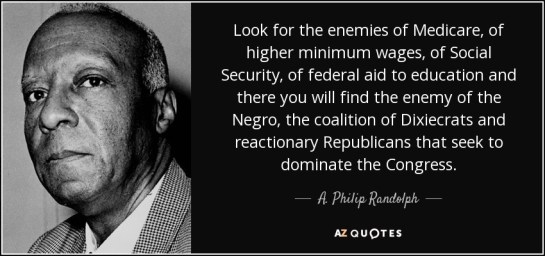
Book Review: Kersten, Andrew E, and Lang, Clarence, Editors: “Reframing Randolph. Labor, Black Freedom, and the Legacies of A. Philip Randolph.” New York University Press, 2015.

randolph-quote

I got this book from Oak Cliff Branch of Dallas Public Library.

Asa Philip Randolph is glorified and criticized in the essays collected here. Whether they appreciated him or not, all the writers agreed that he had a profound effect on American civil rights.

I started a sort of timeline:

  • 1898: born
  • 1920s: Street corner orator and co-editor of “The Messenger”
  • 1925: Newly organized Pullman Porters ask him to take over as President. Black Sleeping Car Porters and Maids formed
  • 1935 or so: finally gets a contract from Pullman. Drops “and maids” and joins the American Federation of Labor (AFL) Within it, he argues for anti-discrimination policies until the end of his career
  • 1941: With threat of March on Washington Movement (MOWM), gets Executive Order 8088 (? Forgot the number) outlawing racial discrimination in war industries. Not nearly as much as was demanded, but Randolph calls off the march and is covered with glory for having “forced” the President of the United States to acknowledge the federal government’s role in overcoming racial discrimination. Federal Employment Practices Commission (FEPC) is formed and the MOWM people try to enforce it with marches and pickets throughout the war.
  • 1936: Formation of National Negro Congress. He serves 1 term as president and then resigns as he feels the organization is communist dominated
  • 1960 or so: He is President of the National African Labor Congress NALC
  • 1963: he and Bayard Rustin organize the March on Washington for Jobs and Freedom. They cooperated with MLK on it. Of course, MLK stole the show.
  • 1965: he is honored with formation of A. Philip Randolph Institute (APRI). Chapters are formed in every Central Labor Council and endure today
  • 1968 Ocean Hill-Brownsville conflict between community oriented school board and the United Federation of Teachers. Randolph sided with labor leader Al Shanker and took heat for it
  • 1972: Coalition of Black Trade Unionists (CBTU) formed as NALC fades away
  • 1974: African American women from Randolph movements start the Coalition of Labor Union Women (CLUW)

I was left with the impression that Randolph successfully, eventually, got the AFL to be less racist. The CIO, of course, probably had a bigger effect. Randolph got the federal government on the right track. I think he was a consistent social – democrat, even though the various writers seem to think he wavered this way and that. I think any wavering he did came from trying to fit the civil rights movement into the AFL. Like the social-democrats of today, Randolph looked at the working class. He analyzed it and pushed for its success. Like the social-democrats of today, he did not analyze the obstructionist class and devise ways of overcoming them once and for all.

On the downside, the book accuses him of outright sexism in dealing with women’s politics. They also criticize his rabid anti-communism as unnecessarily divisive. If he read the book today and were asked to comment, I’m sure he would say that those who cannot compromise aren’t going to get anything done in contemporary politics.

–Gene Lantz

I’m on KNON radio every Saturday at 9 AM Central Time. Click here if you want to know what I really think!

It’s incredible, but lots of people don’t know the difference between right and wrong!

mecivilrightssupper

It’s evident from today’s discussions around Confederate monuments, white supremacy marches, and free speech. President Trump, that fountain of wisdom, says that we have to take down the Washington monument if we’re opposing Jefferson Davis. Some of my liberal friends, gritting their teeth, say they will defend white supremacists’ right to march and speak out “to the death.”

The racists in Boston today say they aren’t rallying for bigotry, but for “free speech.” They’re trying to frame the argument so that anybody opposed to their disgusting views is against freedom.

There’s a good explanation for the confusion

The confusion over right and wrong today has the same root cause as a tremendous lot of confusion — people have no standard of measurement. With no actual standard, they are going by their feelings. No one would admit that, but it’s true. People are trying to decide very important questions simply by the way they happen to be feeling.

All philosophies are branches of idealism versus materialism. Idealists believe that the standards for everything exist only in their minds — in their ideal world. All the stuff that we see, touch, and smell, is only an approximation of the perfect ideal.

Materialists believe in the real world. We believe that any concept of a perfect ideal would have to be generalized from all the stuff we can sense. The material world comes first, and perfection is just something to talk about when we have extra time.

What standard would work?

The good of humanity is an excellent standard. “Good,” then, is what helps humanity. “Evil” detracts from us. “Right” advances us and “wrong” pushes us backward.

If everyone used that simple standard, the arguments would be over.

Getting back to the present situation, tax dollars should no longer be used to honor the Confederacy. Racism should be suppressed. It’s not a moral issue nor a difficult philosophical problem. It’s just knowing the difference between right and wrong.

–Gene Lantz

You can hear me on “Workers Beat” on KNON.org or 89.3FM in the Dallas area, 9AM central time every Saturday

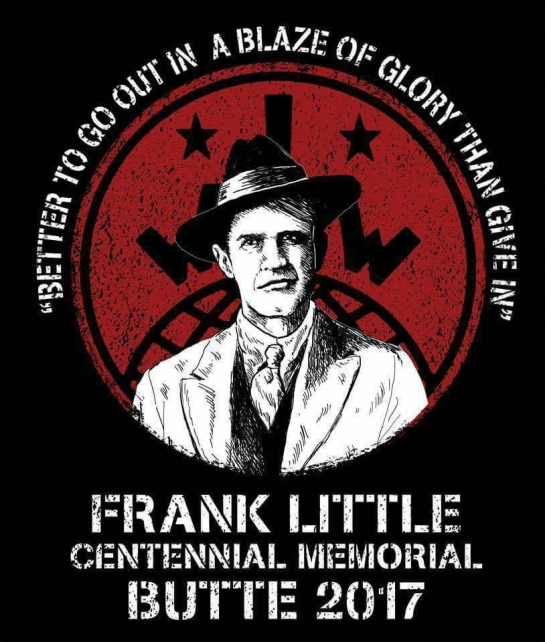
Botkin, Jane Little, Frank Little and the IWW. The Blood that Stained an American Family. University of Oklahoma Press, Norman, 2017

19990476_10213796116440546_8070776055463485877_n

The author will speak in Butte, Montana, on August 1

A giant hole in American labor history has been filled.

Frank Little’s Great Grand Niece has explained every known detail of the great union organizer’s life. 125 pages of careful notations testify to her ability as an historian of the first rank, but she also reveals family records hidden for a century. She has written not only the best biography of Frank Little possible, but she also put the events of his life and times in context so that a reader can, from this one book, draw the important lessons of the missing chapters, 1905-1919, of American history.

Why Frank Little and His Times Matter

Frank Little was a top organizer for the Industrial Workers of the World, the IWW, the Wobblies, the One Big Union, the OBU. At the time he was lynched, one hundred years ago on August 1, he was Chairman of the General Executive Board. Not all details are known, but his legacy probably includes:

1. Implementation of passive resistance tactics decades before Gandhi or MLK
2. Implementation of organizing itinerant farm workers decades before Cesar Chavez
3. Implementation of Industrial Organizing (as opposed to craft organizing) decades before the CIO
4. Champion of the argument that workers should stay out of World War I
If Frank Little had survived his 39th year, and if his ideas had survived, civil rights would have been greatly advanced. Labor would have put aside all arguments against minorities and immigrants long ago. Itinerant farm workers would have been organized far earlier. Divisions in the ranks of organized labor would have melted away. Thousands of soldiers’ lives would have been saved and American workers would have had a far better understanding of capitalism, imperialism, and socialism than they do now or have ever had. This last point is based on Frank Little’s adamant opposition to World War I. He was one of the two most outspoken labor leaders in the world on this point. The other one was V.I. Lenin in Russia.
In our spare time, my wife and I have tried to collect what little we could find out about Frank Little. I posted it years ago at http://labordallas.org/hist/little.htm.
The new book shows that I was wrong on several small details, but my only general mistake was to have underestimated the man and his importance.

Why Didn’t We Already Know All This?

Within a month of Frank Little’s lynching at the hands of the copper bosses of Montana, The United States government launched the fiercest attack against the working class in our history. Free speech, one of Frank Little’s greatest accomplishments, was trampled. Unionists were hunted down and deported or arrested and tortured. Heavy jail sentences were laid on any of the hundreds railroaded for having “conspired with Frank H. Little” to undermine war production.

Union halls were raided and all records were confiscated. History, especially any history associated with Frank Little, was wiped clean. Fear was so great that even Frank Little’s relatives dared not remember him. Fear was so great that the silence lasted almost 100 years, until now.

–Gene Lantz

You can still find me every Saturday at 9AM Central Time on http://knon.org. 

I write on http://tx.aflcio.org/dallas and http://texasretiredamericans.org