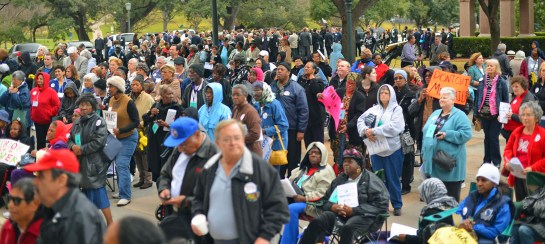
Those who want significant change have to fight every day in the short run. We fight for things like democracy, better wages, more rights, and fair treatment. Incidentally, nearly all of those battles are defensive. We rarely pick a fight. The bosses initiate nearly all battles.

peopleracing

In all these short run battles, we have had victories in the past. But as long as the bosses remain in power, we can lose everything we have gained.

What we have to do is win the long-run battle as to who is in charge. We have to overcome the bosses if any of our gains, short or long run, are to last.

So the short term is our battles, nearly always defensive battles, on immediate problems. The long term fight is for power.

How Are Long-term and Short-term Battles Related?

Most people don’t see the long term, and you can’t blame them. The short-term problems are too pressing. Union organizers like to joke that “When you’re up to your ass in alligators, it’s hard to remember that your original intention was to drain the swamp.”

But nearly everybody nowadays is painfully aware of their particular part of the short-term battles. Those who hope to win in the long-term have to join everybody else in the short term battles.

Think about it. If some radical person or organization won’t help you with your pressing immediate problem, will you trust them enough to join them on something else? Thinking activists have to take the progressive side of every short-term battle.

Losing Doesn’t Motivate, Only Winning Motivates

Another important reason for joining short-term battles is to win them. Contrary to what a lot of people may think, people are not motivated by losing. The school of “hard knocks” may have academic value, but it doesn’t encourage people to “try, try again.” People are motivated by winning, and all the statistics in history prove it.

By winning smaller, short term battles, we educate and inspire people to win further battles. If we can do this long enough, everybody will be ready for bigger battles, and we can win them!

–Gene Lantz

Click here for more of these ideas

Yesterday, I was given the opportunity to help striking workers.

symfrenchhorn

The Fort Worth Symphony Musicians are on strike. A couple of the leaders were on my radio show, then I went over to Ft Worth for their rally, march, and picket last evening. I was so proud of them for their courage!

The number of important labor strikes diminished after Reagan was elected in 1980, and has almost disappeared today. They are all tangled up with government supervision and extremely difficult to carry off.

Withholding Our Labor Is Our Weapon

The truth is, all we have is our labor, and almost the only real economic power we have is to withhold our labor. That doesn’t always mean striking. It might mean some kind of slowdown or “work to rule.” it might mean a sickout or “blue flu” day.

There are laws closely regulating what you can and can’t do on any kind of concerted action. That’s because our enemies, the bosses and their government lackeys, already know that withholding our labor is about all we can do — and they intend to limit it as much as they can!

Despite everything, we can still win strikes. Our slogan is “One Day Longer!

Boycotts, too, are Highly Regulated

The same is true of boycotts, which are much less effective weapons, but we can use them because  workers are also consumers.

We Have One Greater Power

Solidarity is our greatest strength. The Musicians Union might not be able to shut down the city of Fort Worth because they don’t occupy a vital economic center. But they could hit the economy hard if they had enough friends and allies. Suppose the taxi and bus drivers committed to helping, for example!

With enough friends and allies, labor could apply all kinds of economic pressures. Further, by pooling our financial resources to make sure strikers’ families keep eating, we could make a strike last indefinitely. The Musicians, by the way, have already thought of that. They have an on-line donation site.

If we were really pulling together. workers could win everything we want. That has to be the goal. The isolated strikes of today, like the musicians in Fort Worth, are good practice for us all!

–Gene Lantz

Click here for more of these ideas


I appreciate everybody in the progressive movement for anything they say or do.

ppreflex

But the “armchair socialists,” who don’t actually do anything, and the “knee-jerk activists,” who try to do everything imaginable, worry me.

The main problem with the knee-jerkers is that they won’t last long. A lot of the things they try won’t work out, and they will tend to get discouraged early. Burnout. Years later, we’ll hear them saying, “Oh I used to be full of piss and vinegar, but…”

As they don’t think through any plan nor program, they just grab anything that comes up. In fact, if something seems pretty outrageous, then they figure it’s more “anti-establishment” and consequently even more attractive to them.

If we don’t think through what we’re doing, we’re leading other people down wrong paths. Some of those paths are dangerous and some of them are just wastes of time. That’s why I keep arguing for people to make up their minds what strategies they like and how those strategies relate to what they are actually doing.

If you think the next president is going to set everything right, then why are you spending all your time on something else? If you think organizing is the key, why would you go “rabbit chasing” all over the political spectrum? If you agree with me that single purpose coalitions (click here) are far stronger than those that try to do everything, why would you try to turn every meeting into a convention of a New Communist Party that will solve all ills?

The best activists are those that take action, then re-evaluate in terms of an overall strategy for what they want to accomplish, then take more action. Action and thinking have to combine. The knee jerkers will be whatever help they may be, do whatever damage they’re going to do, and will be seen no more — unless we can convert them into rational activists before they burn out!

–Gene Lantz

Click here for more of these ideas

The best part of my Labor Day weekend was when City Councilman Phillip Kingston told the AFL-CIO Labor Day Breakfast crowd that Dallas is experiencing a “progressive upsurge!”

ldkingstonphillip

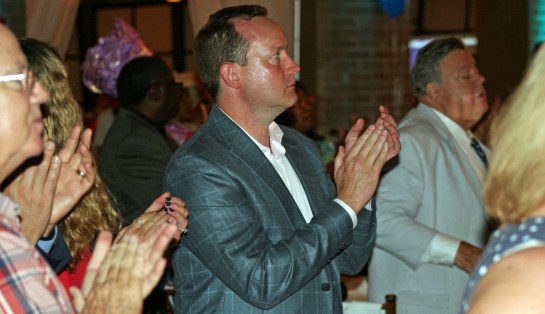
Councilman Kingston at the Breakfast. More photos at Gene Lantz Facebook

He’s absolutely right, I’m proud to have been part of it over the last decades and proud of how it’s all coming about. I’d also like to tell him and all, “You ain’t seen nothing yet!”

My weekend

I can’t separate everything that happened from my own experiences, so I’ll just tell it from a personal point of view. Labor Day weekend started at 9 AM on Saturday, Sep 3, for me. That’s when my radio show “Workers Beat” proudly hosted Arthur C Fleming, President of the Dallas NAACP, on the air. Fleming talked about some of the things the great civil rights organization is doing here. He sounded very practical, very businesslike.

It started getting really good when he talked about taking Confederate monuments off taxpayer-provided property. Now that’s a subject that I love! But I had to leave the show with my buddy Bonnie Mathias while I ran for the Martin Luther King Jr center in South Dallas.

Reverend Ed Middleton and Lauren Tenney had organized the annual Workers Rights Board Forum and march at the King Center. They let me host the show because I guaranteed them that I am the most strict chairman in all the progressive movement. Overstated as usual, but I’m pretty strict.

All the speakers were great. The high point, for me, was when Herb Keener of CWA 6215 gave a short summary of the wonderful new book, “Runaway Inequality,” which I’ve been raving about on this blog. Herb announced that he and I were organizing a class on the book. Later, we decided to call it for noon on Saturday, September 17, at 1408 N Washington.

After all 4 speakers and a short Q&A, we marched. Lauren led us about 4 blocks away and then back. All on the sidewalk. We’re scared of the Dallas police of course, but not really that scared. I carried my guitar and led “Solidarity Forever” as we marched. Lots of passersby honked and waved their approval!

The AFL-CIO breakfast was the best ever. They sold out of tickets! They honored women in labor and came up with the Linda Bridges award. Bridges led the Texas teachers union until she died. My dear friend Sherron Molina won the award.

Next came the Democrats’ picnic. It was great big, extremely diverse, and confusing all around, just like the Democrats. County Judge Clay Jenkins got a tremendous ovation when he was introduced, but the biggest ovation of all came for my friend Sheriff Valdez.

What’s It Mean to Me?

There really is a progressive upsurge in Dallas. I’ve been there watching it grow. When Sheriff Valdez first ran for office, I was the one who made the motion that the AFL-CIO support her. She got the support and is now one of the most famous sheriffs in America.

The Democrats didn’t always have a picnic on Labor Day. Long before they turned Dallas County blue, Dr Theresa Daniels organized the first picnic. She asked me to lead “Solidarity Forever,” and I did. The Democrats actually took over the idea from a much smaller one in Kiest Park run by the Jobs with Justice group which Elaine Lantz and I had started and run.

The Dallas AFL-CIO didn’t always have a Labor Day Breakfast. There were a couple of years in the 1990s when the unionists just didn’t think it was worth doing. During those years, Jobs with Justice put on Labor Day events just to make sure something happened. The AFL-CIO started it up again and it’s been a growing success since then.

Dallas didn’t always have a Workers Rights Board hearing and a march on the Saturday before Labor Day. Jobs with Justice started that, too.

What’s the Progressive Upsurge in Dallas?

There are several good reasons that Dallas is now a blue county with a successful labor movement. One small contributor is the 25 or so years of steady solidarity work by North Texas Jobs with Justice. Another one is the Texas Organizing Committee, which started as ACORN even before JwJ. Another one is the recent addition of the Workers Defense Project to the Dallas progressive milieu. Another is the great organizing work done by the Dallas Democratic Party. Another is the big change in the national labor movement that came in the leadership elections of 1995. Another one is the three-year-old local leadership of Mark York of the Dallas AFL-CIO.

Put them all together, you get a progressive upsurge!

What’s Next?

Elaine Lantz has proposed, and Mark York has agreed, that Dallas needs some kind of labor/community mobilization committee. We need to consult with a lot of people to decide exactly how it should work, but I’ve found a darned good place to start that discussion: Herb Keener’s class on the book, “Runaway Inequality” by Les Leopold at noon on Saturday, September 17, at 1408 N Washington in East Dallas.

Be there, and let’s keep up the momentum of the progressive upsurge in Dallas!

–Gene Lantz

Click here for more of these ideas


Like a lot of unionists, like all materialists, I’m not really so crazy about the Democrats nor the Republicans. So why not vote Green Party?

exxon-me-nytimes

After all, they’re a progressive party on environmental issues and environmental issues really matter. Since I don’t know much of anything about their candidates, I don’t know anything bad — and the 2016 campaign is smearing both of the major party candidates terribly.

It’s not because, not exactly because, the Green Party took enough votes away from Al Gore in Florida to make George Bush president. It’s not exactly because Texas Greens took half a million dollars under the table from the  Republicans in 2010. By the way, I ran across a good old friend the other day who didn’t even believe it, or maybe he couldn’t remember back that far, so I had to look up a bunch of references for him. I’ll put them down below.

So What’s My Problem?

More than anything else, my whole purpose in doing this blog is to get people to think through their strategy for progressive change. What’s your theory?

My theory is that the entire progressive battle can be boiled down to employers against employees. The employers are what’s holding us back, and the employees are what’s impelling us forward. It’s a matter of choosing sides and sticking with it.

Voting for the Green Party in 2016 is not going to help the employee side. If it means anything at all in this awful two-party system we’re straddled with, it means some help for the wrong side.

People are confused because they don’t know the difference between the American two-party (ugh) system and the parliamentary systems of Europe and other countries. In those other countries. one votes for the party that one loves, and that party gets offices roughly in proportion to the votes they get. In the American system, that isn’t what happens. One of the two parties takes power; the other loses out. Everybody that votes their heart (or their stomach or their endocrine glands) instead of their brain has, at best, wasted their time and everybody else’s. Actually, it’s worse than that.

You’re a leader, even when you don’t want to be. Please realize that whatever you decide is going to affect others. We’re all listening to one another. People are listening to you.So — think!


  1. We’re in a two party system
  2. One, just one, of those two parties is going to take the critical offices
  3. Other people are watching what you do and are influenced by it
  4. Therefore, the right vote is the vote that will advance your theory of progressive change

As I’ve said before in this blog, it isn’t the candidates and it isn’t the parties that matter. It’s the progressive movement. It’s the workers.

–Gene Lantz

Click here for more of these ideas

Some old articles about how the Republicans financed the Greens in Texas

http://www.dallasnews.com/news/politics/state-politics/20100610-Texas-Democrats-take-Green-Party-to-8824.ece

Texas Democrats take Green Party to court over ballot funding

http://www.dallasnews.com/news/politics/state-politics/20100625-Judge-blocks-Green-Party-candidates-from-4442.ece

Judge blocks Green Party candidates from Texas ballot

  • By WAYNE SLATER / The Dallas Morning News

Published: 25 June 2010 06:33 AM

Updated: 26 November 2010 02:41 PM

A state judge blocked Green Party candidates from Texas’ general election ballot Thursday, ruling that illegal corporate money was used in a Republican attempt to put them there to benefit Gov. Rick Perry.

District Judge John Dietz said he expected his injunction would be stayed by a higher court.

He issued the injunction after a day of testimony in Austin that implicated a former top Perry aide in efforts to field Green Party candidates in November.

https://en.wikipedia.org/wiki/Green_Party_of_Texas

The Green Party’s efforts to get its candidates on the ballot for the 2010 elections was challenged when it was revealed that the Green Party’s petition drive had been funded by corporate interests linked to Republican operatives.[1] Republican operatives linked to the reelection campaign of Governor Rick Perry helped to fund the signature drive for ballot access.[2][3] A court challenge resulted in the Green Party candidates being allowed to remain on the ballot, and the near 92,000 signatures gathered in support of the Green Party from registered Texas voters were validated.[4][5]

GOP ties bind Green Party candidates in Texas case

GARY SCHARRER , AUSTIN BUREAU

Published 5:30 am, Tuesday, June 29, 2010

http://www.chron.com/news/houston-texas/article/GOP-ties-bind-Green-Party-candidates-in-Texas-case-1702618.php 

AUSTIN — Even if allegations about an illegal petition drive are true, knocking Green Party candidates off the November general election ballot before they can be proven imposes “a death penalty,” lawyers for the party argued Monday in a written appeal to the Texas Supreme Court.

The party has until Friday to certify its candidates for the fall election, but a judge last Friday ordered it not to proceed because of an “unauthorized illegal contribution” by a corporation with Republican links.

“This case matters because voters should have an alternative to entrenched career politicians. Despite the signatures of over 90,000 Texans, entrenched career politicians and their lawyers want to deny voters the right to choose in November,” said David Rogers, one of the Green Party lawyers.

A GOP front group — with help from Texas Republicans — raised $532,500 in anonymous contributions to help the Green Party get enough signatures to make the ballot. Democrats assume the liberal Green Party gubernatorial candidate, Deb Shafto, would siphon votes from Democrat Bill White and help GOP incumbent Rick Perry.


Why has inflation been so low in the past few years?

money

If interest rates are near zero, and they have been for some years, doesn’t that mean that corporations can borrow pretty much all the money they want? Since the lenders only keep a small “reserve” of what they lend, wouldn’t all this borrowing result in a big increase in the total supply of money?

If we have more or less the same things to buy, and there’s a lot more money floating around, wouldn’t that mean high inflation?

The Money Supply Is Increasing

The Federal Reserve publishes their estimate of the total amount of money in the U.S. They call it “M2” and it includes everything, bank accounts as  well as currency. In July of 2011 it was $9,232.6 trillion, or $9,232,600,000,000. At the end of June 2013, it was $10598.4 trillion. That’s an increase of $1,365.8 trillion in 2 years. I didn’t pick the years, they were just the first ones I found. Probably, the money supply increased a lot more in the 2007-2009 recession period, so the change would be even more dramatic than this recent 15% increase.

That’s Monetary Policy

The operations of the federal reserve are usually made to sound pretty dark and unfathomable, but essentially all they do is increase the money supply in hard times. They have a number of ways to do it, but it’s still just about all they do. I don’t think they can even constrict the money supply — they can just make it grow faster or slower.

Fiscal policy is actually a lot more important. That’s government spending. If the people running the American government had really wanted to get out of the 2006 recession quickly, they would have turned on the spigots of government spending. They didn’t because they didn’t want to. That left the entire problem up to the Federal Reserve and the expansion of the money supply. They fell to their task mightily.

They lowered interest rates to near zero so that businesses could basically get all the money they might want. They started “buying” treasury bonds with money they basically manufactured. Trillions of dollars went into the economy and the goods and services didn’t actually change that much. If something was worth $10 when there were $5 trillion in the economy, it makes sense that its price would inflate to $20 when the money supply doubled. But it didn’t.

So, why no inflation?

Money Has to Move

The velocity of money is how fast it moves through the economy. If it doesn’t move through the economy, it has practically no effect on prices. If the government gives trillions of dollars to fat cats who just sit on it, store it in overseas accounts, or just use it to buy back their own stock, which is what they did, prices don’t change much.

If the government had fought the recession with fiscal policy, inflation would likely have been more of a problem. If the government had hired some of the many unemployed to fix some of the infrastructure, teach the children, or prepare for the future, the new money would have gone into wages — and those wages would have been quickly spent. More money and more velocity at the same time would have resolved the recession more quickly, but there would have been more inflation.

So, the short answer to “why no inflation?” is that the new trillions of dollars went to very wealthy people who just kept it.

Why is Economics so Dark and Illogical?

In olden days, a “philosopher” was someone who generalized from a great deal of knowledge. Today, we divide up all knowledge into various “disciplines” with geniuses in one field completely ignorant of any other field. We divided politics from economics for Heaven knows what reason, and neither one of them makes any sense without the other. The Polysci grads don’t know beans about economics and the Econ grads don’t know politics.

The Polysci profs snow everybody with statistics because they don’t really want anybody to know their arcane secrets. The Econ profs do the same thing. My friend Jorge Rieger compared them to the secretive priests of old, and it’s a pretty good comparison. If you’re interested in a simpler explanation of economics, click here for the Little School.

–Gene Lantz

Click here for more of these ideas


I’m completely optimistic in believing that fundamental change will come to world societies. Further, I believe it will happen before the present rulers destroy us and the planet. It’s because I realize that I’m not any smarter than others, and I’m not stupid. So they’re not stupid either, so we’ll get together and win some day.

Once I was sure that we will be victorious, I began to speculate as to how our victory might come about.

I think there are basically three versions:

torches-pitchforks

  1. People will gather their torches and pitchforks and force the misleaders out
  2. We’ll elect better and better candidates until we actually have a set of good ones
  3. We’ll carry out a worldwide general strike

Torches and Pitchforks

Probably the idea of some kind of violent overthrow of the existing powers is the oldest scenario. It sounds the easiest and the fastest. It’s also the most dangerous, because it’s easy to start thinking that the rest of the world’s villagers only need some kind of a “spark,” — one heroic act of an individual or small group — and then they’ll grab their weapons.

So they try one ultraleftist act of terrorism after another, hoping to get the right “spark.” But it never happens and they just get a lot of people killed or jailed.

Electing Our Way to Power

When President Obama was elected, some people thought we had done all we had to do. He would take care of the rest. Other people thought electing Obama was good and that he could take us part way, then we’d elect somebody even better the next time. In the course of a few elections, we would end up with Judges, Legislators, and Administrators who would save us.

I imagine they felt the same way in 1931 when they elected Franklin Roosevelt. Maybe also in 1859 when Abraham Lincoln took the White House. George Washington?

I think it’s the most popular idea because one doesn’t really have to do much besides vote and a little bit, maybe, of phone banking or neighborhood canvassing. No risk in any of that, and it’s not too hard. If it doesn’t work, then they’ve still earned the right to gripe about everything until the next election.

Stopping the Economy Until We Get What We Want

The idea of a worldwide general strike isn’t as un-historical as it might sound. Workers actually tried it, with considerable success, in 1886. Railroad workers practically shut the nation down in 1877. They might have won their strike if the soldiers hadn’t started killing them. There have been successful city-wide general strikes in several cities, including Seattle and even Houston!

The Industrial Workers of the World was once a big organization that terrified the bosses. Their idea was to organize all workers at their worksites — in every industry — and then shut down the economy. Hundreds of them were deported, arrested, or killed in the bosses’ backlash.

I don’t want to pretend to know more than they did, but they might have done better if they had gone in for organizing communities, civil rights organizations, church groups, and other kinds of affinity groups instead of just workers at worksites. They might also have done better if they hadn’t been so hell-bent on not participating in politics and not forming alliances with other progressives.

The downside of this “stop the economy” idea is that a substantial number of workers and working families would have to be organized. There would have to be unions in critical work places, plus community groups and a lot of other kinds of organizations. And they’d have to work toward co-ordination with the others. It would take political work as well as organizing. That’s a tremendous amount of hard work.

The upside to all that hard work is that leadership would develop. Leadership would also be tested along the way, and we’d end up with the kind of leaders who could actually run a new, better society. Neither of the other two scenarios has that advantage.

What’s the Catch?

There are players on the other side.

It’s easy to think that everybody wants social progress just because we do and almost everybody we know does. But we don’t hang around with the Koch brothers, do we? We don’t hold memberships in the National Chamber of Commerce or the National Association of Manufacturers or the National Right to Work Committee. We’re not listed in the Forbes 500, but other people are, and they don’t want change just as much as we do want it.

If we were to grab our pitchforks, they’d grab their bombs and drones.

If we were to elect good candidates, they’d pour billions into electing bad ones.

The wealthy people clinging to the status quo know what they’re doing. Do we?

2 comments

Did you receive separate fund appeals from “Our Revolution” and from “Brand New Congress” today? I did.

sandersberniefragmented

The Bernie Sanders presidential campaign was a wonderful, mighty force and pulled millions of people together. If it stayed together, it had the potential to make significant changes in our democracy.

But the chances of its staying together began to diminish as soon as the formal campaign ended. Some of the Bernie-ites split because they didn’t want to pull for Hillary Clinton. Others, including most of the working people, agreed with Senator Sanders that the Clinton campaign was the best we could do in 2016. The split didn’t seem too bad.

Then “Brand New Congress” appeared and claimed to be the heirs of the Bernie movement. A short time later, Bernie himself announced “Our Revolution” to carry on the proud banners of the progressive Bernie movement. On his live-stream presentation, he didn’t mention “Brand New Congress” nor any other organization that might come forward and claim the Bernie mantle. Today, they each hit me up for money. Practically simultaneously. That’s not cooperation, it’s competition between fund raising organizations.

I had heard rumors that some Bernie-ite leaders had split immediately before the live-stream presentation. If the rumors are true, I don’t know why they left. But if they did, it’s fragmentation that the progressive movement can ill-afford.

A movement is more than fund raising

I was very pleased to hear Bernie Sanders mention forms of struggle beyond electoral work. So far, I haven’t seen any of it, but I think a national march or a series of regional marches might help pull people together. Activists aren’t going to participate forever with organizations that only raise money for electoral campaigns.

Unity doesn’t come easy

Even a great reform program like Bernie’s isn’t magnetic enough to hold a large, diverse political group together. Even a great charismatic leader like Bernie isn’t enough. People need understanding and theory that can lead us to victory, not just terrific slogans and terrific leaders.

How do you think the change you want can come about? Think it through and let your conclusions be your guide.

–Gene Lantz

Click here for more of these ideas


For a while there, activists thought some of the countries in South America had gone socialist. People pointed to the peoples’ electoral victories and had the highest admiration for progressive elected leaders like Hugo, Evo, and Lula. Some thought they had it made.

struggle

The progressives are under fire today. Hugo died, one of Evo’s ministers was recently murdered by striking miners, and Dilma Rousseff is on trial in Brazil.(Click here for a very good article). Is it Salvador Allende all over again?

I’m not going to say that anybody in any of those South American progressive movements did anything wrong. They’re there and I’m here. They know a lot of stuff that I don’t. The point is that nothing comes easy.

Everything that working people can win can be lost again as long as the bosses remain in power.

Just one more thing. Don’t think that what happens in Brazil, or anywhere, isn’t part of your own struggle. They will never win without you, and you will never win without them.

–Gene Lantz

Click here for more of these ideas