Archive

unions

I love this union cause.

— William H. Sylvis, founder of the National Labor Union

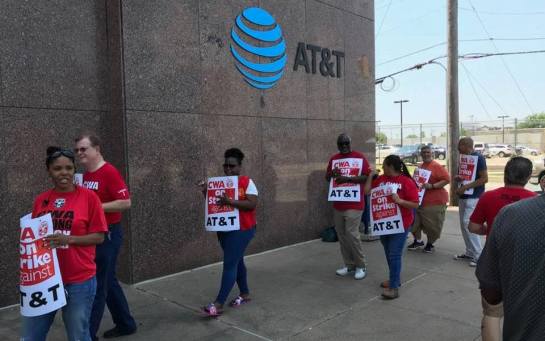
I had to hurry with the Dallas Labor Newsletter today because I didn’t want to miss picketing with Communications Workers Local 6150 over at the AT&T building.

sherron-legacyT

There was a national walkout concerning around 20 unions today, according to CWA 6150 President Scott Wilson. Here in Dallas, workers expected to stay out only four hours. Wilson was careful to let me know that this was an Unfair Labor Practices (ULP) strike, not an economic strike.

Legally speaking, and unions have to be scrupulously legal under the watchdog eyes of a hostile government, there’s a lot of difference between a ULP and an ordinary strike. One of the main differences is that companies can’t just replace everybody that goes on strike if it’s ULP.

Today’s strike will be examined by the National Labor Relations Board. I imagine that the company will claim that they committed no unfair labor practices, and of course the union already said that they did. According to Scott Wilson, the company started contacting each union member individually to try to convince them to take whatever the company wanted them to take. That’s illegal.

Unions elect their bargaining committees. It’s supervised by the government and done very carefully. Then company representatives and union representatives sit down together and work something out — or that’s the way it’s supposed to work. If the company went around the process and started approaching individual members, that’s illegal. AT&T surely knows that.

The trouble is, they also know that the Labor Board isn’t likely to penalize them much, if at all. Companies are getting more and more aggressive against their workers because the government is so completely and savagely against us this days. The Supreme Court just ruled that employers can take away our right to sue them when they misbehave. The President just passed three anti-union executive orders. Another Supreme Court case, “Janus Versus AFSCME,” may impose anti-union “right to work/scab” rules on all federal employees. We’re holding our breath on that one.

If you think about it for a minute, you realize that an attack on the right to organize is an attack on democracy. Organizing is just about the only way that ordinary people can defend their democratic rights. Take that away and you have fascism.

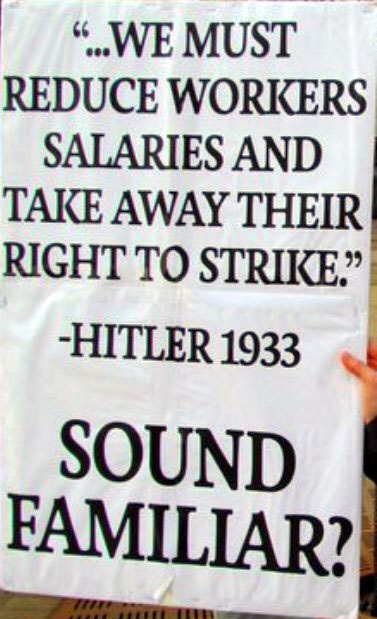
Hitler knew that. That’s why one of his earliest moves was to outlaw all unions and seize their assets.

There’s a solution

The solution for saving the right to organize lies in solidarity with one another. In the last couple of decades, unions have gotten better and better about helping other progressive organizations and individuals. Take for example the environmentalists who picketed Exxon/Mobil last week. Three of us local union members spoke at it, and then, best of all, we heard from one of Exxon’s victims in — believe it or not — Australia! I recorded the Australian oil worker’s comments on Facebook, and it’s had 1,400 views so far.

But other progressive organizations do not ordinarily rally to help unions. At the CWA 6201 picket today, only union members were there. In fact, I was the only one who wasn’t a member of that local. Part of the problem is that unions haven’t learned to ask for help, but part of it is sectarianism and anti-worker sentiment on the part of some other activists.

When we get together, we will win.

–Gene Lantz

I’m on KNON radio FM 89.3 in Dallas every Saturday at 9AM central time. Podcasts are available on the “events” tab. If you are curious about what I really think, check out my personal web site.

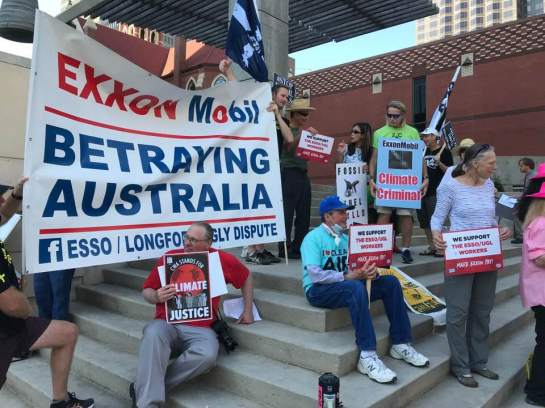
About 25 people from all over Texas and three guys from Australia protested Exxon/Mobil’s shareholder meeting in Dallas on May 30.

exxon-australia

The sometime biggest, and sometime second biggest, corporation in the world has its headquarters right outside Dallas. They hold their annual shareholders’ meetings in the luxurious Meyerson Symphony Hall downtown. Across the street, labor and environmental activists revealed corporate crimes to newspersons and the world at large.

The surprise group came from Victoria’s Gippsland Basin, Australia, where Exxon has 23 offshore installations. Their spokesperson, Troy Carter, spoke on Facebook Live for seven minutes. He said that 230 members of the Australian Workers Union and the Electrical Trades Union were terminated 343 days earlier. The next day, they were offered their jobs with a 40% pay cut! They have been protesting every day since.

The Australian’s printed materials were meant to explain to Exxon stockholders that the corporation was spending a lot more on union busting than it would have cost them to keep their well-trained workforce. But the corporation would not let them into the symphony hall; consequently they had to disseminate their message broadly.

In the United States, the Australian’s tour is being helped by the United Steelworkers of America. The Australians plan to meet with Dallas AFL-CIO leader Mark York before heading to Austin to talk with Texas AFL-CIO leaders. Their Texas tour will end in Houston, where there are many petrochemical workers.

Speakers talked about the danger to our planet from fossil fuels. A woman from Corpus Christi, on the Texas coast, said that her organization was trying to stop Exxon from building the biggest plastics factory in the world. “Do you want more plastic in your oceans?” “Do you want more plastic in your air?” “Do you want more plastic in your bodies?” she asked.

A man from Waco, in Central Texas, talked about special environmental problems caused by Exxon in his hometown.

Herb Keener of Communications Workers 6215 and Gene Lantz of United Auto Workers Local 848 spoke for the “blue” section of the “blue/green” (labor/environmental) alliance. Keener’s talk was captured on Facebook Live. He mentioned that he expected Exxon to follow other major corporations in spending their windfall from last December’s giant tax giveaway by purchasing their own stock. These financial maneuvers enrich stockholders without any benefit to employees nor to the general economy.

The protest had a long list of sponsors: 350 Dallas, Society of Native Nations, Dallas Peace and Justice Center, CodePink Dallas, Communications Workers of America/CWA Local 6215, Dallas Sierra Club, Downwinders At Risk, Dallas Palestine Coalition, Pax Christi Dallas, Our Revolution North Texas, Texas Drought Project, Texas Environmental Justice Advocacy Services (TEJAS), Solidarity Texas – Dallas Chapter, System Change Not Climate Change, Veterans For Peace North Texas, Waco Friends of Peace and Climate, Texas Coalition for Environmental Awareness, and more.

-Gene Lantz

I’m still on KNON radio 89.3 FM in Dallas at 9 AM Central Time every Saturday. Podcasts are available from the “events” tab on the site. If you are curious about what I really think, check out my personal web site.

The Supreme Court pro-corporation, anti-worker, decision on May 21, 2018, was a giant step toward fascism. The nastiest five judges ruled that employers may force all employees (that’s almost all of us) to abide by their orders without recourse to the courts or to class action lawsuits.

The bosses call it “mandatory arbitration,” but Ruth Bader Ginsburg, speaking for the dissenting four judges, called it “egregiously wrong.”  In almost all aspects of American life, a citizen has the right to sue to enforce laws, but not any more.

Ruth Bader Ginsburg

The days of big class-action lawsuits to enforce civil rights or civil liberties laws in the workplace are gone. Every individual with a grievance will now be forced to face the corporate lawyers alone and in a corporate-dominated arbitration procedure! Shortchanged by your boss? Ripped off by your boss? Sexually harassed by your boss? Racially persecuted by your boss? Tough luck!

Individual workers’ grievances rarely amount to enough money to make it worth a lawyer’s time; consequently, few workers will even be able to find a lawyer. Something similar happened in Texas when workers’ comp cases in Texas were put under mandatory arbitration  — injured workers couldn’t get legal representation!

What Will Happen?

A lot of big employers have already persecuted their employees with these arrangements. Now, nearly all of them will. Workers will have a choice: sign your rights away or forget about this job!

If working conditions are poor in America today, expect them to get worse. If bosses flout the law today, expect them to flout it more.

If right is right, a lot more working people are going to investigate unionizing. Union workers usually solve their grievances under arbitration, too, but the system is set up under rigorous labor laws, and the union can still appeal to the courts.

Whether or not a big increase in union organizing really happens depends partly on whether or not workers realize the full extent of their most recent screwing. That means that we are going to have to make a robust organizing effort, and that will be difficult after the pounding our unions have taken since 1980.

The Supreme Court’s next big labor decision, in the hands of the same guys, may be a major attack on union finances. That would make a major national organizing effort even more difficult.

But organizing is exactly what has to be done. Everyone who can feel the hot breath of fascism drawing near needs to rally around the working class. Those who can form unions must form them. Those who cannot form unions must join constituency or auxiliary groups associated with labor. If that happens, and it is what must happen, then we cannot be defeated.

–Gene Lantz

I’m on KNON radio 89.3FM in North Texas every Saturday at 9 AM Central Time. Podcasts can be found under the “events” tab on the web site. If you want to know what I really think, check out my personal web site.

Several socialist groups came together on April 29, 2018, in Lake Cliff Park in Dallas to celebrate MayDay. They were kind enough to allow the oldest person in attendance to remind them of the long workers’ tradition by leading singing of “The International.”

Another Mayday celebration, by another group of socialists, takes place at Kidd Springs Park at 5:30PM on May 1st. One cannot help but observe that the progressive movement, even the activists who supposedly have the highest levels of consciousness, continues to be disunited. It’s like Will Rogers used to say about the weather: “Everybody talks about unity, but nobody does anything about it!” I believe the trend, though, is positive.

The trend toward celebrating the International Workers Day is a very positive sign. I can remember reserving that very same Lake Cliff Park pavilion May 1, 1984, and doing all the preparations and publicizing myself. Then I sat there, alone, for two hours hoping somebody would come, but they didn’t! This year, we have two of them. The first one had about 40 people, and I imagine the second will be at least as big.

I’ll be doing a talk about “MayDay Then and Now” at Roma’s Pizza, 7402 Greenville Avenue, beginning at 6 pm on Saturday, May 5th. I’d like to count that as a third MayDay celebration. Every year, I publicize MayDay on my radio show.

MayDay Has a History

The workers’ movement, of course, goes back at least to Moses and the slaves of Egypt, and workers probably celebrated the vernal equinox around MayDay long before they had calendars. But the year 1886 marks the close association of the workers’ movement with May 1.

That year, the word went out from Chicago for a worldwide general strike to demand the 8-hour day. There were protests everywhere. Strikers were killed in Chicago. A police riot erupted on May 4th during another rally in Haymarket square. Authorities came down hard on the Chicago movement and, in 1887, hanged four of the main leaders. Since then, the world remembers “Chicago, 1886” on May 1st.

The repression from the bosses combined with the opportunism of many American labor leaders separated the Americans from the International Workers Day; consequently there have been few celebrations here until recently.

Was Labor Stronger Before?

Almost any reading of labor history will bring out the romantic in us. We long for the great general strike of 1874, or the worldwide struggle of 1886, or the organizing frenzy of 1935-1947. In 1980, when the American government decisively teamed up with the bosses to suppress the labor movement, unions began a numerical free fall that continues today. We had 35% of the workforce organized into unions, and we have only 11% now. People dream about the good old days.

No, We’re Stronger Now!

But despite the decline in union numbers, American labor is actually stronger today than ever. Part of the reason is productivity, but most of it is education. One worker today is four times as productive as those who organized in 1935-47. If one worker walks off the job today, it’s like four workers striking in the old days.

We have more unity than ever. In 1935-47, remember that the American Federation of Labor and the Congress of Industrial Organizations were two separate and competing organizations. Remember also that racism and other kinds of chauvinism were far more divisive in the “old days” than they are today. The AFL-CIO didn’t even try to organize the millions of undocumented workers before 1999 — they joined the government in calling for deportation!

Today, the AFL-CIO bends over backward to work with church, civil rights, and community organizations. In 1987, unions were so totally isolated that five of the more progressive ones had to create a separate organization, Jobs with Justice, to try to build solidarity outside the official labor movement. Today, virtually all unions have gone past their initial hostility and regularly work with Jobs with Justice and other solidarity efforts.

In the old days, many workers were barely literate. Today, we command more information than they could have imagined. With our phones and computers, workers have the ability to function as almost a single worldwide unit. That’s power! We’re only at the first stages of using it, but today we have the power!

–Gene Lantz

I’m on KNON radio at 9AM Central Time every Saturday. Podcasts can be found from the “events’ tab. If you are interested in what I really think, look at my personal web site.


Book Review: Rosenblum, Jonathan “Beyond $15. Immigrant workers, faith activists, and the revival of the labor movement.” Beacon Press, Boston, 2017

Jonathan Rosenblum led the long campaign that ended when Sea-Tac, Washington, won a $15/hour minimum wage. Even if he had never done anything else, everyone should read his book.

VB jonathan rosenblum_1

But he actually did a lot of other things in thirty-odd years as an organizer. He’s on Wikipedia at https://en.wikipedia.org/wiki/Jonathan_Rosenblum_(activist).


I knew Jonathan when we both headed local Jobs with Justice chapters. As I recall, his statewide group included five successful chapters fighting for justice along with unions, churches, civil rights organizations, and community groups. Both of us were at the Battle in Seattle.

Jonathan was working for the Service Employees Union (SEIU) when he helped bring about the ground-breaking miracle in Sea-Tac. But his success came from the Jobs with Justice approach of bringing everyone together, union or not, to focus on a common problem. It’s something that almost all organizers talk about, many of us try, and very few have actually found their way to victories. On the other hand, traditional union organizing drives have been failing for decades.

During my own 25 years with Jobs with Justice, I joined many many union campaigns. All of them welcomed my help and the help of the diverse organizations and spokespersons that I worked with. I can’t think of a single union, though, that significantly accepted our input in the process. We were always helpers, and willing helpers at that, but never partners. That’s the difference in the Rosenblum approach.

Without going into historical reasons for it, Rosenblum blames the “business unionism” that took over in the United States in 1947 and continues today, for our failures and our diminishing union density. He doesn’t overlook the all-out anti-worker government initiatives that have prevailed since 1980, in fact he describes the assault concerning the airline industry in detail, but he thinks that today’s unions could cope a lot better than we have.

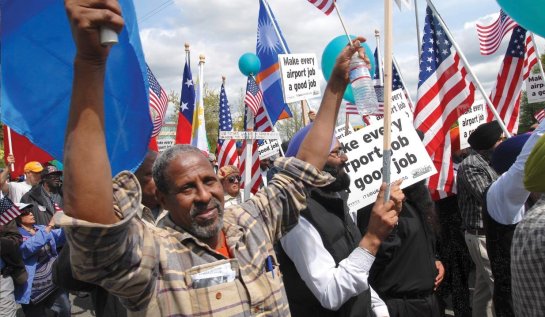
sea-tacdemo

Coping with the joint business/government offensive against working people is not just a matter of making a few adaptations. Rosenblum believes that present union structures are doomed to failure and must be rebuilt on a new basis of solidarity with all workers. He doesn’t comment on the present efforts of the main labor federation, the AFL-CIO, in a strong progressive direction, and that is possibly because his SEIU union had split away.

Value of Union Bargaining

I don’t know if my own endorsement would mean anything, but I 100% agree with the following quote about our complete misunderstanding of the bargaining process:

Page 164: “In my experience bargaining union contracts and negotiating with politicians, I found that labor negotiators – both paid union staff and also union members – nearly always overestimate the importance of what happens at the bargaining table. The process of negotiating can become all-consuming. In that environment it becomes natural for participants to overvalue factors like the strength of the spokespeople, the authority of facts and data, the logic of the argument, or your relationship with your management counterpart. You begin to believe that the bargaining room is the center of the struggle. But it’s not. It’s just the place where workers reap the rewards of the pressure that they’ve been able to imposer on an adversary through collective workplace or street action, economic or political leverage, and media coverage. And the bargaining rewards will be in direct relationship to the amount of power that workers have been able to exert away from the table.”

Finding Answers

Leadership is knowing what to do next. Unfortunately, Rosenblum can’t offer a “cookbook” for success in all campaigns. He offers a lot of inspiration and some very general guidelines on his last page:

Pg191 (last page summary): “Big change won’t come from the brilliance of individual leaders or a political masterstroke, but rather by combining the thousands of acts of simple courage and grace that on their own may seem inconsequential, but together make for wholesale transformation. From these daily lessons, from the wreckage of our present circumstances, we can create a new labor movement, win back power for working people, and build a just society.”

Don’t miss this book!

–Gene Lantz

I’m still on knon.org at 9 AM Central Time every Saturday. Podcasts for the last two weeks are available from the “events” tab on KNON’s home page. If you want to know what I really think, check out my personal web site.

While they are common in Europe, most of us have never seen a big political strike in our lifetimes, until now.

okla-teacher3

The strikes in West Virginia, Oklahoma, Kentucky, and Arizona represent a big step up for the American working class. Newspersons are treating the phenomena as something angry teachers are doing, but it is much more than that. It’s a giant step upward for  American workers.

What Is a Political Strike?

Almost all we know about strikes in America since 1947 is limited to actions against a single employer. The austerity oppressing American workers since 1980 has not been met with the kind of united class action we commonly see in Europe. The French railway workers, for example, are just about shutting down the nation right now, and it’s not so they can get a raise. It’s a political strike against government! So are the school employees’ actions in the United States!

If we organized for it, we could be conducting concerted action everywhere to get an increase in the minimum wage. The “Fight for Fifteen” could be a political strike, and I believe that, sooner rather than later, it will be.

It’s Not Just Teachers

Teacher aides, bus drivers, cafeteria workers, and all kinds of school employees are doing picket duty. They are joined by students, parents, and the public at large. School administrators, in many cases, are helping by shutting down the schools so that strikers can make up the pay they’re losing with extra school days in the summer. Many politicians and high-profile personalities such as sports figures are on our side. Just about every progressive person is spreading the word on social media.

The demands are not limited to teacher raises. The strikers are demanding an end to the steady starvation of public education and full funding for everything the students need.

It’s Not Just Unions

In fact, I’m not even sure that the unions are directly involved. If one looks at the web site for the Oklahoma Education Association or the Oklahoma American Federation of Teachers, it’s hard to tell what’s going on. Both of their Facebook Pages have some good photos, but very little to show that the biggest unions are backing the strike. I have a theory about that.

One of the leaders from West Virginia told me that their strike was “wildcat.” It means that the official unions did not call it and did not officially support it. It also means that the official unions were not legally nor financially responsible for it. My theory is that America’s unions are so constrained, so hogtied, that they dare not push the legal limits with such an action. I’m guessing that all the strikes today are “wildcat.”

I don’t exactly blame them. Unions represent their members and that’s all, no more no less. If they go out on a limb, they may be risking their entire existence. They could be fined every cent they have and then some. Officers could be put in jail. It would not be the first time that the government has punished organized workers. Would that be the responsible thing for a union that represents all its members?

CHEERS to the AFL-CIO Labor Federation

The American Federation of Labor/Congress of Industrial Organizations is not a labor union. It is a federation and consequently has a different legal and political situation. In my opinion, the present AFL-CIO leadership is far in advance of most of their constituent unions. That’s why I emphasize that all progressives should be working with them.

President Rich Trumka has given the national AFL-CIO position on teacher strikes: “When working people dutifully play by the rules and still can’t get ahead, they’re going to upend those rules. That’s exactly what’s happening today. Teachers, from West Virginia and Kentucky to Oklahoma and Arizona, are fighting to overturn a rigged system that has left them behind for decades. They’re inspiring a resurgence of collective action among all working people who are hungry for real change to improve our lives. The 12.5 million members of the AFL-CIO are proud to stand with all those marching to secure a brighter future for our teachers, students and families”

The only part of Trumka’s statement I disagree with is where he said it was “teachers.” Teachers may be spearheading it, but we are witnessing a giant working class process. Conditions, meaning low unemployment and high discontent, are ripe for it to spread throughout the nation.

–Gene Lantz

I discuss these things on KNON’s “Workers Beat” program at 9 AM Central Time every Saturday. From the “events” tab, you can see the last two programs. If you want to know what I really think, check out my personal web site


The Economic Policy Institute recently ran a couple of good studies about wages.
hitlerquote

Factory Workers Earn More Money

EPI says, “…manufacturing workers still earn 13.0 percent more in hourly compensation than comparable private-sector workers. This manufacturing premium, however, has declined by about one-fourth (3.9 percentage points) since the 1980s, when it was 16.9 percent.” So why do manufacturing workers make more money than “comparable” people? And why is the margin diminishing?

Here’s another question that bugs the heck out of my friends who work in aerospace but are members of the Auto Workers Union: “Why do auto workers get much better contracts than aerospace workers?” We work just as hard and have had as much or more training. We have the same national union leaders, the same history, and the same intentions, but our wages and conditions have never been as good as theirs. Why?

It’s Not the Work, It’s the Organizing

Manufacturing workers are easier to organize than other workers. There are more of them in one place. They work closer together. They live closer together, They have more of the same interests. Contrast, for example, techies. Techies are notoriously hard to organize, even though they may really want a union. They live all over the place. They work almost entirely alone. Some of them actually work at home. They tend to travel for work. They don’t usually advance within the same company, but move from one company to another for advancement. It is very hard to organize techies.

The easier we are to organize, the more likely we are to have a union and thus get better wages.

Aerospace workers can cuss the auto workers all they want, but the fact is that auto workers were easier to organize. Assembly line production calls for the highest levels of cooperation among workers. Take just a few of the workers off an assembly line, and it has to shut down!

Airplanes, for the most part, aren’t made on assembly lines. It’s hard to win a strike in aerospace, but it’s much easier in auto. Better organizing, better contracts!

Why Is the Gap Decreasing?

EPI says that the gap between [organized] factory workers and everybody else is decreasing since 1980. I almost laughed when I saw that date. 1980 is the year that American government set new anti-worker policies and elected its best enforcer —
Ronald Reagan. So the question answers itself.

Unionism in America has atrophied beneath the government assault, and the advantage of unionism is not nearly as widespread as it was pre-Reagan. We fell from 35% of the workforce to the present 11%. Union workers still make way more money than non-union workers doing comparable work, but there just aren’t that many union workers left to bring up the statistics.

Whose Wages Are Rising?

The other interesting article from EPI said, “States with minimum wage increases between 2013 and 2017 saw faster wage growth for low-wage workers compared with states without any minimum wage increases (5.2 percent vs. 2.2 percent).”

Last month, Wall Street had a minor panic when it was announced that wages were rising for the first time in recent history. They were barely rising, but they were slightly higher than inflation for that same period. Since then, economists and political pundits have been saying that wages will continue to rise and that the government will have to take steps, such as raising interest rates, against the trend.

Capitalists may say otherwise, in fact they do, but they do not want wages to rise.

But wages did, statistically, rise a little bit in February, 2018. The reason was that some local and state governments, responding to political pressure from working people, were beginning to raise their minimum wages. An increase for low-wage workers has a profound effect on statistics, because there are so many low-wages workers. Also, all wages tend to rise when they are pushed up from the bottom.

Nineteenth century writers Karl Marx and Frederich Engels noted that workers would tend to benefit themselves more by organizing politically than they would by fighting the bosses one company at a time. It’s not a new idea; it’s just a true one.

Crossing the Line

There are a lot of references to “the line” in literature. There’s the “red line,” there’s the “line in the sand,” and there’s the “picket line.” If you want to get someone to answer the question “Which side [of the line] are you on?” just ask them if they support increasing the minimum wage. It cuts through a lot of verbiage.

Even though unemployment is statistically low, and the time is ripe for organizing, your own wages aren’t likely to rise much until you actually organize. Either organize a union on the job or organize politically to raise wages. That’s the road to success!

–Gene Lantz

I’m still on KNON.org 89.3FM in Dallas every Saturday at 9 AM Central /Time. If you want to know what I really think, check out my personal web site.


 

The West Virginia teachers strike of 2018 was one of the most dramatically successful labor events of recent times. After striking for 9 days, they won a freeze on new health care costs and a 5% general wage increase for themselves and for all state workers! In addition, it was basically a wildcat strike, which means that it was not officially called by any of the three major unions involved and, thus, did not have their official backing. Official backing usually means strike benefits such as a small weekly stipend and, sometimes, health care for the duration of the strike. They didn’t have that.

teacherstrike

On March 10, I had an organizer from one of the West Virginia support groups on KNON radio. Steven Noble Smith said that the preparations had begun last December. Here is how he described the overall characteristic of the strike: “It was rooted and grounded deeply in the everyday pain of working people!”

Smith’s group was one of several that joined in backing the school employees as their movement grew. “Everybody was welcome in this movement,” he told the KNON audience. At least one of the supporting organizations was political, the Working Families Party. Others had been inspired, perhaps, by the Bernie Sanders movement, or perhaps by their disgust with the current government.

One of the contributions of Smith’s group was raising funds for some of the workers who were striking without any remuneration. The money raised in a short period, over $300,000, was impressive. I also found out from Smith some of the other elements of a successful labor action such as training, regular public action, social media, and interacting with commercial newspersons. But what, I asked him pointedly, was the key?

Smith explained, “What matters… is mass action!” Beginning last December, school employees had been holding public actions. The group planning and the individual contributions, Smith said, were very innovative. Many of the actions took place in the state capitol.

Responses Not So Hot

The total victory in West Virginia was announced around March 6, which was primary election day here in Texas. There was news coverage, especially from national sources, but it was dwarfed by local election news. That’s not the worst of it.

I also went around and asked some of my union friends about their responses to West Virginia. They were pleased and a little bit awed. But any suggestion of seeing what we could do here at home brought exactly the response I had been dreading. “I wish my own union had members like West Virginia!”

It’s not just lately, I’ve been hearing this from union leaders for forty years! “Our members are chicken,” “Our members are Republicans,” “Our members would never take action,” etc etc etc. Excuses!

My Big Gripe

I can understand why unions seldom go on strike. Nobody wants to. There’s a lot of pain and a lot of risk involved. The government pretends to be neutral, but it isn’t. Even easier forms of concerted action such as boycotts, petitioning campaigns, and slowdowns are perilous for unions and for the individuals involved. That’s not my complaint.

My complaint is that unions and, especially, union staffers, don’t try. Undoubtedly, the West Virginia school employees were not ready to strike last December. It took three months for them to get ready, and that three months of preparation paid off for them in March.

That’s what we ought to be learning from West Virginia — that preparations for concerted action should under way. Otherwise, how do we expect to survive the present onslaught?

-Gene Lantz

I’m still on KNON radio 89.3FM every Saturday from 9 AM to 10AM. If you want to know what I really think, check out my personal web site

Take a look at recent news from the point of view of the progressive movement. Keep in mind that only the working class, and working class issues, can truly pull the movement together. The entire working class will not unite over gun control, over the right to abortion, over civil rights, or any of the other important causes. Wages and working conditions will unite us, because all of us care most about them.

On May 6, Texas held the first primary elections of the season. Democrats were overjoyed to double the turnout that they had in the last mid-term elections. Republicans improved about 15%. But the raw number of votes determines election winners, not percentages of improvement. While the Democrats were able to get a million voters to the polls, the Republicans got half again as many. The leading Democrat, Beto O’Rourke for Senate, got 600,000 votes, while the Republican incumbent got 1.3 million! The same was true in the governor’s race.

One of the reasons for improved Democratic Party turnout was that they fielded candidates in every race, even in the ones where they were almost sure to lose. There’s a downside to that, because some of the contested seats were held by rock-solid working class incumbents with 100% pro-worker voting records. Politicians are mostly opportunists, not principled leaders.

Labor is calling the results “mostly good news” because over 90% of our endorsed candidates got into runoffs or won outright. But we lost three of the best of the state representatives, including Roberto Alonzo of Dallas who has been honored nationwide for his commitment to labor’s cause. Labor worked hard for their candidates

Progressive Movement Remains Fragmented

No one could deny that there is an upsurge in the progressive movement since the 2016 elections. The big improvement in voting statistics demonstrates it. But cohesion is not one of the grand characteristics. The most unifying theme among Democrats was dislike for President Trump, according to the pundits.

But the only way they could unite effectively is around the basic issues of the working class, and the election results did not show that trend. While the AFL-CIO could honestly claim a 90% success rate, another organization, Emily’s List, which only endorses on women’s issues, could claim 100%, according to the Politico news service. All their endorsed women were in runoffs or had won outright.

Labor’s candidate for the Democratic nomination for governor was controversial because of being a woman, a Latina, and gay; but she won a thumping big plurality and goes into the runoff with a big advantage among Democratic voters. It would be a stretch to claim that she did so well because of the AFL-CIO endorsement, when Emily’s List had better results.

People who want serious change remain confronted with this problem: how can we unite the progressive movement?

Best News Was Barely Reported

While pages and pages of newsprint covered the Texas elections, there was scant coverage of the teachers’ strike in West Virginia. But from the point of view of unifying the progressive movement around workers’ issues, the news from West Virginia was at least as important, if not more so. For the first time in years, American labor saw a well planned and well-executed strike create big gains for workers. By holding out statewide for nine days, those teachers won a 5% raise for themselves and for all state workers. They also got a freeze on health care costs. The AFL-CIO Executive Board endorsed the strike in, I think, about the 7th day. The American Federation of Teachers spoke encouragement, but I didn’t see any of the nationwide forces really throwing themselves into it. The main fund raising I saw was one of those “go fund me” accounts.

In today’s news, way back in the back pages, teachers in Oklahoma have issued an ultimatum to their legislature. Arizona teachers are also talking strike.

Historical View is Bad, but Mostly Good

A lot of people, including me, believe that economic conditions are leading the capitalist class toward choosing fascism as their preferred form of rule. The great robbery called the “tax cut” went through Congress in December with very little popular support. Despite their best efforts, it is unlikely that the rich will convince Americans to warm to it very much.

What I’m saying is that it is getting harder for the rich to continue robbing the American people. That’s why they are working so hard to disarm us with voter suppression, dangerous foreign policy, anti-union legislation and legal decisions, deregulation, redistricting, and destruction of civil rights and civil liberties. Once our rights are gone, we can’t defend ourselves at all. That’s fascism.

Even though I think the obscenely wealthy are likely to choose fascism, I don’t think they will be able to implement it. That’s the good news. We aren’t as dumb as they may think. Actually, we’re far better educated and far more capable of coming together than the Italians and Germans of the 1930s were.

This is the time to organize. Low unemployment and high discontent are the ingredients for a great upsurge. Despite the low voter turnout numbers, Americans have more energy, and it is more generalized, then at any time since World War II. We may be fragmented, but we won’t stay that way. Once we are united, nothing can stop us!

–Gene Lantz

I’m still on KNON radio 89.3FM in Dallas from 9 to 10 AM Central Time every Saturday. If you are interested in what I really think, check out my personal web site.