Archive

unions

2018 stretches before us like a blank canvas. Economists and Republican politicians are painting a gorgeous festival on it. Democrats are using only one color: black.

fat-famine

Predictions Take the Safe Road

Nearly all predictions are just linear projections of trends currently underway. For example, American production has been rising slightly so the prediction is that it will rise even more. Unemployment has been low, so the prediction is that it will stay low. I saw one prediction saying that wages will go up in 2018, even though they have been going down since the 1970s.

For A Few, Everything Looks Great!

The disastrous “Tax and Jobs Bill” that just passed the Congress shows what is intended. It is a gigantic giveaway to the rich at the long-term expense of the poor.  This is not a new trend. It has been going on clearly since American domination of the world began to diminish in the late 1970s. It is reasonable safe, therefore, to predict that the rich will continue to get much richer and the poor much poorer in 2018. Inequality will worsen.

Using the same linear projection approach, one would have to conclude that democracy will continue to ebb and the environment will get even less hospitable.

Politics May Get Messy

The last poll before the Republicans passed their big giveaway, conducted by NBC News, said that only 24% of the American people supported the legislation. Republicans say that people will start liking it as soon as they see tiny improvements in their paychecks beginning in January. Democrats say that support for “trickle down” will fall even further as people see what was actually in the bill.

As 2018 begins, Republicans and their only legislative accomplishment are extremely unpopular. President Trump has the lowest ratings in history. Does that mean that they are going to take a mighty hit in the November elections? Are the Democrats going to take charge and bring back the rosy Obama days?

We should be skeptical. Republicans are backed by an awful lot of money, and money wins elections. Also, they hold state power. Who is to say how they might use their money and their power before November?

They might, for example, start another war. They’ve been talking up war with North Korea for months and they have the ability to start such a war just at the time when they consider it most propitious for their election prospects. It worked for both Bush Presidents, who had low ratings before invading Iraq and high ratings afterward. Sure, lots of people would die, but Republicans might well benefit at the polls!

Before deciding that the Democrats will surely make a comeback in November, remember that they have problems of their own. They robbed Bernie Sanders of the 2016 presidential nomination and, by now, everybody knows it. Deputy Democratic Party  Chairman Keith Ellison is touring America right now to try to bring all the Bernies back into the fold, but it’s safe to say that some of them won’t come. The Democrats would have to be really sloppy to not make some gains in 2018, but will they actually turn things around?

In summary, the safe set of expectations for 2018 is that it will be great for the great, but not for us.

What to Hope For

A lot of really good  things could happen in 2018. Low unemployment and high consciousness are requisites for an organizing boom. If unions and the other types of organizations presently underway aggressively take advantage of the situation, we could see some real organizational strength develop for working people. Then (and only then) we might expect to see a reversal in the steady decline in our American wages, benefits, and living standards.

There must be half a dozen organizations expecting to take over the Democratic Party, end all corruption, end its dedication to capitalism, and make it a workers’ party. There are others who believe they can create a workers party — perhaps from the Greens or from the Working Families Party — or from scratch. Conditions for a workers party have never been better because of the high educational levels and consciousness of the American people.

The progressive movement is a giant in America. The Women’s March on the day after Trump took power put more people on the streets than ever before in American history. They are planning another one in January 2018.

Even though very few Americans even know what a political strike is, they are becoming common in other parts of the world. With modern communications and the high level of consciousness among people, especially among young people, we may see major changes in America that come from outside the electoral system.

Expect the worst. Hope for and work for the best!

–Gene Lantz

I’m still on KNON radio, 89.3FM in Dallas, at 9 AM Central Time every Saturday. If you want to know what I really think, check out http://lilleskole.us


Book Review:

Schrecker, Ellen: Many Are the Crimes. McCarthyism in America. Little Brown and Company, Boston, 1998.

whitebread

I remember the 1950s like white bread: bland, not nourishing, and an important part of every meal. Books, movies, and all things cultural talked about “the American way” as if it were the best of all worlds and the best ever created or imagined. Socialism was never mentioned, except in a pejorative way in movies like “I Married a Communist” or “I Was a Communist for the FBI!” We did not smoke dope in Muscogee, or anywhere else as far as I knew. We kept our hair short and our minds shorter.

It has taken many years for me to realize that the wasteland of the 1950s was created deliberately. Too bad I didn’t have Ellen Schrecker’s book in 1953! It would have saved me a lot of personal anguish.

communist-dead

Schrecker details important aspects of the anti-communist crusade from World War I to modern times. Except for a brief period during World War II, when the United States and the Soviet Union were wary allies, the crusade was relentless.

Schrecker is an academic, so don’t expect her to take sides. She’s just reporting what happened. Academics are afraid to take sides. However, the sheer immensity of the government-run effort to destroy civil rights, civil liberties, and any kind of resistance speaks for itself.

The author reminds us often that she doesn’t sympathize with the communists. She stands on the high ground of impartiality, and, in a way, that makes the facts about the  FBI and the other zealots even stronger.

Schrecker doesn’t shrink from pointing out that a great many of the tactics implemented by the FBI and taken up by other government entities were illegal. A great deal of the testimony against communists and liberal thinkers consisted of FBI-solicited lies. J. Edgar Hoover is hardly the only guilty party. Schrecker doesn’t spare the intellectuals and liberals who all-too-easily jumped on the anti-communist bandwagon. She also doesn’t spare the right-wing union officials who cashed in when, with government help, they drove the militants out of the American union movement.

I’m particularly interested in what happened to the American unions after 1947, when the anti-communist and anti-union Taft-Hartley law was passed. Unions resisted it at first, but here’s what Schrecker says on page 380: “…by the early 1950s, most of the nation’s unions had adjusted to the law and abandoned their struggle against it. It was a serious mistake. Taft-Hartley created an unfavorable legal environment that forced the entire labor movement onto the defensive. Unable to employ the aggressive organizing tactics that had been successful in the 1930s, unions found it difficult to expand. As a result, by the 1970s, when the postwar boom began to falter and the well-paid blue-collar jobs of the members began to disappear, labor was unable to mobilize either the political or the economic clout to protect its earlier gains. It’s numbers dropped… Instead of reaching beyond its traditional white male constituency in the heavy industry and skilled trades of the Northeast, Midwest, and West, the labor movement turned inward and raided its own left wing.”

On page 382: “Its rupture with the left hastened its transformation from a movement to a bureaucracy…. Once the left-wingers were gone, organized labor lost its dynamism….”

The saddest of the tragedies throughout this long, detailed book comes on the last page when the author considers “Can it happen again?” “…the process through which McCarthyism came to dominate American politics is infinitely replicable.” In less academic language: Yes, it can happen again.

–Gene Lantz

I’m still on KNON radio at 9 AM Central Time every Saturday. If you’re interested in what I really think, look at http://lilleskole.us.


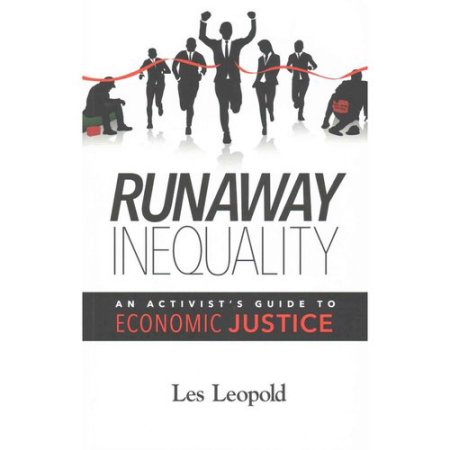
It is absolutely wonderful that the Communications Workers of America are buying books and teaching classes on “Runaway Inequality” by Les Leopold. It stirs a lot of thinking.

runawayinequalitybook

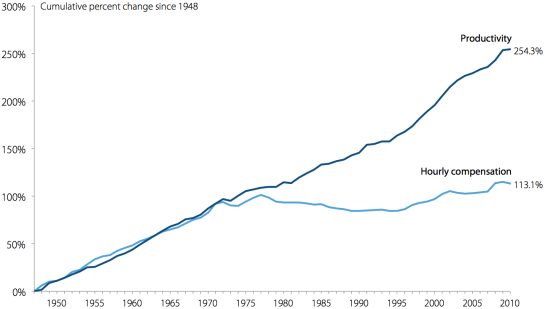
The core argument is that something has been seriously wrong in America since the mid 1970s, when wages stopped rising at a rate similar to the increasing productivity. Productivity is the amount of wealth that one average worker creates in one average working hour.

productivity-wages

As the graph shows clearly, wages and productivity seemed to rise together from the late 1940s to the mid-1970s, then productivity continued rising with the same upward slope, but wages flattened out. Profits rose, but wages didn’t. The change, Les Leopold says, came about because of deliberate policy changes. The book is full of other graphs showing the policies that changed, the resulting inequality, and the amazing effects of this incredible rise in inequality. Leopold then concludes by saying that ordinary Americans must band together and change those policies. In other words, wage-earners have to do what the bosses have been doing. It’s a “must read” book, and the classes (I’ve taken them twice) are inspiring!

There are further questions

  1. Is the period 1947-2016 a representative period of history, or is it unusual?
  2. Is the problem local or systemic?;
  3. Given the situation described in the book, is there really a solution for wage-earners?

What period of economic history is “normal?”

The entire book and all its conclusions come from the hypothesis that something went wrong in the 1970s. I have my doubts. The unusual period in American history was not 1974-2016, as Leopold suggests, but 1947-1974, the first part of the graph. In other words, there is nothing unusual about wages being suppressed in a capitalist economy. The unusual period was 1947-1974.

Take a quick look at how unusual was the post-war world:

  • Europe and Asian were bombed flat. American had virtually no competitors in the capitalist world
  • American unions were far stronger than in any time in history
  • The United States set the terms for all economic transactions in the capitalist world
  • The United States had almost all of the world’s gold

Then look at how things changed: By 1974, German and Japanese automobiles were flooding the world. President Nixon had given up America’s control over gold. Unionism had peaked around 1957 and was clearly slipping. The Chinese were having tea with Nixon and had broken up their alliance with the Soviet Union. Economic competition between nations was getting back to “normal.” What every nation had to do, to compete, was lower their costs. Their costs are our wages and benefits.

Is the problem local or systemic?

Our problems derive from the system we live in. American working families are having pretty much the same problems that other capitalist nations are facing. We have probably lost more than the families in other nations since the mid 1970s, but we had more to lose. The lords of American industry and finance have been able to hold on to their hegemony in the world only by sacrificing our wages and benefits.

Even worse, the long-term process of robbing working families entails destroying our democracy. The end of World War II was a triumph of democracy, and nowhere was democracy stronger than here, in the land of the winners. Several of Les Leopold’s graphs show how democracy is diminished. A very striking one is the graph showing that the United States has more people incarcerated than any nation of any size in the world! Today, many people are saying that we live under a plutocracy and that democracy is dead and gone.

It isn’t true. The absence of democracy is fascism, and we don’t have fascism in America. Even in 1947, our democracy was not complete. It was partial. Since the mid-1970s, our democracy has faded, but not disappeared. If the process continues as it is going now, it would be fair to say that fascism is the logical outcome. But it hasn’t happened yet.

Is there a solution?

Given the system we live in as described in “Runaway Inequality,” are we likely to be able to reverse the policies that have brought disaster for working families since the mid 1970s? No. What happened since 1974 is not unusual, it’s part of the ordinary process of world capitalist economics.

If there is a solution for American working families. it will come from a different system.

Gene Lantz

I’m still on KNON radio, 89.3FM, every Saturday at 9AM Central Time. If you’re interested in what I really think, check out http://lilleskole.us


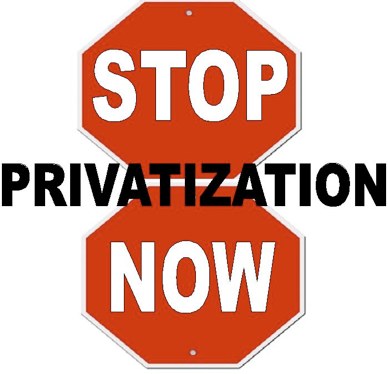
On the “Workers Beat” radio show this morning, I interviewed advocates for Dallas County Schools, a public service that provides transportation and safety for children going to North Texas schools. We are experiencing a propaganda blitz calling for us to vote “against” them in the November 7, 2017, election. How we came to this little historical intersection is an interesting story, and it illustrates a much larger problem for our world under capitalism.

privatization-stop

Today’s radio program was the third time I’ve had advocates for Dallas County Schools. The first ones were bus drivers organized by an independent union. They complained that somebody was out to smear their driving records but, when one considers that they log 106,000 miles per day, their driving record was pretty good. Co-Host Bonnie Mathias and I smelled a rat even then. We decided, without any explanation or prompting, that somebody was out to privatize Dallas County Schools.

When I interviewed the interim superintendent and the organizer for National Education Association later on, I was convinced that privatization was indeed the issue. They said that Texas Senator Don Huffines had originated the entire process with legislation calling for the vote. Although the “remedy” he proposed was complicated, it was skewed toward privatization, said my interviewees.

A Board member who hasn’t been on my radio show had contacted the Dallas AFL-CIO for help a few weeks ago. I sat in on the meeting. Later on, she and I corresponded as I tried to get to the bottom of what was going on.

Today I talked with a Board member and another union official. They went over the charges listed on the three expensive 4-color mailings I have received. They refuted them one by one. Mistakes had been made in the past, they said, but the superintendent and most of the Board had been replaced since then and rectification was under way. Further, the charges against them were overstated or even out right lies!

Nobody mentioned it on the radio, but they said there have been at least 5 robo-calls urging the voters to vote against them. Who paid for five robo calls and 3 big mailings? They said that the mysterious “Protect Dallas Kids” organization that opposed them had filed the required legal reports. They received money from the Dallas Citizens’ Alliance and one of the biggest corporation in North Texas, AT&T. A great deal more had been spent than had been reported, they said.

The Dallas Citizens Committee’s involvement was no surprise. Their main front is the Dallas Morning News, which has editorialized against the Dallas County Schools.

Other than Senator Huffines, I could only find one name associated with the propaganda blitz. The Treasurer, which is required to be listed on political propaganda, is also the Treasurer of the Dallas Republican Party. The address given is right outside Dallas County, but is in Huffines’ Senate District.

As I wrote in the Dallas AFL-CIO newsletter, the anti-worker credentials of Senator Don Huffines, the Dallas Morning News, and the Dallas Republican Party are well established. We stand with the workers!

There’s a Much Larger Lesson

In general, capitalists want to privatize everything. They have already privatized many of the prisons, much of the space program, and a great deal of America’s war machine. They argue that business can do everything cheaper and more efficiently than government, even though even the most shallow thinker can see why they can’t — to every expense they have to add profits.

Almost any form of economic activity can be used to generate profits. That’s why they keep trying to privatize everything. It’s a major issue in so-called trade negotiations as the big transnational corporations try to crate more profit centers all over the world.

The Speaker of the House, Paul Ryan, has been trying to privatize Medicare for years. So far, the Senate has stopped him, but that doesn’t mean he won’t keep trying. They also want to provide everything having to do with veterans’ care.

Unions generally oppose privatizing. We argue that it leads to fewer services and more costs.  On the other side, the bosses look for any kind of problem that a public service may have, then they use that to argue for destroying the public entity and substituting themselves. That’s what’s going on with the Dallas County Schools, and it’s going on all over the world.

When we have a public service, there is always a possibility of corruption; but when we privatize, corruption is guaranteed!

–Gene Lantz

I’m on http://knon.org/workers-beat/ every Saturday at 9 Central Time. If you’re interested in what I really think, try http://lilleskole.us


The new documentary film “Dolores” has opened. Its subject, Dolores Huerta of the United Farm Workers, is promoting it. She appeared in Dallas on October 11. The audience was knocked out of their socks!

Dolores_Ecard_Dallas1_v1

The biopic begins her life story when she was only 25 and had only 7 children. She and Cesar Chavez, both longtime community organizers, focused together on organizing workers in the California fields. It carries on through all the battles, all the innovative tactics, all the disappointments, and the victories of their dramatic organizing history.

After the film, a standing ovation greeted the 87-year old mother of 11 who has made and is making this American history. She answered every question with the same even-handed practicality that characterized her approach all through the movie.

One of our most popular labor movement children, primary school student Lucia Montemayor, daughter of our Dallas AFL-CIO Political Director, asked, “When can I start organizing?”

Huerta replied sweetly, “What are you waiting for?”

Police violence was a topic for two big reasons 1) all the violence that the farmworkers faced in the film and, 2) Huerta’s personal hospitalization after being attacked by San Francisco policemen. Without any rancor, Huerta said that everyone should oppose injustice whenever and wherever it arises. She went out of her way to say that Jerry Jones, millionaire owner of the Dallas  Cowboys football team, should be encouraging his  players to oppose injustice instead of  threatening to fire them.

Someone asked how Huerta juggled motherhood  and  career. This is a question she has dealt with often. Throughout her adult life, she has been criticized for not remaining at home “in a woman’s place.” In fact, it is common for many parents to hide behind their children and claim, “I can’t fight injustice because I put my children first” – thereby condemning the next generation to live in a world no better or even worse than the one the lazy parents live in. Huerta said that parents have to work for a better world because it has to be done. One of her sons was with her. He testified, “We had to share our mother with the world – but she shared the world with us!”

Several questions had to do with the discouragement that organizers often feel. Of course Huerta’s smiling responses were essentially that people must keep on trying. From Dolores Huerta, these weren’t just words. She has backed them with a lifetime of commitment!

–Gene Lantz

I’m on knon.org every Saturday at 9AM Central Time. If you want to know what I really think, look at http://lilleskole.us

Book Review: Kersten, Andrew E, and Lang, Clarence, Editors: “Reframing Randolph. Labor, Black Freedom, and the Legacies of A. Philip Randolph.” New York University Press, 2015.

randolph-quote

I got this book from Oak Cliff Branch of Dallas Public Library.

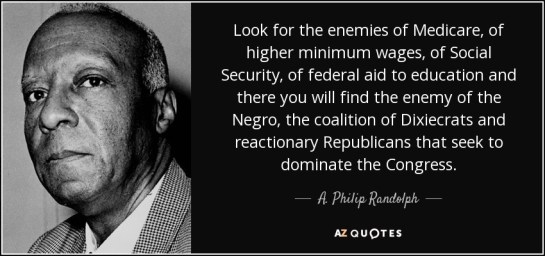
Asa Philip Randolph is glorified and criticized in the essays collected here. Whether they appreciated him or not, all the writers agreed that he had a profound effect on American civil rights.

I started a sort of timeline:

  • 1898: born
  • 1920s: Street corner orator and co-editor of “The Messenger”
  • 1925: Newly organized Pullman Porters ask him to take over as President. Black Sleeping Car Porters and Maids formed
  • 1935 or so: finally gets a contract from Pullman. Drops “and maids” and joins the American Federation of Labor (AFL) Within it, he argues for anti-discrimination policies until the end of his career
  • 1941: With threat of March on Washington Movement (MOWM), gets Executive Order 8088 (? Forgot the number) outlawing racial discrimination in war industries. Not nearly as much as was demanded, but Randolph calls off the march and is covered with glory for having “forced” the President of the United States to acknowledge the federal government’s role in overcoming racial discrimination. Federal Employment Practices Commission (FEPC) is formed and the MOWM people try to enforce it with marches and pickets throughout the war.
  • 1936: Formation of National Negro Congress. He serves 1 term as president and then resigns as he feels the organization is communist dominated
  • 1960 or so: He is President of the National African Labor Congress NALC
  • 1963: he and Bayard Rustin organize the March on Washington for Jobs and Freedom. They cooperated with MLK on it. Of course, MLK stole the show.
  • 1965: he is honored with formation of A. Philip Randolph Institute (APRI). Chapters are formed in every Central Labor Council and endure today
  • 1968 Ocean Hill-Brownsville conflict between community oriented school board and the United Federation of Teachers. Randolph sided with labor leader Al Shanker and took heat for it
  • 1972: Coalition of Black Trade Unionists (CBTU) formed as NALC fades away
  • 1974: African American women from Randolph movements start the Coalition of Labor Union Women (CLUW)

I was left with the impression that Randolph successfully, eventually, got the AFL to be less racist. The CIO, of course, probably had a bigger effect. Randolph got the federal government on the right track. I think he was a consistent social – democrat, even though the various writers seem to think he wavered this way and that. I think any wavering he did came from trying to fit the civil rights movement into the AFL. Like the social-democrats of today, Randolph looked at the working class. He analyzed it and pushed for its success. Like the social-democrats of today, he did not analyze the obstructionist class and devise ways of overcoming them once and for all.

On the downside, the book accuses him of outright sexism in dealing with women’s politics. They also criticize his rabid anti-communism as unnecessarily divisive. If he read the book today and were asked to comment, I’m sure he would say that those who cannot compromise aren’t going to get anything done in contemporary politics.

–Gene Lantz

I’m on KNON radio every Saturday at 9 AM Central Time. Click here if you want to know what I really think!

Three hours after we went into the theater, we emerged dazed and questioning.

Movie Review: “Blade Runner 2049,” Directed by Denis Villeneuve, 163 minutes

bladerunner

The last hour, or so it seemed, was the credits. The more the graphics arts in a movie, the longer the movie credits. My movie buddy always sits through to the final frame, because she wants to know if it was union-made or not. This one had three union logos at the end: Sag-Aftra, Teamsters, and IATSE.

Frankly, I loved every minute of it and would still be sitting there if it had gone on, but I suspect that this movie, like the 1982 Blade Runner, will undergo some cutting and re-cutting before they’re done. The original was one of the greatest accomplishments in movie sci-fi of all time. That’s not because of the incredible graphics. I suppose the incredible graphics award will go to one of those Transformer movies. It’s the way that all the elements of the movie, including music, backgrounds, special effects, acting, stunts — all of it — come together to produce a moody symphony.

Like the first movie, this one is basically a hard-boiled detective story set in a horrible future world dominated by corporations whose greed has left the planet barely inhabitable. Near-human android slaves (replicants) have all the jobs. There is no happiness in either group. There’s no sunshine anywhere at all. It’s as grim as if the Trump Administration had lasted until 2049.

I may have to see the film again, because I caught a number of tributes to other movies and other art forms, and there were probably a lot that I didn’t catch. And like all good sci-fi, there were some really great philosophical and moral questions raised by the replicant-killing Blade Runner, the not-so-bad replicants that he didn’t kill, the evil replicants that he did, and the even-more-evil corporation at the root of it all.

—Gene Lantz

I’m on KNON radio every Saturay at 9 AM Central Time. If you want to know what I really think, click here.

Book Review: Gaddis, John Lewis, “The Cold War. A New History.” Penguin Press, NY. 2005.

khruschev

I got the book from the Oak Cliff Dallas library. Gaddis had already written several earlier books on the period, so this one is sort of a compilation, he says.

What I liked about it was that he included some of the significant events of the Cold War period. It’s not chronological. He presents events in the order he wants in order to make the point he wants to make: that the Cold War was not so much a part of the long confrontation between labor and capital, but rather an historically isolated one of democracy versus totalitarianism. From the first, in his detached academic way, he cheers the American side.

Although it’s presented way out of order, he does talk about the 1948 CIA intervention to keep the Italian Communist Party from winning their national elections. He talks, a little bit, about America’s overthrow of the elected government of Chile and the installation of fascist terror. He mentions the CIA overthrows of the elected governments of Guatemala and Iran.

Like a lot of post-Soviet Union books, he gives his explanation for the failure of that government. He seems to think that Premier Gorbachev was confused and easily swayed by that smooth-talking Ronald Reagan. He says that the Soviets erred by trying to live up to their commitment to worldwide revolution by supporting the Cubans, the Angolans, the Vietnamese, and the many other peoples that tried to advance beyond capitalism and called to the Soviets for help. He says the Soviets couldn’t afford them.

But the fundamental problem, he says, was that the Soviets could not provide the standard of living that their people had been promised. When Khruschev said “We will bury you,” no matter how that was interpreted here, he meant that the Soviets had a superior economic system.

Over the years, I’ve heard a number of smart people talking about the mistakes of the Soviet Union. Some of them imply that those mistakes were also made by the worldwide socialist movement and, especially, by CPUSA here. I think this book nudges us toward an idea of what those mistakes might have been:

1) They mistakenly thought they could extend cooperation with the United States and other capitalist nations after Hitler was defeated.

2) They mistakenly thought that capitalist economies would resume their desperate pre-war economic depression after the war

3) They mistakenly thought that no single capitalist nation could unite the others against them

4) They underestimated the post-war prosperity phase.

Having lived through the Cold War, and after visiting the Soviet Union twice and doing some of my own studying, I have to agree with the book’s author on this important main point: I don’t know if the Soviets could have provided a superior standard of living for their citizens, but I am convinced that they didn’t.

Gaddis, the author, says that a market economy is fundamentally superior to a planned economy because it is more flexible. The Chinese economy, he says, succeeds because they embraced capitalism.

Certainly, the Korean War, the Missile Crisis, and the Vietnam war are covered.  But some things were not.

I just glanced at the book’s index to see if he included some of what I considered the most important aspects of the Cold War: The Taft-Hartley law that put America’s unions into a long downward spiral, the trial and execution of the Rosenbergs, Senator Joe McCarthy’s hearings, the McCarran Anti-Subversive Act(s) that sent American activists to prison, and the House Unamerican Activities Committee which destroyed so many lives. None of them are mentioned; none even made the index. If he had mentioned such things, I might have given more credibility to his thesis that the Soviets and Americans were equally to blame for having started and perpetuated the Cold War.

I don’t think that this “equal blame” idea can stand the test of history, because the wealthy capitalist countries opposed the Soviet Union in every possible way from its inception, 100 years ago. World War II provided only a brief interruption in attacks against the Soviets, and they did that only because Hitler had become such a threat to all of them. From 1917 to 1941, and again immediately after the war, the United States and the other imperialist nations did all they could to undermine and overthrow the Soviets.

I think that the Soviet Union fell as the result of an attack. The frontal attacks, although there were plenty of them, could not bring the Soviets down. But the long siege did.

World War II ended with a gigantic Soviet and American victory in 1945. The declaration of Cold War came from Winston Churchill, sharing a podium with President Truman,  in Fulton, Missouri, March 5, 1946 – less than a year after the hot war ended.

–Gene Lantz

I’m on KNON radio 89.3 FM from 9 to 10 every Saturday. Call in your opinions!

For the past several weeks, I’ve been hosting on-line meetings on digital organizing.

digital-organization-computer

It’s not that I know a lot about it. I do these meetings because they need doing. Our progressive movement is exploding like an adolescent in a growth spurt. But, like an adolescent, it isn’t very well coordinated and doesn’t seem to know where it’s going.

The on-line part of the work could bring us together, it could coordinate our activities, and it could help turn this strong but clumsy adolescent into the soldier we need.

Techies Don’t Usually Set Organizational Policy

I have been around computers since 1963. In business and in politics, the techies usually get called into strategy meetings, but only to provide a general idea of what is possible. The overall goals of each organization are set by somebody else, and the techies shoehorn their abilities into someone else’s parameters.

It’s still like that within most organizations. Some glaring exceptions are  MoveOn and Facebook — where the techies created and ran the entire operation.

Today’s Techies Run Wild

Almost everybody with a computer, or even with a smart phone, has the potential today to play a big role in politics — for good or for evil. In our mish-mosh progressive movement, the techies create their own strategies, if they have any at all, and they tend to go every which-a-way.

There are a lot of classes, some excellent ones are on-line, about digital organizing, but they are primarily concerned with HOW to implement various technologies. I see very little about WHY?

That’s why I freely admit that I’ve been doing this for thirty years and still don’t know what I’m doing.

Disseminating Information Is Not Enough

If we know a lot about communications and social media, we can reach a lot of people with a lot of information. So what? If we aren’t working together to build a progressive movement that can stand up to the challenges from the other side, the 1%, the enemy, then why throw out all this info?

Organizing, even the segment of organizing called digital, means joining people together for a common purpose. It isn’t how many people we can reach, it’s how many we can move!

Organizations Often Work Against One Another

Who doesn’t dream of unity? But it’s just a dream if we don’t take stock of the very real reasons that disunity persists in the progressive movement. We have to recognize obstacles if we are to overcome them.

One big obstacle, probably the biggest, is how the “progressive” organizations are funded. In general, we beg for donations from the people who have money. Often as not, they are, as a class, the very people we are trying to overcome. The donor class keeps all of us begging and, far worse, competing against each other for contributions.

If we asked individuals about the need for unity, almost all of them will agree. But those same individuals, working in “progressive” organizations, are primarily competitors for money, not co-operators. As a movement, we’re killing ourselves with our own opportunism!

There are other reasons for disunity, of course. Big egos get in the way. Deliberate saboteurs and agent provocateurs are among us all the time.  Our adolescent obsessions with one part of the progressive movement over the others disunites us. Arguments over tactics are often a source of friction. Putting aside tactics, we don’t really even agree on our major goals.

Unity Requires Agreed-Upon Principles

The first thing the progressive movement should agree on is what we are trying to do. That goal is to overcome those who are now running the world (into the ground) and implement a better, more democratic, system.

The second is an overall strategy based on empowering working families, as opposed to bosses. The bosses are running things now, for their own benefit, and their employees have very little say-so about the important things. Unions, because they represent working families, are especially important.

Then comes tactics. Progressives should be taking part in every arena of political struggle that benefits working people and disadvantages our bosses. Everything we do that makes our side stronger and their side weaker is a good tactic.

Our resources vary, and some tactics are better than others. That’s why we need democratic discussion among ourselves to sort out the best immediate activities. But the guideline, the first thing, always has to be uppermost in our thinking.

So, What Do We Do Right Now?

Figure out which activities are best moving us toward our goal. Use our digital magic to boost those progressive activities. Participate in the ideological discussion around those actions so that participants will get all possible value from being part of it. Agitate, educate, and organize!

–Gene Lantz

I invite your opinions. I’m on http://knon.org 89.3FM in Dallas every Saturday at 9 Central Time