Archive

politics

Working Americans have always fought the bosses. We’ve won a few battles and lost many, but we always fought on.

redflag

The closest we ever came to a “cease fire” in America’s class war came between 1947 and 1972, “The American Century.” During those few years, the United States had so much economic domination over the rest of the post-war world that they were able to buy off militant workers and collaborationist leaders. Unionists regularly received 3% annual raises and steady improvements in their benefits packages, including retirement. Non-union people got their improvements, but only as a result of the unions.

Then Came International Competition

After 1972, when President Nixon was obliged to change the worldwide monetary agreement set up after the great war, the bosses returned to business as usual. Their usual business is screwing their workers whether they are organized into unions or not. From those days forward, bosses in every capitalist country have been getting government handouts for themselves and austerity for everybody else.

They would like to continue that, but, as I said, we’ve always fought them. We’ve never won a decisive victory and, for the most part, never even thought about a decisive victory. Our battles have been over immediate objectives such as a pay raise for a limited number of workers or voting rights.

Our Victories Have Been Temporary

Even when we win, our victories are temporary because the bosses are still in power and, sooner or later, will try to reverse our successes. Thus, for example, we won the Voting Rights Act and then lived to see it gutted by the Supreme Court. We fought to see our American standard of living rise to the highest in the world, then saw it fall ignominiously.

The trends on our side of the class war are getting hopeful. Just on the wages front, for example, we aren’t just fighting a few scattered battles over peanuts here and there, we are engaged today in a nationwide battle to raise the minimum wage to a respectable figure. The Fight for Fifteen can involve everybody, and actually does involve quite a few of us.

Things Are Looking Up

On the political side, millions were drawn into action by the Bernie Sanders campaign, and I do not believe it is over. Instead, we are on our way toward a working people’s political party that would give us a real choice in elections. I don’t know if that is what Bernie Sanders intends, but I think the momentum of his followers is going that way. Union leadership is better integrated, more militant, and far more progressive than it has been since 1947.

Most exciting of all, I believe that Americans are better informed, more capable, more connected, and more sophisticated than ever in history before.

–Gene Lantz
Click here for more of these ideas

Nothing stays the same. Those who hope to continue the limited democracy in America today, without change, aren’t looking at how the world operates.

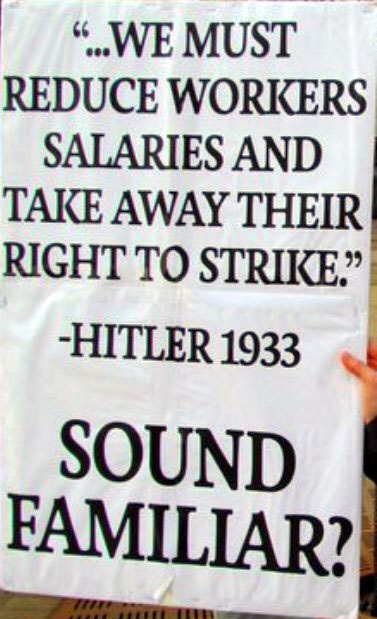
hitlerquote

Some of the pundit are already describing America’s political system with the word “chaos.” (Click here)

The nations today are competing with one another by forcing austerity onto their respective workforces. The competition will not get any easier because, no matter how cheaply goods can be produced in one country, another can lower their labor costs even further as long as the bosses are in power and as long as the workforce doesn’t actually starve.

The bosses in power can, and will, enforce more austerity as long as they can. That will include union busting, civil rights violations, misogyny and racism just as it does today. At some point, the bosses will have frittered away the illusion that they rule “with the consent of the governed.”

At that point, they will rule without pretending to have our consent, with naked force. That’s fascism. That’s a choice of government that the bosses can make and will make when there are no easier choices.  It’s capitalism in its death throes.

Fascism will not solve the boss’s competition problem. The only reason that Nazi Germany lasted as long as it did, 12 years, was because of their early successes in war. A fascist government today, without the option of making war without destroying the planet, wouldn’t even last that long. But who wants to go through fascism for any length of time?

It isn’t hard to see what the bosses will do, because they are doing it now. The question is, what do we have to do to carry America on the road to fascism? As the great parliamentarian Edmund Burke said, “The only thing necessary for the triumph of evil is for good men to do nothing.”

–Gene Lantz

Click here for more of these ideas

The War for Independence isn’t just a simple tale of heroism and yearning for freedom.

indianbook

Howard Zinn’s history (click here)  pointed out that a major cause of the conflict had to do with the British treaties with the Natives. The British had promised no further westward expansion, while the colonialists fully intended to do just what they did to the Natives all the way to the Pacific.

African Americans were ill treated during and after the war. (click here) The defeated British did try to carry out their promise to free all their African American soldiers around New York and were quicker to end official slavery altogether than were the racists in the South.

The newly created United States distinguished itself among “civilized” nations for racism, imperialism and genocide over the next century. In 1854, Frederick Douglas’ July 4th speech asked, “What have I, or those I represent, to do with your national independence? Are the great principles of political freedom and of natural justice, embodied in that Declaration of Independence, extended to us? and am I, therefore, called upon to bring our humble offering to the national altar, and to confess the benefits and express devout gratitude for the blessings resulting from your independence to us? Would to God, both for your sakes and ours, that an affirmative answer could be truthfully returned to these questions!” (click here)

Did the British enjoy some moral high ground over the colonialists? Were the people our ancestors fought better or worse than the ones they fought against? Few of us today are so knowledgeable as to be able to make that call. Certainly not I!

But we are not honest people if we don’t consider all the aspects of our history that are clearly at hand.

–Gene Lantz

Click here for more of these ideas


Do you have a lot of confidence in the law and justice?

gavel

I recently wrote that there are a lot of psychos in corporations. I didn’t mention the ones in government.

Texans have their sense of justice eroded away almost every time they read a newspaper. They just found out, for example, that a Dallas judge ruled that the state’s Attorney General, chief law enforcer Ken Paxton, can’t wiggle out of facing his three felony indictments. He is expected to face judgement on the fraud and swindling charges against him. Click here.

Paxton’s government job seems to be waging war against every kind of justice that comes from federal sources. He recently lost his Supreme Court suit against women’s health care. Click here. He joined in a lawsuit against U.S. Virgin Islands Attorney General Claude Earl Walker because Walker had tried to subpoena records from Exxon. The issue was global warming.

Paxton doesn’t have to worry much about state criminal laws, because they are reviewed by the Texas Supreme Court. All their judges are elected, all are Republicans, and it’s hard to remember when they ruled against a corporation or in favor of an individual.

Paxton is probably inspired by our last governor, who still isn’t in jail for having used his power to remove an attorney with a criminal suit against him. Or there’s the Texas Congressman who re-rigged all the congressional districts and never spent a day in jail.

Where I live in Dallas, District Attorneys are supposed to stand for justice. But there are more exonerated former prisoners from here than from anywhere. The current officeholder isn’t holding office quite a bit of the time because she goes in and out of a mental hospital. Dallasites would kind of like to see her removed and there have been some public calls for it, but some of us are reluctant. If she doesn’t step down pretty soon, the Governor, a paragon of Republican virtue, will appoint her replacement.

That could be a lot worse!

Leave a Reply

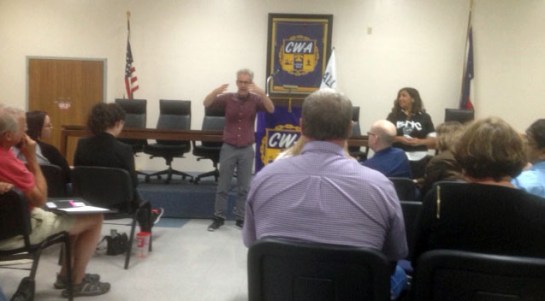
The exciting new organization “Brand New Congress” (BNC, click here)  just held its first meeting in my town. Its provocative electoral program may be the most innovative set of ideas in a century or more. In the 2018 primary elections, they plan to run more than 400 candidates without any regard to political party. The candidates will be people who have contributed to their communities, are good at it, and will uphold a radical progressive program similar to Bernie Sanders’ present campaign.

bnc-zac

Brand New Congress met at the Dallas CWA 6215 Hall, where Bernie has his offices

One of the most interesting twists in the projected scenario is their intention to totally disregard party affiliations. The main speaker said, ““Parties are so 19th century!” Polls are showing that a lot of Democrats and Republicans are not so crazy about their own parties. Youth has been showing its disdain for some time; I recently read that only 19% of Americans 19 to 29 years old voted in 2014!

How It Will Work

The Brand New Congress strategy would have their candidates running mostly as Independents, but, where it’s easier, as Democrats, Republicans, Greens, or anything else that’s useful! In other words, they would use political parties the same way they said Bernie Sanders used the Democratic Party — to get on the various state ballots and to obtain a wider hearing.

Turnout at our meeting was good, but not nearly as good as earlier Bernie meetings. Like the Bernie meetings, diversity was not its strongest characteristic. I’d estimate about 8% African Americans, maybe 10% Latinos, 2% Native American, and 40% women attended. Like the Bernie meetings, they were considerably younger on average than most political gatherings.

It’s worth noting that neither of the two presenters claimed that Bernie Sanders would publicly support this program.

Will It Work?

After having seen the electoral miracles accomplished by the 74 year old socialist from Vermont this year, who is prepared to say that Brand New Congress won’t be successful? Who could say that almost anything couldn’t be done by the younger people around the Bernie campaign? One of the BNC organizers maintained that Bernie had raised $240 million and moved tens of thousands of volunteers!

During the last decades, a growing number of citizens has developed a severe distaste for the status quo and a yearning for something different. Maybe these are the “people with a plan” who bring that change!

On the Other Hand

The idea of such a broadly innovative electoral campaign is breathtaking. But after I resumed regular breathing, my age and experience began to ask questions. In the immediate sense, I didn’t like all of the answers. Hope I’m wrong on every count:

  1. The strategy is purely electoral and limited to the U.S. Congress. Whenever somebody tells me that a single tactic is going to revolutionize America, I start wondering if they aren’t making a fetish of that tactic. Remember Occupy? A revolutionary program, it seems to me, would have to relate to all forms of struggle.
  1. Although one of the BNC presenters talked a lot about his views on the economy, little or no mention of the international situation was mentioned. People who think that their country is the only one that matters may be a little bit out of step with the economic situation today.
  1. Where are the working people in all this? I heard one mention of the term “working class,” but it was parenthetical and in passing. The idea that all Americans can be brought together under a single program seems idealistic to me. Only working people can confront the bosses and beat them, not a vague idea of “everybody.”
  1. Much worse, I didn’t hear any mention at all of the bosses and how they were going to relate to all this. Do people think that there’s only one side in this fight? There are two sides, and the other side isn’t just sitting around waiting to see what happens. They are really good at all forms of political fighting, especially elections. Also, they blacklist people. They arrest people. They kill people. You can’t expect success with a strategy that ignores them.
  1. How would we govern? No one would be happier than I to see somebody make gigantic fundamental change in American politics by 2018, but this electoral trick sounds more like a coup than a revolution. In a revolutionary process, people organize themselves by communities, by workplaces, and by their interests. They get better and better at meeting challenges and utilizing opportunities. Leadership develops at every level. Revolutionary struggle is a giant learning process whereby everybody learns more than how to take power, they also learn what to do with it.

Maybe my skepticism has no place as America yearns for improvement. Let’s not condemn, but encourage. Let’s do what we can!

–Gene Lantz

Click here for more of these ideas

Listening to almost anybody talk about American politics today unavoidably leaves one with the impression that they don’t know what they’re talking about. Populist? Nationalist? What do all those terms mean, if anything?

nationalismquote

Click here for a glossary and lesson on political words. Click here for my previous analysis.

What one considers good or bad in politics depends on how one understands the idea of progress. Everything is moving in one direction or another all the time. A positive trend in politics is one that strengthens our side in the lifelong battle with our employers, or one that weakens the employers’ side. That’s progress.

Progressive for Whom?

If ordinary working people are strengthened by being more unified, or better informed, or by attaining positions of power, that’s progress. Progressive people are those who strengthen workers against their employers. Organizing a new union, for example, would be a progressive thing to do. Helping workers make good electoral decisions by providing useful information would be progressive.

Causing an unnecessary split in a workers’ organization is a reactionary event, the opposite of progressive.

“Left” and “Right” are Fuzzy Concepts

During the capitalist revolution in France around 1789, one group sat to the speakers’ left in parliament and another group sat to the right. That’s where we got “left wing” and “right wing,” but it’s really hard to tell what they mean today. Besides, everything is moving so what’s left today is right tomorrow!

If “Left” is Good, Then Is “Ultraleft” Even Better?

Serious activists might think “left” means “favoring the workers,” but “ultraleft” is a special term that does not mean “even more favorable toward the workers.” An ultraleft is an egotist willing to do anything, progressive or reactionary, to draw attention to themselves. Ultraleftism is a real pain in the movement. It’s been called “the infantile disorder.”

“Liberal” and “Conservative” are Confusing

If a liberal is a nice person who cares for others, what’s a neoliberal and why do the South Americans seem to hate them so? Is a neoliberal the same thing as a neoconservative or neocon? Actually, yes.

If a politician is racist and misogynistic, but votes for a giant boondoggle for his/her home district, is she/he a liberal or a conservative? If another politician is really stingy on government spending but promotes abortion and gay marriage, what is he/she?

Who’s Middle Class?

It’s common now to confuse “middle class” with “middle income.” I think the unions distorted the definition because union people, it’s true, make more money than other workers and, especially with overtime pay, often get into the middle income range.

The only useful meaning of “middle class” is that they’re neither bosses nor employees. So small shop owners, professionals, preachers, policemen, union staffers, and all the people “caught in the middle” in the great fight between workers and bosses, they’re the middle class.

The French revolutionaries called them “petit-bourgeoisie” or “small capitalists.” Ultraleft supercilious nut cases use it as a derogatory term.

Everybody hates being called middle class and will argue with you until they’re blue in the face about it, but if you can’t understand “middle class,” you probably can’t understand “worker” or “employer” either. Without clarity on those concepts, I don’t see how anybody understands anything about politics.

What’s a Populist?

It’s gotten popular today to talk about “populism of the left” and “populism of the right.” Supposedly clever people refer to Senator Bernie Sanders and Presidential Candidate Donald Trump that way. But what does it mean?

The populist movement of old was made up of agricultural interests banded together politically to fight against the industrialists who were taking over the nation. The populists lost. That battle has been over for some time.

Google says a populist is “A member of a political party claiming to represent the common people.” But don’t all politicians do that? Click here for Wikipedia’s treatment.

I’m pretty sure that what the pundits mean nowadays by “populist” is a candidate that doesn’t directly represent the employing class. As no candidate ever says he/she directly represents the employing class, it’s a pretty meaningless term.

What’s a Nationalist?

There are books on this. Nationalism, dividing people’s interests more or less by their region of origin, is usually divisive and hence reactionary. Not always, though. Groups of people fighting imperialist domination may be using nationalism in a very progressive way. People that use it to split the overall progressive movement, though, need to be avoided.

Think of the Class

If one sticks to the idea that workers are the only ones who can really overcome their employers, and that strengthening our side or weakening the employers’ side is the definition of “progressive,” one can be more clear in their communicating and their own thinking. Always, think of the class!

–Gene Lantz

Click here for more of these ideas


We all hear about “drawing the line” and “crossing the line.” They say in Texas that it has something to do with the Alamo, but there’s a more universal line. It’s the class line.

picket

The physical line between bosses and workers is the picket line

It’s not always simple to figure out who we’re talking about when we sing the great old union song, “Which Side Are You On?” Almost everybody pretends to be on our side.

One could pick around all day trying to sort out exactly who is in the capitalist class, the working class, and the middle class. We can categorize ourselves over and over again as we consider different issues such as gay marriage, global warming, gun control, art lovers, art haters, renters or owners, etc etc. But the important line is the one between workers and bosses. There’s a sure-fire way to know just who is on the workers’ side and who is on the other side.

It’s the issue of wages

Our side wants better wages. Their side wants worse wages.

A new organization has been formed to fight against the Obama Administration’s change in the overtime law. The new law gives considerably more wages to certain workers, and the new organization, “Partnership to Protect Workplace Opportunity,” (who do they pay to come up with these names?) is on the opposite side of the line that really matters. You can look at their list at http://protectingopportunity.org/about-ppwo/ On their side you will find the National Restaurant Association, the U.S. Chamber of Commerce, Associated General Contractors, Associated Builders and Contractors, Jimmy John’s, and lots of  banks, insurers and  auto dealers.

Usually, when they are trying to influence legislation, they sneak around about it so we don’t know who they are. Read Dark Money. I guess the new organization is trying a new tactic by letting us know who (some of them) they are. Maybe they think it will intimidate us?


What they have in common is that they’re all for worse wages. They’re all bosses. They’re all against us. It’s good to know about them.

–Gene Lantz

Click here for more of these ideas

In a casual discussion group I participate in, somebody asked, “Where are we in the swing of the historical pendulum? Are we close to revolution?”

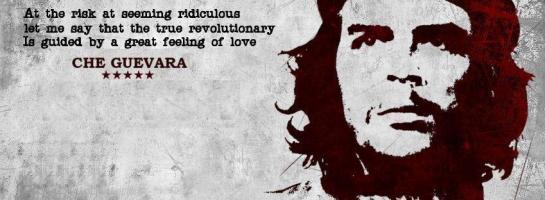
Che

I didn’t try to answer at all, because I couldn’t deal with the way the question was framed. There is no “historical pendulum.” It’s common to believe that history just swings back and forth or goes around in circles, but it doesn’t. The general movement of history is forward and progressive. We aren’t savages any more, most of us, and we aren’t serfs nor slaves. Over the centuries, progress is being made.

But later, I wished I had answered the question, because my analysis may seem unusual to some people: Revolution in the United States and in most of the world may be just around the corner!

Doom and Gloom

OK, there are a lot of naysayers and former radicals among us today. The implosion of the Soviet Union hit hard. The rapid change in Eastern Europe devastated some folks, and the difficulties they’re having in Venezuela and Brazil today are squeezing the optimism away. Add to that the tremendous success that dark money has enjoyed in turning our American democracy backward during the last 4 decades. It’s enough to get some people down. Some people. But they aren’t taking the long view.

The Long View Looks Great!

What are the requirements for a qualitatively better society? A well informed and well organized public with leadership from among the workers. We have that, more than ever!

Nowadays, I am in awe of the millennials. They grew up understanding more about using new technology than I will ever learn. Technology extends their knowledge and their capabilities.

The millennials also grew up without all the anticommunism that crippled the thinking of my generation. When I was young, we were afraid to even look to the left, much less think in that direction. The Bernie campaign has made “capitalism” and “socialism” everyday words. People are thinking thoughts that used to be taboo.

Today’s young people have the entire world at their fingertips. Most of my generation would never have left home if it hadn’t been for the military draft.

Don’t Overlook the Unions

Unions are the organized sector of the working class. It’s true that there aren’t as many union members per capita as there were in 1957, but that’s misleading. One worker today is doing the work of 4 pre-war workers. And he/she is likely to be highly skilled and hard to replace. Workers are just as central to the progressive movement as they were in Russia in 1917 and every year since! Nobody else can stand up to the bosses eyeball to eyeball, but workers can!

Older people think that the 1960s and 1970s were the revolutionary times. Long hair and marijuana do not a revolution make! Ask them how much union support they enjoyed in their anti-war marches, their feminist causes, their environmental rallies, or anything they look back on with smug satisfaction of revolutionary activity. Unions barely participated in those days, but things have turned around now. It’s hard to find a street action that isn’t supported by AFL-CIO members. In fact, they originate a lot of them!

Furthermore, it is now possible for everybody to work with America’s unions. From 1947 to 1995, that was impossible. The unions in the post war years grew more and more isolated, but today they are reaching out with both arms!

Communications Are Already Revolutionized

There were a number of revolutions in the 20th century. They did it with clandestine meetings, secret leaflets, and a tiny few underground newspapers. One person might “spread the word” to a few dozen on a very good day. Today, we can reach thousands, maybe tens of thousands, without leaving home!

The possibilities are amazing!

–Gene Lantz

Click here if you’re interested in more such ideas

I just got a text from a friend asking for advice. He wants to know whether or not to spend more than he can afford to go to the Democratic Party national convention. He’s a big Bernie fan and Bernie says they should reform the Democratic Party. “Is that even possible?” I ask.

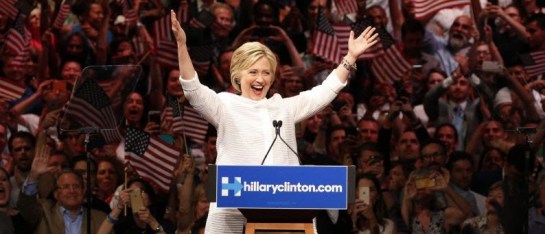
clintonhillary

Until the Bernie campaign made history this year, I had never even seriously considered any hope for the Democratic party. But Bernie has changed a lot of opinions this year, some of them dramatically. Even some of mine.

I am not going to question, in the immediate sense, that Bernie is right in his efforts. Every inch of democracy that we can squeeze out of this capitalist system is worth fighting for. If he can get the Democrats to change some of their rules in a positive direction, I’m all for it.

But, before we go all-out in trying to turn an existing political party into an instrument for fundamental change in America, we need to examine some of our words, including “political party” and “fundamental change.”

The working people will never make permanent improvements as long as the bosses are in power. That’s my guideline. “Fundamental change,” then, requires that the bosses not remain in power. Everything else may be worth fighting for, but it’s still temporary and will eventually have to be fought for again and again.

A “political party” is a committee that organizes, leads, and promotes the interests of a given class. Both the Republican and the Democratic Party promote the interests of the boss class. When they talk about reforming one or the other of them, they are only talking about various rules, not their basic commitment to continuing capitalism. Even Bernie might talk about “reining in” capitalism, but he doesn’t talk about overcoming it.

So, no. I don’t believe it’s worth major time and effort to try to reform the Democratic Party to achieve fundamental progress. What we actually need is a political party based on workers. We need a workers party like those in several other countries. Usually, they aren’t revolutionary organizations, but they are workers’ organizations. A workers party in the United States would be a great historical step forward.

It’s my opinion, expressed previously, that the Bernie Sanders movement could result in a workers party in America. I think we’re very close to it, but not if all our energies are turned into a hopeless effort to reform the Democratic Party.

I don’t want to leave the impression that I’m against the Democrats or even the Republicans. Workers have every interest in working with whoever will help us advance. We need to work with whatever situation we have. Anything less than that shows either a lack of commitment to the workers’ movement or ignorance of strategy and tactics.

–Gene Lantz

Click here if you’re interested in more such ideas