Archive

history

Book Review:

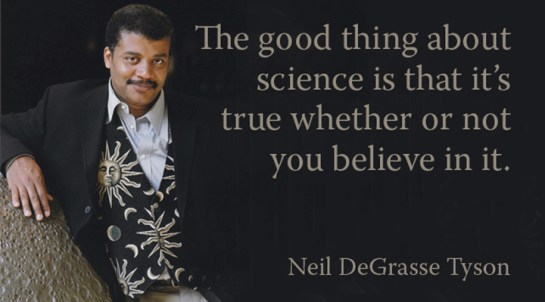
Tyson, Neil DeGrasse, “Astrophysics for People in a Hurry.” W.W. Norton and Company, New York, 2017

I waited in line to get this at the public library.  How’s this for a stunning first sentence: “In the beginning, nearly fourteen billion years ago, all the space and all the matter and all the energy of the known universe was contained in a volume less than one-trillionth the size of the period that ends this sentence.”

science-true

He goes on to attempt to explain the incredible knowledge gained over the ages about our universe. There are some giant numbers involved, and he tries to make them understandable, or at least acceptable, with folksy comparisons, as in the opening sentence.

He doesn’t directly answer the question “What’s outside outer space,” nor “What happened before time began,” but I didn’t expect him to. They are trick questions.

I was disappointed that he did not mention the idea that the expanding universe has no center or starting point. I think I heard him say that once on television. I can’t understand how everything could have derived from a “big bang,” if there is no central point from which everything is expanding away. But then, there are a lot of things I didn’t really understand as I read through Tyson’s short book.

Tyson’s ruminations on how humans are affected by an understanding of our place in the universe are worth the whole book. Tyson once did a television series in 2014 on Fox called “Cosmos, a Space Time Odyssey.” Earlier, in 1980, Carl Sagan had done “Cosmos: A Personal Voyage” on PBS. One might learn more from them. The best details I found just by clicking the links around Wikipedia’s “Astrophysics” entry.

Astrophysics is a topic of interest to anyone interested in religion. The obvious contradiction between Tyson’s entire book and the first lines of the Holy Bible causes a scramble for some kind of resolution. Tyson doesn’t concern himself with it at all, but he makes his attitude clear on page 206, near the end, when he is listing attributes of a “cosmic perspective:” “The cosmic perspective is spiritual –even redemptive – but not religious.”

-Gene Lantz

I talk about the world from a worker’s view on KNON radio at 9 AM Central Time every Saturday. Click the “events” tab to find the last two hourlong programs. If you want to know what I really think, check out my personal web site.

While they are common in Europe, most of us have never seen a big political strike in our lifetimes, until now.

okla-teacher3

The strikes in West Virginia, Oklahoma, Kentucky, and Arizona represent a big step up for the American working class. Newspersons are treating the phenomena as something angry teachers are doing, but it is much more than that. It’s a giant step upward for  American workers.

What Is a Political Strike?

Almost all we know about strikes in America since 1947 is limited to actions against a single employer. The austerity oppressing American workers since 1980 has not been met with the kind of united class action we commonly see in Europe. The French railway workers, for example, are just about shutting down the nation right now, and it’s not so they can get a raise. It’s a political strike against government! So are the school employees’ actions in the United States!

If we organized for it, we could be conducting concerted action everywhere to get an increase in the minimum wage. The “Fight for Fifteen” could be a political strike, and I believe that, sooner rather than later, it will be.

It’s Not Just Teachers

Teacher aides, bus drivers, cafeteria workers, and all kinds of school employees are doing picket duty. They are joined by students, parents, and the public at large. School administrators, in many cases, are helping by shutting down the schools so that strikers can make up the pay they’re losing with extra school days in the summer. Many politicians and high-profile personalities such as sports figures are on our side. Just about every progressive person is spreading the word on social media.

The demands are not limited to teacher raises. The strikers are demanding an end to the steady starvation of public education and full funding for everything the students need.

It’s Not Just Unions

In fact, I’m not even sure that the unions are directly involved. If one looks at the web site for the Oklahoma Education Association or the Oklahoma American Federation of Teachers, it’s hard to tell what’s going on. Both of their Facebook Pages have some good photos, but very little to show that the biggest unions are backing the strike. I have a theory about that.

One of the leaders from West Virginia told me that their strike was “wildcat.” It means that the official unions did not call it and did not officially support it. It also means that the official unions were not legally nor financially responsible for it. My theory is that America’s unions are so constrained, so hogtied, that they dare not push the legal limits with such an action. I’m guessing that all the strikes today are “wildcat.”

I don’t exactly blame them. Unions represent their members and that’s all, no more no less. If they go out on a limb, they may be risking their entire existence. They could be fined every cent they have and then some. Officers could be put in jail. It would not be the first time that the government has punished organized workers. Would that be the responsible thing for a union that represents all its members?

CHEERS to the AFL-CIO Labor Federation

The American Federation of Labor/Congress of Industrial Organizations is not a labor union. It is a federation and consequently has a different legal and political situation. In my opinion, the present AFL-CIO leadership is far in advance of most of their constituent unions. That’s why I emphasize that all progressives should be working with them.

President Rich Trumka has given the national AFL-CIO position on teacher strikes: “When working people dutifully play by the rules and still can’t get ahead, they’re going to upend those rules. That’s exactly what’s happening today. Teachers, from West Virginia and Kentucky to Oklahoma and Arizona, are fighting to overturn a rigged system that has left them behind for decades. They’re inspiring a resurgence of collective action among all working people who are hungry for real change to improve our lives. The 12.5 million members of the AFL-CIO are proud to stand with all those marching to secure a brighter future for our teachers, students and families”

The only part of Trumka’s statement I disagree with is where he said it was “teachers.” Teachers may be spearheading it, but we are witnessing a giant working class process. Conditions, meaning low unemployment and high discontent, are ripe for it to spread throughout the nation.

–Gene Lantz

I discuss these things on KNON’s “Workers Beat” program at 9 AM Central Time every Saturday. From the “events” tab, you can see the last two programs. If you want to know what I really think, check out my personal web site


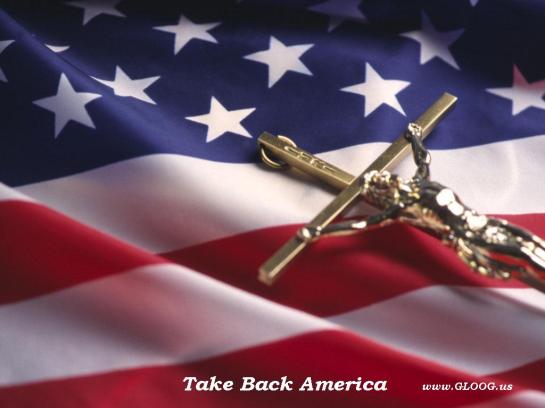
Book Review: Hedges, Chris, “American Fascists. The Christian Right and the War on America.” Free Press, New York, 2006

Flag&Cross_01

“When Fascism comes to America, it will be wrapped in the flag and carrying a cross”

sometimes attributed to the author Sinclair Lewis and sometimes to Louisiana Governor Huey Long

I appreciated this Dallas Public Library book more than I enjoyed it. I really liked his examination of the underlying precepts of radical right evangelism and his historical comparisons to the thinking and strategies of earlier fascists. On the downside, I think he credited televangelists like Jerry Falwell and Pat Robertson too much and blamed fascist financiers like the Koch brothers too little. I think Hedges understands a lot more about the ideology of fascism than he does about the reasons for it.

Hedges was a top-level foreign correspondent. He really knows how to do research and how to present it. He focused his research on the section of protestant evangelism in the United States that he names “dominionism.”

From page 11: “Dominionism, born out of a theology known as Christian reconstructionism, seeks to politicize faith. It has, like all fascist movements, a belief in magic along with leadership adoration and a strident call for moral and physical supremacy of a master race, in this case American Christians.”

I was interested in faith and fascism because of callers to my radio talk show “Workers Beat” today, March 31, 2018. One of them said that the current pastor of the First Baptist Church of Dallas, Robert Jeffress had said that everything President Trump does is okay because it is “ordained by God.” Another caller said that Jeffress, a few years ago, had called President Obama “the anti-christ.”

Another book, “’White Metropolis” charges First Baptist with far-right racist politics in the past. Hedges doesn’t mention Jeffress in his 2006 book, but he hits hard against Pat Robertson and Jerry Falwell, both of whom are presumably in Heaven now.

Long-time unionists know that Americanism is often evoked against its own people. Labor writer Len DeCaux tells us about a 1913 strike organized by the Industrial Workers of the World, employers tried to use the American flag as a strike breaking device. Declaring March 17 “Flag Day,” they draped flags over mill gates with signs calling for a return to work. The silk workers, makers of flags themselves, retorted with a huge American flag across Main Street bearing these words: “We wove the flag; we dyed the flag. We live under the flag; but we won’t scab under the flag!” –Excerpted “The Living Spirit of the Wobblies”

During a speech delivered in 1918, labor leader Eugene Victor Debs made a similar statement: 3No wonder Jackson said that ‘Patriotism is the last refuge of scoundrels.’ He had the Wall Street gentry in mind or their prototypes, at least; for in every age it has been the tyrant, who has wrapped himself in the cloak of patriotism, or religion, or both.”

Can They Be Stopped?

Author Chris Hedges thinks that the radical Christian Right should be repressed. He thinks that the liberal approach of extreme tolerance for varying points of view will lead to the destruction of America. He points out that Hitler could have been stopped if Germans had been less pathologically tolerant. On page 202, Hedges says, “Debate with the radical Christian Right is useless. We cannot reach this movement. It does not want a dialogue. It is a movement based on emotion and cares nothing for rational thought and discussion…. This movement is bent on our destruction. The attempts by many liberals to make peace would be humorous if the stakes were not so deadly.”

I agree with Hedges. Tolerance cannot be extended to include intolerance. Where the book goes wrong, though, is in implying that these unscrupulous and opportunistic evangelists can, on their own hook, bring fascism to America. Hitler, working alone or with his ideological compatriots, couldn’t have done it either. The ideologists are not that powerful nor persuasive. Fascism is a form of rule chosen deliberately by rulers. That’s the danger.

–Gene Lantz

I’m still on KNON radio 89.3 FM in Dallas 9-10AM Central Time every Saturday. From the home page, hit the “events” tab to hear the last two programs. If you are interested in what I really think, check out my personal site

Republicans continue the countdown on democracy with their plans for the 2020 census. African American and Latino organizations are trying to stop them.

count2

The NAACP’s lawsuit says that the last census seriously undercounted African Americans, and preparations, or lack of preparations, for the 2020 census threatens to do the same. Latinos are especially upset by the Trump Administration’s plan to ask if they are citizens or not.

If the Republicans get away with it, they will be able to seriously diminish Black and Brown representation in government. Their anti-democratic redistricting would be made even easier for them.

Historical Context

This is not the first time that the parties in power have used counting as a way to undermine democracy. Bear in mind that the first constitution counted slaves as 3/5’s of a person so that slaveholders could amass more electoral clout, even though the slaves had no say about anything.

Political Context

The fight for a fair census is another part of the larger fight for democracy and against incipient fascism. Voter suppression laws from state governments are rampant. Redistricting has undercut the “minority” vote. Big money has won Supreme Court backing and is now free  to dominate all elections without even revealing who they are. The Voting Rights Act has already been eviscerated.

Working families have to fight on every front to preserve the partial democracy that we have won over the centuries. Every front includes economic struggles as well as electoral.

— Gene Lantz 

I’m still on KNON radio 89.3FM in Dallas at 9 AM Central Time every Saturday. If you look in the “events” tab of knon.org, you can find programs from the last two weeks. If you want to know what I really think, check out my personal web site

A big change is coming in international relations.

war2

It may seem that the whacky international news is only being caused by our whacky president and his whacky ways, but there are several underlying real trends pointing the United States toward starting a new war.

The most obvious one, which I have written about before, is that the Republicans and Donald Trump are looking at some major election losses in November unless they do something drastic. The most recent shifting of posts in the White House is definitely in that direction.

Another reason is more long-term and has to do with trade balances and history.

Looking Back

Nearly all of us living today are products of post-World-War-Two thinking. The “American Century” that began in 1945 put the United States at the head of all nations both militarily and economically. Historically, it was a most unusual situation for the world and for America, but most of us think of it as “normal” because it’s the only situation we have ever experienced. It isn’t normal at all, and it can’t last.

U.S. military domination continues, but is severely challenged right now in Afghanistan, Iraq, Syria, and Yemen. U.S. economic domination continues but is severely challenged by the European Union, new alliances in South America, and, most of all, by China.

U.S. economic domination is no longer based on our industrial productivity. A great deal of our industry has been shut down. Our agricultural production is still very strong, but also faces challenges. If anything, U.S. economic domination is based on finance, especially on borrowing.

An interesting article from CBS News says, “Why China won’t dump its huge U.S. Treasury bond Hoard.” They say it won’t happen, but they wouldn’t have written the article if people weren’t worried about it. Apparently, China holds about $1.2 trillion in U.S. Treasury bonds. They buy them every year, but they slowed down their purchases last year, the article says. It was just an incremental change, the article says.

The Nature of Change

Most change is incremental. It happens so slowly that we hardly notice it until some statistician points it out. These are quantitative changes. But quantitative changes can accumulate and, eventually, create giant qualitative changes that seem to happen all at once and come out of nowhere. Think of a stock market collapse, an earthquake, or a sinkhole. Think of a war.

Why Have a War?

Competition, not cooperation, is the natural behavior of capitalist economies. War is a natural consequence of capitalism. Even in the “American Century” so far, U.S. armies have been engaged over and over again. Even when the armies were not engaged, the U.S. has employed proxy armies such as the “Contras” in Nicaragua, the Kurds in Syria, or the Saudis in Yemen.

What passes for “diplomacy” is actually based on war or the threat of war. Witness the current expulsion of diplomats from Russian embassies, for example.

Why NOT Have a War?

Like any other enterprise, war depends on the cooperation of the people carrying it out. If we refuse, if we mobilize against it, no one can force us into the next big war. But we need to get started.

-Gene Lantz

I’m still on KNON.org 89.3 FM in Dallas at 9 AM Central Time every Saturday. Programs are podcast for two weeks and can be found under the “events” tab of the home page. If you are interested in what I really think, check out my personal web site.


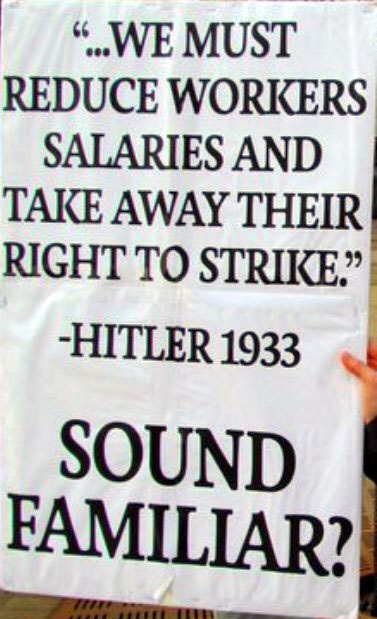
The Economic Policy Institute recently ran a couple of good studies about wages.

hitlerquote

Factory Workers Earn More Money

EPI says, “…manufacturing workers still earn 13.0 percent more in hourly compensation than comparable private-sector workers. This manufacturing premium, however, has declined by about one-fourth (3.9 percentage points) since the 1980s, when it was 16.9 percent.” So why do manufacturing workers make more money than “comparable” people? And why is the margin diminishing?

Here’s another question that bugs the heck out of my friends who work in aerospace but are members of the Auto Workers Union: “Why do auto workers get much better contracts than aerospace workers?” We work just as hard and have had as much or more training. We have the same national union leaders, the same history, and the same intentions, but our wages and conditions have never been as good as theirs. Why?

It’s Not the Work, It’s the Organizing

Manufacturing workers are easier to organize than other workers. There are more of them in one place. They work closer together. They live closer together, They have more of the same interests. Contrast, for example, techies. Techies are notoriously hard to organize, even though they may really want a union. They live all over the place. They work almost entirely alone. Some of them actually work at home. They tend to travel for work. They don’t usually advance within the same company, but move from one company to another for advancement. It is very hard to organize techies.

The easier we are to organize, the more likely we are to have a union and thus get better wages.

Aerospace workers can cuss the auto workers all they want, but the fact is that auto workers were easier to organize. Assembly line production calls for the highest levels of cooperation among workers. Take just a few of the workers off an assembly line, and it has to shut down!

Airplanes, for the most part, aren’t made on assembly lines. It’s hard to win a strike in aerospace, but it’s much easier in auto. Better organizing, better contracts!

Why Is the Gap Decreasing?

EPI says that the gap between [organized] factory workers and everybody else is decreasing since 1980. I almost laughed when I saw that date. 1980 is the year that American government set new anti-worker policies and elected its best enforcer —
Ronald Reagan. So the question answers itself.

Unionism in America has atrophied beneath the government assault, and the advantage of unionism is not nearly as widespread as it was pre-Reagan. We fell from 35% of the workforce to the present 11%. Union workers still make way more money than non-union workers doing comparable work, but there just aren’t that many union workers left to bring up the statistics.

Whose Wages Are Rising?

The other interesting article from EPI said, “States with minimum wage increases between 2013 and 2017 saw faster wage growth for low-wage workers compared with states without any minimum wage increases (5.2 percent vs. 2.2 percent).”

Last month, Wall Street had a minor panic when it was announced that wages were rising for the first time in recent history. They were barely rising, but they were slightly higher than inflation for that same period. Since then, economists and political pundits have been saying that wages will continue to rise and that the government will have to take steps, such as raising interest rates, against the trend.

Capitalists may say otherwise, in fact they do, but they do not want wages to rise.

But wages did, statistically, rise a little bit in February, 2018. The reason was that some local and state governments, responding to political pressure from working people, were beginning to raise their minimum wages. An increase for low-wage workers has a profound effect on statistics, because there are so many low-wages workers. Also, all wages tend to rise when they are pushed up from the bottom.

Nineteenth century writers Karl Marx and Frederich Engels noted that workers would tend to benefit themselves more by organizing politically than they would by fighting the bosses one company at a time. It’s not a new idea; it’s just a true one.

Crossing the Line

There are a lot of references to “the line” in literature. There’s the “red line,” there’s the “line in the sand,” and there’s the “picket line.” If you want to get someone to answer the question “Which side [of the line] are you on?” just ask them if they support increasing the minimum wage. It cuts through a lot of verbiage.

Even though unemployment is statistically low, and the time is ripe for organizing, your own wages aren’t likely to rise much until you actually organize. Either organize a union on the job or organize politically to raise wages. That’s the road to success!

–Gene Lantz

I’m still on KNON.org 89.3FM in Dallas every Saturday at 9 AM Central /Time. If you want to know what I really think, check out my personal web site.


Take a look at recent news from the point of view of the progressive movement. Keep in mind that only the working class, and working class issues, can truly pull the movement together. The entire working class will not unite over gun control, over the right to abortion, over civil rights, or any of the other important causes. Wages and working conditions will unite us, because all of us care most about them.

On May 6, Texas held the first primary elections of the season. Democrats were overjoyed to double the turnout that they had in the last mid-term elections. Republicans improved about 15%. But the raw number of votes determines election winners, not percentages of improvement. While the Democrats were able to get a million voters to the polls, the Republicans got half again as many. The leading Democrat, Beto O’Rourke for Senate, got 600,000 votes, while the Republican incumbent got 1.3 million! The same was true in the governor’s race.

One of the reasons for improved Democratic Party turnout was that they fielded candidates in every race, even in the ones where they were almost sure to lose. There’s a downside to that, because some of the contested seats were held by rock-solid working class incumbents with 100% pro-worker voting records. Politicians are mostly opportunists, not principled leaders.

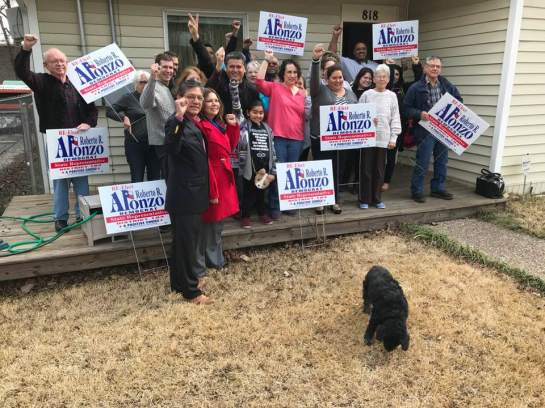
Labor is calling the results “mostly good news” because over 90% of our endorsed candidates got into runoffs or won outright. But we lost three of the best of the state representatives, including Roberto Alonzo of Dallas who has been honored nationwide for his commitment to labor’s cause. Labor worked hard for their candidates
Progressive Movement Remains Fragmented

No one could deny that there is an upsurge in the progressive movement since the 2016 elections. The big improvement in voting statistics demonstrates it. But cohesion is not one of the grand characteristics. The most unifying theme among Democrats was dislike for President Trump, according to the pundits.

But the only way they could unite effectively is around the basic issues of the working class, and the election results did not show that trend. While the AFL-CIO could honestly claim a 90% success rate, another organization, Emily’s List, which only endorses on women’s issues, could claim 100%, according to the Politico news service. All their endorsed women were in runoffs or had won outright.

Labor’s candidate for the Democratic nomination for governor was controversial because of being a woman, a Latina, and gay; but she won a thumping big plurality and goes into the runoff with a big advantage among Democratic voters. It would be a stretch to claim that she did so well because of the AFL-CIO endorsement, when Emily’s List had better results.

People who want serious change remain confronted with this problem: how can we unite the progressive movement?

Best News Was Barely Reported

While pages and pages of newsprint covered the Texas elections, there was scant coverage of the teachers’ strike in West Virginia. But from the point of view of unifying the progressive movement around workers’ issues, the news from West Virginia was at least as important, if not more so. For the first time in years, American labor saw a well planned and well-executed strike create big gains for workers. By holding out statewide for nine days, those teachers won a 5% raise for themselves and for all state workers. They also got a freeze on health care costs. The AFL-CIO Executive Board endorsed the strike in, I think, about the 7th day. The American Federation of Teachers spoke encouragement, but I didn’t see any of the nationwide forces really throwing themselves into it. The main fund raising I saw was one of those “go fund me” accounts.

In today’s news, way back in the back pages, teachers in Oklahoma have issued an ultimatum to their legislature. Arizona teachers are also talking strike.

Historical View is Bad, but Mostly Good

A lot of people, including me, believe that economic conditions are leading the capitalist class toward choosing fascism as their preferred form of rule. The great robbery called the “tax cut” went through Congress in December with very little popular support. Despite their best efforts, it is unlikely that the rich will convince Americans to warm to it very much.

What I’m saying is that it is getting harder for the rich to continue robbing the American people. That’s why they are working so hard to disarm us with voter suppression, dangerous foreign policy, anti-union legislation and legal decisions, deregulation, redistricting, and destruction of civil rights and civil liberties. Once our rights are gone, we can’t defend ourselves at all. That’s fascism.

Even though I think the obscenely wealthy are likely to choose fascism, I don’t think they will be able to implement it. That’s the good news. We aren’t as dumb as they may think. Actually, we’re far better educated and far more capable of coming together than the Italians and Germans of the 1930s were.

This is the time to organize. Low unemployment and high discontent are the ingredients for a great upsurge. Despite the low voter turnout numbers, Americans have more energy, and it is more generalized, then at any time since World War II. We may be fragmented, but we won’t stay that way. Once we are united, nothing can stop us!

–Gene Lantz

I’m still on KNON radio 89.3FM in Dallas from 9 to 10 AM Central Time every Saturday. If you are interested in what I really think, check out my personal web site.

 

Book review: Glenn Frankel, “High Noon. The Hollywood Blacklist and the Making of an American Classic.” Bloomsbury, New York

garycooper

There aren’t any actual good guys that I know of in the story about the American film blacklist. There are just bad guys, to one degree or another, and victims. The main character in this book is Carl Foreman, who wrote “High Noon” and saw it through. According to the book, Foreman’s views were shaped by the anti-communist witch hunt going on at the time (1952). Foreman was one of the victims.

The plot of the movie, as you know, concerns a lawman under pressure from a gang of killers. He can’t find anyone to back him up, but he can’t figure any way out of it either. So he has to face almost certain death alone. He survives (it’s still a Hollywood movie) and is embittered about the law (the system?) and about the people he had considered his friends. He dumps his tin star and rides away. The town becomes a ghost town, just as it deserved.

The town in High Noon is a metaphor for Hollywood. I’m old enough to remember when the movie came out, and I’m also old enough to remember the schlock that passed for American films afterward. Rock Hudson flirted with Doris Day in every other movie for the next ten years!

I’ve read several books about the witch hunt that is sometimes called the “McCarthy period.” I liked this one because it names a lot of names of the name namers. It doesn’t equivocate as to who was profiting by turning in their friends, who was lying to begin with, and who found some way around it. Foreman was one of those last ones. He was a victim to be sure, but he came out of it better than many former Reds. He managed to avoid naming any names, too, according to the book.

A lot of fuss is made over film star John Wayne, who was one of the biggest red-baiters in Hollywood. This may have been because many of the people he was victimizing had served honorably in World War II, while Wayne ducked it and made his fortune playing war heroes. Wayne hated “High Noon” and Carl Foreman. There’s an interesting interview on YouTube in which Wayne tries to cover his venom with a patriotic veil.

I also liked the film analysis in the book. Several artists did what has to be their best, or way up there nearly best, work in this movie under difficult circumstances. I can’t think of a better performance by Katy Jurado or Lloyd Bridges. Lon Chaney Jr, who ruined his image by playing The Wolfman over and over, was especially outstanding. Gary Cooper played Gary Cooper for the 1000th time, but it’s hard to think of a better version! If you’re curious about Cooper’s role in the witch hunt, you’ll get your answer in this book.

The book offers a lot of answers about this terrible period in American history. The questions continue to overshadow the answers, especially “Will it happen again?”

–Gene Lantz

I’m still on KNON radio 89.3 fm in Dallas every Saturday at 9 AM Central Time. If you are curious about what I really think, check out my personal web site


I received a mailing to help me promote “School Choice Week” on the air.

At KNON radio studios, I receive  a lot of right-wing mail. I think it’s because my program is called “Workers Beat” and conservatives can’t conceive of a radio show that is actually for workers. When one says “workers” they assume you mean management, I guess, because all the other radio programs are either written by the bosses or approved by them. I throw away a lot of free books about how to get more work out of workers.

The School Choice mailing came from a post office box in some town in California. It says that there are 32,240 American events to promote “school choice” during January 21-27.  It says that 6.7 million students and supporters will be participating. It says there are 54 events in my town. It says I should promote them on KNON radio and it offers me materials to broadcast.

I assume they sent this to every radio station in America at considerable cost. It’s part of a national effort to destroy the public schools. If you aren’t worried, you should be.

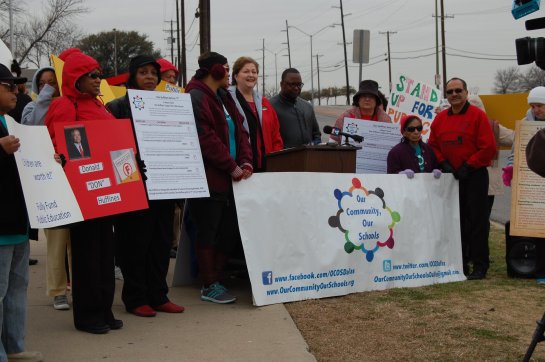
ocos-rena

A Little History on Schooling

America, more than most countries, advanced free public education. It’s one of the reasons that America shot ahead of the rest of the world in the 20th century. But there was always resistance. It took a Civil War to offer free public education to African American children, for example, and even then their public schooling was inferior to that offered to the Master Race of American Anglos. It still is.

The Brown Vs Topeka Supreme Court case in 1954 signaled a renewed fight for fair education. Whites were encouraged to fight against fairness in a number of interesting ways. One way was to move to white suburbs. One way was to create “magnet schools.” These “magnets” drew off the most outspoken activist parents and gave them what they wanted — decent education for their own kids — while leaving the rest of the kids, largely those with parents who had to work, behind.

They loosened the restraints on home schooling for the parents who didn’t have to work. Another way was to push for school vouchers so that tax money could be used for private schools. Yet another way was to push for “charter schools” to use tax money in ways that were out of the control of the people.

It’s the same fight that we were having during the Civil War and Reconstruction, but in different forms.

Who Wants to Destroy Public Education?

The people with the most money want to stop paying taxes. A lot of federal money, and the largest part of any state budget, goes to education. That’s tax money that rich people would rather not pay. After all, their kids don’t even need the public schools. They have always had better schools, before the Civil War and after.

In this regard, wealthy people’s desire to stop paying taxes, the effort to undermine public schooling fits into the larger explanation of what’s wrong in American politics today. In order to maintain their profits and beat their international competitors, wealthy Americans are trying to contain their costs. We are their costs. Public school children are their costs, in their view.

Public schools retain all their traditional enemies, too. Religion in general and the Catholic Church in particular head the list. They think they can get public money to promote their superstitions. In the short run, they can, because the very wealthy welcome any help they can get to destroy public education. Look at poor Louisiana!

In the long run, the very wealthy don’t want to pay for Catholic schools, either, so their little cabal won’t endure very far beyond the collapse of public education. The Catholics will be left at the altar once their usefulness is over.

Just to be Clear

State legislatures have been cutting public education funding for some time. It is especially true in states where right-wing Republicans have seized control. First they drain away all the resources, then they impose crazy unreasonable rules, then they piously claim that the schools are “failing.” Then they cut some more and pass some more rules.

One doesn’t have to be smart to figure out that they intend to rob American children of their right to a decent education.

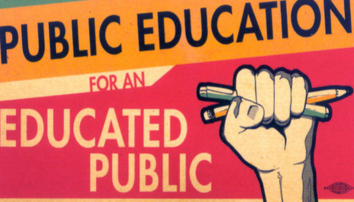
Public education

Fight Back

The American Federation of Teachers and the National Education Association, the main unions, are forming coalitions with community groups to clarify the issues and direct the fightback. I’m proud that the main labor federation, AFL-CIO, backs them.

As usual, our enemies have many ways to divide us. They say that they are magnanimously seeking ways to overcome school “failures.” They say they are promoting “innovation,” and “school choice.” They are spending a lot of money to buy politicians and do direct advertising.

That’s why I got the stupid mailing about “school choice week.”

–Gene Lantz

I’m still on KNON radio 89.3 FM in Dallas at 9AM central time every Saturday. If you are curious about what I really think, check out my personal web site.