Archive

history

Movie Review: “Woman Walks Ahead,” Directed by Susanna White, 1 hour, 43 minutes

Woman_Walks_Ahead

On the 4th of July, my movie buddy and I learned about people who probably weren’t celebrating the birth of this nation and all the freedom we supposedly enjoy.

Some of the historical background is on Wikipedia. The story starts in 1889 when a painter named Caroline Weldon from Brooklyn comes to the Standing Rock reservation to make a portrait of the great Sitting Bull. In this version, she stays close to him to the end of his life.

If Sitting Bull and Caroline Weldon were as sexy and good-looking as Michael Greyeyes and Jessica Chastain, their Hollywood versions, romance would be inevitable. To the credit of the movie, though, there is very little romantic diversion from the essential story about the end of the great fighting nation and its chief.

The movie makers were challenged to depict a situation of incredible humiliation, degradation, deliberate starvation, racist violence, and genocide. They did a good job of it. The results are hard to watch in places. At the same time, one has to imagine that reality at the Standing Rock Reservation had to have been far worse.

Like some of the best Westerns, this one stars the scenery. The other actors are truly wonderful. Jessica Chastain underplays her role with an admirable professionalism. Michael Greyeyes brings a great and complicated man to life. The main racist villain, Sam Rockwell, is so evil and so broadly representative of the oppressive attitudes of the time that he nearly steals the movie. His is one of those characters that viewers can almost taste and smell.

The director gets the most praise because she tells an essential American story without skipping over its horror and without preaching about it. We count ourselves lucky to have found this movie. Others may have to look hard for it.

–Gene Lantz

I’m still on KNON radio 89.3 FM in Dallas TX at 9 AM CST every Saturday. If you are curious about what I really think, check out my personal site.


a member of the National Indian Defense Association “NIDA”, reached out to Sitting Bull, acting to be his voice, secretary, interpreter and advocate.


Have you noticed the number of journalists getting killed lately?

It makes you stop and think about it. Around the world, journalists who try speaking truth to power are getting murdered. President Donald Trump isn’t helping when he tries to convince everybody that truth is fabricated, dark is light, and up is down. By constantly demonizing journalists, he’s painting a big bulls eye on their backs.

Which brings me to my letter to the editor printed today in the Dallas Morning News. It said that the recent decisions of the five anti-worker Supreme Court Justices reveal that they are opposed to democracy and would like to do away with it. The editors removed one word from my letter, “fascism.”

I equated the absence of democracy with fascism. If someone, like the Supremes, moves us away from democracy, they’re moving us toward fascism. That simple.

I try to explain things like that on my radio show every Saturday. Last Saturday a guy called to ask if I think all “conservatives” are also “fascists.” I said no, and I quoted conservative columnist David Brooks who recently wrote, “You can be a Republican or a Conservative, but not both.” He said true conservatives embrace democracy because they want freedom for all individuals.

If you aren’t for workers, I say, then you are automatically for corporations because their interests are opposite. Mussolini said that fascism was corporatism, and that makes sense to me.

I explore things like that all the time in my writing and on my radio show. Does that mean I’m in line to get killed? The studio is on the ground floor of an office building. Two sides are glass. Around my neighborhood, I’m always on my bicycle. Unprotected. I think that if I get to be as effective as I’d like to be in spreading the truth, I’d be in line to join the growing line of dead truth spreaders.

I thought about getting a gun, but that would kind of dilute the message, wouldn’t it?


–Gene Lantz

I’m on KNON radio 89.3 FM in Dallas at 9 AM Central Time every Saturday. If you are curious about what I really think, check out my personal web site.

gun

Movie Review, “1945,” Directed by Ferenc Török. 91 minutes

1945-2guys

I like to accuse my intellectual friends of only liking black-and-white movies in obscure dialects. They’d be sure to like “1945,” but almost anybody who likes good movies would, too.

It’s deceptively simple: Two tight-lipped Jewish guys come into a small Hungarian village immediately after World War II.

Can you imagine that? The all-gentile townspeople can. They have been dreading this coming every moment since their own participation in the holocaust.

I like filmmakers who understand their powerful medium and use it expertly. They don’t necessarily have to have wide screen, technicolor, computer graphics, or a cast of thousands to draw us moviegoers in and change us through art. This is a very sparse movie, like a tiny and innocent looking stick of dynamite.

The best movie comparison I could make is to “High Noon.” It’s not a cowboy movie, but the pacing and the tension it creates are similar. If you liked High Noon, you’d probably like “1945,” and who doesn’t like High Noon?

–Gene Lantz

I’m still on KNON radio 89.3FM in Dallas every Saturday at 9AM Central Time. There are podcasts under the “events” tab. If you want to know what I really think, check out my personal web site.


Book Review:

Levinson, Marc, “An Extraordinary Time. The End of the Postwar Boom and the Return of the Ordinary Economy.” Basic Books, New York, 2016. Dallas Public Library 330.9045 L665E

keynes-quot-inflation

The unusual economic period was the third quarter of the 20th century, also known as the Post War Boom, or the Golden Era. That’s when many people made good livings and some made fortunes. The “ordinary economy” in the title is what we have now – basic capitalism where some still make great fortunes but everybody else is struggling.

He takes an international approach. He points to a few national economies that did OK while the majority foundered, but mostly he shows the similar problems that the wealthy nations suffered after 1973. His point of departure was the oil crisis, but it might just as well have been the failure of the Bretton Woods international financial agreement 1945-1973.

I particularly enjoyed the way Levinson deflated the claims of various schemes of government intervention. He quotes figures to show that none of the much-vaunted “new” approaches actually did much to help after 1973. Reaganism was just as big a bust as any other “new” theory. Actually, they weren’t even new.

His international approach is far superior to what we usually read in American newspapers and political campaign advertisements. They only talk about what happened in America without regard for world changes. His way is better. For example, suppose an economist said that a certain new technology should have greatly improved manufacturing production in America. Maybe the reason it didn’t is because some other country did it better or cheaper. That’s pretty much what actually happened to American manufacturing, not some mistaken priorities within our own economy.

What limits this economics book is its commitment to capitalism. He dispenses with the Soviet Union’s economic travails in two pages. The rest is about the major capitalist economies. Nowhere in the book could one even ask the essential question of economics, “If we can produce enough for everybody, then why isn’t everybody doing OK?”

The set of statistics most critical for Levinson is those on productivity. He says that the Golden Age was golden because of high productivity in the wealthy nations. The crisis that began in 1973 and continues now was marked by substantially lower productivity. If productivity could be restored to high levels, everything would be just fine, according to Levinson. At the same time, he offers no suggestion as to how that could be done.

You might as well say, and I think Levinson does say, in so many words, “The Golden Age was just a fluke. Misery is the norm.” I recommend this book for its open-minded analysis and despite its conclusions.

–Gene Lantz

I’m still on KNON radio 89.3FM in Dallas at 9 Central Time every Saturday. Podcasts can be found under the “events” tab. If you are curious about what I really think, check out my personal web site.

I just got the word, via Bruce Bostick of the Steelworkers, that Ed Sadlowski died yesterday.  He was one of the great American labor leaders who ultimately didn’t win.

sadkiwski-leaflet

It’s easy for us to remember the great leaders for working families if they rose to some title or office that makes the history books. What we don’t remember is the thousands who did the work but didn’t get the titles. The Sadlowski campaign for President of the Steelworkers was a landmark event in 1977, but Ed didn’t win the election.

After the draft was repealed in 1972, America’s big student movement dribbled away. For a lot of the 1960s-70s “radicals,” the progressive movement was over. You see them all the time. They’re the older guys with ponytails who love to talk about it, but it was only an interlude for them.

The young people who had been transformed by that great anti-war movement continued engaging in the many struggles for justice. Many of them still are. In general, though, they didn’t look to organized labor for causes. Unions did not want them. Most unions had ignored or opposed them throughout their political awakening and, to be frank, many of us had little or no hope for the union movement.

Sadlowski was a point of departure. His energetic fight for justice in the Steelworkers’ union showed that there were great things to be done in the union movement and great people were doing them. We flocked to the Sadlowski campaign, even to the point of giving up college career plans and getting Steelworker jobs.

Ed Sadlowski did not reject the outside help. He paid a price in red-baiting for that. I don’t think the red-baiting caused him to lose the election. He lost because he was bucking a mighty tide of conservatism and isolation in the American union movement, in my opinion. But the red-baiting hurt, too.

If we knew our labor history, we’d know that there were heroes in many unions who bucked the tide. Steel and the Miners Union may have been in the papers more, but it was going on in a lot of places.

I think the big payoff for the insurgents began in 1987 when a few unions started Jobs with Justice. In 1992, as I recall, there was a big conference of the more progressive unions to discuss the problems of low-paid workers. Then in 1995, John Sweeney, Richard Trumka, and Linda Chavez-Thompson overturned 100 years of continuous officeholding in the AFL-CIO. That’s when it really started getting good, and it’s improved every day since then!

The Ed Sadlowski’s may not get the titles and the awards, but they did the work for all of us.

–Gene Lantz

I’m still on KNON radio 89.3FM in Dallas at 9 AM Central Time every Saturday. The “events” tab on the web site leads to recent podcasts. If you want to know what I really think, check out my personal web site.

President Trump is the champion of fair trade for American workers. Or is he destroying the hopes of all workers for a peaceful and beneficial world? Or does he even know what he’s doing?

me-nonafta

A lot of working families were won over by Trump’s promise to renegotiate so-called “trade” agreements and restore American jobs. People, including a lot of union people, are still hoping he will. Yesterday, he poked his finger into the eyes of several world leaders at the G7 meeting in Canada. He said he was representing American workers.

What’s “Fair,” What’s “Free?”

For decades, since the Clinton Administration at least, American unions have been campaigning on the slogan “Fair trade, not free trade.” We always say “We’re not against trade — we just want it fair.” But it’s been very hard for union leaders to resist xenophobia and isolationism, because those “isms,” — right along with nationalism and racism — are also against the trade deals that America negotiated since Clinton.

The people that knew what they were talking about presented the argument that the so-called “free trade” deals were only “free” for big transnational corporations — not for the working families in America or any other country. Big corporations received “freedom” to pay low wages and pollute, nobody else got anything. That’s why we opposed NAFTA and all the others leading up to the “Trans Pacific Partnership” that was still an issue in the 2016 presidential campaign.

The people that knew what they were talking about actually favored trade deals if they included wage and environmental protection. But not everybody is so sophisticated. They hate the trade deals anyway. That’s why so many of them voted for Trump.

There’s a History to “Free Trade”

I recently read a complete history of Britain and found an interesting reference. When Britain “ruled the waves” and ruled the world, their slogan was “free trade.” From the time they defeated Napolean until World War I, the English favored what they called “free trade.” They didn’t , at least not immediately, necessarily open their own markets, but they wanted everybody else, especially their many colonies in Asia and Africa, to open theirs.

In other words, “free trade” meant, then and now, the “freedom” of one country’s corporate rulers to exploit everybody else. Another word for it is modern imperialism.

After World War I, and especially after World War II, when the United States took over world trade, corporations wanted “free trade” for the exact same reasons. But the “freedom” was always for the exploiters and never for the exploited, then and now.

Everything Ends

There are different ways to look at the Trump program on trade issues. Economists and pundits are arguing that he’s destroying the world and setting us back centuries. Trump and his supporters say he is restoring fairness. Xenophobes and racists are rooting for him, as they have all along.

But there’s another, more interesting way to look at Trump’s trade wars. American economic domination is coming to an end. It actually ended in the 1970s, according to some. Since then, international leaders have simply agreed to keep the system in place even though the United States is living on credit and has been for decades. The post-war system put in place by the United States after WWII has actually fallen apart. Donald Trump is just an opportunist trying to turn the situation to his own benefit.

A Real Solution to the Trade Wars

Modern nations were created by capitalism. Each nation is run by and for the bosses. Their economic and political decisions are made for the benefit of the dominant class — the capitalist class. That includes much more than trade deals and treaties. It also includes global pollution, war and genocide.

It is theoretically possible that the various governments, as presently constituted, could cooperate on trade in a way that would benefit the inhabitants of the various nations. But that’s only in theory. It has never worked that way because the inhabitants, us, were never in charge. We still aren’t, and there will be no solution until we are.

–Gene Lantz

I’m still on KNON radio 89.3FM in Dallas at 9 AM Central Time every Saturday. The “events” tab on the web site leads to recent podcasts. If you want to know what I really think, check out my personal web site.


Last night I listened to an outstanding report from a participant of the 1960s-70s American student anti-war movement. The reporter really knew his stuff, and his analysis was superb.

communist-dead

At the end, though, I disagreed. It wasn’t that I don’t concede that the guy knows twice as much about the student movement as I do. It isn’t that I don’t agree that the student movement shook the world, refashioned people’s thinking, and contributed greatly to ending the Vietnam War. He’s absolutely right on that.

What I disagreed with was the emphasis. The progressive movement that we are experimenting with right now is the biggest, most important, and most potentially effective people’s movement since the American Civil War. Maybe even better than that. The student movement was nearly all college students, and mostly white draft-age males at that. Even the civil rights movement of 1954-1968 was limited to a relatively small sector of the population. The labor upsurge of 1935-1947 was great, but the union movement was split between the AFL and CIO then. The Industrial Workers of the World exceeds everything in pure romanticism, but I don’t think there were ever more than 100,000 actual members. The populist movement of the late 19th century was limited to farmers and, for the most part, didn’t even include landless farm workers. Outside Texas, the populists were infamous for their racism.

No, now is better.

Communists and Fascists Today

We had communists and fascists in the old days. We have them now.  People understand them both better now than they did when they were just “hot button” emotional topics. It is true that fascism is inching forward in America, but it is also true that people know what to do about it. More importantly, the fascists can’t use anti-communism as effectively as they did before. Anti-communism is dying out among America’s youth.

Just Look At Us!

I looked around the room while my friend was talking about our student movement. The crowd was mostly young, but not all young. In gender and race, it was diverse. When my friend talked about making leaflets for anti-war demonstrations, I realized that the people at the meeting had, in their purses and pockets, more thinking and communicating power than we ever dreamed of as students. They could make leaflets in minutes if they wanted to, but they don’t even need leaflets. They are experts at communicating. This small group could have easily reached thousands of co-thinkers before they left the room!

Labor Is Getting Past Its Isolation

Speaking of the room, it was the auditorium of the local school employees’ union, American Federation of Teachers. The president of the local union walked through and said hello to a few of us. Could you imagine, in your wildest dreams, that the student anti-war movement could have met in an AFT union hall? Albert Shanker was President of that union in those days, and he was, next to the president of the American Federation of Labor, the most fanatical supporter of the war in Vietnam.

Labor isolated itself from the progressive movement in most instances between 1947 and 1995, then they made a gigantic change toward standing for all workers.

Today’s progressive movement is warmly accepted in union halls. The Dallas AFL-CIO welcomes radical Bernie-Sanders-socialists several times a month! The AFL-CIO banner regularly appears at anti-war, civil rights, gay rights, environmentalist, and immigrants’ rights rallies. If anything, the national and state leaderships of the labor federation are even more integrated into the general progressive movement than Dallas unions.

I like studying the history of other progressive movements. There are many good things to learn, and we learned some of them last night. But don’t get carried away with the past. Now is better.

All We Have Is Now

I welcome discourse when I publish. Disagreements are welcome. But bear in mind that today’s situation is the only one we have. Romanticizing earlier situations may be fun or interesting, but all our efforts can’t go into “then.” They have to go into now! On that, last night’s reporter, and everyone else, agrees!

–Gene Lantz

I’m still on KNON radio 89.3FM in Dallas at 9 Central Time every Saturday. Podcasts can be found under the “events” tab. If you are curious about what I really think, check out my personal web site.

Let’s do a Woody Guthrie festival on his birthday this year! Are you in?

woodyquot-hateasong

If he had survived, he would have been 106 on July 14. It’s a Saturday and a good day for a cookout and a singalong. The incredible Gerardo Contreras of UAW 848 is willing to do the cooking. I believe that both KNON’s “Workers Beat” program and Dallas AFL-CIO would sponsor and benefit from any money we raise.

My idea is to assemble a small choir to perform and lead audience participation songs, just as Woody or Pete Seeger would have done. Individuals or groups might want to do their own performances, but some songs, like “This Land Is Your Land” cry out to have everybody sing.

There are hundreds of songs to choose from, but here are some of the best-known ones.

All You Fascists Bound to Lose  https://www.youtube.com/watch?v=VwcKwGS7OSQ (choir- singalong)

Biggest Thing that Man Has Ever Done https://www.youtube.com/watch?v=qB-YnV0e3Lc

Deportee (Anthony Esparza)  https://www.youtube.com/watch?v=qu-duTWccy

Do Re Mi https://www.youtube.com/watch?v=46mO7jx3JEw

Hard traveling https://www.youtube.com/watch?v=kfq5b1bppJQ

I Ain’t Got No Home / Old Man Trump https://www.youtube.com/watch?v=jANuVKeYezs

I’ve Got to Know https://www.youtube.com/watch?v=lyo_Hilxlj0

Jesus Christ  https://www.youtube.com/watch?v=EDS00Pnhkqk

“Talking Unions” https://www.youtube.com/watch?v=WU2RUoakYIM

Oklahoma Hills https://www.youtube.com/watch?v=IYFUUxxn6Vk

Philadelphia Lawyer https://www.youtube.com/watch?v=bjeen-Hl8uc

Pretty Boy Floyd https://www.youtube.com/watch?v=fBF3aXvquHs

Ranger’s Command https://www.youtube.com/watch?v=FznriVNbWCI

This Land Is Your Land (choir-singalong) https://www.youtube.com/watch?v=wxiMrvDbq3s

Tom Joad https://www.youtube.com/watch?v=dimhKln0KBg

Union Maid  https://www.youtube.com/watch?v=S1g4ddaXRs0

You Gotta Go Down  and Join the Union https://www.youtube.com/watch?v=zN8kGzHH00I

Labor’s musical tradition tends to get lost every now and then. Let’s re-discover some of it!

–Gene Lantz

I’m on KNON radio 89.3 FM in Dallas at 9 AM central time every Saturday. Podcasts are available from the “events” tab. If you want to know what I really think, check out my personal web site

Book Review: Barlett, Donald L, and Steele, James B. “The Betrayal of the American Dream.” Public Affairs, NY, 2012 Dallas library 330.973 B289B 2012

mlk-quot-capitalism

If recent economic developments have not already terrified you, this might be a good book to absorb. It is very much like “Runaway Inequality,” the book promoted by the Communications Workers of America that I reviewed earlier.  It has some of the same dire warnings and suggested solutions as the classes that the AFL-CIO conducted under the name “Common Sense Economics.”

The authors really hate “free trade,” tax giveaways to the rich, deregulation, or capitalist-directed globalization.

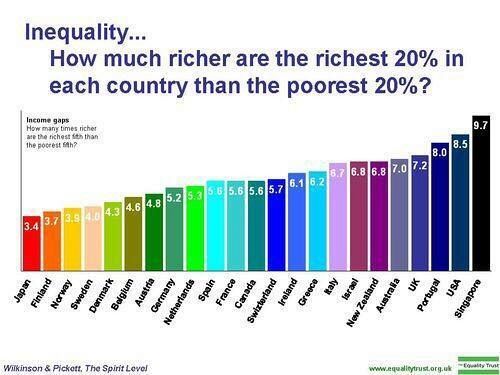
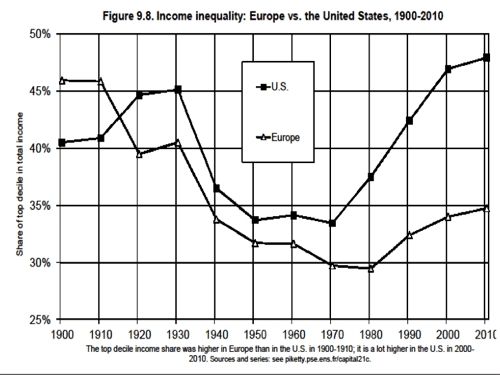
Here is the message in a nutshell: “Something terrible happened in America in the 1970s. Since then, virtually all new economic developments have been bad for the working people and crazy good for the very rich. Inequality is rampant. We need to bring back some of the more reasonable practices that were in place before the disaster struck.”

In my review of “Runaway Inequality,” I pointed out that our recent period isn’t the odd one. The odd one was the third quarter of the 20th century. The reasonably good times when some of the productivity gains streamed into workers’ paychecks were not normal. They were just weird.

Today, when the capitalists grab everything in a runaway train ride to oblivion, that’s what’s normal. Trying to go back to the practices of the 1950s is a lot harder than it looks, because the ruling rich are dead-set against it.

Why weren’t the rich dead set against equitable economic practices in 1950? I can think of at least three good explanations. 1) They ruled the world. They had almost no international competition because they had destroyed every other country during the war. 2) American labor was very strong after a tremendous upsurge 1935-1947. 3) The Soviet Union was still seen as a viable alternative to capitalism, and it was important to buy and/or destroy any pro-Soviet sentiment. None of those things were true in America by the time Ronald Reagan was elected.

Even though this book has great reporting on economic events, and even though it has very intelligent prescriptions for making economic things the way they used to be, I don’t think their hopes for the future are likely to happen. The book is great at explaining, but not so useful as a guide to action.

Actually, I began to be skeptical in the introductory pages when they said, “…we define the ‘middle class’ strictly by income….” They could have just said “middle income” instead of “middle class.” The problem with trying to rally middle-income people is that they aren’t really a class. A class is defined by political interests, and middle-income people are all over the map in their interests. Some of them are workers, some of them are lawyers, some of them are trust fund babies, some of them are shopkeepers. 

If someone is serious about making change, they need to start thinking about the working class.

–Gene Lantz

I’m on radio KNON FM89.3 in Dallas at 9 AM central time every Saturday. Podcasts can be found from the “events’ tab on the web site. If you are curious about what I really think, check out my personal web site.