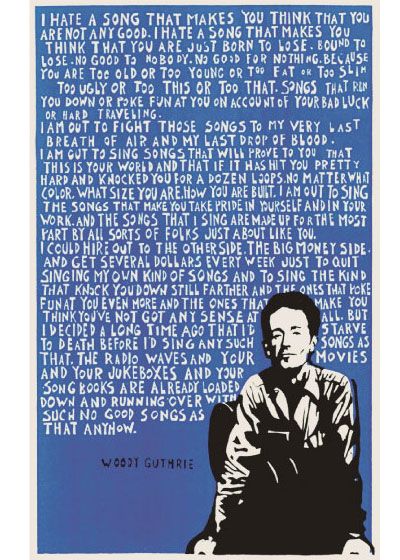
Let’s do a Woody Guthrie festival on his birthday this year! Are you in?
If he had survived, he would have been 106 on July 14. It’s a Saturday and a good day for a cookout and a singalong. The incredible Gerardo Contreras of UAW 848 is willing to do the cooking. I believe that both KNON’s “Workers Beat” program and Dallas AFL-CIO would sponsor and benefit from any money we raise.
My idea is to assemble a small choir to perform and lead audience participation songs, just as Woody or Pete Seeger would have done. Individuals or groups might want to do their own performances, but some songs, like “This Land Is Your Land” cry out to have everybody sing.
There are hundreds of songs to choose from, but here are some of the best-known ones.
Labor’s musical tradition tends to get lost every now and then. Let’s re-discover some of it!
–Gene Lantz
I’m on KNON radio89.3 FM in Dallas at 9 AM central time every Saturday. Podcasts are available from the “events” tab. If you want to know what I really think, check out my personal web site
Book Review: Barlett, Donald L, and Steele, James B. “The Betrayal of the American Dream.” Public Affairs, NY, 2012 Dallas library 330.973 B289B 2012
If recent economic developments have not already terrified you, this might be a good book to absorb. It is very much like “Runaway Inequality,” the book promoted by the Communications Workers of America that I reviewed earlier. It has some of the same dire warnings and suggested solutions as the classes that the AFL-CIO conducted under the name “Common Sense Economics.”
The authors really hate “free trade,” tax giveaways to the rich, deregulation, or capitalist-directed globalization.
Here is the message in a nutshell: “Something terrible happened in America in the 1970s. Since then, virtually all new economic developments have been bad for the working people and crazy good for the very rich. Inequality is rampant. We need to bring back some of the more reasonable practices that were in place before the disaster struck.”
In my review of “Runaway Inequality,” I pointed out that our recent period isn’t the odd one. The odd one was the third quarter of the 20th century. The reasonably good times when some of the productivity gains streamed into workers’ paychecks were not normal. They were just weird.
Today, when the capitalists grab everything in a runaway train ride to oblivion, that’s what’s normal. Trying to go back to the practices of the 1950s is a lot harder than it looks, because the ruling rich are dead-set against it.
Why weren’t the rich dead set against equitable economic practices in 1950? I can think of at least three good explanations. 1) They ruled the world. They had almost no international competition because they had destroyed every other country during the war. 2) American labor was very strong after a tremendous upsurge 1935-1947. 3) The Soviet Union was still seen as a viable alternative to capitalism, and it was important to buy and/or destroy any pro-Soviet sentiment. None of those things were true in America by the time Ronald Reagan was elected.
Even though this book has great reporting on economic events, and even though it has very intelligent prescriptions for making economic things the way they used to be, I don’t think their hopes for the future are likely to happen. The book is great at explaining, but not so useful as a guide to action.
Actually, I began to be skeptical in the introductory pages when they said, “…we define the ‘middle class’ strictly by income….” They could have just said “middle income” instead of “middle class.” The problem with trying to rally middle-income people is that they aren’t really a class. A class is defined by political interests, and middle-income people are all over the map in their interests. Some of them are workers, some of them are lawyers, some of them are trust fund babies, some of them are shopkeepers.
If someone is serious about making change, they need to start thinking about the working class.
–Gene Lantz
I’m on radio KNON FM89.3 in Dallas at 9 AM central time every Saturday. Podcasts can be found from the “events’ tab on the web site. If you are curious about what I really think, check out my personal web site.
The main players in today’s economy aren’t “rational men” as assumed in classical economics. They are “sociopathic men.” It’s the first and most important lesson.
What crippled economics as a science was its separation, in the late 19th century, from other disciplines, especially politics. At the same time, it was decided that economies work because “rational men” (sorry ladies) cause the supply and demand for commodities to balance out at a fair market price.
It’s like the Holy Bible of economics: nobody actually believes it but everybody quotes it.
If we still studied politics and economics together, as we did before economist Alfred Marshall, we would see that it isn’t rationality that makes the world go around, it’s antagonism. Our economy is vastly different from their economy.
Bad Is Good
All these “rational men” do not have identical interests. In fact, our interests are extremely disparate. While ordinary working people like you and me want high employment, good wages, and low prices; our employers usually want the opposite. What is good for us, especially high wages, is bad for them.
Back in Alfred Marshall’s time, this opposition may not have seemed so important to people studying single economic data in a single market. But two great changes have occurred since then that make oppositional understanding vital: world war and governmental economic policy.
National “Good” is International “Bad”
Nations exploit one another. The First World War was fought to determine which industrialized nations were going to do the exploiting. That wasn’t a decision made by rational men within a single economy. “War is politics by other means,” as we say. Politicians made the decisions to carry out world wars, and the winners reaped the benefit. War determined international economics, but it certainly wasn’t because of rational men.
“Whose Economy” Depends on “Whose Government”
Capitalism has a built-in propensity for crisis. Early in the 20th century, and especially during the Great Depression, governments began to take affirmative action to save capitalism from itself. They recognized that monetary policy and fiscal policy could be used to heat up or cool down an economy to some extent.
The biggest problem was oppositional interests. Governments generally interceded in the economy on behalf of the richest capitalists and not for the majority.
But another big problem was created by all this government intervention. Instruments of debt and other purely financial instruments were floating around everywhere, and they became an obsession. A major part of economics was no longer concerned with commodities at all.
Government tried to regulate financial institutions, but they gave that up in 1999 when Texas Senator Phil Gramm got the “Financial Services Modernization Act” passed.
Without regulation, banks and other financial institutions began to use the tremendous resources that they could mobilize in high-stakes gambling. They particularly liked bundles of low-quality mortgage debt and its various crazy derivatives. The bust that followed was called the “Great Recession.” After that, the government re-regulated to some extent, but they are presently disassembling regulations again for the same reason — amazing profits for the very rich.
It’s not in the interest of the people, and it’s not rational. That’s the first lesson.
–Gene Lantz
I’m on KNON radio at 9 AM Central Time every Saturday. Podcasts can be found from the “events” tab on their website. If you are curious about what I really think, check out my personal web site.
Book Review: Kishtainy, Niall, “A Little History of Economics.” Yale Univ. Press, New Haven and London, 2017. Dallas Library 330.09 K61L 2017 X117192583 BNO
What I do might be called whining or griping, but I call it asking. I go around telling people that we are in the middle of the biggest worker upsurge in American history, but that our effectiveness is limited by our chronic failure to come together. I ask people what we should do about it.
Nobody seems to know the whole answer but, during the past weekend, I received some good tips. The College of Complexes, a weekly “free speech” forum, let me speak on the history of labor upsurges compared to the present day. I said that American labor was stronger today than ever in history. I also said that significant improvement in our society would result if we manage to pull together. Eventually, they will post the whole evening on their Youtube channel: http://www.collegeofcomplexes.org/LectureLibrary2.html. They already have me several times from earlier appearances.
In the discussion, some of the best ideas came from the anti-worker section. One of them denounced socialism in general and me in particular, but he said that what we really need is total organization at the grass roots level, then a takeover of the corrupt American government. I applauded that as absolutely brilliant.
Another speaker was not pleased with anything I said, but he believed that American involvement in the Middle East was a “big crime.” He said that strong anti-trust legislation is needed. He said that the problem is that we are being ruled by an unscrupulous elite that dominates both major political parties. He added that energy companies could not be trusted and that the corporate news media has betrayed us. I couldn’t have said it better!
A couple of the speakers lauded President Trump and said that I should be supporting him. I agreed that I would be prone to vote for him if the delivered on his promise of $1 trillion on infrastructure improvements. I also said I’d promote him for the Nobel Peace Prize, as several right-wing Republicans are doing, if he brought all American troops back home.
On social media, I’ve been complaining that there were two separate MayDay picnics with, as far as I could tell, no effort to pull together. I also lamented that there were seven different public actions against the NRA convention in Dallas May 4-6. A rational voice responded that I’m probably over-reacting and that, sometimes, there are good reasons to avoid working with some groups and individuals.
I fall back on the best answer I’ve had since I started asking these questions on January 21, 2016. “Leadership will come out of the movement.” That was from my friend and radio guest, Kenneth Williams.
My own advice is this: “Keep Asking!”
–Gene Lantz
I’m still on KNON radio89.3FM in Dallas at 9 AM every Saturday. Podcasts are available from the “events” tab. If you want to know what I really think, see my personal web site
Several socialist groups came together on April 29, 2018, in Lake Cliff Park in Dallas to celebrate MayDay. They were kind enough to allow the oldest person in attendance to remind them of the long workers’ tradition by leading singing of “The International.”
Another Mayday celebration, by another group of socialists, takes place at Kidd Springs Park at 5:30PM on May 1st. One cannot help but observe that the progressive movement, even the activists who supposedly have the highest levels of consciousness, continues to be disunited. It’s like Will Rogers used to say about the weather: “Everybody talks about unity, but nobody does anything about it!” I believe the trend, though, is positive.
The trend toward celebrating the International Workers Day is a very positive sign. I can remember reserving that very same Lake Cliff Park pavilion May 1, 1984, and doing all the preparations and publicizing myself. Then I sat there, alone, for two hours hoping somebody would come, but they didn’t! This year, we have two of them. The first one had about 40 people, and I imagine the second will be at least as big.
I’ll be doing a talk about “MayDay Then and Now” at Roma’s Pizza, 7402 Greenville Avenue, beginning at 6 pm on Saturday, May 5th. I’d like to count that as a third MayDay celebration. Every year, I publicize MayDay on my radio show.
MayDay Has a History
The workers’ movement, of course, goes back at least to Moses and the slaves of Egypt, and workers probably celebrated the vernal equinox around MayDay long before they had calendars. But the year 1886 marks the close association of the workers’ movement with May 1.
That year, the word went out from Chicago for a worldwide general strike to demand the 8-hour day. There were protests everywhere. Strikers were killed in Chicago. A police riot erupted on May 4th during another rally in Haymarket square. Authorities came down hard on the Chicago movement and, in 1887, hanged four of the main leaders. Since then, the world remembers “Chicago, 1886” on May 1st.
The repression from the bosses combined with the opportunism of many American labor leaders separated the Americans from the International Workers Day; consequently there have been few celebrations here until recently.
Was Labor Stronger Before?
Almost any reading of labor history will bring out the romantic in us. We long for the great general strike of 1874, or the worldwide struggle of 1886, or the organizing frenzy of 1935-1947. In 1980, when the American government decisively teamed up with the bosses to suppress the labor movement, unions began a numerical free fall that continues today. We had 35% of the workforce organized into unions, and we have only 11% now. People dream about the good old days.
No, We’re Stronger Now!
But despite the decline in union numbers, American labor is actually stronger today than ever. Part of the reason is productivity, but most of it is education. One worker today is four times as productive as those who organized in 1935-47. If one worker walks off the job today, it’s like four workers striking in the old days.
We have more unity than ever. In 1935-47, remember that the American Federation of Labor and the Congress of Industrial Organizations were two separate and competing organizations. Remember also that racism and other kinds of chauvinism were far more divisive in the “old days” than they are today. The AFL-CIO didn’t even try to organize the millions of undocumented workers before 1999 — they joined the government in calling for deportation!
Today, the AFL-CIO bends over backward to work with church, civil rights, and community organizations. In 1987, unions were so totally isolated that five of the more progressive ones had to create a separate organization, Jobs with Justice, to try to build solidarity outside the official labor movement. Today, virtually all unions have gone past their initial hostility and regularly work with Jobs with Justice and other solidarity efforts.
In the old days, many workers were barely literate. Today, we command more information than they could have imagined. With our phones and computers, workers have the ability to function as almost a single worldwide unit. That’s power! We’re only at the first stages of using it, but today we have the power!
–Gene Lantz
I’m on KNON radio at 9AM Central Time every Saturday. Podcasts can be found from the “events’ tab. If you are interested in what I really think, look at my personal web site.
Book review: Jeffreys, Diarmuid, “Hell’s Cartel. IG Farben and the making of Hitler’s war machine.” Metropolitan Books, New York, 2008
The biggest corporation in Europe solidly backed the Nazis during the time they were taking power. During the ensuing war, the big chemical company was more and more deeply involved in Nazi warmaking and ethnic cleansing.
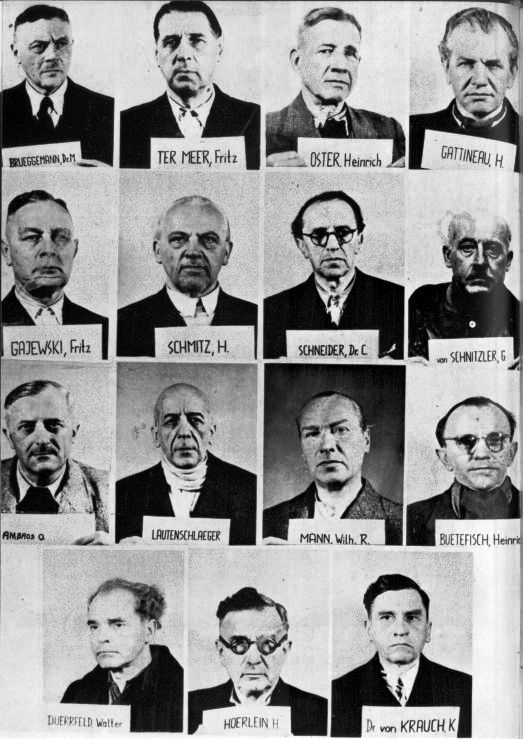
The book begins and ends with the trial of several top company officials. In between, it details the history of the conglomerate from the time that it supplied poison gas during World War I through the trials that ended in 1948. In both wars, they provided much of the vital expertise and materials.
IG Farben established and ran its own slave labor camp as part of the Auschwitz complex. The abuse and murder of tens of thousands of slave laborers was carried out in Farben facilities just as in the other death camps. One of their small but very successful product lines was Zyklon-B, the death gas.
Working people usually say that we do the bidding of “whoever signs our checks.” Have you ever wondered who signed the checks for Nazi doctor Josef Mengele, who killed hundreds of people with torture and outrageous medical experiments? IG Farben.
The company executives received light sentences and early parole. They went on to continued successful careers in European industry.
Books and movies about Nazi Germany have poured out in an endless stream since the end of WWII. We are fascinated with the horror of it and with the questions that are never quite satisfactorily answered, “How could this have happened? Why didn’t somebody do something?”
This book supplies part of the answer, if readers are ready to accept it. Hitler came to power essentially because wealthy Germans, like the officials at IG Farben, preferred the Nazis to the Communists. Even after the war, even during the trials at Nuremberg 1947-48, the main distraction from justice was fear of rising communism.
–Gene Lantz
I’m still on KNON 89.3FM radio in Dallas at 9 AM Central Time on Saturdays. If you want to know what I really think, check out my personal web site.
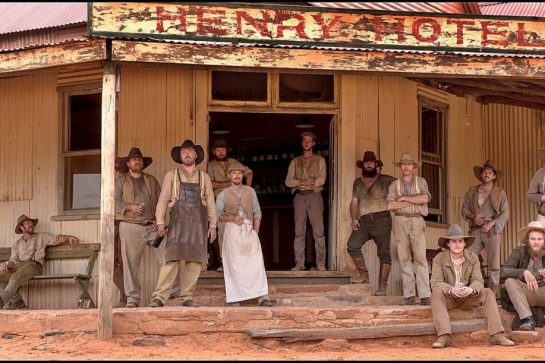
Movie Review: “Sweet Country,” Directed by Warwick Thornton. 113 minutes
My movie buddy and I are suckers for anything Australian. I think it’s the way they subsidize their movies that gives them such an intelligent edge. This one is more of a character study and an exposition than a story, even though there’s more than enough action.
The movie claims to be based on actual events in 1929. An indigenous man kills an Anglo, then goes on the run. Moviegoers may have seen wyly outlaws evade posses and madmen dying in salt deserts before, but seldom told with this much plain grit.
The indigenous characters are largely inarticulate and given to local idioms. The film has to use subtitles for some of their dialogue. There is a lot of symbolism that is open to interpretation, but one theme is clear throughout: racism. Like any story revolving around racism then as now, those dancing around the theme included the decent, the indecent, and the willfully ignorant.
The chase through the outback gives the filmmakers and the moviewatchers wonderful opportunities for vista viewing. The old John Ford westerns have absolutely nothing on this Australian cowboy movie.
But it’s the characters that matter. Moviewatchers get a solid inside look at these realistic settlers and their near-slave employees. Degradation and inspiration are there in handfuls. Warwick Thornton and his Australian team have made us a gratifying movie that is to be taken seriously and thoroughly enjoyed. The price of a ticket seems hardly enough to repay them.
–Gene Lantz
I’m still on KNON radio89.3 FM in Dallas at 9 AM Central Time on Saturdays. If you want to know what I really think, check out my personal web site,
Book Review: Rosenblum, Jonathan “Beyond $15. Immigrant workers, faith activists, and the revival of the labor movement.” Beacon Press, Boston, 2017
Jonathan Rosenblum led the long campaign that ended when Sea-Tac, Washington, won a $15/hour minimum wage. Even if he had never done anything else, everyone should read his book.
I knew Jonathan when we both headed local Jobs with Justice chapters. As I recall, his statewide group included five successful chapters fighting for justice along with unions, churches, civil rights organizations, and community groups. Both of us were at the Battle in Seattle.
Jonathan was working for the Service Employees Union (SEIU) when he helped bring about the ground-breaking miracle in Sea-Tac. But his success came from the Jobs with Justice approach of bringing everyone together, union or not, to focus on a common problem. It’s something that almost all organizers talk about, many of us try, and very few have actually found their way to victories. On the other hand, traditional union organizing drives have been failing for decades.
During my own 25 years with Jobs with Justice, I joined many many union campaigns. All of them welcomed my help and the help of the diverse organizations and spokespersons that I worked with. I can’t think of a single union, though, that significantly accepted our input in the process. We were always helpers, and willing helpers at that, but never partners. That’s the difference in the Rosenblum approach.
Without going into historical reasons for it, Rosenblum blames the “business unionism” that took over in the United States in 1947 and continues today, for our failures and our diminishing union density. He doesn’t overlook the all-out anti-worker government initiatives that have prevailed since 1980, in fact he describes the assault concerning the airline industry in detail, but he thinks that today’s unions could cope a lot better than we have.
Coping with the joint business/government offensive against working people is not just a matter of making a few adaptations. Rosenblum believes that present union structures are doomed to failure and must be rebuilt on a new basis of solidarity with all workers. He doesn’t comment on the present efforts of the main labor federation, the AFL-CIO, in a strong progressive direction, and that is possibly because his SEIU union had split away.
Value of Union Bargaining
I don’t know if my own endorsement would mean anything, but I 100% agree with the following quote about our complete misunderstanding of the bargaining process:
Page 164: “In my experience bargaining union contracts and negotiating with politicians, I found that labor negotiators – both paid union staff and also union members – nearly always overestimate the importance of what happens at the bargaining table. The process of negotiating can become all-consuming. In that environment it becomes natural for participants to overvalue factors like the strength of the spokespeople, the authority of facts and data, the logic of the argument, or your relationship with your management counterpart. You begin to believe that the bargaining room is the center of the struggle. But it’s not. It’s just the place where workers reap the rewards of the pressure that they’ve been able to imposer on an adversary through collective workplace or street action, economic or political leverage, and media coverage. And the bargaining rewards will be in direct relationship to the amount of power that workers have been able to exert away from the table.”
Finding Answers
Leadership is knowing what to do next. Unfortunately, Rosenblum can’t offer a “cookbook” for success in all campaigns. He offers a lot of inspiration and some very general guidelines on his last page:
Pg191 (last page summary): “Big change won’t come from the brilliance of individual leaders or a political masterstroke, but rather by combining the thousands of acts of simple courage and grace that on their own may seem inconsequential, but together make for wholesale transformation. From these daily lessons, from the wreckage of our present circumstances, we can create a new labor movement, win back power for working people, and build a just society.”
Don’t miss this book!
–Gene Lantz
I’m still on knon.org at 9 AM Central Time every Saturday. Podcasts for the last two weeks are available from the “events” tab on KNON’s home page. If you want to know what I really think, check out my personal web site.