Archive

elections

The exciting new organization “Brand New Congress” (BNC, click here)  just held its first meeting in my town. Its provocative electoral program may be the most innovative set of ideas in a century or more. In the 2018 primary elections, they plan to run more than 400 candidates without any regard to political party. The candidates will be people who have contributed to their communities, are good at it, and will uphold a radical progressive program similar to Bernie Sanders’ present campaign.

bnc-zac

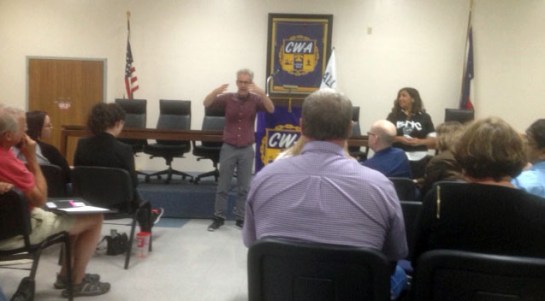
Brand New Congress met at the Dallas CWA 6215 Hall, where Bernie has his offices

One of the most interesting twists in the projected scenario is their intention to totally disregard party affiliations. The main speaker said, ““Parties are so 19th century!” Polls are showing that a lot of Democrats and Republicans are not so crazy about their own parties. Youth has been showing its disdain for some time; I recently read that only 19% of Americans 19 to 29 years old voted in 2014!

How It Will Work

The Brand New Congress strategy would have their candidates running mostly as Independents, but, where it’s easier, as Democrats, Republicans, Greens, or anything else that’s useful! In other words, they would use political parties the same way they said Bernie Sanders used the Democratic Party — to get on the various state ballots and to obtain a wider hearing.

Turnout at our meeting was good, but not nearly as good as earlier Bernie meetings. Like the Bernie meetings, diversity was not its strongest characteristic. I’d estimate about 8% African Americans, maybe 10% Latinos, 2% Native American, and 40% women attended. Like the Bernie meetings, they were considerably younger on average than most political gatherings.

It’s worth noting that neither of the two presenters claimed that Bernie Sanders would publicly support this program.

Will It Work?

After having seen the electoral miracles accomplished by the 74 year old socialist from Vermont this year, who is prepared to say that Brand New Congress won’t be successful? Who could say that almost anything couldn’t be done by the younger people around the Bernie campaign? One of the BNC organizers maintained that Bernie had raised $240 million and moved tens of thousands of volunteers!

During the last decades, a growing number of citizens has developed a severe distaste for the status quo and a yearning for something different. Maybe these are the “people with a plan” who bring that change!

On the Other Hand

The idea of such a broadly innovative electoral campaign is breathtaking. But after I resumed regular breathing, my age and experience began to ask questions. In the immediate sense, I didn’t like all of the answers. Hope I’m wrong on every count:

  1. The strategy is purely electoral and limited to the U.S. Congress. Whenever somebody tells me that a single tactic is going to revolutionize America, I start wondering if they aren’t making a fetish of that tactic. Remember Occupy? A revolutionary program, it seems to me, would have to relate to all forms of struggle.
  1. Although one of the BNC presenters talked a lot about his views on the economy, little or no mention of the international situation was mentioned. People who think that their country is the only one that matters may be a little bit out of step with the economic situation today.
  1. Where are the working people in all this? I heard one mention of the term “working class,” but it was parenthetical and in passing. The idea that all Americans can be brought together under a single program seems idealistic to me. Only working people can confront the bosses and beat them, not a vague idea of “everybody.”
  1. Much worse, I didn’t hear any mention at all of the bosses and how they were going to relate to all this. Do people think that there’s only one side in this fight? There are two sides, and the other side isn’t just sitting around waiting to see what happens. They are really good at all forms of political fighting, especially elections. Also, they blacklist people. They arrest people. They kill people. You can’t expect success with a strategy that ignores them.
  1. How would we govern? No one would be happier than I to see somebody make gigantic fundamental change in American politics by 2018, but this electoral trick sounds more like a coup than a revolution. In a revolutionary process, people organize themselves by communities, by workplaces, and by their interests. They get better and better at meeting challenges and utilizing opportunities. Leadership develops at every level. Revolutionary struggle is a giant learning process whereby everybody learns more than how to take power, they also learn what to do with it.

Maybe my skepticism has no place as America yearns for improvement. Let’s not condemn, but encourage. Let’s do what we can!

–Gene Lantz

Click here for more of these ideas

Listening to almost anybody talk about American politics today unavoidably leaves one with the impression that they don’t know what they’re talking about. Populist? Nationalist? What do all those terms mean, if anything?

nationalismquote

Click here for a glossary and lesson on political words. Click here for my previous analysis.

What one considers good or bad in politics depends on how one understands the idea of progress. Everything is moving in one direction or another all the time. A positive trend in politics is one that strengthens our side in the lifelong battle with our employers, or one that weakens the employers’ side. That’s progress.

Progressive for Whom?

If ordinary working people are strengthened by being more unified, or better informed, or by attaining positions of power, that’s progress. Progressive people are those who strengthen workers against their employers. Organizing a new union, for example, would be a progressive thing to do. Helping workers make good electoral decisions by providing useful information would be progressive.

Causing an unnecessary split in a workers’ organization is a reactionary event, the opposite of progressive.

“Left” and “Right” are Fuzzy Concepts

During the capitalist revolution in France around 1789, one group sat to the speakers’ left in parliament and another group sat to the right. That’s where we got “left wing” and “right wing,” but it’s really hard to tell what they mean today. Besides, everything is moving so what’s left today is right tomorrow!

If “Left” is Good, Then Is “Ultraleft” Even Better?

Serious activists might think “left” means “favoring the workers,” but “ultraleft” is a special term that does not mean “even more favorable toward the workers.” An ultraleft is an egotist willing to do anything, progressive or reactionary, to draw attention to themselves. Ultraleftism is a real pain in the movement. It’s been called “the infantile disorder.”

“Liberal” and “Conservative” are Confusing

If a liberal is a nice person who cares for others, what’s a neoliberal and why do the South Americans seem to hate them so? Is a neoliberal the same thing as a neoconservative or neocon? Actually, yes.

If a politician is racist and misogynistic, but votes for a giant boondoggle for his/her home district, is she/he a liberal or a conservative? If another politician is really stingy on government spending but promotes abortion and gay marriage, what is he/she?

Who’s Middle Class?

It’s common now to confuse “middle class” with “middle income.” I think the unions distorted the definition because union people, it’s true, make more money than other workers and, especially with overtime pay, often get into the middle income range.

The only useful meaning of “middle class” is that they’re neither bosses nor employees. So small shop owners, professionals, preachers, policemen, union staffers, and all the people “caught in the middle” in the great fight between workers and bosses, they’re the middle class.

The French revolutionaries called them “petit-bourgeoisie” or “small capitalists.” Ultraleft supercilious nut cases use it as a derogatory term.

Everybody hates being called middle class and will argue with you until they’re blue in the face about it, but if you can’t understand “middle class,” you probably can’t understand “worker” or “employer” either. Without clarity on those concepts, I don’t see how anybody understands anything about politics.

What’s a Populist?

It’s gotten popular today to talk about “populism of the left” and “populism of the right.” Supposedly clever people refer to Senator Bernie Sanders and Presidential Candidate Donald Trump that way. But what does it mean?

The populist movement of old was made up of agricultural interests banded together politically to fight against the industrialists who were taking over the nation. The populists lost. That battle has been over for some time.

Google says a populist is “A member of a political party claiming to represent the common people.” But don’t all politicians do that? Click here for Wikipedia’s treatment.

I’m pretty sure that what the pundits mean nowadays by “populist” is a candidate that doesn’t directly represent the employing class. As no candidate ever says he/she directly represents the employing class, it’s a pretty meaningless term.

What’s a Nationalist?

There are books on this. Nationalism, dividing people’s interests more or less by their region of origin, is usually divisive and hence reactionary. Not always, though. Groups of people fighting imperialist domination may be using nationalism in a very progressive way. People that use it to split the overall progressive movement, though, need to be avoided.

Think of the Class

If one sticks to the idea that workers are the only ones who can really overcome their employers, and that strengthening our side or weakening the employers’ side is the definition of “progressive,” one can be more clear in their communicating and their own thinking. Always, think of the class!

–Gene Lantz

Click here for more of these ideas


Don’t let the dry lifeless movie critics talk you out of seeing this wonderful film!

freestateofjones

Movie review: “Free State of Jones,” Directed by Gary Ross, 139 minutes

Movies, books, statues, and historical markers all over the country romanticize the Confederacy. The truth is that it was a nasty war fought for nasty reasons. Here and there, southern people resisted the confederacy to the point of armed struggle. It’s incredible but true, though, that local farmers, deserters, and runaway slaves combined to win military victories against Confederate soldiers around Jones County, Mississippi

I read the book some time ago and was really looking forward to this movie. If there was anything at all disappointing, it’s because the film followed the book a bit too closely. The facts for the book were mostly taken from a miscegenation trial in the 1930s involving one of the many descendants of guerrilla leader Newton Knight and his runaway slave wife, Rachel. The people’s uprising in Jones County is the best part of the story, but the book and movie add on a lot of the dismal history of Mississippi afterward.

BTW, the state just closed the case of the murder of civil rights martyrs Chaney, Goodman, and Schwerner; so ugly history marches on in Mississippi. We just noted the anniversary of the gutting of the Voting Rights Act by the Supreme Court, and it’s extremely relevant to this film.

Movies like the blockbuster success “Gone With the Wind,” are ordinarily more than happy to lie about what really happened. This one doesn’t. Go see it!

Movie review: “Genius,” Directed by Michael Grandage. 104 minutes

People who like a little action and a lot less talking in their movies aren’t going to like “Genius,” but I cried through part of it and thought it was really worthwhile. Fans of Ernest Hemingway, F. Scott Fitzgerald, and, especially, Thomas Wolfe, are already aware that their editor, Maxwell Perkins, is given a lot of credit for their books’ successes. This is about Perkins and Wolfe, and it’s almost 100% dialogue.

The movie critics don’t like this one either, because the two men are more or less reduced to stereotypes, or so they say. I say that trying to explain Perkins and Wolfe would be a difficult assignment, but one worth doing. I’d be curious to know if other film makers could have done it better.

If you don’t know or care about Maxwell Perkins or Thomas Wolfe, you wouldn’t like this movie. If you do, though, it’s a fine film.

Movie review: “The Neon Demon,” Directed by Nicolas Winding Refn. Not sure of length.

If someone is just dying to see Elle Fanning in her skivvies, they might want to see this movie about innocence and high fashion. Oh yes, there’s one really nice shot of a mountain lion. As the wide-eyed protagonist meets savage fashionistas, one begins to realize that something truly terrible is going to happen at the ending. But is it worth sitting through long, boring, unrelated technical movie tricks to get to it?

The only real crime that will cause me to walk out of a movie is that it’s boring. This one is.

–Gene Lantz

Click here for more of these ideas

 

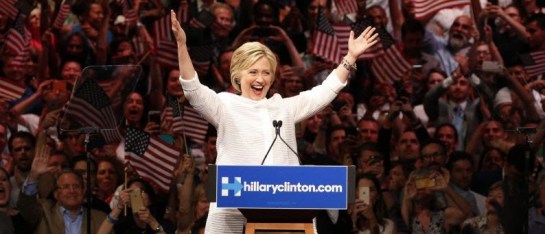
I just got a text from a friend asking for advice. He wants to know whether or not to spend more than he can afford to go to the Democratic Party national convention. He’s a big Bernie fan and Bernie says they should reform the Democratic Party. “Is that even possible?” I ask.

clintonhillary

Until the Bernie campaign made history this year, I had never even seriously considered any hope for the Democratic party. But Bernie has changed a lot of opinions this year, some of them dramatically. Even some of mine.

I am not going to question, in the immediate sense, that Bernie is right in his efforts. Every inch of democracy that we can squeeze out of this capitalist system is worth fighting for. If he can get the Democrats to change some of their rules in a positive direction, I’m all for it.

But, before we go all-out in trying to turn an existing political party into an instrument for fundamental change in America, we need to examine some of our words, including “political party” and “fundamental change.”

The working people will never make permanent improvements as long as the bosses are in power. That’s my guideline. “Fundamental change,” then, requires that the bosses not remain in power. Everything else may be worth fighting for, but it’s still temporary and will eventually have to be fought for again and again.

A “political party” is a committee that organizes, leads, and promotes the interests of a given class. Both the Republican and the Democratic Party promote the interests of the boss class. When they talk about reforming one or the other of them, they are only talking about various rules, not their basic commitment to continuing capitalism. Even Bernie might talk about “reining in” capitalism, but he doesn’t talk about overcoming it.

So, no. I don’t believe it’s worth major time and effort to try to reform the Democratic Party to achieve fundamental progress. What we actually need is a political party based on workers. We need a workers party like those in several other countries. Usually, they aren’t revolutionary organizations, but they are workers’ organizations. A workers party in the United States would be a great historical step forward.

It’s my opinion, expressed previously, that the Bernie Sanders movement could result in a workers party in America. I think we’re very close to it, but not if all our energies are turned into a hopeless effort to reform the Democratic Party.

I don’t want to leave the impression that I’m against the Democrats or even the Republicans. Workers have every interest in working with whoever will help us advance. We need to work with whatever situation we have. Anything less than that shows either a lack of commitment to the workers’ movement or ignorance of strategy and tactics.

–Gene Lantz

Click here if you’re interested in more such ideas


Book Review

Billionaires Are Pulling America’s Strings

Mayer, Jane: Dark Money. The Hidden History of the Billionaires Behind the Rise of the Radical Right. Doubleday, New York, 2016.

dark_money600x350px

There’s a great quote at the beginning of this best-selling book:

“We must make our choice. We may have democracy, or we may have wealth concentrated in the hands of a few, but we can’t have both.” –Louis Brandeis

This wonderful book solves a number of contemporary mysteries:

  • If Americans are better educated and better informed than ever, why have our political ideas lurched toward ignorance?
  • If we understand economics better than ever, why is wealth disparity so awful?
  • How can our commentators and professors afford to say patently ridiculous things without losing their livelihood?
  • If we all have to live on this planet, why are we polluting so much?

The answer is dark money. A carefully crafted network of billionaires has bought off politicians, economists, professors, and commentators and turned them into ventriloquists’ dummies who repeat and repeat and repeat the things that billionaires want said. They have gone beyond buying a few columnists and professors. They own think tanks, newspapers, information networks, Radio & TV networks, professors and entire faculties, individual politicians and entire state legislatures. Their effect on the federal government is substantial.

Their contributions to this underhanded scheme are more or less legal and even tax deductible!

The main architect of this secret and underhanded network is named Charles Koch. Many years ago, he took up his father’s interest in right wing organizations such as the John Birch Society. As the years passed, Koch and his billionaire co-conspirators became better and better at influencing legislation and public opinion. It’s all detailed in Jane Mayer’s book.

Although most of their maneuvers result directly in more money for themselves, the perpetrators generally claim to be ideologically motivated. The book’s author, in my opinion, gives them too much credit in this direction. She usually refers to them as “arch conservatives” or “libertarians.”

I wouldn’t characterize them so generously. If Benito Mussolini was correct when he defined “fascism” as simply “corporatism,” then “fascists” is the more accurate description of Koch and his cronies. Nazi propagandist Joseph Goebbels would be proud of them!

In that regard, they are not completely in step with the entire ruling class of America, which has so far not elected to rule through fascism. They still rely on the Republican and Democratic parties to keep our limited democracy working for them. The Koch network operates primarily through the Republican Party, but not completely. They maintain their independence and their “corporatism” fascist goals. It would be interesting to see if they completely try to take over the Republican Party, as seems to be their goal, or if they try to establish a formidable fascist party.

Whichever way they go, a united and well informed progressive movement is the solution to the threat they raise. This book goes a long way toward that solution.

–Gene Lantz

How do you decide whom to vote for? How do you decide anything? I’m reading postings that say “If Bernie isn’t the candidate, I will never vote for Hillary.” or “If my candidate doesn’t get the nomination, I’m not voting!” and things like that. How did they decide those things?

voteclass

How Do We Decide Anything?

Once, I was astounded when I was taking a class in business finance. The homework assignment was whether to buy factory machine A or machine B. It dumbfounded me. The astounding thing was when I found out how the decision was made in business. They figured cost, production, and expected life of each machine. Whichever one made the most money over a period of time was the right answer.

In other words, the decision was made based on the probable outcomes of the choices. If you support this person and he/she wins, what do you think will happen? If you support that person and he/she wins, what do you think will happen? If you support some other person and he/she doesn’t win, what do you think will happen?

It’s Not Whom You Love

It’s not a question of whom you love or whom you hate, who gives you the creeps and who makes you feel all sunny. None of the candidates are perfect, but you still have to make a decision. Your decision will have likely consequences, outcomes. Some of those outcomes are better than the others. That’s rational decision making.

Progress Comes from United Working People

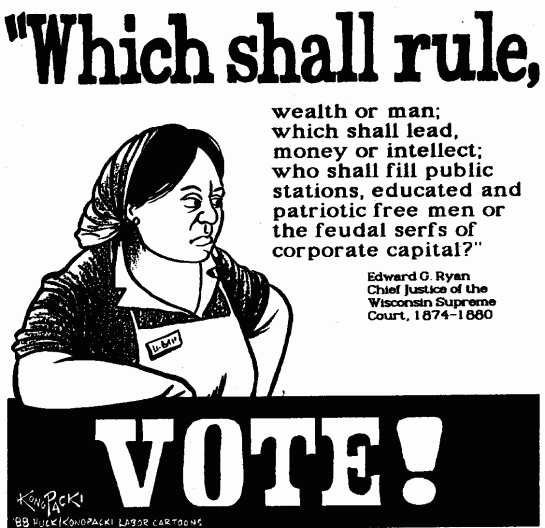
The best political advice I ever got was “think of the class.” How will the working class fare under this or that political leader. And don’t try to convince yourself that the working class has no interest in elections. We have an interest in every arena of struggle, a big interest — and it’s usually the opposite of the bosses’ interest.

End of Sermon

Put your emotions aside, make a rational decision about what to do, then do it. Afterward, you can re-evaluate and do the same thing or something else. Whatever you decide, rationally.

–Gene Lantz


My friend Glenn Scott at a democracy rally

My friend Glenn Scott at a democracy rally

We live in a limited democracy. Its extent is constantly being re-defined by class struggle. When the nation began, white male property owners aged 35 and up ran everything. Slaveholders got extra clout. We came a long way, and every inch was a fight. I’ve written about democracy  before.

The fight for democracy is being led from North Texas by Congressman Marc Veasey. Local activists stand strongly with Veasey on issues such as unfair redistricting and voter suppression. Both are supposed to get decisive court decisions this summer.

Unions Are in the Fight

CWA Notes reports on a news conference in front of the White House. CWA, Public Citizen, Common Cause and other democracy allies called on President Obama to issue an executive order requiring federal contractors to disclose their political spending and to push Congress to take action to repair and strengthen the Voting Rights Act.

“Wall Street’s deregulated, anti-union, trickle-down, one percent economics are being propped up by out-of-control campaign donations to our elected officials,” said CWA President Chris Shelton. “Americans deserve a democracy that works for all Americans – one in which everyone has an equal voice and elected officials are accountable to the people, not the wealthy.”

The Communications Workers are inviting people to join Senator Warren in a telephone town hall meeting June 15 at 7P. The Take on Wall Street campaign will be explained and volunteer efforts will be solicited. That’s organizing for democracy!  Click here to register for the telephone conference.

The Election Campaign has Revealed a Dark Truth

Both the Republican and the Democratic presidential campaigns drew back the curtain shrouding the basic secret of the two-party system: neither party is actually very democratic. The bosses have rigged the game. As I have written before, we may have already entered the early stages of the next giant historical step for American working people — the formation of a workers party.

That would be a lot more democratic. We’d be able to move a few inches in the right direction after several decades of lost ground.

What About Real Democracy?

As long as there is inequality, there can be no complete democracy. The worse the inequality, the more democracy suffers. That’s what has been happening since about 1980 in America — growing inequality and diminishing democracy.

If we want a strong, lasting democracy, we are going to have to do something about the vast inequality that is subverting democracy today. The good news is that more and more people are figuring that out and joining the fight!

–Gene Lantz


The clearest lesson learned from the current election cycle is that Americans, especially young Americans, are out of patience with both halves of our electoral system.

ara-bernieWorking people have long dreamed of having a political party that consistently represents their interests. I’ve heard radicals blast union leaders because they haven’t stepped out alone to start a workers party. I’ve heard people so desperate for a workers party that they formed a pretend one.

Once, I was actually in a group that said it was a workers party. The American Workers Party was started by Tony Mazzochi of the Oil, Chemical, and Atomic Workers 20+ years ago. The United Electricians were involved. I was on the Executive Board. They had a wonderful membership card with a great quote from Eugene Victor Debs on it: “As long as there is a working class, I am in it. As long as their is a criminal class, I am of it. And as long as there is a soul in prison, I am not free!”

What they didn’t have is a snowball’s chance of actually making any difference in America. Part of the deal that brought them some funding, Mazzochi admitted at the 3rd meeting I attended, was that they would not run candidates! As soon as I heard that, I quit. Never went back. It was a pipe dream.

What Would a Workers Party Look Like?

A real workers party would have significant support from organized labor. It would have a mass base. It would have a clear program. Unlike both of the bosses’ parties today, candidates would be under discipline to carry out that worker-friendly program! It might not be revolutionary in and of itself, but it would be a step on a revolutionary path.

Do We Already Have A Workers Party in America? Maybe!

As I wrote on June 5, I expect great things from the Bernie Sanders movement. I’m not sure what Bernie intends, but I think that a significant part of his young followers will stay together. I think they will endorse and work for down-ballot candidates in 2016. I think that, by 2017, they will be picking some of their own candidates in local races. By 2020, they may well be ready to run their own presidential candidate. Americans will be more than ready for them.

I don’t know what they might call it and I don’t much care. If it keeps the program it’s fighting for today, and if it continues to add supporters as it has up to now, and if the Communications Workers, Postal Employees and other progressive unions stick to their guns, — all of which seem likely — we are going to have a workers party in America!

–Gene Lantz

The doomsayers who have been counting Bernie Sanders out of the Democratic primary race all along are doing it again. The pundits are asking, “what’s next?”

Marchers for Bernie

Marchers for Bernie

What’s Next?

There’s no “next” until Senator Sanders concedes the primary race, and he’s not conceding. But even if he did, would he go the way of previous candidates, including President Obama, who said they would keep the movement alive, but didn’t? The answer is no.

Sanders has already started picking down-ballot races to boost, even as far down the ballot as some state legislators. Some of his supporters are already working on a movement called “Brand New Congress” to carry the momentum for progress forward whether it’s in the presidential race or anywhere else.

Is Bernie Pure Enough?

Of course, there are activists who never actually supported Bernie and still don’t. He wasn’t pure enough for them. For some people, if V.I. Lenin’s stuffed body doesn’t reanimate and walk out of the Kremlin to lead them, nobody is good enough.

Those people don’t see all of politics as processes. Nothing stays the same, everything is changing. The Bernie Sanders campaign has already, and still is, moving America and the world toward real change. It’s true that he’s a social democrat and by definition not a revolutionary. It’s true that his program of electoral reform and restraining Wall Street wouldn’t, by itself, result in permanent gains. The workers will never make permanent gains as long as the bosses are in power, and Senator Sanders has only said he wants to restrain them, not dis-empower them.

But he has started and amplified a wonderful trend in American politics!

Look What’s Already Been Accomplished!

Millions of Americans have realized that the two-party system, neither half of it, is really democratic. Millions have become conscious of the amazing power that big money exerts over the electoral system. Millions have begun seeking real solutions, and I don’t mean they were sitting in their easy chairs and daydreaming about it. Millions are in movement! Millions are experimenting. Millions are working together. That’s amazing accomplishment!

What’s Next?

This movement is going to continue. The youth of America, already smarter and more capable than the rest of us, are taking this movement forward. This isn’t a flash-in-the-pan new trick like the Occupy movement. This is millions of young people joining together to seek fundamental change. They don’t even need the older Americans. They don’t even need Bernie. If they needed to, they could just outlast us older people. But they don’t need to, and they won’t.

The movement identified today with the Bernie Sanders election campaign is going to go on far beyond electoral politics, and it’s going to win!

–Gene Lantz