Archive

economy

President Trump is the champion of fair trade for American workers. Or is he destroying the hopes of all workers for a peaceful and beneficial world? Or does he even know what he’s doing?

me-nonafta

A lot of working families were won over by Trump’s promise to renegotiate so-called “trade” agreements and restore American jobs. People, including a lot of union people, are still hoping he will. Yesterday, he poked his finger into the eyes of several world leaders at the G7 meeting in Canada. He said he was representing American workers.

What’s “Fair,” What’s “Free?”

For decades, since the Clinton Administration at least, American unions have been campaigning on the slogan “Fair trade, not free trade.” We always say “We’re not against trade — we just want it fair.” But it’s been very hard for union leaders to resist xenophobia and isolationism, because those “isms,” — right along with nationalism and racism — are also against the trade deals that America negotiated since Clinton.

The people that knew what they were talking about presented the argument that the so-called “free trade” deals were only “free” for big transnational corporations — not for the working families in America or any other country. Big corporations received “freedom” to pay low wages and pollute, nobody else got anything. That’s why we opposed NAFTA and all the others leading up to the “Trans Pacific Partnership” that was still an issue in the 2016 presidential campaign.

The people that knew what they were talking about actually favored trade deals if they included wage and environmental protection. But not everybody is so sophisticated. They hate the trade deals anyway. That’s why so many of them voted for Trump.

There’s a History to “Free Trade”

I recently read a complete history of Britain and found an interesting reference. When Britain “ruled the waves” and ruled the world, their slogan was “free trade.” From the time they defeated Napolean until World War I, the English favored what they called “free trade.” They didn’t , at least not immediately, necessarily open their own markets, but they wanted everybody else, especially their many colonies in Asia and Africa, to open theirs.

In other words, “free trade” meant, then and now, the “freedom” of one country’s corporate rulers to exploit everybody else. Another word for it is modern imperialism.

After World War I, and especially after World War II, when the United States took over world trade, corporations wanted “free trade” for the exact same reasons. But the “freedom” was always for the exploiters and never for the exploited, then and now.

Everything Ends

There are different ways to look at the Trump program on trade issues. Economists and pundits are arguing that he’s destroying the world and setting us back centuries. Trump and his supporters say he is restoring fairness. Xenophobes and racists are rooting for him, as they have all along.

But there’s another, more interesting way to look at Trump’s trade wars. American economic domination is coming to an end. It actually ended in the 1970s, according to some. Since then, international leaders have simply agreed to keep the system in place even though the United States is living on credit and has been for decades. The post-war system put in place by the United States after WWII has actually fallen apart. Donald Trump is just an opportunist trying to turn the situation to his own benefit.

A Real Solution to the Trade Wars

Modern nations were created by capitalism. Each nation is run by and for the bosses. Their economic and political decisions are made for the benefit of the dominant class — the capitalist class. That includes much more than trade deals and treaties. It also includes global pollution, war and genocide.

It is theoretically possible that the various governments, as presently constituted, could cooperate on trade in a way that would benefit the inhabitants of the various nations. But that’s only in theory. It has never worked that way because the inhabitants, us, were never in charge. We still aren’t, and there will be no solution until we are.

–Gene Lantz

I’m still on KNON radio 89.3FM in Dallas at 9 AM Central Time every Saturday. The “events” tab on the web site leads to recent podcasts. If you want to know what I really think, check out my personal web site.


Book Review: Barlett, Donald L, and Steele, James B. “The Betrayal of the American Dream.” Public Affairs, NY, 2012 Dallas library 330.973 B289B 2012

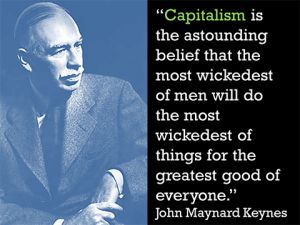
mlk-quot-capitalism

If recent economic developments have not already terrified you, this might be a good book to absorb. It is very much like “Runaway Inequality,” the book promoted by the Communications Workers of America that I reviewed earlier.  It has some of the same dire warnings and suggested solutions as the classes that the AFL-CIO conducted under the name “Common Sense Economics.”

The authors really hate “free trade,” tax giveaways to the rich, deregulation, or capitalist-directed globalization.

Here is the message in a nutshell: “Something terrible happened in America in the 1970s. Since then, virtually all new economic developments have been bad for the working people and crazy good for the very rich. Inequality is rampant. We need to bring back some of the more reasonable practices that were in place before the disaster struck.”

In my review of “Runaway Inequality,” I pointed out that our recent period isn’t the odd one. The odd one was the third quarter of the 20th century. The reasonably good times when some of the productivity gains streamed into workers’ paychecks were not normal. They were just weird.

Today, when the capitalists grab everything in a runaway train ride to oblivion, that’s what’s normal. Trying to go back to the practices of the 1950s is a lot harder than it looks, because the ruling rich are dead-set against it.

Why weren’t the rich dead set against equitable economic practices in 1950? I can think of at least three good explanations. 1) They ruled the world. They had almost no international competition because they had destroyed every other country during the war. 2) American labor was very strong after a tremendous upsurge 1935-1947. 3) The Soviet Union was still seen as a viable alternative to capitalism, and it was important to buy and/or destroy any pro-Soviet sentiment. None of those things were true in America by the time Ronald Reagan was elected.

Even though this book has great reporting on economic events, and even though it has very intelligent prescriptions for making economic things the way they used to be, I don’t think their hopes for the future are likely to happen. The book is great at explaining, but not so useful as a guide to action.

Actually, I began to be skeptical in the introductory pages when they said, “…we define the ‘middle class’ strictly by income….” They could have just said “middle income” instead of “middle class.” The problem with trying to rally middle-income people is that they aren’t really a class. A class is defined by political interests, and middle-income people are all over the map in their interests. Some of them are workers, some of them are lawyers, some of them are trust fund babies, some of them are shopkeepers. 

If someone is serious about making change, they need to start thinking about the working class.

–Gene Lantz

I’m on radio KNON FM89.3 in Dallas at 9 AM central time every Saturday. Podcasts can be found from the “events’ tab on the web site. If you are curious about what I really think, check out my personal web site.

The main players in today’s economy aren’t “rational men” as assumed in classical economics. They are “sociopathic men.” It’s the first and most important lesson.

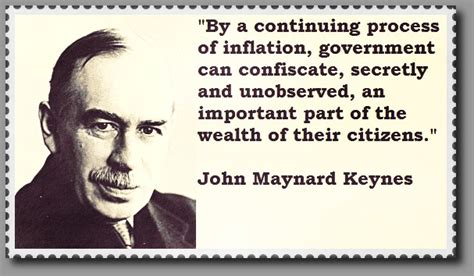
keynes-quot2

What crippled economics as a science was its separation, in the late 19th century, from other disciplines, especially politics. At the same time, it was decided that economies work because “rational men” (sorry ladies) cause the supply and demand for commodities to balance out at a fair market price.

It’s like the Holy Bible of economics: nobody actually believes it but everybody quotes it.

If we still studied politics and economics together, as we did before economist Alfred Marshall, we would see that it isn’t rationality that makes the world go around, it’s antagonism. Our economy is vastly different from their economy.

Bad Is Good

All these “rational men” do not have identical interests. In fact, our interests are extremely disparate. While ordinary working people like you and me want high employment, good wages, and low prices; our employers usually want the opposite. What is good for us, especially high wages, is bad for them.

Back in Alfred Marshall’s time, this opposition may not have seemed so important to people studying single economic data in a single market. But two great changes have occurred since then that make oppositional understanding vital: world war and governmental economic policy.

National “Good” is International “Bad”

Nations exploit one another. The First World War was fought to determine which industrialized nations were going to do the exploiting. That wasn’t a decision made by rational men within a single economy. “War is politics by other means,” as we say. Politicians made the decisions to carry out world wars, and the winners reaped the benefit. War determined international economics, but it certainly wasn’t because of rational men.

“Whose Economy” Depends on “Whose Government”

Capitalism has a built-in propensity for crisis. Early in the 20th century, and especially during the Great Depression, governments began to take affirmative action to save capitalism from itself. They recognized that monetary policy and fiscal policy could be used to heat up or cool down an economy to some extent.

The biggest problem was oppositional interests. Governments generally interceded in the economy on behalf of the richest capitalists and not for the majority.

But another big problem was created by all this government intervention. Instruments of debt and other purely financial instruments were floating around everywhere, and they became an obsession. A major part of economics was no longer concerned with commodities at all.

Government tried to regulate financial institutions, but they gave that up in 1999 when Texas Senator Phil Gramm got the “Financial Services Modernization Act” passed.

Without regulation, banks and other financial institutions began to use the tremendous resources that they could mobilize in high-stakes gambling. They particularly liked bundles of low-quality mortgage debt and its various crazy derivatives. The bust that followed was called the “Great Recession.” After that, the government re-regulated to some extent, but they are presently disassembling regulations again for the same reason — amazing profits for the very rich.

It’s not in the interest of the people, and it’s not rational. That’s the first lesson.

–Gene Lantz

I’m on KNON radio at 9 AM Central Time every Saturday. Podcasts can be found from the “events” tab on their website. If you are curious about what I really think, check out my personal web site.


Book review: Jeffreys, Diarmuid, “Hell’s Cartel. IG Farben and the making of Hitler’s war machine.”  Metropolitan Books, New York, 2008

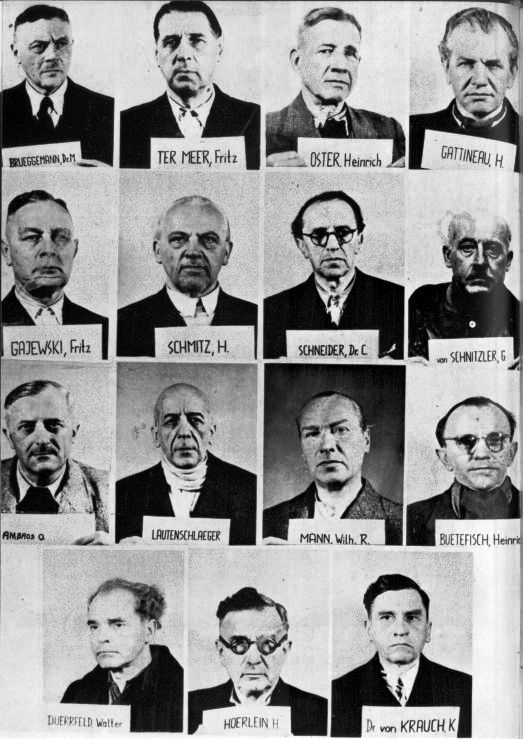
IG Farben defendents

The biggest corporation in Europe solidly backed the Nazis during the time they were taking power. During the ensuing war, the big chemical company was more and more deeply involved in Nazi warmaking and ethnic cleansing.

The book begins and ends with the trial of several top company officials. In between, it details the history of the conglomerate from the time that it supplied poison gas during World War I through the trials that ended in 1948. In both wars, they provided much of the vital expertise and materials.

IG Farben established and ran its own slave labor camp as part of the Auschwitz complex. The abuse and murder of tens of thousands of slave laborers was carried out in Farben facilities just as in the other death camps. One of their small but very successful product lines was Zyklon-B, the death gas.

Working people usually say that we do the bidding of “whoever signs our checks.” Have you ever wondered who signed the checks for Nazi doctor Josef Mengele, who killed hundreds of people with torture and outrageous medical experiments? IG Farben.

The company executives received light sentences and early parole. They went on to continued successful careers in European industry.

Books and movies about Nazi Germany have poured out in an endless stream since the end of WWII. We are fascinated with the horror of it and with the questions that are never quite satisfactorily answered, “How could this have happened? Why didn’t somebody do something?”

This book supplies part of the answer, if readers are ready to accept it. Hitler came to power essentially because wealthy Germans, like the officials at IG Farben, preferred the Nazis to the Communists. Even after the war, even during the trials at Nuremberg 1947-48, the main distraction from justice was fear of rising communism.

–Gene Lantz

I’m still on KNON 89.3FM radio in Dallas at 9 AM Central Time on Saturdays. If you want to know what I really think, check out my personal web site.


A big change is coming in international relations.

war2

It may seem that the whacky international news is only being caused by our whacky president and his whacky ways, but there are several underlying real trends pointing the United States toward starting a new war.

The most obvious one, which I have written about before, is that the Republicans and Donald Trump are looking at some major election losses in November unless they do something drastic. The most recent shifting of posts in the White House is definitely in that direction.

Another reason is more long-term and has to do with trade balances and history.

Looking Back

Nearly all of us living today are products of post-World-War-Two thinking. The “American Century” that began in 1945 put the United States at the head of all nations both militarily and economically. Historically, it was a most unusual situation for the world and for America, but most of us think of it as “normal” because it’s the only situation we have ever experienced. It isn’t normal at all, and it can’t last.

U.S. military domination continues, but is severely challenged right now in Afghanistan, Iraq, Syria, and Yemen. U.S. economic domination continues but is severely challenged by the European Union, new alliances in South America, and, most of all, by China.

U.S. economic domination is no longer based on our industrial productivity. A great deal of our industry has been shut down. Our agricultural production is still very strong, but also faces challenges. If anything, U.S. economic domination is based on finance, especially on borrowing.

An interesting article from CBS News says, “Why China won’t dump its huge U.S. Treasury bond Hoard.” They say it won’t happen, but they wouldn’t have written the article if people weren’t worried about it. Apparently, China holds about $1.2 trillion in U.S. Treasury bonds. They buy them every year, but they slowed down their purchases last year, the article says. It was just an incremental change, the article says.

The Nature of Change

Most change is incremental. It happens so slowly that we hardly notice it until some statistician points it out. These are quantitative changes. But quantitative changes can accumulate and, eventually, create giant qualitative changes that seem to happen all at once and come out of nowhere. Think of a stock market collapse, an earthquake, or a sinkhole. Think of a war.

Why Have a War?

Competition, not cooperation, is the natural behavior of capitalist economies. War is a natural consequence of capitalism. Even in the “American Century” so far, U.S. armies have been engaged over and over again. Even when the armies were not engaged, the U.S. has employed proxy armies such as the “Contras” in Nicaragua, the Kurds in Syria, or the Saudis in Yemen.

What passes for “diplomacy” is actually based on war or the threat of war. Witness the current expulsion of diplomats from Russian embassies, for example.

Why NOT Have a War?

Like any other enterprise, war depends on the cooperation of the people carrying it out. If we refuse, if we mobilize against it, no one can force us into the next big war. But we need to get started.

-Gene Lantz

I’m still on KNON.org 89.3 FM in Dallas at 9 AM Central Time every Saturday. Programs are podcast for two weeks and can be found under the “events” tab of the home page. If you are interested in what I really think, check out my personal web site.


The Economic Policy Institute recently ran a couple of good studies about wages.

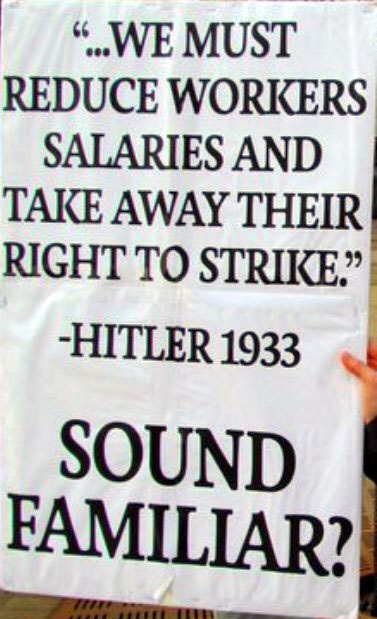
hitlerquote

Factory Workers Earn More Money

EPI says, “…manufacturing workers still earn 13.0 percent more in hourly compensation than comparable private-sector workers. This manufacturing premium, however, has declined by about one-fourth (3.9 percentage points) since the 1980s, when it was 16.9 percent.” So why do manufacturing workers make more money than “comparable” people? And why is the margin diminishing?

Here’s another question that bugs the heck out of my friends who work in aerospace but are members of the Auto Workers Union: “Why do auto workers get much better contracts than aerospace workers?” We work just as hard and have had as much or more training. We have the same national union leaders, the same history, and the same intentions, but our wages and conditions have never been as good as theirs. Why?

It’s Not the Work, It’s the Organizing

Manufacturing workers are easier to organize than other workers. There are more of them in one place. They work closer together. They live closer together, They have more of the same interests. Contrast, for example, techies. Techies are notoriously hard to organize, even though they may really want a union. They live all over the place. They work almost entirely alone. Some of them actually work at home. They tend to travel for work. They don’t usually advance within the same company, but move from one company to another for advancement. It is very hard to organize techies.

The easier we are to organize, the more likely we are to have a union and thus get better wages.

Aerospace workers can cuss the auto workers all they want, but the fact is that auto workers were easier to organize. Assembly line production calls for the highest levels of cooperation among workers. Take just a few of the workers off an assembly line, and it has to shut down!

Airplanes, for the most part, aren’t made on assembly lines. It’s hard to win a strike in aerospace, but it’s much easier in auto. Better organizing, better contracts!

Why Is the Gap Decreasing?

EPI says that the gap between [organized] factory workers and everybody else is decreasing since 1980. I almost laughed when I saw that date. 1980 is the year that American government set new anti-worker policies and elected its best enforcer —
Ronald Reagan. So the question answers itself.

Unionism in America has atrophied beneath the government assault, and the advantage of unionism is not nearly as widespread as it was pre-Reagan. We fell from 35% of the workforce to the present 11%. Union workers still make way more money than non-union workers doing comparable work, but there just aren’t that many union workers left to bring up the statistics.

Whose Wages Are Rising?

The other interesting article from EPI said, “States with minimum wage increases between 2013 and 2017 saw faster wage growth for low-wage workers compared with states without any minimum wage increases (5.2 percent vs. 2.2 percent).”

Last month, Wall Street had a minor panic when it was announced that wages were rising for the first time in recent history. They were barely rising, but they were slightly higher than inflation for that same period. Since then, economists and political pundits have been saying that wages will continue to rise and that the government will have to take steps, such as raising interest rates, against the trend.

Capitalists may say otherwise, in fact they do, but they do not want wages to rise.

But wages did, statistically, rise a little bit in February, 2018. The reason was that some local and state governments, responding to political pressure from working people, were beginning to raise their minimum wages. An increase for low-wage workers has a profound effect on statistics, because there are so many low-wages workers. Also, all wages tend to rise when they are pushed up from the bottom.

Nineteenth century writers Karl Marx and Frederich Engels noted that workers would tend to benefit themselves more by organizing politically than they would by fighting the bosses one company at a time. It’s not a new idea; it’s just a true one.

Crossing the Line

There are a lot of references to “the line” in literature. There’s the “red line,” there’s the “line in the sand,” and there’s the “picket line.” If you want to get someone to answer the question “Which side [of the line] are you on?” just ask them if they support increasing the minimum wage. It cuts through a lot of verbiage.

Even though unemployment is statistically low, and the time is ripe for organizing, your own wages aren’t likely to rise much until you actually organize. Either organize a union on the job or organize politically to raise wages. That’s the road to success!

–Gene Lantz

I’m still on KNON.org 89.3FM in Dallas every Saturday at 9 AM Central /Time. If you want to know what I really think, check out my personal web site.
 

Republicans are driving the national debt to unprecedented heights. Are they really “deficit hawks” as they always claim?

mitbuyinggovt72The whole idea that politicians have some kind of guiding principles or ideology is nonsense. What they actually have is material incentives to do what they do, vote the way they vote.

If the very wealthy people who direct most politicians want more spending on the military, or on tax cuts for themselves, that’s what they get. There isn’t some principle or ideology involved.

One thing that really upset Republicans during the Obama Administration was what they called “sequestration.” Under it, they had limits on what they could spend. Republicans wanted it, but only as long as it applied to spending to benefit the people. What galled them was that it also applied to the military. They’ve now broken that restriction and they are once again free to spend the money they want to spend to dominate the world.

When it comes to Medicare, Medicaid, Social Security, education, health care — anything that benefits working people and has to be partially paid for by taxation from the wealthy — they will still claim to be deficit hawks. It would be a funny joke if it weren’t so horrible.

How Long Can They Borrow?

The American government can go on borrowing — selling bonds — as long as they can find someone to buy them.  They sold a lot of them since the 2008 crisis, and there was nothing to back them. We didn’t have any more gold, or any more treasure of any kind. America just sold bonds, and people, especially people in other nations, bought them.

Theoretically, that could go on forever. When another nation, say China, invests in United States Treasury Bills, as they often do, they are committing to a continuation of world economic stability based on the U.S. Dollar and United States economic domination. Otherwise, they wouldn’t get their bond money back.

It would be interesting to examine the cost of debt servicing now that the American debt is shooting up over $20 trillion dollars. I found a number: $174,800,239,416.18 that is supposed to represent the service cost for the last year. That’s $175 billion.  https://www.treasurydirect.gov/govt/reports/ir/ir_expense.htm

The amount goes up or down depending on the interest rates. But if people, especially people in other nations, become more reluctant to buy bonds, and if America keeps selling them, as they must, then the interest rates will necessarily go up. The cost of servicing the debt will go up, too.

This brings me back to the question of military spending. If the United States can still destroy any other nation, then it isn’t likely that any of them will stop cooperating with the worldwide economic system as it is. So, how long can America borrow? As long as it can find lenders.

–Gene Lantz

I”m still on KNON radio 89.3 FM in Dallas at 9 AM Central Time every Saturday. If you are curious as to what I really think, check out my personal web site


World stock markets nosedived for a fourth day running on Tuesday, having seen $4 trillion wiped off from what just eight days ago had been record high values.

–NBC News

dark_money600x350px

Just the week before, Oxfam America announced their analysis of all the world’s wealth created in 2017. Eighty-seven percent of it went to the upper 1%!

I’m wondering if that same wealthy 1% took 87% of the $4 trillion loss? 

Probably not. The investors that took a bath this week aren’t the pros. They aren’t the ones with computers and experts doing their trading for them. They wouldn’t even know how to “sell short” like the big-time investors who are making fortunes from the downturn.

Once, before the implosion, I visited Moscow. They had a lot of fine museums made from the palatial buildings created in tsarist days. One of them had been the stock market. The Soviets, I was told, were running their economy without a stock market.

The Chinese, I understand, do have a stock market. It’s careening downward as this is written, just as other markets are around the world. The purpose of a stock market is to facilitate the flow of capital. Unfortunately, it also provides a giant gambling den where professional sharks swallow their competitors.

I’ve listened to several experts talk about the present downturn, and they are unanimous in saying that it’s just a correction and does not really reflect the basic world economy, which is sound. It seems to me that they nearly always say that during sharp downturns, because they don’t want investor panic to add to the problem, and they are nearly always right. But not always.

The experts go on to say that the selloff began when statistics were revealed showing that workers were beginning to get paid a tiny bit more. Wages, they said, were rising at the 3% rate. That’s a little bit more than inflation so, though tiny, it’s on the positive side for workers.

Why is good news for workers such bad news for capitalists?

–Gene Lantz

I’m still on KNON radio 89.3 FM in Dallas at 9 AM Central Time every Saturday. If you want to know what I really think, check out my personal web site