Archive

Monthly Archives: June 2016

walnolangeorgebusted Traditionally, it’s easiest to organize economic units working under the same employer in more or less the same vicinity. It’s even better, as the auto workers showed us, if they work on assembly lines, so that just a few missing workers can stop production.

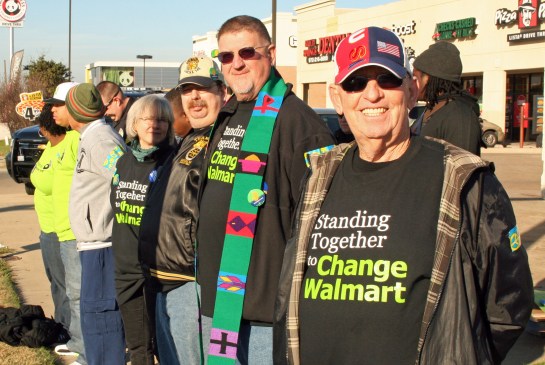
People who are scattered out, working under multiple employers, aren’t so easy. Until recently, they were considered pretty well impossible to organize. But some groups, such as For Respect at Walmart, are organizing the impossible. In the photo, right to left, there’s a retiree activist, a preacher, a Teamster, then a housewife. The rest are low-paid part-time Walmart workers. They’re all in handcuffs waiting to be taken to a police station.

Once I rode a bus to a Farm Workers action in California. The other occupants were home health care workers. If there were 50 of them, then they had 50 employers, most of whom were old people with limited money. And yet, they were organized! The Service Employees organized them by targeting the state agency controlling their working conditions rather than the 50 employers!

All over America today, low-paid part-time food service employees are being signed up for the “Fight for $15” minimum wage movement. They’re also signing up members of more substantial unions, students, and a whole lot of well-intentioned, high-intelligence people who don’t otherwise have anything to do with food service.

The new progressive leadership of the AFL-CIO is emphasizing its constituency groups. In most cases, people don’t have to be union members to join. The connection to organized labor makes them much more powerful.

Our traditional methods of organizing are way out of date. Revolutions are being organized today with social media, and American organizers are learning how it’s done. The internet changes the very nature of organizing.

If we are going to save the planet and ourselves, every worker needs to be organized. Every worker can be organized.

–Gene Lantz

Around the nation, people are celebrating the 2016 Verizon strike. I don’t usually celebrate until the affected members have voted on the contract offer, but there are important lessons to be learned here. Americans can use strikes to win, not just a little bit but everything!

Here’s what “Gawker” had to say on its web site about Verizon:

“Strikes have always worked. Strikes still work. Pro-business forces like to deride unions as socialist parasites, but strikes are, in a sense, one of the purest free market actions that workers can take: the refusal to sell
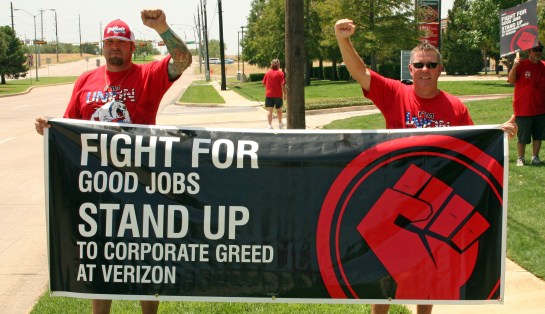
verizon strikers

The public is asked to join in — and they should!

labor at a price that is deemed too low. This has the effect of raising the price of labor. Though “Economics 101″ idiots like to pretend that the free market will always magically produce the perfect wage for every job, the reality is that working people-people with less money-are always at a disadvantage when it comes to asserting the leverage necessary to raise their own wages, because they can’t afford to stop working and lose a paycheck. This is the biggest hurdle that strikes have to clear. It’s hard for working people to leave work, demanding better wages and working conditions. It’s a gamble. But it tends to pay off.

‘As much as workers need wages, businesses need labor even more. The free market has not raised your wages in decades. The government has not raised your wages in decades. You need to raise your own wages. Organize. Then strike. It’s always good to be reminded that it works.”

Working People Have Few Weapons

The ability to withhold our labor, either through strikes or slowdowns, is the strongest thing we can do. Nearly every tactic in our arsenal is just a way to lead up to a strike or a slowdown. We need to think seriously about how we can use our main power.

Do Strikes “Still Work?”

A lot of people might disagree that “strikes still work.” If you look at the Bureau of Labor Statistics on strikes, you can see that strike activity dropped tremendously in 1982, and there have been fewer than 100 big strikes in the entire nation in the years since then. In 2015, there were only 12. In 2009, when the recession was at its worst, there were only 5! In 1952, there were 470!

What Happened in 1982?

Reagan happened in 1982. The spokesperson for General Electric and corporate America in general dragged out an obscure court ruling, NLRB v. Mackay Radio, that cut away most of our legal right to strike in America. He used it to “permanently replace” the Flight Controllers. Unions have to think long and hard about conducting an economic strike now, because the company can hire scabs and keep them permanently.

The Reagan presidency signaled the end of any hope of labor-management partnership, even though many labor leaders clung to their illusions. Government was clearly on the side of business, and both of them were against American workers!

Why Bring It Up?

There are more than one kind of strike. I don’t mean the legal difference between an “economic” strike and an “unfair labor practices” strike. I mean that there are strikes against companies and there are strikes against governments.

Strikes Against Governments?

The idea of a political strike to change government policy is well known in Europe, and it used to be known here in America. The great worldwide strike of May 1, 1886, is celebrated all over the planet, and it was centered here, in Chicago! It was a political strike to get government to set an 8-hour day. The “student moratoriums” and the “Chicano Moratorium” of the 1960s were political strikes.

We usually treat the Industrial Workers of the World (IWW) as part of our illustrious union history. But they weren’t exactly unionists. They were revolutionaries.

The IWW intended to organize all workers, or at least a large enough percentage of workers, to be able to shut the entire nation down. They weren’t planning it so they could get a raise or a 10-minute coffee break. They intended to overcome capitalism and institute socialism in America. If only the workers had known about it, they might have won; but the bosses found out, too.

Economic and Political Strikes Both Deserve Our Support

In a way, every little strike action in America is a dress rehearsal for something much more profound. The Communications Workers at Verizon asked for, and got, a lot of public support and participation. The Wal-Mart workers strain to get everybody’s help, as do other groups from time to time.

Participating in a strike for better wages and participating in a strike for government change — both — are good training for everyone. They result in a better organized, better informed, more capable, stronger progressive movement.

Let’s Daydream Together about Political Strikes

Suppose someone was able to unite the progressive Americans who really want fundamental change. Suppose they had the technical know-how and the access to internet servers to organize us by the millions. That’s not as crazy as it sounds. Bernie Sanders just did it this year!

Suppose those millions agreed on some fundamental demand. It might be raising the minimum wage to $15/hour. It might be cutting working hours. It might be saving the planet. Anyway, suppose they came to agree on something.

Then suppose they set a date, for example May 1, 2017. Then suppose they said that date would begin a “virtual” strike. Nobody would actually stop working, but people would declare their willingness to participate. We’d learn from that, every time we did it.

Eventually, suppose somebody examined the data from the “virtual” tactic, found it very good, and then actually called for a do-or-die nationwide political strike until the goal had been met. You see where I’m going with this?

–Gene Lantz


The clearest lesson learned from the current election cycle is that Americans, especially young Americans, are out of patience with both halves of our electoral system.

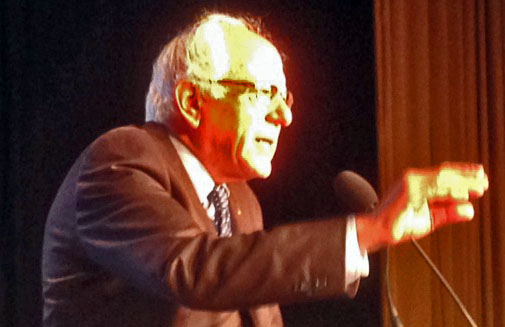
ara-bernieWorking people have long dreamed of having a political party that consistently represents their interests. I’ve heard radicals blast union leaders because they haven’t stepped out alone to start a workers party. I’ve heard people so desperate for a workers party that they formed a pretend one.
Once, I was actually in a group that said it was a workers party. The American Workers Party was started by Tony Mazzochi of the Oil, Chemical, and Atomic Workers 20+ years ago. The United Electricians were involved. I was on the Executive Board. They had a wonderful membership card with a great quote from Eugene Victor Debs on it: “As long as there is a working class, I am in it. As long as their is a criminal class, I am of it. And as long as there is a soul in prison, I am not free!”

What they didn’t have is a snowball’s chance of actually making any difference in America. Part of the deal that brought them some funding, Mazzochi admitted at the 3rd meeting I attended, was that they would not run candidates! As soon as I heard that, I quit. Never went back. It was a pipe dream.

What Would a Workers Party Look Like?

A real workers party would have significant support from organized labor. It would have a mass base. It would have a clear program. Unlike both of the bosses’ parties today, candidates would be under discipline to carry out that worker-friendly program! It might not be revolutionary in and of itself, but it would be a step on a revolutionary path.

Do We Already Have A Workers Party in America? Maybe!

As I wrote on June 5, I expect great things from the Bernie Sanders movement. I’m not sure what Bernie intends, but I think that a significant part of his young followers will stay together. I think they will endorse and work for down-ballot candidates in 2016. I think that, by 2017, they will be picking some of their own candidates in local races. By 2020, they may well be ready to run their own presidential candidate. Americans will be more than ready for them.

I don’t know what they might call it and I don’t much care. If it keeps the program it’s fighting for today, and if it continues to add supporters as it has up to now, and if the Communications Workers, Postal Employees and other progressive unions stick to their guns, — all of which seem likely — we are going to have a workers party in America!

–Gene Lantz

Movie Review, Josh Fox, “How to Let Go of the World and Love All The Things Climate Can’t Change!”

exxonregulatebaby

Dallas pickets Exxon at least once a year

Slowly, the environmentalists are winning the argument over global warming. We usually call the other side “climate denyers,” but the real argument is with the extractive industries, especially oil. We’re arguing with multi-billionaire oil men who stand to lose a lot of money if the world ever adopts a sane policy on carbon emissions.

Those oil men are buying professional liars — college professors, scientists, politicians, policy wonks — and even paying to buy the appearance of a grass-roots pro-pollution movement. That’s what we’re up against.

Josh Fox once did a pretty good dramatic movie “Gasland,” with an environmental theme behind the love story. This time, he’s out with a documentary starring himself. One might think it’s rehashing Al Gore’s excellent documentary of a few years ago. I think it was named “An Inconvenient Truth,” and it was quite effective. The new movie is different.

Fox takes a much more personal approach. He films himself going around the world to look at some of the worst aspects of global warming. He also takes a positive approach in showing some of the efforts to fight back. He dances around and celebrates the good stuff, but doesn’t try to pretend that this war is already won.

On the downside, the movie is too long. There are three good probable reasons:

  • Environmentalists are in love with statistics and facts, and they can’t stop telling them even when everybody has left.
  • Always be suspicious when a movie’s producer, director, and star are the same guy. They just can’t edit out anything they’ve filmed, especially if their own image is in it!
  • There’s just an awful lot to say about a truly critical, horrendous, world crisis!

Where are the workers?

Working people don’t want to suffocate any more than anybody else, but most of the folks leading the environmental movement are middle-class, college educated, and fairly affluent. The union movement, to its eternal credit, is working hard to grow a “blue (collar) / green (grass)” alliance. Where I live, the Communications Workers are strongest on environmental issues.

Not all unions are eager to join the environmental movement. Not all non-union workers are, either. If someone is afraid of losing their job over pollution controls, they’ll generally take jobs over clean air any day of the week. It’s a matter of feeding the family in the here and now. No amount of yelling at them will change their minds.

The people we need to focus on and yell at are the bosses in the extractive industries.

–Gene Lantz

The doomsayers who have been counting Bernie Sanders out of the Democratic primary race all along are doing it again. The pundits are asking, “what’s next?”

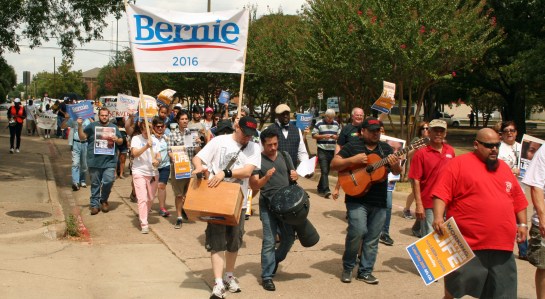
Marchers for Bernie

Marchers for Bernie

What’s Next?

There’s no “next” until Senator Sanders concedes the primary race, and he’s not conceding. But even if he did, would he go the way of previous candidates, including President Obama, who said they would keep the movement alive, but didn’t? The answer is no.

Sanders has already started picking down-ballot races to boost, even as far down the ballot as some state legislators. Some of his supporters are already working on a movement called “Brand New Congress” to carry the momentum for progress forward whether it’s in the presidential race or anywhere else.

Is Bernie Pure Enough?

Of course, there are activists who never actually supported Bernie and still don’t. He wasn’t pure enough for them. For some people, if V.I. Lenin’s stuffed body doesn’t reanimate and walk out of the Kremlin to lead them, nobody is good enough.

Those people don’t see all of politics as processes. Nothing stays the same, everything is changing. The Bernie Sanders campaign has already, and still is, moving America and the world toward real change. It’s true that he’s a social democrat and by definition not a revolutionary. It’s true that his program of electoral reform and restraining Wall Street wouldn’t, by itself, result in permanent gains. The workers will never make permanent gains as long as the bosses are in power, and Senator Sanders has only said he wants to restrain them, not dis-empower them.

But he has started and amplified a wonderful trend in American politics!

Look What’s Already Been Accomplished!

Millions of Americans have realized that the two-party system, neither half of it, is really democratic. Millions have become conscious of the amazing power that big money exerts over the electoral system. Millions have begun seeking real solutions, and I don’t mean they were sitting in their easy chairs and daydreaming about it. Millions are in movement! Millions are experimenting. Millions are working together. That’s amazing accomplishment!

What’s Next?

This movement is going to continue. The youth of America, already smarter and more capable than the rest of us, are taking this movement forward. This isn’t a flash-in-the-pan new trick like the Occupy movement. This is millions of young people joining together to seek fundamental change. They don’t even need the older Americans. They don’t even need Bernie. If they needed to, they could just outlast us older people. But they don’t need to, and they won’t.

The movement identified today with the Bernie Sanders election campaign is going to go on far beyond electoral politics, and it’s going to win!

–Gene Lantz

Book Review: Stead, Arnold, “Always on Strike. Frank Little and the Western Wobblies. Haymarket Books, Chicago, 2014.franklittletombstone

Almost anybody who looks at American labor history knows that Frank Little was a leader of the Industrial Workers of the World who was lynched in Butte, Montana, August 1, 1917. There are a lot of newspaper accounts, a movie, and one book about his death. However, almost nobody knows anything about his life.

He was extremely important, consequently this is a very welcome book. As far as I can find out, it’s the first published biography. Even 99 years after it should have been done, this is a very welcome work!

There’s not a lot in this work that one couldn’t find out from my own earlier postings on Frank Little, which the book’s author surely read. He mentions me three times in the book, but only in speculating whether or not I was telling the truth. The book is somewhat speculative about what really happened, and it’s filled in to a large degree with scholarly explanations of various philosophers who, I’m pretty sure, Frank Little had never heard of.

My other petty complaint about the book has to do with Big Bill Haywood, the President of the IWW. The author implies that there was bad blood between Haywood and Little. That caused me to go back and re-read The Autobiography of Big Bill Haywood (International Publishers, New York, 1929). Haywood mentions Frank Little as a Board member who was “an energetic worker, part Cherokee Indian, black-eyed, hot-blooded, and reliable.” (page 301) He doesn’t say anything about any disagreement.

Author Stead can’t be blamed for the paucity of information. After Frank was lynched, almost on signal, the U.S. Government under J. Edgar Hoover began the “Red scare” of the time. Nobody knows how many people were deported, killed, jailed, or horsewhipped during the period, but there were a lot of them. Just knowing Frank Little was a serious offense. Even his own family didn’t talk about him. I know that first hand, because I interviewed his niece in Yale, Oklahoma.

Every physical trace of Frank Little, except his grave and tombstone in Butte, disappeared.

In my opinion, the book might have emphasized Frank Little’s importance more than it did. He was the main leader of the free speech movement of his time. He pioneered nonviolent civil disobedience decades before Dr. Martin Luther King. He started the IWW in successfully organizing farm laborers decades before Cesar Chavez. At his last meeting of the IWW Executive Board, he lost a vote on firmly opposing the First Great Imperialist War. If he had won, history might have been different.

William Z Foster, another great labor organizer of the period, claimed that Frank Little agreed with him on “boring from within” the American Federation of Labor — a strategy that paid off in 1935 with the forming of the Committee for Industrial Organizing (CIO). Thus, if Frank Little had lived and continued as Chairman of the IWW Executive Board, they might have gone on to become an important part of the great labor upsurge of 1935-1947 and beyond.

But of course, he didn’t win that last vote and he didn’t live more than a few days longer. He went to Butte, where 194 workers had died in the Spectator Mine disaster, and made a speech in defense of job safety. He argued that the coming war was not an excuse to give in to the bosses on safety issues. Hoodlums, probably from the mine company, put a rope around his neck, knocked his crutches aside, and dragged him behind an automobile through the streets of Butte to a railroad overpass, where they strung up his wretched body and hoped everybody would forget him.

We never will.

–Gene Lantz

womanlynched

Darn, I missed the anniversary of Jane Elkins’ hanging again. It was May 27, 1853, when they carried out Judge John H Reagan’s orders and hanged her in downtown Dallas, right where the Old Red Courthouse is today. There’s an elementary school named after Reagan. Nothing for Jane. Every year, I try to remember to try to get people to commemorate Jane Elkins day.

Last year, she was a character in a play. She’s mentioned in some of the material at the Old Red Courthouse museum because she is officially the first woman ever executed in Texas. They probably hanged plenty of others, but they didn’t write it down. Most people don’t know about Jane.

Read More

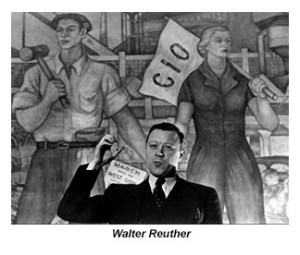
Walter Reuther CIO

Walter Reuther is a pivotal character in labor history

Most union histories say little about the Taft-Hartley law except that unions opposed it, Democratic President Harry Truman vetoed it, and the Republican Congress passed it anyway. It was the axis about which the American labor movement swung from highly progressive and successful into a long downward spiral.


The law signaled the end of the cooperation between labor and progressive Democrats that produced such landmark improvements as the National Labor Relations Act, Fair Labor Standards Act, unemployment compensation, workers compensation, and Social Security. It was the first big anti-labor law to pass since 1932. It’s intent was to greatly weaken and isolate organized labor. It worked great!

Taft Hartley hit labor like a tsunami. It destroyed whole unions, many careers, and many lives. Combined with the “Iron Curtain” speech of the previous year, it dovetailed into the witch hunt that sapped American culture for the next decades and is affecting us still. Like a tsunami, though, it also lifted some boats. Opportunists took over the unions.

Communists and socialists had played a major role in building the Congress of Industrial Organizations (CIO). Taft Hartley made it illegal for them to serve as union leaders. Some of them disavowed their previous connection, some of them kept their principles but lost their careers, a tiny few held fast and survived, but at great cost.

Devastation

Walter Reuther and the CIO expelled 14 unions for refusing to give in to Taft Hartley. Then they raided them. Only two survived: the United Electrical Workers  (UE) and the International Longshoremen and Warehousemen Union (ILWU). Both of them remained vigorous and progressive through the long period of growing isolation of organized labor. Both of them stood up for civil rights and against war when neither was generally popular. Both of them stood up for  solidarity when most unions increasingly adopted “go it alone” as their credo.

Prior to 1947, the CIO was the point of America’s progressive spear. They were internationalist. They pushed hard for improvements in Social Security for all. They demanded national health care for all. They demanded a shortening of the work week for all. After 1947, the union movement forgot the shorter work week, and they accepted company proposals for employer based pensions and health care. Union members continued to get higher salaries, better pensions, and solid health care into the 1970s while the rest of the working class did the best they could.

In 1980, when the employers and the government turned viciously against their old buddies running the union movement, we were largely friendless and almost helpless! Walter Reuther, who was probably the best of the mainstream union leaders, had been killed in 1971, right after protesting Nixon’s handling of the Vietnam War. American union leadership didn’t fully adapt to the hostile new situation until 1995 when the AFL-CIO, for the first time in a century, did not let the outgoing leadership pick its replacements.

Turning things around

The new leadership has been turning things around. It’s a hard job, but it’s working. Our days of isolation are over and the sun is shining on organized labor today. Taft Hartley wounded us severely, but not mortally.

Here’s how Eugene Victor Debs once put it: “Ten thousand times has the labor movement stumbled and bruised itself. We have been enjoined by the courts, assaulted by thugs, charged by the militia, traduced by the press, frowned upon in public opinion, and deceived by politicians. But notwithstanding all this and all these, labor is today the most vital and potential power this planet has ever known, and its historic mission is as certain of ultimate realization as is the setting of the sun.”


Mavis Belisle on KNON

Mavis Belisle reports on dumping of radioactive poison in Texas

Lon Burnam called the “Workers Beat” program on KNON radio on June 4 to ask my guest, Mavis Belisle, to explain about the Dallas company that is currently dumping low level radioactive waste in Texas and wants a permit to dump the really poisonous stuff. I’d been calling them “Waste Management,” but Mavis said the correct name was “Waste Control Specialists.”

Here’s Mavis explaining on YouTube: https://youtu.be/UfmLy2iFa8o

The owner was infamous for making major contributions to the Texas politicians who originally permitted the dumping. If it were simply up to the Texans, few of us doubt that the company would get another permit to solve one of the most vexing problems in the world: what to do with the plutonium and other poisons being created by all the nuclear power plants.

Up to now, there has been no solution. Mavis said that the government had plans to dump it under a mountain in Nevada, but the Nevadans found out about it so those plans were cancelled. The stuff is just piling up. They keep making more of it, and there’s absolutely nothing they can do to safely store or dispose of it.

Mavis said that plutonium doesn’t degrade. It will still be around, she said, for the same length of time that the human race has existed up to now.

Why would companies and politicians allow this sorry state of affairs? Greed.

–Gene Lantz