Archive

Tag Archives: unions

People were shocked recently when French President Francois Hollande, head of the Socialist Party, forced legislation through that would make it easier for bosses to lay people off, make them work longer hours, cut their pay and cut into some of their special leaves — such as maternity leave. Click here for BBC version. Protests were very large. I read that 70% of the people were against the new labor rules. But they passed!

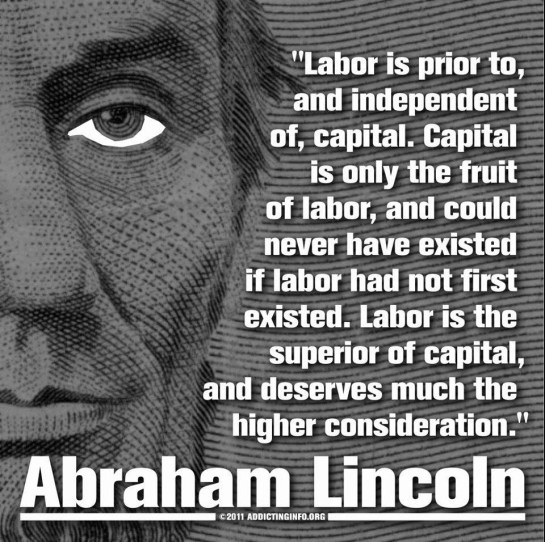
lincolnlabor

How could that be?

The simple answer is that Hollande is a SINO — Socialist in Name Only. But simple name calling doesn’t really provide any answers. Undoubtedly, France is a capitalist nation with a president who calls himself a socialist and leads a party that calls itself socialist. They got elected, but they didn’t overcome the bosses and, probably, never intended to.

As long as the bosses are in power, workers will never win any permanent gains. Everything we can win, even the 35-hour week that they enjoy(ed) in France, can still be taken away.

France is a capitalist nation and subject to the same economic laws that govern all the capitalist nations. All of them function in competition with one another. When the competition gets rough, as it is worldwide right now, the employers turn like vicious cannibals against their own people in order to drive down costs. Most costs are labor costs, so capitalist governments, including ours, are in the process of competing with one another by chopping away our standards of living.

Even nations that actually have overcome the employers have to compete with other nations within a world capitalist system. Did the Soviet workers ever win a 35-hour week? I don’t think so.

It doesn’t matter much what the government calls itself as long as it is still capitalist and still operating under the capitalist rules.

–Gene Lantz

Click here for more of these ideas

In a casual discussion group I participate in, somebody asked, “Where are we in the swing of the historical pendulum? Are we close to revolution?”

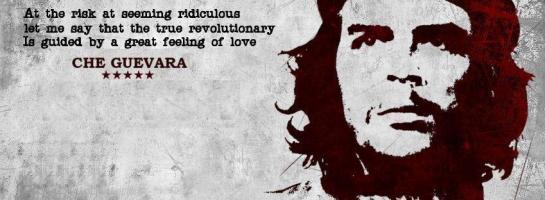
Che

I didn’t try to answer at all, because I couldn’t deal with the way the question was framed. There is no “historical pendulum.” It’s common to believe that history just swings back and forth or goes around in circles, but it doesn’t. The general movement of history is forward and progressive. We aren’t savages any more, most of us, and we aren’t serfs nor slaves. Over the centuries, progress is being made.

But later, I wished I had answered the question, because my analysis may seem unusual to some people: Revolution in the United States and in most of the world may be just around the corner!

Doom and Gloom

OK, there are a lot of naysayers and former radicals among us today. The implosion of the Soviet Union hit hard. The rapid change in Eastern Europe devastated some folks, and the difficulties they’re having in Venezuela and Brazil today are squeezing the optimism away. Add to that the tremendous success that dark money has enjoyed in turning our American democracy backward during the last 4 decades. It’s enough to get some people down. Some people. But they aren’t taking the long view.

The Long View Looks Great!

What are the requirements for a qualitatively better society? A well informed and well organized public with leadership from among the workers. We have that, more than ever!

Nowadays, I am in awe of the millennials. They grew up understanding more about using new technology than I will ever learn. Technology extends their knowledge and their capabilities.

The millennials also grew up without all the anticommunism that crippled the thinking of my generation. When I was young, we were afraid to even look to the left, much less think in that direction. The Bernie campaign has made “capitalism” and “socialism” everyday words. People are thinking thoughts that used to be taboo.

Today’s young people have the entire world at their fingertips. Most of my generation would never have left home if it hadn’t been for the military draft.

Don’t Overlook the Unions

Unions are the organized sector of the working class. It’s true that there aren’t as many union members per capita as there were in 1957, but that’s misleading. One worker today is doing the work of 4 pre-war workers. And he/she is likely to be highly skilled and hard to replace. Workers are just as central to the progressive movement as they were in Russia in 1917 and every year since! Nobody else can stand up to the bosses eyeball to eyeball, but workers can!

Older people think that the 1960s and 1970s were the revolutionary times. Long hair and marijuana do not a revolution make! Ask them how much union support they enjoyed in their anti-war marches, their feminist causes, their environmental rallies, or anything they look back on with smug satisfaction of revolutionary activity. Unions barely participated in those days, but things have turned around now. It’s hard to find a street action that isn’t supported by AFL-CIO members. In fact, they originate a lot of them!

Furthermore, it is now possible for everybody to work with America’s unions. From 1947 to 1995, that was impossible. The unions in the post war years grew more and more isolated, but today they are reaching out with both arms!

Communications Are Already Revolutionized

There were a number of revolutions in the 20th century. They did it with clandestine meetings, secret leaflets, and a tiny few underground newspapers. One person might “spread the word” to a few dozen on a very good day. Today, we can reach thousands, maybe tens of thousands, without leaving home!

The possibilities are amazing!

–Gene Lantz

Click here if you’re interested in more such ideas

Organizing Gets Easier and Easier

I’m flattered when somebody introduces me as an organizer. They sometimes say I’m a “union organizer,” which is not actually true. A real union organizer is a paid professional with a strong background in labor law. I consider myself a “worker organizer.” But everybody is an organizer.

We organize every time we meet somebody for lunch. It’s all organizing. But what’s critical is organizing on the job.

organiz9

A Short History of Organizing, Starting with Slave Labor

Looking back through history, we can see that organizing was really hard to do when most work was done by slaves. Nat Turner, John Brown and Spartacus all found out how hard. They all failed, and were executed for trying. The only successful slave organizer I know of was Toussaint L’Ouverture in Haiti around 1800. The reason it was so difficult was probably because slaves were pretty much interchangeable. When one was worked to death, another could be easily substituted.

Serfs and sharecroppers, who mostly replaced slaves, were a little more organizable. I think that’s because they had to know a little bit more about their jobs and weren’t so easy to switch around. The Southern Tenant Farmers Union of the 1930s was one of the more successful efforts. I actually met H.L. Mitchell once. Their gigantic accomplishment was to fight racial barriers that have always made organizing in the American South so difficult. Even back in those days, there were a few small guilds of workers who could be organized because they had special skills and tools.

The Bosses Do Most of Our Organizing

Modern unions came about because of the industrial revolution. England was the first capitalist nation, the first to industrialize, and of course the first to have organized unions. In America, the first successful unions were people who made shoes. It wasn’t everybody in a shoe factory. It was only the most skilled workers. For the next couple of centuries, the more skilled workers tended to organize around their special skills and tools. We call that craft unionism, and it was the model for the American Federation of Labor (AF of L) during its century of dominating organized workers in America. In steel production, for example, the molders and machinists might be organized, but not the people shoveling coal and ore. In textile, the cutters would be organized but not the women doing the sewing.

Modern Industrial Organizing Finally Developed

Labor’s Giant Step (free book on Amazon) can trace its development to the beginning of the 20th century, when the Industrial Workers of the World set out to organize everybody who worked, skilled and unskilled, men or women, Black, Brown, or white. By then, industrialization had made just about every job in America into a somewhat skilled position. It was difficult to replace one worker with another. General education and training were involved. The IWW ran into a minor obstacle because the AF of L undermined them, but their major obstacle was the U.S. government. IWW’ers were arrested, deported, horsewhiped, and murdered.

The saying goes that you can kill revolutionaries but you can’t kill revolutionary ideas. So industrial unionism eventually triumphed when the AF of L started the Committee for Industrial Organization (CIO) in 1935. Three years later, they thought better of it and expelled them, but by then the CIO was strong enough to survive and thrive on its own. After 1935, the biggest and most successful unions were those who organized “wall-to-wall,” everybody in a given industry from the most skilled computer operator to the lady sweeping the floors. AF of L unions adopted industrial organizing.

The best known pioneer and most successful union of the CIO was the auto workers. You can see why they organized so well, because auto manufacturing, more than most other work, was done by assembly line. If you could get three or four people on strike, you could shut down the line! Once again, the bosses had done most of what was necessary to organize workers!

Organizing Gets Easier and Easier

American industry became so well organized that the anti-worker bosses had to get the U.S. government to help them keep wages and benefits down by outsourcing the work to other countries. The same process of organizing is taking place in those other countries, so the bosses won’t benefit from outsourcing forever, but it works for them as an interim solution.

Meanwhile, Americans are better informed and more skillful than ever. The internet is making a qualitative jump in people’s access to information. It would be possible, in my estimation, to organize a national shutdown in only a few days. A worldwide shutdown could be organized in a matter of weeks. After that, everything is possible.

–Gene Lantz

Click here if you’re interested in more such ideas

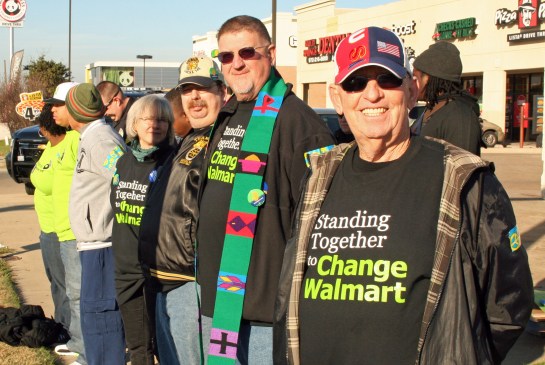
walnolangeorgebusted Traditionally, it’s easiest to organize economic units working under the same employer in more or less the same vicinity. It’s even better, as the auto workers showed us, if they work on assembly lines, so that just a few missing workers can stop production.
People who are scattered out, working under multiple employers, aren’t so easy. Until recently, they were considered pretty well impossible to organize. But some groups, such as For Respect at Walmart, are organizing the impossible. In the photo, right to left, there’s a retiree activist, a preacher, a Teamster, then a housewife. The rest are low-paid part-time Walmart workers. They’re all in handcuffs waiting to be taken to a police station.

Once I rode a bus to a Farm Workers action in California. The other occupants were home health care workers. If there were 50 of them, then they had 50 employers, most of whom were old people with limited money. And yet, they were organized! The Service Employees organized them by targeting the state agency controlling their working conditions rather than the 50 employers!

All over America today, low-paid part-time food service employees are being signed up for the “Fight for $15” minimum wage movement. They’re also signing up members of more substantial unions, students, and a whole lot of well-intentioned, high-intelligence people who don’t otherwise have anything to do with food service.

The new progressive leadership of the AFL-CIO is emphasizing its constituency groups. In most cases, people don’t have to be union members to join. The connection to organized labor makes them much more powerful.

Our traditional methods of organizing are way out of date. Revolutions are being organized today with social media, and American organizers are learning how it’s done. The internet changes the very nature of organizing.

If we are going to save the planet and ourselves, every worker needs to be organized. Every worker can be organized.

–Gene Lantz

The clearest lesson learned from the current election cycle is that Americans, especially young Americans, are out of patience with both halves of our electoral system.

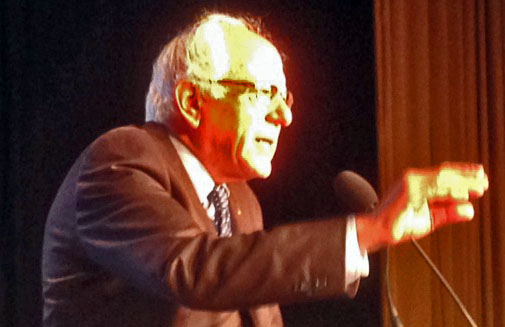
ara-bernieWorking people have long dreamed of having a political party that consistently represents their interests. I’ve heard radicals blast union leaders because they haven’t stepped out alone to start a workers party. I’ve heard people so desperate for a workers party that they formed a pretend one.
Once, I was actually in a group that said it was a workers party. The American Workers Party was started by Tony Mazzochi of the Oil, Chemical, and Atomic Workers 20+ years ago. The United Electricians were involved. I was on the Executive Board. They had a wonderful membership card with a great quote from Eugene Victor Debs on it: “As long as there is a working class, I am in it. As long as their is a criminal class, I am of it. And as long as there is a soul in prison, I am not free!”

What they didn’t have is a snowball’s chance of actually making any difference in America. Part of the deal that brought them some funding, Mazzochi admitted at the 3rd meeting I attended, was that they would not run candidates! As soon as I heard that, I quit. Never went back. It was a pipe dream.

What Would a Workers Party Look Like?

A real workers party would have significant support from organized labor. It would have a mass base. It would have a clear program. Unlike both of the bosses’ parties today, candidates would be under discipline to carry out that worker-friendly program! It might not be revolutionary in and of itself, but it would be a step on a revolutionary path.

Do We Already Have A Workers Party in America? Maybe!

As I wrote on June 5, I expect great things from the Bernie Sanders movement. I’m not sure what Bernie intends, but I think that a significant part of his young followers will stay together. I think they will endorse and work for down-ballot candidates in 2016. I think that, by 2017, they will be picking some of their own candidates in local races. By 2020, they may well be ready to run their own presidential candidate. Americans will be more than ready for them.

I don’t know what they might call it and I don’t much care. If it keeps the program it’s fighting for today, and if it continues to add supporters as it has up to now, and if the Communications Workers, Postal Employees and other progressive unions stick to their guns, — all of which seem likely — we are going to have a workers party in America!

–Gene Lantz

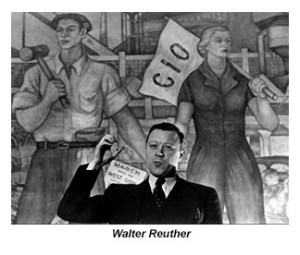
Walter Reuther CIO

Walter Reuther is a pivotal character in labor history

Most union histories say little about the Taft-Hartley law except that unions opposed it, Democratic President Harry Truman vetoed it, and the Republican Congress passed it anyway. It was the axis about which the American labor movement swung from highly progressive and successful into a long downward spiral.


The law signaled the end of the cooperation between labor and progressive Democrats that produced such landmark improvements as the National Labor Relations Act, Fair Labor Standards Act, unemployment compensation, workers compensation, and Social Security. It was the first big anti-labor law to pass since 1932. It’s intent was to greatly weaken and isolate organized labor. It worked great!

Taft Hartley hit labor like a tsunami. It destroyed whole unions, many careers, and many lives. Combined with the “Iron Curtain” speech of the previous year, it dovetailed into the witch hunt that sapped American culture for the next decades and is affecting us still. Like a tsunami, though, it also lifted some boats. Opportunists took over the unions.

Communists and socialists had played a major role in building the Congress of Industrial Organizations (CIO). Taft Hartley made it illegal for them to serve as union leaders. Some of them disavowed their previous connection, some of them kept their principles but lost their careers, a tiny few held fast and survived, but at great cost.

Devastation

Walter Reuther and the CIO expelled 14 unions for refusing to give in to Taft Hartley. Then they raided them. Only two survived: the United Electrical Workers  (UE) and the International Longshoremen and Warehousemen Union (ILWU). Both of them remained vigorous and progressive through the long period of growing isolation of organized labor. Both of them stood up for civil rights and against war when neither was generally popular. Both of them stood up for  solidarity when most unions increasingly adopted “go it alone” as their credo.

Prior to 1947, the CIO was the point of America’s progressive spear. They were internationalist. They pushed hard for improvements in Social Security for all. They demanded national health care for all. They demanded a shortening of the work week for all. After 1947, the union movement forgot the shorter work week, and they accepted company proposals for employer based pensions and health care. Union members continued to get higher salaries, better pensions, and solid health care into the 1970s while the rest of the working class did the best they could.

In 1980, when the employers and the government turned viciously against their old buddies running the union movement, we were largely friendless and almost helpless! Walter Reuther, who was probably the best of the mainstream union leaders, had been killed in 1971, right after protesting Nixon’s handling of the Vietnam War. American union leadership didn’t fully adapt to the hostile new situation until 1995 when the AFL-CIO, for the first time in a century, did not let the outgoing leadership pick its replacements.

Turning things around

The new leadership has been turning things around. It’s a hard job, but it’s working. Our days of isolation are over and the sun is shining on organized labor today. Taft Hartley wounded us severely, but not mortally.

Here’s how Eugene Victor Debs once put it: “Ten thousand times has the labor movement stumbled and bruised itself. We have been enjoined by the courts, assaulted by thugs, charged by the militia, traduced by the press, frowned upon in public opinion, and deceived by politicians. But notwithstanding all this and all these, labor is today the most vital and potential power this planet has ever known, and its historic mission is as certain of ultimate realization as is the setting of the sun.”