Archive

unions

Movie Review: “Sorry to Bother You,” Written and directed by Boots Riley, 111 minutes

sorry-to-bothe

There are films that I wish I’d seen with 100 close friends with different viewpoints. Then I could conduct 100 intense conversations that might help clarify what my movie buddy and I sat through.

One thing is certain: this is all-time championship heavy social commentary. It’s on a level with “Brazil,” and maybe a lot better. About everything else, I’m not so sure.

I have questions I’d like to ask my 100 insightful friends: “Does everybody in the movie, including the star-crossed lovers, have to be whacky?” “Why is there an ending after the ending?” “Was playing with the N-word really necessary?” We saw a white couple walk out right after the N-word session, so I guess they were offended. But then, they may have only been confused.

There’s a lot to be figured out, and I’m not sure that even my 100 imaginary intellectual friends would be enough to put me at ease. There are layers tucked under the layers. Just for example, what does the title mean? To begin with, I thought it was just a whimsical title. Then I realized that the main character was a telemarketer who started every call with that phrase, so I thought the title was descriptive. Then, after the movie jolted my world, I decided that the title was a pre-apology from the writer/director straight to me. He was sorry he had to shake up most of my perceptions and a good many of my conclusions, but he went ahead and did it anyway.

Would I recommend the movie? Honestly, no. I am reluctant to recommend it because I’d be risking my credibility with some readers. Lots of people are not going to like this movie. But I’m tempted to recommend it anyway, duplicitous as it sounds, because I want more people to see it and then, maybe, explain it to me.

Would I recommend it? Well, I’m glad we went, and so is my movie buddy. It fits our definition of art, because interacting with it changed us in undefined ways.

I understand that the so-called “gig economy,” temporary jobs with no rights, benefits, or certain compensation, has taken over 20% of the American economy. And the percentage is rising fast. Maybe I should recommend that everybody go see “Sorry to Bother You.”

Before it’s too late.

–Gene Lantz

I’m on KNON radio at 9 AM Central Time every Saturday. Under the “events” tab, one can find the last two programs podcasted. If you are curious about what I really think, check out my personal web site.
I liked a great deal of what I saw at the Texas Democratic Party convention in Ft Worth on June 22, but not everything.

conv-laborcaucuscrowd

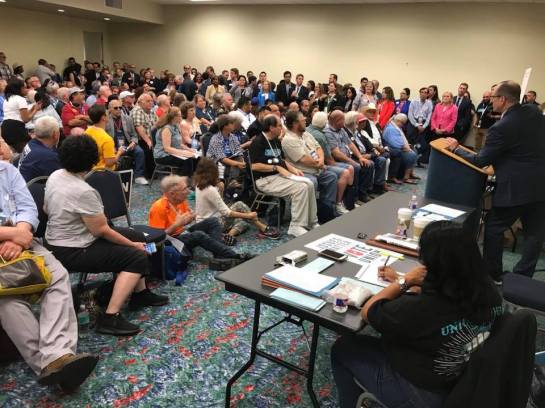
The first thing we attended was the Labor Caucus. Texas AFL-CIO President Rick Levy presided over a completely packed meeting with people standing three deep along the back and sides. I caught Levy’s opening remarks on “Facebook Live” where you can see them at https://www.facebook.com/gene.lantz.7.

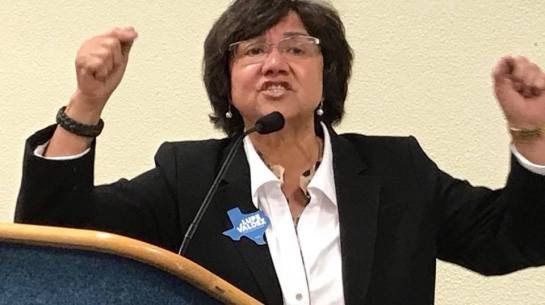
Just about every critical candidate in Texas was there seeking union help. Levy could only recognize most of them briefly due to time constraints. The ones that he introduced to the podium were the most critical statewide candidates such as Lupe Valdez for Governor.

candidate-lupevaldez

I noticed at least two unions had bought ads in the Democrats’ brochure: CWA and UAW. The Texas AFL-CIO booth in the Exhibit Hall was abuzz with activity. They took polaroids of people posing in front of their big slogan, “I’m union, I fight, I vote!’ It has a “big fist” image, to show power and commitment.

Labor’s big impact on the Democrats was evident everywhere. It doesn’t mean that labor is in their pocket, it actually means the opposite. Texas Democratic Party Chair Gilberto Hinojosa likes to say that Labor and the Democrats are “joined at the hip,” but in truth labor’s activities are very much our own. In this photo, you can see Texas AFL-CIO President Rick Levy thinking carefully while Hinojosa speaks to the Labor Caucus.

conv-levy-gilbertohinojosa

The deep polarization in America is causing working families to support Democrats. Recent news reports show Republicans trying to implement $6 trillion in cuts that would affect working people, less than a year after their big tax giveaway of more than a $trillion$ to the wealthy. The Texas Republican Party’s platform, just finished June 18, is a kick in the face to working families, and especially to our children.

On the downside

In their exuberance, the first dozen or so speakers at the Democrats’ convention emphasized two main themes: immigration and gun violence. These are hot-button issues today, to be sure, but they are issues that the Democrats already own. The Republicans have generously donated those issues and those voters to the Democrats.

But what about fighting the corporate takeover? What about America’s three ongoing wars and attempts to coerce and undermine other nations? What about America’s disgraceful top-of-the-world prison population? What about taking concrete steps to end the health care hodgepodge and support Medicare for All? What about saving the state’s environment in the face of rampant oil well fracking and nuclear waste dumping? I didn’t hear those issues, except for some vague emotional appeals here and there.

The inescapable conclusion is that the Democrats are not ready to forego big corporate campaign donations any more than the Republicans are.

What will you do?

I realize that many of America’s best activists have adopted the age-old goal of trying to take over the Democratic Party. I hope they do, but history tells us that it isn’t likely.

Supporting working families, not candidates nor parties, is the way to go. It may be true that nearly all of labor’s candidates in 2018 will be democrats, and it may be true that an individual activist can be more effective short-term working directly for candidates than he/she might be while working for the AFL-CIO, but that would be a major long-term mistake.

The electoral arena is only one of many, and we must choose labor in every one!

If the goal is to make serious change, activists must recognize that only workers can do that. They are the only ones who can stand up to capitalists. A few years ago, one could not have been blamed for feeling that the AFL-CIO and unions in general were not rightfully the leaders of the working class, but that is no longer true and has not been true since 1995. The AFL-CIO today truly works for the entire class and strives to organize everybody.

That’s the team we should join!

–Gene Lantz

I’m still on KNON radio 89.3FM in Dallas at 9 AM Central Time every Saturday. The “events” tab on the web site leads to recent podcasts. If you want to know what I really think, check out my personal web site.


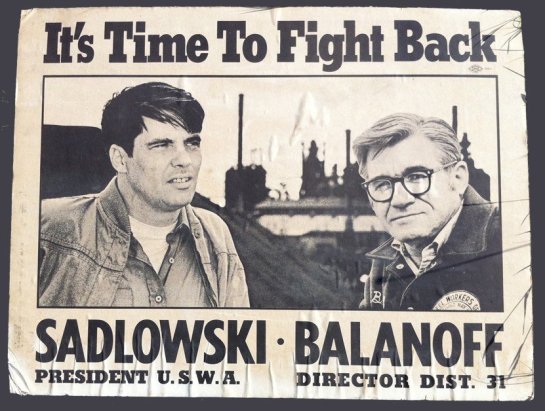
I just got the word, via Bruce Bostick of the Steelworkers, that Ed Sadlowski died yesterday.  He was one of the great American labor leaders who ultimately didn’t win.

sadkiwski-leaflet

It’s easy for us to remember the great leaders for working families if they rose to some title or office that makes the history books. What we don’t remember is the thousands who did the work but didn’t get the titles. The Sadlowski campaign for President of the Steelworkers was a landmark event in 1977, but Ed didn’t win the election.

After the draft was repealed in 1972, America’s big student movement dribbled away. For a lot of the 1960s-70s “radicals,” the progressive movement was over. You see them all the time. They’re the older guys with ponytails who love to talk about it, but it was only an interlude for them.

The young people who had been transformed by that great anti-war movement continued engaging in the many struggles for justice. Many of them still are. In general, though, they didn’t look to organized labor for causes. Unions did not want them. Most unions had ignored or opposed them throughout their political awakening and, to be frank, many of us had little or no hope for the union movement.

Sadlowski was a point of departure. His energetic fight for justice in the Steelworkers’ union showed that there were great things to be done in the union movement and great people were doing them. We flocked to the Sadlowski campaign, even to the point of giving up college career plans and getting Steelworker jobs.

Ed Sadlowski did not reject the outside help. He paid a price in red-baiting for that. I don’t think the red-baiting caused him to lose the election. He lost because he was bucking a mighty tide of conservatism and isolation in the American union movement, in my opinion. But the red-baiting hurt, too.

If we knew our labor history, we’d know that there were heroes in many unions who bucked the tide. Steel and the Miners Union may have been in the papers more, but it was going on in a lot of places.

I think the big payoff for the insurgents began in 1987 when a few unions started Jobs with Justice. In 1992, as I recall, there was a big conference of the more progressive unions to discuss the problems of low-paid workers. Then in 1995, John Sweeney, Richard Trumka, and Linda Chavez-Thompson overturned 100 years of continuous officeholding in the AFL-CIO. That’s when it really started getting good, and it’s improved every day since then!

The Ed Sadlowski’s may not get the titles and the awards, but they did the work for all of us.

–Gene Lantz

I’m still on KNON radio 89.3FM in Dallas at 9 AM Central Time every Saturday. The “events” tab on the web site leads to recent podcasts. If you want to know what I really think, check out my personal web site.
President Trump is the champion of fair trade for American workers. Or is he destroying the hopes of all workers for a peaceful and beneficial world? Or does he even know what he’s doing?

me-nonafta

A lot of working families were won over by Trump’s promise to renegotiate so-called “trade” agreements and restore American jobs. People, including a lot of union people, are still hoping he will. Yesterday, he poked his finger into the eyes of several world leaders at the G7 meeting in Canada. He said he was representing American workers.

What’s “Fair,” What’s “Free?”

For decades, since the Clinton Administration at least, American unions have been campaigning on the slogan “Fair trade, not free trade.” We always say “We’re not against trade — we just want it fair.” But it’s been very hard for union leaders to resist xenophobia and isolationism, because those “isms,” — right along with nationalism and racism — are also against the trade deals that America negotiated since Clinton.

The people that knew what they were talking about presented the argument that the so-called “free trade” deals were only “free” for big transnational corporations — not for the working families in America or any other country. Big corporations received “freedom” to pay low wages and pollute, nobody else got anything. That’s why we opposed NAFTA and all the others leading up to the “Trans Pacific Partnership” that was still an issue in the 2016 presidential campaign.

The people that knew what they were talking about actually favored trade deals if they included wage and environmental protection. But not everybody is so sophisticated. They hate the trade deals anyway. That’s why so many of them voted for Trump.

There’s a History to “Free Trade”

I recently read a complete history of Britain and found an interesting reference. When Britain “ruled the waves” and ruled the world, their slogan was “free trade.” From the time they defeated Napolean until World War I, the English favored what they called “free trade.” They didn’t , at least not immediately, necessarily open their own markets, but they wanted everybody else, especially their many colonies in Asia and Africa, to open theirs.

In other words, “free trade” meant, then and now, the “freedom” of one country’s corporate rulers to exploit everybody else. Another word for it is modern imperialism.

After World War I, and especially after World War II, when the United States took over world trade, corporations wanted “free trade” for the exact same reasons. But the “freedom” was always for the exploiters and never for the exploited, then and now.

Everything Ends

There are different ways to look at the Trump program on trade issues. Economists and pundits are arguing that he’s destroying the world and setting us back centuries. Trump and his supporters say he is restoring fairness. Xenophobes and racists are rooting for him, as they have all along.

But there’s another, more interesting way to look at Trump’s trade wars. American economic domination is coming to an end. It actually ended in the 1970s, according to some. Since then, international leaders have simply agreed to keep the system in place even though the United States is living on credit and has been for decades. The post-war system put in place by the United States after WWII has actually fallen apart. Donald Trump is just an opportunist trying to turn the situation to his own benefit.

A Real Solution to the Trade Wars

Modern nations were created by capitalism. Each nation is run by and for the bosses. Their economic and political decisions are made for the benefit of the dominant class — the capitalist class. That includes much more than trade deals and treaties. It also includes global pollution, war and genocide.

It is theoretically possible that the various governments, as presently constituted, could cooperate on trade in a way that would benefit the inhabitants of the various nations. But that’s only in theory. It has never worked that way because the inhabitants, us, were never in charge. We still aren’t, and there will be no solution until we are.

–Gene Lantz

I’m still on KNON radio 89.3FM in Dallas at 9 AM Central Time every Saturday. The “events” tab on the web site leads to recent podcasts. If you want to know what I really think, check out my personal web site.


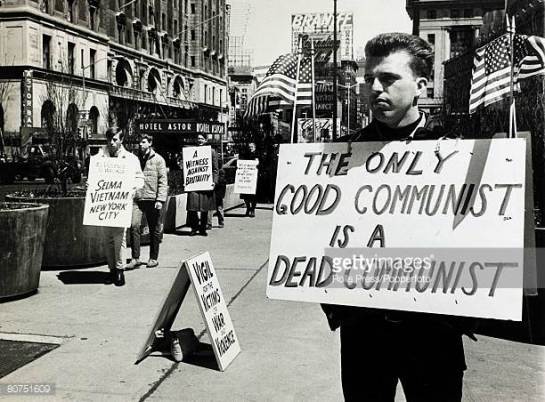
Last night I listened to an outstanding report from a participant of the 1960s-70s American student anti-war movement. The reporter really knew his stuff, and his analysis was superb.

communist-dead

At the end, though, I disagreed. It wasn’t that I don’t concede that the guy knows twice as much about the student movement as I do. It isn’t that I don’t agree that the student movement shook the world, refashioned people’s thinking, and contributed greatly to ending the Vietnam War. He’s absolutely right on that.

What I disagreed with was the emphasis. The progressive movement that we are experimenting with right now is the biggest, most important, and most potentially effective people’s movement since the American Civil War. Maybe even better than that. The student movement was nearly all college students, and mostly white draft-age males at that. Even the civil rights movement of 1954-1968 was limited to a relatively small sector of the population. The labor upsurge of 1935-1947 was great, but the union movement was split between the AFL and CIO then. The Industrial Workers of the World exceeds everything in pure romanticism, but I don’t think there were ever more than 100,000 actual members. The populist movement of the late 19th century was limited to farmers and, for the most part, didn’t even include landless farm workers. Outside Texas, the populists were infamous for their racism.

No, now is better.

Communists and Fascists Today

We had communists and fascists in the old days. We have them now.  People understand them both better now than they did when they were just “hot button” emotional topics. It is true that fascism is inching forward in America, but it is also true that people know what to do about it. More importantly, the fascists can’t use anti-communism as effectively as they did before. Anti-communism is dying out among America’s youth.

Just Look At Us!

I looked around the room while my friend was talking about our student movement. The crowd was mostly young, but not all young. In gender and race, it was diverse. When my friend talked about making leaflets for anti-war demonstrations, I realized that the people at the meeting had, in their purses and pockets, more thinking and communicating power than we ever dreamed of as students. They could make leaflets in minutes if they wanted to, but they don’t even need leaflets. They are experts at communicating. This small group could have easily reached thousands of co-thinkers before they left the room!

Labor Is Getting Past Its Isolation

Speaking of the room, it was the auditorium of the local school employees’ union, American Federation of Teachers. The president of the local union walked through and said hello to a few of us. Could you imagine, in your wildest dreams, that the student anti-war movement could have met in an AFT union hall? Albert Shanker was President of that union in those days, and he was, next to the president of the American Federation of Labor, the most fanatical supporter of the war in Vietnam.

Labor isolated itself from the progressive movement in most instances between 1947 and 1995, then they made a gigantic change toward standing for all workers.

Today’s progressive movement is warmly accepted in union halls. The Dallas AFL-CIO welcomes radical Bernie-Sanders-socialists several times a month! The AFL-CIO banner regularly appears at anti-war, civil rights, gay rights, environmentalist, and immigrants’ rights rallies. If anything, the national and state leaderships of the labor federation are even more integrated into the general progressive movement than Dallas unions.

I like studying the history of other progressive movements. There are many good things to learn, and we learned some of them last night. But don’t get carried away with the past. Now is better.

All We Have Is Now

I welcome discourse when I publish. Disagreements are welcome. But bear in mind that today’s situation is the only one we have. Romanticizing earlier situations may be fun or interesting, but all our efforts can’t go into “then.” They have to go into now! On that, last night’s reporter, and everyone else, agrees!

–Gene Lantz

I’m still on KNON radio 89.3FM in Dallas at 9 Central Time every Saturday. Podcasts can be found under the “events” tab. If you are curious about what I really think, check out my personal web site.
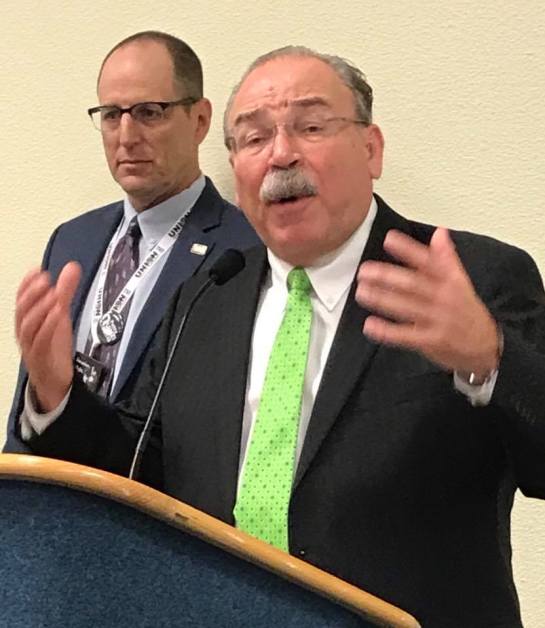
There’s so much complaining about unions, especially our own! But our radio program on the Communications Workers of America revealed some very positive aspects of the American union movement.

cwa6171travispirotte-tonyschaffer2

My co-host, Bonnie Mathias is an outspoken member of two CWA locals, including the Dallas dominating CWA 6215. Our guests were from CWA 6171, headquartered in Krum, Texas. Travis Pirotte is the elected president, and Tony Schaeffer is the professional representative from CWA District 6, a five-state region. Tony is the big guy on your left in the photo.

Right now, CWA 6171 is negotiating a new contract with Frontier. A couple of callers wanted to know if they were expecting the company to want big pay cuts. They also wanted to know if the union was doing anything about the national problem of companies’ outsourcing work from union members to low-paid subcontractors. Another caller wanted to know if their union was trying to organize any of the many low-paid, no-benefits workers in the “gig” economy. These were really good questions.

Tony is the expert on negotiations. He said that the company had not made any economic proposals yet. Unions negotiate “economic” and “non-economic” issues separately, with the non-economics usually first, he said. As for the sub-contractors stealing work from the union, Tony said that the CWA has been fighting this nationwide all along.

The Good Part

For me, the good part was when Bonnie and our guests started talking about all the socially responsible things that their union is doing. I knew that Herb Keener from CWA 6215 speaks up for the Blue/Green Alliance between labor and environmentalists. I also know that Claude Cummings, District 6 leader, is a major figure in civil rights activities — whether they concern union members or not. It was good to hear the guests confirm these things.

exxonherb2

–Gene Lantz

I’m on KNON radio 89.3 FM in Dallas at 9 AM central time every Saturday. Podcasts are available from the “events” tab. If you want to know what I really think, check out my personal web site

I love this union cause.

— William H. Sylvis, founder of the National Labor Union

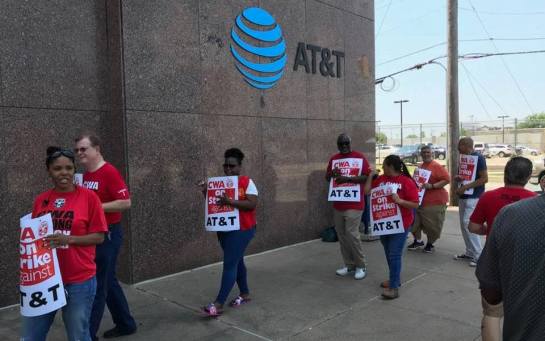
I had to hurry with the Dallas Labor Newsletter today because I didn’t want to miss picketing with Communications Workers Local 6150 over at the AT&T building.

sherron-legacyT

There was a national walkout concerning around 20 unions today, according to CWA 6150 President Scott Wilson. Here in Dallas, workers expected to stay out only four hours. Wilson was careful to let me know that this was an Unfair Labor Practices (ULP) strike, not an economic strike.

Legally speaking, and unions have to be scrupulously legal under the watchdog eyes of a hostile government, there’s a lot of difference between a ULP and an ordinary strike. One of the main differences is that companies can’t just replace everybody that goes on strike if it’s ULP.

Today’s strike will be examined by the National Labor Relations Board. I imagine that the company will claim that they committed no unfair labor practices, and of course the union already said that they did. According to Scott Wilson, the company started contacting each union member individually to try to convince them to take whatever the company wanted them to take. That’s illegal.

Unions elect their bargaining committees. It’s supervised by the government and done very carefully. Then company representatives and union representatives sit down together and work something out — or that’s the way it’s supposed to work. If the company went around the process and started approaching individual members, that’s illegal. AT&T surely knows that.

The trouble is, they also know that the Labor Board isn’t likely to penalize them much, if at all. Companies are getting more and more aggressive against their workers because the government is so completely and savagely against us this days. The Supreme Court just ruled that employers can take away our right to sue them when they misbehave. The President just passed three anti-union executive orders. Another Supreme Court case, “Janus Versus AFSCME,” may impose anti-union “right to work/scab” rules on all federal employees. We’re holding our breath on that one.

If you think about it for a minute, you realize that an attack on the right to organize is an attack on democracy. Organizing is just about the only way that ordinary people can defend their democratic rights. Take that away and you have fascism.

Hitler knew that. That’s why one of his earliest moves was to outlaw all unions and seize their assets.

There’s a solution

The solution for saving the right to organize lies in solidarity with one another. In the last couple of decades, unions have gotten better and better about helping other progressive organizations and individuals. Take for example the environmentalists who picketed Exxon/Mobil last week. Three of us local union members spoke at it, and then, best of all, we heard from one of Exxon’s victims in — believe it or not — Australia! I recorded the Australian oil worker’s comments on Facebook, and it’s had 1,400 views so far.

But other progressive organizations do not ordinarily rally to help unions. At the CWA 6201 picket today, only union members were there. In fact, I was the only one who wasn’t a member of that local. Part of the problem is that unions haven’t learned to ask for help, but part of it is sectarianism and anti-worker sentiment on the part of some other activists.

When we get together, we will win.

–Gene Lantz

I’m on KNON radio FM 89.3 in Dallas every Saturday at 9AM central time. Podcasts are available on the “events” tab. If you are curious about what I really think, check out my personal web site.

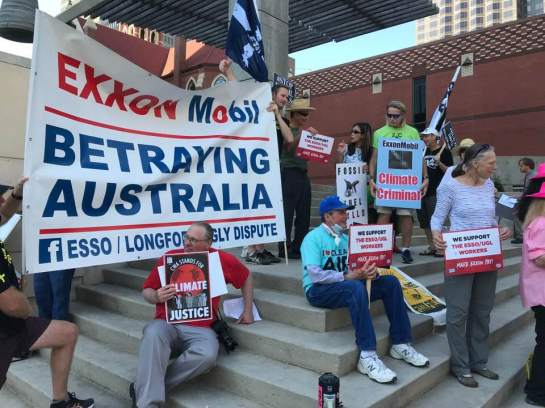
About 25 people from all over Texas and three guys from Australia protested Exxon/Mobil’s shareholder meeting in Dallas on May 30.

exxon-australia

The sometime biggest, and sometime second biggest, corporation in the world has its headquarters right outside Dallas. They hold their annual shareholders’ meetings in the luxurious Meyerson Symphony Hall downtown. Across the street, labor and environmental activists revealed corporate crimes to newspersons and the world at large.

The surprise group came from Victoria’s Gippsland Basin, Australia, where Exxon has 23 offshore installations. Their spokesperson, Troy Carter, spoke on Facebook Live for seven minutes. He said that 230 members of the Australian Workers Union and the Electrical Trades Union were terminated 343 days earlier. The next day, they were offered their jobs with a 40% pay cut! They have been protesting every day since.

The Australian’s printed materials were meant to explain to Exxon stockholders that the corporation was spending a lot more on union busting than it would have cost them to keep their well-trained workforce. But the corporation would not let them into the symphony hall; consequently they had to disseminate their message broadly.

In the United States, the Australian’s tour is being helped by the United Steelworkers of America. The Australians plan to meet with Dallas AFL-CIO leader Mark York before heading to Austin to talk with Texas AFL-CIO leaders. Their Texas tour will end in Houston, where there are many petrochemical workers.

Speakers talked about the danger to our planet from fossil fuels. A woman from Corpus Christi, on the Texas coast, said that her organization was trying to stop Exxon from building the biggest plastics factory in the world. “Do you want more plastic in your oceans?” “Do you want more plastic in your air?” “Do you want more plastic in your bodies?” she asked.

A man from Waco, in Central Texas, talked about special environmental problems caused by Exxon in his hometown.

Herb Keener of Communications Workers 6215 and Gene Lantz of United Auto Workers Local 848 spoke for the “blue” section of the “blue/green” (labor/environmental) alliance. Keener’s talk was captured on Facebook Live. He mentioned that he expected Exxon to follow other major corporations in spending their windfall from last December’s giant tax giveaway by purchasing their own stock. These financial maneuvers enrich stockholders without any benefit to employees nor to the general economy.

The protest had a long list of sponsors: 350 Dallas, Society of Native Nations, Dallas Peace and Justice Center, CodePink Dallas, Communications Workers of America/CWA Local 6215, Dallas Sierra Club, Downwinders At Risk, Dallas Palestine Coalition, Pax Christi Dallas, Our Revolution North Texas, Texas Drought Project, Texas Environmental Justice Advocacy Services (TEJAS), Solidarity Texas – Dallas Chapter, System Change Not Climate Change, Veterans For Peace North Texas, Waco Friends of Peace and Climate, Texas Coalition for Environmental Awareness, and more.

-Gene Lantz

I’m still on KNON radio 89.3 FM in Dallas at 9 AM Central Time every Saturday. Podcasts are available from the “events” tab on the site. If you are curious about what I really think, check out my personal web site.

The Supreme Court pro-corporation, anti-worker, decision on May 21, 2018, was a giant step toward fascism. The nastiest five judges ruled that employers may force all employees (that’s almost all of us) to abide by their orders without recourse to the courts or to class action lawsuits.

The bosses call it “mandatory arbitration,” but Ruth Bader Ginsburg, speaking for the dissenting four judges, called it “egregiously wrong.”  In almost all aspects of American life, a citizen has the right to sue to enforce laws, but not any more.

Ruth Bader Ginsburg

The days of big class-action lawsuits to enforce civil rights or civil liberties laws in the workplace are gone. Every individual with a grievance will now be forced to face the corporate lawyers alone and in a corporate-dominated arbitration procedure! Shortchanged by your boss? Ripped off by your boss? Sexually harassed by your boss? Racially persecuted by your boss? Tough luck!

Individual workers’ grievances rarely amount to enough money to make it worth a lawyer’s time; consequently, few workers will even be able to find a lawyer. Something similar happened in Texas when workers’ comp cases in Texas were put under mandatory arbitration  — injured workers couldn’t get legal representation!

What Will Happen?

A lot of big employers have already persecuted their employees with these arrangements. Now, nearly all of them will. Workers will have a choice: sign your rights away or forget about this job!

If working conditions are poor in America today, expect them to get worse. If bosses flout the law today, expect them to flout it more.

If right is right, a lot more working people are going to investigate unionizing. Union workers usually solve their grievances under arbitration, too, but the system is set up under rigorous labor laws, and the union can still appeal to the courts.

Whether or not a big increase in union organizing really happens depends partly on whether or not workers realize the full extent of their most recent screwing. That means that we are going to have to make a robust organizing effort, and that will be difficult after the pounding our unions have taken since 1980.

The Supreme Court’s next big labor decision, in the hands of the same guys, may be a major attack on union finances. That would make a major national organizing effort even more difficult.

But organizing is exactly what has to be done. Everyone who can feel the hot breath of fascism drawing near needs to rally around the working class. Those who can form unions must form them. Those who cannot form unions must join constituency or auxiliary groups associated with labor. If that happens, and it is what must happen, then we cannot be defeated.

–Gene Lantz

I’m on KNON radio 89.3FM in North Texas every Saturday at 9 AM Central Time. Podcasts can be found under the “events” tab on the web site. If you want to know what I really think, check out my personal web site.