Archive

politics

The New York Times published a long liberal’s lament on the situation in France:

SundayReview | OP-ED COLUMNIST

France in the End of Days

Marine Le Pen’s road to victory is clear enough.
Can a pragmatist stop the extreme right?

Germans embraced the Nazis, not because they were tired of freedom, but because they believed they had found a cure for capitalism.

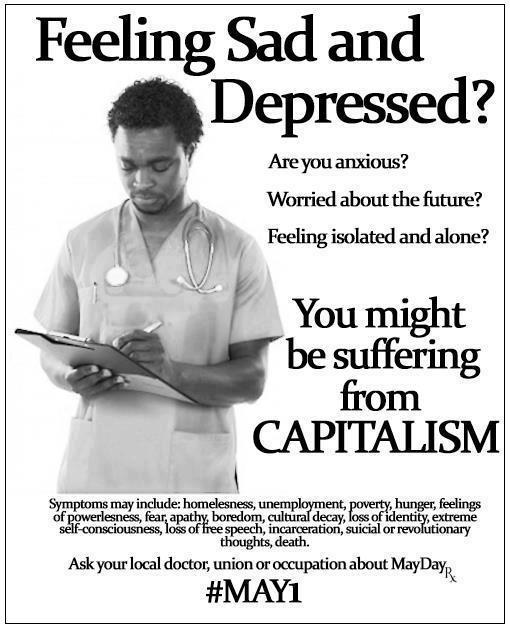
doctorposter-capitalism

From the time it began to take over the world, mid 17th century, until the late 19th century, capitalism provided a better life for its subjects. That is, it was better than serfdom. Serfs were landless farm workers, one step above slaves, who had to take whatever their lords dished out. “Free” labor could leave one employer for another and, to some extent, dicker over conditions of employment.

Capitalism Works Best With Limited Democracy

If workers believe they have a voice in government, they don’t have to be guarded, guided, and pushed to do everything. They don’t run away or deliberately smash the equipment, the way slaves or serfs might. They can be educated for the higher forms of labor that capitalism needs. Consequently, the more successful capitalist economic systems use a limited democracy form of government.

From the beginning of the Republic until after World War II, American struggles made good improvements in our democracy.

What Went Wrong, When Did It Go Wrong?

Capitalism stopped benefiting workers after it conquered the world. When there were no new markets, the capitalists had to turn against one another to fight for the markets they had already saturated. That’s not what they called it. They called it “The war to save democracy,” and “The war to end all wars.”

But WW I was really a bloody turf war between gangsters. For a short period, the winners enjoyed their spoils, but it didn’t last very long because  the basic problem of saturated markets and international competition was still there.

So, they decided to have another world war. This one was complicated for workers, because the Soviet Union, try as they might, couldn’t stay out of it. After they began to fight the invading Nazis, they were incorporated into the same side the United States was on. The U.S. ended the alliance as soon as the Nazis were defeated, of course.

No More World Wars

After the U.S. nuked Japan, actually, after the Soviets and other nations showed that they could do the same thing, world wars lost their appeal as a temporary solution to the capitalist crisis. Even the gangster capitalists weren’t crazy enough to blow up their only planet. So, since the late 1970s, capitalist nations have gotten by on small regional wars, lowering their production costs by attacking their workers, and carrying a whole lot of debt. I recently read, in an investment newsletter, that all growth in the United States since 1980 basically came from debt!

Did the Nazis Solve the Capitalist Crisis?

To Germans between, say, 1933 and 1939, it appeared that fascism was the right way to go. Unemployment dived from 25% into low numbers. Lots of infrastructure was rebuilt. National pride was soaring.

But they had only changed their form of government from limited democracy to fascism, they hadn’t changed their economic system. It was still capitalist and it was still in crisis. The only real way toward a temporary solution was war. Even then, as long as they were winning, fascism still seemed pretty good to the Germans. After that, not so much.

What Looks Good to You Right Now?

To a lot of Americans, the Trump Administration and Republican political domination look pretty good. They think there will be more and better jobs. They think they’ll be making a better living and that the steady abatement of basic democracy isn’t too high a price to pay.

But we are still living in an economic system that has provided all the good it is going to provide, and things are only going to get worse if we can’t save and expand our democracy.


I recently wrote down a decent political program, but how could it be implemented?

flowchartcartoon

The Trick Is to Know What You Want

If a political program is to be implemented, its supporters have to be clear on it and keep it fresh in mind. That’s why the one I wrote is so brief.

Everyone has a certain amount of resources and a certain number of opportunities. Nearly all of us are short of money and time, but we usually have some of one or the other. But we have to pick and choose, carefully, which opportunities we will pursue with our limited resources. Some of them move us closer to the ultimate goal of the political program, and others not so much.

All Strategies and Tactics are Good

The catch is that strategies and tactics are only good in their proper place and time. A mass rally might be the best thing for a May Day activity, or a general strike might be. A letter writing campaign might be good in some situations, but probably not for May Day. It’s all good, but only when it fits the situation!

Can You Trust the Leadership?

Nowadays, new “leaders” are under every rock in the garden. We’re being pulled every whichaway by this or that organization or cause. As I explained in another blog, I tend to follow the AFL-CIO organized labor federation because, whether they are right or wrong, they are always working class and a united working class is the only long-term solution. Also, I’ve been working with these guys for a long long time, so I know their abilities, their intentions, and their shortcomings.

Whose Ax? Whose Ox?

Nearly all organizations and all their activities have short term goals. Some of those short-term goals advance a decent long term political program, but not all of them, and some always more than others. What they do depends on whose ax is being ground, and whose ox has been gored. Even some of our greatest leaders have to be viewed with a certain skepticism.

Take Bernie Sanders, for example. Senator Sanders is probably the most widely respected progressive leader in the United states today, and one would have to go back several years to find someone as deserving of respect. His book from September 2016, which I reviewed, has a wonderful list of things that need to be accomplished. And yet, they consist in their entirety of reforms which, if won, could still be taken away in another period.

None of Our Gains, So Far, Have Been Permanent

There are not and will not be any permanent gains for working people as long as our bosses run the system. Everything we can win — civil rights, voting rights, pay raises — can be taken away by the bosses, and will be taken away whenever they get the chance!

Even the finest organizations such as NAACP and Children’s Defense Fund have limited, temporary, goals. Not that activists shouldn’t support them, but we should support them with the realization that they will only take us a limited distance toward our ultimate goal.

Who and What Shall We Shun?

Are there arenas of political activity that we should avoid? Lots of “radicals” don’t believe in elections. Lots of liberals don’t believe in street actions. Hardly anybody in America believes in general strikes because we don’t know beans about them. Some unionists are always wanting to strike, others are always wanting to cozy up to the bosses. Some people make a fetish of civil disobedience, other people wouldn’t go near it. Some would say that only economics matters, while others would say that art and culture are the only way to make a difference. All of them are wrong.

As I said above, all strategies and tactics are good in the right place and time. The same goes for arenas of struggle. People who eschew elections are non-thinking zealots. People who will never support a strike action are probably cowards or sell-outs. Or, at least, we should admit that, even if we’re not zealous, venal or cowardly, we’re all ignorant.

The test of any opportunity is “How far does it take us toward our ultimate  programmatic goal?

There are no blueprints. We may study previous situations and their heroes until our eyes pop out, and we still won’t know exactly what to do in the next situation. But, if we apply ourselves consciously, study, collaborate with people we respect, stay active and keep our programmatic yardstick handy, we can refine our ability to choose.

That’s an organization plan.


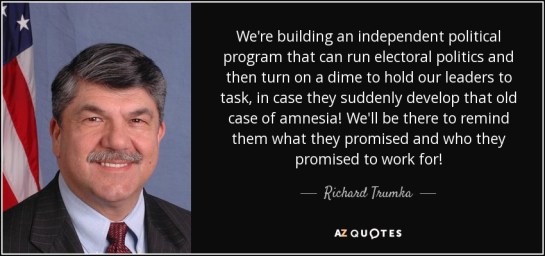
trumka-politicalprogram

In all the struggles of American history, all our victories have been temporary. We need a workers’ political program for permanent change. I’d like to see it come from organized labor, and soon. Instead of vaguely advocating for it, I decided to write down what I would consider the elements of a good program.

Goal of the Party

The goal of a workers’ political party is conclusive victory for workers’ rights and democracy. For members to vary from our goal, even for candidates and office holders, is grounds for expulsion.

Activities

Strategies for achieving our goal begin with a careful analysis of each existing situation. For the last few centuries, the overall worldwide situation has been characterized by domination by the propertied people of the industrialized nations. Peace, even between the major nations, is always uneasy because they are economic competitors.

Who Is With Us?

Against all of the owners and employers are the working class of the world and an undetermined and shifting section of the unstable “in between” class of small businesspersons, professionals, and other “go-betweens” who tend to change allegiances according to which of the two main classes is winning. Members of the Party remain scrupulously aware of who are likely to be supporters and who are likely to be enemies of progress.

All of the non-propertied people are oppressed, but not equally; nor do all of the oppressed have the same resources and capabilities; consequently, strategies are tailored for different groups.

Philosophy

Members of the Party have no time nor taste for fantasies, superstitions, fetishes, and vague feelings. Our activities are guided toward understanding each situation and developing tactics for strengthening our side and undermining the other. We are aware that everything is in constant change. We employ a conscious study of history, but do not consider history an overly strict guideline.

Necessity

The current economic system, while far better than its predecessors, no longer benefits the  people. Instead, it threatens the destruction of our planet.

Democracy

The Party practices internal democracy. Democracy is the only governance that works with volunteers, and it is the absolutely necessary precedent for a victorious new order.

huffingtonarianna

Arianna Huffington, How to Overthrow the Government. Regan Books, New York, 2000

The great columnist eviscerates American politics during the 1999 elections. If one substituted Donald Trump for Pat Buchanan and multiplied all the horrible social statistics by, maybe, ten, you’d come up with the same book that Bernie Sanders wrote in 2016. America has gone to hell because of greedy corporations, unscrupulous politicians, cynical journalists, and for heavens sake why doesn’t everybody vote!

It’s all true, and the fact that Ms Huffington saw it so clearly so far before the 2016 disaster adds even more to her credibility. There’s greatness there!

Donald J Trump, the present president, is in her book because he was active in the 1999 campaign, but he’s all just a joke to her. She said his pronouncements should have had a laugh track (pg 193). Little did we know, in 1999, how much worse things would get by 2017!

However, we would have known if we had read Arianna Huffington’s book then.

So then, How?

Just as I read Bernie Sanders book that was finished in September 2016, I was mostly looking for solutions. Hers and his are about the same: electoral reform and for heavens sake why doesn’t everybody vote! Huffington, unlike Sanders, adds a big dollop of personal charity to her solution. She wants us to join meaningful organizations that build houses, distribute food, and educate children. On the downside, I don’t think she even mentions unions as part of the progressive solution, whereas Bernie takes unionism more seriously.

Huffington’s book ends with 3 pages of bullet items that starts with “Demonstrate at political rallies,” then goes on with a list of charities to join and political reforms to support. We can’t know whether her 1999 suggestions would have worked or not because we didn’t try it. We just let things get worse.

And they will, as long as the people in power remain there.


Facebook has a number of events calling for a general strike on May 1, 2017.

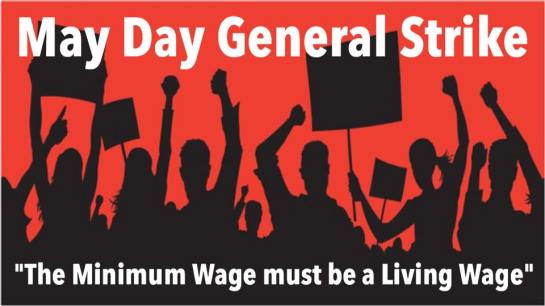
maydaygeneralstrike

I have no idea whether or not it will “succeed,” but it ought to, and, sooner or later, it must!

What Is It?

A general strike, also known as a political strike, is a labor action that is not limited to a single employer. Instead, it takes in a geographic area. The great Seattle general strike shut down Seattle. There was a general strike in Houston 1946, according to the book, “Rainbow at Midnight.” The 1886 strike for the 8-hour day was worldwide.

The idea is to add economic struggle to our usual progressive arsenal of voting, lobbying, and protesting. A general strike asks that we don’t go to work unless our demands are met.

Recently, we saw “A Day Without an Immigrant” and “A Day Without a Woman” show some limited success throughout the United States. It is very hard to assess how many people actually missed work, because they are likely to keep it secret. Also, no clear demands were put forward and it was never clear exactly who was organizing. We do know that a lot of students took the day off and a few small businesses shut down.

In my opinion, both of these operations were worthwhile because, for the first time since 1946, Americans are seriously discussing the idea of nationwide participation in economic struggle. If you read this far, that’s a victory!

What Could Happen?

“A strike is an incipient revolution”

–Big Bill Haywood, head of the Industrial Workers of the World

It is possible to achieve great goals if participation levels are high enough in a political strike. We see successes in Europe from time to time. Brazilians just struck March 17 over cuts in their government pensions. They shut down Sao Paulo!

What Should Happen On May 1, 2017?

“It is not sufficient to fight, comrades, it is also necessary to win!”

–Leon Trotsky, organizer of the Red Army

Pursuing the economic struggle is not only exigent but necessary. Ultimately, the corporations in power have no concern for democracy. They’ve already eroded American democracy considerably and will do their best to destroy it completely. That’s why we have to learn to use economic struggle.

Organizers who want a successful general strike on May 1, 2017, need to come together on demands and strategies. Legislation guaranteeing a national minimum wage of $15/hours would be a good target demand. If Congress should pass such legislation and the President were to sign it into law, the May 1 general strike should be called off. If not, organizers should make certain that employers feel the consequences.

A good strategy would be to organize “flying pickets” on May 1. In advance, sign-making parties could be set up that would help develop and train volunteers. A rendezvous point and some picketing targets could be discussed. On May 1, organizers would gather at the  rendezvous point and send carloads of picketers to selected low-paying enterprises such as fast-food restaurants. The more the better, but even a small turnout at a limited number of targets might have a measurable effect.

What WILL Happen on May 1, 2017?

We’ll see!

Does the progressive movement have its leadership today?

trumkarichardafl

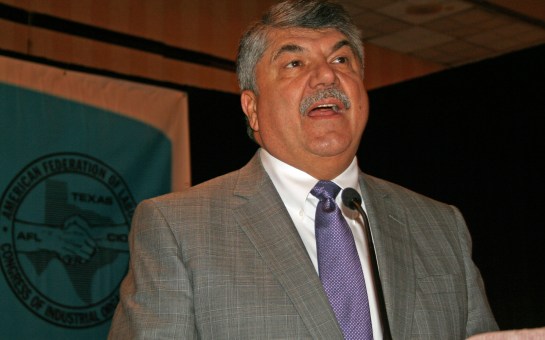
Richard Trumka, President of AFL-CIO

Leadership is everywhere – popping out of our computer screens every time we look! The problem is that they are nearly all self-appointed, untested, and mostly unqualified.

The most popular leaders – Senator Sanders, Senator Warren, Mrs Clinton, etc – all suffer from tunnel vision — a single-minded determination that we will win at the ballot box, while the truth is that democracy keeps shifting away like sand in an hourglass.

Not that elections aren’t critical – but they’re not the only form of struggle. The best leadership available today is the American Federation of Labor/Congress of Industrial Organizations, the AFL-CIO.

Not That Labor Leadership Is Perfect

What we really need is a mass workers’ political party beholden only to working families. We don’t have one, and I don’t see one on the immediate horizon. But when it does come, it is most likely to come out of the AFL-CIO.

Here are some of the positive arguments for AFL-CIO leadership of the progressive movement:

  1. Unions have more money than all the tiny little organizations that are begging for contributions every day.
  2. They have physical buildings, meeting places that are long-established in communities. Here where I live, nearly all the progressive groups try to get into the Communications’ Workers Hall, and the AFL-CIO encourages them.
  3. Say what you might against the better-paid union members, they are solidly working class. If you think about it, most of the progressive groups vying for leadership are actually led by preachers and professionals – people in the ideologically uncertain “in between” class.
  4. While the AFL-CIO works hard on elections, they also work hard year-round on lobbying, organizing workers, participating in protests, economic struggle, and organizing mass demonstrations
  5. Since the leadership turnover of 1995, AFL-CIO leadership has affirmatively tried to end its old policy of isolation. For example, they no longer call for deportation of all undocumented immigrants – they call for organizing them. They have active Constituency Groups trying to organize working people as interest groups such as women, Latinos, gays, etc. Some of the better labor leaders are also coming out strong for public presence and improved communications. They also established Working America to incorporate, politically, all American workers whether or not they work under union contracts.
  6. Many unions maintain a relationship with their vast numbers of retirees and, consequently, greatly increase the union’s political clout. Non-union retirees, like non-union workers, are pretty much on their own, and largely helpless, as political entities.
  7. Increasingly, unions are partnering across national lines. It’s not there yet, but it’s on its way to becoming a world movement.
  8. The basic idea of unionization is cooperation of all workers in a workplace, consequently today’s unions tend to be anti-racist, anti-sexist etc. Women in unions, for example, have already largely achieved the American dream of equal pay for equal work.

OK, There’s a Downside

The reasons that union movement leadership isn’t as good as a mass Workers Party could also be listed:

  1. Individual unions, which make up the AFL-CIO and provide its revenue, are defensive organizations with one dominating purpose – to defend their members against their particular employer. Broader social concerns aren’t the main business of union locals nor of their national leaderships. This constraint has less of an influence on labor’s federation, the AFL-CIO, but it is fundamental to understanding the union movement.
  2. As mentioned above, union members tend to make more money than non-union members; consequently, they don’t share exactly the same viewpoints. While many workers dream of making $15/hour someday, some union members are already making $35!
  3. Union contracts are based on seniority. That means that older longer-term workers tend to displace the younger workers. There is almost no other way to keep bosses from applying work rules unfairly, so seniority rules in union contracts. The aging of the union membership is a harmful consequence. “Who has the youth has the future,” goes the saying, and some of America’s unions try hard to cultivate younger leaders, but seniority keeps pushing them out the door!
  4. While the unions fight hard against losing jobs to outsourcing, they have virtually no defense against losing jobs to automation. This was not always true – the CIO (pre-1955) always fought for shorter working hours – but it seems to be true now. The reason may be that workers, including union workers, are also consumers. As consumers, they are debt-ridden and addicted to overtime pay. They may be averse to discussing shorter working hours as a social solution.
  5. To someone outside the unions, it may seem strange, but some union leaders tend to want to keep things the way they are rather than embrace change. The reason, believe it or not, is fundamental democracy within the labor movement! The present corps of union leaders were democratically elected by their members just the way things are. Any change, especially change that involves mobilizing the membership, is change that will “rock the boat” before the next union elections. If the membership undergoes change, how will the next union elections turn out? This has to be on the minds of local union and national union leaders, but is less of a problem for the AFL-CIO federation.
  6. The AFL-CIO, I think intentionally, has no real sense of history. Without an honest history, they tend to ask people to believe the self-serving union histories that exist. In those histories, all labor leaders of the past were heroes who never actually made a mistake.
  7. Unions aren’t intentionally revolutionary. Their revolutionary potential comes from their consistent advocacy for workers’ rights. The AFL-CIO’s anti-capitalism doesn’t come by intentional design, but from the nature of things. Bosses continually accuse union organizers of trying to destroy their own workplaces, but it isn’t true. Unions simply want a better deal for workers within existing workplaces, not a revolutionary overturn. The union struggle, then, might be seen as eternal, with unions always fighting bosses and always wanting to win in the immediate sense, but never wanting a decisive victory.

Summing Up: Stick With the Unions!

AFL-CIO leadership is today the best option for the progressive movement. An actual Workers Party that seeks power would be better, but a true mass Workers Party is more likely to come out of the AFL-CIO than from the imaginations of radical activists, the Democratic Party, or anywhere else. Consequently, those of us seeking progressive leadership should look to join a union, organize a union, join Working America, and/or, at the least, consult with the AFL-CIO for leadership in the progressive movement.

In our lifetimes, we have never seen the American people as ready to fight as they are right now. Case in point: the January 21st demonstrations put more protesters on the streets than ever in American history.

wom-012117 (4)

Is It Enough?

At the same time that our potential strength is growing, the challenges are growing, too. The far right, the dark money people, the Koch brothers, all of the worst of America’s ruling rich, are far stronger than ever. They were bad enough when they were just the crazies in the John Birch society  the Tea Party and Ku Klux Klan, but now they hold state power!

Does it seem likely that these merciless and unscrupulous power mongers are going to be “touched” by our sentiments? Will they have a “change of heart” after they hear our arguments at Town Hall meetings? Does anyone think they will give up state power just because people carried signs?

What About the Next Elections?

If everything were the way it used to be, or the way it usually is, the Democrats could expect to win big in the 2018 mid-term elections. There is a lot of enthusiasm for fighting the Republicans, thanks to the Republicans. Also, the party in power normally loses in mid-term elections. A lot of our leaders, thinking things are the way they used to be, or the way things usually are, are focusing entirely on the next elections. We’ll warm up in the local elections that occur between now and then, and then we’ll be “really ready” in November, 2018.

American Democracy Is On the Wane

We should fight in the local elections at hand. We should get ready for the 2018 mid-terms. We should continue building giant protests. We shouldn’t concede anything. But is it enough? Even if we think it’s enough, can we be sure?

Consider that the level of democracy that we enjoyed just a few years ago is being eroded away. When Bill Clinton was President, for example, we thought our voting rights were secure. Not only that,  we more or less expected to continue expanding American democracy just as we had more or less consistently since 1776. We’ve seen big money take over our elections with the blessings of the Supreme Court. We’ve seen a President appointed by the same court. We’ve seen the near-sacred Voting Rights Act gutted. We’ve seen unfair redistricting and myriad voter suppression laws become common. Just recently!

Maybe we have enough democracy left to assert ourselves in 2018 and put America back on the path to freedom. I hope so, but I’d like to have something stronger just to make sure.

What Else Is There?

Here in the United States, we know almost nothing about the kinds of economic struggles that are common in other parts of the world. The only truly successful economic boycott we know of was the United Farm Workers’ fight against grape growers. We’ve never seen a successful political strike in our lifetimes. Union organization has almost stopped completely in America due to the combined hostility of bosses and governments.

Those are the things we have to learn if we want to win.

Did You Shift To the Right?

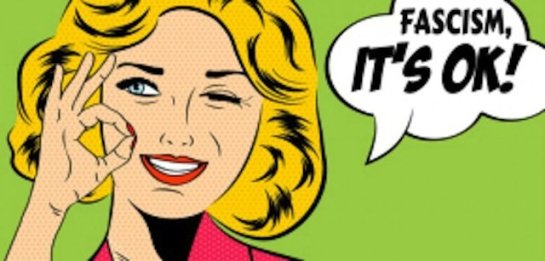
Fascist_OK

The reactionary candidate in the Dutch elections didn’t do as well as predicted. Maybe the fascists won’t win in France, either, but Donald Trump will still be President of the United States and the talking heads of the news will still be saying that there’s a “shift to the right”

They don’t say that somebody else shifted to the right, they say that the electorate did. We’re the electorate, so they mean us. Did you shift to the right? I doubt it.

In fact, a “shift to the right” by the electorate is not what is happening at all. If the electorate were becoming more reactionary, we wouldn’t have seen the liberal election results on marijuana and minimum wage. What we’re seeing is something else.

What Are We Seeing?

We are seeing a shift in tactics by the rich.

Throughout written history, the more-or-less propertyless have fought against the propertied for basic sustenance, for rights, and for freedom. We have done pretty well for ourselves, especially under capitalism. Once workers freed themselves from slavery and serfdom, we went on to get better living conditions, a little bit of dignity for workers, and limited democracy.

Limited Democracy?

We’ve always fought for more democracy, more control over our lives, and in generally we’ve been winning. Winning at least until lately. American workers did particularly well during the golden days from the end of World War II to the late 1970s. That’s when American industry completely dominated the world. We got rid of all-white primaries, poll taxes, English-only ballots, fake literacy tests for Black voters, prohibitions on voting for 18-year-olds, and we made other great accomplishments during that period. But our democracy was always limited.

We never won the right to vote on wars, on plant closures, on layoffs, on hiring policies, and lots of other things that are exclusively done by the propertied class. Only recently, most of us realized that we’ve never had the right to vote on Federal Reserve officers. So our democracy has grown, but it was always limited.

After 1982, when the government started coming down on our right to unionize, our democracy began to erode. When the Supreme Court opened our election process to unlimited financial intervention, when they gutted the Voting Rights Act, and when unfair redistricting and voter suppression laws became common, we began to realize that the long-term trend toward more democracy was being reversed.

Why The Reverse in Democracy?

Around 1980, the propertied class changed their tactics. Instead of kidding us along with limited democracy, they decided on an all-out war against our rights. What changed for them was international competition. The United States no longer had the only functioning factories in the world and had to compete with countries who could make better products cheaper. The squeeze was on.

One can validate this with any account of inequality. From 1945 to the late 1970s, American workers constantly improved our lot. After that, it’s been downhill economically. One good book about it is “Runaway Inequality” by Les Leopold. Leopold shows what happened, but he is a little skimpy on “why” and “what the heck do we do about it?”

The owning class changed their tactics, and we have to fight them! That’s the why and what.