I’m about to celebrate 50 years in the progressive movement.

When I began, we still had Ku Klux Klan trying to attack our activities. We had federal agents around all the time. Some of our own people were the most dangerous of all.
I’m about to celebrate 50 years in the progressive movement.

When I began, we still had Ku Klux Klan trying to attack our activities. We had federal agents around all the time. Some of our own people were the most dangerous of all.
Bernie Sanders, “Our Revolution—A Future to Believe In.” St Martin’s Press ebook, September 26, 2016. Available from Amazon Books and on Kindle

This must-read book details two important political contributions:
The account of the campaign answers the question about how they managed to get so far toward the Democratic Party nomination when they started with virtually nothing and refused to sell out to big contributors. Most of America and even Bernie seem to be surprised at how well people responded to a truthful, direct, approach to America’s actual needs. It’s an inspiring story that needs to be studied.
Part Two, “An Agenda for a New America: How We Transform Our Country” details the problems we face and proposes practical solutions in the form of legislation needed. In many cases, Bernie Sanders had already proposed proper legislation in Congress. In general, his proposals are designed to:
The big problem with Bernie’s wonderful book is the last line, “September 26, 2016.” He completed the book before Donald Trump’s upset victory for the presidency and before Republicans completed their take-over of all three branches of the federal government plus the majority of state governments.
So what do you do with wonderful proposals for legislation when progressive legislation has almost no possibility of passage? What do you do with an inspirational story of a hopeful electoral campaign when our foundation of democracy is crumbling?
Apparently, Bernie thought, on September 26, 2016, what most Americans thought – that the Democrats would have a big victory on November 8. The glaring fact that they didn’t, and the anti-democratic trends already underway, put new perspective on politics in 2017. Bernie’s thoughts of September 2016 are certainly good to know, and actually kind of miraculous to behold, but not much actual use, are they?
We’re going to have to do some thinking of our own.
Rather than leave off on such a negative note, let me make a couple of general proposals that might be helpful in 2017
We must be grateful to Bernie Sanders and others who have taught us so much. A great future awaits!
–Gene Lantz
Hear “Workers Beat” on KNON radio, 89.3FM and knon.org every Saturday at 9 CST
Click here if you want to know what I really think
We can hang together or separately, as the saying goes.

We must, indeed, all hang together, or assuredly we shall all hang separately!
Almost everybody I’ve talked to wants to “do something” right away as concerns the anti-worker government anticipated for January 20, 2017. For several nights after the election results were announced, thousands protested in the streets of several cities, including mine. As far as I could find out, they had a lot of enthusiasm but no program, no structure, and no strategy.
A month and a half later, we still don’t.
I’ve been asking around about inauguration weekend. So far, it sounds like there will be three rallies, one march, some people going off to the state capital and others going to the national capital. There are probably several more activities being cooked up.
The problem is that there is no coordination among them. As far as I’ve been able to find out, each of them is sponsored by one separate group of people and has demands created by and for solely that group.
As far as I know, the progressive movement in my town (Dallas) has always been divided this way and that. Every naive young innocent who ever got involved has said, “We’ve got to get together!” And of course it’s true, but I’ve never seen anybody do it.
The book I’ve been promoting, “Runaway Inequality” talks about “silos” and says that all the progressive groups are in their own silos. The solution, says author Les Leopold, is that we have to come out of our silos and start working together. He doesn’t say why we’re in those silos to begin with, nor how to get out.
The basic reason for the silos is funding. Nearly all “progressive” organizations have to raise money. In that sense, they are competitors for the almighty dollar, not partners in any real sense. No matter what high-minded reasons people may have had for creating an organization, their main purpose in life soon becomes raising enough money to pay staff salaries, not whatever they originally intended to accomplish. In a very real sense, they are exactly like churches, most of whom seem to have lost their sense of purpose centuries ago, and they have to raise money or die! How do you change that?
You have to appeal to individuals. Bernie Sanders showed us that it can be done and how to do it.
The main problem with “knee jerk” activism is that it doesn’t go anywhere. Witness the Occupy movement that had thousands of charged-up protesters. They had no program, in fact they deliberately avoided having a program. As a result, they left nothing behind but some really good slogans and memories. But there’s another, very serious, reason to be cautious about spontaneous street actions.
Leftists may not continue to own the streets in America. Remember, that the progressives in Germany tried to take on the better-organized, more unscrupulous, and better financed Storm Troopers in the streets, but it didn’t work out well for them!
In our lifetimes, leftists and leftist causes pretty much ruled the streets. The fascists have stayed inside the corporate boardrooms and left picketing, street rallies, and marches to the riff-raff (us). But Mr Trump regularly puts together rallies of tens of thousands of hotheads today, and he has already shown that he’s willing to encourage violence against any detractor!
I’m not saying we shouldn’t rule the streets. But we aren’t in the same situation we were in before November 8, 2016. It’s different now.
Progressive people who want to survive and thrive during the Trump Administration need serious strategies for coordinated activity. My proposal is a series of “teach ins,” conference calls, and, possibly, “retreats” to work on programs and to coordinate activities. At the very least, we could set up a “clearing house” function so that different groups would know what the others were planning.
Labor, as the most responsible and most consistently progressive part of the left, needs to center itself in this process.
Everybody going their own whichaway isn’t affordable any more.
–Gene Lantz
Hear “Workers Beat” on KNON radio, 89.3FM and knon.org every Saturday at 9 CST
Click here if you want to know what I really think
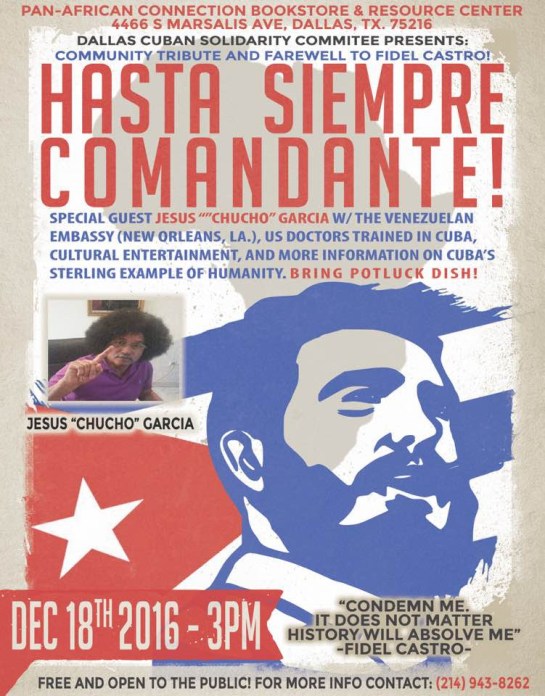
Today I am supposed to get a chance to say a few words at a memorial for Fidel Castro.

I probably won’t say a lot about his great courage, his internationalism, or his fine intellect, because there are other speakers and I’m sure they will cover that. Instead, I will try to stress what we should have learned from Fidel’s victories and defeats.
At the same time, I might mention a number of other victories and defeats we are aware of, such as the Obama election victory, the Bernie Sanders election defeat, America’s Equal Rights Amendment, the People’s Party of Texas in 1896, or the 8-hour day movement.
The main thing that separates the victories from the defeats is not intellect, and it’s not courage. It’s the approach to strategic decisions.
In Fidel’s victories, and in every victory, strategy began with a correct assessment of the situation at hand. The Fidelistas correctly decided that Cubans were ready to get rid of the Batista dictatorship and that they would support armed struggle. He figured out that the international community would generally favor his effort and that the Eisenhower Administration would not immediately intervene. I’m sure they had a much more detailed and thought-out assessment. If their assessments had been wrong, most of us would have never heard of Fidel Castro or socialism in Cuba.
If we’re trying to figure out the best way forward in the United States in December, 2016, and I hope we are all working on that, we need to start with a correct assessment. Trying to copy Castro in 1959 would be a disastrous mistake. Trying to copy any strategic decisions in any other situations would likewise be disastrous.
We have to do what the Cubans did. We have to figure out our situation and then determine the way forward.
–Gene Lantz
Listen to “Workers Beat” at 9 CST every Saturday morning on 89.3FM and http://knon.org
If you want to know what I really think, look at my life’s lessons site
I urge all progressives to fight reactionaries on every front, but the main one is going to be the battle to save basic democracy in America.

Economist Josh Bivens has a good summary of expected Trump policies on line. It doesn’t look good.
Mr. Hitler made immediate improvements in the German economy by massive infrastructure programs and by going to war. Will Mr Trump be able to do the same?
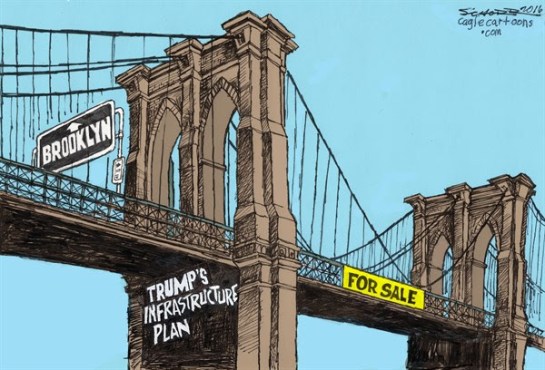
The U.S. Congress has blocked infrastructure programs all the way through the Obama Administration, even though they would have greatly shortened the long recession. It is unlikely that they would allow Mr Trump to implement anything good along those lines, because their main commitment is to the barons of finance, not construction businesses and certainly not to the American workers. Actually, I’d love to be proven wrong on this.
Mr Hitler had tremendous early successes in his war-making, but that was largely because the Great Powers did nothing to rein him in. They thought he would put an end to communism before he struck at any major capitalist countries. It is doubtful that Mr Trump will be able to use war to improve the American economy in any meaningful sense, and it is unlikely that he will receive cooperation from the other major capitalist countries in whatever adventures he undertakes.
The world wars that resulted from the economic crises of the 20th century are not considered available as a “solution” to economic and political crisis today, because of the imminent destruction of the planet.
Capitalist economies have always suffered from phases of “ups” and “downs.” “Down” is already overdue after the long recovery during the Obama Administration. The current expectation of new “tight money” policies, combined with Mr Trump’s new tax cuts for the rich and deregulation policies will create an immediate and painful crisis for working people.
If one assumes that our American levels of partial democracy continue, it is unlikely that the party in power will fare well in 2018. In fact, the party in power usually does very poorly in mid-term elections.
None of this is a secret, neither to progressives nor to reactionaries.
Since around 1980, American democracy has already taken hard knocks at the hands of Republicans. Unions were assailed in every imaginable way. The Voting Rights Act was gutted, big money was sanctified by the Supreme Court, Republican redistricting largely overcame the popular vote, and voter suppression schemes were put into effect all over the nation.
The Obama Administration fought to maintain democracy, but does anyone think the Trump Administration will? If Mr Trump were to make outlandish anti-democratic Executive Orders, for example, who in government would oppose him? Not the legislative branch that is already in the hands of Republicans, and not the judiciary which will return to a reactionary anti-worker majority as soon as Mr Trump makes his first appointment.
Mr Hitler, it is often pointed out, won an election without winning the popular vote. How did he stay in power? How will today’s reactionaries try to stay in power?
Get ready to organize and fight!
–Gene Lantz
Listen to “Workers Beat” at 9 CST every Saturday morning on 89.3FM and http://knon.org
If you want to know what I really think, look at my life’s lessons site
Progressives need a program, guidelines, to go forward. One element needed is acknowledgement of history, not only all the bad things that have happened and all the bad situations we face today, but also the positive developments.
We can build on the good things that happened and are happening. There are lots of them. Just yesterday’s Dallas newspaper, for example, included an article announcing that the Texas African American History Memorial had gone up on the Texas Capitol grounds.
Many of us, especially me, have been complaining for decades about the Confederate monuments in and around the Capitol. Yesterday’s new monument is a partial response and a very positive development.
Also in yesterday’s paper, and again in today’s, the Texas Railroad Commission is taken to task for being a superficial front for the oil industry. They’ve been denying that the recent upsurge in earthquakes are associated with oil industry shenanigans. It’s great to see somebody point out corruption, but it’s even better to see a major newspaper that has some regard for the truth!
Most of the “Programs For Action” I’ve seen from individuals and organizations are all negative. It’s certainly fair to point out that we are facing the possibility of fascism in America and that chauvinism has leaped forward. It’s honest to complain about poverty levels and inequality and unfairness. But it’s not a good way to approach writing a useful program of action if it doesn’t acknowledge the progress we’ve made since our days of savagery and slavery.
The recent changes in the American labor movement shouldn’t be ignored. Since 1995, the top leaders of the AFL-CIO have been adjusting their overall program to suit the demands that used to be made only by progressive fringe groups. A good example is Jobs with Justice, which started out in 1987 as virtually an outlaw organization with support from only 5 big unions. Today, it works hand-in-hand with all labor leaders. I wrote a short history of the North Texas Chapter.
In the longer sense, thinking people and organizations are rightfully down on capitalism. It’s terrible in the way it creates poverty, divides people, starts wars, lies, cheats, steals, and generally oppresses us. But it’s completely wrong to ignore its historical value. Capitalism freed the slaves! It organized the workers! It’s productive power was far superior to any of the other economic systems that it replaced. One might even argue that capitalism has been more productive, even, than any of the attempts at planned economy so far!
I’m 100% in favor of a program for progressive change and I intend to continue writing about it. Certainly such a program should point out the many shortcomings of today’s society and the need for decisive action. But our history and our present situation aren’t all bad. There’s a lot of progress to build on!
–Gene Lantz
Listen to “Workers Beat” at 9 CST every Saturday morning on 89.3FM and http://knon.org
If you want to know what I really think, look at my life’s lessons site
Reconstruction Was a Horror in Texas!
It’s amazing how one can see the roots of today’s problems in this important period of U.S. history. I’m writing this on Nov 14, 2016; the same day that Ed Sills of the Texas AFL-CIO wrote that two Texas Legislators have decided that “states rights” still supersedes national law. They have filed two companion bills, SB 89 and SJR 7, by Sen. Bob Hall, R-Canton, that would provide for nullification of federal laws that Texas deems to violate the Constitution. HB 74 by Rep. Dan Flynn, R-Van, is in a similar vein. By their thinking, the Emancipation Proclamation never took effect in Texas because the Texas Legislature didn’t want it!

When I first began to study and ask questions about Texas during the Reconstruction Period, I received the impression that all went rather smoothly. Texans accepted the federal troops, freed the slaves, and continued with their business, I was told.
The following book has some of the facts:
Richter, William L., Overreached on All Sides. The Freedman’s Bureau Administration in Texas 1865-1868. Texas A&M Univ Press, College station, 1991. For forty months, the Freedman’s Bureau attempted to enforce the ideals of political liberty, and, to a lesser extent, economic liberty for African Americans in Texas. This book details their failure to stop lynchings, continued slavery, torture, rape, robbery, and illegal exploitation. The victorious North lacked both the material resources and the commitment to carry out these ideals.
Texans resisted mightily. For those seeking to document the racist atrocities perpetrated by white Texans during Reconstruction rather than believe the glossed-over histories we are usually offered, there are plenty of descriptions here. In fact, there is more blood than ink on these pages. Blacks and their grossly outnumbered white supporters were vilified, terrified, driven out, and murdered throughout the book while the tiny force of reconstructionists hurried from one part of the state to another seeking justice.
Northeast Texas was particularly bad.
But the book also contains many stories of men who made a great effort to bring justice to Texas. Their failure does not diminish their commitment nor valor.
Book Review
Foner, Eric, “Reconstruction, America’s Unfinished Revolution: 1863-1877” History Book Club by arrangement with HarperCollins Publishers, New York, 1988
What most of us were told about reconstruction is that it was a failure and the fault was on the former slaves, who “just weren’t sophisticated enough to make their own way and handle all the gifts they were given.” It’s an ugly view.
This author, on the other hand, talks about the real problems. He especially points to the role that the freedmen played in trying to win their own equality. In spite of criminal acts against them, including numerous mass murders, they managed to accomplish some things, and they laid the groundwork for the future civil rights gains.
Even though the author joins the chorus in branding American Reconstruction a failure, he points out that we did better than any other country that had emancipated its slaves, in that we granted them citizenship fairly soon. Also, he puts the main blame for failure on the economic crisis of the 1870s.
Even though the author doesn’t point it out, one can see how the Republican party evolved from one advocating “free labor” capitalism to one favoring big corporations and caring very little for anybody’s rights – all in a short space of time during the industrialization that followed the Civil War.
I was a little disappointed that there was so little about Texas, and nothing about Dallas. I had read elsewhere that the appointed head of the Freedman’s Bureau in Dallas never made it to the city, but was murdered somewhere in East Texas while en route! About Reconstruction in Dallas, almost nothing is known. See Wikipedia — https://en.wikipedia.org/wiki/History_of_Dallas_(1856%E2%80%9373)
Pg 17: Texas “The (Republican) party’s Southern governors would include Edmund J Davis, who during the war raised the First Texas Cavalry for the Union Army…”
63 Texas “Jean-Charles Houzeau, one of the most remarkable men to take part in the saga of Reconstruction…” revolutionary. Journalist and astronomer who emigrated to Texas in 1858, sided with Unionists there early in the Civil War, and in 1865 arrived in Louisiana. Edited New Orleans Tribune.
97 education “Northern benevolent societies, the Freedmen’s Bureau, and, after 1868, state governments provided most of the funding for black education during Reconstruction. But the initiative often lay with blacks themselves…”
119 murder “In Texas, where the army and Freedmen’s Bureau proved entirely unable to establish order, blacks, according to a Bureau official, ‘are frequently beaten unmercifully, and shot down like wild beasts, without any provocation.’”
121 Texas “One black who refused to be bound and whipped, asserting that ‘he was a freeman and he would not be tied like a slave,’ was shot dead by his employer, a prominent Texas lawyer.”….
181 Johnson “Throughout his Presidency, Johnson held the view – not uncommon among Southern yeomen – that slaves had in some way joined forces with their owners to oppress nonslaveholding whites.”
195 Texans for Suffrage: “A handful of delegates, such as Texas Unionist Edward Degener, called for extending the suffrage to literate blacks, but in general the idea was scarcely contemplated.”
204 TX murder an inalienable right: “Texas courts indicted some 500 white men for the murder of blacks in 1865 and 1866, but not one was convicted. ‘No white man in that state has been punished for murder since it revolted from Mexico,’ commented a Northern visitor. ‘Murder is considered one of their inalienable state rights.’” The footnote is John A Carpenter, “Atrocities in the Reconstruction Period,” JNH, 47( Oct 1962)
205: “The convict lease system, moreover, which had originated on a small scale before the war, was expanded so as to provide employers with a supply of cheap labor. In Texas in 1867, blacks constituted about one third of the convicts confined to the state penitentiary, but nearly 90 percent of those leased out for railroad labor.”
218 Johnson/Jackson: “…Johnson’s hero, Andrew Jackson.” The same page says Johnson was a drunk.
235 40 acres: “In a speech to Pennsylvania’s Republican convention in September 1865, Stevens called for the seizure of the 400 million acres belonging to the wealthiest 10 percent of Southerners. Forty acres would be granted to each adult freedman and the remainder – some 90 percent of the total – sold ‘to the highest bidder’…” The book has several references to the idea of selling or giving land to freedmen. General Sherman did it on his march to Atlanta. Lincoln allowed it on the Carolina Islands and in a large area at a river junction. Johnson, however, had the soldiers remove all African Americans from their land.
243 Natives: On the Civil Rights Bill around 1866. “This defined all persons born in the United States (except Indians) as national citizens…”
279 Citizenship: “Alone among the nations that abolished slavery in the nineteenth century, the United States, within a few years of emancipation, clothed its former slaves with citizenship rights equal to those of whites.” I conclude from this that Reconstruction may have been a “failure,” but it was less of a failure than all the other countries that stopped slavery!
281 Strike 1867: “Strikes broke out among black longshoremen in Charleston, Savannah, Mobile, Richmond and New Orleans, and quickly spread to other workers, including Richmond coopers and Selma restaurant waiters.”
282 Waco: “Throughout the South, planters complained of blacks neglecting their labor. Once a week during the summer of 1868, ‘the negros from the entire county’ quit work and flocked to Waco, Texas, for political rallies.”
285 Tx back wages: “…some Texas leagues demanded back wages for blacks held in slavery after the Emancipation Proclamation.” //I think they mean “union leagues.”
297 Parsons: “…the party did gain the support of Gen. James Longstreet, whose example inspired some Confederate veterans to follow in his footsteps. One was Alabama-born Albert R Parsons, a descendant of Mayflower Pilgrims, who in 1867 established a Waco newspaper advocating black rights, and stumped central Texas for the Republicans.” //the footnote is Hamilton and William, eds., “Graham Papers” 7:533//
299 TX Germans: //Germans are mentioned here and there as scalawags — Southerners opposing the Confederacy.// “The Germans of Southwestern Texas comprised the largest bloc of immigrant Southern Republicans, helping to send to Congress Edward Degener, a San Antonio grocer who had taken part in the revolution of 1848, been imprisoned by Confederate authorities, and seen his two sons executed for treason.” //I googled him and found Wikipedia summary that said he settled in Sisterdale in 1850 and that his two sons were killed in the Nueces massacre. He joined in purchasing the land for the “true der union” monument in Comfort!//
342 KKK shut down, 1868 elections: //There’s a long list of mass murders and other atrocities.// “Unable to hold meetings and fearful that attempts to bring out their vote would only result in further massacres, Georgia and Louisiana Republicans abandoned the Presidential campaign.” (1868 I think)
//some nice photos in the middle of the book//
399 TX planters’ decline: “Planters constituted a large majority of the wealthiest Texans in 1860, but only 17 percent ten years later.”
437 Colfax massacre of 280 people: Apparently armed blacks tried to resist in Louisiana around 1873. “They attempted [armed self-defense] in Colfax. The result was that on Easter Sunday of 1873, when the sun went down that night, it went down on the corpses of two hundred and eighty negroes.”
Pg 440 Davis Suppressed Klan in TX: “By early 1869, order had been restored and the Klan destroyed. Davis proved equally decisive, organizing a crack two-hundred-member State Police, 40 percent of whose members were black. Between 1870 and 1872, the police made over 6,000 arrests, effectively suppressing the Klan and providing freedmen with a real measure of protection in a state notorious for widespread violence.”
480 Sylvis a racist? “William Sylvis, president of the Iron Moulder’s Union, toured the South early in 1869 recruiting members of both races, but simultaneously called the Freedmen’s Bureau, a ‘huge swindle upon the honest workingmen of the country’ and blamed carpetbaggers for the South’s woes.”
528 the Depression of 8173 – largely ended reconstruction: “Buffeted by the shifting tides of public opinion, p[reoccupied first with the economic depression and later with yet another wave of political scandals, the second Grant Administration found it impossible to devise a coherent policy toward the South…. Grant in his second term presided over a broad retreat from the policies of Reconstruction.” //there’s some point here where he refuses to use troops in Louisiana, and that’s the dividing line ending the Reconstruction era.//
531 Supreme Court racism: Slaughterhouse case of 1873. Supreme Court more or less re-affirmed states’ rights. “In the name of federalism, the decision rendered national prosecution of crimes committed against blacks virtually impossible, and gave a green light to acts of terror where local officials either could not or would not enforce the law.”
548 Grange excluded Blacks: Grange …”’really a political society’ which excluded blacks from membership and took an active part in mid-decade Redemption campaigns.”
549 Texas taken by Democrats in 1873: “Texas Democrat Richard Coke defeated Gov. Edmund J Davis in 1873 by a margin of better than two to one.” Texas had a massive influx of white immigrants that changed the demographics.
550 Assassinations! “The situation worsened in 1874 with the formation of the White League, openly dedicated to the violent restoration of white supremacy. It targeted local Republican officeholders for assassination, disrupted court sessions, and drove black laborers from their homes.”
556 Dawes’ early career: “”…the Massachusetts legislature elected Henry L Dawes to fill Sumner’s seat…” //Dawes comes up in my history again as author of legislation ending tribal ownership in Oklahoma — thus opening up all Native lands to exploitation//
556: “Civil Rights Act” “Supreme Court declared it unconstitutional in 1883…”
557 communists in 1875: Some guy in Ohio advocated Greenbackism and was accused as a “proponent of ‘communist revolution.’”
586 1877 strike and federal intervention: Author makes the point that federal govt had decided they didn’t need to intervene in local affairs and thus ended protection of blacks, but they had no qualms about intervening against workers during the general strike of 1877! “Thus, the upheaval marked a fundamental shift in the nation’s political agenda.”
587 Civil rts act of 1875 declared unconstitutional in 1883
603 Summary of failure. “Nonetheless, whether measured by the dreams inspired by emancipation or the more limited goals of securing blacks’ rights as citizens and free laborers, and establishing an enduring Republican presence in the South, Reconstruction can only be judged a failure.” He blames the depression of the 1870s. “None of these factors, however, would have proved decisive without the campaign of violence that turned the electoral tide in many parts of the South, and the weakening of Northern Resolve, itself a consequence of social and political changes that undermined the free labor and egalitarian precepts at the heart of Reconstruction policy.”
Pg 603: “Perhaps the remarkable thing about Reconstruction was not that it failed, but that it was attempted at all and survived as long as it did.”
609 Rewriting history: ‘This rewriting of Reconstruction’s istory was accorded scholarly legitimacy – to its everlasting shame – by the nation’s fraternity of professional historians.”
Pg 609: “The views of the Dunning School shaped historical writing for generations, and achieved wide popularity through DW Griffiths film, Birth of a Nation (which glorified the Ku KLUX Klan and had its premier at the White House during Woodrow Wilson’s Presidency)…”
Pg 612: accomplishments: family, church, and school. “Yet the institutions created or consolidated after the Civil war – the black family, school, and church – provided the base from which the modern civil rights revolution sprang. And for its legal strategy, the movement returned to the laws and amendments of Reconstruction. ‘The river has its bend, and the longest road must terminate’ Rev Peter Randolph a former slave, wrote these words as he dark night of injustice settled over the South. Nearly a century elapsed before the national again attempted to come to terms with the implications of emancipation, and the political and social agenda of Reconstruction. In many ways, it has yet to do so.” //end of book//
–Gene Lantz
This is just a tiny part of my on line labor history collection
On the day after the election, small groups of demonstrators hit the streets in a number of American cities. I just got a request that I join a call for a general strike — a national work stoppage — on Inaugural Day. I call this kind of non-thinking acting-out “knee jerk activism.” It’s more traditionally called “ultra-leftism” and has been correctly labeled, “the infantile disorder.”

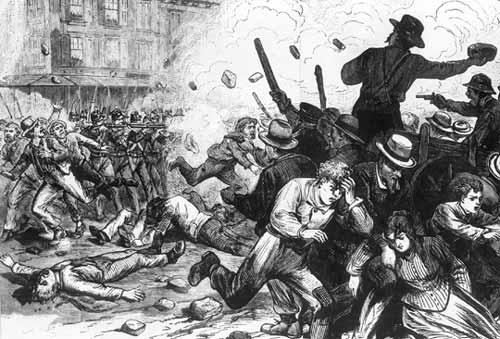
We had a tremendous general strike in 1877
Union activists are used to hearing people call “strike!” when they have no idea whether or not the tactic would work. A lot of them don’t care. If a union called a strike every time some hothead wanted one, we’d get a lot of people fired for nothing. When my union ran a successful 15-month “work to rule” contract fight, there were people calling “strike” instead of doing the hard work of a long struggle. The three of them that I knew personally were all promoted to foreman immediately after the union won. They were company stooges, as it turned out. The company knew that the union might win the long battle, but we would almost certainly have lost a strike.
If you’re reading along in Facebook, you’ve seen lots of responses to the Trump election victory, and nearly all of them are way less than helpful. Some are silly, and some are outright dangerous!
Nearly all the pollsters were wrong about the election results. The best single explanation I’ve seen was in a “letter to editor” in today’s Dallas newspaper. A guy named, I think, Roland Young wrote that when the pollsters called, “We lied!” Some of Trump’s voters may have been too ashamed to confess.
But the best explanation of the pollsters’ failure is that their approaches are based on previous history, and the 2016 presidential race was, to state it modestly, unique.
Elections are the best evidence we have of the national character. If the Electoral College puts Donald Trump in office, does that mean we’re mostly chauvinists like him? Actually, more than half the electorate voted against him, and only 56% of all eligible voters went to the polls at all. The ones that went voted for marijuana and higher minimum wages by much better margins than they voted for Trump.
Everyone who voted for Trump did not do so because they wanted to express their chauvinism. They surely didn’t vote for him because they think his far-flung ideas are actually going to solve America’s problems.
I think it is fair to say that they voted for change. We see this in the unions all the time. Members who haven’t taken the time to investigate the candidates in union elections will nevertheless vote to “throw the bums out” against whoever is in office. Next election, you can’t find anyone who admits they voted for the incumbents and it’s “throw the bums out” again. After a lifetime in the public eye, and because of the outright duplicity of the national Democratic Party, Hillary Clinton was a perfect target for that kind of sentiment.
People voted for Trump over Clinton for the same reason that they had voted, in 2008, for Obama over Clinton. Change.
People voted for Donald Trump because they are dissatisfied with life in America and they don’t know what else to do about it.
I don’t exactly blame them. I’m dissatisfied too, but I know what to do about it.
Media pundits are blaming “white blue-collar workers” for electing Donald Trump. His voters were probably Anglos all right, but they didn’t represent the working class. The working class is the solution, not the problem. The progressive leadership of the AFL-CIO is head and shoulders above any Democratic or Republican Party politician. For now, it’s better to follow them than Bernie Sanders, too.
If we’re willing to do the long hard work of educating and organizing America’s workers, we could win elections. We could win strikes, even general strikes!
But it will take some work.
–Gene Lantz
Click here if you want to know what I really think!
I can’t kid you, there’s a lot to worry about. To begin with, I’m worried that Mrs Clinton might stumble and fall before November 8. A Trump presidency would be a disaster for working people! But I’m also worried about what both major candidates are going to do after November 8.
Mrs Clinton’s saber rattling toward Russia during the debates reminds me that she’s a hawk and has always been a hawk on foreign affairs. She keeps asserting that Russia is working against her election and threatening them with cyber war. She also wants to escalate the war in Syria with a “no-fly” zone. If she shot down a Russian plane in Syria, wouldn’t there be hell to pay? They have nukes! Those of us who would like to see fewer hostilities and less war are likely to be very uncomfortable during her presidency.
It’s good that Mrs Clinton says she won’t push the Trans Pacific Partnership unfair trade deal. Mr Trump doesn’t believe she will stick to opposing it, and I don’t believe either one of them would. I can still remember when candidate Obama was going to fix NAFTA and oppose other unfair trade, now all of us have to worry that President Obama will try an end-run during the lame duck Congress. He’s already working on it!
Unfair trade deals are essential to the big money guys, and few politicians would even try to resist them. Obama doesn’t, and he has a lot more of my respect than either Mrs Clinton or Mr Trump!
The pundits and newspersons seem to think Mr Trump is stupid. They think he is throwing away his political chances by bashing immigrants, encouraging violence at his meetings, skipping over facts to appeal to emotions, catering to the crudest kind of people, claiming the entire electoral process is “rigged,” and, especially, refusing to abide by the decision of the voters after the election (unless he wins).
I’m hoping that stupidity explains his political actions, but I don’t honestly think we can count on it. Like most analysts, Mr Trump already knows he isn’t likely to win over the Electoral College. I think he’s going to try to start an openly fascist movement, the first one since the 1930s in America.
Trump is already a skillful media person, far more skillful than the hate radio manipulators like Rush Limbaugh that have already gained considerable following. He’s already floated the rumor that he may be starting his own television network. We have to assume it would be even less truthful and more sensationalist than Fox News!
A billionaire with his own television network and millions of followers from among the most volatile and least sensible ranks of people could create an anti-worker movement that would dwarf the fascists now operating in Europe. And don’t give me “It can’t happen here” because it can and has before.
So let’s get worried together, and start figuring out what we’re going to do about it!
–Gene Lantz