Archive

economy

Working Americans have always fought the bosses. We’ve won a few battles and lost many, but we always fought on.

redflag

The closest we ever came to a “cease fire” in America’s class war came between 1947 and 1972, “The American Century.” During those few years, the United States had so much economic domination over the rest of the post-war world that they were able to buy off militant workers and collaborationist leaders. Unionists regularly received 3% annual raises and steady improvements in their benefits packages, including retirement. Non-union people got their improvements, but only as a result of the unions.

Then Came International Competition

After 1972, when President Nixon was obliged to change the worldwide monetary agreement set up after the great war, the bosses returned to business as usual. Their usual business is screwing their workers whether they are organized into unions or not. From those days forward, bosses in every capitalist country have been getting government handouts for themselves and austerity for everybody else.

They would like to continue that, but, as I said, we’ve always fought them. We’ve never won a decisive victory and, for the most part, never even thought about a decisive victory. Our battles have been over immediate objectives such as a pay raise for a limited number of workers or voting rights.

Our Victories Have Been Temporary

Even when we win, our victories are temporary because the bosses are still in power and, sooner or later, will try to reverse our successes. Thus, for example, we won the Voting Rights Act and then lived to see it gutted by the Supreme Court. We fought to see our American standard of living rise to the highest in the world, then saw it fall ignominiously.

The trends on our side of the class war are getting hopeful. Just on the wages front, for example, we aren’t just fighting a few scattered battles over peanuts here and there, we are engaged today in a nationwide battle to raise the minimum wage to a respectable figure. The Fight for Fifteen can involve everybody, and actually does involve quite a few of us.

Things Are Looking Up

On the political side, millions were drawn into action by the Bernie Sanders campaign, and I do not believe it is over. Instead, we are on our way toward a working people’s political party that would give us a real choice in elections. I don’t know if that is what Bernie Sanders intends, but I think the momentum of his followers is going that way. Union leadership is better integrated, more militant, and far more progressive than it has been since 1947.

Most exciting of all, I believe that Americans are better informed, more capable, more connected, and more sophisticated than ever in history before.

–Gene Lantz

Click here for more of these ideas

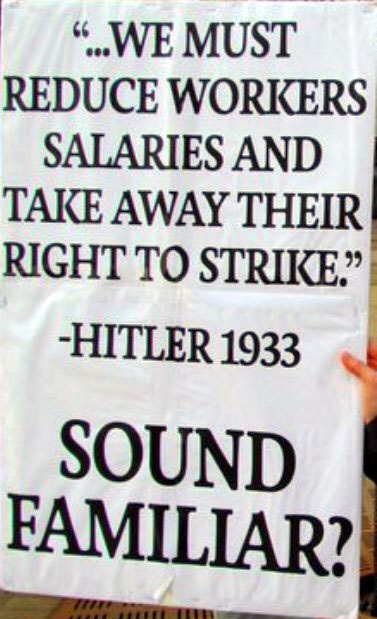
Nothing stays the same. Those who hope to continue the limited democracy in America today, without change, aren’t looking at how the world operates.

hitlerquote

Some of the pundit are already describing America’s political system with the word “chaos.” (Click here)

The nations today are competing with one another by forcing austerity onto their respective workforces. The competition will not get any easier because, no matter how cheaply goods can be produced in one country, another can lower their labor costs even further as long as the bosses are in power and as long as the workforce doesn’t actually starve.

The bosses in power can, and will, enforce more austerity as long as they can. That will include union busting, civil rights violations, misogyny and racism just as it does today. At some point, the bosses will have frittered away the illusion that they rule “with the consent of the governed.”

At that point, they will rule without pretending to have our consent, with naked force. That’s fascism. That’s a choice of government that the bosses can make and will make when there are no easier choices.  It’s capitalism in its death throes.

Fascism will not solve the boss’s competition problem. The only reason that Nazi Germany lasted as long as it did, 12 years, was because of their early successes in war. A fascist government today, without the option of making war without destroying the planet, wouldn’t even last that long. But who wants to go through fascism for any length of time?

It isn’t hard to see what the bosses will do, because they are doing it now. The question is, what do we have to do to carry America on the road to fascism? As the great parliamentarian Edmund Burke said, “The only thing necessary for the triumph of evil is for good men to do nothing.”

–Gene Lantz

Click here for more of these ideas

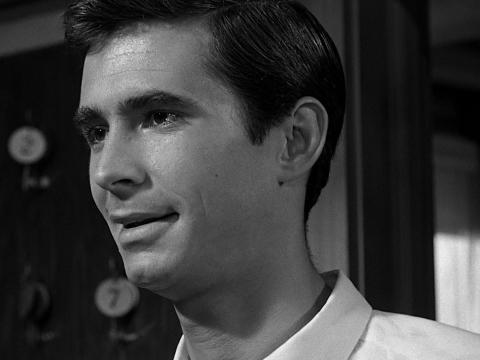
You are four times more likely to find a psychopath among executives than among the general population.

psycho-anthony

Look crazy to you?

In the financial services, it has been estimated that 10% are psychos. (click here for article)

I don’t doubt that a survey of ordinary workers would yield a much higher estimate.

How to Spot One

I got this from Wikipedia (click here):

“The organizational psychopath craves a god-like feeling of power and control over other people. They prefer to work at the very highest levels of their organizations, allowing them to control the greatest number of people. Psychopaths who are political leaders, managers, and CEOs fall into this category.

Interestingly, all the on-line articles I found said that corporations want to avoid hiring psychopaths. But do they really?

Why Are They In Top Spots?

I received this in a recent email, “For me, I said screw it when I found out the personality tests administered when you apply for promotions were used to find psychopathic or near psychopathic individuals for the higher up corporate positions.  To me, if you have to have concienceless mentally ill people run a system then something is inherently wrong with that system.”

My friend’s next email explained, “Concerning the tests, I had a PhD professor and friend learn this the hard way.  … He was approached by a big firm and asked to develop a set of personality tests to keep the ‘ruthless sociopath and psychopathic types’ out of higher management….  Well, he makes the test and they go off and use it for the opposite reasons!”

Bosses Don’t Have to be Nuts to be Bosses

Whether or not a particular boss is a psychopath doesn’t matter much in the grand scheme of things. He’s against you whether he’s sane or not. The Preamble to the constitution of the Industrial Workers of the World begins, “”The working class and the employing class have nothing in common.” Maybe it’s overstated, but you get the idea.

Even though we like to believe that we’re choosing our thoughts and prejudices, we don’t. Our ideas come basically from our actual situation. Employees think like employees and bosses think like bosses. You can see that easily any time somebody gets promoted into management. Their world view magically changes overnight!

While I was researching psychopaths, I came across a quote that reminded me that the bosses nearly always use religion and patriotism to confuse us. Here’s what George Bernard Shaw said, “Patriotism is a pernicious, psychopathic form of idiocy.” Maybe that’s overstated, too, but you get the idea.

–Gene Lantz

Click here for more of these ideas


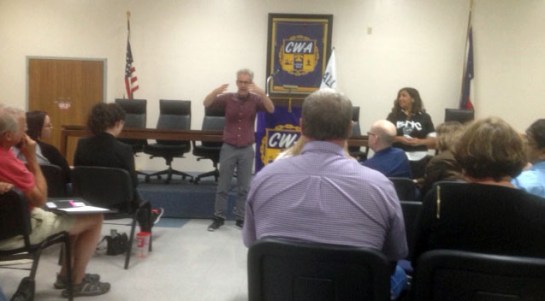
The exciting new organization “Brand New Congress” (BNC, click here)  just held its first meeting in my town. Its provocative electoral program may be the most innovative set of ideas in a century or more. In the 2018 primary elections, they plan to run more than 400 candidates without any regard to political party. The candidates will be people who have contributed to their communities, are good at it, and will uphold a radical progressive program similar to Bernie Sanders’ present campaign.

bnc-zac

Brand New Congress met at the Dallas CWA 6215 Hall, where Bernie has his offices

One of the most interesting twists in the projected scenario is their intention to totally disregard party affiliations. The main speaker said, ““Parties are so 19th century!” Polls are showing that a lot of Democrats and Republicans are not so crazy about their own parties. Youth has been showing its disdain for some time; I recently read that only 19% of Americans 19 to 29 years old voted in 2014!

How It Will Work

The Brand New Congress strategy would have their candidates running mostly as Independents, but, where it’s easier, as Democrats, Republicans, Greens, or anything else that’s useful! In other words, they would use political parties the same way they said Bernie Sanders used the Democratic Party — to get on the various state ballots and to obtain a wider hearing.

Turnout at our meeting was good, but not nearly as good as earlier Bernie meetings. Like the Bernie meetings, diversity was not its strongest characteristic. I’d estimate about 8% African Americans, maybe 10% Latinos, 2% Native American, and 40% women attended. Like the Bernie meetings, they were considerably younger on average than most political gatherings.

It’s worth noting that neither of the two presenters claimed that Bernie Sanders would publicly support this program.

Will It Work?

After having seen the electoral miracles accomplished by the 74 year old socialist from Vermont this year, who is prepared to say that Brand New Congress won’t be successful? Who could say that almost anything couldn’t be done by the younger people around the Bernie campaign? One of the BNC organizers maintained that Bernie had raised $240 million and moved tens of thousands of volunteers!

During the last decades, a growing number of citizens has developed a severe distaste for the status quo and a yearning for something different. Maybe these are the “people with a plan” who bring that change!

On the Other Hand

The idea of such a broadly innovative electoral campaign is breathtaking. But after I resumed regular breathing, my age and experience began to ask questions. In the immediate sense, I didn’t like all of the answers. Hope I’m wrong on every count:

  1. The strategy is purely electoral and limited to the U.S. Congress. Whenever somebody tells me that a single tactic is going to revolutionize America, I start wondering if they aren’t making a fetish of that tactic. Remember Occupy? A revolutionary program, it seems to me, would have to relate to all forms of struggle.
  1. Although one of the BNC presenters talked a lot about his views on the economy, little or no mention of the international situation was mentioned. People who think that their country is the only one that matters may be a little bit out of step with the economic situation today.
  1. Where are the working people in all this? I heard one mention of the term “working class,” but it was parenthetical and in passing. The idea that all Americans can be brought together under a single program seems idealistic to me. Only working people can confront the bosses and beat them, not a vague idea of “everybody.”
  1. Much worse, I didn’t hear any mention at all of the bosses and how they were going to relate to all this. Do people think that there’s only one side in this fight? There are two sides, and the other side isn’t just sitting around waiting to see what happens. They are really good at all forms of political fighting, especially elections. Also, they blacklist people. They arrest people. They kill people. You can’t expect success with a strategy that ignores them.
  1. How would we govern? No one would be happier than I to see somebody make gigantic fundamental change in American politics by 2018, but this electoral trick sounds more like a coup than a revolution. In a revolutionary process, people organize themselves by communities, by workplaces, and by their interests. They get better and better at meeting challenges and utilizing opportunities. Leadership develops at every level. Revolutionary struggle is a giant learning process whereby everybody learns more than how to take power, they also learn what to do with it.

Maybe my skepticism has no place as America yearns for improvement. Let’s not condemn, but encourage. Let’s do what we can!

–Gene Lantz

Click here for more of these ideas

It’s June 25th, the 81st anniversary of the Fair Labor Standards Act. We can thank President Roosevelt and Labor Secretary Perkins for this greatest accomplishment of America’s centuries-long fight for shorter working hours.

haymarketvoices

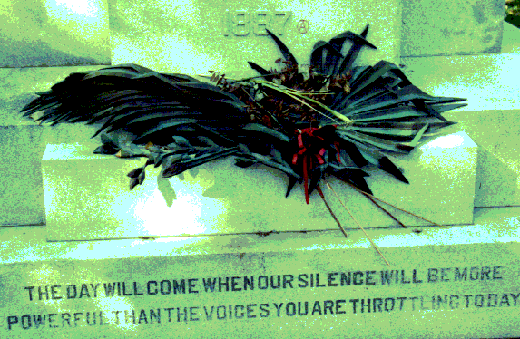
Four Chicago leaders of the 8-hour day were hanged in 1887

A number of Americans were killed when we led the worldwide fight for the 8-hour day in 1886. The Chicago Haymarket Martyrs are the best known. Workers still make pilgrimages to their grave site.

YouTube has a darned good description of the fight as it took place in Milwaukee, Wisconsin. One of the good things about it is that it has a miner’s version of the “8-Hour Song” that was sung everywhere.

The Fight Was Set to Music

I don’t think it’s the best version. The words for the best version are below and they are worth studying for the pure art of it, not to mention the great historical importance. I can’t find this version on YouTube and so I made up a tune and sang it myself. It’s on my Gene Lantz Facebook Page.

We’ve Always Fought over Working Hours

One could say that the entire history of labor could be written as a fight over working hours. I’ve written about that before.

The Battle Continues

For many years, millions of workers have been exempt from the Fair Labor Standards Act and could be worked pretty much endlessly with no extra pay. Among them are low-paid “salary” workers. The Obama Administration’s Department of Labor recently changed the rules so a lot more people could get overtime pay. Almost immediately, a coalition of bosses sprang up to oppose it. I wrote about that, too.

–Gene Lantz

Click here for more of these ideas

The 8-Hour Song

We mean to make things over,

We are tired of toil for naught

With but bare enough to live upon

And ne’er an hour for thought.

We want to feel the sunshine

And we want to smell the flow’rs

We are sure that God has willed it

And we mean to have eight hours;

We’re summoning our forces

From the shipyard, shop and mill

Eight hours for work, eight hours for rest

Eight hours for what we will;

Eight hours for work, eight hours for rest

Eight hours for what we will.

**

The beasts that graze the hillside,

And the birds that wander free,

In the life that God has meted,

Have a better life than we.

Oh, hands and hearts are weary,

And homes are heavy with dole;

If our life’s to be filled with drudg’ry,

What need of a human soul.

Shout, shout the lusty rally,

From shipyard, shop, and mill.

Eight hours for work, eight hours for rest…

The voice of God within us

Is calling us to stand

Erect as is becoming

To the work of His right hand.

Should he, to whom the Maker

His glorious image gave,

The meanest of His creatures crouch,

A bread-and-butter slave?

Let the shout ring down the valleys

And echo from every hill.

Eight hours for work, eight hours for rest…

Ye deem they’re feeble voices

That are raised in labor’s cause,

But bethink ye of the torrent,

And the wild tornado’s laws.

We say not toil’s uprising

In terror’s shape will come,

Yet the world were wise to listen

To the monetary hum.

Soon, soon the deep toned rally

Shall all the nations thrill.

Eight hours for work, eight hours for rest…

From factories and workshops

In long and weary lines,

From all the sweltering forges,

And from out the sunless mines,

Wherever toil is wasting

The force of life to live

There the bent and battered armies

Come to claim what God doth give

And the blazon on the banner

Doth with hope the nation fill:

Eight hours for work, eight hours for rest…

Hurrah, hurrah for labor,

For it shall arise in might

It has filled the world with plenty,

It shall fill the world with light

Hurrah, hurrah for labor,

It is mustering all its powers

And shall march along to victory

With the banner of Eight Hours.

Shout, shout the echoing rally

Till all the welkin thrill.

Eight hours for work, eight hours for rest…

We all hear about “drawing the line” and “crossing the line.” They say in Texas that it has something to do with the Alamo, but there’s a more universal line. It’s the class line.

picket

The physical line between bosses and workers is the picket line

It’s not always simple to figure out who we’re talking about when we sing the great old union song, “Which Side Are You On?” Almost everybody pretends to be on our side.

One could pick around all day trying to sort out exactly who is in the capitalist class, the working class, and the middle class. We can categorize ourselves over and over again as we consider different issues such as gay marriage, global warming, gun control, art lovers, art haters, renters or owners, etc etc. But the important line is the one between workers and bosses. There’s a sure-fire way to know just who is on the workers’ side and who is on the other side.

It’s the issue of wages

Our side wants better wages. Their side wants worse wages.

A new organization has been formed to fight against the Obama Administration’s change in the overtime law. The new law gives considerably more wages to certain workers, and the new organization, “Partnership to Protect Workplace Opportunity,” (who do they pay to come up with these names?) is on the opposite side of the line that really matters. You can look at their list at http://protectingopportunity.org/about-ppwo/ On their side you will find the National Restaurant Association, the U.S. Chamber of Commerce, Associated General Contractors, Associated Builders and Contractors, Jimmy John’s, and lots of  banks, insurers and  auto dealers.

Usually, when they are trying to influence legislation, they sneak around about it so we don’t know who they are. Read Dark Money. I guess the new organization is trying a new tactic by letting us know who (some of them) they are. Maybe they think it will intimidate us?


What they have in common is that they’re all for worse wages. They’re all bosses. They’re all against us. It’s good to know about them.

–Gene Lantz

Click here for more of these ideas

tppflag

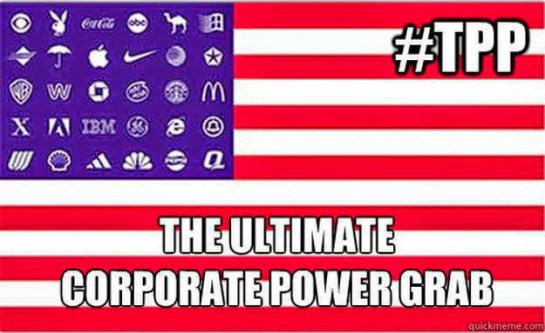
The “Trans Pacific Partnership” is next in a long list of so-called “free trade” bills awaiting Congressional approval. The others were passed during the Clinton and Bush Administrations, and President Obama is hoping to get this one passed in the last session of 2016. It’s a “lame duck” session in which many congresspersons don’t feel as responsible toward the people who watch them but don’t pay them off.

Earlier, President Obama was able to get “fast track” legislation to grease the wheels so that the TPP could slide through without serious discussion or public scrutiny. Unions and environmentalists are dead set against any more of these bills because they mean lost jobs, lower wages & benefits, and more pollution. There’s a good reason for that.

Corporations Run The Process

Unions and environmentalists have no participation in creating the secret treaties. There are representatives, special trade envoys, from the governments involved — but there are also hundreds of corporate lobbyists in the process! Mighty transnational corporations write these things for their own benefit.

What do the big corporations want? They want low wages & benefits and the right to pollute. They want a free hand to do anything they want and make as much money as can be made.  So far, that’s what they have gotten. That’s what the TPP offers them. What does it offer us?

It Isn’t Trade, and It Isn’t Free

What is misnamed “free trade” sets up a separate legal system that overrides the democratic rules of each country involved. That system issues licenses to steal to the corporations who created it. The system guarantees corporate profits, even when the corporation breaks our state or federal laws.

They call it “globalization.” I call it “gobblelization.”

–Gene Lantz

Click here for more of these ideas

Organizing Gets Easier and Easier

I’m flattered when somebody introduces me as an organizer. They sometimes say I’m a “union organizer,” which is not actually true. A real union organizer is a paid professional with a strong background in labor law. I consider myself a “worker organizer.” But everybody is an organizer.

We organize every time we meet somebody for lunch. It’s all organizing. But what’s critical is organizing on the job.

organiz9

A Short History of Organizing, Starting with Slave Labor

Looking back through history, we can see that organizing was really hard to do when most work was done by slaves. Nat Turner, John Brown and Spartacus all found out how hard. They all failed, and were executed for trying. The only successful slave organizer I know of was Toussaint L’Ouverture in Haiti around 1800. The reason it was so difficult was probably because slaves were pretty much interchangeable. When one was worked to death, another could be easily substituted.

Serfs and sharecroppers, who mostly replaced slaves, were a little more organizable. I think that’s because they had to know a little bit more about their jobs and weren’t so easy to switch around. The Southern Tenant Farmers Union of the 1930s was one of the more successful efforts. I actually met H.L. Mitchell once. Their gigantic accomplishment was to fight racial barriers that have always made organizing in the American South so difficult. Even back in those days, there were a few small guilds of workers who could be organized because they had special skills and tools.

The Bosses Do Most of Our Organizing

Modern unions came about because of the industrial revolution. England was the first capitalist nation, the first to industrialize, and of course the first to have organized unions. In America, the first successful unions were people who made shoes. It wasn’t everybody in a shoe factory. It was only the most skilled workers. For the next couple of centuries, the more skilled workers tended to organize around their special skills and tools. We call that craft unionism, and it was the model for the American Federation of Labor (AF of L) during its century of dominating organized workers in America. In steel production, for example, the molders and machinists might be organized, but not the people shoveling coal and ore. In textile, the cutters would be organized but not the women doing the sewing.

Modern Industrial Organizing Finally Developed

Labor’s Giant Step (free book on Amazon) can trace its development to the beginning of the 20th century, when the Industrial Workers of the World set out to organize everybody who worked, skilled and unskilled, men or women, Black, Brown, or white. By then, industrialization had made just about every job in America into a somewhat skilled position. It was difficult to replace one worker with another. General education and training were involved. The IWW ran into a minor obstacle because the AF of L undermined them, but their major obstacle was the U.S. government. IWW’ers were arrested, deported, horsewhiped, and murdered.

The saying goes that you can kill revolutionaries but you can’t kill revolutionary ideas. So industrial unionism eventually triumphed when the AF of L started the Committee for Industrial Organization (CIO) in 1935. Three years later, they thought better of it and expelled them, but by then the CIO was strong enough to survive and thrive on its own. After 1935, the biggest and most successful unions were those who organized “wall-to-wall,” everybody in a given industry from the most skilled computer operator to the lady sweeping the floors. AF of L unions adopted industrial organizing.

The best known pioneer and most successful union of the CIO was the auto workers. You can see why they organized so well, because auto manufacturing, more than most other work, was done by assembly line. If you could get three or four people on strike, you could shut down the line! Once again, the bosses had done most of what was necessary to organize workers!

Organizing Gets Easier and Easier

American industry became so well organized that the anti-worker bosses had to get the U.S. government to help them keep wages and benefits down by outsourcing the work to other countries. The same process of organizing is taking place in those other countries, so the bosses won’t benefit from outsourcing forever, but it works for them as an interim solution.

Meanwhile, Americans are better informed and more skillful than ever. The internet is making a qualitative jump in people’s access to information. It would be possible, in my estimation, to organize a national shutdown in only a few days. A worldwide shutdown could be organized in a matter of weeks. After that, everything is possible.

–Gene Lantz

Click here if you’re interested in more such ideas

Book Review

Billionaires Are Pulling America’s Strings

Mayer, Jane: Dark Money. The Hidden History of the Billionaires Behind the Rise of the Radical Right. Doubleday, New York, 2016.

dark_money600x350px

There’s a great quote at the beginning of this best-selling book:

“We must make our choice. We may have democracy, or we may have wealth concentrated in the hands of a few, but we can’t have both.” –Louis Brandeis

This wonderful book solves a number of contemporary mysteries:

  • If Americans are better educated and better informed than ever, why have our political ideas lurched toward ignorance?
  • If we understand economics better than ever, why is wealth disparity so awful?
  • How can our commentators and professors afford to say patently ridiculous things without losing their livelihood?
  • If we all have to live on this planet, why are we polluting so much?

The answer is dark money. A carefully crafted network of billionaires has bought off politicians, economists, professors, and commentators and turned them into ventriloquists’ dummies who repeat and repeat and repeat the things that billionaires want said. They have gone beyond buying a few columnists and professors. They own think tanks, newspapers, information networks, Radio & TV networks, professors and entire faculties, individual politicians and entire state legislatures. Their effect on the federal government is substantial.

Their contributions to this underhanded scheme are more or less legal and even tax deductible!

The main architect of this secret and underhanded network is named Charles Koch. Many years ago, he took up his father’s interest in right wing organizations such as the John Birch Society. As the years passed, Koch and his billionaire co-conspirators became better and better at influencing legislation and public opinion. It’s all detailed in Jane Mayer’s book.

Although most of their maneuvers result directly in more money for themselves, the perpetrators generally claim to be ideologically motivated. The book’s author, in my opinion, gives them too much credit in this direction. She usually refers to them as “arch conservatives” or “libertarians.”

I wouldn’t characterize them so generously. If Benito Mussolini was correct when he defined “fascism” as simply “corporatism,” then “fascists” is the more accurate description of Koch and his cronies. Nazi propagandist Joseph Goebbels would be proud of them!

In that regard, they are not completely in step with the entire ruling class of America, which has so far not elected to rule through fascism. They still rely on the Republican and Democratic parties to keep our limited democracy working for them. The Koch network operates primarily through the Republican Party, but not completely. They maintain their independence and their “corporatism” fascist goals. It would be interesting to see if they completely try to take over the Republican Party, as seems to be their goal, or if they try to establish a formidable fascist party.

Whichever way they go, a united and well informed progressive movement is the solution to the threat they raise. This book goes a long way toward that solution.

–Gene Lantz