Archive

civil rights

In our lifetimes, we have never seen the American people as ready to fight as they are right now. Case in point: the January 21st demonstrations put more protesters on the streets than ever in American history.

wom-012117 (4)

Is It Enough?

At the same time that our potential strength is growing, the challenges are growing, too. The far right, the dark money people, the Koch brothers, all of the worst of America’s ruling rich, are far stronger than ever. They were bad enough when they were just the crazies in the John Birch society  the Tea Party and Ku Klux Klan, but now they hold state power!

Does it seem likely that these merciless and unscrupulous power mongers are going to be “touched” by our sentiments? Will they have a “change of heart” after they hear our arguments at Town Hall meetings? Does anyone think they will give up state power just because people carried signs?

What About the Next Elections?

If everything were the way it used to be, or the way it usually is, the Democrats could expect to win big in the 2018 mid-term elections. There is a lot of enthusiasm for fighting the Republicans, thanks to the Republicans. Also, the party in power normally loses in mid-term elections. A lot of our leaders, thinking things are the way they used to be, or the way things usually are, are focusing entirely on the next elections. We’ll warm up in the local elections that occur between now and then, and then we’ll be “really ready” in November, 2018.

American Democracy Is On the Wane

We should fight in the local elections at hand. We should get ready for the 2018 mid-terms. We should continue building giant protests. We shouldn’t concede anything. But is it enough? Even if we think it’s enough, can we be sure?

Consider that the level of democracy that we enjoyed just a few years ago is being eroded away. When Bill Clinton was President, for example, we thought our voting rights were secure. Not only that,  we more or less expected to continue expanding American democracy just as we had more or less consistently since 1776. We’ve seen big money take over our elections with the blessings of the Supreme Court. We’ve seen a President appointed by the same court. We’ve seen the near-sacred Voting Rights Act gutted. We’ve seen unfair redistricting and myriad voter suppression laws become common. Just recently!

Maybe we have enough democracy left to assert ourselves in 2018 and put America back on the path to freedom. I hope so, but I’d like to have something stronger just to make sure.

What Else Is There?

Here in the United States, we know almost nothing about the kinds of economic struggles that are common in other parts of the world. The only truly successful economic boycott we know of was the United Farm Workers’ fight against grape growers. We’ve never seen a successful political strike in our lifetimes. Union organization has almost stopped completely in America due to the combined hostility of bosses and governments.

Those are the things we have to learn if we want to win.

Did You Shift To the Right?

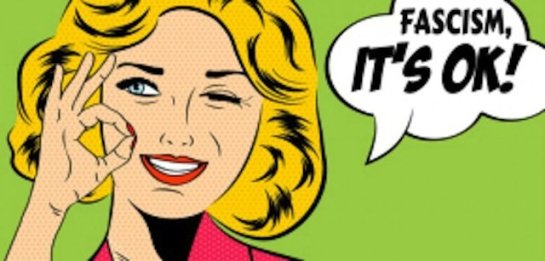
Fascist_OK

The reactionary candidate in the Dutch elections didn’t do as well as predicted. Maybe the fascists won’t win in France, either, but Donald Trump will still be President of the United States and the talking heads of the news will still be saying that there’s a “shift to the right”

They don’t say that somebody else shifted to the right, they say that the electorate did. We’re the electorate, so they mean us. Did you shift to the right? I doubt it.

In fact, a “shift to the right” by the electorate is not what is happening at all. If the electorate were becoming more reactionary, we wouldn’t have seen the liberal election results on marijuana and minimum wage. What we’re seeing is something else.

What Are We Seeing?

We are seeing a shift in tactics by the rich.

Throughout written history, the more-or-less propertyless have fought against the propertied for basic sustenance, for rights, and for freedom. We have done pretty well for ourselves, especially under capitalism. Once workers freed themselves from slavery and serfdom, we went on to get better living conditions, a little bit of dignity for workers, and limited democracy.

Limited Democracy?

We’ve always fought for more democracy, more control over our lives, and in generally we’ve been winning. Winning at least until lately. American workers did particularly well during the golden days from the end of World War II to the late 1970s. That’s when American industry completely dominated the world. We got rid of all-white primaries, poll taxes, English-only ballots, fake literacy tests for Black voters, prohibitions on voting for 18-year-olds, and we made other great accomplishments during that period. But our democracy was always limited.

We never won the right to vote on wars, on plant closures, on layoffs, on hiring policies, and lots of other things that are exclusively done by the propertied class. Only recently, most of us realized that we’ve never had the right to vote on Federal Reserve officers. So our democracy has grown, but it was always limited.

After 1982, when the government started coming down on our right to unionize, our democracy began to erode. When the Supreme Court opened our election process to unlimited financial intervention, when they gutted the Voting Rights Act, and when unfair redistricting and voter suppression laws became common, we began to realize that the long-term trend toward more democracy was being reversed.

Why The Reverse in Democracy?

Around 1980, the propertied class changed their tactics. Instead of kidding us along with limited democracy, they decided on an all-out war against our rights. What changed for them was international competition. The United States no longer had the only functioning factories in the world and had to compete with countries who could make better products cheaper. The squeeze was on.

One can validate this with any account of inequality. From 1945 to the late 1970s, American workers constantly improved our lot. After that, it’s been downhill economically. One good book about it is “Runaway Inequality” by Les Leopold. Leopold shows what happened, but he is a little skimpy on “why” and “what the heck do we do about it?”

The owning class changed their tactics, and we have to fight them! That’s the why and what.


March 8, 2017, could be gigantic!

me-aug31marchlaborday

Good strategies and tactics only come from understanding the situation we’re in. If one overestimates people’s willingness to take action, one tends to try things that can’t be done and make other “ultraleft” errors. If we underestimate people, we end up settling for petty reforms when we could get bigger changes.

For most of my political life, I’ve tended to think people would do a lot more than they actually did. I thought, for example, that voters would really turn out to defeat the Orange Menace last November.

Afterward, when individuals and small groups began to call for militant political action, I fell on the timid side of evaluation. I never imagined that the January 21 marches and rallies would be the biggest in American history, but they were.

Now, to my surprise, I’m seeing some actual results from calls for a “general strike.” Even in my town, some small businesses shut down and a lot of students — of all ages — stayed out of school on February 16. For my entire political life, and all of almost everybody else’s, the call for a “general strike” was just a foolish dream of ultralefts and knee-jerk activists who weren’t even interested in whether it would work or not.

Even a broken clock is right twice a day

Now, calls for a general strike are beginning to get some traction. People are discussing the idea and beginning to talk about what it would take to be successful. I imagine that some people are looking at the general strikes in American history. The years 1877, 1886, and 1919 would be good ones to look at, but general strikes occurred in limited geographical areas right up to the big government attacks on workers that began in 1946. None were effective since then that I know of, until February 16, 2017.

To really make a difference, a general strike needs to be organized. Leadership needs to agree on the demands. They need to make those demands clearly understood, and they need to call off the action if the demands are met. It is hardly fair, and certainly not smart to ask people to make sacrifices without knowing what they are fighting for.

Leadership also needs to figure out how the strike should be conducted and how people’s needs can be met during the action. I have always loved reading about the successful strike in Seattle in 1919 where Rob Rosenthal wrote this poem:

“Nothing moves in the city,

Without our say-so

Let the bosses curse,

Let the papers cry

This morning

I saw it happen, with these ancient eyes of mine

Without our say-so

Nothing moves but the tide!”

March 8 is Coming. Look Out!

As I understand it, the February 16 activities were largely organized on social media. A lot of people didn’t know about “A Day Without An Immigrant,” but a significant number of the ones who knew about it went ahead and participated. That’s the times we live in.

As I understand it, the leaders that organized the biggest demonstrations in American history on January 21 have called for actions on March 8 — International Women’s Day. If “A Day Without  A Woman” goes anything like “A Day Without An Immigrant” –given that more people will know about it, that the leadership has already made itself credible and somewhat seasoned, and that there are more women in America than immigrants — a general strike on March 8 could be the most important political event in America since World War II.

That is, if I understand the times.

–Gene Lantz

I’m on the “Workers Beat” talk show ever Saturday at 9AM. 89.3fm in Dallas and http://knon.org everywhere. If you’re interested in what I really think, click here.

January 28 was significant for learning about immigration and refugees.

dfw-e-1

On the day after President Trump spit in the face of a large world religion, we were confronted with a dramatic historic page-turning and an opportunity to learn a lot.

There are a wide range of positions

Americans are divided on this issue. Positions range from outright racism and jingoism — hating all foreigners — up to my guest on the “Workers Beat” program on http://knon.org and 89.3FM in Dallas. Joshua Hatton gave his position as “abolitionist” and compared it to the brave Americans opposing slavery before the Civil War. They, too, helped people move from South to North, and they, too, opposed any effort to deport people back. The Fugitive Slave Act, tested in the Dred Scott decision, is said to be a major cause of support for the Northern side in the Civil War.

There were so many calls that I didn’t get to ask him if there were any difference between his “abolitionist” position and the old “sin fronteras” socialist position. “Sin fronteras” means “no borders.” In other words, workers could move back and forth across national borders with the same ease that capital does.

The argument is that national borders were created and operated by capitalists to defend their interests and are actually a hindrance to working people on both sides of the border. In 1999, the new leadership of the AFL-CIO labor federation, changed from “deport them all” to “let them in and then organize them.” In other words, solidarity is our strength and division is our weakness. Still, I expected most union people, and most politicians, too, to duck the issue as much as they could, since nobody wants to fight when your own people are divided.

Some politicians really stepped up

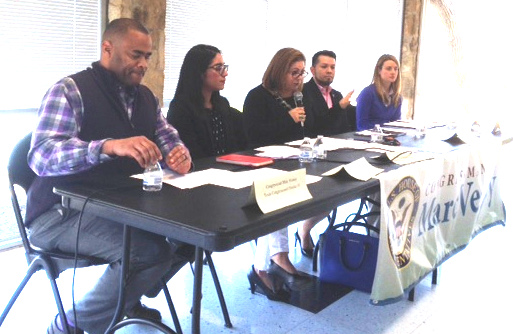
Congressman Marc Veasey of Dallas/Fort Worth has been saying for some time that he opposes Trump’s anti-immigrant actions. He held a meeting on that fateful day, January 28, at Kidd Springs Park. The subject was DACA — Deferred Action on Childhood Arrivals. He had a young woman, Diana Radilla, tell what it was like to be raised undocumented. He also had Congresswoman Linda Sanchez from California. They spoke up strongly on keeping DACA intact.

inmig-veasey-1

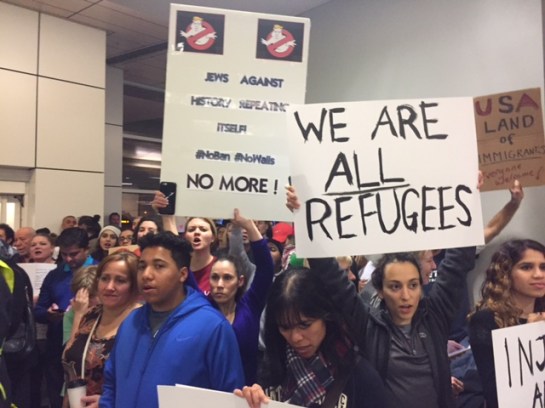
I didn’t realize that morning that crowds were forming in airports. That evening, when I did find out and went to the DFW airport to join the protests, the first person I saw was Marc Veasey. The second was our Dallas County Judge Clay Jenkins. Here were two leading Democrats going far beyond electoral politics to stand with us, 1000 members of the rabble more or less, against anti-immigrant racism!

Would the unions duck?

Contrary to what the bosses like to tell us, unions are scrupulously democratic. Elected union leaders have to consider every move in terms of how much flak they are going to catch from their members. Consequently, I would have expected them to “lay behind the log” on immigration issues as much as they could. I was wrong again.

On the night that we were at the DFW airport, my good friend Rick Schoolcraft turned up. He’s from my own aerospace local. Gary Livingston, from another aerospace local, had been there all day. His aerospace local probably leans as far right as mine does, but there he was.

The next day, I asked permission to use the Dallas AFL-CIO communications network to encourage more participation at the airport. I couldn’t reach the principal leader, Mark York, but his political director, Lorraine Montemayor, told me immediately to go ahead. So I put it on the web site, sent out 4,000 emails, and used labor’s social media to encourage more turnout.

An hour or so later, I found out why I hadn’t been able to reach Mark York. He was already out there, injured ankle and injured shoulder and all, in the middle of the airport protest! Mark was live-streaming the protests and complimenting other unionists, including Darryl and Stacy Sullivan from the Teamsters, for joining the protests. So much for ducking!

What’s Next?

There is a lot of political space between “reasonable immigration/refugee policy” and “Welcome all.” I don’t think the American public is nearly as pro-immigrant/refugee as my radio guest Joshua Hatton or my fellow protesters at the airport. But people are learning fast as we are being prodded by President Trump and incipient fascism.

We learn quickest when we take action. Policy and leadership are emerging, so don’t count out the American people, even on the complicated and difficult issues!

My video of the DFW protests, 3.5 minutes, is on You Tube.

–Gene Lantz

I’m on http://knon.org and 89.3 FM in Dallas every Saturday at 9 Central Time. If you are interested in what I really think, click here.


Bernie Sanders, “Our Revolution—A Future to Believe In.” St Martin’s Press ebook, September 26, 2016. Available from Amazon Books and on Kindle

sandersberniefragmented

S’Wonderful, S’Marvelous!

This must-read book details two important political contributions:

  1. A blow-by-blow account of the miraculous Bernie presidential campaign
  2. Detailed explanation of legislation needed to rescue and advance the people of our nation

The account of the campaign answers the question about how they managed to get so far toward the Democratic Party nomination when they started with virtually nothing and refused to sell out to big contributors. Most of America and even Bernie seem to be surprised at how well people responded to a truthful, direct, approach to America’s actual needs. It’s an inspiring story that needs to be studied.

Part Two, “An Agenda for a New America: How We Transform Our Country” details the problems we face and proposes practical solutions in the form of legislation needed. In many cases, Bernie Sanders had already proposed proper legislation in Congress. In general, his proposals are designed to:

  • Restore and advance democracy
  • Remedy injustices, including racial injustices
  • Restore equality
  • Fix the economy

But It’s No Good

The big problem with Bernie’s wonderful book is the last line, “September 26, 2016.” He completed the book before Donald Trump’s upset victory for the presidency and before Republicans completed their take-over of all three branches of the federal government plus the majority of state governments.

So what do you do with wonderful proposals for legislation when progressive legislation has almost no possibility of passage? What do you do with an inspirational story of a hopeful electoral campaign when our foundation of democracy is crumbling?

Apparently, Bernie thought, on September 26, 2016, what most Americans thought – that the Democrats would have a big victory on November 8. The glaring fact that they didn’t, and the anti-democratic trends already underway, put new perspective on politics in 2017. Bernie’s thoughts of September 2016 are certainly good to know, and actually kind of miraculous to behold, but not much actual use, are they?

We’re going to have to do some thinking of our own.

Some Positive Suggestions

Rather than leave off on such a negative note, let me make a couple of general proposals that might be helpful in 2017

  1. Electoral politics is not the only form of struggle. The most important power that working people have is our ability to withhold our economic cooperation. It is essential, therefore, to dedicate ourselves to organizing workers – to vote, yes, but to work together in other ways too.
  2. We may think that history only repeats itself, but it doesn’t. Bernie Sanders (and also Donald Trump) campaigned on the idea of re-setting the calendar to some earlier date, but we can’t go backward even if we tried. We have an entirely new situation that needs entirely new proposals. For example, we don’t need to fix the Electoral College or even the electoral system as it exists. We need direct participation in government decisions, and for the first time in human history, direct participation is now possible!
  3. Economies can’t be re-set to earlier times. Sanders, and other writers, seem to want to move us backward to pre-Reagan days. Trump apparently wants us some time before the Civil War. We actually need proposals that account for our present situation and then advance into a better future. For example, if certain financial institutions are “too big to fail,” Bernie Sanders suggests that they are “too big to exist” and need to be downsized to the levels of the 1990s. With our present technological abilities, we don’t need them in the downsized version either. If they are “too big to fail,” certain banks and insurance companies need to be taken over and run for the public good.

We must be grateful to Bernie Sanders and others who have taught us so much. A great future awaits!

–Gene Lantz

Hear “Workers Beat” on KNON radio, 89.3FM and knon.org every Saturday at 9 CST

Click here if you want to know what I really think

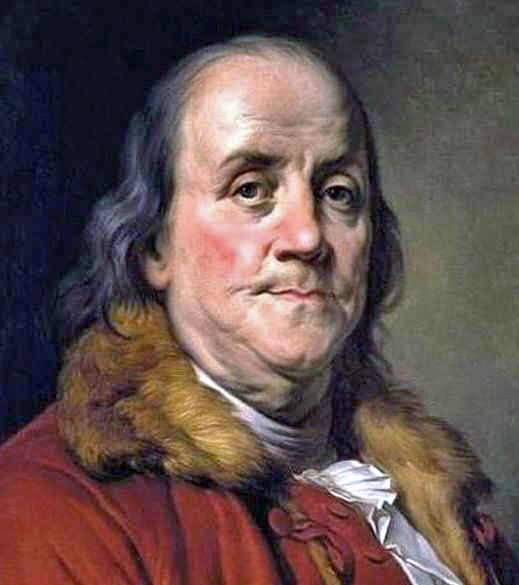
We can hang together or separately, as the saying goes.

benjamin-franklin

We must, indeed, all hang together, or assuredly we shall all hang separately!


Almost everybody I’ve talked to wants to “do something” right away as concerns the anti-worker government anticipated  for January 20, 2017. For several nights after the election results were announced, thousands protested in the streets of several cities, including mine. As far as I could find out, they had a lot of enthusiasm but no program, no structure, and no strategy.

A month and a half later, we still don’t.

I’ve been asking around about inauguration weekend. So far, it sounds like there will be three rallies, one march, some people going off to the state capital and others going to the national capital. There are probably several more activities being cooked up.

The problem is that there is no coordination among them. As far as I’ve been able to find out, each of them is sponsored by one separate group of people and has demands created by and for solely that group.

Can We Afford to Stay Divided?

As far as I know, the progressive movement in my town (Dallas) has always been divided this way and that.  Every naive young innocent who ever got involved has said, “We’ve got to get together!” And of course it’s true, but I’ve never seen anybody do it.

The book I’ve been promoting, “Runaway Inequality” talks about “silos” and says that all the progressive groups are in their own silos. The solution, says author Les Leopold, is that we have to come out of our silos and start working together. He doesn’t say why we’re in those silos to begin with, nor how to get out.

The basic reason for the silos is funding. Nearly all “progressive” organizations have to raise money. In that sense, they are competitors for the almighty dollar, not partners in any real sense. No matter what high-minded reasons people may have had for creating an organization, their main purpose in life soon becomes raising enough money to pay staff salaries, not whatever they originally intended to accomplish. In a very real sense, they are exactly like churches, most of whom seem to have lost their sense of purpose centuries ago, and they have to raise money or die! How do you change that?

You have to appeal to individuals. Bernie Sanders showed us that it can be done and how to do it.

Why Can’t We Just Hit the Streets?

The main problem with “knee jerk” activism is that it doesn’t go anywhere. Witness the Occupy movement that had thousands of charged-up protesters. They had no program, in fact they deliberately avoided having a program. As a result, they left nothing behind but some really good slogans and memories. But there’s another, very serious, reason to be cautious about spontaneous street actions.

Leftists may not continue to own the streets in America. Remember, that the progressives in Germany tried to take on the better-organized, more unscrupulous, and better financed Storm Troopers in the streets, but it didn’t work out well for them!

In our lifetimes, leftists and leftist causes pretty much ruled the streets. The fascists have stayed inside the corporate boardrooms and left picketing, street rallies, and marches to the riff-raff (us). But Mr Trump regularly puts together rallies of tens of thousands of hotheads today, and he has already shown that he’s willing to encourage violence against any detractor!

I’m not saying we shouldn’t rule the streets. But we aren’t in the same situation we were in before November 8, 2016. It’s different now.

One Proposal for Unity

Progressive people who want to survive and thrive during the Trump Administration need serious strategies for coordinated activity. My proposal is a series of “teach ins,” conference calls, and, possibly, “retreats” to work on programs and to coordinate activities. At the very least, we could set up a “clearing house” function so that different groups would know what the others were planning.

Labor, as the most responsible and most consistently progressive part of the left, needs to center itself in this process.

Everybody going their own whichaway isn’t affordable any more.

–Gene Lantz

Hear “Workers Beat” on KNON radio, 89.3FM and knon.org every Saturday at 9 CST

Click here if you want to know what I really think


I urge all progressives to fight reactionaries on every front, but the main one is going to be the battle to save basic democracy in America.

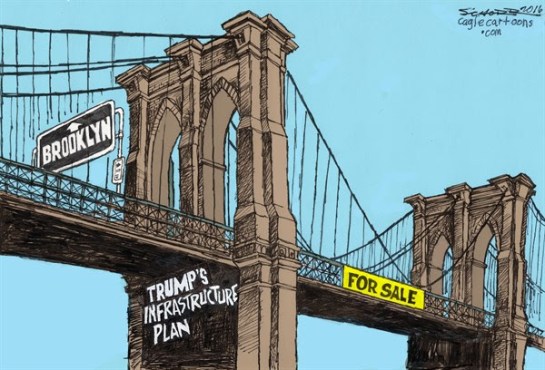
trumpinfrastructure

Simple logic:

  1. The idea that Trump’s policies are going to make life better for Americans is laughable
  2. Given the present system of American politics, the Republicans will not maintain power through the 2018 mid-term elections
  3. They know it
  4. The only way for the anti-worker forces to maintain power is by scrapping democracy
  5. Therefore, progressives must fight for basic democracy now

Will Trump Improve Life for Americans?

Economist Josh Bivens has a good summary of expected Trump policies on line. It doesn’t look good.

Mr. Hitler made immediate improvements in the German economy by massive infrastructure programs and by going to war. Will Mr Trump be able to do the same?

The U.S. Congress has blocked infrastructure programs all the way through the Obama Administration, even though they would have greatly shortened the long recession. It is unlikely that they would allow Mr Trump to implement anything good along those lines, because their main commitment is to the barons of finance, not construction businesses and certainly not to the American workers. Actually, I’d love to be proven wrong on this.

Mr Hitler had tremendous early successes in his war-making, but that was largely because the Great Powers did nothing to rein him in. They thought he would put an end to communism before he struck at any major capitalist countries. It is doubtful that Mr Trump will be able to use war to improve the American economy in any meaningful sense, and it is unlikely that he will receive cooperation from the other major capitalist countries in whatever adventures he undertakes.

The world wars that resulted from the economic crises of the 20th century are not considered available as a “solution” to economic and political crisis today, because of the imminent destruction of the planet.

Capitalist economies have always suffered from phases of “ups” and “downs.” “Down” is already overdue after the long recovery during the Obama Administration. The current expectation of new “tight money” policies, combined with Mr Trump’s new tax cuts for the rich and deregulation policies will create an immediate and painful crisis for working people.

Hard Times Will Likely Dominate the Mid-Term Elections

If one assumes that our American levels of partial democracy continue, it is unlikely that the party in power will fare well in 2018. In fact, the party in power usually does very poorly in mid-term elections.

None of this is a secret, neither to progressives nor to reactionaries.

What Can We Expect about Democracy?

Since around 1980, American democracy has already taken hard knocks at the hands of Republicans. Unions were assailed in every imaginable way. The Voting Rights Act was gutted, big money was sanctified by the Supreme Court, Republican redistricting largely overcame the popular vote, and voter suppression schemes were put into effect all over the nation.

The Obama Administration fought to maintain democracy, but does anyone think the Trump Administration will? If Mr Trump were to make outlandish anti-democratic Executive Orders, for example, who in government would oppose him? Not the legislative branch that is already in the hands of Republicans, and not the judiciary which will return to a reactionary anti-worker majority as soon as Mr Trump makes his first appointment.

Mr Hitler, it is often pointed out, won an election without winning the popular vote. How did he stay in power? How will today’s reactionaries try to stay in power?

Get ready to organize and fight!

–Gene Lantz

Listen to “Workers Beat” at 9 CST every Saturday morning on 89.3FM and http://knon.org

If you want to know what I really think, look at my life’s lessons site

Progressives need a program, guidelines, to go forward. One element needed is acknowledgement of history, not only all the bad things that have happened and all the bad situations we face today, but also the positive developments.

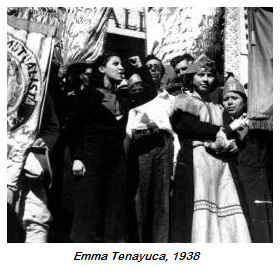
tenayucca1938We can build on the good things that happened and are happening. There are lots of them. Just yesterday’s Dallas newspaper, for example, included an article announcing that the Texas African American History Memorial had gone up on the Texas Capitol grounds.

Many of us, especially me, have been complaining for decades about the Confederate monuments in and around the Capitol. Yesterday’s new monument is a partial response and a very positive development.

Also in yesterday’s paper, and again in today’s, the Texas Railroad Commission is taken to task for being a superficial front for the oil industry. They’ve been denying that the recent upsurge in earthquakes are associated with oil industry shenanigans. It’s great to see somebody point out corruption, but it’s even better to see a major newspaper that has some regard for the truth!

Why So Much Negativity?

Most of the “Programs For Action” I’ve seen from individuals and organizations are all negative. It’s certainly fair to point out that we are facing the possibility of fascism in America and that chauvinism has leaped forward. It’s honest to complain about poverty levels and inequality and unfairness. But it’s not a good way to approach writing a useful program of action if it doesn’t acknowledge the progress we’ve made since our days of savagery and slavery.

Labor Is Improving

The recent changes in the American labor movement shouldn’t be ignored. Since 1995, the top leaders of the AFL-CIO have been adjusting their overall program to suit the demands that used to be made only by progressive fringe groups. A good example is Jobs with Justice, which started out in 1987 as virtually an outlaw organization with support from only 5 big unions. Today, it works hand-in-hand with all labor leaders. I wrote a short history of the North Texas Chapter.

Capitalism Was A Step Forward!

In the longer sense, thinking people and organizations are rightfully down on capitalism. It’s terrible in the way it creates poverty, divides people, starts wars, lies, cheats, steals, and generally oppresses us. But it’s completely wrong to ignore its historical value. Capitalism freed the slaves! It organized the workers! It’s productive power was far superior to any of the other economic systems that it replaced. One might even argue that capitalism has been more productive, even, than any of the attempts at planned economy so far!

A Good Program Acknowledges the Good

I’m 100% in favor of a program for progressive change and I intend to continue writing about it. Certainly such a program should point out the many shortcomings of today’s society and the need for decisive action. But our history and our present situation aren’t all bad. There’s a lot of progress to build on!

–Gene Lantz

Listen to “Workers Beat” at 9 CST every Saturday morning on 89.3FM and http://knon.org

If you want to know what I really think, look at my life’s lessons site

After 1 1/2 years of arguing with my ultraleft friends over why their votes matter, I now have to turn toward my reformist friends and convince them that voting isn’t everything.

me-aug31marchlaborday

A little sidewalk march, protected under Article 1. Anybody can organize one!

If you’re not sure what an ultraleft and a reformist are, feel free to consult my on-line glossary of useful political terms. Just for the sake of this exposition, ultralefts tend to denounce voting and reformists tend to denounce everything else.

The official smart people of America are generally saying, now that Trump is the president-elect, “Well we voted and now we must support our new President and let democracy take its course.” We live in a democracy, but it’s a limited democracy and it’s far from perfect. Even after 250 years of steadily improving it, our democracy is still a long way from fairness or equal treatment. In the last few decades, it’s actually gotten worse than it was, and I have a notion that it’s about to get worser still.

Voting May be Critical, But It Isn’t Everything

Working people struggle against the employers in many arenas. Pretty much all of them, including the electoral arena, are rigged against us, but it is important that we learn to carry out our fight in every battleground. That includes strikes like the very important musicians strike going on right now in Fort Worth, Texas. It includes petitioning campaigns, lobbying efforts, fund raisers, small protests and major marches.

Are you too dignified to march?

Think it over carefully before you answer.

In the same time frame that Republicans take over all aspects of federal government, mid January, we’re going to have a chance to put some strength into the civil rights movement during traditional Martin Luther King Jr birthday celebrations.

On the day after the the inauguration of The Donald, I’m proud to announce that somebody has called for a “Million Women March” in DC and here and there around the country. They invite everyone who believes in women’s rights, and that should include all of us. Even though the march is scheduled for a Saturday, lots of people will take off work on Friday for travel — that might help some of my friends who think a general strike would work on January 20.

I haven’t seen anything yet on activities defending undocumented workers, but I suspect that such events will be called. We won’t be able, physically, to attend everything that somebody thinks up, but we can pick the best ones. I expect to see my ultraleft friends at most of them. Maybe my reformist friends will come this time, too.

Unless they’re too dignified.

–Gene Lantz

No beating around the bush; if you want to know what I really think, click here.