Archive

Tag Archives: economics

World stock markets nosedived for a fourth day running on Tuesday, having seen $4 trillion wiped off from what just eight days ago had been record high values.

–NBC News

dark_money600x350px

Just the week before, Oxfam America announced their analysis of all the world’s wealth created in 2017. Eighty-seven percent of it went to the upper 1%!

I’m wondering if that same wealthy 1% took 87% of the $4 trillion loss? 

Probably not. The investors that took a bath this week aren’t the pros. They aren’t the ones with computers and experts doing their trading for them. They wouldn’t even know how to “sell short” like the big-time investors who are making fortunes from the downturn.

Once, before the implosion, I visited Moscow. They had a lot of fine museums made from the palatial buildings created in tsarist days. One of them had been the stock market. The Soviets, I was told, were running their economy without a stock market.

The Chinese, I understand, do have a stock market. It’s careening downward as this is written, just as other markets are around the world. The purpose of a stock market is to facilitate the flow of capital. Unfortunately, it also provides a giant gambling den where professional sharks swallow their competitors.

I’ve listened to several experts talk about the present downturn, and they are unanimous in saying that it’s just a correction and does not really reflect the basic world economy, which is sound. It seems to me that they nearly always say that during sharp downturns, because they don’t want investor panic to add to the problem, and they are nearly always right. But not always.

The experts go on to say that the selloff began when statistics were revealed showing that workers were beginning to get paid a tiny bit more. Wages, they said, were rising at the 3% rate. That’s a little bit more than inflation so, though tiny, it’s on the positive side for workers.

Why is good news for workers such bad news for capitalists?

–Gene Lantz

I’m still on KNON radio 89.3 FM in Dallas at 9 AM Central Time every Saturday. If you want to know what I really think, check out my personal web site

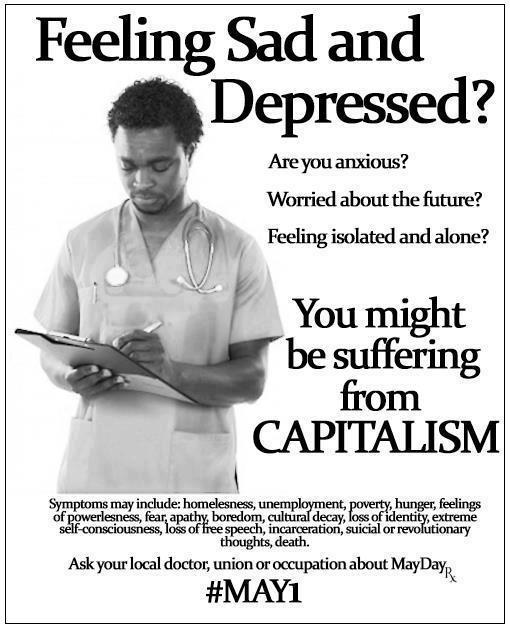
Germans embraced the Nazis, not because they were tired of freedom, but because they believed they had found a cure for capitalism.

doctorposter-capitalism

From the time it began to take over the world, mid 17th century, until the late 19th century, capitalism provided a better life for its subjects. That is, it was better than serfdom. Serfs were landless farm workers, one step above slaves, who had to take whatever their lords dished out. “Free” labor could leave one employer for another and, to some extent, dicker over conditions of employment.

Capitalism Works Best With Limited Democracy

If workers believe they have a voice in government, they don’t have to be guarded, guided, and pushed to do everything. They don’t run away or deliberately smash the equipment, the way slaves or serfs might. They can be educated for the higher forms of labor that capitalism needs. Consequently, the more successful capitalist economic systems use a limited democracy form of government.

From the beginning of the Republic until after World War II, American struggles made good improvements in our democracy.

What Went Wrong, When Did It Go Wrong?

Capitalism stopped benefiting workers after it conquered the world. When there were no new markets, the capitalists had to turn against one another to fight for the markets they had already saturated. That’s not what they called it. They called it “The war to save democracy,” and “The war to end all wars.”

But WW I was really a bloody turf war between gangsters. For a short period, the winners enjoyed their spoils, but it didn’t last very long because  the basic problem of saturated markets and international competition was still there.

So, they decided to have another world war. This one was complicated for workers, because the Soviet Union, try as they might, couldn’t stay out of it. After they began to fight the invading Nazis, they were incorporated into the same side the United States was on. The U.S. ended the alliance as soon as the Nazis were defeated, of course.

No More World Wars

After the U.S. nuked Japan, actually, after the Soviets and other nations showed that they could do the same thing, world wars lost their appeal as a temporary solution to the capitalist crisis. Even the gangster capitalists weren’t crazy enough to blow up their only planet. So, since the late 1970s, capitalist nations have gotten by on small regional wars, lowering their production costs by attacking their workers, and carrying a whole lot of debt. I recently read, in an investment newsletter, that all growth in the United States since 1980 basically came from debt!

Did the Nazis Solve the Capitalist Crisis?

To Germans between, say, 1933 and 1939, it appeared that fascism was the right way to go. Unemployment dived from 25% into low numbers. Lots of infrastructure was rebuilt. National pride was soaring.

But they had only changed their form of government from limited democracy to fascism, they hadn’t changed their economic system. It was still capitalist and it was still in crisis. The only real way toward a temporary solution was war. Even then, as long as they were winning, fascism still seemed pretty good to the Germans. After that, not so much.

What Looks Good to You Right Now?

To a lot of Americans, the Trump Administration and Republican political domination look pretty good. They think there will be more and better jobs. They think they’ll be making a better living and that the steady abatement of basic democracy isn’t too high a price to pay.

But we are still living in an economic system that has provided all the good it is going to provide, and things are only going to get worse if we can’t save and expand our democracy.


Why has inflation been so low in the past few years?

money

If interest rates are near zero, and they have been for some years, doesn’t that mean that corporations can borrow pretty much all the money they want? Since the lenders only keep a small “reserve” of what they lend, wouldn’t all this borrowing result in a big increase in the total supply of money?

If we have more or less the same things to buy, and there’s a lot more money floating around, wouldn’t that mean high inflation?

The Money Supply Is Increasing

The Federal Reserve publishes their estimate of the total amount of money in the U.S. They call it “M2” and it includes everything, bank accounts as  well as currency. In July of 2011 it was $9,232.6 trillion, or $9,232,600,000,000. At the end of June 2013, it was $10598.4 trillion. That’s an increase of $1,365.8 trillion in 2 years. I didn’t pick the years, they were just the first ones I found. Probably, the money supply increased a lot more in the 2007-2009 recession period, so the change would be even more dramatic than this recent 15% increase.

That’s Monetary Policy

The operations of the federal reserve are usually made to sound pretty dark and unfathomable, but essentially all they do is increase the money supply in hard times. They have a number of ways to do it, but it’s still just about all they do. I don’t think they can even constrict the money supply — they can just make it grow faster or slower.

Fiscal policy is actually a lot more important. That’s government spending. If the people running the American government had really wanted to get out of the 2006 recession quickly, they would have turned on the spigots of government spending. They didn’t because they didn’t want to. That left the entire problem up to the Federal Reserve and the expansion of the money supply. They fell to their task mightily.

They lowered interest rates to near zero so that businesses could basically get all the money they might want. They started “buying” treasury bonds with money they basically manufactured. Trillions of dollars went into the economy and the goods and services didn’t actually change that much. If something was worth $10 when there were $5 trillion in the economy, it makes sense that its price would inflate to $20 when the money supply doubled. But it didn’t.

So, why no inflation?

Money Has to Move

The velocity of money is how fast it moves through the economy. If it doesn’t move through the economy, it has practically no effect on prices. If the government gives trillions of dollars to fat cats who just sit on it, store it in overseas accounts, or just use it to buy back their own stock, which is what they did, prices don’t change much.

If the government had fought the recession with fiscal policy, inflation would likely have been more of a problem. If the government had hired some of the many unemployed to fix some of the infrastructure, teach the children, or prepare for the future, the new money would have gone into wages — and those wages would have been quickly spent. More money and more velocity at the same time would have resolved the recession more quickly, but there would have been more inflation.

So, the short answer to “why no inflation?” is that the new trillions of dollars went to very wealthy people who just kept it.

Why is Economics so Dark and Illogical?

In olden days, a “philosopher” was someone who generalized from a great deal of knowledge. Today, we divide up all knowledge into various “disciplines” with geniuses in one field completely ignorant of any other field. We divided politics from economics for Heaven knows what reason, and neither one of them makes any sense without the other. The Polysci grads don’t know beans about economics and the Econ grads don’t know politics.

The Polysci profs snow everybody with statistics because they don’t really want anybody to know their arcane secrets. The Econ profs do the same thing. My friend Jorge Rieger compared them to the secretive priests of old, and it’s a pretty good comparison. If you’re interested in a simpler explanation of economics, click here for the Little School.

–Gene Lantz

Click here for more of these ideas


For weeks now, I’ve been raving about “Raging Inequality” by Les Leopold. Not so much because it’s a great book, which it is, but because the powerful Communications Workers of America (CWA) union is promoting it, teaching classes, and giving away copies. But I’ve been holding something back.

abevigoda

In essence, the book uses economic data and graphs to show how rotten things have been in America since 1980 in contrast to the period 1945-1980. Then it goes on to suggest how we can return fairness to our nation.

What’s wrong with that?

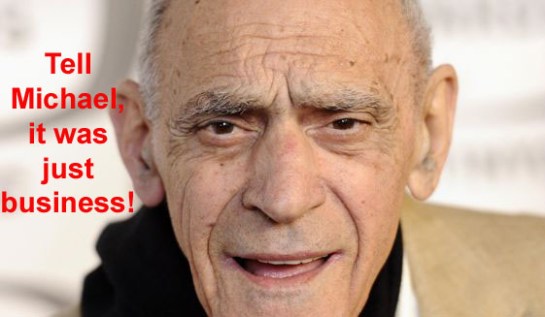
We’re looking at the wrong end of the graphs. The right side of each graph, the period 1980-2016, isn’t the period that’s out of kilter. It’s 1945-1980, the left side of each graph, that was un-historical. That “American century” of 35 years was downright peculiar in the entire 400-year old history of capitalism. It was the only time in history when the working class of any capitalist country ever held its own against the bosses! All the other periods, including the present one, were just business as usual.

Business as usual means constantly increasing the exploitation of the workers. It’s not anybody’s fault, it’s just the only way that capitalism can work. The only thing that can even slow the process down is resistance from the working class.

The post war period in America began with over 1/3 of all American workers in unions. There were more successful strikes in 1946 than in any year before or since. The unions, especially those led by the Congress of Industrial Organizations (CIO), were integrated, practicing solidarity with one another and with the community at large, and even internationalist in their outlook! They were a real force to be reckoned with, and their power took decades to dwindle down to the skeleton that the new progressive AFL-CIO leadership picked up in 1995.

Shouldn’t we be fighting?

Of course we should be fighting every day. That’s why I tout the book so much. It shows where we are now and some of the steps we could make that would take us forward. My objection to it is that we don’t really want to return to 1945-1980, nor can we. We must bear in mind that we are fighting for something entirely new: an end to boss rule.

Until then, every advance that working people make can be taken away, because the bosses are still in power.

Read the book, please!

Let’s do our best to expand this marvelous educational project that the Communications Workers have begun. Let’s read the book and get everyone else to read it.

–Gene Lantz

Click here for more of these ideas