Salon has very good news story covering developments 1982-present and the significance of today’s upsurge. Lone Star Project caught it for their daily news summary. I posted it on my FB page. It’s excellent.
My only problem with the article is that, like nearly all liberal analysis of today, it implies that labor’s problems began with Reagan in 1982. All of them, including the most erudite economists, start in 1982 with evil Republicans and recommend, as a solution, voting for liberal Democrats. They say that 1945-1982 was “normal” and that we could “get back” to that era by voting Democrat.
Nobody, except me and a handful of radical economists, especially Pikety, start with 1947, when America’s real troubles began. When the unions, some of them reluctantly, accepted the Taft Hartley law, solidarity ended.
Not only did the CIO separate from 14 of their best unions after Taft Hartley, the remaining unions raided them. What inevitably followed was decades of union isolation from one another and, even worse, from the public at large. The so-called “Treaty of Detroit” in the 1950s was a tragic error, not a wonderful accomplishment by Walter Reuther of the Autoworkers. When the UAW accepted employer-provided pensions and health care, they turned their backs on everybody else. We’re all paying for it now.
The great tragedy marked by Reagan’s firing and blacklisting of PATCO air traffic controllers was only made possible by the failure of the rest of the labor movement, and its public supporters, to respond. PATCO union leaders made several bad mistakes, including among them their having supported Reagan for election, but the historic lesson from the PATCO firing was that nobody helped them.
Once we understand that it was the lack of labor solidarity, not just Reagan, that was the root of our problems, we can see an actual solution — and it’s not just voting for liberal Democrats. It’s building up the movement for working families!
The current labor upsurge, especially the UAW strike, is attempting to rectify a catastrophe decades in the making. It will take all of us to win!
–Gene Lantz
I”m on knon.org “Workers Beat” radio talk show every Saturday at 9AM Central Time. They also post my “Workers Beat Extra” podcasts there and on Soundcloud. If you are curious about what I really think, check out my personal web site
There are at least three ways that the UAW could win against their 3 large corporate opponents without a massive strike:
A rolling strike: The UAW could strike only in the plants where they are strongest, and the strikes could be limited to relatively short periods. The auto industry is interconnected and uses just-in-time inventory; consequently, one facility might shut down several others for lack of components.
A slowdown: My own local, 848 in Grand Prairie, Texas, ran a successful campaign in 1984-5 and defeated a rich and powerful corporation by “running the plant backwards” for 15 months. During that time, only 65 of us were fired and required strike pay. The first 10 months or so were very difficult and not successful, but we learned how to carry out the fight and, eventually, went on strike for only 11 hours before we reached victory. All 65 of us marched back in the plant with back pay in our pockets! I wrote an account that is available on-line.
A Hit-And-Run: Around 1960, my union local invented an entirely novel tactic. Instead of going on strike, they looked through the membership to see which departments were strongest for the union. Those departments alternated one day work stoppages. A lot of the members were entirely unaffected. Some of them did not even know that a battle was going on, but the stronger units were slowing down production.
Because of just-in-time inventory and assembly-line production, the UAW does not need an expensive full-fledged strike to win. Just a few workers can shut down an assembly line; just a small component shortage can shut down a factory.
I’m not a labor lawyer, so I do not know what tactics might run closer or further from the law. Also, I do not know if any of these suggested tactics might result in as much public support as a full fledged strike against all 3 big auto corporations would surely engender. I don’t know which tactics might result in more political support as the 2024 elections loom large. Ultimately, I believe that the key to victory is the support of the American people, and I believe that working families have that support, and will win more of it as time goes by.
I’m just pointing out that there’s more than one way to defeat a greedy corporation.
–Gene Lantz
I’m on knon.org’s “Workers Beat” talk show at 9AM Central Time every Saturday. My “Workers Beat Extra” podcasts are on knon.org and Soundcloud. Lately, my personal web site, http;//lilleskole.us, has picked up some malware, so be careful.
The answer is “yes,” but there are powerful caveats.
Why Do Unions Tend to Avoid Commercial Media?
American law protects a union’s right to communicate fully and openly with their members. Unions can even publish their candidate recommendations – but only to their members. Unions have to be much more careful when talking to any audience that may include people who are not their members. Some unions don’t talk to them at all.
For unions, there are good reasons to avoid the commercial media. The laws are stacked against us, and the “news” sources virtually all belong to giant corporations who are, after all, our worst enemies. Try Googling “Who owns America’s news?”
And you will find that it’s 15 billionaires in 6 mega corporations. Every one of them would fight to the death to keep their own employees and those of their corporate advertisers from organizing.
“Just 37 years ago, there were 50 companies in charge of most American media. Now, 90% of the media in the United States is controlled by just six corporations: AT&T, CBS, Comcast, Disney, Newscorp and Viacom”
Our “news” is most shamefully dishonest when it comes to economic and foreign policy news. They literally sing from the exact same hymnbook, and that hymnbook is written by corporations with no input from working families. One would like to exclude “public” media such as NPR or the BCC, but it would be a mistake. Compare any news item on the economy or on foreign policy over the full spectrum of what is available. Even the phrasing is practically identical!
Exceptions like the all-volunteer community radio station KNON in Dallas are so small as to be almost negligible. The hour-long talk show, “Workers Beat,” which I have proudly hosted for decades, is the only worker-friendly program on the Texas airwaves and one of only 3 or 4 in the entire South!
When labor takes actions big enough to affect the economy, we sometimes get news coverage. But the bosses’ “other side” version generally gets more.
Consider the Vietnam War
In the 1960s, tiny newspapers sprang up with the truth about the war in Vietnam. While the commercial media went on, as they always do on foreign policy questions, raving about the wonderful work that America was doing in Southeast Asia. tiny newspapers like “Space City News,” “Abraxis,” and “Mockingbird” (I worked on Mockingbird) in Houston and many cities were publishing actual accounts from soldiers’ letters.
Consider the pacifists. They carried out dramatic anti-war actions time and again, but could not get favorable news coverage anywhere except in the “underground” press. Singer Joan Baez was arrested almost daily for trying to stop young men from going overseas. Her commercial news coverage consisted of being denigrated as “Joannie Phoney” in one of the most popular comic strips.
The truth, years later, giant demonstrations and the underground press eventually eroded the truth through. After that, it wasn’t the glorified accounts of Vietnam’s battlefields that swayed the public. It was the scenes of coffins and body bags landing at American airports. Since Vietnam, America has preferred to fight its wars with machines and proxy combatants. Journalists are vetted and “embedded” by the military.
Does my condemnation mean that all commercial “news” must be disregarded as untruthful? Certainly not. Corporate bosses insist that their commercial journalists be scrupulously honest on all the smaller issues, the better to fool us on the big ones.
Public Actions Can Get Good News Coverage
Even though giant corporations monopolize virtually everything we read, hear, or see, democracy still gives us opportunities. The American people believe in democracy and think they have it, even in their news sources. The print trades that once ran the great newspapers may have been broken years ago, but journalists are now joining writers’ unions, especially The Writers Guild formed by the Communication Workers of America. The internet and social media may be spreading innumerable lies, but truth also finds it accessible – and commercial news sources are made wary. More than anything else, handy mobile phones give Americans access to friends and sources they can trust.
The larger and more public our actions are, the more likely they are to get honest coverage. The better that our news conferences and news releases are, the more likely they are to be covered accurately. The more adroitly we use quasi-democratic platforms like talk shows and letters-to-editors, the more likely we are to get our message out.
It is good to understand the corporate media with all its anti-labor proclivities, but it is even more important to take advantage of every possible avenue to reach working families with the truth. We can do that. More and more, we ARE doing it!
–Gene Lantz
I’m on KNON.org’s “Workers Beat” radio talk show every Saturday at 9AM Central time. My “Workers Beat Extra” podcasts are usually published on Wednesdays on KNON and Soundcloud. If you are curious about what I really think, check out my old personal web site.
The American people have zero say-so on foreign policy. None of us ever wanted to die in wars, nor to send our sons and daughters to die, but the people in charge, whose sons and daughters are safe, keep creating havoc around the world. None of us wants our tax money spent on killing everybody’s children anywhere, but we have no say-so. We have to rely on Joe Biden.
Biden and the Democrats created the proxy war in Eastern Europe. All the Russians asked was to stop NATO to stop creeping up on them, but the U.S. would not even discuss it. When a crime like this war is committed, the detectives are supposed to ask “Who benefits?” But our detectives, the public “news” persons, are just house pets who faithfully repeat everything that the state department tells them.
Who benefits?
It’s not the Russians nor the Ukrainians. They’re just doing all the dying. It’s certainly not the Europeans who are paying through the nose for oil and gas now that they can’t get it from Russia. It’s clearly not the starving people who can’t get grain and fertilizer from Ukraine and Russia.
It’s the American oil companies! Anybody who stops and thinks about it will see it! In fact, if they think their way through “who benefits” from the proxy wars in Syria, Iraq, and Libya; they’ll get the same answer: American oil companies.
What’s next?
As the war drags on, the U.S. and the Westerners under U.S. control keep upping the ante. They send just enough weaponry and guidance to keep the automated conflict going because keeping it going, not ending it with any outcome, is in the interests of the oil companies. Possibly, the U.S. oil companies might consider ending the war once they have established, once and for all, that they have taken over all of Russia’s former oil customers. There’s no telling how long that may take.
The most recent development is Biden’s announcement in early July that he will send the illegal cluster bombs that have been condemned all over the world. They come in rockets that explode in the air and send smaller bombs that explode at about eye-level for all the people they will kill. 6% of them fail to explode right away and are left for little children to find and detonate for several years to come.
The war isn’t anywhere close to ending. Just to make sure Russian doesn’t pull out, Biden has made sure to keep NATO creeping up on their borders. Even the pacifists in Sweden have been conned into the game. Ukraine can’t quit because they are defending their homeland. Russia can’t quit for the same reason, they are defending their homeland against certain attack from NATO.
An editorial in the July 8 Washington Post suggests a way to end the war: get Ukraine to join NATO. They would probably do it if they NATO would let them. Biden might let them, too, if the much-vaunted Ukrainian counterattack is failing, and I suspect it is although no one can tell because the state department hasn’t told the American “newspersons” to say anything about that.
If Ukraine joins NATO, then all the Western Powers are obligated to attack Russia. Russian, surrounded sure to lose, would have only two choices: surrender and let the Western powers do anything they want with them, or nuclear war.
Biden could stop it
Joe Biden has a long history with Ukraine. He was there when they were still friendly with the Russians. He helped engineer a new government takeover to be hostile to the Russians. He was there when the Russians said they would invade if the NATO threat continued. He’s been there to promote and aggravate this ongoing war all along.
If the oil companies decide that they have taken over enough (unlikely) or if Joe Biden decides he can stand up the the oil companies, this proxy war could be stopped. In fact, Biden could come out of it looking pretty good if he “suddenly” decided that the U.S. could “intervene” (as if they hadn’t been involved all along) for the sake of peace.
Biden could call a meeting and mediate the peace. At his behest, NATO could pull back. The Ukrainians and Russians could negotiate their territories. People could stop dying. America’s military could spend a lot less of our money. Biden, hero of the hour, would assure his re-election. And the world could take a breath.
–Gene Lantz
I’m on KNON radio’s “Workers Beat” talk show every Saturday at 9AM. My “Workers Beat Extra” podcasts are usually posted on Wednesdays on KNON and Soundcloud. If you are curious about what I really think, you might look at my old personal web site.
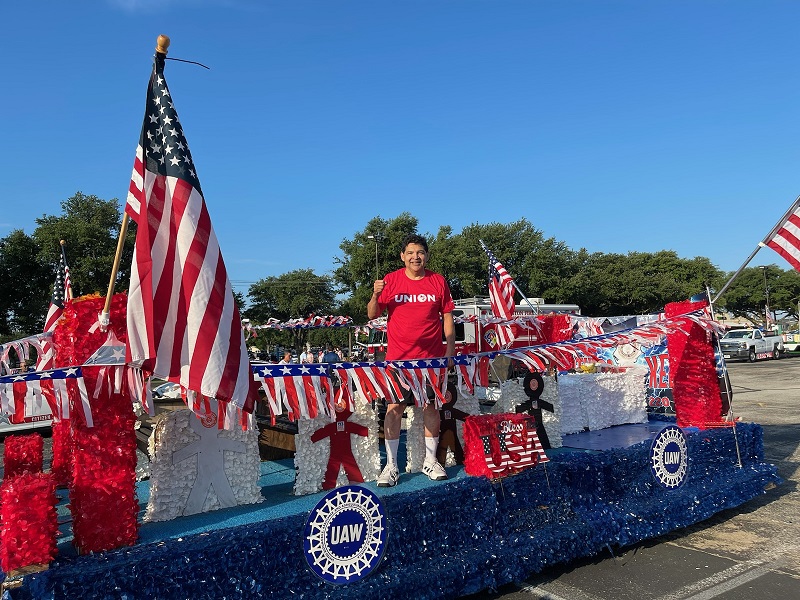
What does Independence Day mean to you? For Gerardo Contreras, pictured above, it’s a time for serious celebration. He decked out a beautiful float for labor’s participation in the 2023 parade in Arlington, Texas. Saint Gerardo is always making such tremendous contributions to North Texas labor.
In one of his most famous speeches, Frederick Douglas told white America, “This Fourth of July is yours, not mine, You may rejoice, I must mourn.” Douglas said that the Declaration of Independence was not a statement of fact, but only a promise for a better future. Martin Luther King Jr used that same theme in 1963. Dallas civil rights activist Kenneth Williams re-affirmed it on KNON radio last Saturday.
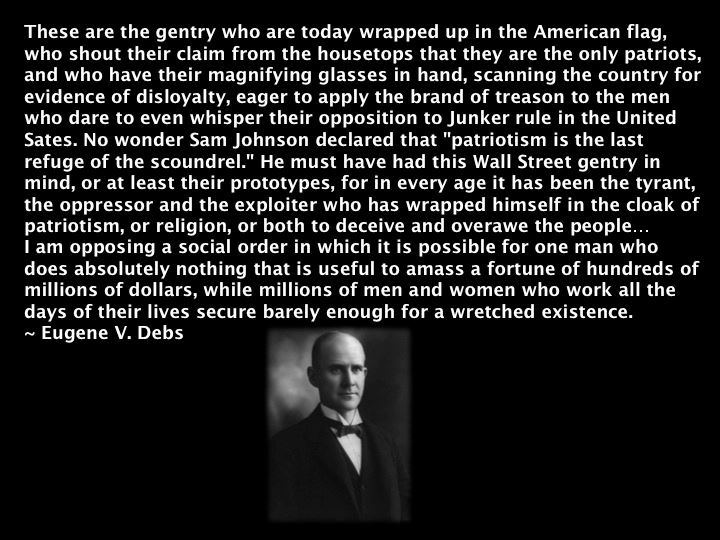
Labor organizer Eugene Victor Debs had harsh words for those who wave the flag while promoting pain and suffering:
As for me, I’m wiling to accept Frederick Douglas’ hopeful interpretation of Independence Day as a promise that is so far unkept. The problem is, and what everybody needs to figure out for themselves while musing about it, is this: Is the U.S. moving closer to keeping that promise or further away?
Who’s Promise?
Thomas Jefferson, the main author of the Declaration being celebrated, was a member of the ruling class of his day. In fact, he was an unapologetic slave owner who talked about everyone being equal while piling up wealth from the misery of Black people. If the Declaration was a promise, was it a promise from Jefferson’s ruling class or a promise from someone else?
If the Declaration was a solemn promise from the small layer of rich colonists who signed the Declaration, they are defaulting today. Americans are losing our constitutional rights. Americans are losing our economic rights. Americans are being pushed down into deep and inescapable poverty. Americans are suffering from climate change. Americans are being taxed so that the oil companies can take over European markets. Americans are dying on battlefields and incurring the guilt of killing many others. Americans are getting shot in their own neighborhoods, even on Independence Day!
The small layer of the ruling rich is betraying every promise made to the 99% of us who are forced to work for them. If the Fourth of July is their holiday celebrating their promise, they can stuff it!
Or Is the Promise One of Our Own?
If the promise in the Declaration of Independence is a promise we made to ourselves, then celebration might be in order. Even while our bosses shred our rights, heat up the Earth, and create new wars; we are learning and organizing. The younger generations carry more knowledge and organizing ability in their pockets than Jefferson or anybody in history ever dreamed of. It only remains for us to use it, and our 4th of July promise will be fulfilled!
–Gene Lantz
I’m on KNON radio’s “Workers Beat” talk show every Saturday at 9AM Central Time. KNON posts my podcasts on Wednesdays. If you are curious about what I really think and how I came to think it, check out my personal web site.
As long as I have been around the progressive movement, well over 50 years, we have expected to see some kind of American Worker’s Party break the two-party stranglehold over politics. Working families, then, would have a real alternative at the polls, we imagined. But it didn’t happen and isn’t closer to happening today. Maybe it’s time to give up on it!
Take a quick look at the history of 3rd parties. The last successful one was the Republican Party around 1859. What a thrill it must have been for the progressives of those days, most of them abolitionists, to have a new political party that offered real hope of ending the very worst of all ingrained American practices, slavery!
Then, let’s see, there were the Populists, mostly farmers, of the 1890s. They died when they endorsed the Democratic Party candidate for president. Gene Debs and the Socialists were able to get 1 million votes while their candidate was in prison, and it was sensational but not threatening to the system. President Theodore Roosevelt tried to get his career restarted with the Bull Moose Party before WWI, but didn’t get far. In 1947, former Vice President Henry Wallace tried to save the Franklin Roosevelt “New Deal” program. I recently read that he received a paltry 2.8% of the popular vote. Billionaire Ross Perot was effective enough in getting Republican voters to make sure that Democrat Bill Clinton won the presidency. The Greens have made some small inroads on Democrat voters, but were embarrassed when people learned that they were taking money from the Republicans.
In 2016 and 2020, lots and lots of American young people thought Bernie Sanders would either take over the Democratic Party from inside or create a powerful new progressive party, but Bernie has already endorsed Biden/Harris and I don’t know what those young revolutionaries may be thinking. Today, the Democrats are worrying that the “No Label” Party, financed by mysterious dark money, will take some of their votes and throw the 2024 election to Trump. But nobody is worried that we’ll end up with three viable parties nor that one of the two “main” parties will get replaced.
Side note: There is a party in existence called the “Working Families” party. They are interesting in states where they are allowed to endorse Democrats or Republicans, but not so much when they have to run on their own.
When I first heard of it, a Workers Party made sense. The unions still had over 20% of the workforce organized and were much stronger in politics than they are today. There were labor (or labour) parties here and there in other countries that were in and out of power from time to time. It just seemed like a natural intermediate step. But there are several reasons, today, to consider giving up the idea.
For one thing, we were just wrong about labor parties. We didn’t analyze the “winner-take-all” aspect of American politics. Other nations generally have parliamentary systems that allow proportional representation in governing bodies based on their percentage of the popular vote. They might win a few seats one year, add a few the next year, and eventually rise to power.
Not us. With America, nobody cares anything about proportions. It’s winner take all! If a party wins 49.9% of every vote in America, they still get nothing. The party with 50.1% gets everything.
For another thing, the organized unions that we were expecting to move up to the next stage of political power have diminished. We had about 35% of the workforce organized in the early 1950s, and we have about 10.1% now. Even if they wanted to launch a workers party, they might not have the strength.
The Bright Side
The positive way of looking at American electoral politics is to consider that progressives may not need any kind of political party to win power. Stages may not matter. With modern technology, especially mobile phones, smart people with a good program and a winning organizational model could organize almost anything in a matter of days. That’s what happened in the “Arab Spring” countries. They had no need for an interim political stage, but went straight from powerless to empowered!
Did the Labor Party Idea Just Wear Away?
Not so many years ago, I can remember top labor leaders saying that they, too, wanted a workers party. They said that building our political strength year by year within the two-party system would eventually give us the power to move off on our own. Now, I wonder if they were serious. I also wonder if the hope for a labor party is still alive among the top union leaders. I tried to find out this morning (June 16, 2023) when they were getting ready to vote, by a big margin, to endorse the Democratic ticket earlier than ever before in history. I was watching them on a webinar, so I asked innocently in the chat box, “Does this mean we’re giving up on the workers party idea?”
I didn’t get an answer. I was kicked out of the meeting and couldn’t get back in. It might have been an error. People make errors in webinars.
–Gene Lantz
I’m on KNON’s “Workers Beat” radio talk show every Saturday at 9 AM Central Time. They post my podcasts on Soundcloud.com, usually on Wednesdays. If you are curious about what I really think, check out my old personal web site.
Leonard, Aaron, “The Folk Singers and the Bureau: The FBI, the Folk Artists and the Suppression of the Communist Party, USA-1939-1956.” Repeater, 2020
Some of the first songs I ever learned were “Good Night, Irene” and “On Top of Old Smokey.” I still sing them. They were top-of-the-chart popular songs by The Weavers in the late 1940s. Then the Weavers disappeared and I didn’t hear anything about any of them until the late 1960s, when everybody knew and loved Pete Seeger, Lee Hayes, and Ronnie Gilbert. I didn’t know much about how J. Edgar Hoover and the FBI secret police hounded and threatened them and everybody who listened to them until I ran across this book.
Thanks to the young man who joined our “flying pickets” action for telling me about it. I think his name was Gregory something or something Gregory. He said I could get it through the public library, but I failed at that and bought it for Kindle from Amazon for $8.95. Good investment.
Attacking artists like the Weavers, Woody Guthrie, Paul Robeson, Sisco Houston, Hudie Ledbetter and others was supposedly justified by Hoover as part of his lifelong campaign against communists. The funny thing is, it’s kind of hard to call these artists reds. Sure, they were in and out of the CPUSA, but so were thousands of progressive and liberal-minded people in those days. I think what really pulled Hoover’s chain was the plain fact that they sang the truth, and fascists hate truth passionately.
I appreciate the author’s speculations, near the end of the book, as to just how much the world might have benefitted if these artists had been allowed access to audiences, recording studios, TV, and movies during those dreadful anti-communist witch hunt years.
Also, I appreciated the way the author gave the background of America’s witch hunt. Like most historians, he makes sure that the readers know that he doesn’t agree with nor approve of communists. People are still too afraid to say anything positive in print, but he does tell the truth about why CPUSA fell from a very large political force down to a miniscule one: government persecution. Not that they didn’t make some mistakes.
Leonard’s criticisms of CPUSA errors during the period ring true to me, because I have talked to old reds who lived through it. Their errors in dealing with the witch hunt came directly from misunderstanding the economic and political situation at the end of World War II. I can see why they would think that American fascism was imminent, but they were wrong and it led them to make unnecessary mistakes.
The folk singers didn’t make any of the decisions nor any of the mistakes. They just sang the truth and sang it well. That was plenty of reason for J.Edgar Hoover!
–-Gene Lantz
I’m on KNON’s “Workers Beat” talk show every Saturday at 9AM. They usually post my weekly podcast on KNON and on Soundcloud during Wednesdays. If you are curious about what I really think, you might look at my old personal web site.
Limited democracy, which characterizes our American political system, cannot endure another of its inherent crises. Change is coming. It will bring either furtherance of democracy or radical curtailment.
For explanatory purposes, examine the western world just prior to the great crisis of October, 1929. The people running things chose their way out of the great depression, some by radically increasing their democracy under Franklin Delano Roosevelt as chief executive; others chose to curtail democracy under Adolph Hitler.
It’s Present, not Future
The polarity between more democracy and less is underway. In Washington State, everybody can vote by mail. In Texas, the right to vote is being whittled away. In some places, abortion rights are enshrined in constitutions. In others, women have no rights at all. In some of the world’s places, gay marriage is common. In others, homosexuality carries the death penalty.
Political parties in the United States each take almost 50% of the vote. Neither more democracy nor less has triumphed, but small, quantitative changes add up historically to big, qualitative change. One more crisis will push us one way or the other.
Choose Your Crisis
As Finland and Sweden join NATO and the war in Ukraine continues, the siege of Russia is set. American oil companies, already taking over Russia’s European markets, will not be restrained from bringing nuclear war closer and closer.
In the East, America is re-establishing bases in the Philippines, training South Koreans, and strengthening ties with Taiwan. As America’s proxy war grew strength in Europe, President Biden tried to turn it toward China. Mighty navies and air forces crisscross the South China Sea. An American general predicts war with the world’s second largest economy within two years.
Sea levels and carbon in the atmosphere continue to rise. Thousands of tons of ice have already melted. Giant ice shelves hang precariously over the ocean. Storms, floods and droughts are already taking lives and threatening food production.
Bank failures within the United States terrify economists. Untamed inflation forces governments to choose between potentially disastrous monetary policies and, for them, unthinkable fiscal policies against the ruling rich. Smaller nations are joining the interlocking BRIC economies that challenge the “American Century” of domination. Reactionaries in the U.S. Congress announce their intention to bring about a worldwide financial meltdown.
The leadership that is offered has hardly any credibility. The most popular politicians capture less than 50% approval ratings. Institutions, such as the U.S. Congress, can’t get above 30%. In “democratic” America, fewer than 50% of the voting age population turns out even in the most highly publicized elections. 30% do not even register.
Choose your crisis, all of them are at hand.
A Program for More Democracy
Our choice has to be more democracy, not less. Our choice is peace; clean air and water; pro-worker economic policies; and leadership we can believe. To take the limits off our American democracy and give people say-so in international and economic affairs, which we do not have and have never had, we must organize.
Organizing is an incremental process. If we take the side of working families on every issue, if we build the organizations that win for working families on every issue, we will be ready to demand and win more democracy during the next crisis. The alternatives are unthinkable.
–Gene Lantz
I’m on KNON.ORG “Workers Beat” radio talk show every Saturday at 9AM Central Time. My weekly podcasts are on their web site and “Workers Beat Extra” on Soundcloud.com. If you are curious about what I really think, check out my old personal web site
Hochschild, Adam, “American Midnight. The Great War, a Violent Peace, and America’s Great Crisis.” Mariner Books, 2022
I found a free Kindle copy through the Dallas public library’s “Libby” service. Now I wish I had a hard copy because of the facts in this history of America from 1917 to around 1924. You could call it the Red Scare. You could call it the most shameful period after the Civil War. Or you could call it a warning about today and tomorrow.
This book changed my view of the period. Previously, I thought that government had simply allowed vigilantes to run amok — arresting, assaulting, and lynching just about anybody they chose. That was bad enough. Having reach Hochschild, I now realize that government was not just standing aside, they were actually fomenting, cooperating, and leading the nastiest gangs of racists they could find. Nearly all the spying was done by government hires. The worst of the mass acts of repression came directly from government agencies.
One might think that the Justice Department would have stood for justice, but they were probably the worst perpetrators. A lot of the worst assaults were called the Palmer raids, after Attorney General Palmer. After them came, probably, the armed forces; but many government offices were in on it, including the post office! J. Edgar Hoover, notorious race baiter, union hater, and all around sociopath, made his chops in the period. We were stuck with him for another 50 years!
Near the end of the book, Hochschild tries to tote up the numbers of people killed, horsewhipped, imprisoned, deported or otherwise deprived of life and liberty, but it’s a hopeless task. Besides, he’s basically talking only of federal cases. All the nasty things that happened at state and local levels would probably have doubled or tripled the size of the book. Then there’s the non-government participation of anti-union bosses and ideologically-driven racists and nativists to consider!
The rationale for the horrors began when Woodrow “He Kept Us Out of War” Wilson was re-elected in 1916. A lot of Americans, including the growing Socialist Party and some of the members of the Industrial Workers of the World, strongly opposed the war. The repression was originally released against anybody who did not want to join the bloodfest. But why, anyone might ask, did it continue after the end of the war and well into the 1920s? The excuse used most was Bolshevism, but the targets were American working people.
There are a couple of things I would have liked to have found in this account. The Greencorn Rebellion in Southeastern Oklahoma was an early expression of anti-war feelings among sharecroppers, including whites, Blacks, and Natives. I would also have appreciated an attempt to go beyond tallying assaults, deportations, imprisonments, and murders just to find out how many workers lost their jobs during this awful period. Of all the terrible things that government and employers do to workers, the most widely applied, and thus the most effective, is to deprive us of the ability to earn a living.
Hochschild clearly condemns certain government officials. He leaves the final judgement of President Wilson open to debate. He gives some credit to “good guys” such as Emma Goldman, Kate Richards O’Hare and of course Eugene Victor Debs. He mentions Frank Little, one of the first anti-war spokespersons lynched. William Z. Foster, who worked through the whole period to try to bring the labor movement together and develop its fighting potential, remains hidden in our histories.
I have always found it interesting to speculate what might have happened in America if different leaders had headed the Socialist Party, the IWW, or the AFofL. Worldwide, the many socialists capitulated early and supported their governments in World War I. There were only two that didn’t. The other one was Russia.
–Gene Lantz
I’m on KNON.org’s “Workers Beat” radio talk show every Saturday at 9AM Central Time. I have about 150 podcasts under the name “Workers Beat Extra” there, too. If you are curious about what I really think, check out my personal web site



 genelantz