Archive

Tag Archives: #1u

Several socialist groups came together on April 29, 2018, in Lake Cliff Park in Dallas to celebrate MayDay. They were kind enough to allow the oldest person in attendance to remind them of the long workers’ tradition by leading singing of “The International.”

Another Mayday celebration, by another group of socialists, takes place at Kidd Springs Park at 5:30PM on May 1st. One cannot help but observe that the progressive movement, even the activists who supposedly have the highest levels of consciousness, continues to be disunited. It’s like Will Rogers used to say about the weather: “Everybody talks about unity, but nobody does anything about it!” I believe the trend, though, is positive.

The trend toward celebrating the International Workers Day is a very positive sign. I can remember reserving that very same Lake Cliff Park pavilion May 1, 1984, and doing all the preparations and publicizing myself. Then I sat there, alone, for two hours hoping somebody would come, but they didn’t! This year, we have two of them. The first one had about 40 people, and I imagine the second will be at least as big.

I’ll be doing a talk about “MayDay Then and Now” at Roma’s Pizza, 7402 Greenville Avenue, beginning at 6 pm on Saturday, May 5th. I’d like to count that as a third MayDay celebration. Every year, I publicize MayDay on my radio show.

MayDay Has a History

The workers’ movement, of course, goes back at least to Moses and the slaves of Egypt, and workers probably celebrated the vernal equinox around MayDay long before they had calendars. But the year 1886 marks the close association of the workers’ movement with May 1.

That year, the word went out from Chicago for a worldwide general strike to demand the 8-hour day. There were protests everywhere. Strikers were killed in Chicago. A police riot erupted on May 4th during another rally in Haymarket square. Authorities came down hard on the Chicago movement and, in 1887, hanged four of the main leaders. Since then, the world remembers “Chicago, 1886” on May 1st.

The repression from the bosses combined with the opportunism of many American labor leaders separated the Americans from the International Workers Day; consequently there have been few celebrations here until recently.

Was Labor Stronger Before?

Almost any reading of labor history will bring out the romantic in us. We long for the great general strike of 1874, or the worldwide struggle of 1886, or the organizing frenzy of 1935-1947. In 1980, when the American government decisively teamed up with the bosses to suppress the labor movement, unions began a numerical free fall that continues today. We had 35% of the workforce organized into unions, and we have only 11% now. People dream about the good old days.

No, We’re Stronger Now!

But despite the decline in union numbers, American labor is actually stronger today than ever. Part of the reason is productivity, but most of it is education. One worker today is four times as productive as those who organized in 1935-47. If one worker walks off the job today, it’s like four workers striking in the old days.

We have more unity than ever. In 1935-47, remember that the American Federation of Labor and the Congress of Industrial Organizations were two separate and competing organizations. Remember also that racism and other kinds of chauvinism were far more divisive in the “old days” than they are today. The AFL-CIO didn’t even try to organize the millions of undocumented workers before 1999 — they joined the government in calling for deportation!

Today, the AFL-CIO bends over backward to work with church, civil rights, and community organizations. In 1987, unions were so totally isolated that five of the more progressive ones had to create a separate organization, Jobs with Justice, to try to build solidarity outside the official labor movement. Today, virtually all unions have gone past their initial hostility and regularly work with Jobs with Justice and other solidarity efforts.

In the old days, many workers were barely literate. Today, we command more information than they could have imagined. With our phones and computers, workers have the ability to function as almost a single worldwide unit. That’s power! We’re only at the first stages of using it, but today we have the power!

–Gene Lantz

I’m on KNON radio at 9AM Central Time every Saturday. Podcasts can be found from the “events’ tab. If you are interested in what I really think, look at my personal web site.
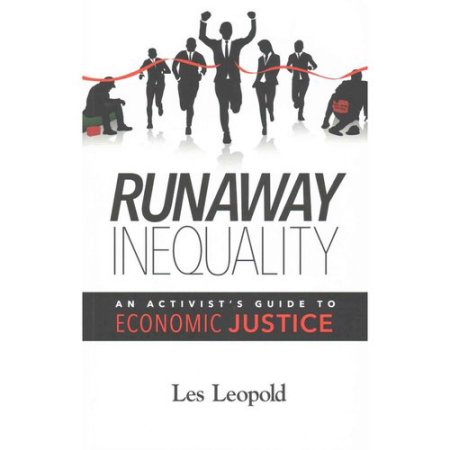


It is absolutely wonderful that the Communications Workers of America are buying books and teaching classes on “Runaway Inequality” by Les Leopold. It stirs a lot of thinking.

runawayinequalitybook

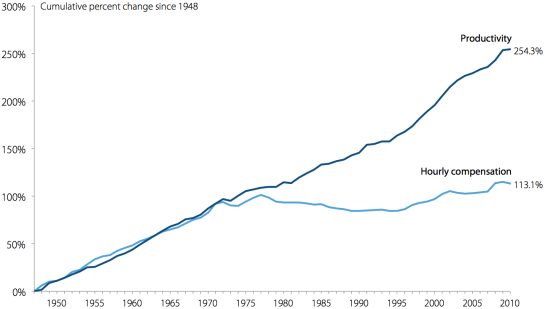
The core argument is that something has been seriously wrong in America since the mid 1970s, when wages stopped rising at a rate similar to the increasing productivity. Productivity is the amount of wealth that one average worker creates in one average working hour.

productivity-wages

As the graph shows clearly, wages and productivity seemed to rise together from the late 1940s to the mid-1970s, then productivity continued rising with the same upward slope, but wages flattened out. Profits rose, but wages didn’t. The change, Les Leopold says, came about because of deliberate policy changes. The book is full of other graphs showing the policies that changed, the resulting inequality, and the amazing effects of this incredible rise in inequality. Leopold then concludes by saying that ordinary Americans must band together and change those policies. In other words, wage-earners have to do what the bosses have been doing. It’s a “must read” book, and the classes (I’ve taken them twice) are inspiring!

There are further questions

  1. Is the period 1947-2016 a representative period of history, or is it unusual?
  2. Is the problem local or systemic?;
  3. Given the situation described in the book, is there really a solution for wage-earners?

What period of economic history is “normal?”

The entire book and all its conclusions come from the hypothesis that something went wrong in the 1970s. I have my doubts. The unusual period in American history was not 1974-2016, as Leopold suggests, but 1947-1974, the first part of the graph. In other words, there is nothing unusual about wages being suppressed in a capitalist economy. The unusual period was 1947-1974.

Take a quick look at how unusual was the post-war world:

  • Europe and Asian were bombed flat. American had virtually no competitors in the capitalist world
  • American unions were far stronger than in any time in history
  • The United States set the terms for all economic transactions in the capitalist world
  • The United States had almost all of the world’s gold

Then look at how things changed: By 1974, German and Japanese automobiles were flooding the world. President Nixon had given up America’s control over gold. Unionism had peaked around 1957 and was clearly slipping. The Chinese were having tea with Nixon and had broken up their alliance with the Soviet Union. Economic competition between nations was getting back to “normal.” What every nation had to do, to compete, was lower their costs. Their costs are our wages and benefits.

Is the problem local or systemic?

Our problems derive from the system we live in. American working families are having pretty much the same problems that other capitalist nations are facing. We have probably lost more than the families in other nations since the mid 1970s, but we had more to lose. The lords of American industry and finance have been able to hold on to their hegemony in the world only by sacrificing our wages and benefits.

Even worse, the long-term process of robbing working families entails destroying our democracy. The end of World War II was a triumph of democracy, and nowhere was democracy stronger than here, in the land of the winners. Several of Les Leopold’s graphs show how democracy is diminished. A very striking one is the graph showing that the United States has more people incarcerated than any nation of any size in the world! Today, many people are saying that we live under a plutocracy and that democracy is dead and gone.

It isn’t true. The absence of democracy is fascism, and we don’t have fascism in America. Even in 1947, our democracy was not complete. It was partial. Since the mid-1970s, our democracy has faded, but not disappeared. If the process continues as it is going now, it would be fair to say that fascism is the logical outcome. But it hasn’t happened yet.

Is there a solution?

Given the system we live in as described in “Runaway Inequality,” are we likely to be able to reverse the policies that have brought disaster for working families since the mid 1970s? No. What happened since 1974 is not unusual, it’s part of the ordinary process of world capitalist economics.

If there is a solution for American working families. it will come from a different system.

Gene Lantz

I’m still on KNON radio, 89.3FM, every Saturday at 9AM Central Time. If you’re interested in what I really think, check out http://lilleskole.us


On the “Workers Beat” radio show this morning, I interviewed advocates for Dallas County Schools, a public service that provides transportation and safety for children going to North Texas schools. We are experiencing a propaganda blitz calling for us to vote “against” them in the November 7, 2017, election. How we came to this little historical intersection is an interesting story, and it illustrates a much larger problem for our world under capitalism.

privatization-stop

Today’s radio program was the third time I’ve had advocates for Dallas County Schools. The first ones were bus drivers organized by an independent union. They complained that somebody was out to smear their driving records but, when one considers that they log 106,000 miles per day, their driving record was pretty good. Co-Host Bonnie Mathias and I smelled a rat even then. We decided, without any explanation or prompting, that somebody was out to privatize Dallas County Schools.

When I interviewed the interim superintendent and the organizer for National Education Association later on, I was convinced that privatization was indeed the issue. They said that Texas Senator Don Huffines had originated the entire process with legislation calling for the vote. Although the “remedy” he proposed was complicated, it was skewed toward privatization, said my interviewees.

A Board member who hasn’t been on my radio show had contacted the Dallas AFL-CIO for help a few weeks ago. I sat in on the meeting. Later on, she and I corresponded as I tried to get to the bottom of what was going on.

Today I talked with a Board member and another union official. They went over the charges listed on the three expensive 4-color mailings I have received. They refuted them one by one. Mistakes had been made in the past, they said, but the superintendent and most of the Board had been replaced since then and rectification was under way. Further, the charges against them were overstated or even out right lies!

Nobody mentioned it on the radio, but they said there have been at least 5 robo-calls urging the voters to vote against them. Who paid for five robo calls and 3 big mailings? They said that the mysterious “Protect Dallas Kids” organization that opposed them had filed the required legal reports. They received money from the Dallas Citizens’ Alliance and one of the biggest corporation in North Texas, AT&T. A great deal more had been spent than had been reported, they said.

The Dallas Citizens Committee’s involvement was no surprise. Their main front is the Dallas Morning News, which has editorialized against the Dallas County Schools.

Other than Senator Huffines, I could only find one name associated with the propaganda blitz. The Treasurer, which is required to be listed on political propaganda, is also the Treasurer of the Dallas Republican Party. The address given is right outside Dallas County, but is in Huffines’ Senate District.

As I wrote in the Dallas AFL-CIO newsletter, the anti-worker credentials of Senator Don Huffines, the Dallas Morning News, and the Dallas Republican Party are well established. We stand with the workers!

There’s a Much Larger Lesson

In general, capitalists want to privatize everything. They have already privatized many of the prisons, much of the space program, and a great deal of America’s war machine. They argue that business can do everything cheaper and more efficiently than government, even though even the most shallow thinker can see why they can’t — to every expense they have to add profits.

Almost any form of economic activity can be used to generate profits. That’s why they keep trying to privatize everything. It’s a major issue in so-called trade negotiations as the big transnational corporations try to crate more profit centers all over the world.

The Speaker of the House, Paul Ryan, has been trying to privatize Medicare for years. So far, the Senate has stopped him, but that doesn’t mean he won’t keep trying. They also want to provide everything having to do with veterans’ care.

Unions generally oppose privatizing. We argue that it leads to fewer services and more costs.  On the other side, the bosses look for any kind of problem that a public service may have, then they use that to argue for destroying the public entity and substituting themselves. That’s what’s going on with the Dallas County Schools, and it’s going on all over the world.

When we have a public service, there is always a possibility of corruption; but when we privatize, corruption is guaranteed!

–Gene Lantz

I’m on http://knon.org/workers-beat/ every Saturday at 9 Central Time. If you’re interested in what I really think, try http://lilleskole.us