Listening to almost anybody talk about American politics today unavoidably leaves one with the impression that they don’t know what they’re talking about. Populist? Nationalist? What do all those terms mean, if anything?

nationalismquote

Click here for a glossary and lesson on political words. Click here for my previous analysis.

What one considers good or bad in politics depends on how one understands the idea of progress. Everything is moving in one direction or another all the time. A positive trend in politics is one that strengthens our side in the lifelong battle with our employers, or one that weakens the employers’ side. That’s progress.

Progressive for Whom?

If ordinary working people are strengthened by being more unified, or better informed, or by attaining positions of power, that’s progress. Progressive people are those who strengthen workers against their employers. Organizing a new union, for example, would be a progressive thing to do. Helping workers make good electoral decisions by providing useful information would be progressive.

Causing an unnecessary split in a workers’ organization is a reactionary event, the opposite of progressive.

“Left” and “Right” are Fuzzy Concepts

During the capitalist revolution in France around 1789, one group sat to the speakers’ left in parliament and another group sat to the right. That’s where we got “left wing” and “right wing,” but it’s really hard to tell what they mean today. Besides, everything is moving so what’s left today is right tomorrow!

If “Left” is Good, Then Is “Ultraleft” Even Better?

Serious activists might think “left” means “favoring the workers,” but “ultraleft” is a special term that does not mean “even more favorable toward the workers.” An ultraleft is an egotist willing to do anything, progressive or reactionary, to draw attention to themselves. Ultraleftism is a real pain in the movement. It’s been called “the infantile disorder.”

“Liberal” and “Conservative” are Confusing

If a liberal is a nice person who cares for others, what’s a neoliberal and why do the South Americans seem to hate them so? Is a neoliberal the same thing as a neoconservative or neocon? Actually, yes.

If a politician is racist and misogynistic, but votes for a giant boondoggle for his/her home district, is she/he a liberal or a conservative? If another politician is really stingy on government spending but promotes abortion and gay marriage, what is he/she?

Who’s Middle Class?

It’s common now to confuse “middle class” with “middle income.” I think the unions distorted the definition because union people, it’s true, make more money than other workers and, especially with overtime pay, often get into the middle income range.

The only useful meaning of “middle class” is that they’re neither bosses nor employees. So small shop owners, professionals, preachers, policemen, union staffers, and all the people “caught in the middle” in the great fight between workers and bosses, they’re the middle class.

The French revolutionaries called them “petit-bourgeoisie” or “small capitalists.” Ultraleft supercilious nut cases use it as a derogatory term.

Everybody hates being called middle class and will argue with you until they’re blue in the face about it, but if you can’t understand “middle class,” you probably can’t understand “worker” or “employer” either. Without clarity on those concepts, I don’t see how anybody understands anything about politics.

What’s a Populist?

It’s gotten popular today to talk about “populism of the left” and “populism of the right.” Supposedly clever people refer to Senator Bernie Sanders and Presidential Candidate Donald Trump that way. But what does it mean?

The populist movement of old was made up of agricultural interests banded together politically to fight against the industrialists who were taking over the nation. The populists lost. That battle has been over for some time.

Google says a populist is “A member of a political party claiming to represent the common people.” But don’t all politicians do that? Click here for Wikipedia’s treatment.

I’m pretty sure that what the pundits mean nowadays by “populist” is a candidate that doesn’t directly represent the employing class. As no candidate ever says he/she directly represents the employing class, it’s a pretty meaningless term.

What’s a Nationalist?

There are books on this. Nationalism, dividing people’s interests more or less by their region of origin, is usually divisive and hence reactionary. Not always, though. Groups of people fighting imperialist domination may be using nationalism in a very progressive way. People that use it to split the overall progressive movement, though, need to be avoided.

Think of the Class

If one sticks to the idea that workers are the only ones who can really overcome their employers, and that strengthening our side or weakening the employers’ side is the definition of “progressive,” one can be more clear in their communicating and their own thinking. Always, think of the class!

–Gene Lantz

Click here for more of these ideas


Don’t let the dry lifeless movie critics talk you out of seeing this wonderful film!

freestateofjones

Movie review: “Free State of Jones,” Directed by Gary Ross, 139 minutes

Movies, books, statues, and historical markers all over the country romanticize the Confederacy. The truth is that it was a nasty war fought for nasty reasons. Here and there, southern people resisted the confederacy to the point of armed struggle. It’s incredible but true, though, that local farmers, deserters, and runaway slaves combined to win military victories against Confederate soldiers around Jones County, Mississippi

I read the book some time ago and was really looking forward to this movie. If there was anything at all disappointing, it’s because the film followed the book a bit too closely. The facts for the book were mostly taken from a miscegenation trial in the 1930s involving one of the many descendants of guerrilla leader Newton Knight and his runaway slave wife, Rachel. The people’s uprising in Jones County is the best part of the story, but the book and movie add on a lot of the dismal history of Mississippi afterward.

BTW, the state just closed the case of the murder of civil rights martyrs Chaney, Goodman, and Schwerner; so ugly history marches on in Mississippi. We just noted the anniversary of the gutting of the Voting Rights Act by the Supreme Court, and it’s extremely relevant to this film.

Movies like the blockbuster success “Gone With the Wind,” are ordinarily more than happy to lie about what really happened. This one doesn’t. Go see it!

Movie review: “Genius,” Directed by Michael Grandage. 104 minutes

People who like a little action and a lot less talking in their movies aren’t going to like “Genius,” but I cried through part of it and thought it was really worthwhile. Fans of Ernest Hemingway, F. Scott Fitzgerald, and, especially, Thomas Wolfe, are already aware that their editor, Maxwell Perkins, is given a lot of credit for their books’ successes. This is about Perkins and Wolfe, and it’s almost 100% dialogue.

The movie critics don’t like this one either, because the two men are more or less reduced to stereotypes, or so they say. I say that trying to explain Perkins and Wolfe would be a difficult assignment, but one worth doing. I’d be curious to know if other film makers could have done it better.

If you don’t know or care about Maxwell Perkins or Thomas Wolfe, you wouldn’t like this movie. If you do, though, it’s a fine film.

Movie review: “The Neon Demon,” Directed by Nicolas Winding Refn. Not sure of length.

If someone is just dying to see Elle Fanning in her skivvies, they might want to see this movie about innocence and high fashion. Oh yes, there’s one really nice shot of a mountain lion. As the wide-eyed protagonist meets savage fashionistas, one begins to realize that something truly terrible is going to happen at the ending. But is it worth sitting through long, boring, unrelated technical movie tricks to get to it?

The only real crime that will cause me to walk out of a movie is that it’s boring. This one is.

–Gene Lantz

Click here for more of these ideas


It’s June 25th, the 81st anniversary of the Fair Labor Standards Act. We can thank President Roosevelt and Labor Secretary Perkins for this greatest accomplishment of America’s centuries-long fight for shorter working hours.

haymarketvoices

Four Chicago leaders of the 8-hour day were hanged in 1887

A number of Americans were killed when we led the worldwide fight for the 8-hour day in 1886. The Chicago Haymarket Martyrs are the best known. Workers still make pilgrimages to their grave site.

YouTube has a darned good description of the fight as it took place in Milwaukee, Wisconsin. One of the good things about it is that it has a miner’s version of the “8-Hour Song” that was sung everywhere.

The Fight Was Set to Music

I don’t think it’s the best version. The words for the best version are below and they are worth studying for the pure art of it, not to mention the great historical importance. I can’t find this version on YouTube and so I made up a tune and sang it myself. It’s on my Gene Lantz Facebook Page.

We’ve Always Fought over Working Hours

One could say that the entire history of labor could be written as a fight over working hours. I’ve written about that before.

The Battle Continues

For many years, millions of workers have been exempt from the Fair Labor Standards Act and could be worked pretty much endlessly with no extra pay. Among them are low-paid “salary” workers. The Obama Administration’s Department of Labor recently changed the rules so a lot more people could get overtime pay. Almost immediately, a coalition of bosses sprang up to oppose it. I wrote about that, too.

–Gene Lantz

Click here for more of these ideas

The 8-Hour Song

We mean to make things over,

We are tired of toil for naught

With but bare enough to live upon

And ne’er an hour for thought.

We want to feel the sunshine

And we want to smell the flow’rs

We are sure that God has willed it

And we mean to have eight hours;

We’re summoning our forces

From the shipyard, shop and mill

Eight hours for work, eight hours for rest

Eight hours for what we will;

Eight hours for work, eight hours for rest

Eight hours for what we will.

**

The beasts that graze the hillside,

And the birds that wander free,

In the life that God has meted,

Have a better life than we.

Oh, hands and hearts are weary,

And homes are heavy with dole;

If our life’s to be filled with drudg’ry,

What need of a human soul.

Shout, shout the lusty rally,

From shipyard, shop, and mill.

Eight hours for work, eight hours for rest…

The voice of God within us

Is calling us to stand

Erect as is becoming

To the work of His right hand.

Should he, to whom the Maker

His glorious image gave,

The meanest of His creatures crouch,

A bread-and-butter slave?

Let the shout ring down the valleys

And echo from every hill.

Eight hours for work, eight hours for rest…

Ye deem they’re feeble voices

That are raised in labor’s cause,

But bethink ye of the torrent,

And the wild tornado’s laws.

We say not toil’s uprising

In terror’s shape will come,

Yet the world were wise to listen

To the monetary hum.

Soon, soon the deep toned rally

Shall all the nations thrill.

Eight hours for work, eight hours for rest…

From factories and workshops

In long and weary lines,

From all the sweltering forges,

And from out the sunless mines,

Wherever toil is wasting

The force of life to live

There the bent and battered armies

Come to claim what God doth give

And the blazon on the banner

Doth with hope the nation fill:

Eight hours for work, eight hours for rest…

Hurrah, hurrah for labor,

For it shall arise in might

It has filled the world with plenty,

It shall fill the world with light

Hurrah, hurrah for labor,

It is mustering all its powers

And shall march along to victory

With the banner of Eight Hours.

Shout, shout the echoing rally

Till all the welkin thrill.

Eight hours for work, eight hours for rest…

We all hear about “drawing the line” and “crossing the line.” They say in Texas that it has something to do with the Alamo, but there’s a more universal line. It’s the class line.

picket

The physical line between bosses and workers is the picket line

It’s not always simple to figure out who we’re talking about when we sing the great old union song, “Which Side Are You On?” Almost everybody pretends to be on our side.

One could pick around all day trying to sort out exactly who is in the capitalist class, the working class, and the middle class. We can categorize ourselves over and over again as we consider different issues such as gay marriage, global warming, gun control, art lovers, art haters, renters or owners, etc etc. But the important line is the one between workers and bosses. There’s a sure-fire way to know just who is on the workers’ side and who is on the other side.

It’s the issue of wages

Our side wants better wages. Their side wants worse wages.

A new organization has been formed to fight against the Obama Administration’s change in the overtime law. The new law gives considerably more wages to certain workers, and the new organization, “Partnership to Protect Workplace Opportunity,” (who do they pay to come up with these names?) is on the opposite side of the line that really matters. You can look at their list at http://protectingopportunity.org/about-ppwo/ On their side you will find the National Restaurant Association, the U.S. Chamber of Commerce, Associated General Contractors, Associated Builders and Contractors, Jimmy John’s, and lots of  banks, insurers and  auto dealers.

Usually, when they are trying to influence legislation, they sneak around about it so we don’t know who they are. Read Dark Money. I guess the new organization is trying a new tactic by letting us know who (some of them) they are. Maybe they think it will intimidate us?


What they have in common is that they’re all for worse wages. They’re all bosses. They’re all against us. It’s good to know about them.

–Gene Lantz

Click here for more of these ideas

tppflag

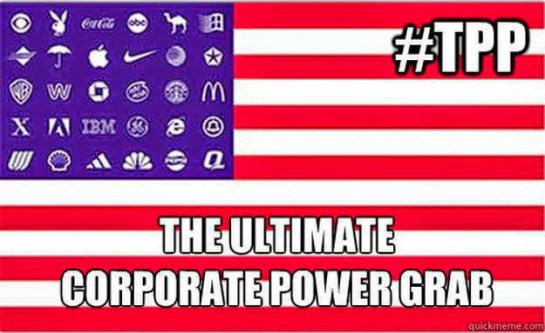
The “Trans Pacific Partnership” is next in a long list of so-called “free trade” bills awaiting Congressional approval. The others were passed during the Clinton and Bush Administrations, and President Obama is hoping to get this one passed in the last session of 2016. It’s a “lame duck” session in which many congresspersons don’t feel as responsible toward the people who watch them but don’t pay them off.

Earlier, President Obama was able to get “fast track” legislation to grease the wheels so that the TPP could slide through without serious discussion or public scrutiny. Unions and environmentalists are dead set against any more of these bills because they mean lost jobs, lower wages & benefits, and more pollution. There’s a good reason for that.

Corporations Run The Process

Unions and environmentalists have no participation in creating the secret treaties. There are representatives, special trade envoys, from the governments involved — but there are also hundreds of corporate lobbyists in the process! Mighty transnational corporations write these things for their own benefit.

What do the big corporations want? They want low wages & benefits and the right to pollute. They want a free hand to do anything they want and make as much money as can be made.  So far, that’s what they have gotten. That’s what the TPP offers them. What does it offer us?

It Isn’t Trade, and It Isn’t Free

What is misnamed “free trade” sets up a separate legal system that overrides the democratic rules of each country involved. That system issues licenses to steal to the corporations who created it. The system guarantees corporate profits, even when the corporation breaks our state or federal laws.

They call it “globalization.” I call it “gobblelization.”

–Gene Lantz

Click here for more of these ideas

ara-bernie

The old joke has the farmer giving  confusing directions and then concluding, “No, I guess you can’t get there from here!”

I just read, on Peoples’ World, a pretty good explanation of anthropology, from primitive communism through slavery and barbarism to capitalism. Then there’s a nice projection about a much better stage of economic production called socialism.

Millions of Americans, and probably billions of people in the world, have had about all the capitalism they can stand and are ready for socialism. The Bernie campaign showed that clearly here at home. So folks are ready to move on to a better place, but the problem is trying to get the directions straight.

As I said in my last post, some people got discouraged and have already concluded, “You can’t get there from here.” I’m not one of those, but I do recognize that there are a lot of differences in opinion in just how socialism could be achieved.

Socialism from an Invading Army?

I received a note just yesterday from someone who said socialism won’t happen in the U.S. but will come in from elsewhere in the world. He didn’t say exactly how that was going to happen, but it’s possible that he thinks socialism will be established elsewhere and then they will send an invading army to bring it to America. When capitalists have their nervous fingers on nuclear weaponry, I kind of hope that’s not likely.

I think, at one time, a few people might have hoped that the Soviet Union would defeat the U.S. in war. I don’t think the Soviets ever thought that. I know I didn’t. I’m sure glad they didn’t try!

It’s not very hopeful, either, that Americans will come to admire some socialist society so much that they will want to emulate it. The best example I can think of is Cuba. Like any revolutionary society, they find themselves suffering mightily from the economic machinations of the capitalists who control the world’s economies. People might want socialism, but they darned sure don’t want to be poor if they don’t have to!

Socialism from elections?

I think a lot more Americans are hoping socialism will come about in an election.

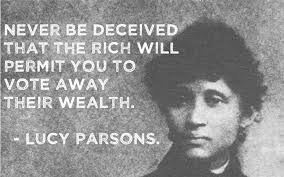
lucyparsonsquote

Socialist Eugene Victor Debs received a million votes while in prison for opposing WWI. Communists and socialists received fairly decent vote totals in the 1930s. They won some races in New York. Socialist groupings still run candidates, and one of them actually won a minor race a couple years ago in, was it Washington state?

Candidate Bernie Sanders wasn’t afraid of the word “socialism” in his campaign, and his millions of followers aren’t afraid of it either. I think they, some of them, believe they are going to reform the Democratic Party to the extent that it will actually break with capitalism and lead us to a better world. Wouldn’t that be nice? Whether they win that battle or not, everybody wins when we achieve more democracy.

I don’t think they are going to reform the Democratic Party, but bless them for trying. I do think that their efforts might someday result in a workers party, and that would be a tremendous step forward for the American people. It wouldn’t be socialism, but our electoral choices would be a lot better than they are now.

Socialism from Guerrilla Warfare?

In my day, a lot of young people were so taken with Fidel Castro and the Cuban revolution that they thought we should pick up rifles and head for the mountains here in the U.S.. You really have to admire the brave  Fidelistas. I admire a lot of people in history, but I don’t think that copying them amounts to much of a plan. As far as I know, all the Americans in the mountains with guns right now aren’t on our side.

At one point the Black Panthers had guns, but they weren’t trying to overthrow anything with them. They were trying to provide decent protection for African American communities suffering from certain policemen and other criminals. Even that was mostly unsuccessful.

Socialism Through Unionism?

The Industrial Workers of the World thought they were going to achieve socialism by on-the-job organizing. Once all workers, or a sufficient number of workers, were organized, they could just sit down until capital capitulated. I admire that. I’m 100% for more unions and stronger unions. Actually, it seems kind of reasonable, but the IWW’s thinking has the same flaw as the other simple theories I’ve already mentioned. What flaw?

We Aren’t In This Game by Ourselves

There are people on the other side. Enemies. Smart people. Powerful people. Secret people, so secret that we hardly ever hear about them except every now and then when somebody writes a great book like Dark Money. We might call them “the 1%,” or “capital,” but the simplest designation is “the bosses.”

If they didn’t exist, or if they were stupid, or if they were impotent, any old strategy to achieve socialism would work just fine. But they’re not.

If we want to achieve lasting progress, we have to get really serious.

–Gene Lantz

Click here if you’re interested in more

In a casual discussion group I participate in, somebody asked, “Where are we in the swing of the historical pendulum? Are we close to revolution?”

Che

I didn’t try to answer at all, because I couldn’t deal with the way the question was framed. There is no “historical pendulum.” It’s common to believe that history just swings back and forth or goes around in circles, but it doesn’t. The general movement of history is forward and progressive. We aren’t savages any more, most of us, and we aren’t serfs nor slaves. Over the centuries, progress is being made.

But later, I wished I had answered the question, because my analysis may seem unusual to some people: Revolution in the United States and in most of the world may be just around the corner!

Doom and Gloom

OK, there are a lot of naysayers and former radicals among us today. The implosion of the Soviet Union hit hard. The rapid change in Eastern Europe devastated some folks, and the difficulties they’re having in Venezuela and Brazil today are squeezing the optimism away. Add to that the tremendous success that dark money has enjoyed in turning our American democracy backward during the last 4 decades. It’s enough to get some people down. Some people. But they aren’t taking the long view.

The Long View Looks Great!

What are the requirements for a qualitatively better society? A well informed and well organized public with leadership from among the workers. We have that, more than ever!

Nowadays, I am in awe of the millennials. They grew up understanding more about using new technology than I will ever learn. Technology extends their knowledge and their capabilities.

The millennials also grew up without all the anticommunism that crippled the thinking of my generation. When I was young, we were afraid to even look to the left, much less think in that direction. The Bernie campaign has made “capitalism” and “socialism” everyday words. People are thinking thoughts that used to be taboo.

Today’s young people have the entire world at their fingertips. Most of my generation would never have left home if it hadn’t been for the military draft.

Don’t Overlook the Unions

Unions are the organized sector of the working class. It’s true that there aren’t as many union members per capita as there were in 1957, but that’s misleading. One worker today is doing the work of 4 pre-war workers. And he/she is likely to be highly skilled and hard to replace. Workers are just as central to the progressive movement as they were in Russia in 1917 and every year since! Nobody else can stand up to the bosses eyeball to eyeball, but workers can!

Older people think that the 1960s and 1970s were the revolutionary times. Long hair and marijuana do not a revolution make! Ask them how much union support they enjoyed in their anti-war marches, their feminist causes, their environmental rallies, or anything they look back on with smug satisfaction of revolutionary activity. Unions barely participated in those days, but things have turned around now. It’s hard to find a street action that isn’t supported by AFL-CIO members. In fact, they originate a lot of them!

Furthermore, it is now possible for everybody to work with America’s unions. From 1947 to 1995, that was impossible. The unions in the post war years grew more and more isolated, but today they are reaching out with both arms!

Communications Are Already Revolutionized

There were a number of revolutions in the 20th century. They did it with clandestine meetings, secret leaflets, and a tiny few underground newspapers. One person might “spread the word” to a few dozen on a very good day. Today, we can reach thousands, maybe tens of thousands, without leaving home!

The possibilities are amazing!

–Gene Lantz

Click here if you’re interested in more such ideas

I just got a text from a friend asking for advice. He wants to know whether or not to spend more than he can afford to go to the Democratic Party national convention. He’s a big Bernie fan and Bernie says they should reform the Democratic Party. “Is that even possible?” I ask.

clintonhillary

Until the Bernie campaign made history this year, I had never even seriously considered any hope for the Democratic party. But Bernie has changed a lot of opinions this year, some of them dramatically. Even some of mine.

I am not going to question, in the immediate sense, that Bernie is right in his efforts. Every inch of democracy that we can squeeze out of this capitalist system is worth fighting for. If he can get the Democrats to change some of their rules in a positive direction, I’m all for it.

But, before we go all-out in trying to turn an existing political party into an instrument for fundamental change in America, we need to examine some of our words, including “political party” and “fundamental change.”

The working people will never make permanent improvements as long as the bosses are in power. That’s my guideline. “Fundamental change,” then, requires that the bosses not remain in power. Everything else may be worth fighting for, but it’s still temporary and will eventually have to be fought for again and again.

A “political party” is a committee that organizes, leads, and promotes the interests of a given class. Both the Republican and the Democratic Party promote the interests of the boss class. When they talk about reforming one or the other of them, they are only talking about various rules, not their basic commitment to continuing capitalism. Even Bernie might talk about “reining in” capitalism, but he doesn’t talk about overcoming it.

So, no. I don’t believe it’s worth major time and effort to try to reform the Democratic Party to achieve fundamental progress. What we actually need is a political party based on workers. We need a workers party like those in several other countries. Usually, they aren’t revolutionary organizations, but they are workers’ organizations. A workers party in the United States would be a great historical step forward.

It’s my opinion, expressed previously, that the Bernie Sanders movement could result in a workers party in America. I think we’re very close to it, but not if all our energies are turned into a hopeless effort to reform the Democratic Party.

I don’t want to leave the impression that I’m against the Democrats or even the Republicans. Workers have every interest in working with whoever will help us advance. We need to work with whatever situation we have. Anything less than that shows either a lack of commitment to the workers’ movement or ignorance of strategy and tactics.

–Gene Lantz

Click here if you’re interested in more such ideas


Organizing Gets Easier and Easier

I’m flattered when somebody introduces me as an organizer. They sometimes say I’m a “union organizer,” which is not actually true. A real union organizer is a paid professional with a strong background in labor law. I consider myself a “worker organizer.” But everybody is an organizer.

We organize every time we meet somebody for lunch. It’s all organizing. But what’s critical is organizing on the job.

organiz9

A Short History of Organizing, Starting with Slave Labor

Looking back through history, we can see that organizing was really hard to do when most work was done by slaves. Nat Turner, John Brown and Spartacus all found out how hard. They all failed, and were executed for trying. The only successful slave organizer I know of was Toussaint L’Ouverture in Haiti around 1800. The reason it was so difficult was probably because slaves were pretty much interchangeable. When one was worked to death, another could be easily substituted.

Serfs and sharecroppers, who mostly replaced slaves, were a little more organizable. I think that’s because they had to know a little bit more about their jobs and weren’t so easy to switch around. The Southern Tenant Farmers Union of the 1930s was one of the more successful efforts. I actually met H.L. Mitchell once. Their gigantic accomplishment was to fight racial barriers that have always made organizing in the American South so difficult. Even back in those days, there were a few small guilds of workers who could be organized because they had special skills and tools.

The Bosses Do Most of Our Organizing

Modern unions came about because of the industrial revolution. England was the first capitalist nation, the first to industrialize, and of course the first to have organized unions. In America, the first successful unions were people who made shoes. It wasn’t everybody in a shoe factory. It was only the most skilled workers. For the next couple of centuries, the more skilled workers tended to organize around their special skills and tools. We call that craft unionism, and it was the model for the American Federation of Labor (AF of L) during its century of dominating organized workers in America. In steel production, for example, the molders and machinists might be organized, but not the people shoveling coal and ore. In textile, the cutters would be organized but not the women doing the sewing.

Modern Industrial Organizing Finally Developed

Labor’s Giant Step (free book on Amazon) can trace its development to the beginning of the 20th century, when the Industrial Workers of the World set out to organize everybody who worked, skilled and unskilled, men or women, Black, Brown, or white. By then, industrialization had made just about every job in America into a somewhat skilled position. It was difficult to replace one worker with another. General education and training were involved. The IWW ran into a minor obstacle because the AF of L undermined them, but their major obstacle was the U.S. government. IWW’ers were arrested, deported, horsewhiped, and murdered.

The saying goes that you can kill revolutionaries but you can’t kill revolutionary ideas. So industrial unionism eventually triumphed when the AF of L started the Committee for Industrial Organization (CIO) in 1935. Three years later, they thought better of it and expelled them, but by then the CIO was strong enough to survive and thrive on its own. After 1935, the biggest and most successful unions were those who organized “wall-to-wall,” everybody in a given industry from the most skilled computer operator to the lady sweeping the floors. AF of L unions adopted industrial organizing.

The best known pioneer and most successful union of the CIO was the auto workers. You can see why they organized so well, because auto manufacturing, more than most other work, was done by assembly line. If you could get three or four people on strike, you could shut down the line! Once again, the bosses had done most of what was necessary to organize workers!

Organizing Gets Easier and Easier

American industry became so well organized that the anti-worker bosses had to get the U.S. government to help them keep wages and benefits down by outsourcing the work to other countries. The same process of organizing is taking place in those other countries, so the bosses won’t benefit from outsourcing forever, but it works for them as an interim solution.

Meanwhile, Americans are better informed and more skillful than ever. The internet is making a qualitative jump in people’s access to information. It would be possible, in my estimation, to organize a national shutdown in only a few days. A worldwide shutdown could be organized in a matter of weeks. After that, everything is possible.

–Gene Lantz

Click here if you’re interested in more such ideas