Theater Review: “Sweat” Written by Lynn Nottage and Directed at the Dallas Theater Center by Tim Bond. Run ends Feb 10
When jobs disappear, do we disappear too?
My theater buddy and I couldn’t stop talking about “Sweat” after we saw it. The play covers a handful of workers who socialized together through the period 2000-2008. If you’re old enough to remember, those were hard times for factory workers who had made a decent living previously.
The background is layoffs. For these workers, and for millions of Americans, the layoffs and cutbacks seemed as meaningless as they were devastating. Lots of people were hit, hardly anybody knew why. Usually, we talk about these things with statistics and graphs, but this play talks about it in terms of people.
Layoffs and cutoffs created desperation, and desperation brought alienation. Alienation created hate. Many of us have seen it up close. It takes many forms such as: wife abuse, jealousy, divorce, estrangement, substance abuse, and all the ugly forms of chauvinism.
With a handful of friends, “Sweat” demonstrates several of the tragedies. Multiply it by millions and you’ll have America’s working class.
–Gene Lantz
I’m on KNON’s “Workers Beat” radio program at 9 AM every Saturday Central Time. They podcast it on Itunes. If you are curious about what I really think, see my personal web site
Harrigan, Stephen, “The Gates of the Alamo.” Penguin Books, New York, 2000
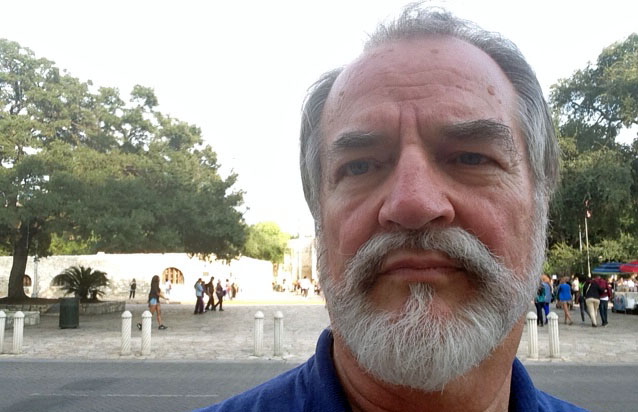
The Alamo is the #1 tourist attraction in Texas. It’s a shrine!
Historical fiction about the Texan rebellion against Mexico. I really grew to hate Mister Harrigan with the craven envy peculiar only to cowards. He writes and researches better than I ever will. This book sounds so immediately true, right down to the color of the local flora, that one tends to accept everything in this account as true. But it is fiction after all, as he reminds us in the afterward.
Unlike other Texas fiction, and unlike most Texas “History,” which is also fiction, Harrigan tells both sides with considerable compassion. If I hadn’t already been convinced of the accuracy of this account, I would have been won over just by two phrases on page 575, just two pages short of the ending. Santa Ana, long after the rebellion, is sitting in a New York restaurant and remembering, “…the rapacity of the United States as evidenced by its invasion of Mexico; the slaughter of thousands of innocent civilians by the so-called Texas Rangers…”
Santa Ana, during the time of the rebellion, is painted as a very bad guy. He insisted on executing all the Texas fighting men, no matter how they may have surrendered. But Harrigan is quick to remind us, near the end, that he also fought against French imperialism. And, he was largely responsible for the commercialization of chewing gum.
–-Gene Lantz
I’m on KNON’s “Workers Beat” program at 9 AM every Saturday Central Time. They podcast it on Itunes. If you want to know what I really think, check out my personal web site. I have 4 of my own novels there. They aren’t as good as Harrigan, but they’re shorter!
“I don’t see why we need to stand by and watch a country go communist due to the irresponsibility of its own people.” — Henry Kissinger, U.S. Secretary of State, responding to why they overthrew the government in Chile in 1973
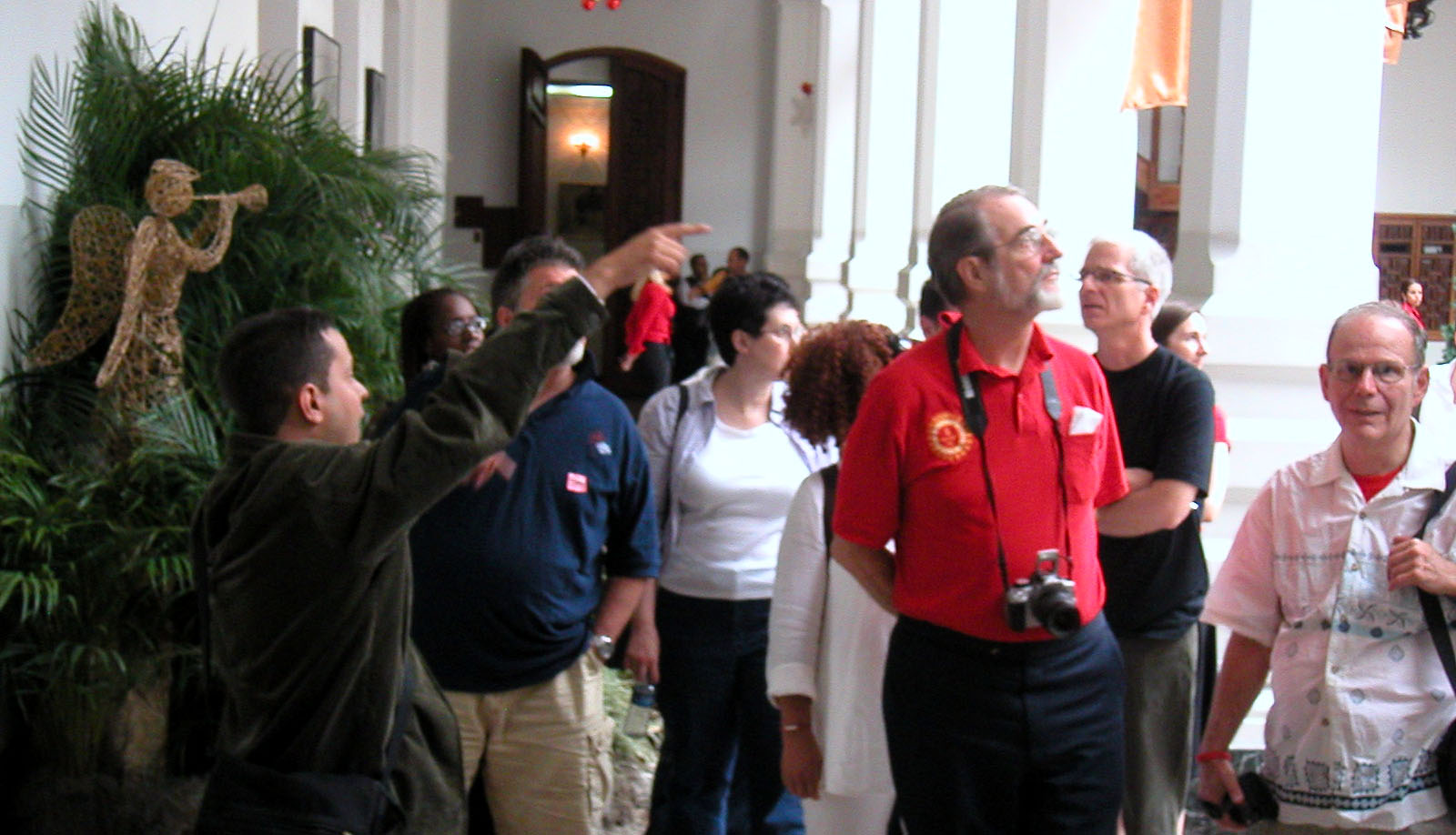
Meeting Venezuelans during their 2006 election
The United States has recognized the opposition leader in Venezuela as their rightful President. They are calling for an overthrow. They say that the elected president was illegally elected and that he disqualified some of his opposition. They have pulled their closest allies in with them.
Right in the middle of the crisis over whether or not Donald Trump can dictate his wishes to the American people, Trump is calling somebody else “a dictator!”
The fascist president of Brazil, who imprisoned his opposition and then “won” his election, is one of the happy club now calling for the overthrow of Venezuela. The U.S. efforts to take over Venezuela’s government and its oil didn’t start yesterday, it started when the great majority of Venezuelans elected, and then defended, an anti-imperialist president.
The pattern was set in Chile when the great majority of Chileans elected the mildly anti-imperialist Salvadore Allende. First they undermined the economy, then they organized the right-wing forces, then they permeated the military. Then they bombed the presidential palace, killed Allende, and installed a fascist government that murdered the remaining oppositionists.
Anyone not already familiar with what happened might just browse for “Chile Allende” on Youtube. There are dozens of videos. https://youtu.be/9h8deIN-OoU is one.
Here in America, the silence is deafening. Mr Trump and his gang get to make their accusations every day on every information source. The “honest reporters” reach beyond the Trump Administration to interview leaders and experts from previous administrations, all of whom share the same imperialist views. I wish I could say that the only imperialists in America are Republicans, but you’d know better.
The Venezuelans get some criticism from the so-called “left” as well as from the outspoken imperialists. Certain leftists blame the Venezuelan (and the Chilean) leaders for being social democrats instead of real working-class advocates. In other words, they didn’t deal directly with the local capitalists who were bound to conspire with the United States against them and; consequently, should have known they’d be overthrown sooner or later.
Whether it’s true or not is irrelevant. We in America aren’t responsible for decisions in other countries, but in our own. We might love the Venezuelans or hate them, but it isn’t up to us to overthrow their government.
I like the position taken by the World Federation of Trade Unions and its spokepersons in “Labor Today” here:
“The World Federation of Trade Unions (WFTU), representing 95 million workers of the five continents as well as the world class-oriented labor movement, strongly rejects the attempted coup d’état against the legitimate government of the Bolivarian Republic of Venezuela.
‘This interference, orchestrated by the US government, NATO and the EU and executed by the representatives of the transnationals and monopolies in the country, constitutes a flagrant violation of the most elementary rules of international law and of the Venezuela’s sovereignty. For the WFTU, it is an inalienable right of each people to decide for themselves, without outside interventions, on their present and future.
‘At the same time, the WFTU reaffirms, as it has already done on several occasions, its solidarity with the Venezuelan people, with the working class and our affiliated organizations in the country in front of this imperialist threat. In addition, we call on the Venezuelan people to reject the maneuvers of the imperialists and their lackeys in the region, to condemn the plans of the murderers of the peoples. We will continue to support the Venezuelan working class, for the deepening of the Bolivarian process, until the abolition of man by man exploitation, towards a new world, without wars and imperialist barbarism. This is the only way forward to repel the plans of the imperialists.
‘Long live internationalist solidarity!”
–Gene Lantz
I’m on KNON’s “Workers Beat” program at 9 AM every Saturday Central Time. They podcast it on Itunes. If you are curious about what I really think, check out my personal web site.
There are lots of on-line comments about the gig economy. WhatIs says, “A study by Intuit predicted that by 2020, 40% of American workers would be independent contractors.” There are higher and lower estimates here and there, depending on how they define the jobs that have no benefits, no rights, no dignity, and no guarantee that employment will last more than one day. It’s maybe one step above serfdom.
We’d have to be stupid to ignore the gig economy
But every article I saw said that the gig economy is growing and will keep on growing. The reasons they give are so inadequate that they almost constitute untruths: they attribute the growing gig economy to the changing nature of work. Unfortunately, that’s not what’s happening.
More and more people are working part-time, split shift, “independent contractor,” no-future jobs because that’s what the employers want. It’s what they have always wanted, but they never had such power over the government as they have now. The gig economy is growing because employers do not want workers with guaranteed jobs, workers with health care, workers with any kind of rights at all. In several levels of government, but especially in state legislatures, they are moving to reduce all of us into the gig economy.
Uber Drivers Rally
Last Saturday, a woman walked into the KNON studios and said “Hi, I’m Edith.” We greeted her and I tried to find out why she wanted to be on the “Workers Beat” talk show. She said she was a driver, so I assumed she was from the Amalgamated Transit Union and there to talk about management’s privatization scheme. They want to let Dallas’ disabled people get transported by Uber and Lyft temporary drivers instead of the professionals from ATU.
About 20 minutes into the program, Edith started talking about Uber management, and I finally realized that she was the woman I had exchanged e-mails with during the previous week. She wants to organize Uber and Lyft drivers. She had some compelling reasons.
Uber has recently cut the percentage of fares that the drivers get, Edith said. Worse than that, they manipulate the hiring process so that newer drivers get more fares. That way the newer drivers will be more likely to stay with Uber until their other options have disappeared. Then they’re stuck.
I’m for organizing all workers, no exceptions, so we got right into the problems and solutions. Edith said there would be a demonstration at Dallas City Hall today.
After the program, I posted an “event” on Facebook for the Uber/Lyft rally. At noon today, I hurried down there. Nobody else showed up, not even Edith. She told me by email that she had gotten discouraged because nobody else would commit to come. I told Edith that the proof of a good activist in the period we live in is not how successful they are, but whether or not they give up. So we’re going to try again on the 2nd Monday next month, or at least I hope so.
What Do We Learn?
First of all, a job with absolutely no guarantees can change at management’s whim. That’s why management likes them so much. Thousands of out-of-work government employees are, right now, applying to go to work for Uber or Lyft. It may seem like a good option, or perhaps the only option, but it will change when management wants it changed, and they never willingly change things for the betterment of the employees.
Gig jobs will just get worse as more people depend on them.
Second of all, gig workers are extremely difficult to organize. It’s one of those impossible things that has to happen. That’s why Edith couldn’t get anybody to the rally. It’s also why the established unions aren’t trying very hard to organize gig workers.
But it has to happen because the gig economy will keep on growing as long as bosses are running “our” government. One might pretend to be “objective” and say it doesn’t have to happen because there are other alternatives like fascism. That’s not an alternative, it’s a disaster!
–Gene Lantz
I’m on KNON’s “Workers Beat” program 89.3 FM in Dallas at 9 AM Central Time every Saturday. They podcast on Itunes. If you are curious about what I really think, check out my personal web site
Movie Review: “On the Basis of Sex,” Directed by Mimi Leder, 2 hours
My movie buddy and I enjoyed the biopic about Supreme Court Ruth Bader Ginsberg’s early days in the fight for gender equality, even though it was formulaic and predictable from the beginning to the powerful ending where the real Ginsberg mounted the Supreme Court steps.
The movie is very timely as it hit theaters just as Ginsberg was missing her very first sessions while battling lung cancer. The last report I saw said that she had beaten cancer once more and was back on the job. The documentary, “RBG,” about her had just closed a week or so before this dramatization was available. Another reason that the movie is so timely is that the Supreme Court has been making headlines for years as it cleared legalities out of the way for the ongoing power-grab of the plutocracy.
Only Ginsberg’s early legal efforts, and especially her first big trial before the Supreme Court, are covered. But the inference is that she went on to win more and more gains for women. We were pleased that the movie didn’t try to give all the credit to the legal system, but made the point that people change things before laws recognize it.
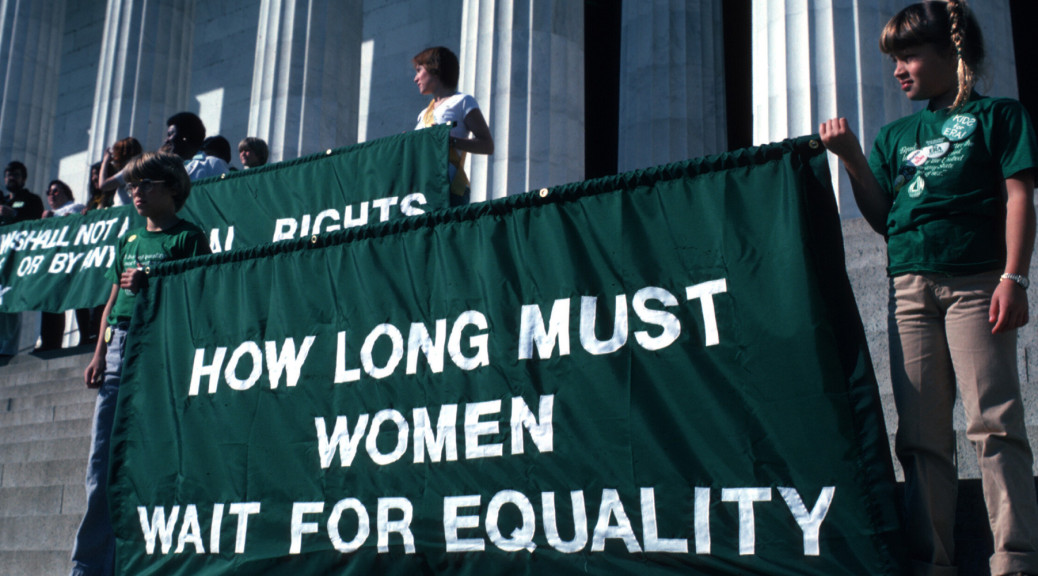
In discussions after the movie, we talked about the Equal Rights Amendment, which both of us fought for in the 1970s. It passed in Congress but, like any constitutional amendment, it had to be ratified in the states. We came close but we didn’t win, or rather we haven’t won yet.
The ERA would have overturned all the many statutes and case precedents justifying gender discrimination in America. Ginsberg’s approach, in the movie, was to tackle them one-by-one, and that’s what she and others have been doing. The movie implies that we’ve been winning all this time and will continue winning until gender equality is fully achieved.
But, so far, it hasn’t happened.
Why Not?
Women live longer and consequently outnumber men in America and on the planet. If they could get together, even vote together on women’s issues, they would win. But the truth is that they don’t.
Texas has had two outstanding women candidates for governor in the last two elections. Both were outstanding for their stands on women’s equality. Neither one of them won, and neither one of them got all of the women votes. I think that both of them, like Ruth Bader Ginsberg and maybe even like Hillary Clinton, made some progress; but so far no victory cigar!
Frederick Engels, in the 19th century, wrote that women were the first oppressed class, mostly because their oppression coincided with the birth of written history. Both written history and women’s oppression came about because surplus wealth was beginning to be produced. Men took that wealth and developed writing to account for it. They developed women’s oppression in order to make sure that their heirs were biologically theirs.
Engels said that women’s oppression would end in future society because women would be in the workforce and fully as productive as men. I think that’s been the case so far. The laws didn’t change first. What happened first was that women established their power and their rights in the workforce.
Union Women Are Far Ahead
Most American workers aren’t organized into unions, but the ones that are practice women’s equality rather thoroughly. As our working people attain more power, women’s equality will at long last attain its final goal.
Meantime, let’s keep marching!
–Gene Lantz
I’m on KNON’s Workers Beat program 89.3 FM in Dallas at 9 AM Central Time every Saturday. They podcast it on Itunes. If you are curious about what I really think, check out my personal web site
Working people in other nations must be simply amazed that the Americans would let 800,000 workers get locked out while everybody else goes to work as if nothing was happening. After all, if we so much as shut down one airport, one railroad, one highway, or one city for half a day, we’d get whatever we wanted.
Call Congress. Then what?
Without making any excuses, one can look back in American labor history for some of the reasons that nobody has walked out in solidarity. The biggest one is that everybody waits for the unions to do it and, as the saying goes, it ain’t going to happen!
Unions have power, and because they have power, they have tremendous government supervision. Most union contracts have a “no strike” provision. Management would love to see a union violate their contract, because they would then be free to do almost anything they wanted, and the government would happily assist.
In the old days, unions got what they wanted primarily by striking. The Industrial Workers of the World had hardly any other tactics. At the same time, their legal status was about the same as bank robbers. Some of the most powerful unions, mostly in transportation, gained some legal status with the passage of the Railway Labor Act in the 1920s. In the 1930s, the Roosevelt Administration gave us the National Labor Relations Act. It set up the supposedly neutral National Labor Relations Board to referee disputes between management and labor. Legal at last, the unions went on the biggest organizing drive in history.
But there was a price. With government arbitration came a lot of government supervision. In 1947, Republicans came down hard on labor laws. That’s when the vicious “right to scab” laws were legalized in the infamous Taft-Hartley bill. Texas led the way. Republicans have made sure that labor laws worsened.
It may sound innocent to say that “secondary boycotts are outlawed,” but what it means is that unions cannot stop work in solidarity with other unions. Our fundamental principle, “An injury to one is the concern of all” is quoted a lot more than it is used, and it can’t legally be used at for major work stoppage.
Unions are calling for an all-out lobbying effort. A few unions, including one in Dallas, are hitting the streets, and that is a big step forward. But it’s not likely that they will go further.
Why doesn’t someone else do it?
Why is everybody waiting for unions to call walkouts? It’s because our solidarity with the rest of the working class is still fairly weak. From 1947’s Taft-Hartley Act to 1995, America’s unions did very little to promote their relations with churches, community groups, civil rights people, and protest organizations. They accepted their isolation.
With the AFL-CIO elections of 1995, unions began to get back on track. But it’s a long road from a national labor convention to a grass roots coalition at the local level. I’m very proud that my own AFL-CIO Council in Dallas has made giant strides, but not every council has and, even in Dallas, these coalitions are still quite young.
Most of the individuals with enough personal following to call a major action are politicians. If they called a walkout, or even spoke in favor of walkouts, their campaign funds would rupture. So don’t expect any of them, not even Bernie Sanders, to call for walkouts.
Maybe a rock star will.
Some impossible things happen
If Mr Trump really tries to keep the government shutdown going for an extended period, as he says he will, there will be work stoppages. They will succeed, too.
There is such a thing as “historical imperative.” It says that some things will happen, not because they are likely or even possible, but because they have to happen. Maybe Americans don’t understand our own labor history, and maybe we’re easily divided. Maybe we’re ignorant, but we’re not stupid.
–Gene Lantz
I’m on KNON radio’s “Workers Beat” program at 9 AM Central Time every Saturday. They podcast it on Itunes. If you are curious about what I really think, look at my personal web site
This isn’t a Hollywood movie with a given gimmick, heroes, villains, and a romantic ending. It is a delicate, multi- layered garment that must be pulled back gently to reveal its true design. It earns its honors and awards without any trumpets nor fanfare.
It’s not really about theft, even though the impoverished Japanese family gets a lot of its basic necessities that way. It’s not about poverty, slums, or sex either. That’s just the setting for a story about universal themes of love, commitment, and, above all, family.
My movie buddy and I found the subtitled movie slow for the first hour and a half, even though we kept picking up nuances that intrigued us just enough to keep us in our seats. The last half hour explains everything and pushes every tiny circumstance into hard questions that challenge everything we have thought and felt about the little group of shoplifters and thieves.
I guess that’s art.
–Gene Lantz
I’m on KNON radio’s “Workers Beat” program 89.3 FM in Dallas at 9 AM Central Time every Saturday. They podcast on Itunes. If you are curious about what I really think, check out my personal web site
Today I posted a prologue and Chapter One of “Commissioner Torres and the New Government” on http://lilleskole.us, my personal web site. It’s actually my 4th book-length effort. One of them is autobiographical and covers just about everything I’ve learned so far.
What would your revolution look like?
The other three are speculative fiction about a guy named Leo Torres who gets involved with revolutionaries just when the old order of things has fallen apart. Leo gets in on the revolution from the ground floor.
Why?
You may wonder why I write and post these things. Obviously, I’m not going to make any money. They aren’t even copyrighted. It’s not because of the silly old shibboleth “Writers write because they have to.”
I’m one of many people who would like to see a better world, but I’m one of the very few who have tried to describe it. For decades I’ve dodged the question the same way almost every activist does by saying, “I don’t know what the world I’m fighting for would look like, because it’s up to those people living in that world to decide for themselves.” It may be true, but it’s still a dodge.
If we’re fighting for a better world, we ought to be able to describe it. Or at least we ought to try.
I decided on speculative fiction as my way of initiating a discussion on what might happen and what we might do about it. After all, does anybody think that we’ll just wake up one day in a better world?
Nearly all of our sci-fi is dystopian. Just about the only exception is the Star Trek series. They didn’t even have a revolution to get into their wonderful world. They just listened to the Vulcans. In one episode, Mister Spock hints that the Vulcans had to go through some very trying times before they became so civil, but he doesn’t tell us much about it. So we actually have no pattern to follow.
For a long time, American activists tried to copy the Russian revolution. When it imploded, a lot of them were disgusted and demoralized. Some others have tried to follow Chairman Mao. Some followed Nkrumah, Ho Chi Minh, and some followed Castro. I think we could learn from all of them, but we couldn’t learn enough. We have to do a lot of our own thinking.
So, we speculate.
The World I Made
Looking toward the future, especially in the Donald Trump era, one can see disaster ahead. It’s not a matter of whether or not the planet will become inhabitable and wealth inequality will make economic life impossible. It’s only a matter of when.
But I have great faith in myself and other people. Sooner or later we will give up on the people who are destroying the economy and the ecology. We will embrace new leaders and new ways of running things. In the world I create in my sci-fi novels, people have just recently done that. Following the advice of revolutionaries, civilized people have disbanded their armies and their police. They formed local militias to keep order while respected and capable leaders are elected to make economic and social decisions.
The revolutionaries at the center help coordinate activities and continue to advise the localities. As you might imagine, there is very little continuity between one locality and another. There are a tremendous number of problems to be resolved. What will people eat? How will they get it? How will trade continue? How will people get from one place to the next?
Because the air and water are almost undrinkable and unbreathable, something drastic has to be done about the burning of fossil fuels. Because all systems are down, there is no electricity. Without electricity and transportation, there is no long-distance communication. Without transportation, people will not be able to get the goods and services they need to stay alive. What would you do about those things?
The first two novels take the easy way out. They only deal with some of the smaller questions.
My first novel deals with whether or not revolution is possible and worthwhile. It’s common to hear it said that humanity isn’t worth saving, that people will never learn to live without war, that people are essentially greedy and incapable of cooperation, and that every revolution has failed because people are basically just no damned good!
My second novel is more specific. It tries to deal with the fact that certain sectors of the population will not cooperate in building a better world. Hardened drug addicts, for example, are unlikely to cooperate in civil society. What would you do with them?
The third novel is by far the most ambitious. It recognizes that government is necessary and begins to discuss the ins and outs of setting up and running such a government. Is democracy the answer? If so, what would be the machinery of democracy? Here’s a really thorny question, “How could a society avoid the tyranny of the majority?”
I don’t know if you can answer these questions, but I know that I can’t. But I’m inviting you to join me in trying to find out.
–Gene Lantz
I’m on KNON radio’s “Workers Beat” talk show 89.3 FM in Dallas at 9 AM every Saturday. Call in 972-647-1893 with your ideas. They podcast it on Itunes. If you are curious about what I really think, check out my personal web site at http://lilleskole.us
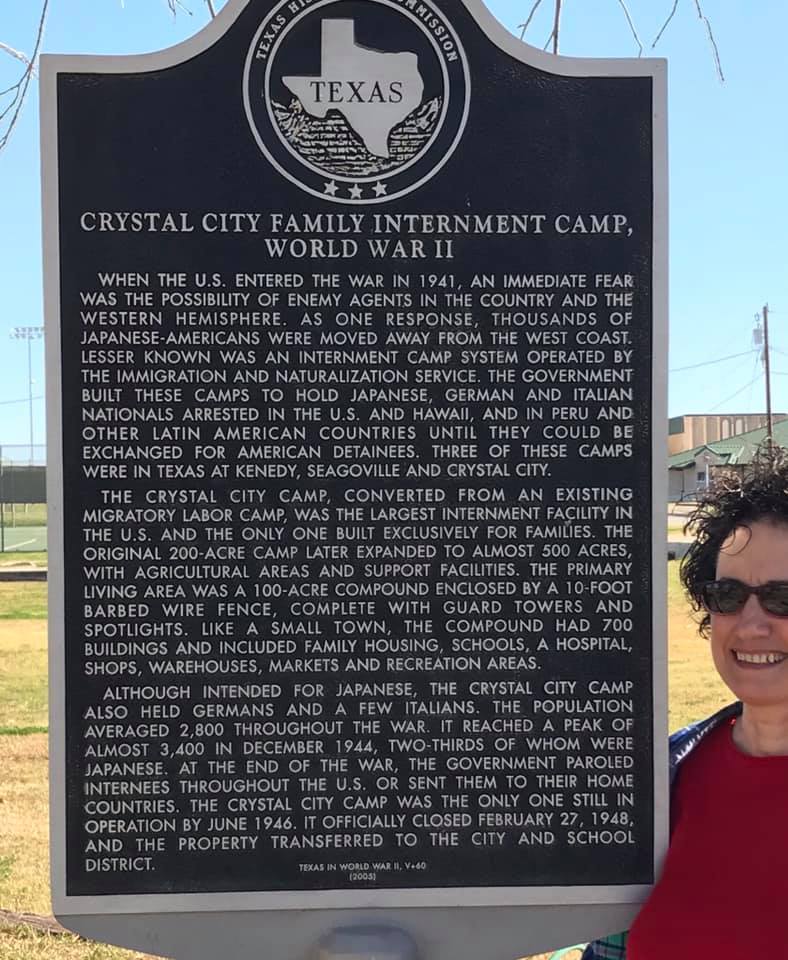
Texans are forever taking their children to see the Alamo, and a lot of them go to the San Jacinto Battlefield. But if they really care about Texas history, they should make a pilgrimage to Crystal City, where ordinary working people made a lot of history.
Crystal City was the site of the biggest concentration camp of World War II. Japanese families were there from 1943 through the end of the war. A few Italians and Germans were also sent there from other parts of the U.S. and Latin America. The United States traded them for our own prisoners of war.
Crystal is also a great civil rights site. The Chicano movement that terrified Anglos in the 1970s began in Crystal City. The struggles of some of the most desperate working families in America took place in Crystal City. For a while there, they won!
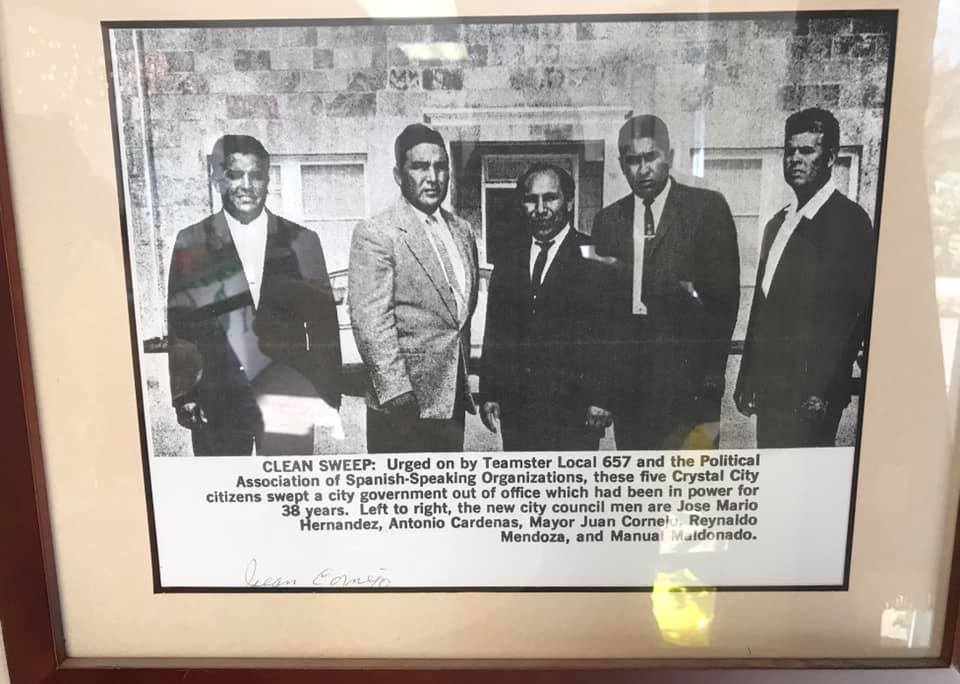
I think it was in 1963 that five very courageous Latinos took city government power from the dominant Anglos. With only 10% of the population, Anglos had always dominated everything. Then in 1969, Juan Campeon and Jose Angel Gutierrez convened La Raza Unida Party at Salon Campestre just outside the city limits and on the banks of the Nueces River.
La Raza Unida soon took over government in all of Zavala County and in surrounding counties. Inspired by La Raza, other Chicanos throughout America began to form their own fighting civil rights organizations.
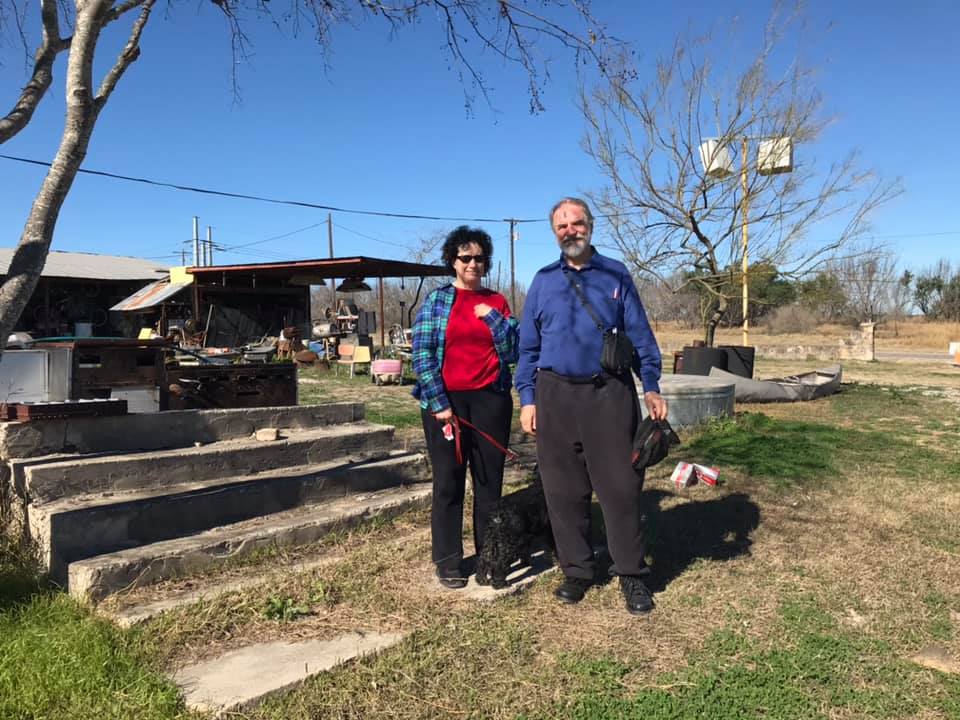
Today, only the cement steps of the old Salon Campestre remain. There are no historical markers for La Raza Unida. They hold no government offices, but Mexican American Democrats and other organizations owe their initial inspiration to the courageous workers of Crystal City. There’s a great play about it. It’s named “Crystal.”
About 8,000 people, nearly all Mexican Americans, live in Crystal. A branch of the historic Nueces river runs (when there is enough water) just outside the city limits. There are no unions in existence, even though the CIO tried in the 1940s and the Teamsters tried in the 1960s to organize the cannery workers.
There are no museums in Crystal City. The library is closed. There are several statues of Popeye the Sailor Man and some claims to be the Spinach Capital of the World, but the great contributions and sacrifices of working families are noted only in the minds of certain Chicanos and a handful of amateur historians like us, who care about real history.
–Gene Lantz
I’m on KNON’s “Workers Beat” talk show 89.3 FM in Dallas every Saturday at 9 AM Central Time. If you are curious about what I really think, check out my personal web site