Archive

women

My friend Charlotte recently asked, “In an overpopulated world, why are Trump and other national leaders trying to raise birth rates?” I thought it was a profound question and one that deserves careful examination.

Birth rates in various countries get published every now and then. Like record high gold prices, though, they aren’t considered very fundamental to what’s going on. Or maybe, like gold prices, birth rate statistics reveal a lot more than the oligarchs want us to know.

Charlotte’s insightful question generates some other interesting questions:

  • “Why are reactionaries, especially religious reactionaries, opposed to birth control?”
  • “If reactionaries want more children, why don’t they want to take care of them?”
  • ”If they had higher birth rates, wouldn’t they get more unemployment, especially as automation eats our jobs away? Doesn’t rising automation, especially artificial intelligence, argue for our needing fewer workers?”
  • “Trump says he wants more population, so why is he against immigration?”

I got this from a web site:

“Right-wing governments and figures with nationalistic tendencies (including Trump) also want to increase birth rates to maintain a strong military and to counter ethnic, racial, and cultural diversification from immigration. These types of leaders often embrace the “Great Replacement” conspiracy theory which states that white people are being “replaced” with foreign non-white populations that have higher birth rates. As well as opposing immigration, these governments are hostile to reproductive health and rights, especially abortion care.

‘Probably the most influential pronatalist in the Trump administration is the richest man on Earth and father-of-14 Elon Musk, who bought his new position as Trump’s right-hand man with a $288 million campaign donation. Musk has been trying to sow panic over declining birth rates for years, claiming that the human population is on the verge of collapse due to people having small families, and that low birth rates present a “much bigger risk to civilization than global warming.”

Birth rates weren’t much of an issue before hard-fighting women were able to win some control over what happens to their own bodies. Check out the tough life of Margaret Sanger to see more about that long and terrible fight.

In the mid-1960s, it looked like women and progress had finally won in America and some other countries. More recently, the oligarchs have pushed women’s rights way backwards. Again, Charlotte might ask, “Why?”

The answer lies in the economic nature of world capitalism. Each nation is pitted against the others, and the chief way they compete is with cheap labor. Whoever drives down the cost of labor lowest, beats the other competitors. Nations that have more workers, naturally, get lower labor costs.

What we call a “nation” and what more scientific people call a “state” is actually a political subdivision run by its ruling class. For the major nations, that ruling class is the capitalist class, which might also be called the owning class, or the billionaire class, or, in our case, the oligarchs. They compete with each other economically until they’ve vacuumed up every bit of profit possible. Then they go to war against each other.

They need higher birth rates for their wars, too.

Movie Review: “Poor Things,” Directed by Yorgos Lanthimos, 141 minutes

My movie buddy had to drag me away from the lobby outside the entrance to “Poor Things.” I wanted to stay and warn everybody to stay away. It’s over 2 hours of pretentious nonsense about a baby girl growing within a woman’s body. It’s a misogynist fantasy wasting $35 million worth of the latest technology, technique, and style.

There! Now I know you won’t be able to resist going. I saw a couple of outright rave reviews before I started mine. I found a major reviewer who calls “Poor Things” “best movie of the year.” https://www.rogerebert.com/reviews/poor-things-movie-review-2023. Another joins in praising its technical accomplishments, both in film and in storytelling: https://www.vox.com/culture/23992608/poor-things-review. Reviewers, apparently, loved it.

The movie really does have a lot going for it. Everything about it is quirky and over-the-top. Mark Ruffalo, as a Casanova cad, is hilarious, especially in the scene where the child/woman enthusiastically dances jerkily in the middle of a prim ballroom dance and Ruffalo tries to cover for her with impromptu twirls and dips. I could cut that 4 minute scene out and watch it every now and then, but not anything else.

On the way home, my movie buddy analyzed the title. “Poor Things” doesn’t refer to anybody in the movie. It’s the audience, us.

–genelantz

Book Review:

Windham, Lane, “Knocking on Labor’s Door. Union Organizing in the 1970s and the Roots of a New Economic Divide.” University of North Carolina Press, Chapel Hill, 2017

Capitalism is said to have begun in the middle of the 17th century in England. Workers and bosses have been fighting since then. Any period in that great long battle for democracy, dignity and a living wage would be an interesting period.

picketing

This author chose the 1970s in the United States. Certain underlying economic and social developments made it a period of interesting class warfare.

  • The civil rights movement and the women’s movement had created a more diversified, and more militant bunch of activists into organizable workplaces
  • The “American Century” of economic domination over the war-weary victims of World War II was noticeably beginning to end
  • America’s most devoted and seasoned labor activists had been driven away by the great witch hunt that began in 1946. Union militancy had turned into “business unionism.”

Union density peaked at about 35% of the workforce earlier, but unions still had about 20% of the workforce in the early 1970s. Union members had far better wages, better benefits, better pensions, and better jobs than the workforce at large. Part of the consequence of getting more for union members while ignoring other workers was increasing isolation for the unions.

Nevertheless, young people wanted to unionize. They fought hard. For the most part in the 1970s, they lost. One could argue that the events from 1947’s Taft Hartley law to 1970 had foreordained that labor would lose, but that isn’t Mr. Lane’s argument. It’s mine.

Lane argues that companies simply worked harder at union busting. They increasingly won government over to their side. By the end of the 1970s, when Ronald Reagan was elected, the downhill slide was evident to everyone. In 1995, maybe a little late, the AFL-CIO started trying to adjust to the new situation.

One shining light in Lane’s book is the early success of an organization called “9 to 5.” They organized women to fight for the workplace rights that the larger women’s movement had won through federal legislation. The idea of organizing outside the control of government authorities like the National Labor Relations Board was a good one, and they had some early successes. However, it didn’t last.

In fact, most of the hopes that young activists may have had for union organizing in the 1970s were crushed. This is not a happy book to read. I wish he had chosen the 1990s, when American labor began to show some real promise.

–Gene Lantz

I’m on KNON’s “Workers Beat” talk show every Saturday at 9AM Central Time. We podcast it and “Workers Beat Extra” dialogue on Wednesdays on Soundcloud.com. If you are curious about what I really think, check out my old personal site.

TV Review

“Stateless” streaming on Netflix. The first three episodes are directed by Emma Freeman; the other three by Jocelyn Moorhouse.

Please don’t miss this great Australian series.

STATELESS (L to R) FAYSSAL BAZZI as AMEER and SORAYA HEIDARI as MINA in episode 102 of STATELESS Cr. BEN KING/NETFLIX © 2020

The series examines what happens to the lives of those associated with an immigrant detention center that is operated for profit. This one is in Australia, where they unfailingly make great dramas, but the ones in the Rio Grande Valley are also run for profit.

Two of the main characters are inmates: an Afghani trying to save his daughters from the Taliban and an Australian citizen who is trying to hide her identity. The other two administrate the place: an immigration specialist and an ordinary working dude trying out a new job as a prison guard. The place works its wonders on them. Even more, the world system that creates 70 million dislocated asylum seekers and then mistreats them miserably works its wonders on us, the audience.

Part of the story, Wikipedia says, is directly true. All of it sounds true, seems true, hurts truly.

A word about the quality of the presentation: the penetrating insight into every character could only have been revealed by women. Both directors and both writers were women. Their sensitivity is a marvel.

By way of explaining how good the acting is, let me ask you if you’ve ever seen a Cate Blanchett picture where her acting didn’t overshadow everybody else? Cate Blanchett is very good in “Stateless,” but her role is limited. She is listed as one of several Executive Directors. If you’re a fan of Australian TV, let me ask if you’ve ever seen Marta Dusseldorp in anything in which her skill didn’t dominate everybody else? In this series, Ms Dusseldorp and Ms Blanchett are just part of a wonderful ensemble of players. Everybody is excellent. The actors for the four main characters are beyond excellent.

Top acting kudos has to go to Yvonne Strahovski. Her role is the most demanding, and she pushes each of her emotional portrayals beyond limits. After the first few scenes, you may recognize her as the cold hearted Commander’s wife in “The Handmaid’s Tale,” or maybe you won’t recognize her, but you won’t forget her again after you see her in “Stateless!”

Yvonne Strahovski

The Australian immigration/detention system takes a beating in “Stateless,” but several characters, including some administrators, give the impression that they are doing the best that they can in a rotten situation. At least they are trying. My movie buddy and I agreed, several times as we watched the series over a few nights, that the worst of the miseries “Stateless” encountered must be far worse here at home in the United States, where what they are trying to do with the immigration situation isn’t just rotten.

–Gene Lantz

I’m still on KNON’s “Workers Beat” radio talk show at 9AM Central Time every Saturday. We podcast the program and “Workers Beat Extra” on Soundcloud. If you are interested in what I really think, check out my personal web site

Are you sure we’ll have an election in November, 2020?

Most American activists, including me, are working on the elections. We have no experience in any political environment that does not include regular, orderly, elections. We have always lived under a partial democracy. Many Americans believe they live in a democracy that is much more complete than it actually is. In general, we believe in democracy, we think we have it, and we expect it to continue.

People in other countries could tell us a thing or two. Historians could tell us a thing or two. Democracy is not a permanent form of government. In other countries, democracy isn’t taken for granted. Sometimes it is stronger, sometimes it is weaker, and sometimes it is gone!

Democracy Is Diminished

Democracy in the United States is diminishing, and has been diminishing for several decades. The Trump administration has accelerated the rate of diminishing democracy. Just look at some news articles from this week:

John Bachtel wrote a very good summary of the ways that the Trump Administration has recently increased its stranglehold on what remains of our legal system. See “Surging Authoritarianism…” The short version is that Trump has consolidated his hold over the entire Republican Party and the legal system. As I write this, he is busy purging everybody in government who might disagree with him about anything.

The slogan that was so important to millions of American activists, “No one is above the law,” would draw cynical laughter today.

The other recent article of great importance came from the Associated Press on March 3: “U.S. Plans Shift in Focus of Military.” Defense Secretary Mark Esper says specifically that the United States is planning for a war with China! A clipping is on my Facebook Page.

How Democracy Gets Cancelled

Despots never tell us that they intend to destroy democracy. Instead, they tell us that they have to “temporarily” suspend elections or some other aspect of democracy because of a crisis. The crisis, likely as not, is one that they created.

Mr Trump might use war with China. He might use the Covid-19 worldwide health crisis. Somebody might blow up an American building in the scenario that worked so well for George Bush. It wouldn’t be hard for Trump to find or create his “crisis” since he already controls so much of government and public life.

How Democracy Gets Saved

America’s partial democracy came from the British. The Revolutionary War and, more importantly, the Civil War, improved it. Hundreds of actions for civil rights and women’s rights improved it even more. When I was a young man, it was reasonable to expect that democracy in America would continue to improve far into the future. Then came Reagan, union busting, gerrymandering, voter suppression, and repeal of democratic rights we had thought were unassailable.

Democracy was won in wars, in strikes, in demonstrations, and in all forms of political action carried out by progressive people. Democracy will be defended in America the same way, but it’s going to take some serious informing and organizing to win.

What Can You Do?

At the individual level, there’s not a lot you can do beyond complaining. But if you join progressive organizations: unions, civil rights groups, women’s rights groups, and progressive political organizations, then together, we have a chance. But it will not be easy.

-Gene Lantz

I’m on KNON’s “Workers Beat” program every Saturday at 9 AM Central Time. If you are curious about what I really think, check out my personal web site

Book Review:

Gao Xingjian, “Soul Mountain.” English translation published by Perennial (Harper Collins) New York, 2001

You finally complete the 500 pages and you wonder why it is written mostly in second person. You wonder why it won the Nobel Prize. You assume it may be because the Nobel judges are eager to encourage dissent in China. You wonder if it might have been more poetry than prose. You wonder if it would have worked out if you had been able to read it aloud to the woman.

She said she didn’t want to hear it read aloud. She thinks it would be pretentious. You wonder if you only wanted to read it aloud because you are pretentious. Or is the book itself pretentious? Is it pretentious to think about being pretentious?

You say that she would have enjoyed it as a romantic experience. She says you have no idea what women might enjoy. Men only exploit women and never care what they want.

You say that women are not that different from men. She says they are different and that you are chauvinistic to say there is no difference. You challenge her to define chauvinism. She says she does not need to define it because you are before her and you are the finest example of chauvinism.

You say she is acting silly. You try to embrace her.

She warms a little. She says maybe you aren’t chauvinistic. Maybe you are only patronizing.

You say that you have wondered all over China and investigated many ancient cultural ideas. You say that you discover a great deal of Chinese culture and that it is in this book.

She says it only shows what a hopeless idealist you are. You aren’t even slightly interested in the real world, she says.

What is real, you ask her.

–Gene Lantz

I’m on KNON radio’s “Workers Beat” every Saturday at 9AM Central Time. If you are curious about what I really think, check out my personal web site

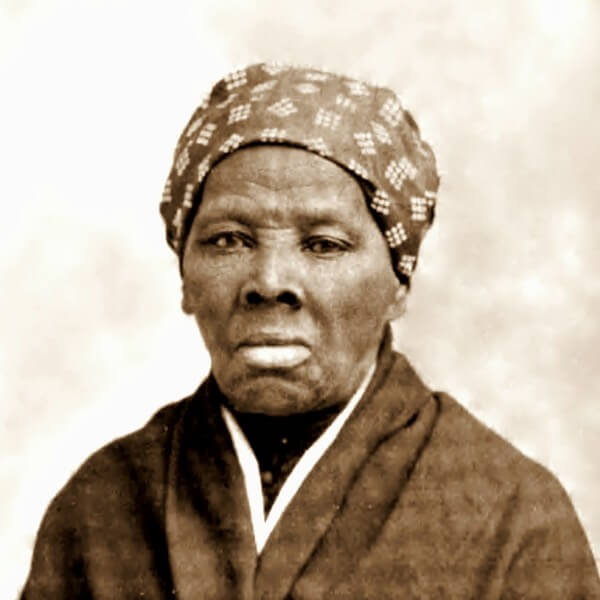
Movie Review: “Harriet,” Directed by Kasi Lemmons, 125 minutes

If you study Harriet Tubman’s life and accomplishments, you’ll wonder how the film makers thought they could cram it all into a mere two hour movie. I heard a radio review with the director, who said that she wanted to make sure that people didn’t see the film as a mere biopic.

It is a biopic, though, complete with those little written sub-headings that show the times and places where important events took place. There was probably no other way to do it, because Harriet Tubman was not a one-time heroine. Her personal exploits in saving people from slavery and in actually ending slavery spanned decades in time and hundreds of miles in distance.

We really loved this movie, but my movie buddy and I love history and the civil rights movement. We think of the American Civil War not as a meaningless tragedy as it is usually portrayed, but as a giant leap forward for all of us. Those who agree are really going to like “Harriet.”

So get comfortable for a long and edifying experience when you go to this one. It’s worth it.

You can listen to an opera about Tubman on Youtube: https://youtu.be/0wpqiyA1nHE

The 1978 TV mini-series, :A woman Called Moses,” can be bought on-line:https://app.pureflix.com/videos/253311526823/watch

The theme song with animated video is on Youtube: https://youtu.be/2bl3KJgWQKk

The Wikipedia version of Harriet Tubman’s life is at https://en.wikipedia.org/wiki/Harriet_Tubman

–Gene Lantz

I’m on KNON’s “Workers Beat” program every Saturday at 9AM Central Time. If you are curious about what I really think, check out my personal web site

What Do You Have to Lose?

Today, while Corporate America, dark money, and an even darker government are trying to destroy the United Auto Workers, it would be good to consider what it means for all of us. To do that, look back in American history to a time before the UAW became the first great success of the Committee for Industrial Organization.

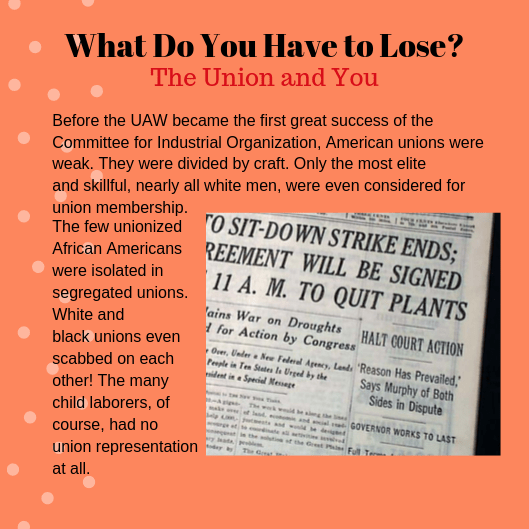
In 1935, nearly all American unions were weak. They were divided by craft. Only the most elite and skillful, nearly all white men, were even considered for union membership. The few unionized African Americans were isolated in segregated unions. White and black unions in the same workplace even scabbed on each other! The many child laborers, of course, had no union representation at all.

Color and gender lines were broken once and forever in the union. The UAW organized industrially. That is, everybody who worked in the industry was a candidate for membership. Their anti-discrimination pattern and their militant action were followed in the great upsurge that followed, and working people in America gained unprecedented power.

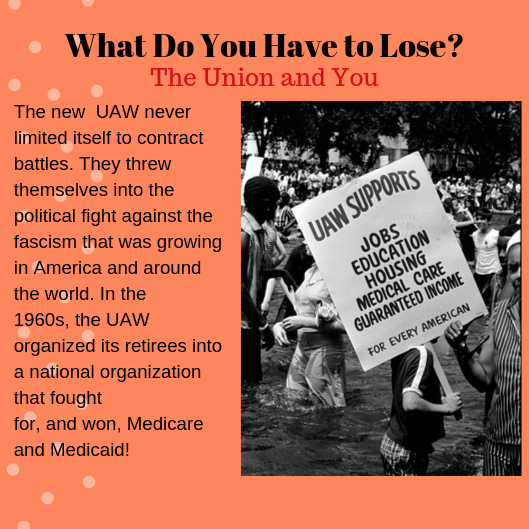
The UAW never limited itself to contract battles. They threw themselves into the political fight against the fascism that was growing in America and around the world. In the 1960s, the UAW organized its retirees into a national organization that fought for, and won, Medicare and Medicaid!

The explosion of worker power went far beyond improving wages and benefits. America’s civil rights also surged forward, and the UAW was more than just a great example to follow.

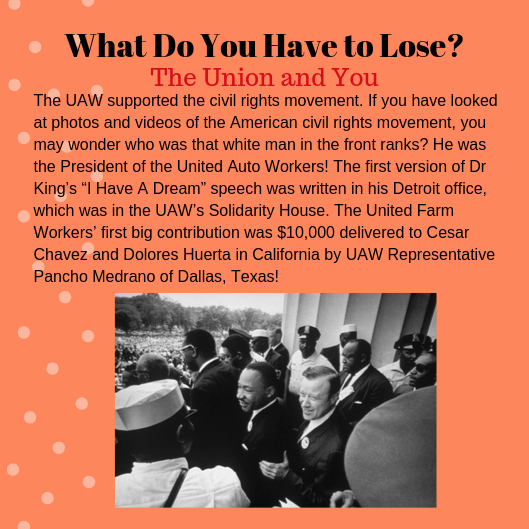
The UAW supported the civil rights movement. If you have looked at photos and videos of the American civil rights movement that began in 1954, you may wonder who was that white man in the front ranks? He was the President of the United Auto Workers! The first version of Dr King’s “I Have A Dream” speech was written in his Detroit office, which was in the UAW’s Solidarity House. The United Farm Workers’ first big contribution was $10,000 delivered to Cesar Chavez and Dolores Huerta in California by UAW Representative Pancho Medrano of Dallas, Texas!

Before the UAW, most American workers were no better off than day laborers. Corporate America has never forgiven the union for its part in bringing dignity into our workplaces. They would like nothing better than to destroy the UAW and the entire American labor movement. That’s why we have to fight!

–Gene Lantz

I’m on KNON radio’s “Workers Beat” at 9 AM Central Time every Saturday. They podcast on http://knon.org. If you are curious about what I really think, check out my personal web site

Movie Review: “Red Joan,” Directed by Trevor Nunn, 1 hour, 50 Minutes

What a relief it was to see “Red Joan” during its third, and probably last, week at the Magnolia in Dallas! So many movies lately are just blather! We had endured “A Long Days Journey Into Night,” then endured only the first few minutes of “Booksmart” and “Wine Country” — both exercises in idiocy, so my movie buddy and I were starting to feel that the movies are becoming hopeless.

Then we were rescued by Dame Judi Dench and her new movie about an 80-something woman in England who was arrested for having been a spy when she was a 20-something. An actress new to us, Sophie Cookson, gets most of the movie as the conflicted younger woman.

The title character makes it clear that pre-war England was quite different from modern times, and that’s one of the main strengths of the movie. As the younger character goes through a complicated love life, changing politics, and a role in the creation of the atomic bomb, the audience really does get an opportunity to stop and think.

One gets a chance to speculate on the personalities involved. One gets a chance to learn something and to be affected by something. Thank goodness!

–Gene Lantz

I’m on KNON’s “Workers Beat” radio program, 89.3FM in Dallas, every Saturday at 9 AM Central Time. If you are curious about what I really think, see my personal web site.