Archive

politics

TV Review

“Stateless” streaming on Netflix. The first three episodes are directed by Emma Freeman; the other three by Jocelyn Moorhouse.

Please don’t miss this great Australian series.

STATELESS (L to R) FAYSSAL BAZZI as AMEER and SORAYA HEIDARI as MINA in episode 102 of STATELESS Cr. BEN KING/NETFLIX © 2020

The series examines what happens to the lives of those associated with an immigrant detention center that is operated for profit. This one is in Australia, where they unfailingly make great dramas, but the ones in the Rio Grande Valley are also run for profit.

Two of the main characters are inmates: an Afghani trying to save his daughters from the Taliban and an Australian citizen who is trying to hide her identity. The other two administrate the place: an immigration specialist and an ordinary working dude trying out a new job as a prison guard. The place works its wonders on them. Even more, the world system that creates 70 million dislocated asylum seekers and then mistreats them miserably works its wonders on us, the audience.

Part of the story, Wikipedia says, is directly true. All of it sounds true, seems true, hurts truly.

A word about the quality of the presentation: the penetrating insight into every character could only have been revealed by women. Both directors and both writers were women. Their sensitivity is a marvel.

By way of explaining how good the acting is, let me ask you if you’ve ever seen a Cate Blanchett picture where her acting didn’t overshadow everybody else? Cate Blanchett is very good in “Stateless,” but her role is limited. She is listed as one of several Executive Directors. If you’re a fan of Australian TV, let me ask if you’ve ever seen Marta Dusseldorp in anything in which her skill didn’t dominate everybody else? In this series, Ms Dusseldorp and Ms Blanchett are just part of a wonderful ensemble of players. Everybody is excellent. The actors for the four main characters are beyond excellent.

Top acting kudos has to go to Yvonne Strahovski. Her role is the most demanding, and she pushes each of her emotional portrayals beyond limits. After the first few scenes, you may recognize her as the cold hearted Commander’s wife in “The Handmaid’s Tale,” or maybe you won’t recognize her, but you won’t forget her again after you see her in “Stateless!”

Yvonne Strahovski

The Australian immigration/detention system takes a beating in “Stateless,” but several characters, including some administrators, give the impression that they are doing the best that they can in a rotten situation. At least they are trying. My movie buddy and I agreed, several times as we watched the series over a few nights, that the worst of the miseries “Stateless” encountered must be far worse here at home in the United States, where what they are trying to do with the immigration situation isn’t just rotten.

–Gene Lantz

I’m still on KNON’s “Workers Beat” radio talk show at 9AM Central Time every Saturday. We podcast the program and “Workers Beat Extra” on Soundcloud. If you are interested in what I really think, check out my personal web site

I don’t see a lot of effort being put into winning over the 40% of Americans who support Donald Trump. Mostly, I see them being called names like “moron,” “idiot,” “fascist,” and “white supremacist.” And yet, people who are working to make a better world have to have them.

Why make enemies?
Making enemies is not a good stratgegy

The last evaluation of Trump’s levels of support that I saw was on “The Hill:” https://thehill.com/homenews/campaign/506076-the-hills-campaign-report-trumps-job-approval-erodes-among-groups-that

It says his overall approval rating has dropped to 38%, but it’s still 57% when they consider Anglos only. It’s a comment on the state of the nation that political polarity is almost total: 91% of Republicans and 2% of Democrats approve of Trump. That’s a serious divide!

If anyone is serious about making a better world, they surely recognize that allowing 40% of America to become bitter enemies of progress is not a pathway to progress. They need to be won over, not demonized!

Why Do People Love Trump?

I see a lot of speculation, but it’s not seriously thought out. The reason that millions love Donald Trump is not that they are somehow defective or purposefully evil. What they are is afraid. The Trump strategy is to make them just as afraid as possible, and it’s working. Unfortunately, those of us on the side of progress, by vilifying them, are cooperating with Trump’s plan.

What Are They Afraid Of?

Trump plays on basic fears. One of them is that “minorities” are a growing demographic that should exceed 50% in the near future. Anglos are very conscious that “minorities” are have historically been mistreated, and they fear the same for themselves when they lose their majority.

Another basic fear is that America is losing its economic, military, and cultural dominance of the rest of the world. Xenophobia is a real feeling, and it can be heightened through demagoguery. China’s economic success threatens Anglos.

How Do You Deal With Frightened People?

Certainly not by scaring them even more. Certainly not by calling them names. Progressives have to stop exacerbating Trump’s scare tactics. What we have to do is patiently explain that life can go on, even after Anglos stop dominating minorities and the rest of the world. We should patiently explain, too, that demagoguery will not stop the changing of demographics nor world economics.

Our explanations should show that Trump’s policies are directly benefiting the richest people, not the rest of us. Right now, Trump’s political coalition is dominated by the super-rich who know very well what they’re doing; but it is supported by millions who aren’t benefiting, aren’t likely to benefit ever, and really don’t know what they are doing.

It doesn’t hurt, either, to point out how much Mr. Trump is making things worse. Our employment hopes, our hopes for our health, and the very existence of our planet are threatened by Trump policies. But we have to point out Trump’s flaws without pinning them on his supporters. We can do without Trump, certainly, but we can’t make a better world without our other 40%.

–Gene Lantz

I’m on KNON’s Workers Beat radio talk show every Saturday at 9 AM Central Time. They podcast it along with other material on Soundcloud.com. If you are curious about what I really think, check out my personal web site

I have begun to really appreciate Lenin. Previously, I looked up to the guy but didn’t really like reading his works. They were too argumentative, and the people he was arguing against, long dead and forgotten, didn’t seem worth all the fuss. It seemed to me that just about everything Lenin wrote, except maybe his major original contribution, “Imperialism,” was a polemic. Hard, unyielding, mean polemic, too.

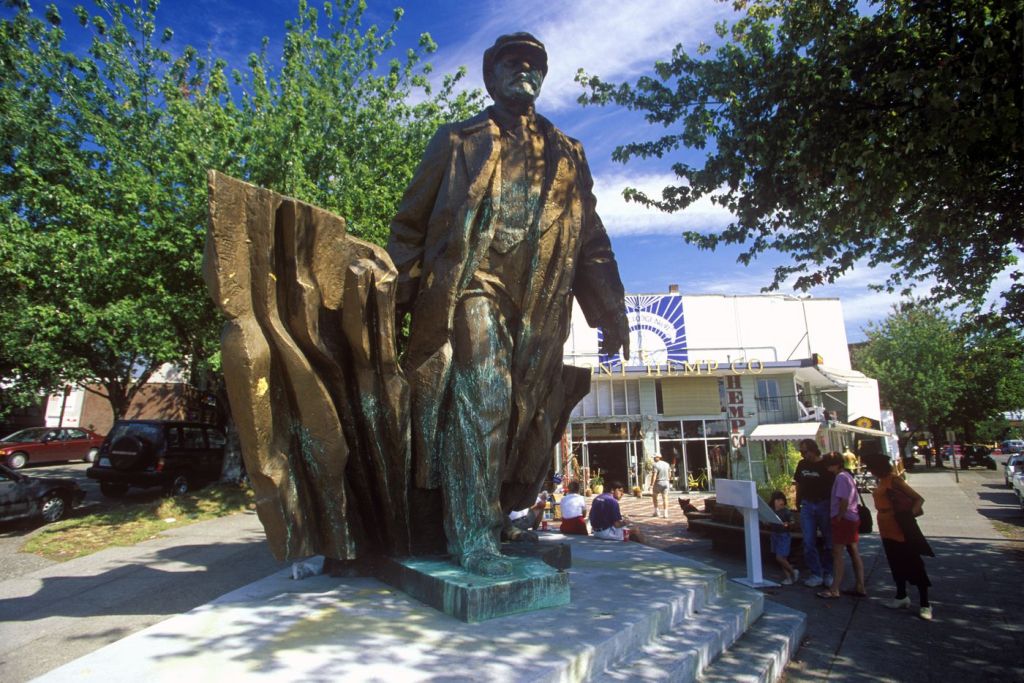
Statue of Lenin in Seattle

Then we come to today. We have going probably the greatest worldwide upsurge of revolutionary youth in the history of humanity. I have never seen so many people so open to change and so insistent. But, big but, they have no program. They are going every whichaway. Makes me appreciate Lenin and I’ll tell you why.

I didn’t learn much from “Life of Lenin,” except that his older brother was one of the many youths hanged for revolutionary activities, but I learned a bit from Krupskaya’s account of their life together. I think she said that he came to Petrograd in 1898. At that time, the youthful revolutionaries were doing educationals for workers every Sunday. Classes, that’s all they were doing.

Not long before that, a fellow named Plekhanov had translated major Marxist literature into Russian. It had been written decades earlier, but it was just then getting into a language they could all read. Lenin had studied it, and he started arguing that the Russian Social Democratic Labor Party should adopt Marxism. I imagine that Lenin didn’t want to see everybody go down the willy-nilly path his brother had followed. He wanted something that might work.

I have a notion that it was a lot like it is in the United States now. There were a lot of young activists doing this and that, but nobody actually had a plan. Lenin had a plan, and he was willing to fight for it. I don’t think that Lenin was a particularly handsome guy, and I’ve never heard that he was a great orator. As I said, his argumentative writing is hard to follow. But lately, I’ve finally realized why he had to be so pugnacious. Then and now, there are a tremendous lot of wrong ideas floating around, and they need to be shot down and replaced with something that might work.

“When Trotsky spoke, we applauded wildly,” some soldier from that period wrote, “but when Lenin spoke, we marched!”

–Gene Lantz

I’m on KNON’s “Workers Beat” program every Saturday at 9 AM Central Time. All my recent audio rants are podcast on Soundcloud. If you are curious about what I really think, check out my personal web site

Labor needs an advanced program to meet today’s extreme challenges:

  • Six-hour day!
  • No corporate bailouts!
  • Democracy first!
  • Infrastructure!
  • Organize Everybody!

Nobody is prouder than I of the improvements in the AFL-CIO since the leadership change of 1995. We have reached new peaks this year with our May 1 celebrations and our taking sides with the movement for racial justice.

But the situation is changing so quickly and so dramatically that I believe the American labor movement needs very advanced thinking if we expect to be able to say that we truly represent the needs of all working families. There is little danger, in this extreme situation, of overreaching.

Six Hour Day!

Because of the ongoing unemployment crisis, now is the time to re-implement our old demand for shorter working hours. A six-hour day would help with unemployment and, most likely, increase labor productivity just as it did when the Fair Labor Standards Act came.

During the heyday of the CIO and for a while afterward, American unions demanded “30 for 40 with no cut in pay!” We wanted a 30-hour work week with the same pay we were making in 40 hours. I once checked the resolutions at conventions of the UAW and found that “30 for 40” was there every convention until 1957. That same year was also the peak of U.S. labor organizing. We had 37% of the workforce organized in America!

After 1957, shorter working hours was forgotten and it’s hard to find a union leader today that even knows about it. One exception is a former officer of a local of the United Transportation Union. The UTU is a railroad union. Tom Berry actually negotiated a contract with a 6 hour work day in it, and he will still talk to you about it any Saturday evening when his free speech forum takes place in Dallas. I’m proud he’s my friend.

Somewhere in my moldy pile of old books, I have one about the struggle for shorter working hours. I think it might be named “It’s About Time.” Just as one could make a case for the age old class struggle being a fight for democracy, one could also say it was about time.

Prior to the industrial revolution, most people worked from dawn to dusk. They were outdoors, varying their tasks, and doing their own pacing, so it may not have been nearly as hard for them as it was for factory workers after the industrial revolution. From the industrial revolution forward, working families have fought their bosses over working hours.

In 1886, we had worldwide strikes to try to win an 8-hour day. The main leaders of that movement in Chicago were rounded up and hanged, so we didn’t hear a lot more about it until the Great Depression. When unemployment soared, the Roosevelt Administration pushed for the Fair Labor Standards Act. It was finally passed on June 25, 1938.

The FLSA doesn’t guarantee an 8-hour day. It just mandates overtime pay for working over 40 hours in a given workweek. Bosses don’t like to pay overtime, so 40 hours became something of a norm on many worksites.

America’s overtime problem today rivals that of 1938, so everybody should be able to understand and get behind the demand for shorter working hours now.

Jobs and Infrastructure

Now is the time to demand trillions of dollars for infrastructure repair and advancement. Truly terrible unemployment may be with us for a long time if strong progressive action is not taken. Among the many pressing infrastructure problems is the need for fast internet everywhere.

Democracy Comes First!

Our political demands must be improved in the direction of defending and strengthening democracy, because working families need it most and the wealthy employers of today are not going to provide it. Our usual demands for fair wages, benefits and the right to organize, of course, must be pursued.

No More Corporate Bailouts!

Since 2007, most of the economic action of the government has been directed toward propping up employers with little regard for working families. It needs to stop. If a corporation can only survive by getting a government bailout, it doesn’t need to survive. If workers are displaced by corporate failure, they should be employed directly by government. Their efforts should go toward meeting human needs, not profits.

Corporations have shown and are showing that they cannot be trusted “middle men” to distribute corporate welfare as wages to their suffering employees. In the last crisis and the current one, corporations hid their windfalls from the public and, as soon as they could, redistributed the money to themselves!

They are in that same process with pandemic bailout money right now!

Organize Everybody!

American labor has done is doing a valiant job, especially considering our dwindling resources. In order to bring forward a truly progressive agenda, we are going to have to redouble our efforts to win over the general American population. Our on-line arm, Working America, is perfectly suited to doing this work, especially during the pandemic.

With a progressive program and a digital approach, American labor can organize everybody!

–Gene Lantz

I’m on KNON’s “Workers Beat” radio talk who every Saturday at 9 AM Central Time. We podcast it, and some of my other talks, on Soundcloud. If you are curious about what I really think, check out my personal web site

Book Review:

Hart, Bradley W. “Hitler’s American Friends. The Third Reich’s Supporters in the United States.” St Martin’s Press, NY, 2018

A highly successful German spy and propagandist officed with a U.S. Senator in the Capitol. At least three senators cooperated in letting the spy use their franking privileges (envelopes with stamps) to disseminate articles from the Congressional Record from Senate speeches that were originally written by the spy himself!

Literally millions of Americans subscribed to fascist literature and radio broadcasts. One of the most popular men in America, aviator Charles Lindburgh, was the main spokesperson for Hitler’s American Friends.

Lindburgh, and a lot of the other people mentioned in the book, may have been more committed to non-intervention, pacifism, or isolationism more than they were to Hitler himself; consequently there is a lot of gray area. In the late 1930s, there were lots of non-interventionists, including many liberals and the Communist Party itself. There were also a lot of anti-semite Jew-haters, including Lindbergh and the great industrialist, Henry Ford.

In basic statistics, probably the largest part of Hitler’s American Friends were simply German immigrants who continued to favor their homeland, right or wrong.

Other than the many paid spies and saboteurs, most of the Americans who assisted Hitler could claim some other ideological motivation. Hardly any of them faced any serious punishment after the war.

One of the prominent persons who suffered only from a tarnished reputation was labor leader John L. Lewis, founding leader of the Congress of Industrial Organizations (CIO). His motivations seemed to be non-interventionism and dislike for President Roosevelt. Strike action during the war, when almost all unions took a wartime no-strike pledge, further subtracted from Mr. Lewis’ patriotic credentials.

How far did the pro-Hitler movement get? Author Bradley Hart speculates that the Republicans may have gone far if they had chosen Lindbergh as their presidential candidate in 1940. But who really knows?

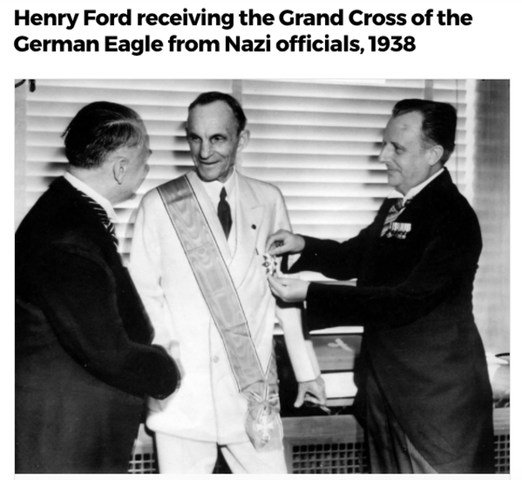
I was more interested in the long list of U.S. corporations that cooperated with the Hitler regime. Henry Ford led the list. He is also named as Hitler’s largest American financial contributor in another very good book, “Who Financed Hitler.” Ford accepted Germany’s second highest medal of honor from Nazis! But General Motors, in Hart’s book, was hardly less guilty than Ford in cooperating with and profiting from the Nazi era. Coca-Cola and IBM were deeply involved, too. Did you know that Fanta was originally created for the Nazi Germany market?

History is probably not the main reason people will have for reading this book. We want to compare American fascism from another period with what is going on today. Right now, we want to know, how many Americans would accept fascism as the way to govern our country? Your guess?

-Gene Lantz

I’m on KNON’s “Workers Beat” radio talk show every Saturday at 9 AM Central Time. They podcast the program and my other rants on Soundcloud.com. If you are curious about what I really think, check out my personal web site.

We’re seeing a lot of articles and op-eds about how old crazy stupid Donald Trump keeps making terrible blunders that could cost him the election. But what if they aren’t errors? What if they are part of a deliberate plan?

Recently, Trump sticks up for the Confederacy, threatens to call out the army against protesters, attacks protesters so he can pose for a photo-op, advocates undermining Social Security, refuses to wear a face mask,  moves his convention so Republicans can risk COVID at a mass meeting, calls a mass meeting in the city best known for mass lynching, and tries to ruin the Post Office. These are unpopular actions. The pundits say he’s ruining his chance for re-election in November.

I want to add that Trump is actively opposing vote-by-mail, but that particular dangerous and unpopular stance needs to be considered separately.

What if Mr Trump is not worried about the November elections because he and his filthy rich supporters intend to cancel them? Here in America and among Americans, cancelling a presidential election may sound incredible. But dictators do it all the time!

It’s never happened in America, you might protest, but lots of things that have never happened in America are happening since Mr Trump took office.

The State of Georgia just held an election, and the word used to describe it was “chaos!” An earlier election in Wisconsin was the same. People on our side think that this chaos is shameful and must be remedied. People on Trump’s side don’t think so at all. They think that bad election precedents may provide a pretext for postponing the November presidential race.

In many states, including mine, politicians have already set legal precedent for postponing elections. The one we’re about to have in July was originally set for April. What’s to keep the Trump forces from postponing the one in November? Assuming the COVID pandemic keeps getting worse, which it is and is being worsened by deliberate political decisions, then “postponing” the November elections may seem more palatable to some unthinking members of the electorate, and to ALL of the supporters of the candidates that are expected to lose!

If vote-by-mail is allowed, and if the Post Office has not been destroyed, then the pandemic wouldn’t even make a decent fig-leaf excuse for postponing the November election. The HEROES Act, passed in the house and stymied in the Senate, would save the Post Office. Rightwing lawsuits to bar vote-by-mail are making their way to the Supreme Court right now. What do you think will happen?

It is difficult to absorb the true gravity of today’s situation or the meaning of the protests in the cities of the world. Even though they have captured all the headlines and are undeniably important, I think they are only skirmishes in a battle that has yet to come.

From Wikipedia: “A skirmish is a term first used in the 14th century.[2] It meant a small-scale fight between two opposing forces or a preliminary battle involving troops in front of the main force.”

The main forces of the antagonists have not yet engaged. Only the advanced forces have begun the combat. The skirmishers on our side are the youth. They are more willing to fight, and they have more to fight for. On the other side, the skirmishers are police forces. They are the first line of administration for the people who run our society.

The main forces have yet to be committed. So far, the military has not been employed, at least not completely. Mr. Trump threatens to use them, and he certainly would, but he hasn’t yet. Organized labor, always defensive, is not likely to respond until there is no other choice. There is some hope that workers may organize outside the restrictions set up to cripple traditional unions. A general strike may not be so far in the future.

The economic situation makes the war inevitable. As American economic power decreased relatively, beginning in the early 1970s, the employers demanded more and more from the working class. For the workers, the situation has become intolerable. It is fight or die.

Class war is not new, but the circumstances have changed drastically. Workers are far better educated and far better networked than ever before. Employers not only have their traditional rifles and bayonets, but they also have nuclear weapons.

New strategies will come into play. It is unlikely that major working class forces will commit until the situation gets more desperate, but insightful people may be ready to fight now. The trick is to find each other and organize.

-Gene Lantz

I’m on KNON’s ‘Workers Beat” program every Saturday at 9AM Central Time. The radio show and several “Workers Beat Extra” presentations are podcast every Wednesday. If you are curious about what I really think, check out my personal web site..

Around the world, more people are in motion today than at any time since the early 1970s. The flash point was the police murder of Mr George Floyd in Minneapolis. There are demonstrations all over the planet, and some of them are quite militant. But do they have a plan?

Police brutality is hardly the only issue. Planet-wide, we are in an economic downturn that looks to become worse than the Great Depression. Any chance of saving Earth from environmental disaster is ticking away. The fascists among us are overwhelming our democracy. We are dying everywhere of a pandemic that is not, whatever the politicians might say, under control. All hope of international cooperation seems destroyed by President Trump. World war may be imminent. To put it succinctly, the system is breaking down.

Answers, Anyone?

I seek answers. As a talk radio host, I get to listen to a lot of heartfelt complaints. I ask them, “What should we do? What is the solution?” But they don’t know.

Social media is full of the same. Unending complaints about the world we live in; almost no positive suggestions. To be sure, the electoral enthusiasts among us continue to ask people to vote. I certainly agree with them, but I wouldn’t want to stand in front of the angry throngs of America today and say that my sole answer to their swollen anger is “vote Democrat in 2020.” They have heard that many times before, and they aren’t buying it.

The radicals among us, on both sides of the spectrum, aren’t connecting. One gentleman called our talk show and said that we need to re-institute segregation. What an awful person, but at least he had a plan! The so-called leftists call in and say that we have to “fight imperialism” or “smash the state.”  They’re probably right, but those are long-term goals, not prescriptions for the here and now.

Labor Turns Away

Just about the best of the down-to-Earth solutions being posed has just slipped away from us. The AFL-CIO national labor federation had called for a “Day of Action” June 3 to win passage of the HEROES Act in Congress. The Act would greatly ameliorate the economic crisis. It would also help with the political crisis by providing more money for electoral reform. But, alas, just today, the national leadership postponed the Day of Action.

They sent out a statement that was very good, but didn’t really explain why they postponed their actions for June 3. It may well have been a result of last night’s attack on National AFL-CIO Headquarters in Washington DC. Windows were broken and a fire was set! We might assume that they believed that the June 3 Day of Action would invite more thuggery.

I absolutely loved the Tweet sent out by the President of the Central Labor Council in Sioux Falls, South Dakota: “It hurts to see damage being done to the @AFLCIO headquarters. But I believe it brings to light two facts: 1) The people did not recognize the building as the headquarters of a movement that fights for them 2) That is our fault.

In my opinion, the labor leadership made a major mistake. If labor is truly in solidarity with the anti-racists on the street, we should be on the street with them. Others are marching without condoning violence and looting, why shouldn’t we?

Another possibility is that the AFL-CIO does not want to risk being seen as anti-police because they generally welcome organized police associations into labor’s organizations. Some of us think that, too, is a mistake.

By calling off the Day of Action, our labor federation turns down the opportunity to lead the progressive movement in a positive direction. Our demand to pass the HEROES Act might not solve all of America’s problems, but it certainly goes in the right direction. Further, our demand had the distinction of being just about the only reasonable positive demand being proposed!

OUR FAILURE

Vandals vandalize, looters loot, and America’s great and powerful progressive movement continues milling around leaderless! That’s our failure.

–Gene Lantz

I’m on KNON radio’s “Workers Beat” talk show every Saturday at 9 AM Central Time. The podcasts are on Soundcloud. If you are curious about what I really think, check out my personal web site

Serious groups and individuals are trying to find a way forward during this crisis, but many of us come up with different answers. The reason is that we don’t really understand the problem. That’s our biggest mistake.

It’s popular now to blame President Trump for everything. Since Bernie Sanders cancelled his campaign, some of my friends are blaming Joe Biden. In a more general sense, some blame the Republicans. Some still blame the Democrats. Some blame the people who vote wrong, some blame the people who don’t vote at all. Some blame the Chinese and others say we should be more like the Chinese.

All of them are only partially right.

The economic/ecological/financial/medical/political crisis is not the fault of the Chinese, not the fault of the pandemic, not Trump’s fault, not Obama’s, and not Adam Smith’s. If we were going to blame one of them, we should probably single out Adam Smith. He’s the one who promoted our big mistake by spreading the horse-hockey theory that capitalism was a rational system.

Keynes explains capitalism

Capitalism is not a rational system. Never was, still isn’t, never will be. Capitalism really isn’t even a system. The best way to define capitalism is to say that capitalists are running things. The capitalists replaced the aristocrats mostly in the 17th and 18th centuries. The aristocrats had replaced the slave owners in a long process before that. Aristocrats were more productive than the slave owners. Capitalists were more productive than aristocrats, but they still hadn’t evolved up to a rational system.

Even Adam Smith didn’t actually claim that capitalism was guided by rational thinking. He said it was guided by an “invisible hand” that made it good for everyone. He didn’t say that the invisible hand was rational, so that’s to his credit. He should have said, though, that it’s a crazy hand. A psychopathic hand. That would have been more honest.

Capitalists work from a national framework. They take over other, less efficient, economies. They don’t prefer to use their national armies, but they will. When there are no more territories or peoples to take over, they have to face off against one another. That was the situation in 1914 when the big capitalists made us go to war.

If the capitalists were in control of a rational system, they might have found some other kind of solution. I don’t think that individual capitalists, for the most part, really wanted to go to war. Well, maybe Winston Churchill, but not a lot of the capitalists.

After the War to End All Wars and a brief period of prosperity to replace everything they had broken and to grow some new cannon fodder, the capitalists extended their crisis into the Great Depression. Another World War and another prosperous period of replacing broken things brought them into their present crisis.

During and since the Great Depression, the capitalists have been using their power over the government to bail out their failed businesses. In 2007, armored trucks full of money scurried from government agencies to banks and big business. They are doing it again now, and they will have to do it again in future if they are going to stay in power.

What If We Had a Rational System?

Let me change the direction of the argument slightly. Let us suppose for a moment that we actually were living under a rational system. One aspect of a rational system would be to avoid overpopulating our planet. The basic reason for overpopulation is government policies to encourage high birth rates. Presently, nations need high birthrates in order to compete with one another in an irrational world. In a rational world, they wouldn’t.

Pandemics would be less of a threat. Famine would be less of a problem. If an epidemic threatened in some part of the world, the rest of the world could mobilize to isolate and stop it. In a rational world.

Our biggest mistake is blaming individuals, nations, ideologies, or circumstances for our problems. We should blame the capitalists who run our irrational system, and we should democratically replace them with rational leaders. That simple!

–Gene Lantz

I’m on KNON radio’s “Workers Beat” program every Saturday at 9AM central time. They podcast the weekly program and “Workers Beat Extra” on Wednesdays. If you are curious about what I really think, check out my personal web site.