Archive

politics

A big change is coming in international relations.

war2

It may seem that the whacky international news is only being caused by our whacky president and his whacky ways, but there are several underlying real trends pointing the United States toward starting a new war.

The most obvious one, which I have written about before, is that the Republicans and Donald Trump are looking at some major election losses in November unless they do something drastic. The most recent shifting of posts in the White House is definitely in that direction.

Another reason is more long-term and has to do with trade balances and history.

Looking Back

Nearly all of us living today are products of post-World-War-Two thinking. The “American Century” that began in 1945 put the United States at the head of all nations both militarily and economically. Historically, it was a most unusual situation for the world and for America, but most of us think of it as “normal” because it’s the only situation we have ever experienced. It isn’t normal at all, and it can’t last.

U.S. military domination continues, but is severely challenged right now in Afghanistan, Iraq, Syria, and Yemen. U.S. economic domination continues but is severely challenged by the European Union, new alliances in South America, and, most of all, by China.

U.S. economic domination is no longer based on our industrial productivity. A great deal of our industry has been shut down. Our agricultural production is still very strong, but also faces challenges. If anything, U.S. economic domination is based on finance, especially on borrowing.

An interesting article from CBS News says, “Why China won’t dump its huge U.S. Treasury bond Hoard.” They say it won’t happen, but they wouldn’t have written the article if people weren’t worried about it. Apparently, China holds about $1.2 trillion in U.S. Treasury bonds. They buy them every year, but they slowed down their purchases last year, the article says. It was just an incremental change, the article says.

The Nature of Change

Most change is incremental. It happens so slowly that we hardly notice it until some statistician points it out. These are quantitative changes. But quantitative changes can accumulate and, eventually, create giant qualitative changes that seem to happen all at once and come out of nowhere. Think of a stock market collapse, an earthquake, or a sinkhole. Think of a war.

Why Have a War?

Competition, not cooperation, is the natural behavior of capitalist economies. War is a natural consequence of capitalism. Even in the “American Century” so far, U.S. armies have been engaged over and over again. Even when the armies were not engaged, the U.S. has employed proxy armies such as the “Contras” in Nicaragua, the Kurds in Syria, or the Saudis in Yemen.

What passes for “diplomacy” is actually based on war or the threat of war. Witness the current expulsion of diplomats from Russian embassies, for example.

Why NOT Have a War?

Like any other enterprise, war depends on the cooperation of the people carrying it out. If we refuse, if we mobilize against it, no one can force us into the next big war. But we need to get started.

-Gene Lantz

I’m still on KNON.org 89.3 FM in Dallas at 9 AM Central Time every Saturday. Programs are podcast for two weeks and can be found under the “events” tab of the home page. If you are interested in what I really think, check out my personal web site.


Take a look at recent news from the point of view of the progressive movement. Keep in mind that only the working class, and working class issues, can truly pull the movement together. The entire working class will not unite over gun control, over the right to abortion, over civil rights, or any of the other important causes. Wages and working conditions will unite us, because all of us care most about them.

On May 6, Texas held the first primary elections of the season. Democrats were overjoyed to double the turnout that they had in the last mid-term elections. Republicans improved about 15%. But the raw number of votes determines election winners, not percentages of improvement. While the Democrats were able to get a million voters to the polls, the Republicans got half again as many. The leading Democrat, Beto O’Rourke for Senate, got 600,000 votes, while the Republican incumbent got 1.3 million! The same was true in the governor’s race.

One of the reasons for improved Democratic Party turnout was that they fielded candidates in every race, even in the ones where they were almost sure to lose. There’s a downside to that, because some of the contested seats were held by rock-solid working class incumbents with 100% pro-worker voting records. Politicians are mostly opportunists, not principled leaders.

Labor is calling the results “mostly good news” because over 90% of our endorsed candidates got into runoffs or won outright. But we lost three of the best of the state representatives, including Roberto Alonzo of Dallas who has been honored nationwide for his commitment to labor’s cause. Labor worked hard for their candidates

Progressive Movement Remains Fragmented

No one could deny that there is an upsurge in the progressive movement since the 2016 elections. The big improvement in voting statistics demonstrates it. But cohesion is not one of the grand characteristics. The most unifying theme among Democrats was dislike for President Trump, according to the pundits.

But the only way they could unite effectively is around the basic issues of the working class, and the election results did not show that trend. While the AFL-CIO could honestly claim a 90% success rate, another organization, Emily’s List, which only endorses on women’s issues, could claim 100%, according to the Politico news service. All their endorsed women were in runoffs or had won outright.

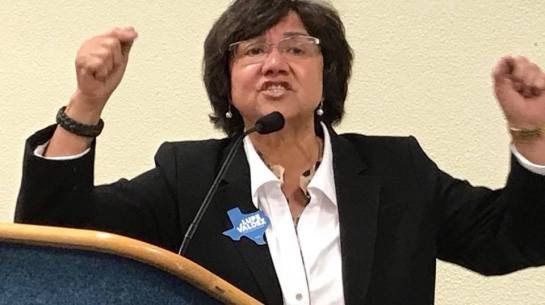
Labor’s candidate for the Democratic nomination for governor was controversial because of being a woman, a Latina, and gay; but she won a thumping big plurality and goes into the runoff with a big advantage among Democratic voters. It would be a stretch to claim that she did so well because of the AFL-CIO endorsement, when Emily’s List had better results.

People who want serious change remain confronted with this problem: how can we unite the progressive movement?

Best News Was Barely Reported

While pages and pages of newsprint covered the Texas elections, there was scant coverage of the teachers’ strike in West Virginia. But from the point of view of unifying the progressive movement around workers’ issues, the news from West Virginia was at least as important, if not more so. For the first time in years, American labor saw a well planned and well-executed strike create big gains for workers. By holding out statewide for nine days, those teachers won a 5% raise for themselves and for all state workers. They also got a freeze on health care costs. The AFL-CIO Executive Board endorsed the strike in, I think, about the 7th day. The American Federation of Teachers spoke encouragement, but I didn’t see any of the nationwide forces really throwing themselves into it. The main fund raising I saw was one of those “go fund me” accounts.

In today’s news, way back in the back pages, teachers in Oklahoma have issued an ultimatum to their legislature. Arizona teachers are also talking strike.

Historical View is Bad, but Mostly Good

A lot of people, including me, believe that economic conditions are leading the capitalist class toward choosing fascism as their preferred form of rule. The great robbery called the “tax cut” went through Congress in December with very little popular support. Despite their best efforts, it is unlikely that the rich will convince Americans to warm to it very much.

What I’m saying is that it is getting harder for the rich to continue robbing the American people. That’s why they are working so hard to disarm us with voter suppression, dangerous foreign policy, anti-union legislation and legal decisions, deregulation, redistricting, and destruction of civil rights and civil liberties. Once our rights are gone, we can’t defend ourselves at all. That’s fascism.

Even though I think the obscenely wealthy are likely to choose fascism, I don’t think they will be able to implement it. That’s the good news. We aren’t as dumb as they may think. Actually, we’re far better educated and far more capable of coming together than the Italians and Germans of the 1930s were.

This is the time to organize. Low unemployment and high discontent are the ingredients for a great upsurge. Despite the low voter turnout numbers, Americans have more energy, and it is more generalized, then at any time since World War II. We may be fragmented, but we won’t stay that way. Once we are united, nothing can stop us!

–Gene Lantz

I’m still on KNON radio 89.3FM in Dallas from 9 to 10 AM Central Time every Saturday. If you are interested in what I really think, check out my personal web site.


Book review: Glenn Frankel, “High Noon. The Hollywood Blacklist and the Making of an American Classic.” Bloomsbury, New York

garycooper

There aren’t any actual good guys that I know of in the story about the American film blacklist. There are just bad guys, to one degree or another, and victims. The main character in this book is Carl Foreman, who wrote “High Noon” and saw it through. According to the book, Foreman’s views were shaped by the anti-communist witch hunt going on at the time (1952). Foreman was one of the victims.

The plot of the movie, as you know, concerns a lawman under pressure from a gang of killers. He can’t find anyone to back him up, but he can’t figure any way out of it either. So he has to face almost certain death alone. He survives (it’s still a Hollywood movie) and is embittered about the law (the system?) and about the people he had considered his friends. He dumps his tin star and rides away. The town becomes a ghost town, just as it deserved.

The town in High Noon is a metaphor for Hollywood. I’m old enough to remember when the movie came out, and I’m also old enough to remember the schlock that passed for American films afterward. Rock Hudson flirted with Doris Day in every other movie for the next ten years!

I’ve read several books about the witch hunt that is sometimes called the “McCarthy period.” I liked this one because it names a lot of names of the name namers. It doesn’t equivocate as to who was profiting by turning in their friends, who was lying to begin with, and who found some way around it. Foreman was one of those last ones. He was a victim to be sure, but he came out of it better than many former Reds. He managed to avoid naming any names, too, according to the book.

A lot of fuss is made over film star John Wayne, who was one of the biggest red-baiters in Hollywood. This may have been because many of the people he was victimizing had served honorably in World War II, while Wayne ducked it and made his fortune playing war heroes. Wayne hated “High Noon” and Carl Foreman. There’s an interesting interview on YouTube in which Wayne tries to cover his venom with a patriotic veil.

I also liked the film analysis in the book. Several artists did what has to be their best, or way up there nearly best, work in this movie under difficult circumstances. I can’t think of a better performance by Katy Jurado or Lloyd Bridges. Lon Chaney Jr, who ruined his image by playing The Wolfman over and over, was especially outstanding. Gary Cooper played Gary Cooper for the 1000th time, but it’s hard to think of a better version! If you’re curious about Cooper’s role in the witch hunt, you’ll get your answer in this book.

The book offers a lot of answers about this terrible period in American history. The questions continue to overshadow the answers, especially “Will it happen again?”

–Gene Lantz

I’m still on KNON radio 89.3 fm in Dallas every Saturday at 9 AM Central Time. If you are curious about what I really think, check out my personal web site


I received a mailing to help me promote “School Choice Week” on the air.

At KNON radio studios, I receive  a lot of right-wing mail. I think it’s because my program is called “Workers Beat” and conservatives can’t conceive of a radio show that is actually for workers. When one says “workers” they assume you mean management, I guess, because all the other radio programs are either written by the bosses or approved by them. I throw away a lot of free books about how to get more work out of workers.

The School Choice mailing came from a post office box in some town in California. It says that there are 32,240 American events to promote “school choice” during January 21-27.  It says that 6.7 million students and supporters will be participating. It says there are 54 events in my town. It says I should promote them on KNON radio and it offers me materials to broadcast.

I assume they sent this to every radio station in America at considerable cost. It’s part of a national effort to destroy the public schools. If you aren’t worried, you should be.

ocos-rena

A Little History on Schooling

America, more than most countries, advanced free public education. It’s one of the reasons that America shot ahead of the rest of the world in the 20th century. But there was always resistance. It took a Civil War to offer free public education to African American children, for example, and even then their public schooling was inferior to that offered to the Master Race of American Anglos. It still is.

The Brown Vs Topeka Supreme Court case in 1954 signaled a renewed fight for fair education. Whites were encouraged to fight against fairness in a number of interesting ways. One way was to move to white suburbs. One way was to create “magnet schools.” These “magnets” drew off the most outspoken activist parents and gave them what they wanted — decent education for their own kids — while leaving the rest of the kids, largely those with parents who had to work, behind.

They loosened the restraints on home schooling for the parents who didn’t have to work. Another way was to push for school vouchers so that tax money could be used for private schools. Yet another way was to push for “charter schools” to use tax money in ways that were out of the control of the people.

It’s the same fight that we were having during the Civil War and Reconstruction, but in different forms.

Who Wants to Destroy Public Education?

The people with the most money want to stop paying taxes. A lot of federal money, and the largest part of any state budget, goes to education. That’s tax money that rich people would rather not pay. After all, their kids don’t even need the public schools. They have always had better schools, before the Civil War and after.

In this regard, wealthy people’s desire to stop paying taxes, the effort to undermine public schooling fits into the larger explanation of what’s wrong in American politics today. In order to maintain their profits and beat their international competitors, wealthy Americans are trying to contain their costs. We are their costs. Public school children are their costs, in their view.

Public schools retain all their traditional enemies, too. Religion in general and the Catholic Church in particular head the list. They think they can get public money to promote their superstitions. In the short run, they can, because the very wealthy welcome any help they can get to destroy public education. Look at poor Louisiana!

In the long run, the very wealthy don’t want to pay for Catholic schools, either, so their little cabal won’t endure very far beyond the collapse of public education. The Catholics will be left at the altar once their usefulness is over.

Just to be Clear

State legislatures have been cutting public education funding for some time. It is especially true in states where right-wing Republicans have seized control. First they drain away all the resources, then they impose crazy unreasonable rules, then they piously claim that the schools are “failing.” Then they cut some more and pass some more rules.

One doesn’t have to be smart to figure out that they intend to rob American children of their right to a decent education.

Public education

Fight Back

The American Federation of Teachers and the National Education Association, the main unions, are forming coalitions with community groups to clarify the issues and direct the fightback. I’m proud that the main labor federation, AFL-CIO, backs them.

As usual, our enemies have many ways to divide us. They say that they are magnanimously seeking ways to overcome school “failures.” They say they are promoting “innovation,” and “school choice.” They are spending a lot of money to buy politicians and do direct advertising.

That’s why I got the stupid mailing about “school choice week.”

–Gene Lantz

I’m still on KNON radio 89.3 FM in Dallas at 9AM central time every Saturday. If you are curious about what I really think, check out my personal web site.


The Republican position on undocumented workers is basically to deport them all. Round them up like cattle in concentration camps, and ship them to the other side of a humongous 2,000 mile wall. Twelve million human beings. Is that really likely?

Put Yourself in Their Shoes

Let’s say you are a refugee from, for example, Guatemala. Or anywhere. You reluctantly left your home because you were facing hunger, assassination, torture, or some other kind of repression there. After a rough trip to the United States, you found conditions that were pretty terrible compared to the local citizenry, but better than conditions back where you came from.

Your life has an “underground” quality. You enroll your kids in school but, just to be careful, you don’t tell them exactly where you live. You stay out of public life in all aspects, because you worry about being uprooted or causing someone you care about to be uprooted. All this was true when you came to the U.S., it’s true now, and it will still be true after all the Republican fulminations against you.

If the repression in the United States gets worse, you aren’t likely to leave. You’ll just sink further into the underground, won’t you? Maybe you’ll take certain measures: take your kids out of school? Move more often? Change jobs more often? Change names more often? But you won’t leave voluntarily, and you won’t make it easy for ICE to find you.

There’s Always Crime

If things get so bad that you can’t feed your family legitimately , there’s always crime. You can buy a gun for mugging people. A handy crowbar for burglaries is even cheaper. You didn’t want to be part of a growing criminal underground, but it’s better than watching your children go hungry, isn’t it? You do what you have to do. You didn’t make this world, but you still have to live in it.

–Gene Lantz

I’m still on http://knon.org/workers-beat/ at 9 AM Central Time every Saturday. If you are interested in what I actually think, check out http://lilleskole.us

You may not have seen the census report indicating that labor’s numbers went up in 2017. Also, the Los Angeles Times unionized! This could be a great year for working people!

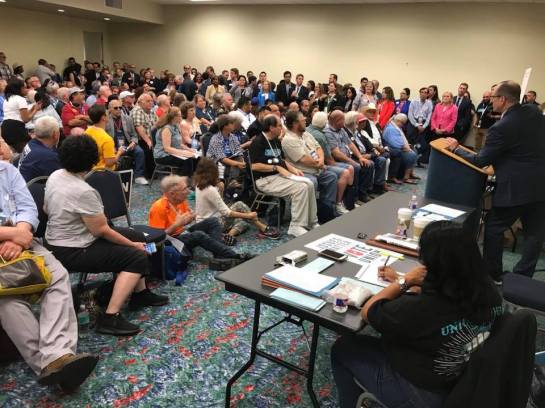
I spent the weekend January 19-22 in Austin listening to speeches and attending workshops with the Texas AFL-CIO Committee on Political Education (COPE).

copecrowd

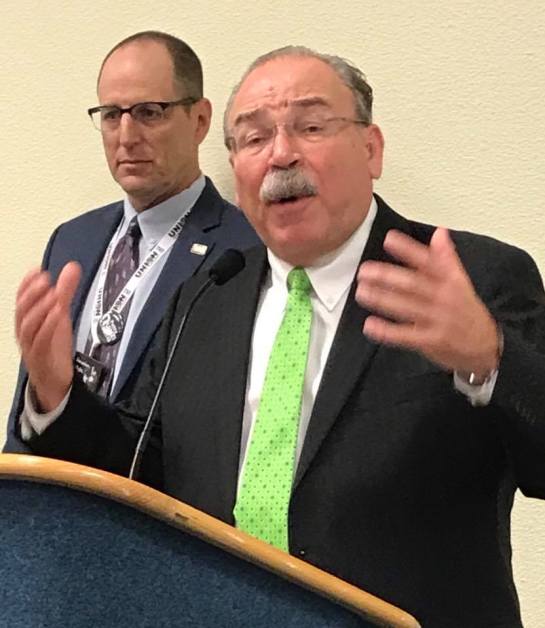
There were over 400 labor leaders, young and old. Speakers included candidates for governor of Texas, international union presidents, and one of the top national AFL-CIO leaders, Liz Schuler.  I’ve put summaries on http://tx.aflcio.org/dallas and on http://texasretiredamericans.org plus several Facebook pages.

I was delighted!

The endorsement process was very telling. To begin with, they refused to endorse the one-and-only Democrat running for the U.S. Senate. President Rick Levy said that labor just didn’t want to be taken for granted, and the guy hadn’t shown up! Next, they skipped over the sharp-talking right-centrist governor’s candidate with the most money and the most fund-raising ability so they could endorse a gay Latina!

When the endorsement proposals were presented, one delegate got up to say that we shouldn’t be so incautious in endorsing her. He didn’t say why, but the next 4 or 5 speakers blasted homophobia, sexism, racism, and every other kind of chauvinism they could think of! Then the congregation ratified the endorsement overwhelmingly!

Doesn’t sound like the old labor movement at all. In the old days, they were reluctant to endorse anybody in primary elections. They just waited until the Democrats had decided, then carefully chose a few candidates that they thought might win with or without their help. Then they went through the motions of helping, mostly with surreptitious financial donations that their members hardly ever found out about.

Election Tactics

Several speakers, including the hired professional political science experts, talked about a new way of doing things. It was actually kind of hard for me to understand what they meant. As far as I understand anything, they are still going to be relying on phone banking and door-to-door canvassing of union members only. They just plan to do a lot more of it and they plan to start “in March instead of October.” (I enjoyed telling them that my organization started in early January, last week!)

But there may be some qualitative differences. They may rely on town hall meetings and even home meetings more than the grueling long-distance canvassing that we ordinarily do. They may try to discourage donations to candidates in favor of using the money to pay union activists to work on our own electoral program. That would be a really big difference!

I’m not positive about what they will end up actually doing. Everything unions do is done in government straight-jackets, so they may not be able to vary their tactics as much as they would like.

It Feels Different, It Feels Good!

I’ve been to many union political conferences and I’ve been around the union movement at least 40 years. I don’t remember ever seeing so much enthusiasm. I don’t remember so much unity. I don’t remember ever having so much confidence in the leadership. I don’t remember hearing so many things that made sense.

–Gene Lantz

I’m still on http://knon.org/workers-beat/ at 9 AM central time every Saturday. If you’re interested in what I really think, check out http://lilleskole.us


Every serious progressive I know is gearing up for election work. There are basically two ways to go about it, and I would like to contrast them here. I’ll call them “what we normally do” and “what we oughta do.”

ballot

Voting

Normally

In almost every election, progressives work for certain candidates or we work for a political party. Analysis leads us toward choosing candidates and races where we can win. America’s elections, unlike those in more civilized countries, are “winner take all.” You either win a race or you lose it; consequently, activists check the demographics and opinion polls before they deploy their resources.

One of the important things that people look at before designating a certain candidate as “viable” is “how much money have they raised?” It is my understanding that 85% of all American elections could be predicted if we knew which candidate had the most money.

According to today’s newspaper, Texas Democratic governor candidate Mark White just became more “viable” than Lupe Valdez because he raised more than twice as much money in their first reporting period.

It’s ironic that White now has $100,000 in campaign money, while the incumbent Republican he wants to run against has $40,000,000 and rising. So White may be more “viable” than Valdez by this standard, but he’s 400 times less “viable” than Governor Abbott!

Nevertheless, Democrats will work for the more “viable” candidate and their fund-raising ability will be an important determinant.

At the end of the campaign, the chosen candidates will either win or lose. The people and organizations that put their time and treasure into those campaigns will think they either have a “friend” or an “enemy” in the given political position, but that’s about all they will have. Those “friend” and “enemy” designations aren’t very concrete. Our “friends” often betray us because they weren’t sincere to begin with. Nearly all politicians are opportunists who look out for themselves first and always.

Next elections, the progressive activists will go through it all again. They will start more or less empty handed, and they will end up more or less the same way. The one concrete thing that they will gain is a sense of self-sanctification that allows them to gripe about everybody else right up to the next election: “Why didn’t those so-and-sos vote!”

A Better Approach to Elections

Progressives should develop the ability to see past candidates, political parties, and elections. They should examine their own goals and realize that what they really want is fundamental improvement in our society — a lot more improvement than was ever intended by Democrats or Republicans!

To get that kind of change, progressives need to build our own progressive organizations. There are a lot of progressive organizations worth building, but my personal favorite is the American labor movement.

Instead of pursuing candidates or parties during elections, we can and should be examining our organizations and looking for ways to strengthen them. One of the best explanations I’ve ever seen came from some West Coast labor people who developed a “labor neighbor” campaign.

“Labor neighbor,” in essence, is a process of locating and strengthening the individual activists within a progressive organization. A union might, for example, identify one of their members who really wants to work for change. They then provide information and support for that member. Instead of canvassing door-to-door where some candidate wants them, they would canvass in that particular member’s neighborhood. His or her electoral strength would improve for that election, but also beyond the election to the next election or to the next political opportunity.

Then they pick another good activist and help him/her the same way. Labor/neighbor!

I’ve been working on a similar approach within the Texas Alliance for Retired Americans. Our Dallas Chapter identified one member, Mary, who was willing to improve her political strength in her own precinct. We were able to get two big lists of her neighbors. We telephoned a bunch of them and invited them over to Mary’s for coffee and donuts.

Mary ended up with a lot of information that can help her in whatever political opportunities, including the current elections, present themselves. I thought it was a pretty good program and I’d like to see it extended.

But I realize that a lot of political-minded progressives aren’t going to prioritize this kind of work. They are going to chase after some candidate or some political party in 2018 just as they always have done. There are two different philosophies here: one believes that election work is an end unto itself; the other believes that building a progressive movement is the priority.

One is purely reformist, the other has revolutionary potential.

Elections Matter, But They Aren’t Everything

Some radical activists don’t believe in elections at all, but I’m not one of them. I believe that every arena of political struggle should be utilized to bring about desired progressive changes in society. In my “labor neighbor” model above, the designated activist who was strengthened in his electoral work is also strengthened in other matters.

He/she, for example, might be able to bring some neighbors to a march or a picket line that had nothing to do with electoral politics but had everything to do with building progressive people’s power. As he/she applies their newfound ability and strength, they will develop more of each. The progressive movement will consequently grow toward being able to make some real improvement.

It’s not just a game.

–Gene Lantz

I’m on KNON.org radio 89.3FM every Saturday at 9 Central Time. If you want to know what I really think, try http://lilleskole.us


I feel that I should explain, especially to those people who avoid me. It’s true that I’m incapable of cordial conversation. In no time, I turn almost every conversation into an “ask” for this or that. Sometimes I’m after contributions to the retiree cause, sometimes I want people to come to something, sometimes I ask them to “make a few calls.”

me-sanantonio

Here’s my excuse: I have an urgent sense of history unfolding.

We Think We’re in Normal Times

In normal times, things go on pretty much as they have. There are no sharp changes in normal times. We think it’s “just the way things are,” and the inference is that they have always been that way.

But there are no normal times. Nothing is static, everything is constantly changing. When little, barely noticeable, changes start to accumulate, then giant, sudden changes occur. I saw one of those little changes in my e-mail today. It said that Republicans are proposing another $492 million cut in the Social Security Administration’s budget. It’s just one of many relatively “little” changes that undermine the American standard of living. It’s been going on since 1980.

I also saw, today, that the latest Texas Voter Suppression law is going into effect. I saw that President Trump is saber-rattling, again, against North Korea. He added Iran this past week.

These little changes undermining our standard of living and taking away our democracy so that we can’t fight back, are likely to add up to a big change. It’s impossible to predict when, but it’s foolish to ignore the truth that the big change is looming more likely.

Two Big Changes Ahead

If the coalition of big-money funders and ignorant reactionary pawns continues to get its way, America is going fascist. Who would deny that incipient fascism is already upon us? Who would fail to admit the direction they are taking us? Who would fail to notice that fascism, the total extinction of democracy with working people completely under the thumbs of corporate masters, is exactly what they intend?

The other big change that might occur is a defeat of the big money funders and ignorant reactionary pawns. An enlightened and activated populace may yet join together into an irresistible progressive force that will regain the upper hand for democracy and begin a new path to peace and progress.

Pick One

Those with an urgent sense of history know that one of those big changes is coming. You can have one or the other but you can’t have neither. You can’t have “normal times.”

That’s why I ask people to study and to get active in the most meaningful way. That’s why I’m such a pain in the butt.

–Gene Lantz

I’m still on KNON radio 89.3 FM in Dallas every Saturday at 9 Central Time. If you want to know what I really think, check out http://lilleskole.org


2018 stretches before us like a blank canvas. Economists and Republican politicians are painting a gorgeous festival on it. Democrats are using only one color: black.

fat-famine

Predictions Take the Safe Road

Nearly all predictions are just linear projections of trends currently underway. For example, American production has been rising slightly so the prediction is that it will rise even more. Unemployment has been low, so the prediction is that it will stay low. I saw one prediction saying that wages will go up in 2018, even though they have been going down since the 1970s.

For A Few, Everything Looks Great!

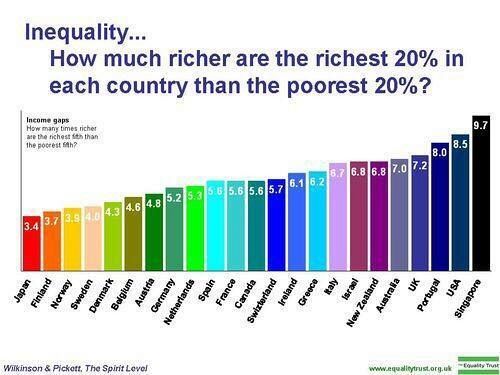
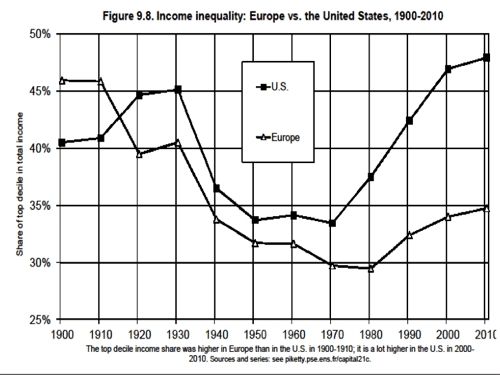
The disastrous “Tax and Jobs Bill” that just passed the Congress shows what is intended. It is a gigantic giveaway to the rich at the long-term expense of the poor.  This is not a new trend. It has been going on clearly since American domination of the world began to diminish in the late 1970s. It is reasonable safe, therefore, to predict that the rich will continue to get much richer and the poor much poorer in 2018. Inequality will worsen.

Using the same linear projection approach, one would have to conclude that democracy will continue to ebb and the environment will get even less hospitable.

Politics May Get Messy

The last poll before the Republicans passed their big giveaway, conducted by NBC News, said that only 24% of the American people supported the legislation. Republicans say that people will start liking it as soon as they see tiny improvements in their paychecks beginning in January. Democrats say that support for “trickle down” will fall even further as people see what was actually in the bill.

As 2018 begins, Republicans and their only legislative accomplishment are extremely unpopular. President Trump has the lowest ratings in history. Does that mean that they are going to take a mighty hit in the November elections? Are the Democrats going to take charge and bring back the rosy Obama days?

We should be skeptical. Republicans are backed by an awful lot of money, and money wins elections. Also, they hold state power. Who is to say how they might use their money and their power before November?

They might, for example, start another war. They’ve been talking up war with North Korea for months and they have the ability to start such a war just at the time when they consider it most propitious for their election prospects. It worked for both Bush Presidents, who had low ratings before invading Iraq and high ratings afterward. Sure, lots of people would die, but Republicans might well benefit at the polls!

Before deciding that the Democrats will surely make a comeback in November, remember that they have problems of their own. They robbed Bernie Sanders of the 2016 presidential nomination and, by now, everybody knows it. Deputy Democratic Party  Chairman Keith Ellison is touring America right now to try to bring all the Bernies back into the fold, but it’s safe to say that some of them won’t come. The Democrats would have to be really sloppy to not make some gains in 2018, but will they actually turn things around?

In summary, the safe set of expectations for 2018 is that it will be great for the great, but not for us.

What to Hope For

A lot of really good  things could happen in 2018. Low unemployment and high consciousness are requisites for an organizing boom. If unions and the other types of organizations presently underway aggressively take advantage of the situation, we could see some real organizational strength develop for working people. Then (and only then) we might expect to see a reversal in the steady decline in our American wages, benefits, and living standards.

There must be half a dozen organizations expecting to take over the Democratic Party, end all corruption, end its dedication to capitalism, and make it a workers’ party. There are others who believe they can create a workers party — perhaps from the Greens or from the Working Families Party — or from scratch. Conditions for a workers party have never been better because of the high educational levels and consciousness of the American people.

The progressive movement is a giant in America. The Women’s March on the day after Trump took power put more people on the streets than ever before in American history. They are planning another one in January 2018.

Even though very few Americans even know what a political strike is, they are becoming common in other parts of the world. With modern communications and the high level of consciousness among people, especially among young people, we may see major changes in America that come from outside the electoral system.

Expect the worst. Hope for and work for the best!

–Gene Lantz

I’m still on KNON radio, 89.3FM in Dallas, at 9 AM Central Time every Saturday. If you want to know what I really think, check out http://lilleskole.us