Archive

history

I talk to the young folks, they don’t understand,

‘A thing this old man has to say…”

–from the song “I Wish I Was 18 Again” as sung by Jerry Lee Lewis

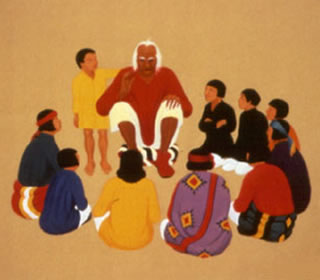
storyteller

I would tell young people that they are going to have to win their rights all over again. I would also tell them not to settle for what their parents had. I would tell them to figure out what needs to be done to get things right, even if it takes some time and experimentation, and then to do it!

False Roads Are Almost the Only Roads

I suppose that everyone is entitled to their own mistakes. In my 50 years of activism, Almost everything I ever did turned out to be mistaken, so I certainly have no right to expect young people to do any better than my own sorry example. Nevertheless, I have to try to warn you.

You Will End Up Working for the Man

Almost all of us want to choose a career that will actually make things better than they are. That’s why there are so many college students in the arts and in social studies. They want to do something meaningful while earning their living. It sounds reasonable but it’s nonsense.

In this system, we work for the people who have money and power. We perform the duties laid out by the people who sign our paychecks. The people with money and power are not the people who want change, no matter how they may sugar-coat it. If we want to make a living, we have to please them. So don’t waste your time trying to find a job as a progressive change agent, you will, sooner or later, be disappointed. A better career choice is one where you can make as much money as possible with as little of your time as possible. Look for a job with a union or one that can be organized into a union.

When In Doubt, Choose Democracy

When you are confronted with a decision about how to best employ your resources in the struggle for a better world, democracy makes a good guideline. In general, the political system democracy is in opposition to the economic system capitalism. Democracy pushes for equality. Capitalism has to have inequality.

Study Our History

Their history tells us that George Washington overcame British autocracy, that Lincoln freed the slaves, and that Martin Luther King Jr ended discrimination. Without taking anything away from these outstanding people, we need to acknowledge the masses of people who did the work before them.

Take, for example, the civil rights movement. It didn’t start in Montgomery in 1954. It was well underway before slaveholder George Washington’s time. There were great people who made great sacrifices to win the degree of racial equality that we have presently attained. Some of them were preachers, teachers and wonderful orators, but, in the final analysis, Black people in America freed themselves!

The union movement is responsible for bringing economic and social advancement for workers. There were some wonderful leaders that we know of. But the union movement, by its very nature, consists of and relies on the rank and file members. Workers in America, to the extent that we are free, freed ourselves!

The War Continues

We sometimes win a battle against our bosses; we sometimes lose one. But the war will continue as long as they are in charge. Every advance that we make will have to be won again, sooner or later.

So, my young friends, you will have to win everything that was won before. I’m hoping you’ll go further.

–Gene Lantz

I’m on KNON radio every Saturday at 9 AM Central Time. If you want to know what I really think, check out my personal web site


You may not have seen the census report indicating that labor’s numbers went up in 2017. Also, the Los Angeles Times unionized! This could be a great year for working people!

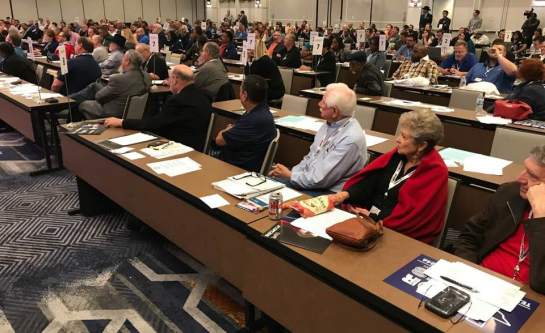
I spent the weekend January 19-22 in Austin listening to speeches and attending workshops with the Texas AFL-CIO Committee on Political Education (COPE).

copecrowd

There were over 400 labor leaders, young and old. Speakers included candidates for governor of Texas, international union presidents, and one of the top national AFL-CIO leaders, Liz Schuler.  I’ve put summaries on http://tx.aflcio.org/dallas and on http://texasretiredamericans.org plus several Facebook pages.

I was delighted!

The endorsement process was very telling. To begin with, they refused to endorse the one-and-only Democrat running for the U.S. Senate. President Rick Levy said that labor just didn’t want to be taken for granted, and the guy hadn’t shown up! Next, they skipped over the sharp-talking right-centrist governor’s candidate with the most money and the most fund-raising ability so they could endorse a gay Latina!

When the endorsement proposals were presented, one delegate got up to say that we shouldn’t be so incautious in endorsing her. He didn’t say why, but the next 4 or 5 speakers blasted homophobia, sexism, racism, and every other kind of chauvinism they could think of! Then the congregation ratified the endorsement overwhelmingly!

Doesn’t sound like the old labor movement at all. In the old days, they were reluctant to endorse anybody in primary elections. They just waited until the Democrats had decided, then carefully chose a few candidates that they thought might win with or without their help. Then they went through the motions of helping, mostly with surreptitious financial donations that their members hardly ever found out about.

Election Tactics

Several speakers, including the hired professional political science experts, talked about a new way of doing things. It was actually kind of hard for me to understand what they meant. As far as I understand anything, they are still going to be relying on phone banking and door-to-door canvassing of union members only. They just plan to do a lot more of it and they plan to start “in March instead of October.” (I enjoyed telling them that my organization started in early January, last week!)

But there may be some qualitative differences. They may rely on town hall meetings and even home meetings more than the grueling long-distance canvassing that we ordinarily do. They may try to discourage donations to candidates in favor of using the money to pay union activists to work on our own electoral program. That would be a really big difference!

I’m not positive about what they will end up actually doing. Everything unions do is done in government straight-jackets, so they may not be able to vary their tactics as much as they would like.

It Feels Different, It Feels Good!

I’ve been to many union political conferences and I’ve been around the union movement at least 40 years. I don’t remember ever seeing so much enthusiasm. I don’t remember so much unity. I don’t remember ever having so much confidence in the leadership. I don’t remember hearing so many things that made sense.

–Gene Lantz

I’m still on http://knon.org/workers-beat/ at 9 AM central time every Saturday. If you’re interested in what I really think, check out http://lilleskole.us


I feel that I should explain, especially to those people who avoid me. It’s true that I’m incapable of cordial conversation. In no time, I turn almost every conversation into an “ask” for this or that. Sometimes I’m after contributions to the retiree cause, sometimes I want people to come to something, sometimes I ask them to “make a few calls.”

me-sanantonio

Here’s my excuse: I have an urgent sense of history unfolding.

We Think We’re in Normal Times

In normal times, things go on pretty much as they have. There are no sharp changes in normal times. We think it’s “just the way things are,” and the inference is that they have always been that way.

But there are no normal times. Nothing is static, everything is constantly changing. When little, barely noticeable, changes start to accumulate, then giant, sudden changes occur. I saw one of those little changes in my e-mail today. It said that Republicans are proposing another $492 million cut in the Social Security Administration’s budget. It’s just one of many relatively “little” changes that undermine the American standard of living. It’s been going on since 1980.

I also saw, today, that the latest Texas Voter Suppression law is going into effect. I saw that President Trump is saber-rattling, again, against North Korea. He added Iran this past week.

These little changes undermining our standard of living and taking away our democracy so that we can’t fight back, are likely to add up to a big change. It’s impossible to predict when, but it’s foolish to ignore the truth that the big change is looming more likely.

Two Big Changes Ahead

If the coalition of big-money funders and ignorant reactionary pawns continues to get its way, America is going fascist. Who would deny that incipient fascism is already upon us? Who would fail to admit the direction they are taking us? Who would fail to notice that fascism, the total extinction of democracy with working people completely under the thumbs of corporate masters, is exactly what they intend?

The other big change that might occur is a defeat of the big money funders and ignorant reactionary pawns. An enlightened and activated populace may yet join together into an irresistible progressive force that will regain the upper hand for democracy and begin a new path to peace and progress.

Pick One

Those with an urgent sense of history know that one of those big changes is coming. You can have one or the other but you can’t have neither. You can’t have “normal times.”

That’s why I ask people to study and to get active in the most meaningful way. That’s why I’m such a pain in the butt.

–Gene Lantz

I’m still on KNON radio 89.3 FM in Dallas every Saturday at 9 Central Time. If you want to know what I really think, check out http://lilleskole.org


Book Review:

Schrecker, Ellen: Many Are the Crimes. McCarthyism in America. Little Brown and Company, Boston, 1998.

whitebread

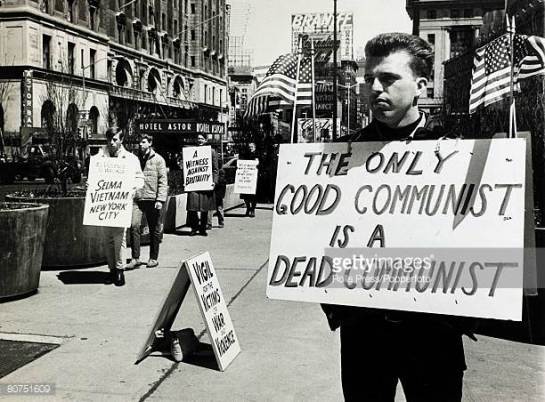
I remember the 1950s like white bread: bland, not nourishing, and an important part of every meal. Books, movies, and all things cultural talked about “the American way” as if it were the best of all worlds and the best ever created or imagined. Socialism was never mentioned, except in a pejorative way in movies like “I Married a Communist” or “I Was a Communist for the FBI!” We did not smoke dope in Muscogee, or anywhere else as far as I knew. We kept our hair short and our minds shorter.

It has taken many years for me to realize that the wasteland of the 1950s was created deliberately. Too bad I didn’t have Ellen Schrecker’s book in 1953! It would have saved me a lot of personal anguish.

communist-dead

Schrecker details important aspects of the anti-communist crusade from World War I to modern times. Except for a brief period during World War II, when the United States and the Soviet Union were wary allies, the crusade was relentless.

Schrecker is an academic, so don’t expect her to take sides. She’s just reporting what happened. Academics are afraid to take sides. However, the sheer immensity of the government-run effort to destroy civil rights, civil liberties, and any kind of resistance speaks for itself.

The author reminds us often that she doesn’t sympathize with the communists. She stands on the high ground of impartiality, and, in a way, that makes the facts about the  FBI and the other zealots even stronger.

Schrecker doesn’t shrink from pointing out that a great many of the tactics implemented by the FBI and taken up by other government entities were illegal. A great deal of the testimony against communists and liberal thinkers consisted of FBI-solicited lies. J. Edgar Hoover is hardly the only guilty party. Schrecker doesn’t spare the intellectuals and liberals who all-too-easily jumped on the anti-communist bandwagon. She also doesn’t spare the right-wing union officials who cashed in when, with government help, they drove the militants out of the American union movement.

I’m particularly interested in what happened to the American unions after 1947, when the anti-communist and anti-union Taft-Hartley law was passed. Unions resisted it at first, but here’s what Schrecker says on page 380: “…by the early 1950s, most of the nation’s unions had adjusted to the law and abandoned their struggle against it. It was a serious mistake. Taft-Hartley created an unfavorable legal environment that forced the entire labor movement onto the defensive. Unable to employ the aggressive organizing tactics that had been successful in the 1930s, unions found it difficult to expand. As a result, by the 1970s, when the postwar boom began to falter and the well-paid blue-collar jobs of the members began to disappear, labor was unable to mobilize either the political or the economic clout to protect its earlier gains. It’s numbers dropped… Instead of reaching beyond its traditional white male constituency in the heavy industry and skilled trades of the Northeast, Midwest, and West, the labor movement turned inward and raided its own left wing.”

On page 382: “Its rupture with the left hastened its transformation from a movement to a bureaucracy…. Once the left-wingers were gone, organized labor lost its dynamism….”

The saddest of the tragedies throughout this long, detailed book comes on the last page when the author considers “Can it happen again?” “…the process through which McCarthyism came to dominate American politics is infinitely replicable.” In less academic language: Yes, it can happen again.

–Gene Lantz

I’m still on KNON radio at 9 AM Central Time every Saturday. If you’re interested in what I really think, look at http://lilleskole.us.


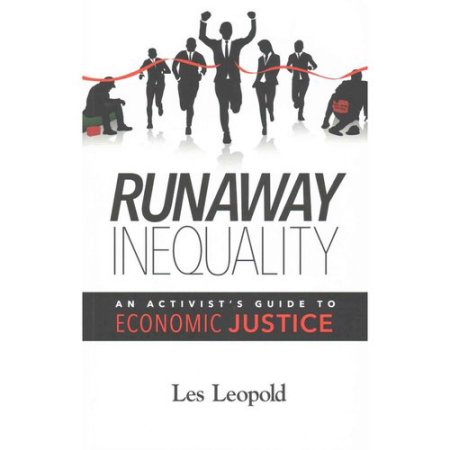
It is absolutely wonderful that the Communications Workers of America are buying books and teaching classes on “Runaway Inequality” by Les Leopold. It stirs a lot of thinking.

runawayinequalitybook

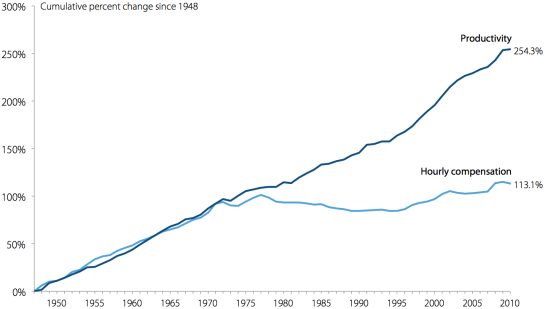
The core argument is that something has been seriously wrong in America since the mid 1970s, when wages stopped rising at a rate similar to the increasing productivity. Productivity is the amount of wealth that one average worker creates in one average working hour.

productivity-wages

As the graph shows clearly, wages and productivity seemed to rise together from the late 1940s to the mid-1970s, then productivity continued rising with the same upward slope, but wages flattened out. Profits rose, but wages didn’t. The change, Les Leopold says, came about because of deliberate policy changes. The book is full of other graphs showing the policies that changed, the resulting inequality, and the amazing effects of this incredible rise in inequality. Leopold then concludes by saying that ordinary Americans must band together and change those policies. In other words, wage-earners have to do what the bosses have been doing. It’s a “must read” book, and the classes (I’ve taken them twice) are inspiring!

There are further questions

  1. Is the period 1947-2016 a representative period of history, or is it unusual?
  2. Is the problem local or systemic?;
  3. Given the situation described in the book, is there really a solution for wage-earners?

What period of economic history is “normal?”

The entire book and all its conclusions come from the hypothesis that something went wrong in the 1970s. I have my doubts. The unusual period in American history was not 1974-2016, as Leopold suggests, but 1947-1974, the first part of the graph. In other words, there is nothing unusual about wages being suppressed in a capitalist economy. The unusual period was 1947-1974.

Take a quick look at how unusual was the post-war world:

  • Europe and Asian were bombed flat. American had virtually no competitors in the capitalist world
  • American unions were far stronger than in any time in history
  • The United States set the terms for all economic transactions in the capitalist world
  • The United States had almost all of the world’s gold

Then look at how things changed: By 1974, German and Japanese automobiles were flooding the world. President Nixon had given up America’s control over gold. Unionism had peaked around 1957 and was clearly slipping. The Chinese were having tea with Nixon and had broken up their alliance with the Soviet Union. Economic competition between nations was getting back to “normal.” What every nation had to do, to compete, was lower their costs. Their costs are our wages and benefits.

Is the problem local or systemic?

Our problems derive from the system we live in. American working families are having pretty much the same problems that other capitalist nations are facing. We have probably lost more than the families in other nations since the mid 1970s, but we had more to lose. The lords of American industry and finance have been able to hold on to their hegemony in the world only by sacrificing our wages and benefits.

Even worse, the long-term process of robbing working families entails destroying our democracy. The end of World War II was a triumph of democracy, and nowhere was democracy stronger than here, in the land of the winners. Several of Les Leopold’s graphs show how democracy is diminished. A very striking one is the graph showing that the United States has more people incarcerated than any nation of any size in the world! Today, many people are saying that we live under a plutocracy and that democracy is dead and gone.

It isn’t true. The absence of democracy is fascism, and we don’t have fascism in America. Even in 1947, our democracy was not complete. It was partial. Since the mid-1970s, our democracy has faded, but not disappeared. If the process continues as it is going now, it would be fair to say that fascism is the logical outcome. But it hasn’t happened yet.

Is there a solution?

Given the system we live in as described in “Runaway Inequality,” are we likely to be able to reverse the policies that have brought disaster for working families since the mid 1970s? No. What happened since 1974 is not unusual, it’s part of the ordinary process of world capitalist economics.

If there is a solution for American working families. it will come from a different system.

Gene Lantz

I’m still on KNON radio, 89.3FM, every Saturday at 9AM Central Time. If you’re interested in what I really think, check out http://lilleskole.us


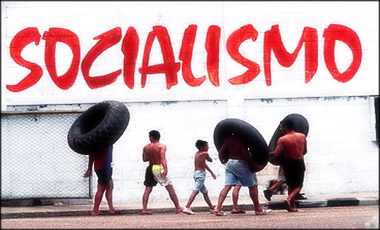
Socialism has become a popular topic for liberal discussion. Thousands of young people are joining moderate socialist organizations such as SP, DSA, or one of the Bernie-ite electoral groups.

socialismo

It is wonderful to see so many people committing to a better world, but I’m not sure how serious they are. It would be good to take a look backward to see how this discussion was conducted over the ages.

Socialism was a suitable subject for tea parties and Utopian literature for a couple of centuries before the 20th. There were even some harmless experiments, including one here in North Texas in the 1850s. The draft law of the Confederacy ended the Texas experiments with guns and terror.

The hippies of the 1960s recapitulated that early period and did some more harmless experimenting with communal living, counter-cultural institutions and what they called the “land trip.” Almost all of them either gave it up or moved to Costa Rica or both.

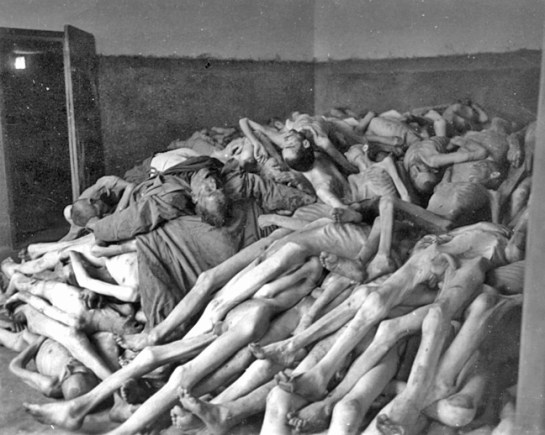
In 1917, though, the talk got serious. Since then, serious advocates of socialism have realized that an opposition exists and it’s not just arguing politely. Millions died in the civil war after that first socialist economy was established.

deadpeople2

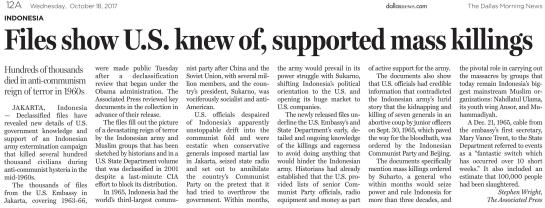
The “arguments” of the opposition then took the form of fascism. In Italy, Germany, and Spain, the socialists were put down with guns and terror.  No sooner had the Nazis been defeated than the “arguments” of the opposition began killing millions in Korea, Vietnam, Guatemala, Iran, Chile, South Africa, Angola, and Indonesia. Sorry if I left some out.

clipping

Here in the United States, only a few of the advocates of socialism actually died and a few, not a whole lot, were imprisoned. But an awful lot of them lost their jobs and suffered blacklisting. Many Americans are still terrified of socialism because the terror that began in 1947 worked rather well for the anti-socialists. If it hadn’t, they would have gone much further, as they did in other nations.

Socialism is serious business. It’s not enough to discuss and advocate it. We need a plan.

–Gene Lantz

I’m on http://knon.org/workers-beat at 9 AM Central Time every Saturday. If you’re interested in what I really think, look at http://lilleskole.us


Movie Review: “Suburbicon,” Directed by George Clooney, 105 minutes

It's a lot of movies

Matt Damon and Juliana Moore star in a movie that could have been named “Hunter for a Raisin in Pleasantville”


Kudos for the team who made “Suburbicon” for having four, count ’em, four union logos after the credits: Producers Guild, Sag-Aftra, Teamsters, and IATSE. That’s just one of the film’s many good features. We liked this movie.

In the next-to-last scene, I realized that it was a comedy. If I had known that all along, I’d have enjoyed it more because it’s really a pretty good comedy. The problem, and the probable reason that it is setting records for tickets not sold, is that the film makers also weren’t sure it was a comedy. It might have been a murder mystery, a civil rights drama, or a horror story. “Suburbicon” has elements that could be compared to some really great movies such as “Night of the Hunter,” “Raisin in the Sun,’ and “Pleasantville,” If you saw those movies and liked them, you’ll also like parts of “Suburbicon” — but you probably won’t enjoy the entirety as much unless you follow my advice: “Think of it as a comedy.”

The original script was from Joel and Ethan Coen. But the film’s credits show two other writers jumped in and added their alien ideas. That was unfortunate, because the Coen brothers have an unbroken string of smash hit comedies. I wanted to see this movie because I love George Clooney and admire the way he trades in his matinee-idol image for self-sacrificing humor. I also admire leading man Matt Damon for playing super hero secret agents one day, then sappy zoo-buying dads the next. He takes it even further this time. I also wanted to see the movie because I firmly believe that no one, no matter how hard they try, can poke enough fun at the 1950s in America. Even if it did nothing else, “Suburbicon” moves to the top of anti- sterile, racist, anti-communist, cold-war hysterical, 1950s movies!

The plot: Two pre-adolescent boys, one anglo and one Black, play a little baseball together in a perfect little all-white suburb in the late 1950s. Then there are mobs and murders right and left. Some of it fits right into whatever you may think of as the plot line, and some of them don’t. You’ll enjoy the movie as we did if you keep in mind “It’s a comedy!”

–Gene Lantz

I’m on http://knon.org/workers-beat every Saturday at 9AM Central Time. If you’re interested in what I really think, see http://lilleskole.us

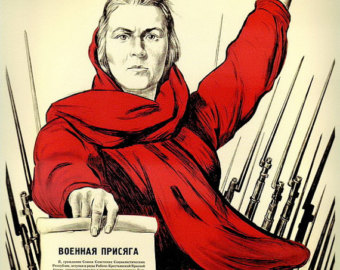
In the long view of history, the most important event of the 20th century was the Bolshevik revolution that occurred 100 years ago on November 7, 1917.

russianwoman

There will be small groups, and some large groups, of people singing  “The International” in their own languages all over the world. It’s probably the most popular song ever sung, but is almost completely unknown here in America. The song is now associated with Russia, but it was originally French. The lyrics came from the Paris Commune (1872?) . One of the English versions is at https://youtu.be/VUw_aaBjCpE.

Over here, people know almost nothing about the event. They think it was some kind of a putsch, or sneaky takeover — or that the bosses actually handed their power over, as they did with Hitler in Germany.

What actually happened was that the works of Karl Marx and Frederich Engels began to be translated into Russian sometime around the 1880s. Before that, there were young revolutionaries, but they didn’t know what they were doing and tended toward terrorism. One of them, executed by the tsarist government, had a little brother named Ulyanov. That little brother decided that he would study up before trying anything revolutionary. As he became more knowledgeable and took on leadership, he adopted the name pen name Lenin.

I think it was in 1903, at a party congress of the Russian Social Democratic Labor Party, that Lenin argued for a scientific Marxist revolutionary approach. He won a majority in the voting. The Russian word for “majority” is “bolshevik.”

In 1905 Russia was shaken by their losing role in a war with Japan. Among other important developments, the anti-war movement and other progressives formed giant committees that vied with the tsarist government for power. The Russian word for “committee” is “soviet.” The main committee was in Petrograd and was run by another revolutionary who had taken the name Trotsky. They lost that struggle, but the idea of these committees was familiar to the progressives after that.

What followed was years and years of hard work. Lenin was exiled, but he managed to argue for his policies through underground newspapers. By early 1917, the Russian empire was in another crisis. This time, they were getting whipped by Germany in World War I.

Progressives overthrew the Tsar, but the government they formed was basically capitalist. The new leaders wanted to continue the war and the war economy. The Bolsheviks argued for “bread, land, and peace” and “All Power to the Soviets!”

New Committees were formed. Some of them were called “workers, peasants, and soldiers soviets.” This time, Lenin and his Bolsheviks were the main force in the progressive movement. By mid 1917, the Petrograd Soviet was virtually equal to the “official” government. Power was up for grabs, and the soldiers were streaming into the soviets.

I’ve been told that only a handful of people actually died on November 7, 1917. Apparently, only one battalion of soldiers still supported the government, and they couldn’t effectively protect it. People from the soviet stormed the Winter Palace and took charge.

The United States and several other countries already had soldiers on Russian soil, and they didn’t leave. Instead, they joined in a civil war to overthrow the Bolsheviks. In the rest of the world, progressives began to split apart. The American Socialist Party split is dramatized in the movie “Reds.” Essentially, the Socialists kicked the supporters of Lenin out, and they had to form their own party.

Since then, they’ve been trying to explain what happened.

–Gene Lantz

I’m on http://knon.org/workers-beat every Saturday at 9 central time. If you want to know what I really think, look at http://lilleskole.us

The new documentary film “Dolores” has opened. Its subject, Dolores Huerta of the United Farm Workers, is promoting it. She appeared in Dallas on October 11. The audience was knocked out of their socks!

Dolores_Ecard_Dallas1_v1

The biopic begins her life story when she was only 25 and had only 7 children. She and Cesar Chavez, both longtime community organizers, focused together on organizing workers in the California fields. It carries on through all the battles, all the innovative tactics, all the disappointments, and the victories of their dramatic organizing history.

After the film, a standing ovation greeted the 87-year old mother of 11 who has made and is making this American history. She answered every question with the same even-handed practicality that characterized her approach all through the movie.

One of our most popular labor movement children, primary school student Lucia Montemayor, daughter of our Dallas AFL-CIO Political Director, asked, “When can I start organizing?”

Huerta replied sweetly, “What are you waiting for?”

Police violence was a topic for two big reasons 1) all the violence that the farmworkers faced in the film and, 2) Huerta’s personal hospitalization after being attacked by San Francisco policemen. Without any rancor, Huerta said that everyone should oppose injustice whenever and wherever it arises. She went out of her way to say that Jerry Jones, millionaire owner of the Dallas  Cowboys football team, should be encouraging his  players to oppose injustice instead of  threatening to fire them.

Someone asked how Huerta juggled motherhood  and  career. This is a question she has dealt with often. Throughout her adult life, she has been criticized for not remaining at home “in a woman’s place.” In fact, it is common for many parents to hide behind their children and claim, “I can’t fight injustice because I put my children first” – thereby condemning the next generation to live in a world no better or even worse than the one the lazy parents live in. Huerta said that parents have to work for a better world because it has to be done. One of her sons was with her. He testified, “We had to share our mother with the world – but she shared the world with us!”

Several questions had to do with the discouragement that organizers often feel. Of course Huerta’s smiling responses were essentially that people must keep on trying. From Dolores Huerta, these weren’t just words. She has backed them with a lifetime of commitment!

–Gene Lantz

I’m on knon.org every Saturday at 9AM Central Time. If you want to know what I really think, look at http://lilleskole.us