Archive

elections

I’ve been investigating the various strategies for dealing with the upcoming Trump government.

williamskennethmlk

Rowlett activist Kenneth Williams

The best was the simplest: “Get active, because leadership will emerge from the struggle!” Kenneth Williams said that on my radio show, “Workers Beat” Saturday at 9.

Another guest on the show, historian Max Krochmal who was talking about his new book, Blue Texas,  offered a lot of encouragement when he pointed out that Texans have organized successfully under much more difficult circumstances than we face today.

Here’s what Franklin Delano Roosevelt advised in the depths of the Great Depression, “Do something. If it turns out to be wrong, do something else. But, above all, do something!”

Several Strategies Are Being Offered

So far, I’ve had opportunities to check out strategies offered by the Communications Workers of America, Our Revolution, Indivisible, Democratic Socialists of America, Communist Party USA, and just about everybody I know. I like all of them and none.

A Union Idea

The CWA held a webinar on the topic of the upcoming Senate confirmations of Mr Trump’s cabinet nominees. They explained how terrible they are, of course, but we knew that. Their idea is to get the Democrats to delay the confirmation while we use our union networks, social media, and informal communications to rouse the population. In the short term, it sounded pretty good.

The Bernie Sandinistas

For over the weekend of January 7, I sat through about 7 hours of education, planning, and organization with Our Revolution in Dallas. I missed the first 5 hours. I was a little bit surprised to hear them talking almost exclusively about winning elections and conducting successful lobbying campaigns. Only one person mentioned street actions, and I actually had whispered the idea to him before he spoke.

I don’t think it’s because they were excluding street actions, I think it’s because lobbying and election work are what originally brought them together and, for many of these young activists, it’s the only kind of political work they’ve ever had.

At the end of the second day, I asked if I could make a proposal. I proposed that we support activities around the coming MLK birthday. It passed unanimously, enthusiastically, and with no discussion. Then they went right back to talking about elections and lobbying.

The Bernie people, where I live, are the largest, youngest, and most optimistic group in local politics. I was delighted to see them setting up a regional structure and electing officers. I understand that we’re going to be something of a model for organizing Our Revolution nationwide. I have high hopes.

“Indivisible” Plans to Copy the Tea Party

I saw some of this on Rachel Madow, and there were two guys at the Our Revolution meeting promoting a pamphlet and web page called “Indivisible.” It is apparently made up of former congressional staffers who had firsthand experience with the obstructionist tactics of the Tea Party during the Obama years. They recommend that Democrats do the same thing to Mr Trump.

One of the presenters said, “If we want to preserve what we are used to, our top priority needs to be… Use obstruction and delay to minimize the damage that we know is coming.” He explained that the one thing the Tea Party had going for them was the fact that they were organized.

One could drive a truck through the hole in this argument: Tea Party success came from their access to big money, not their organizational genius.

Our role in this strategy is to lobby the Democrats to get them to act like Tea Partiers. I’d  say it’s a whole lot better than doing nothing.

Democratic Socialists Are Fired Up

The Democratic Socialists of America, an offshoot from the old Socialist Party during the Vietnam War, have always wanted to take over the Democratic Party. They still do. Bernie Sanders got them close in 2016, so they are growing in numbers and enthusiasm today. If Bernie’s, and labor’s, candidate to lead the Democratic National Committee, Keith Ellison, gets the job, it will add even more credibility to this venerable political strategy.

Meanwhile, DSA activists are moving faster and with more certainty than just about anybody. Whether or not one agrees, long term, that the Democratic Party is going to transform into a working people’s party, anybody who craves action would do well to follow DSA.

Communist Party, USA Has Been Changing

I read a series of articles on People’s World, which is “sort of” associated with CPUSA, and sort of not. The writer recommended fighting the Trump government on all fronts and with all strategies. That makes a tremendous amount of sense, but doesn’t winnow down the opportunities very much. If you recommend everything, is it very much different from recommending nothing?

But CPUSA and its worldwide network justly claim to have more experience fighting fascism than anybody. Their basic text, Dmitrov’s “Against War and Fascism,” is the best exposition of what fascism is and how to put together a united front against it. Those are lessons from the 1930s, of course, and not directly applicable to today. I don’t think CPUSA thinks fascism has come to America, but they point out that there are certainly trends in that direction.

Historically, the communists would have put a lot more emphasis on workers and the working class. They would have had a clear aim of eventually taking power through class struggle. Nowadays, it’s pretty hard to tell the difference between them and the larger, more socially acceptable, less red-baited, legitimized-by-Bernie, DSA. Both of them say what Kenneth Williams said at the beginning of this article: “get busy!”

My Two Cents

I’ve been thinking through this strategy thing a lot. It’s the reason I started this blog.

I think there are things missing from all of the suggestions above. They don’t start with a solid analysis of what’s wrong, they are basically short-term solutions, and they tend to pine for the “good old days.”

What’s actually wrong is that American capitalism is at the end of its rope. It can’t deliver the goods any more, hasn’t been able to for some time. It isn’t fascist yet, but it’s going that way and the only thing that can stop the process is you and me.

The good old days weren’t that good, and nobody but nobody wants to go back to them. Americans want to go ahead to something better and they won’t settle for anything less.

Voters haven’t turned racist or backward, they’re just desperate. A lot of them voted for Trump for the same reason they voted for Obama — anything other than what we have!

As I said in an earlier article, there are no long term solutions for those of us caught in this system.

That’s why we need long-term plans for fundamental change. The goals are in Bernie’s book — things like free education, decent health care, democracy, and all the many fine things he explained so well. I think Bernie has set the goals very well, the argument should be over how to achieve them. For that, we have to organize everybody, and we organize through successful struggles.

Each of us need to adopt long term goals like those Bernie set down. We need to recognize that elections and lobbying are not the only way to struggle and that, in fact, real change is more likely to come from organized economic activity than from generous politicians. That means that fundamental fights over economic benefits weigh more heavily than purely social questions. It means that workplace organizations mean more than idealistic social groupings.

We have to analyze our own resources and opportunities so we can pick the struggles we join, even if we have to skip some of them.

Then we have to get busy and organize. Leadership will emerge from struggle.

–Gene Lantz

KNON hasn’t fired me yet, so I’m still on the radio at 9 AM every Saturday. 89.3FM and knon.org. If you are curious about what I really think, click here.

We’re forced today to battle to hang on to what little we have. But it’s good to keep in mind what we actually want.

jobs

For example, we are trying to keep the bosses from shipping our jobs overseas. Mr Trump says he will help us. We say we want to keep those jobs, but is that really our ultimate goal?

In a Better World, We Don’t Want Jobs

What we actually want is wages, not jobs. We get fooled on that when politicians announce that they have brought in a certain number of jobs after giving away millions in tax abatements and other concessions to this or that corporation. The jobs, if they ever materialize at all, often turn out to pay very little. Texas is a great example of this. Texas politicians claim that they brought in more jobs than any other state, but they hide the fact that they also have more minimum wage jobs than any other state.

Texas and the rest of the South had full employment up to 1860. Everybody who wanted a job had one. Lots of people who didn’t want a job still had one. Slaves didn’t make any wages, but they by Golly had full employment!

It isn’t jobs we want.

If all our gains in productivity (wealth produced per worker per hour) went to shortening our working hours, out jobs would only last about two hours a day, 5 days a week. As the wealth produced would still be the same, we could enjoy the same wages that we made with the old-time long hours.

In a Better World, We Don’t Want Obama Care

Right this minute, the fight is on to try to save the Affordable Care act. But is it really what we want? Wouldn’t we really rather have free health care as a right — so we could have great public health services and medical experts consulting with us to keep our health at the peak?

In a Better World, We Don’t Want Electoral Reform

The Republicans have severely battered the democratic system, and they are probably going to try to do a whole lot more damage before the Mid-Term elections. We have to fight to stop voter suppression, the flood of money into elections, and the outright falsehoods perpetrated against us in election campaigns. But what would we like to have?

Now that almost everyone in America has access to a telephone or a computer, why shouldn’t we do away with representational democracy altogether and begin direct democracy? It would be a lot easier and cheaper than the present system, not to mention being far more fair. Why not have a national discussion over, for example, the federal budget, and then take a day or two for everybody to register their vote electronically? Computers could count the vote and let us know the outcome right away!

We could say similar things about free education, ending chauvinism, the right to emigrate, ending wars, child care, military expenditures, etc. There are better ways to do things than the options we are presently being offered.

A Better World Is Attainable

Shorter working hours, free health care, and direct democracy may sound like science fiction. It’s probably true that they wouldn’t have worked as well in the past as they could work now, and they would certainly work better in the future than they would work now, but they could work now!

The system that we live under doesn’t adapt to the possibilities of improvements for its constituents. Mostly, it only adapts to the possibilities of improvements for a tiny few rich people, and those rich people do the best they can to hold everybody else back.

But we could have a better world for everyone. Having a clear idea of what we want is Part One of developing a strategy to get it.

–Gene Lantz

I’m on http://knon.org and 89.3 FM radio every Saturday at 9 CST. If you are curious about what I really think, click here.


We can better understand the system we live in by taking a long historical view.

rottenapple

Our economic and government system, while a great improvement over its predecessors, rotted to its core by early in the last century.

After that time, there were no solutions for the society as a whole. There were, however, solutions for certain wealthy people.

World War I and World War II, although they cost millions of workers’ lives and reversed a great deal of progress, turned out pretty good for the wealthy people of the United States. They enjoyed a prosperous, though temporary, period after each successful war. The people in the nations that lost suffered terribly, of course, but as I said, there were solutions for certain wealthy people after the 20th century began.

That so-called “solution,” world war, isn’t available to them any more because of nuclear proliferation.

Some time during the 1970s, the “American Century” of post war prosperity began to wane. Working Americans haven’t done particularly well since then, and have in fact begun to slide backward. The temporary economic “solutions” worked only for the very wealthy, and they continue that way today. Some people call this a crisis of capitalism.

The Crisis is Natural

If an economic system has to sell its products for more than they cost, and if the workers of a given nation do not have the resources to pay, then the products have to be sold somewhere else. The wealthy owners have to compete for that “somewhere else.” Since the 1970s, the wealthy owners of the United States have stopped winning that competition. It shows in all the statistics. Their only way to beat out their competitors is to reduce the wages, benefits, and social benefits of poorer people. That’s what they have been doing and what they continue to do.

Deregulation, Privatization, Corporate Welfare and Outsourcing are Necessary Props

To prop up the wealthy, to provide a “solution” for the wealthy (not for us), they cause their government to deregulate their businesses, privatize the socially-owned sector, hand out tax breaks and outright gifts to corporations, and outsource work to countries where wages and environmental regulations are more advantageous to them.

It’s Temporary

Even though the wealthy people are able to get their government to cooperate in their economic “solutions,” the results are only temporary, because the wealthy people in other countries are doing the same thing. It’s a competition usually, nowadays, called, “the race to the bottom.” That’s what we call it. They probably call it “good business.”

Things get temporarily better for the wealthy class while everybody else suffers.

Comes the Trump Government

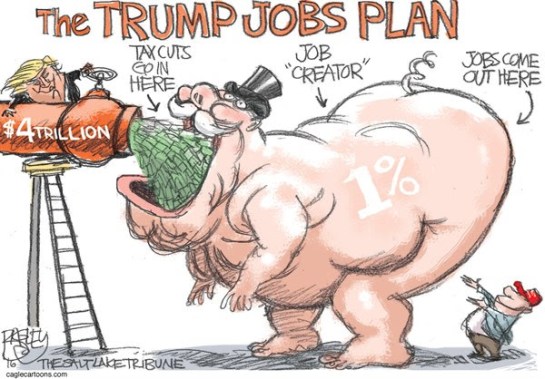
President-elect Donald J Trump will accelerate all of the “solutions” listed above, solutions only for the wealthy and not for us, and they will be, if anything, temporary fixes. The crisis will continue, there is no way to turn it around because the international competition will still be there.

No matter what reforms we may attempt, the overall competitive system will remain rotten and will continue to get rottener.

We need a new system.

–Gene Lantz

I’m on knon.org and 89.3FM in Dallas at 9 AM every Saturday. If you want to know what I really think, look at my life’s lessons

Bernie Sanders, “Our Revolution—A Future to Believe In.” St Martin’s Press ebook, September 26, 2016. Available from Amazon Books and on Kindle

sandersberniefragmented

S’Wonderful, S’Marvelous!

This must-read book details two important political contributions:

  1. A blow-by-blow account of the miraculous Bernie presidential campaign
  2. Detailed explanation of legislation needed to rescue and advance the people of our nation

The account of the campaign answers the question about how they managed to get so far toward the Democratic Party nomination when they started with virtually nothing and refused to sell out to big contributors. Most of America and even Bernie seem to be surprised at how well people responded to a truthful, direct, approach to America’s actual needs. It’s an inspiring story that needs to be studied.

Part Two, “An Agenda for a New America: How We Transform Our Country” details the problems we face and proposes practical solutions in the form of legislation needed. In many cases, Bernie Sanders had already proposed proper legislation in Congress. In general, his proposals are designed to:

  • Restore and advance democracy
  • Remedy injustices, including racial injustices
  • Restore equality
  • Fix the economy

But It’s No Good

The big problem with Bernie’s wonderful book is the last line, “September 26, 2016.” He completed the book before Donald Trump’s upset victory for the presidency and before Republicans completed their take-over of all three branches of the federal government plus the majority of state governments.

So what do you do with wonderful proposals for legislation when progressive legislation has almost no possibility of passage? What do you do with an inspirational story of a hopeful electoral campaign when our foundation of democracy is crumbling?

Apparently, Bernie thought, on September 26, 2016, what most Americans thought – that the Democrats would have a big victory on November 8. The glaring fact that they didn’t, and the anti-democratic trends already underway, put new perspective on politics in 2017. Bernie’s thoughts of September 2016 are certainly good to know, and actually kind of miraculous to behold, but not much actual use, are they?

We’re going to have to do some thinking of our own.

Some Positive Suggestions

Rather than leave off on such a negative note, let me make a couple of general proposals that might be helpful in 2017

  1. Electoral politics is not the only form of struggle. The most important power that working people have is our ability to withhold our economic cooperation. It is essential, therefore, to dedicate ourselves to organizing workers – to vote, yes, but to work together in other ways too.
  2. We may think that history only repeats itself, but it doesn’t. Bernie Sanders (and also Donald Trump) campaigned on the idea of re-setting the calendar to some earlier date, but we can’t go backward even if we tried. We have an entirely new situation that needs entirely new proposals. For example, we don’t need to fix the Electoral College or even the electoral system as it exists. We need direct participation in government decisions, and for the first time in human history, direct participation is now possible!
  3. Economies can’t be re-set to earlier times. Sanders, and other writers, seem to want to move us backward to pre-Reagan days. Trump apparently wants us some time before the Civil War. We actually need proposals that account for our present situation and then advance into a better future. For example, if certain financial institutions are “too big to fail,” Bernie Sanders suggests that they are “too big to exist” and need to be downsized to the levels of the 1990s. With our present technological abilities, we don’t need them in the downsized version either. If they are “too big to fail,” certain banks and insurance companies need to be taken over and run for the public good.

We must be grateful to Bernie Sanders and others who have taught us so much. A great future awaits!

–Gene Lantz

Hear “Workers Beat” on KNON radio, 89.3FM and knon.org every Saturday at 9 CST

Click here if you want to know what I really think

A New York Times article on December 15, 2016, “Bots at War For Your Soul,” explains that some of the arguments on twitter are actually generated by, and carried out by, robots!

What kind of jobs

We never ask “What kind of jobs?” Will we fall for anything and everything?

How could anybody fall for such an outlandish scam? A lot of us do, according to the article. I’d be a little more sanctimonious about it if I hadn’t also fallen into a stupid “flame war” on email just yesterday.

We’re being told in yesterday’s newspaper that Russians actually guided the 2016 elections into the Trump win column. People fell for that. We’re told, all the time, that “fake news” stories, especially on social media, confused the electorate and the general political scene?

Why?

Some of the answers are obvious. For example, we tend to believe things that we see over and over, and, since almost all of our Facebook and Twitter friends believe the same things we do, over and over is how information is presented to us. But that’s not the fundamental problem.

The fundamental problem with belief in America is that we have given up our objectivity. We’ve ditched the scientific approach. We’ve become addicts for information that suits us and fits into the frameworks we’ve already established. We’re suckers. We don’t believe our own senses, and we don’t check facts.

Just to prove my point, I offer you the 2016 election results.  Snake oil consumption on a mass scale!

If we ever sober up, I am hoping that we re-evaluate the fundamental difference between all philosophies: some of them are materialistic and the rest are idealistic. The idealistic people can believe almost anything. Their only test for truth is whether or not it “feels right.” The materialistic ones favor facts and science. The idealistic ones believe that “truth is in the eye of the beholder.” The materialistic ones believe that truth is truth — it may be hard to discover, but it’s still truth.

Scientists, when they’re being scientists, are materialists because it’s the only way they can make progress. At home watching TV, they may become romanticists and superstitious fools, but that’s just for recreation. All of us are materialists when it really matters, when it comes to getting our cars to run or our computers to work, but we are constantly subjected to the boss’s philosophy, idealism, in all our movies, all our TV, nearly all our books, etc. Idealism is the philosophy used by Voodoo religionists, crooked politicians and our employers.

–Gene Lantz

If you’re interested in what I actually think, click here

I urge all progressives to fight reactionaries on every front, but the main one is going to be the battle to save basic democracy in America.

trumpinfrastructure

Simple logic:

  1. The idea that Trump’s policies are going to make life better for Americans is laughable
  2. Given the present system of American politics, the Republicans will not maintain power through the 2018 mid-term elections
  3. They know it
  4. The only way for the anti-worker forces to maintain power is by scrapping democracy
  5. Therefore, progressives must fight for basic democracy now

Will Trump Improve Life for Americans?

Economist Josh Bivens has a good summary of expected Trump policies on line. It doesn’t look good.

Mr. Hitler made immediate improvements in the German economy by massive infrastructure programs and by going to war. Will Mr Trump be able to do the same?

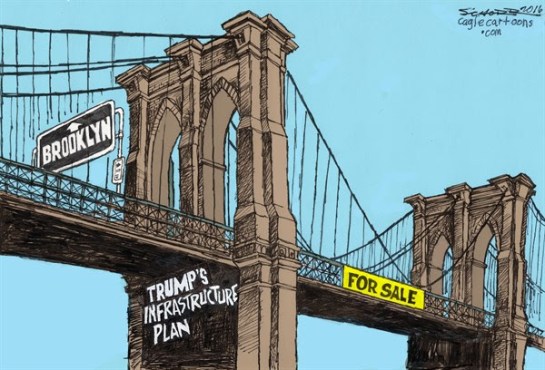
The U.S. Congress has blocked infrastructure programs all the way through the Obama Administration, even though they would have greatly shortened the long recession. It is unlikely that they would allow Mr Trump to implement anything good along those lines, because their main commitment is to the barons of finance, not construction businesses and certainly not to the American workers. Actually, I’d love to be proven wrong on this.

Mr Hitler had tremendous early successes in his war-making, but that was largely because the Great Powers did nothing to rein him in. They thought he would put an end to communism before he struck at any major capitalist countries. It is doubtful that Mr Trump will be able to use war to improve the American economy in any meaningful sense, and it is unlikely that he will receive cooperation from the other major capitalist countries in whatever adventures he undertakes.

The world wars that resulted from the economic crises of the 20th century are not considered available as a “solution” to economic and political crisis today, because of the imminent destruction of the planet.

Capitalist economies have always suffered from phases of “ups” and “downs.” “Down” is already overdue after the long recovery during the Obama Administration. The current expectation of new “tight money” policies, combined with Mr Trump’s new tax cuts for the rich and deregulation policies will create an immediate and painful crisis for working people.

Hard Times Will Likely Dominate the Mid-Term Elections

If one assumes that our American levels of partial democracy continue, it is unlikely that the party in power will fare well in 2018. In fact, the party in power usually does very poorly in mid-term elections.

None of this is a secret, neither to progressives nor to reactionaries.

What Can We Expect about Democracy?

Since around 1980, American democracy has already taken hard knocks at the hands of Republicans. Unions were assailed in every imaginable way. The Voting Rights Act was gutted, big money was sanctified by the Supreme Court, Republican redistricting largely overcame the popular vote, and voter suppression schemes were put into effect all over the nation.

The Obama Administration fought to maintain democracy, but does anyone think the Trump Administration will? If Mr Trump were to make outlandish anti-democratic Executive Orders, for example, who in government would oppose him? Not the legislative branch that is already in the hands of Republicans, and not the judiciary which will return to a reactionary anti-worker majority as soon as Mr Trump makes his first appointment.

Mr Hitler, it is often pointed out, won an election without winning the popular vote. How did he stay in power? How will today’s reactionaries try to stay in power?

Get ready to organize and fight!

–Gene Lantz

Listen to “Workers Beat” at 9 CST every Saturday morning on 89.3FM and http://knon.org

If you want to know what I really think, look at my life’s lessons site

After 1 1/2 years of arguing with my ultraleft friends over why their votes matter, I now have to turn toward my reformist friends and convince them that voting isn’t everything.

me-aug31marchlaborday

A little sidewalk march, protected under Article 1. Anybody can organize one!

If you’re not sure what an ultraleft and a reformist are, feel free to consult my on-line glossary of useful political terms. Just for the sake of this exposition, ultralefts tend to denounce voting and reformists tend to denounce everything else.

The official smart people of America are generally saying, now that Trump is the president-elect, “Well we voted and now we must support our new President and let democracy take its course.” We live in a democracy, but it’s a limited democracy and it’s far from perfect. Even after 250 years of steadily improving it, our democracy is still a long way from fairness or equal treatment. In the last few decades, it’s actually gotten worse than it was, and I have a notion that it’s about to get worser still.

Voting May be Critical, But It Isn’t Everything

Working people struggle against the employers in many arenas. Pretty much all of them, including the electoral arena, are rigged against us, but it is important that we learn to carry out our fight in every battleground. That includes strikes like the very important musicians strike going on right now in Fort Worth, Texas. It includes petitioning campaigns, lobbying efforts, fund raisers, small protests and major marches.

Are you too dignified to march?

Think it over carefully before you answer.

In the same time frame that Republicans take over all aspects of federal government, mid January, we’re going to have a chance to put some strength into the civil rights movement during traditional Martin Luther King Jr birthday celebrations.

On the day after the the inauguration of The Donald, I’m proud to announce that somebody has called for a “Million Women March” in DC and here and there around the country. They invite everyone who believes in women’s rights, and that should include all of us. Even though the march is scheduled for a Saturday, lots of people will take off work on Friday for travel — that might help some of my friends who think a general strike would work on January 20.

I haven’t seen anything yet on activities defending undocumented workers, but I suspect that such events will be called. We won’t be able, physically, to attend everything that somebody thinks up, but we can pick the best ones. I expect to see my ultraleft friends at most of them. Maybe my reformist friends will come this time, too.

Unless they’re too dignified.

–Gene Lantz

No beating around the bush; if you want to know what I really think, click here.


Reconstruction Was a Horror in Texas!

It’s amazing how one can see the roots of today’s problems in this important period of U.S. history. I’m writing this on Nov 14, 2016; the same day that Ed Sills of the Texas AFL-CIO wrote that two Texas Legislators have decided that “states rights” still supersedes national law. They have filed two companion bills, SB 89 and SJR 7, by Sen. Bob Hall, R-Canton, that would provide for nullification of federal laws that Texas deems to violate the Constitution. HB 74 by Rep. Dan Flynn, R-Van, is in a similar vein. By their thinking, the Emancipation Proclamation never took effect in Texas because the Texas Legislature didn’t want it!


Lynching

When I first began to study and ask questions about Texas during the Reconstruction Period, I received the impression that all went rather smoothly. Texans accepted the federal troops, freed the slaves, and continued with their business, I was told.

What an incredible lie!

The following book has some of the facts:

Richter, William L., Overreached on All Sides. The Freedman’s Bureau Administration in Texas 1865-1868. Texas A&M Univ Press, College station, 1991. For forty months, the Freedman’s Bureau attempted to enforce the ideals of political liberty, and, to a lesser extent, economic liberty for African Americans in Texas. This book details their failure to stop lynchings, continued slavery, torture, rape, robbery, and illegal exploitation. The victorious North lacked both the material resources and the commitment to carry out these ideals.

Texans resisted mightily. For those seeking to document the racist atrocities perpetrated by white Texans during Reconstruction rather than believe the glossed-over histories we are usually offered, there are plenty of descriptions here. In fact, there is more blood than ink on these pages. Blacks and their grossly outnumbered white supporters were vilified, terrified, driven out, and murdered throughout the book while the tiny force of reconstructionists hurried from one part of the state to another seeking justice.

Northeast Texas was particularly bad.

But the book also contains many stories of men who made a great effort to bring justice to Texas. Their failure does not diminish their commitment nor valor.

A Definitive Text on Reconstruction

Book Review
Foner, Eric, “Reconstruction, America’s Unfinished Revolution: 1863-1877” History Book Club by arrangement with HarperCollins Publishers, New York, 1988

What most of us were told about reconstruction is that it was a failure and the fault was on the former slaves, who “just weren’t sophisticated enough to make their own way and handle all the gifts they were given.” It’s an ugly view.

This author, on the other hand, talks about the real problems. He especially points to the role that the freedmen played in trying to win their own equality. In spite of criminal acts against them, including numerous mass murders, they managed to accomplish some things, and they laid the groundwork for the future civil rights gains.

Even though the author joins the chorus in branding American Reconstruction a failure, he points out that we did better than any other country that had emancipated its slaves, in that we granted them citizenship fairly soon. Also, he puts the main blame for failure on the economic crisis of the 1870s.

Even though the author doesn’t point it out, one can see how the Republican party evolved from one advocating “free labor” capitalism to one favoring big corporations and caring very little for anybody’s rights – all in a short space of time during the industrialization that followed the Civil War.

I was a little disappointed that there was so little about Texas, and nothing about Dallas. I had read elsewhere that the appointed head of the Freedman’s Bureau in Dallas never made it to the city, but was murdered somewhere in East Texas while en route! About Reconstruction in Dallas, almost nothing is known. See Wikipedia — https://en.wikipedia.org/wiki/History_of_Dallas_(1856%E2%80%9373)

Here are some of the sentences from the book:

Pg 17: Texas “The (Republican) party’s Southern governors would include Edmund J Davis, who during the war raised the First Texas Cavalry for the Union Army…”

63 Texas “Jean-Charles Houzeau, one of the most remarkable men to take part in the saga of Reconstruction…”  revolutionary. Journalist and astronomer who emigrated to Texas in 1858, sided with Unionists there early in the Civil War, and in 1865 arrived in Louisiana. Edited New Orleans Tribune.

97 education “Northern benevolent societies, the Freedmen’s Bureau, and, after 1868, state governments provided most of the funding for black education during Reconstruction. But the initiative often lay with blacks themselves…”

119 murder “In Texas, where the army and Freedmen’s Bureau proved entirely unable to establish order, blacks, according to a Bureau official, ‘are frequently beaten unmercifully, and shot down like wild beasts, without any provocation.’”

121 Texas “One black who refused to be bound and whipped, asserting that ‘he was a freeman and he would not be tied like a slave,’ was shot dead by his employer, a prominent Texas lawyer.”….

181 Johnson “Throughout his Presidency, Johnson held the view – not uncommon among Southern yeomen – that slaves had in some way joined forces with their owners to oppress nonslaveholding whites.”

195 Texans for Suffrage: “A handful of delegates, such as Texas Unionist Edward Degener, called for extending the suffrage to literate blacks, but in general the idea was scarcely contemplated.”

204 TX murder an inalienable right: “Texas courts indicted some 500 white men for the murder of blacks in 1865 and 1866, but not one was convicted. ‘No white man in that state has been punished for murder since it revolted from Mexico,’ commented a Northern visitor. ‘Murder is considered one of their inalienable state rights.’” The footnote is John A Carpenter, “Atrocities in the Reconstruction Period,” JNH, 47( Oct 1962)

205: “The convict lease system, moreover, which had originated on a small scale before the war, was expanded so as to provide employers with a supply of cheap labor. In Texas in 1867, blacks constituted about one third of the convicts confined to the state penitentiary, but nearly 90 percent of those leased out for railroad labor.”

218 Johnson/Jackson: “…Johnson’s hero, Andrew Jackson.” The same page says Johnson was a drunk.

235 40 acres: “In a speech to Pennsylvania’s Republican convention in September 1865, Stevens called for the seizure of the 400 million acres belonging to the wealthiest 10 percent of Southerners. Forty acres would be granted to each adult freedman and the remainder – some 90 percent of the total – sold ‘to the highest bidder’…” The book has several references to the idea of selling or giving land to freedmen. General Sherman did it on his march to Atlanta. Lincoln allowed it on the Carolina Islands and in a large area at a river junction. Johnson, however, had the soldiers remove all African Americans from their land.

243 Natives: On the Civil Rights Bill around 1866. “This defined all persons born in the United States (except Indians) as national citizens…”

279 Citizenship: “Alone among the nations that abolished slavery in the nineteenth century, the United States, within a few years of emancipation, clothed its former slaves with citizenship rights equal to those of whites.” I conclude from this that Reconstruction may have been a “failure,” but it was less of a failure than all the other countries that stopped slavery!

281 Strike 1867: “Strikes broke out among black longshoremen in Charleston, Savannah, Mobile, Richmond and New Orleans, and quickly spread to other workers, including Richmond coopers and Selma restaurant waiters.”

282 Waco: “Throughout the South, planters complained of blacks neglecting their labor. Once a week during the summer of 1868, ‘the negros from the entire county’ quit work and flocked to Waco, Texas, for political rallies.”

285 Tx back wages: “…some Texas leagues demanded back wages for blacks held in slavery after the Emancipation Proclamation.” //I think they mean “union leagues.”

297 Parsons: “…the party did gain the support of Gen. James Longstreet, whose example inspired some Confederate veterans to follow in his footsteps. One was Alabama-born Albert R Parsons, a descendant of Mayflower Pilgrims, who in 1867 established a Waco newspaper advocating black rights, and stumped central Texas for the Republicans.” //the footnote is Hamilton and William, eds., “Graham Papers” 7:533//

299 TX Germans: //Germans are mentioned here and there as scalawags — Southerners opposing the Confederacy.// “The Germans of Southwestern Texas comprised the largest bloc of immigrant Southern Republicans, helping to send to Congress Edward Degener, a San Antonio grocer who had taken part in the revolution of 1848, been imprisoned by Confederate authorities, and seen his two sons executed for treason.” //I googled him and found Wikipedia summary that said he settled in Sisterdale in 1850 and that his two sons were killed in the Nueces massacre. He joined in purchasing the land for the “true der union” monument in Comfort!//

342 KKK shut down, 1868 elections: //There’s a long list of mass murders and other atrocities.// “Unable to hold meetings and fearful that attempts to bring out their vote would only result in further massacres, Georgia and Louisiana Republicans abandoned the Presidential campaign.” (1868 I think)

//some nice photos in the middle of the book//

399 TX planters’ decline: “Planters constituted a large majority of the wealthiest Texans in 1860, but only 17 percent ten years later.”

437 Colfax massacre of 280 people: Apparently armed blacks tried to resist in Louisiana around 1873. “They attempted [armed self-defense] in Colfax. The result was that on Easter Sunday of 1873, when the sun went down that night, it went down on the corpses of two hundred and eighty negroes.”

Pg 440 Davis Suppressed Klan in TX: “By early 1869, order had been restored and the Klan destroyed. Davis proved equally decisive, organizing a crack two-hundred-member State Police, 40 percent of whose members were black. Between 1870 and 1872, the police made over 6,000 arrests, effectively suppressing the Klan and providing freedmen with a real measure of protection in a state notorious for widespread violence.”

480 Sylvis a racist? “William Sylvis, president of the Iron Moulder’s Union, toured the South early in 1869 recruiting members of both races, but simultaneously called the Freedmen’s Bureau, a ‘huge swindle upon the honest workingmen of the country’ and blamed carpetbaggers for the South’s woes.”

528 the Depression of 8173 – largely ended reconstruction: “Buffeted by the shifting tides of public opinion, p[reoccupied first with the economic depression and later with yet another wave of political scandals, the second Grant Administration found it impossible to devise a coherent policy toward the South…. Grant in his second term presided over a broad retreat from the policies of Reconstruction.” //there’s some point here where he refuses to use troops in Louisiana, and that’s the dividing line ending the Reconstruction era.//

531 Supreme Court racism: Slaughterhouse case of 1873. Supreme Court more or less re-affirmed states’ rights. “In the name of federalism, the decision rendered national prosecution of crimes committed against blacks virtually impossible, and gave a green light to acts of terror where local officials either could not or would not enforce the law.”

548 Grange excluded Blacks: Grange …”’really a political society’ which excluded blacks from membership and took an active part in mid-decade Redemption campaigns.”

549 Texas taken by Democrats in 1873: “Texas Democrat Richard Coke defeated Gov. Edmund J Davis in 1873 by a margin of better than two to one.” Texas had a massive influx of white immigrants that changed the demographics.

550 Assassinations! “The situation worsened in 1874 with the formation of the White League, openly dedicated to the violent restoration of white supremacy. It targeted local Republican officeholders for assassination, disrupted court sessions, and drove black laborers from their homes.”

556 Dawes’ early career: “”…the Massachusetts legislature elected Henry L Dawes to fill Sumner’s seat…” //Dawes comes up in my history again as author of legislation ending tribal ownership in Oklahoma — thus opening up all Native lands to exploitation//

556: “Civil Rights Act” “Supreme Court declared it unconstitutional in 1883…”

557 communists in 1875: Some guy in Ohio advocated Greenbackism and was accused as a “proponent of ‘communist revolution.’”

586 1877 strike and federal intervention: Author makes the point that federal govt had decided they didn’t need to intervene in local affairs and thus ended protection of blacks, but they had no qualms about intervening against workers during the general strike of 1877! “Thus, the upheaval marked a fundamental shift in the nation’s political agenda.”

587 Civil rts act of 1875 declared unconstitutional in 1883

603 Summary of failure. “Nonetheless, whether measured by the dreams inspired by emancipation or the more limited goals of securing blacks’ rights as citizens and free laborers, and establishing an enduring Republican presence in the South, Reconstruction can only be judged a failure.” He blames the depression of the 1870s. “None of these factors, however, would have proved decisive without the campaign of violence that turned the electoral tide in many parts of the South, and the weakening of Northern Resolve, itself a consequence of social and political changes that undermined the free labor and egalitarian precepts at the heart of Reconstruction policy.”

Pg 603: “Perhaps the remarkable thing about Reconstruction was not that it failed, but that it was attempted at all and survived as long as it did.”

609 Rewriting history: ‘This rewriting of Reconstruction’s istory was accorded scholarly legitimacy – to its everlasting shame – by the nation’s fraternity of professional historians.”

Pg 609: “The views of the Dunning School shaped historical writing for generations, and achieved wide popularity through DW Griffiths film, Birth of a Nation (which glorified the Ku KLUX Klan and had its premier at the White House during Woodrow Wilson’s Presidency)…”

Pg 612: accomplishments: family, church, and school. “Yet the institutions created or consolidated after the Civil war – the black family, school, and church – provided the base from which the modern civil rights revolution sprang. And for its legal strategy, the movement returned to the laws and amendments of Reconstruction. ‘The river has its bend, and the longest road must terminate’ Rev Peter Randolph a former slave, wrote these words as he dark night of injustice settled over the South. Nearly a century elapsed before the national again attempted to come to terms with the implications of emancipation, and the political and social agenda of Reconstruction. In many ways, it has yet to do so.” //end of book//

–Gene Lantz

This is just a tiny part of my on line labor history collection

On the day after the election, small groups of demonstrators hit the streets in a number of American cities. I just got a request that I join a call for a general strike — a national work stoppage — on Inaugural Day. I call this kind of non-thinking acting-out “knee jerk activism.” It’s more traditionally called “ultra-leftism” and has been correctly labeled, “the infantile disorder.”

strike1877

We had a tremendous general strike in 1877

Union activists are used to hearing people call “strike!” when they have no idea whether or not the tactic would work. A lot of them don’t care. If a union called a strike every time some hothead wanted one, we’d get a lot of people fired for nothing. When my union ran a successful 15-month “work to rule” contract fight, there were people calling “strike” instead of doing the hard work of a long struggle. The three of them that I knew personally were all promoted to foreman immediately after the union won. They were company stooges, as it turned out. The company knew that the union might win the long battle, but we would almost certainly have lost a strike.

If you’re reading along in Facebook, you’ve seen lots of responses to the Trump election victory, and nearly all of them are way less than helpful. Some are silly, and some are outright dangerous!

First, Figure Out What Happened

Nearly all the pollsters were wrong about the election results. The best single explanation I’ve seen was in a “letter to editor” in today’s Dallas newspaper. A guy named, I think, Roland Young wrote that when the pollsters called, “We lied!” Some of Trump’s voters may have been too ashamed to confess.

But the best explanation of the pollsters’ failure is that their approaches are based on previous history, and the 2016 presidential race was, to state it modestly, unique.

Are Americans Mostly Chauvinists?

Elections are the best evidence we have of the national character. If the Electoral College puts Donald Trump in office, does that mean we’re mostly chauvinists like him? Actually, more than half the electorate voted against him, and only 56% of all eligible voters went to the polls at all. The ones that went voted for marijuana and higher minimum wages by much better margins than they voted for Trump.

Everyone who voted for Trump did not do so because they wanted to express their chauvinism. They surely didn’t vote for him because they think his far-flung ideas are actually going to solve America’s problems.

What They Wanted Was Change

I think it is fair to say that they voted for change. We see this in the unions all the time. Members who haven’t taken the time to investigate the candidates in union elections will nevertheless vote to “throw the bums out” against whoever is in office. Next election, you can’t find anyone who admits they voted for the incumbents and it’s “throw the bums out” again. After a lifetime in the public eye, and because of the outright duplicity of the national Democratic Party, Hillary Clinton was a perfect target for that kind of sentiment.

People voted for Trump over Clinton for the same reason that they had voted, in 2008, for Obama over Clinton. Change.

People voted for Donald Trump because they are dissatisfied with life in America and they don’t know what else to do about it.

I don’t exactly blame them. I’m dissatisfied too, but I know what to do about it.

Educate and Organize the Working People

Media pundits are blaming “white blue-collar workers” for electing Donald Trump. His voters were probably Anglos all right, but they didn’t represent the working class. The working class is the solution, not the problem. The progressive leadership of the AFL-CIO is head and shoulders above any Democratic or Republican Party politician. For now, it’s better to follow them than Bernie Sanders, too.

If we’re willing to do the long hard work of educating and organizing America’s workers, we could win elections. We could win strikes, even general strikes!

But it will take some work.

–Gene Lantz

Click here if you want to know what I really think!