Archive

art

Movie Review: “Leave No Trace,” Directed by Debra Granik, 119 minutes

leave-no-trace

A man and his daughter live in the national forest. Occasionally, they go into Portland, Oregon, to visit the veterans hospital and buy a few groceries. But then they go back into hiding in the woods. It takes a criminal-sniffing police dog to find them.

It’s the girl’s story. She gets most of the camera’s attention and nearly all the lines. She’s the one undergoing changes. Her silently suffering father mostly just endures. It takes real acting to do that. There are a few other people in the cast, but they have small roles with little effect on the audience — even though they clearly affect the girl.

I saw the film with a friend who backpacks. He was carefully watching all of the camping gear and at-home-with-nature operations that the daughter and father carried out. He approved. “Leave no trace,” he explained, is a slogan that campers and backpackers use to mean that they clean up after themselves. In this movie, it means a lot more.

I didn’t realize until afterward that director Granek had also given us “Winters Bone,” the  excellent film that launched the career of young Jennifer Lawrence. There are a lot of similarities. Both are really worthwhile films.

Just to top it off, there were three — count ’em three — different union logos in the last frame: Teamsters, IATSE, and Sag-Aftra.

–Gene Lantz

I’m on radio KNON’s “Workers Beat” program at 9 AM central time every Saturday.  They podcast two weeks under the “events” tab. If you are curious about what I really think, check out my personal web site.

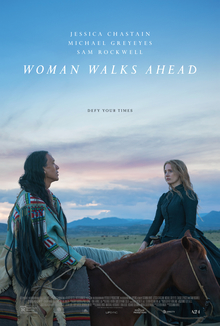
Movie Review: “Woman Walks Ahead,” Directed by Susanna White, 1 hour, 43 minutes

Woman_Walks_Ahead

On the 4th of July, my movie buddy and I learned about people who probably weren’t celebrating the birth of this nation and all the freedom we supposedly enjoy.

Some of the historical background is on Wikipedia. The story starts in 1889 when a painter named Caroline Weldon from Brooklyn comes to the Standing Rock reservation to make a portrait of the great Sitting Bull. In this version, she stays close to him to the end of his life.

If Sitting Bull and Caroline Weldon were as sexy and good-looking as Michael Greyeyes and Jessica Chastain, their Hollywood versions, romance would be inevitable. To the credit of the movie, though, there is very little romantic diversion from the essential story about the end of the great fighting nation and its chief.

The movie makers were challenged to depict a situation of incredible humiliation, degradation, deliberate starvation, racist violence, and genocide. They did a good job of it. The results are hard to watch in places. At the same time, one has to imagine that reality at the Standing Rock Reservation had to have been far worse.

Like some of the best Westerns, this one stars the scenery. The other actors are truly wonderful. Jessica Chastain underplays her role with an admirable professionalism. Michael Greyeyes brings a great and complicated man to life. The main racist villain, Sam Rockwell, is so evil and so broadly representative of the oppressive attitudes of the time that he nearly steals the movie. His is one of those characters that viewers can almost taste and smell.

The director gets the most praise because she tells an essential American story without skipping over its horror and without preaching about it. We count ourselves lucky to have found this movie. Others may have to look hard for it.

–Gene Lantz

I’m still on KNON radio 89.3 FM in Dallas TX at 9 AM CST every Saturday. If you are curious about what I really think, check out my personal site.


a member of the National Indian Defense Association “NIDA”, reached out to Sitting Bull, acting to be his voice, secretary, interpreter and advocate.


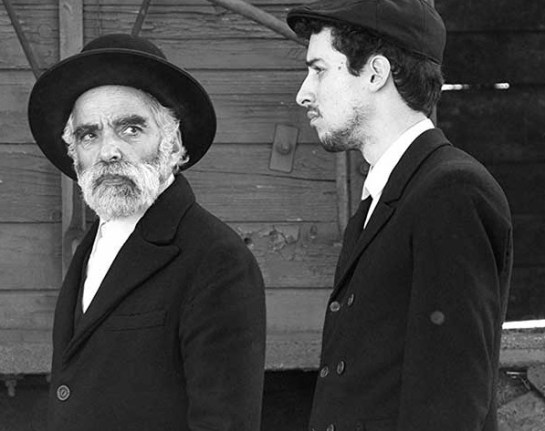
Movie Review, “1945,” Directed by Ferenc Török. 91 minutes

1945-2guys

I like to accuse my intellectual friends of only liking black-and-white movies in obscure dialects. They’d be sure to like “1945,” but almost anybody who likes good movies would, too.

It’s deceptively simple: Two tight-lipped Jewish guys come into a small Hungarian village immediately after World War II.

Can you imagine that? The all-gentile townspeople can. They have been dreading this coming every moment since their own participation in the holocaust.

I like filmmakers who understand their powerful medium and use it expertly. They don’t necessarily have to have wide screen, technicolor, computer graphics, or a cast of thousands to draw us moviegoers in and change us through art. This is a very sparse movie, like a tiny and innocent looking stick of dynamite.

The best movie comparison I could make is to “High Noon.” It’s not a cowboy movie, but the pacing and the tension it creates are similar. If you liked High Noon, you’d probably like “1945,” and who doesn’t like High Noon?

–Gene Lantz

I’m still on KNON radio 89.3FM in Dallas every Saturday at 9AM Central Time. There are podcasts under the “events” tab. If you want to know what I really think, check out my personal web site.


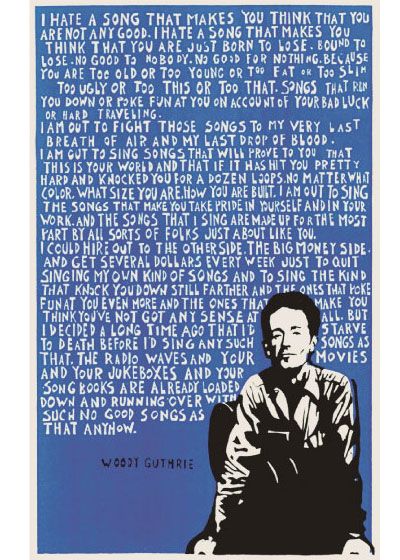
Let’s do a Woody Guthrie festival on his birthday this year! Are you in?

woodyquot-hateasong

If he had survived, he would have been 106 on July 14. It’s a Saturday and a good day for a cookout and a singalong. The incredible Gerardo Contreras of UAW 848 is willing to do the cooking. I believe that both KNON’s “Workers Beat” program and Dallas AFL-CIO would sponsor and benefit from any money we raise.

My idea is to assemble a small choir to perform and lead audience participation songs, just as Woody or Pete Seeger would have done. Individuals or groups might want to do their own performances, but some songs, like “This Land Is Your Land” cry out to have everybody sing.

There are hundreds of songs to choose from, but here are some of the best-known ones.

All You Fascists Bound to Lose  https://www.youtube.com/watch?v=VwcKwGS7OSQ (choir- singalong)

Biggest Thing that Man Has Ever Done https://www.youtube.com/watch?v=qB-YnV0e3Lc

Deportee (Anthony Esparza)  https://www.youtube.com/watch?v=qu-duTWccy

Do Re Mi https://www.youtube.com/watch?v=46mO7jx3JEw

Hard traveling https://www.youtube.com/watch?v=kfq5b1bppJQ

I Ain’t Got No Home / Old Man Trump https://www.youtube.com/watch?v=jANuVKeYezs

I’ve Got to Know https://www.youtube.com/watch?v=lyo_Hilxlj0

Jesus Christ  https://www.youtube.com/watch?v=EDS00Pnhkqk

“Talking Unions” https://www.youtube.com/watch?v=WU2RUoakYIM

Oklahoma Hills https://www.youtube.com/watch?v=IYFUUxxn6Vk

Philadelphia Lawyer https://www.youtube.com/watch?v=bjeen-Hl8uc

Pretty Boy Floyd https://www.youtube.com/watch?v=fBF3aXvquHs

Ranger’s Command https://www.youtube.com/watch?v=FznriVNbWCI

This Land Is Your Land (choir-singalong) https://www.youtube.com/watch?v=wxiMrvDbq3s

Tom Joad https://www.youtube.com/watch?v=dimhKln0KBg

Union Maid  https://www.youtube.com/watch?v=S1g4ddaXRs0

You Gotta Go Down  and Join the Union https://www.youtube.com/watch?v=zN8kGzHH00I

Labor’s musical tradition tends to get lost every now and then. Let’s re-discover some of it!

–Gene Lantz

I’m on KNON radio 89.3 FM in Dallas at 9 AM central time every Saturday. Podcasts are available from the “events” tab. If you want to know what I really think, check out my personal web site

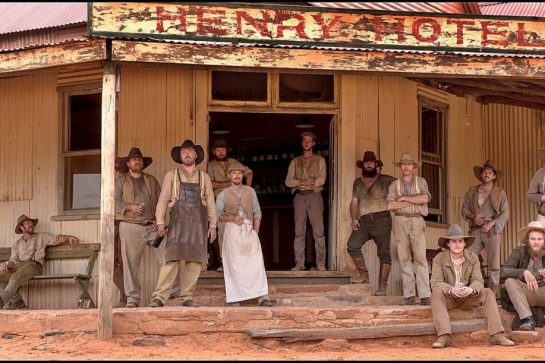
Movie Review: “Sweet Country,” Directed by Warwick Thornton. 113 minutes

sweet-country-premier

My movie buddy and I are suckers for anything Australian. I think it’s the way they subsidize their movies that gives them such an intelligent edge. This one is more of a character study and an exposition than a story, even though there’s more than enough action.

The movie claims to be based on actual events in 1929. An indigenous man kills an Anglo, then goes on the run. Moviegoers may have seen wyly outlaws evade posses and madmen dying in salt deserts before, but seldom told with this much plain grit.

The indigenous characters are largely inarticulate and given to local idioms. The film has to use subtitles for some of their dialogue. There is a lot of symbolism that is open to interpretation, but one theme is clear throughout: racism. Like any story revolving around racism then as now, those dancing around the theme included the decent, the indecent, and the willfully ignorant.

The chase through the outback gives the filmmakers and the moviewatchers wonderful opportunities for vista viewing. The old John Ford westerns have absolutely nothing on this Australian cowboy movie.

But it’s the characters that matter. Moviewatchers get a solid inside look at these realistic settlers and their near-slave employees. Degradation and inspiration are there in handfuls. Warwick Thornton and his Australian team have made us a gratifying movie that is to be taken seriously and thoroughly enjoyed. The price of a ticket seems hardly enough to repay them.

–Gene Lantz

I’m still on KNON radio 89.3 FM in Dallas at 9 AM Central Time on Saturdays. If you want to know what I really think, check out my personal web site,

Book review: Glenn Frankel, “High Noon. The Hollywood Blacklist and the Making of an American Classic.” Bloomsbury, New York

garycooper

There aren’t any actual good guys that I know of in the story about the American film blacklist. There are just bad guys, to one degree or another, and victims. The main character in this book is Carl Foreman, who wrote “High Noon” and saw it through. According to the book, Foreman’s views were shaped by the anti-communist witch hunt going on at the time (1952). Foreman was one of the victims.

The plot of the movie, as you know, concerns a lawman under pressure from a gang of killers. He can’t find anyone to back him up, but he can’t figure any way out of it either. So he has to face almost certain death alone. He survives (it’s still a Hollywood movie) and is embittered about the law (the system?) and about the people he had considered his friends. He dumps his tin star and rides away. The town becomes a ghost town, just as it deserved.

The town in High Noon is a metaphor for Hollywood. I’m old enough to remember when the movie came out, and I’m also old enough to remember the schlock that passed for American films afterward. Rock Hudson flirted with Doris Day in every other movie for the next ten years!

I’ve read several books about the witch hunt that is sometimes called the “McCarthy period.” I liked this one because it names a lot of names of the name namers. It doesn’t equivocate as to who was profiting by turning in their friends, who was lying to begin with, and who found some way around it. Foreman was one of those last ones. He was a victim to be sure, but he came out of it better than many former Reds. He managed to avoid naming any names, too, according to the book.

A lot of fuss is made over film star John Wayne, who was one of the biggest red-baiters in Hollywood. This may have been because many of the people he was victimizing had served honorably in World War II, while Wayne ducked it and made his fortune playing war heroes. Wayne hated “High Noon” and Carl Foreman. There’s an interesting interview on YouTube in which Wayne tries to cover his venom with a patriotic veil.

I also liked the film analysis in the book. Several artists did what has to be their best, or way up there nearly best, work in this movie under difficult circumstances. I can’t think of a better performance by Katy Jurado or Lloyd Bridges. Lon Chaney Jr, who ruined his image by playing The Wolfman over and over, was especially outstanding. Gary Cooper played Gary Cooper for the 1000th time, but it’s hard to think of a better version! If you’re curious about Cooper’s role in the witch hunt, you’ll get your answer in this book.

The book offers a lot of answers about this terrible period in American history. The questions continue to overshadow the answers, especially “Will it happen again?”

–Gene Lantz

I’m still on KNON radio 89.3 fm in Dallas every Saturday at 9 AM Central Time. If you are curious about what I really think, check out my personal web site


Movie Review: The Insult, Directed by Ziad Doueiri. 112 minutes

The_Insult_(film)

It’s not just about two strangers quarreling over home repairs. OK, that’s how it starts. But this is one of those movies where a little personal incident illustrates universal pain.

We’ve been reading about the turmoil in the Middle East for a long, long time, but what’s it like for the people living in it? That would probably be very hard to explain.

You Gotta Love Movies

The wonderful thing about The Insult is that it doesn’t exactly explain it. It just takes you through that other world and lets you feel it.

If you have already chosen sides, or if you think you have chosen sides, you may have to re-evaluate. You may find out there are more than just a few sides. I kind of like to think that the protagonists in this movie, even though they are at war with each other, both represent a side of their own — decency.

Neither of them really wants to become symbols of deep seated anguish and national hostility. The characters really grow on the viewer, no matter what kind of baggage we brought into the theater.

Unless you really can’t stand movies in multiple foreign languages, or if you hate courtroom drams, I think you’d like this one.

–Gene Lantz

I’m still on KNON radio 89.3 FM in Dallas every Saturday at 9AM Central Time. If you want to know what I really think, check out my personal web site.


Book Review:

Schrecker, Ellen: Many Are the Crimes. McCarthyism in America. Little Brown and Company, Boston, 1998.

whitebread

I remember the 1950s like white bread: bland, not nourishing, and an important part of every meal. Books, movies, and all things cultural talked about “the American way” as if it were the best of all worlds and the best ever created or imagined. Socialism was never mentioned, except in a pejorative way in movies like “I Married a Communist” or “I Was a Communist for the FBI!” We did not smoke dope in Muscogee, or anywhere else as far as I knew. We kept our hair short and our minds shorter.

It has taken many years for me to realize that the wasteland of the 1950s was created deliberately. Too bad I didn’t have Ellen Schrecker’s book in 1953! It would have saved me a lot of personal anguish.
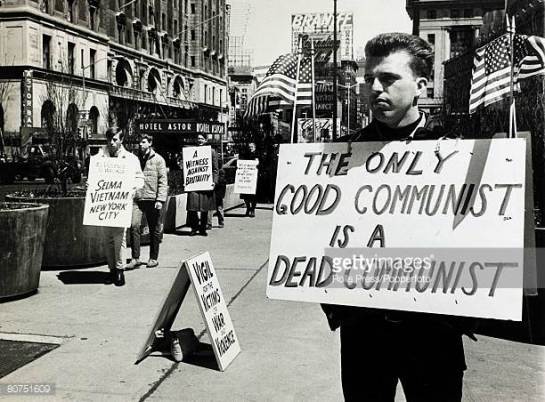
communist-dead

Schrecker details important aspects of the anti-communist crusade from World War I to modern times. Except for a brief period during World War II, when the United States and the Soviet Union were wary allies, the crusade was relentless.

Schrecker is an academic, so don’t expect her to take sides. She’s just reporting what happened. Academics are afraid to take sides. However, the sheer immensity of the government-run effort to destroy civil rights, civil liberties, and any kind of resistance speaks for itself.

The author reminds us often that she doesn’t sympathize with the communists. She stands on the high ground of impartiality, and, in a way, that makes the facts about the  FBI and the other zealots even stronger.

Schrecker doesn’t shrink from pointing out that a great many of the tactics implemented by the FBI and taken up by other government entities were illegal. A great deal of the testimony against communists and liberal thinkers consisted of FBI-solicited lies. J. Edgar Hoover is hardly the only guilty party. Schrecker doesn’t spare the intellectuals and liberals who all-too-easily jumped on the anti-communist bandwagon. She also doesn’t spare the right-wing union officials who cashed in when, with government help, they drove the militants out of the American union movement.

I’m particularly interested in what happened to the American unions after 1947, when the anti-communist and anti-union Taft-Hartley law was passed. Unions resisted it at first, but here’s what Schrecker says on page 380: “…by the early 1950s, most of the nation’s unions had adjusted to the law and abandoned their struggle against it. It was a serious mistake. Taft-Hartley created an unfavorable legal environment that forced the entire labor movement onto the defensive. Unable to employ the aggressive organizing tactics that had been successful in the 1930s, unions found it difficult to expand. As a result, by the 1970s, when the postwar boom began to falter and the well-paid blue-collar jobs of the members began to disappear, labor was unable to mobilize either the political or the economic clout to protect its earlier gains. It’s numbers dropped… Instead of reaching beyond its traditional white male constituency in the heavy industry and skilled trades of the Northeast, Midwest, and West, the labor movement turned inward and raided its own left wing.”

On page 382: “Its rupture with the left hastened its transformation from a movement to a bureaucracy…. Once the left-wingers were gone, organized labor lost its dynamism….”

The saddest of the tragedies throughout this long, detailed book comes on the last page when the author considers “Can it happen again?” “…the process through which McCarthyism came to dominate American politics is infinitely replicable.” In less academic language: Yes, it can happen again.

–Gene Lantz

I’m still on KNON radio at 9 AM Central Time every Saturday. If you’re interested in what I really think, look at http://lilleskole.us.


Movie Review, “Three Billboards Outside Ebbing, Missouri,” Directed by Martin McDonagh. 115 minutes
francesmcdormand
There are supposed to be at least five stages of grief, but Mildred Hayes is stuck at number two — rage. She is out to get a certain transgressor and she’s willing to take on the town’s law enforcement — and the town itself! The plot is too good to spoil here, but let me make a couple of comments about the value of the movie.
There’s an art experience here that everybody can relate to. It involves the viewpoints of the good, the evil, the young, the old, the comfortable and the discomforted. My movie buddy and I picked the movie of course because of its star, Frances McDormand. Just as we expected, she is absolutely wonderful as Mildred Hayes. The surprise for us was how terrific the entire supporting cast was. Woody Harrelson was far better as a caring and sympathetic man than he usually is as a rough and tumble sardonic stereotype cowboy, even though he’s still, as he often is, a cop.
Best of all is the villain, well, sort of a villain, played by Sam Rockwell. We usually see Rockwell playing characters who are insane, but they are usually cleverly so. In “Three Billboards,” he’s not only insane but also cruel, chauvinistic, and stupid. The actor carries it off beautifully. His lowly character becomes, I think, the best example of the many examples that show what this fine movie is about — being fully human.
–Gene Lantz
I’m on http://knon.org/workers-beat every Saturday at 9AM Central Time. If you want to know what I really think, look at http://lilleskole.us