Archive

art

Movie Review

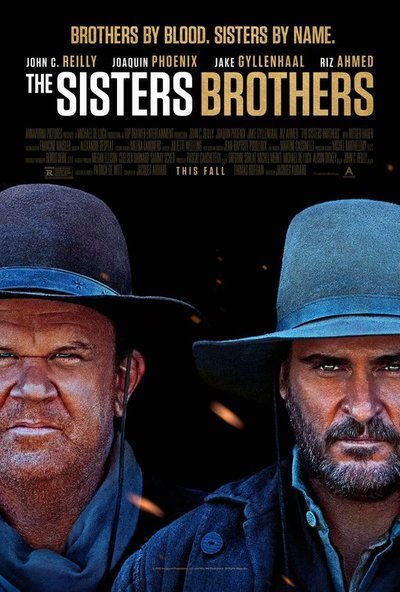
“The Sisters Brothers,” Directed by Jacques Audiard. 121 minutes

sistersbrothers

There’s some really terrific shooting scenes in this movie. It takes place in 1851, and the two cold-blooded professional murderers who are the heroes of this film do not have the traditional movie gun, the Colt 45 Peacemaker. The ones they have throw sparks and nasty sounds as well as lead. I don’t think I’ve ever seen better shootout scenes.

There’s a Dallas Angle: La Réunion

Another good thing about the movie, something that makes it more authentic to me, is the central idea of something that was going on in Dallas, Texas, during the period. One guy, and only one guy because everybody else in the movie is a cold blooded murderer, has a dream of going to Dallas and joining a socialist colony there. What makes it so authentic is that there really was a socialist colony forming right outside Dallas in the early 1850s. Wikipedia tells the story very well, even though they are a little too definitive about the dates when it started and when it ended.

The one man with his socialistic dream gives contrast to some of the characters and, to a small extent, tends to humanize others.

More Good Things

One could not ask for better actors than Joaquin Phonenix and John C. Reilly. One could not ask for more interesting scenes of horses running across rough western terrain. Some of the dialogue was outstanding.

On the Downside

We appreciated the effort to make an authentic western, but my movie buddy and I didn’t really like “The Sisters Brothers.” I think the problem was explained in a radio interview where the main star, John C. Reilly, explains that it was a labor of love. Apparently, they loved every scrap of film so much that they couldn’t cut anything out. They left everything in — every unrelated, going nowhere, irrelevant detail.

The result is a meandering movie with plot lines and asides going higher and thither. If they had tightened it up and put it into focus, it might have been a horse opera of worth.

–Gene Lantz

I’m on KNON 89.3 FM “Workers Beat” talk show every Saturday at 9 Central Time. If you are curious about what I really think, check out my personal web site

Movie Review

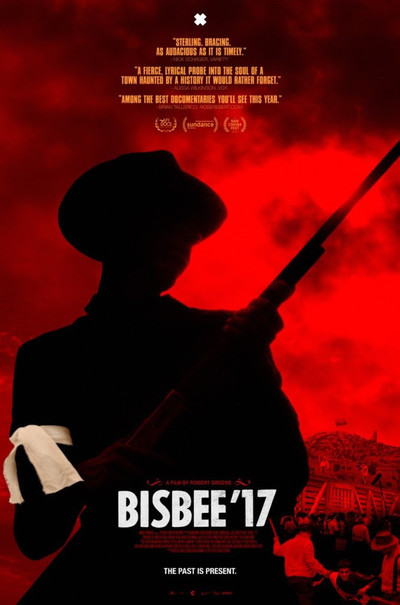
“Bisbee 17,” Directed by Robert Greene. 124 minutes

bisbee17

My movie buddy and I ordered tickets as soon as we heard there was a documentary on the Bisbee Deportation. Good thing we did, because they only scheduled three showings in our town. Most towns won’t get to see it at all. I wonder if they will show it in Bisbee, Arizona?

People who like artsy, independent movies for their own sake might like the film. People who judge movies on their effectiveness probably won’t. People who just want to see some honest working people’s history revealed at last will be glad they made “Bisbee 17,” but even then, I’m not sure they will like it.

The Wikipedia version, just telling the story straight, is a better way to find out about the forced deportation of 1,300 striking miners on July 12, 1917. I have always wondered how they carried it out, but the movie explains that very well.

The Phelps Dodge Mining company and its stooge sheriff deputized over 2,000 men. They made sure to get the Anglo-Saxons because they were targeting virtually every man who wasn’t. They armed those deputies and then started arresting all strikers and anybody who might support them, even people who only attended one meeting “just to listen.” One deputy arrested and deported his own brother, according to the movie, and never saw him again.

Then they marched everybody down to the railroad and loaded them on cars to nowhere. The sheriff announced that he would kill any who returned to Bisbee. The compliant (complicit) railroad company took them out into the desert and stranded them there.

The strikers were with the Industrial Workers of the World (IWW). They were supposed to have been represented by the Mine, Mill, and Smelter Workers but union complacence gave the energetic IWW a chance to move in. It’s not in the movie, but one of the main IWW organizers was my personal hero, Frank Little. Little ducked the deportation and went on to another copper miners’ strike in Montana, where he was lynched less than 3 weeks after the Bisbee Deportation.

The artistic movie man took advantage of the centennial re-enactment of the Bisbee Deportation to film the local people preparing for and carrying out their re-enactment roles. As they were all Bisbee people, most of them were also the descendants of the perpetrators. Many of them still held the same racist, chauvinist, jingoistic beliefs of their forebearers and said so in the movie.

Maybe the best scene is when one outraged man speaks to a planning meeting of Bisbee citizens and says, roughly, “Some of you are saying we have to tell ‘both sides’ of the story! That’s like telling ‘both sides’ of the holocaust!” He made a good point, but the re-enactors didn’t listen. The movie man didn’t, either. That’s the problem with “Bisbee 17.”

–Gene Lantz

I’m on KNON 89.3 FM “Workers Beat” talk show every Saturday at 9 Central Time. If you are curious about what I really think, check out my personal web site


We always assume that Lizzie Borden was guilty of the axe murders of her father and stepmother.

Movie Review:

“Lizzie,” Directed by Craig Macneill. 105 minutes

Chloe Sevigny produced this film and carries almost every scene as the central character. She does a fine job of acting, but Kristen Stewart deserves tremendous credit not only for a fine acting job but also because she keeps stretching her capabilities by taking on more and more diverse roles. In this one, the vivacious star of all those “Twilight” movies plays a mousy little immigrant housekeeper.

The real Lizzie Borden was never convicted of all that whacking, but the literary Lizzie, it seems, will forever be guilty until proven innocent.  Recently, she’s also become a feminist trailblazer. She wouldn’t have acted out so murderously, we are given to understand in the movie, if she hadn’t been repressed in the 1890’s. I think this movie makes that point very well through the drama itself, through the tension we in the audience feel on Lizzie’s behalf, and decidedly not because of sermonizing.

lizzieborden

After the movie, you might want to decide about Lizzie’s culpability and motivations on your own. Wikipedia has a good treatment. You might also want to check out the 1975 made-for-TV version starring another very good and versatile actress named Elizabeth Montgomery. It’s free on YouTube. It’s also very good.

We liked the movie. It had a lot of tension and, all the way through, seemed very honest. Also, there were three union logos in the last frame.

–Gene Lantz

I’m on KNON’s “Workers Beat” program 89.3 FM at 9 AM every Saturday Central Time. They podcast them on Itunes. If you are curious about what I really think, check out my personal web site.

I enthusiastically recommend the content and ideas in Michael Moore’s new documentary, but I can’t actually recommend the movie.

Movie Review:

“Fahrenheit 11/9” Written and Directed by Michael Moore. 2 hours 6 minutes.

Michael Moore of Flint, Michigan, is probably the greatest satirist since Johnathan Swift. While his latest and most ambitious movie fulfills its purpose in illustrating virtually everything that’s wrong in Donald Trump’s America, it also highlights the inadequacy our response.

michael-moore

In Moore’s defense, one might say that listing today’s evils is necessarily a long and grim task. However, such length and such anger don’t fit well into a moviegoing experience. “I felt like I was getting beat up,” was my movie buddy’s summary.

Three or four, or maybe four or five, separate documentaries would have carried the message and made the point better. I wouldn’t mind a feature-length documentary on the scandal of lead poisoning in Flint, or on comparisons between Trump and Hitler, on the Florida teenagers’ response to school shootings, on the failures of our electoral system, and most certainly I wouldn’t mind a feature length documentary on the wonderful school employees of West Virginia. But trying to cover them all, and even more stuff, in one continuous documentary film?

Moore’s over-ambitious project took so much time that it squeezed out all the room that he used in his earlier films for humor. There are some great laughs in “Fahrenheit 11/9,” but only a few.

That’s not my main complaint.

Where Is the Solution?

In an interview introducing his film, Michael Moore said that its purpose was to get people to vote this November. But that isn’t clear at all in the movie. Even if it were clear, for whom would Mr. Moore have us vote? In this film, he lambastes the Democrats almost as much as the Republicans. That can only lead people to do exactly what Moore tells us not to do, stay home on November 6.

At one point, one of the characters featured tells people to join unions. But another part of the movie disparages unions.

Apparently, the outraged Michael Moore wants us to be outraged, but what does he want us to do about it? Many Americans are already outraged. Somebody needs to tell them to join unions and other progressive organizations and fight for a progressive program with a real, long-term social solution.

Otherwise, we’re just a bunch of simple-minded outraged anarchists.

–Gene Lantz

I’m on KNON radio’s “Workers Beat” program at 9 AM central time every Saturday. They podcast on Itunes. If you are curious about what I really think, check out my personal web site.

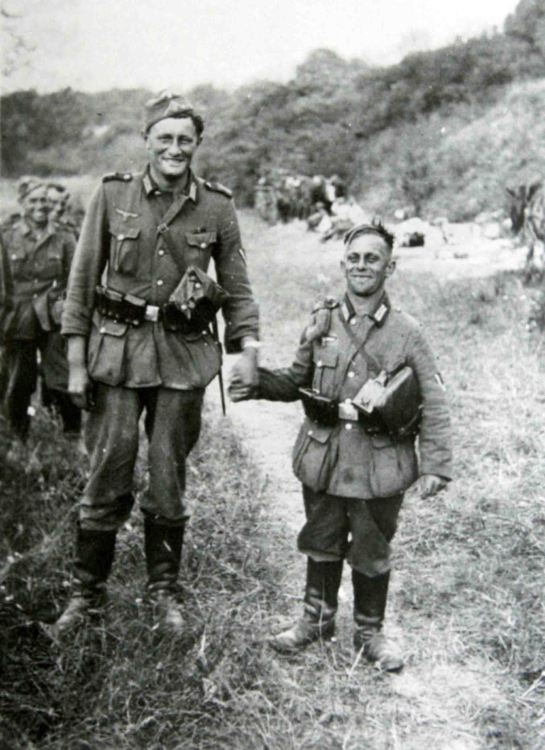
Movie Review: “The Captain (Der Haptmann)”.  Directed by Robert Schwentke. 1 hour, 58 minutes.

germansoldiers2

Just as you learned from the trailer, the movie is about a low-level German deserter who masquerades as an officer during the final two weeks of World War II. Toward the end of the movie, one learns that it’s a true story about a young man named Willi Herold.

Before that, you spend nearly two hours wondering and watching Willi pull off his incredible masquerade. Not only does he convince everybody he meets that he really is a high-level German officer with direct instructions from Hitler; but he convinces everybody watching the movie that he is one of the worst stereotypes of a monstrous Nazi in a monstrous war.

And we are never actually told his motivations. We really don’t know where to put Willi Herold, and he doesn’t tell us. Is he doing everything he does because he knows he is close to death and is living in a state of panic? Or is he just a terrible person who sees a chance to do something awful?

Also, we are never actually told whether we are watching a farce or a horror movie. Some scenes are as grim as any war movie ever filmed, maybe worse. Other scenes are so downright wacky that they might be some kind of movie tribute to Federico Fellini, the great Italian film maker who used realism only part of the time.

My movie buddy and I agreed that the movie was well made and that it is important. A work of art is defined as something that changes you, but it recognizes no obligation to guarantee the nature of the change.

The actors in “The Captain,” all of them set free to portray the far extremes of human emotion, are simply wonderful. The music and the shiny black and white cinematography melt the audience into the screen. My movie buddy and I agreed that we felt the need to seek out someone who would explain what we had just seen. Or maybe what we really need is somebody to sit us down and carefully explain Nazi Germany and World War II.

–Gene Lantz

I’m on KNON radio’s “Workers Beat,” 89.3FM in Dallas, at 9 AM Central Time every Saturday. They podcast it on Itunes. If you are curious about what I really think, check out my personal web site

Movie Review:

“Never Going Back,” directed by Augustine Frizzell, 1 hour 26 minutes

“Puzzle,” Directed by Marc Turtletaub, 1 hour 43 minutes

This is the year of the women in movies as well as elections. My movie buddy and I caught two better-than-average films this weekend.

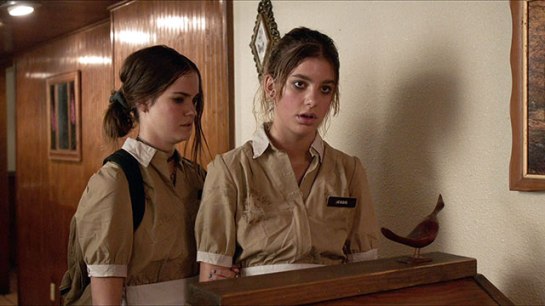
waitresses-stoned

Jessie and Angela are two wild teenaged waitresses in “Never Going Back.” Agnes is a straightlaced housewife in “Puzzle.” There are light moments, but neither movie is a comedy. Both of them ring true as comments on the lives of contemporary American women.

Jessie and Angela are parent- and school- free waifs just about to turn 17. They live with Jessie’s older brother. He is a stoner and aspiring drug dealer. He has even less sense than they do. He tries to borrow money from them while they save up to spend a weekend on the faraway beach in Galveston. The movie, takes place in Garland, Texas,  next to Dallas.

The viewer would probably respect the young women a lot more if they weren’t such zany outlaws, but he/she would probably care for them less. I worried about them all the way through the film.

I wasn’t worried about Agnes in the other movie, but I was pulling for her. As the film begins, she is taking care of men, her husband and two nearly grown sons. Before that, she took care of her father. “You’re the boss,” she cheerfully tells her husband at one point.

But Agnes has a secret. She’s taken up competitive jig saw puzzling with an exotic man in the big city. Agnes guides herself through big changes, but she is never entirely out of control. One admires her all the way through the film.

Both movies are well done. The music is particularly good, and the acting is outstanding.

For moviegoers who are interested in women as victims and women as rebels, these are two pretty good movies.

–Gene Lantz

I am on KNON radio’s “Workers Beat” program every Saturday at 9 AM Central Time. If you want to know what I really think, check out my personal web site

The car accident was not the fault of old Glen Lang. Somebody left the handbrake off their delivery truck, and it rolled down Nob Hill, across the stop sign, and right at the driver’s side of Glen’s little auto. He saw it coming, and the first thing that crossed Glen’s careful mind was not his own safety. He thought, instead, of whether or not he was to blame, which of course he wasn’t, but he didn’t have time to resolve that before his car was lifted in the air and whisked to safety on the other side of the intersection.

And, before Glen even had time to realize that he had been saved, Wonder Woman jumped into his car! “Let’s go,” she said, and Glen obediently eased the car slowly forward. This was going to take a few minutes to assimilate.

gadot-face

Eventually, though, Glen had the presence of mind to peep hesitantly over at the strangely clad but very real woman in the front seat of his car. She was, indeed, Wonder Woman, complete with the red boots, the boomerang tiara, and the glowing magic lasso at her side. Or, he decided, she might not be the real Wonder Woman, but she was certainly Gal Gadot, the Israeli actress who played Wonder Woman in movies.

Gal Gadot, Glen had realized in the movie theater, was perfection. She didn’t just look like Wonder Woman, she looked like the best woman that God ever made. She was the penultimate wish of every man, perfection. What she would be doing in an old man’s ancient automobile was more than he could figure out.

It crossed his mind, of course, to ask her. But years of cautious living had taught Glen that questioning a good thing was unlikely to help anything and might hurt. So he just drove.

“I was on my way home,” he said tentatively.

Gadot smiled broadly and looked right at him, right at Glen!

He must have blushed. He hoped he hadn’t, but he knew he probably had. He examined the road ahead scrupulously, paid full attention to his driving, kept his face toward the road, and kept driving.

What should he do next? He tried to keep his thoughts concealed while he figured out the next course of action. But what was it?

The thought of politely asking Wonder Woman where she wanted to be dropped off was, of course, the first idea. But on further consideration, he thought it might sound foolish. After all, if she was Wonder Woman she could call her invisible aircraft any time and go anywhere she wanted, so why would she need Glen for a chauffeur? If she wasn’t really Wonder Woman, but was actually Gal Gadot, then she could surely have a limousine pick her up anywhere. So asking her where she wanted to be dropped off was surely superfluous and might only make him, Glen, look like a silly chatterbox, just talking to hear himself talk.

As he had already told Gal Gadot that he was driving home, and as she had not given him further direct instructions, that’s where he drove.

As he pulled into the driveway, he wondered what protocol was in order next. Should he run around to open the door for her — surely a silly thing to do for a woman who could not only open a door but lift an entire car — or should he just sit there and wait for instructions — “and look dumb,” he thought. Besides, do younger people open doors for each other? It also occurred to him to just sit there in the driveway, which would, also, he thought, look dumb.

No other course of action availing itself, Glen decided to just get out of the car. By then, she had already solved all the protocol problems by opening her own door and getting out of the car first. Then she waited, again smiling magnificently and looking right directly at old Glen Lang.

Anybody else, Glen realized, might have lost their cool. But he was resolved. He walked to the door and held it open for whoever it was, either the most beautiful actress ever in a movie or an actual goddess. She walked right in.

Like anybody else, Glen then glanced around to see if there was anything amiss in his little place. Of course there wasn’t. He wasn’t rich, but he wasn’t a slob, either. At the same time, the little house was, he admitted, rather humble for such a guest. He wondered if it smelled like old people?

Nothing seemed to bother Gal Gadot about the place. “I’ve gotta get these boots off,” she smiled, “Do you mind?” And before Glen had the presence of mind to answer, she was sitting on his little sofa and pulling her wondrous boots off her wondrous feet.

“Would you care for a-a, a glass of water?” he asked. He hated that he had stammered, and he was embarrassed to realize that he was almost positive that he was blushing again.

“Not just yet,” she said as she stood up on her incredible bare feet and then — completely to Glen’s shock — placed her hand on his forearm. “Why don’t you show me around first?” Her irresistible smile weakened Glen’s knees. He tried to not, but he looked down at her hand. He had never seen such a beautiful hand. He had never noticed such perfectly manicured nails. Such skin coloring, such  smoothness, such a lack of pores or unsightly hair! How much time had passed?

And, it seemed to Glen, that she was standing closer than any woman had stood near Glen in decades. He thought he could smell her and even feel the radiation of her body heat. He strained his hopes that he wasn’t going to embarrass himself in front of her, but he was almost positive that he would. And then something even worse began to present itself to the squirming self-consciousness of Glen Lang.

He felt a stirring in his pants.

“Uh,” Glen’s voice seemed to have dropped a couple of octaves and was almost a grunt when he finally responded, “Yes.”

He led Gal Gadot through the narrow kitchen. He pointed out the bathroom with just the slightest hope that a rest stop was what the goddess might want — but she didn’t respond — and then found himself hesitating in front of the open bedroom door. Then he entirely ran out of the ability to think, and just stood there immobile.

The gorgeous hand of Wonder Woman herself pushed Glen Lang gently inside. Then it slithered down his back and, to his utter disbelief, slightly squeezed his buttock! For the first time, Glen stopped worrying that he would faint and started hoping that he would!

Wonder Woman then took over completely. First she undressed Glen, then herself. The breastplate came off and revealed, as he would have thought if he could have thought at all, that Gal Gadot was even more perfect without her costume than with it. Glen cowered. Gadot glowed!

Glen Lang was amazed with Gal Gadot, but he was also amazed with himself. He hadn’t had a stiff erection in at least a decade, and he was sure that, no matter what this beautiful goddess might want, he would not be able to provide it.

But he had that same worry in intimate situations when he was younger, and somehow had provided himself with an adequate erection when the occasion demanded it. So, as he had done when he was much younger, he waited silently and hoped. Sure enough, and to his complete amazement, the long-missing erection was developing!

Not only did Glen Lang get an erection, but he found himself perfectly capable as the Goddess slid beneath him on the top of his tiny bed. Before it was over, Glen had even begun to remember some small part of his old technique.

Afterward, he at last said said one of the awkward things that he had hoped he wouldn’t say, “I can’t believe I did that,” he gasped.

“It was good,” beamed the naked goddess.

“I haven’t been able to do that for years. Not for years and years,” Glen protested

“Well,” Gal Gadot said, “I may deserve some of the credit.”

“Certainly, certainly,” Glen said, and realized that it was perfectly true. How could any man not respond sexually to Wonder Woman or Gal Gadot?

He lay quietly, in fear that he might again say something out of place.

Finally, she broke the long silence, “You OK?”

“Better than that,” he smiled and turned on his side toward her. In fact, he was aware, he was beginning to feel just the slightest stirring around his penis again. “I think I’ve died and gone to Heaven.”

She smiled and snuggled close.

“I feel like I have died and gone to Heaven,” Glen repeated. No response.

“Have I?” he finally asked. “Did that truck hit my car? Have I died and gone to Heaven?”

“Yes,” softly reassured the beautiful goddess. “How do you like it so far?”

–Gene Lantz

I’m on KNON radio 89.3 FM in Dallas at 9 AM Central Time every Saturday. You can find podcasts under the “events” tab. If you are curious about what I really think, check out my personal web site

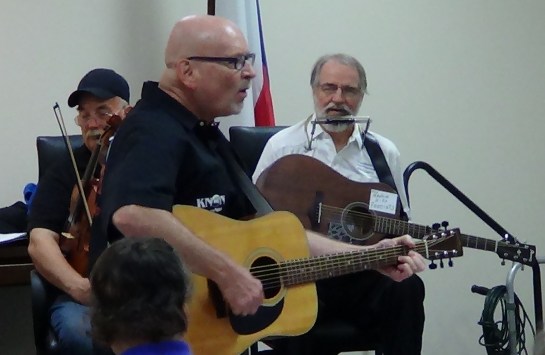
I organized a musical event for July 14 at the CWA Local 6215 hall in Dallas. We celebrated Bastille Day and Woody Guthrie’s birthday. As far as I know, it was the first of
its kind in Dallas history. It came out very well. About 50-55 people, including 6 performers, had a great time. There was a lot of good will. I’m not sure how much money we
raised for KNON radio’s “Workers Beat” program, but we raised $534.25 that I know of for Dallas AFL-CIO.

But why did I do it?

I’ve organized cultural events before. In general, I’m motivated by a desire to restore the kind of cultural traditions that helped build the American labor movement during
its great upsurge, 1935-1947. I also like to try to combine the labor movement with other progressive elements, in fact that’s what I’m usually trying to do — build unity. As
for fund raising, I’m always raising money for my program on KNON. But I had a special reason for making this one a fund raiser for the Dallas AFL-CIO.

It is my opinion that the labor movement is being bled to death by Donald J Trump and the Republican party. The recent Supreme Court, Janus Vs AFSCME, will deplete labor’s
finances by millions of dollars. Trump’s executive orders driving federal unions out of their workplace offices will cost a lot. The concerted effort of such savage anti-
worker organizations as the National Right to Work Committee and many others is designed to discourage workers and stop dues payments. Many state legislatures are trying to
stop or hinder dues collections.

I don’t know any numbers, and the labor movement is not likely to start advertising its weaknesses, but I think it’s fair to assume that they really need money. I knew I
could’t raise a lot of money with a simple singalong on July 14, but I also knew that we have to start changing people’s attitudes about financing the labor movement. That was
my motivation. I’m pleased with the result.

Here’s What Happened

If you missed the event, you might want to read what was said and watch videos of what was sung. Here are my notes.

Host’s introductions and comments:

Introduce Dallas AFL-CIO principal officer Mark York. He will include greetings from Texas AFL-CIO President Rick Levy as follows:

“I can’t think of a better quote about labor songs and culture than from the man himself [Woody Guthrie]:

‘I hate a song that makes you think that you are not any good. I hate a song that makes you think that you are just born to lose. Bound to lose. No good to nobody. No good for
nothing. Because you are too old or too young or too fat or too slim or too ugly or too this or too that. Songs that run you down or poke fun at you on account of your bad
luck or hard travelling. I am out to fight those songs to my very last breath of air and my last drop of blood. I am out to sing songs that will prove to you that this is your
world and that if it has hit you pretty hard and knocked you for a dozen loops, no matter what color, what size you are, how you are built, I am out to sing the songs that
make you take pride in yourself and in your work. And the songs that I sing are made up for the most part by all sorts of folks just about like you. I could hire out to the
other side, the big money side, and get several dollars every week just to quit singing my own kind of songs and to sing the kind that knock you down still farther and the
ones that poke fun at you even more and the ones that make you think that you’ve not got any sense at all. But I decided a long time ago that I’d starve to death before I’d
sing any such songs as that. The radio waves and your movies and your jukeboxes and your songbooks are already loaded down and running over with such no good songs as that
anyhow.’

‘We have to make our own songs and our own culture and remember who we are and what we are fighting for. Thanks to you and the folks putting this together for reminding us to
always be true to our best nature and be proud of who we are.” –Rick Levy

Host (me): Thank you for being here to help us revive labor’s cultural heritage. It’s a singalong. You should have a song sheet with the words to the chorus of some great
songs.

When you leave today, I’d like to have your contact information on the back of the song sheets so you can learn about future events.

Why do we say that Woody Guthrie is America’s greatest songwriter? He began his singing career in the 1930s and was taken from public view by 1950, so hardly anybody in this
room has any direct memories of him. Some of you know the name of his son, Arlo Guthrie, and some of you may know some of the songs that he wrote, but he wrote hundreds and
had a profound effect on the progressive movement in America. That’s why we’re celebrating him today.

Woody put working people first. Almost all of his songs are about working families, and many of them are about organizing. One of the most famous is “Union Maid,” brought to
you here by Linda Coleman. She’ll sing the verses, but she wants you to help her sing the chorus

Union Maid and some introductory video: https://youtu.be/rkq8dK0GP6o

Woody Guthrie popularized the “Talking blues.” You’ve heard this style from Nobel-prize-winner Bob Dylan. But you may never have asked where Dylan got his style. Let’s have a
couple of talking blues from Brother Kenneth Williams:

Talking Union
Mean Talking Blues: https://youtu.be/oxMKDrDGZ0g

Woody sang for unions, for people on strike, and for organizing drives. Here is Kenny Winfree with Woody’s song: “You Gotta Go Down”
You Gotta Go Down and Join the Union: https://youtu.be/ynQqbpRM_bw

Almost any book of folk songs will have more Woody Guthrie tunes than those from any other writer. He wrote songs about everything. Pete Seeger tells the story of the
blacklist time when the FBI was arresting, deporting, or intimidating every progressive artist in America. The FBI actually visited Woody and Pete, and Pete said it really was
intimidating. But he said Woody laughed about it and immediately wrote a new song: Would I point a gun for my country.

All folk music is very close to gospel music. When Woody was just a little boy in Okemah, Oklahoma, his mother sang gospel and folk music to him. James Kille brings you some
of Woody’s original lyrics:
Jesus Christ: https://youtu.be/OdsBZHJ6ePY

In the tradition of original folk music, we bring you this satire by our own Dallas group: The Billionaires
Billionaire song (in previous video I think)

Fund Pitch:
All his life, Woody Guthrie was committed to the progressive movement, and so are we. We’d like to have your help in keeping two pillars of progressivism going strong: KNON
radio and the Dallas AFL-CIO. KNON allows the “Workers Beat” every Saturday at 9 AM. We advertise as many progressive events as we can find out, and we explain why people need
to join the movement. The very center of the movement in Dallas is the AFL-CIO Central Labor Council. The labor movement has put its old isolation behind it and is a
fundamental part of progressivism today. It takes money to run these things, and they’re always short. As Woody used to say when they asked him if he was a communist: “Well, I
might be, I’ve been in the red all my life.”

Please fill out the pledge form in your brochures. You can get all the paperwork done with Bonnie Mathis, who has her computer warmed up and waiting for you. When you get
finished, how about some free lunch and a beer? We’ll start the music up as soon as the artists all eat.
Fund Pitch

Noon: Lunch break

Ashaken Farewell
Shenandoah (Included with “Philadelphia lawyer” below)

Introduce the performers? At least Jon Gentry on violin. Ben Willett recording us.

Woody loved to write about cowboys, and he had fun with everything he did. Next James Kille, Linda Coleman, and I will bring you one of Woody’s ballads.
Philadelphia Lawyer: https://youtu.be/sewKC7EVysw

Today, the treatment of immigrants is an international scandal. Woody was sensitive to the problem when he wrote this song, presented to you by Anthony Esparza.
Deportee: https://youtu.be/iYGiR-TN3LQ

All of us are pretty much amateurs except for Kenny Winfree. I asked him to do a couple of extra numbers before we get back to Woody Guthrie
Kenny Winfree extra songs: https://youtu.be/dSKUtCbKv2o

Back around 1990, My wife and I visited Okemah, Oklahoma, where Woody was born in 1912. We asked people about Woody and they said “We don’t talk about him here.” Within a few
years, they changed their tune and now the Woody Guthrie annual festival is an important national event. It’s a sign of the times: As the government gets crazier, the people
are getting more sane.

Oklahoma may not have loved Woody all the time during his lifetime, but Woody sure loved Oklahoma! Join me in the chorus please!
Oklahoma Hills: https://youtu.be/AsHSSSw9UmI

In Woody’s time, the biggest issue became the fascist takeover of Europe. Woody fought it every way he could. Some people would say that we need a fight like that now!
All You Fascists Bound to Lose: https://youtu.be/-X5wHfLfKhc

Americans come together around Woody’s songs. Let’s join in on the chorus for this one.
This Land is Your Land: https://youtu.be/oL8RNiIi3qI

THANKS FOR COMING!

Movie Review: “Sorry to Bother You,” Written and directed by Boots Riley, 111 minutes

sorry-to-bothe

There are films that I wish I’d seen with 100 close friends with different viewpoints. Then I could conduct 100 intense conversations that might help clarify what my movie buddy and I sat through.

One thing is certain: this is all-time championship heavy social commentary. It’s on a level with “Brazil,” and maybe a lot better. About everything else, I’m not so sure.

I have questions I’d like to ask my 100 insightful friends: “Does everybody in the movie, including the star-crossed lovers, have to be whacky?” “Why is there an ending after the ending?” “Was playing with the N-word really necessary?” We saw a white couple walk out right after the N-word session, so I guess they were offended. But then, they may have only been confused.

There’s a lot to be figured out, and I’m not sure that even my 100 imaginary intellectual friends would be enough to put me at ease. There are layers tucked under the layers. Just for example, what does the title mean? To begin with, I thought it was just a whimsical title. Then I realized that the main character was a telemarketer who started every call with that phrase, so I thought the title was descriptive. Then, after the movie jolted my world, I decided that the title was a pre-apology from the writer/director straight to me. He was sorry he had to shake up most of my perceptions and a good many of my conclusions, but he went ahead and did it anyway.

Would I recommend the movie? Honestly, no. I am reluctant to recommend it because I’d be risking my credibility with some readers. Lots of people are not going to like this movie. But I’m tempted to recommend it anyway, duplicitous as it sounds, because I want more people to see it and then, maybe, explain it to me.

Would I recommend it? Well, I’m glad we went, and so is my movie buddy. It fits our definition of art, because interacting with it changed us in undefined ways.

I understand that the so-called “gig economy,” temporary jobs with no rights, benefits, or certain compensation, has taken over 20% of the American economy. And the percentage is rising fast. Maybe I should recommend that everybody go see “Sorry to Bother You.”

Before it’s too late.

–Gene Lantz

I’m on KNON radio at 9 AM Central Time every Saturday. Under the “events” tab, one can find the last two programs podcasted. If you are curious about what I really think, check out my personal web site.