Archive

art

Movie Review: “Poor Things,” Directed by Yorgos Lanthimos, 141 minutes

My movie buddy had to drag me away from the lobby outside the entrance to “Poor Things.” I wanted to stay and warn everybody to stay away. It’s over 2 hours of pretentious nonsense about a baby girl growing within a woman’s body. It’s a misogynist fantasy wasting $35 million worth of the latest technology, technique, and style.

There! Now I know you won’t be able to resist going. I saw a couple of outright rave reviews before I started mine. I found a major reviewer who calls “Poor Things” “best movie of the year.” https://www.rogerebert.com/reviews/poor-things-movie-review-2023. Another joins in praising its technical accomplishments, both in film and in storytelling: https://www.vox.com/culture/23992608/poor-things-review. Reviewers, apparently, loved it.

The movie really does have a lot going for it. Everything about it is quirky and over-the-top. Mark Ruffalo, as a Casanova cad, is hilarious, especially in the scene where the child/woman enthusiastically dances jerkily in the middle of a prim ballroom dance and Ruffalo tries to cover for her with impromptu twirls and dips. I could cut that 4 minute scene out and watch it every now and then, but not anything else.

On the way home, my movie buddy analyzed the title. “Poor Things” doesn’t refer to anybody in the movie. It’s the audience, us.

–genelantz

Book Review:

Leonard, Aaron, “The Folk Singers and the Bureau: The FBI, the Folk Artists and the Suppression of the Communist Party, USA-1939-1956.” Repeater, 2020

Some of the first songs I ever learned were “Good Night, Irene” and “On Top of Old Smokey.” I still sing them. They were top-of-the-chart popular songs by The Weavers in the late 1940s. Then the Weavers disappeared and I didn’t hear anything about any of them until the late 1960s, when everybody knew and loved Pete Seeger, Lee Hayes, and Ronnie Gilbert. I didn’t know much about how J. Edgar Hoover and the FBI secret police hounded and threatened them and everybody who listened to them until I ran across this book.

Thanks to the young man who joined our “flying pickets” action for telling me about it. I think his name was Gregory something or something Gregory. He said I could get it through the public library, but I failed at that and bought it for Kindle from Amazon for $8.95. Good investment.

Attacking artists like the Weavers, Woody Guthrie, Paul Robeson, Sisco Houston, Hudie Ledbetter and others was supposedly justified by Hoover as part of his lifelong campaign against communists. The funny thing is, it’s kind of hard to call these artists reds. Sure, they were in and out of the CPUSA, but so were thousands of progressive and liberal-minded people in those days. I think what really pulled Hoover’s chain was the plain fact that they sang the truth, and fascists hate truth passionately.

I appreciate the author’s speculations, near the end of the book, as to just how much the world might have benefitted if these artists had been allowed access to audiences, recording studios, TV, and movies during those dreadful anti-communist witch hunt years.

Also, I appreciated the way the author gave the background of America’s witch hunt. Like most historians, he makes sure that the readers know that he doesn’t agree with nor approve of communists. People are still too afraid to say anything positive in print, but he does tell the truth about why CPUSA fell from a very large political force down to a miniscule one: government persecution. Not that they didn’t make some mistakes.

Leonard’s criticisms of CPUSA errors during the period ring true to me, because I have talked to old reds who lived through it. Their errors in dealing with the witch hunt came directly from misunderstanding the economic and political situation at the end of World War II. I can see why they would think that American fascism was imminent, but they were wrong and it led them to make unnecessary mistakes.

The folk singers didn’t make any of the decisions nor any of the mistakes. They just sang the truth and sang it well. That was plenty of reason for J.Edgar Hoover!

-Gene Lantz

I’m on KNON’s “Workers Beat” talk show every Saturday at 9AM. They usually post my weekly podcast on KNON and on Soundcloud during Wednesdays. If you are curious about what I really think, you might look at my old personal web site.

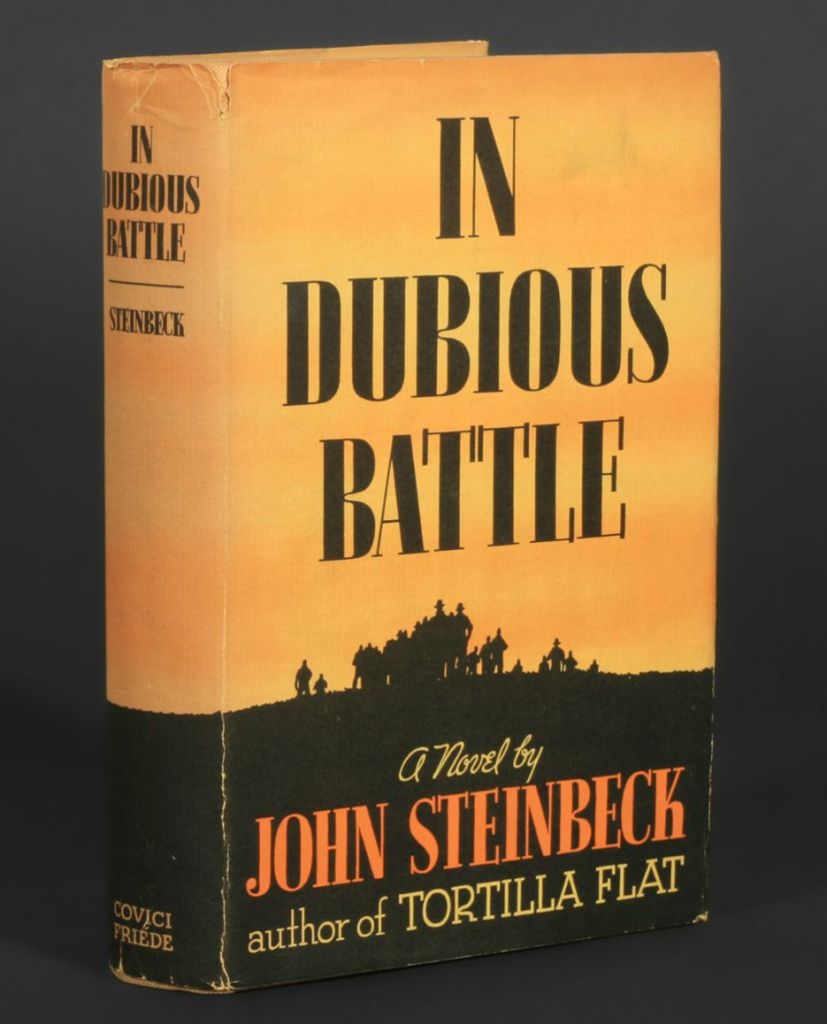
Film Review: “In Dubious Battle,” Directed by James Franco, 1917

Movie Review

“In Dubious Battle,” directed by James Franco, 1917

Prime video still has “In Dubious Battle” for a few more days. It’s an interesting and progressive film with a strong pro-worker attitude.

Jim and Mac are farm worker organizers of the Industrial Workers of the World in 1933. Even though the fighting Wobblies were largely crushed in most industries by the red scare during and after World War I, their Agricultural Department outlasted all their other fine efforts. Pulitzer winner John Steinbeck wrote the book around 1937 based on strikes and labor battles in California. It isn’t as well known as his “Of Mice and Men,” nor “Grapes of Wrath,” but it’s about the same people: itinerant farm workers of the Great Depression.

Mac is the old hand. He’s rather cynical as he teaches the neophyte Jim how to focus on agitating a battle to the exclusion of any other considerations. They take jobs as apple pickers in order to encourage the downtrodden workers to rise up and fight their exploiting bosses. In that regard, the film is quite inspirational and really sounds close to what really happened.

Actually, I kind of hope it isn’t what really happened, because the bosses and their hired terrorists seem to get and keep the upper hand. I watched the film with a genuine union organizer with real experience, and she had severe criticisms of the way the strike was begun and handled.

As art, though, the film is pretty good. I don’t know how the producers were able to do it, but they assembled quite an assortment of headliners in the main speaking parts. We spotted Selena Gomez, Vincent D’Onofrio, Robert Duvall, Sam Shepard, Ed Harris and Bryan Cranston. James Franco directed himself in the main role.

The result is a film that is fine for inspiration, but not for learning organizing tactics. If there were real people like Mac and Jim, they should have learned this: it is not sufficient to fight. It is also necessary to win!

–Gene Lantz

I’m on KNON.org’s “Workers Beat” radio talk show every Saturday at 9 Central Time. If you are curious about what I really think, check out my personal web site

Film review:

“The Painted Bird,” Directed by Václav Marhoul, 2 hours 49 minutes

My movie buddy and I watched this film streamed from HULU in our comfortable living room. If we had seen it in a theater, I don’t know if we could have stayed through it. I understand that many other moviegoers have walked out, not because they didn’t appreciate the film, but because they appreciated it too much!

You can tell it’s a novel. Too much happens with too many characters for an original screenplay. Also, it’s really long. It’s in the starkest black and white. The main character is mute, most of the characters are too miserable to talk, so it’s almost a silent movie.

The story, briefly, is about an Eastern European boy who suffers through the period coincident with World War II. He wanders from one miserable hovel to the next and suffers amazing, disgusting, depredations from backward and somewhat insane perpetrators. They don’t limit themselves to persecuting the boy. Some of the things they do to one another are extremely difficult to watch and almost impossible to put into words.

On the technical side of the production, any one of several amazing accomplishments would make this art movie worth watching. I don’t see how they managed to assemble such an array of international movie stars. I can’t begin to explain how they managed to train the animals to portray such wild extremes of behavior. The cinematography is breathtaking. The props include authentic German and Russian war machines. All the settings are either gorgeous or grotesque. In short, the movie is done well.

And finally, what does it all mean? Does it mean that many humans, perhaps a majority, are cruel and perverted? Does it mean that humans, even an unprotected little boy, can endure almost anything? Or is it just a statement about certain people in a certain place and a certain period of time? Probably, it will mean different things to different people, but I can almost guarantee that the effect will be on a grand scale and this movie will be talked about for some time to come.

–Gene Lantz

I’m on KNON’s “Workers Beat” radio talk show every Saturday at 9AM Central Time. We podcast the program and “Workers Beat Extra” on Wednesdays. If you are curious about what I really think, check out my personal web site.

Movie Review:

“The Trial of the Chicago 7,” written and directed by Aaron Sorkin. 140 minutes on Netflix

What makes this movie so relevant for today is the contrasting strategies portrayed. The movie makes the different ideologies clear. There were a lot of approaches to the Anti-War movement during the Vietnam invasion and not all of them are in this movie, but some critical ones were. With historical hindsight, we can evaluate them.

In 1969 leaders of the Black Panthers, Students for a Democratic Society, the newly formed Yippie Party, and one pacifist associated with the War Resisters League were put on trial for having crossed state lines in order to “incite a riot” at the Democratic Party National Convention. It was a political show trial staged by the Nixon Administration in hopes of dampening the anti-war fervor of the time.

We can dispense with Nixon’s nasty strategy easily: it failed. The anti-war movement did not diminish during or after the trial. What is much more interesting is the contrasting approaches of the defendants.

The strategy of the protagonist with the pacifist view was to appeal to people’s better nature and provide a good example of anti-war intelligence. He was the most reasonable of the bunch, or at least he seemed so until he slugged one of the bailiffs.

Bobby Seale of the Black Panthers was not involved in organizing the demonstrations. The Nixon “Justice” department apparently indicted him, as the script explains, just to scare the jurors. Seale doesn’t talk strategies with the other defendants, but his interactions with the judge showed his defiant attitude. During the trial, the Chicago Police murdered Fred Hampton, Chicago leader of the Panthers. The judge in the trial infamously had Bobby Seale bound and gagged in the courtroom.

The two “Yippies,” Abie Hoffman and Jerry Rubin, steal the movie, as they did the publicity around the long trial, by joking and mocking the judicial system. Their goal, as gleefully explained in the movie, was to create a “cultural revolution.” Their antics were supposed to reveal the fundamental injustice of the war, the trial, and the entire American way of life. That would somehow lead to fundamental changes, but they were accused in the movie of being simple opportunists aggrandizing their own reputations and book sales.

Students for a Democratic Society was a mass movement. It didn’t last very long, but it had a tremendous impact on society and on the war in Vietnam while it lasted. Its main spokesperson in the movie was Tom Hayden who used his anti-war fame to gain a very successful career in California politics. Hayden explains that his movement’s goal was to win power through elections.

All of the defendants agreed on one thing: they wanted to end the war in Vietnam. In that regard, history explains to us that they were on the right track. The war in Vietnam is probably the only U.S. war whose extent was severely limited by popular dissent.

They also agreed that demonstrating at the Democratic Party Convention was a good tactic. The Democrats, after all, had started the war under the Kennedy Administration and carried it to fabulous extremes under Johnson. One could argue that the Chicago demonstrations helped defeat Hubert Humphrey and put Richard Nixon into the White House. Nixon then carried the war even further, but we have no historical way of evaluating what “Happy Warrior” Humphrey would have done.

The characters in the movie, especially Hayden and Hoffman, argue strategies. Viewers like you and I get to decide who was the most effective.

Gene Lantz

I’m on KNON’s “Workers Beat” talk show every Saturday at 9 AM Central Time. I also podcast “Workers Beat Extra” on Soundcloud every Wednesday.  If you are curious about what I really think, check out my personal web site.

You can learn all the technicalities of the movie with the Wikipedia article. https://en.wikipedia.org/wiki/The_Trial_of_the_Chicago_7

For a rave review of the movie’s artistic aspects, see https://www.rogerebert.com/reviews/the-trial-of-the-chicago-7-movie-review-2020

TV Review: “One Dollar” Ten chapters of a TV series on CBS All Access.

“One Dollar” is a modern film noir. It’s also a lot of other things that make it really worthwhile.

It’s social commentary about life in America’s Rust Belt as the jobs disappear and the people sink into despondency. It’s uplifting vignettes about people caring for one another during hard times. Its an exploration of the lives of working families in crisis. It’s a tribute. It’s one damn fine piece of artistry.

In a small town near Pittsburg, the first men to come to work at the town’s steel mill discover pools of blood. There are no bodies, and apparently no one is missing. Competence is not one of the characteristics of the local police force. Only one tired and cynical ex-police detective has the interest and the ability to figure out what happened. He can’t sleep. He can’t express himself. He’s a perfectly jaded film noir detective. He can’t stop inquiring.

Not all of the excellently portrayed characters in the small town have anything at all to do with the blood crime. Some of them just briefly carry around the one dollar bill that circulates around town and gives the series its name and motif. But they all explain the town and the times.

It’s a darned good story well told. But that’s not why I raised my opinion several notches before I got to Chapter 10. It was when I realized that Robert Altman, the great American film director who died in 2006, was still alive through the works of present-day directors. I have always thought that Altman’s “Nashville” represented the highest order of film technique, and I saw a lot of it in “One Dollar.”

Remember Altman’s great transitions from one vaguely related part of the story to another? Remember how he could juggle a dozen different stories and keep them all interesting even though they seemed unrelated? “One Dollar” does that. It works and I am grateful.

-Gene Lantz

I’m on KNON’s “Workers Beat” talk show every Saturday at 9AM Central Time. They podcast the program and “Workers Beat Extra” on Soundcloud. If you are curious about what I actually think, check out my personal web site

TV Review

“Stateless” streaming on Netflix. The first three episodes are directed by Emma Freeman; the other three by Jocelyn Moorhouse.

Please don’t miss this great Australian series.

STATELESS (L to R) FAYSSAL BAZZI as AMEER and SORAYA HEIDARI as MINA in episode 102 of STATELESS Cr. BEN KING/NETFLIX © 2020

The series examines what happens to the lives of those associated with an immigrant detention center that is operated for profit. This one is in Australia, where they unfailingly make great dramas, but the ones in the Rio Grande Valley are also run for profit.

Two of the main characters are inmates: an Afghani trying to save his daughters from the Taliban and an Australian citizen who is trying to hide her identity. The other two administrate the place: an immigration specialist and an ordinary working dude trying out a new job as a prison guard. The place works its wonders on them. Even more, the world system that creates 70 million dislocated asylum seekers and then mistreats them miserably works its wonders on us, the audience.

Part of the story, Wikipedia says, is directly true. All of it sounds true, seems true, hurts truly.

A word about the quality of the presentation: the penetrating insight into every character could only have been revealed by women. Both directors and both writers were women. Their sensitivity is a marvel.

By way of explaining how good the acting is, let me ask you if you’ve ever seen a Cate Blanchett picture where her acting didn’t overshadow everybody else? Cate Blanchett is very good in “Stateless,” but her role is limited. She is listed as one of several Executive Directors. If you’re a fan of Australian TV, let me ask if you’ve ever seen Marta Dusseldorp in anything in which her skill didn’t dominate everybody else? In this series, Ms Dusseldorp and Ms Blanchett are just part of a wonderful ensemble of players. Everybody is excellent. The actors for the four main characters are beyond excellent.

Top acting kudos has to go to Yvonne Strahovski. Her role is the most demanding, and she pushes each of her emotional portrayals beyond limits. After the first few scenes, you may recognize her as the cold hearted Commander’s wife in “The Handmaid’s Tale,” or maybe you won’t recognize her, but you won’t forget her again after you see her in “Stateless!”

Yvonne Strahovski

The Australian immigration/detention system takes a beating in “Stateless,” but several characters, including some administrators, give the impression that they are doing the best that they can in a rotten situation. At least they are trying. My movie buddy and I agreed, several times as we watched the series over a few nights, that the worst of the miseries “Stateless” encountered must be far worse here at home in the United States, where what they are trying to do with the immigration situation isn’t just rotten.

–Gene Lantz

I’m still on KNON’s “Workers Beat” radio talk show at 9AM Central Time every Saturday. We podcast the program and “Workers Beat Extra” on Soundcloud. If you are interested in what I really think, check out my personal web site

TV Review: “Babylon Berlin” directed by Tom Tykwer. three seasons on Netflix

The biggest and most expensive TV series ever produced for German television is running in 100 countries around the world. There are a string of awards. Americans may have trouble with the dubbing and, possibly, with the German expressionism style. If we get involved in the period being depicted, though, we can answer some of our questions about German fascism and, maybe, get some insights into our own.

It isn’t just good entertainment, it’s also a profound learning experience for non-Germans in our historical period.

As we face incipient fascism in several nations and our own, we can profit from trying to understand Germany during the crumbling of the Weimar Republic and before the rise of Hitler. “The Nazis didn’t just fall from the sky,” explains one of the show’s creators. For all we know in America, they may as well have, because many of us don’t know squat.

The two main characters through all 3 seasons are police. He’s a morphine addict and she’s a part-time prostitute. His problems come from shell-shock during WWI, hers from abject poverty. Their combined flaws, compared to that of the general Berlin society around 1929, make them comparatively the healthiest people in the story.

The two of them carry out what might have been called ordinary police procedural drama. But it’s what happens in the background that really matters. They deal with the political/economic situation that helps us answer our questions about Nazis. For the serious questioner, the Wikipedia version explains the period.

In the first three TV seaons, the Nazis aren’t the major political players. Much more important are the monarchists who want to restore the Kaiser, destroy the communists, and make Germany a dominant military power once more. The monarchists sincerely believe that they would have won WWI had it not been for the “fifth column” of anti-war protesters at home. The Nazis agree with them on that, and both of them team up to malign and discredit the big communist movement.

For sheer anti-communism, it would be hard for anybody to beat the social democrats running the government during the Weimar Republic. They made an early deal with the monarchists in the army to destroy the Spartacist League (militant communists) in 1919. They succeeded and executed Rosa Luxemburg and Carl Leibnecht, the leadership way before this TV story begins.

Here, we have a big, rather amorphous, communist party, and a number of organizations opposing them: Trotskyists, monarchists, and the Weimar government itself. Confusing everything are the non-political but very powerful underworld gangsters. Our two police “heroes” are theoretically neutral as they stand up for law and order.

It’s the flapper era. Depravity is commonplace. The rich are disgusting; the poor are miserable. Nobody respects the government. Democracy is strange and alien to the Germans, and they can never forget that it was forced on them by the victors of WWI.

The Weimar government was never accepted by the German people. Their loyalties are divided among the anti-government organizations. As long as the economy is working, though, things go along. The third season ends with the stock market crash and the beginning of the Great Depression.

I understand that shooting will begin soon on Season Four.

–Gene Lantz

I’m on KNON’s “Workers Beat” program every Saturday at 9AM Central Time. If you are curious about what I really think, check out my personal web site

Book Review:

Cash, Wiley, “The Last Ballad.” William Morrow, an imprint of Harper Collins Publishers, 2017

Two pages of the book’s afterword, 371-2, reprint everything that is actually known about American labor’s great heroine known usually as Ella May Wiggins. A little more is known about the Gastonia textile strike of 1929. This author uses what is known to weave together a fine piece of historical fiction that certainly satisfies my own high regard for Ella May.

Four of Ella May’s nine children died from pellagra and whooping cough. The one in her womb died with her when she was murdered by strikebreakers. The living children went to an orphanage. The men charged with murder were defended by the mill owners and found innocent.

Ella May’s story is not a happy one, but it is important. Whether she did or didn’t do all the things in this book, historians agree that she stood up for integrating the African American and Caucasian strikers. This was a long time before black/white unity began to pay off in victories for working families. Ella May was a pioneer as well as a martyr.

There are details of her short life, March-1900 to Sept 14-1929, on Wikipedia. https://en.wikipedia.org/wiki/Ella_May_Wiggins

The author was born in Gastonia, North Carolina, in the area where the strike and the murders took place. With this book, he won the Southern Book Prize for Literary Fiction and my heartfelt gratitude.

–Gene Lantz

I’m on KNON radio’s “Workers Beat” program every Saturday at 9AM Central Time. If you are curious about what I really think, check out my personal web site