Archive

Monthly Archives: June 2016

assets/Uploads/_resampled/CroppedImage292447-PH2.jpg

Barbara Ehrenreich examines dangerous flaws in America’s thinking

Bright-Sided. How the relentless promotion of positive thinking has undermined America by Barbara Ehrenreich. Metropolitan Books, Henry Holt and Company, New York, 2009

The author of “Nickel and Dimed” and fifteen other socially conscious books dares to attack the preachers and hucksters of “feel good” America, and she does it successfully. For some, her steely iconoclasm might be hard to take at first. Almost gleefully, she reveals that preachers lie, God doesn’t necessarily want you to be wealthy, losing your job is not necessarily the best thing that every happened to you, and that pleasant thoughts will not cure cancer.

In other words, positive thinking as expounded by Norman Vincent Peale (Power of Positive Thinking), Mary Baker Eddy (Christian Science), televangelists, and the Human Resources expert in charge of layoffs is a crock. Further, all of them are essentially working for the bosses who owe their own happy thoughts to material comfort and to their confidence in their ability to pay somebody to manipulate the rest of us into a world of delusions.

The big lie of positive thinking is so pervasive that it would be difficult to read through Ehrenreich’s book without thinking of some of our own misconceptions. Do we sing with sincerity, “Dream, and it might come true…”, “Pretend you’re happy when you’re blue…”, and “Put on a happy face…”?

If we leave the TV on while reading, we’ll probably notice dozens of examples leaping right off Ehrenreich’s pages onto our television screen! All of the religion spokespersons, all of the commercials, most of the dramatic content, and much of the news promotes the same “don’t worry, be happy” misguidance.

Ehrenreich is right on, and the book has considerable value. But criticisms come to mind as well. A damaging lack in Ehrenreich’s work against positive thinking is that it doesn’t go nearly far enough. She doesn’t emphasize the millions (billions?) of dollars being spent to buy “scholars,” “newspaper columnists,” and “think tank experts.” Modern society is not merely seduced by the positive thinking preachers and gurus, the bosses actually drives us into a false philosophy much larger and stronger than that – idealism as opposed to scientific materialism. Idealists make easy victims for positive thinking hucksters and the bosses who guide them. Check out materialism versus idealism.

me-realjobsrealwages

The official report says only 38,000 jobs were added to the U.S. economy in May. Economists say 200,000/month are needed. At the same time, the unemployment rate dropped because so many unemployed people answered “no” when they were asked if they were looking for a job. They call that “dropping out of the labor force.” The participation rate has been really low since 2008.

If they counted the people too discouraged to look for a job and the millions of people forced against their will to hold part-time jobs, the unemployment rate would be 10-11% and it would make a lot more sense.

Shorten the working hours

The obvious solution to the ravages of unemployment is to shorten working hours. One could write an entire history of the United States just on the issue of the fight to decrease the hours of work. The fight reached its zenith with the worldwide political strike of May 1, 1886, which focused on Chicago. They hanged the leaders of the 8 hour day movement.

Unions in the Congress of Industrial Organizations (CIO) demanded lower working hours throughout their history. “30 for 40 with no cut in pay” was their demand, and they kept it up until they disappeared into the AFL-CIO in 1955. Since then, unions have asked for more wages and more benefits, but not for shorter hours. I don’t know why.

Our big partial victory was the 1938 Fair Labor Standards Act, which mandated that employers pay time-and-a-half when hourly workers put in more than 40 hours in a week. They have been fighting over that act since then. The current battle is because President Obama wants more workers to qualify for overtime pay, and the bosses, of course, don’t. They’d like to hang the President, too.

–Gene Lantz

marxdmn

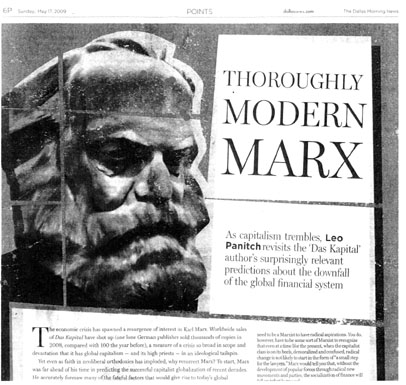
When I was in high school, my girlfriend’s BFF was the daughter of a college professor. We double-dated, and that’s how I came to be sitting in the prof’s living room. Young and eager for intellectual discussion, I asked her about Karl Marx. She went crazy angry on me and snapped, “He was a Russian dictator and that’s all you need to know!”

Even I, a hick from a hick town, knew Karl Marx wasn’t Russian. So I learned two things:

  1. College professors may not always be so smart
  2. There’s something really scary about the name “Karl Marx.”

I didn’t ask anybody again until the middle of the Vietnam War, when I and millions of others were trying to figure out how to understand and improve our society. Even then, I was too anti-Marx indoctrinated to try any serious study. Eventually, I gave in to the overwhelming curiosity generated by the nagging question, “If there’s nothing to be learned, why are they trying so hard to keep me from learning it?”

So I plowed through a number of books and pamphlets by Karl Marx, Frederick Engels, and V.I. Lenin. Some of it was really hard to read. I had to get a friend to teach a “course” on Capital Volume One in my living room, just to get through the book. As these things were written mostly in the 19th century, the language was different. A lot of Lenin’s writings were polemics, arguments, against obscure people I never heard of with Russian names I couldn’t pronounce or remember. But the biggest obstacle of all was the anti-communism buried deep in my bones during my childhood in the McCarthy witch hunt days.

I didn’t like a lot of the people who posed as “Marxist scholars.” They were an awful lot like Biblical scholars; and I can’t understand or relate to either one very well.

Other people told me that they knew all about Marxism, but that it was irrelevant today because it was written before computers, before global warming, and before nuclear weapons.

I think that those who dismiss or attack Marxism are generally wrong. There’s a lot of relevant stuff to be learned there, even though it’s pretty hard to dig out through reading the old books. Fortunately, today, there’s a shorter and easier way on-line. See what you think!  –genelantz