Archive

Tag Archives: working class

Working Americans have always fought the bosses. We’ve won a few battles and lost many, but we always fought on.

redflag

The closest we ever came to a “cease fire” in America’s class war came between 1947 and 1972, “The American Century.” During those few years, the United States had so much economic domination over the rest of the post-war world that they were able to buy off militant workers and collaborationist leaders. Unionists regularly received 3% annual raises and steady improvements in their benefits packages, including retirement. Non-union people got their improvements, but only as a result of the unions.

Then Came International Competition

After 1972, when President Nixon was obliged to change the worldwide monetary agreement set up after the great war, the bosses returned to business as usual. Their usual business is screwing their workers whether they are organized into unions or not. From those days forward, bosses in every capitalist country have been getting government handouts for themselves and austerity for everybody else.

They would like to continue that, but, as I said, we’ve always fought them. We’ve never won a decisive victory and, for the most part, never even thought about a decisive victory. Our battles have been over immediate objectives such as a pay raise for a limited number of workers or voting rights.

Our Victories Have Been Temporary

Even when we win, our victories are temporary because the bosses are still in power and, sooner or later, will try to reverse our successes. Thus, for example, we won the Voting Rights Act and then lived to see it gutted by the Supreme Court. We fought to see our American standard of living rise to the highest in the world, then saw it fall ignominiously.

The trends on our side of the class war are getting hopeful. Just on the wages front, for example, we aren’t just fighting a few scattered battles over peanuts here and there, we are engaged today in a nationwide battle to raise the minimum wage to a respectable figure. The Fight for Fifteen can involve everybody, and actually does involve quite a few of us.

Things Are Looking Up

On the political side, millions were drawn into action by the Bernie Sanders campaign, and I do not believe it is over. Instead, we are on our way toward a working people’s political party that would give us a real choice in elections. I don’t know if that is what Bernie Sanders intends, but I think the momentum of his followers is going that way. Union leadership is better integrated, more militant, and far more progressive than it has been since 1947.

Most exciting of all, I believe that Americans are better informed, more capable, more connected, and more sophisticated than ever in history before.

–Gene Lantz

Click here for more of these ideas

You are four times more likely to find a psychopath among executives than among the general population.

psycho-anthony

Look crazy to you?

In the financial services, it has been estimated that 10% are psychos. (click here for article)

I don’t doubt that a survey of ordinary workers would yield a much higher estimate.

How to Spot One

I got this from Wikipedia (click here):

“The organizational psychopath craves a god-like feeling of power and control over other people. They prefer to work at the very highest levels of their organizations, allowing them to control the greatest number of people. Psychopaths who are political leaders, managers, and CEOs fall into this category.

Interestingly, all the on-line articles I found said that corporations want to avoid hiring psychopaths. But do they really?

Why Are They In Top Spots?

I received this in a recent email, “For me, I said screw it when I found out the personality tests administered when you apply for promotions were used to find psychopathic or near psychopathic individuals for the higher up corporate positions.  To me, if you have to have concienceless mentally ill people run a system then something is inherently wrong with that system.”

My friend’s next email explained, “Concerning the tests, I had a PhD professor and friend learn this the hard way.  … He was approached by a big firm and asked to develop a set of personality tests to keep the ‘ruthless sociopath and psychopathic types’ out of higher management….  Well, he makes the test and they go off and use it for the opposite reasons!”

Bosses Don’t Have to be Nuts to be Bosses

Whether or not a particular boss is a psychopath doesn’t matter much in the grand scheme of things. He’s against you whether he’s sane or not. The Preamble to the constitution of the Industrial Workers of the World begins, “”The working class and the employing class have nothing in common.” Maybe it’s overstated, but you get the idea.

Even though we like to believe that we’re choosing our thoughts and prejudices, we don’t. Our ideas come basically from our actual situation. Employees think like employees and bosses think like bosses. You can see that easily any time somebody gets promoted into management. Their world view magically changes overnight!

While I was researching psychopaths, I came across a quote that reminded me that the bosses nearly always use religion and patriotism to confuse us. Here’s what George Bernard Shaw said, “Patriotism is a pernicious, psychopathic form of idiocy.” Maybe that’s overstated, too, but you get the idea.

–Gene Lantz

Click here for more of these ideas


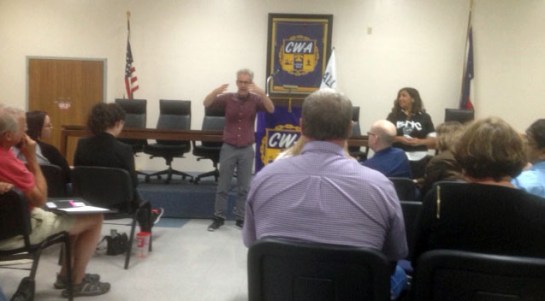
The exciting new organization “Brand New Congress” (BNC, click here)  just held its first meeting in my town. Its provocative electoral program may be the most innovative set of ideas in a century or more. In the 2018 primary elections, they plan to run more than 400 candidates without any regard to political party. The candidates will be people who have contributed to their communities, are good at it, and will uphold a radical progressive program similar to Bernie Sanders’ present campaign.

bnc-zac

Brand New Congress met at the Dallas CWA 6215 Hall, where Bernie has his offices

One of the most interesting twists in the projected scenario is their intention to totally disregard party affiliations. The main speaker said, ““Parties are so 19th century!” Polls are showing that a lot of Democrats and Republicans are not so crazy about their own parties. Youth has been showing its disdain for some time; I recently read that only 19% of Americans 19 to 29 years old voted in 2014!

How It Will Work

The Brand New Congress strategy would have their candidates running mostly as Independents, but, where it’s easier, as Democrats, Republicans, Greens, or anything else that’s useful! In other words, they would use political parties the same way they said Bernie Sanders used the Democratic Party — to get on the various state ballots and to obtain a wider hearing.

Turnout at our meeting was good, but not nearly as good as earlier Bernie meetings. Like the Bernie meetings, diversity was not its strongest characteristic. I’d estimate about 8% African Americans, maybe 10% Latinos, 2% Native American, and 40% women attended. Like the Bernie meetings, they were considerably younger on average than most political gatherings.

It’s worth noting that neither of the two presenters claimed that Bernie Sanders would publicly support this program.

Will It Work?

After having seen the electoral miracles accomplished by the 74 year old socialist from Vermont this year, who is prepared to say that Brand New Congress won’t be successful? Who could say that almost anything couldn’t be done by the younger people around the Bernie campaign? One of the BNC organizers maintained that Bernie had raised $240 million and moved tens of thousands of volunteers!

During the last decades, a growing number of citizens has developed a severe distaste for the status quo and a yearning for something different. Maybe these are the “people with a plan” who bring that change!

On the Other Hand

The idea of such a broadly innovative electoral campaign is breathtaking. But after I resumed regular breathing, my age and experience began to ask questions. In the immediate sense, I didn’t like all of the answers. Hope I’m wrong on every count:

  1. The strategy is purely electoral and limited to the U.S. Congress. Whenever somebody tells me that a single tactic is going to revolutionize America, I start wondering if they aren’t making a fetish of that tactic. Remember Occupy? A revolutionary program, it seems to me, would have to relate to all forms of struggle.
  1. Although one of the BNC presenters talked a lot about his views on the economy, little or no mention of the international situation was mentioned. People who think that their country is the only one that matters may be a little bit out of step with the economic situation today.
  1. Where are the working people in all this? I heard one mention of the term “working class,” but it was parenthetical and in passing. The idea that all Americans can be brought together under a single program seems idealistic to me. Only working people can confront the bosses and beat them, not a vague idea of “everybody.”
  1. Much worse, I didn’t hear any mention at all of the bosses and how they were going to relate to all this. Do people think that there’s only one side in this fight? There are two sides, and the other side isn’t just sitting around waiting to see what happens. They are really good at all forms of political fighting, especially elections. Also, they blacklist people. They arrest people. They kill people. You can’t expect success with a strategy that ignores them.
  1. How would we govern? No one would be happier than I to see somebody make gigantic fundamental change in American politics by 2018, but this electoral trick sounds more like a coup than a revolution. In a revolutionary process, people organize themselves by communities, by workplaces, and by their interests. They get better and better at meeting challenges and utilizing opportunities. Leadership develops at every level. Revolutionary struggle is a giant learning process whereby everybody learns more than how to take power, they also learn what to do with it.

Maybe my skepticism has no place as America yearns for improvement. Let’s not condemn, but encourage. Let’s do what we can!

–Gene Lantz

Click here for more of these ideas

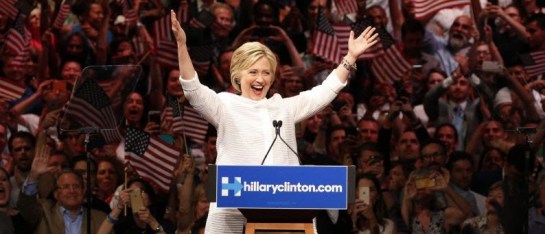
I just got a text from a friend asking for advice. He wants to know whether or not to spend more than he can afford to go to the Democratic Party national convention. He’s a big Bernie fan and Bernie says they should reform the Democratic Party. “Is that even possible?” I ask.

clintonhillary

Until the Bernie campaign made history this year, I had never even seriously considered any hope for the Democratic party. But Bernie has changed a lot of opinions this year, some of them dramatically. Even some of mine.

I am not going to question, in the immediate sense, that Bernie is right in his efforts. Every inch of democracy that we can squeeze out of this capitalist system is worth fighting for. If he can get the Democrats to change some of their rules in a positive direction, I’m all for it.

But, before we go all-out in trying to turn an existing political party into an instrument for fundamental change in America, we need to examine some of our words, including “political party” and “fundamental change.”

The working people will never make permanent improvements as long as the bosses are in power. That’s my guideline. “Fundamental change,” then, requires that the bosses not remain in power. Everything else may be worth fighting for, but it’s still temporary and will eventually have to be fought for again and again.

A “political party” is a committee that organizes, leads, and promotes the interests of a given class. Both the Republican and the Democratic Party promote the interests of the boss class. When they talk about reforming one or the other of them, they are only talking about various rules, not their basic commitment to continuing capitalism. Even Bernie might talk about “reining in” capitalism, but he doesn’t talk about overcoming it.

So, no. I don’t believe it’s worth major time and effort to try to reform the Democratic Party to achieve fundamental progress. What we actually need is a political party based on workers. We need a workers party like those in several other countries. Usually, they aren’t revolutionary organizations, but they are workers’ organizations. A workers party in the United States would be a great historical step forward.

It’s my opinion, expressed previously, that the Bernie Sanders movement could result in a workers party in America. I think we’re very close to it, but not if all our energies are turned into a hopeless effort to reform the Democratic Party.

I don’t want to leave the impression that I’m against the Democrats or even the Republicans. Workers have every interest in working with whoever will help us advance. We need to work with whatever situation we have. Anything less than that shows either a lack of commitment to the workers’ movement or ignorance of strategy and tactics.

–Gene Lantz

Click here if you’re interested in more such ideas


How do you decide whom to vote for? How do you decide anything? I’m reading postings that say “If Bernie isn’t the candidate, I will never vote for Hillary.” or “If my candidate doesn’t get the nomination, I’m not voting!” and things like that. How did they decide those things?

voteclass

How Do We Decide Anything?

Once, I was astounded when I was taking a class in business finance. The homework assignment was whether to buy factory machine A or machine B. It dumbfounded me. The astounding thing was when I found out how the decision was made in business. They figured cost, production, and expected life of each machine. Whichever one made the most money over a period of time was the right answer.

In other words, the decision was made based on the probable outcomes of the choices. If you support this person and he/she wins, what do you think will happen? If you support that person and he/she wins, what do you think will happen? If you support some other person and he/she doesn’t win, what do you think will happen?

It’s Not Whom You Love

It’s not a question of whom you love or whom you hate, who gives you the creeps and who makes you feel all sunny. None of the candidates are perfect, but you still have to make a decision. Your decision will have likely consequences, outcomes. Some of those outcomes are better than the others. That’s rational decision making.

Progress Comes from United Working People

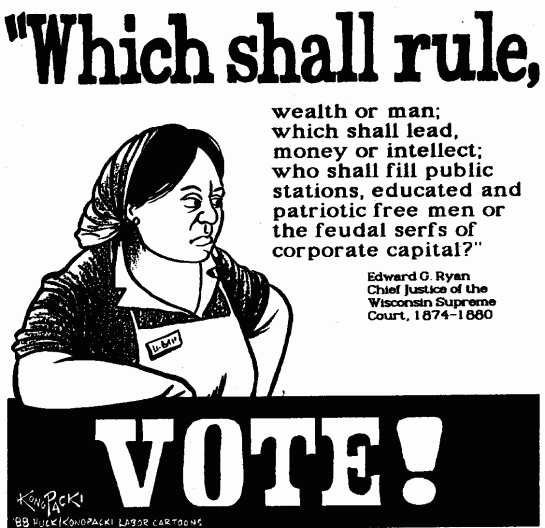
The best political advice I ever got was “think of the class.” How will the working class fare under this or that political leader. And don’t try to convince yourself that the working class has no interest in elections. We have an interest in every arena of struggle, a big interest — and it’s usually the opposite of the bosses’ interest.

End of Sermon

Put your emotions aside, make a rational decision about what to do, then do it. Afterward, you can re-evaluate and do the same thing or something else. Whatever you decide, rationally.

–Gene Lantz