Archive

Tag Archives: working class

Salon has very good news story covering developments 1982-present and the significance of today’s upsurge. Lone Star Project caught it for their daily news summary. I posted it on my FB page. It’s excellent.

https://www.salon.com/2023/09/21/uaws-high-stakes-gambit-this-strike-is-a-potential-paradigm-shift_partner/

My only problem with the article is that, like nearly all liberal analysis of today, it implies that labor’s problems began with Reagan in 1982. All of them, including the most erudite economists, start in 1982 with evil Republicans and recommend, as a solution, voting for liberal Democrats. They say that 1945-1982 was “normal” and that we could “get back” to that era by voting Democrat.

Nobody, except me and a handful of radical economists, especially Pikety, start with 1947, when America’s real troubles began. When the unions, some of them reluctantly, accepted the Taft Hartley law, solidarity ended.

Not only did the CIO separate from 14 of their best unions after Taft Hartley, the remaining unions raided them. What inevitably followed was decades of union isolation from one another and, even worse, from the public at large. The so-called “Treaty of Detroit” in the 1950s was a tragic error, not a wonderful accomplishment by Walter Reuther of the Autoworkers. When the UAW accepted employer-provided pensions and health care, they turned their backs on everybody else. We’re all paying for it now.

The great tragedy marked by Reagan’s firing and blacklisting of PATCO air traffic controllers was only made possible by the failure of the rest of the labor movement, and its public supporters, to respond. PATCO union leaders made several bad mistakes, including among them their having supported Reagan for election, but the historic lesson from the PATCO firing was that nobody helped them.

Once we understand that it was the lack of labor solidarity, not just Reagan, that was the root of our problems, we can see an actual solution — and it’s not just voting for liberal Democrats. It’s building up the movement for working families!

The current labor upsurge, especially the UAW strike, is attempting to rectify a catastrophe decades in the making. It will take all of us to win!

–Gene Lantz

I”m on knon.org “Workers Beat” radio talk show every Saturday at 9AM Central Time. They also post my “Workers Beat Extra” podcasts there and on Soundcloud. If you are curious about what I really think, check out my personal web site

There are at least three ways that the UAW could win against their 3 large corporate opponents without a massive strike:

  1. A rolling strike: The UAW could strike only in the plants where they are strongest, and the strikes could be limited to relatively short periods. The auto industry is interconnected and uses just-in-time inventory; consequently, one facility might shut down several others for lack of components.
  2. A slowdown: My own local, 848 in Grand Prairie, Texas, ran a successful campaign in 1984-5 and defeated a rich and powerful corporation by “running the plant backwards” for 15 months. During that time, only 65 of us were fired and required strike pay. The first 10 months or so were very difficult and not successful, but we learned how to carry out the fight and, eventually, went on strike for only 11 hours before we reached victory. All 65 of us marched back in the plant with back pay in our pockets! I wrote an account that is available on-line.
  3. A Hit-And-Run: Around 1960, my union local invented an entirely novel tactic. Instead of going on strike, they looked through the membership to see which departments were strongest for the union. Those departments alternated one day work stoppages. A lot of the members were entirely unaffected. Some of them did not even know that a battle was going on, but the stronger units were slowing down production.

Because of just-in-time inventory and assembly-line production, the UAW does not need an expensive full-fledged strike to win. Just a few workers can shut down an assembly line; just a small component shortage can shut down a factory.

I’m not a labor lawyer, so I do not know what tactics might run closer or further from the law. Also, I do not know if any of these suggested tactics might result in as much public support as a full fledged strike against all 3 big auto corporations would surely engender. I don’t know which tactics might result in more political support as the 2024 elections loom large. Ultimately, I believe that the key to victory is the support of the American people, and I believe that working families have that support, and will win more of it as time goes by.

I’m just pointing out that there’s more than one way to defeat a greedy corporation.

–Gene Lantz

I’m on knon.org’s “Workers Beat” talk show at 9AM Central Time every Saturday. My “Workers Beat Extra” podcasts are on knon.org and Soundcloud. Lately, my personal web site, http;//lilleskole.us, has picked up some malware, so be careful.

As long as I have been around the progressive movement, well over 50 years, we have expected to see some kind of American Worker’s Party break the two-party stranglehold over politics. Working families, then, would have a real alternative at the polls, we imagined. But it didn’t happen and isn’t closer to happening today. Maybe it’s time to give up on it!

Take a quick look at the history of 3rd parties. The last successful one was the Republican Party around 1859. What a thrill it must have been for the progressives of those days, most of them abolitionists, to have a new political party that offered real hope of ending the very worst of all ingrained American practices, slavery!

Then, let’s see, there were the Populists, mostly farmers, of the 1890s. They died when they endorsed the Democratic Party candidate for president. Gene Debs and the Socialists were able to get 1 million votes while their candidate was in prison, and it was sensational but not threatening to the system. President Theodore Roosevelt tried to get his career restarted with the Bull Moose Party before WWI, but didn’t get far. In 1947, former Vice President Henry Wallace tried to save the Franklin Roosevelt “New Deal” program. I recently read that he received a paltry 2.8% of the popular vote. Billionaire Ross Perot was effective enough in getting Republican voters to make sure that Democrat Bill Clinton won the presidency. The Greens have made some small inroads on Democrat voters, but were embarrassed when people learned that they were taking money from the Republicans.

In 2016 and 2020, lots and lots of American young people thought Bernie Sanders would either take over the Democratic Party from inside or create a powerful new progressive party, but Bernie has already endorsed Biden/Harris and I don’t know what those young revolutionaries may be thinking. Today, the Democrats are worrying that the “No Label” Party, financed by mysterious dark money, will take some of their votes and throw the 2024 election to Trump. But nobody is worried that we’ll end up with three viable parties nor that one of the two “main” parties will get replaced.

Side note: There is a party in existence called the “Working Families” party. They are interesting in states where they are allowed to endorse Democrats or Republicans, but not so much when they have to run on their own.

When I first heard of it, a Workers Party made sense. The unions still had over 20% of the workforce organized and were much stronger in politics than they are today. There were labor (or labour) parties here and there in other countries that were in and out of power from time to time. It just seemed like a natural intermediate step. But there are several reasons, today, to consider giving up the idea.

For one thing, we were just wrong about labor parties. We didn’t analyze the “winner-take-all” aspect of American politics. Other nations generally have parliamentary systems that allow proportional representation in governing bodies based on their percentage of the popular vote. They might win a few seats one year, add a few the next year, and eventually rise to power.

Not us. With America, nobody cares anything about proportions. It’s winner take all! If a party wins 49.9% of every vote in America, they still get nothing. The party with 50.1% gets everything.

For another thing, the organized unions that we were expecting to move up to the next stage of political power have diminished. We had about 35% of the workforce organized in the early 1950s, and we have about 10.1% now. Even if they wanted to launch a workers party, they might not have the strength.

The Bright Side

The positive way of looking at American electoral politics is to consider that progressives may not need any kind of political party to win power. Stages may not matter. With modern technology, especially mobile phones, smart people with a good program and a winning organizational model could organize almost anything in a matter of days. That’s what happened in the “Arab Spring” countries. They had no need for an interim political stage, but went straight from powerless to empowered!

Did the Labor Party Idea Just Wear Away?

Not so many years ago, I can remember top labor leaders saying that they, too, wanted a workers party. They said that building our political strength year by year within the two-party system would eventually give us the power to move off on our own. Now, I wonder if they were serious. I also wonder if the hope for a labor party is still alive among the top union leaders. I tried to find out this morning (June 16, 2023) when they were getting ready to vote, by a big margin, to endorse the Democratic ticket earlier than ever before in history. I was watching them on a webinar, so I asked innocently in the chat box, “Does this mean we’re giving up on the workers party idea?”

I didn’t get an answer. I was kicked out of the meeting and couldn’t get back in. It might have been an error. People make errors in webinars.

–Gene Lantz

I’m on KNON’s “Workers Beat” radio talk show every Saturday at 9 AM Central Time. They post my podcasts on Soundcloud.com, usually on Wednesdays. If you are curious about what I really think, check out my old personal web site.

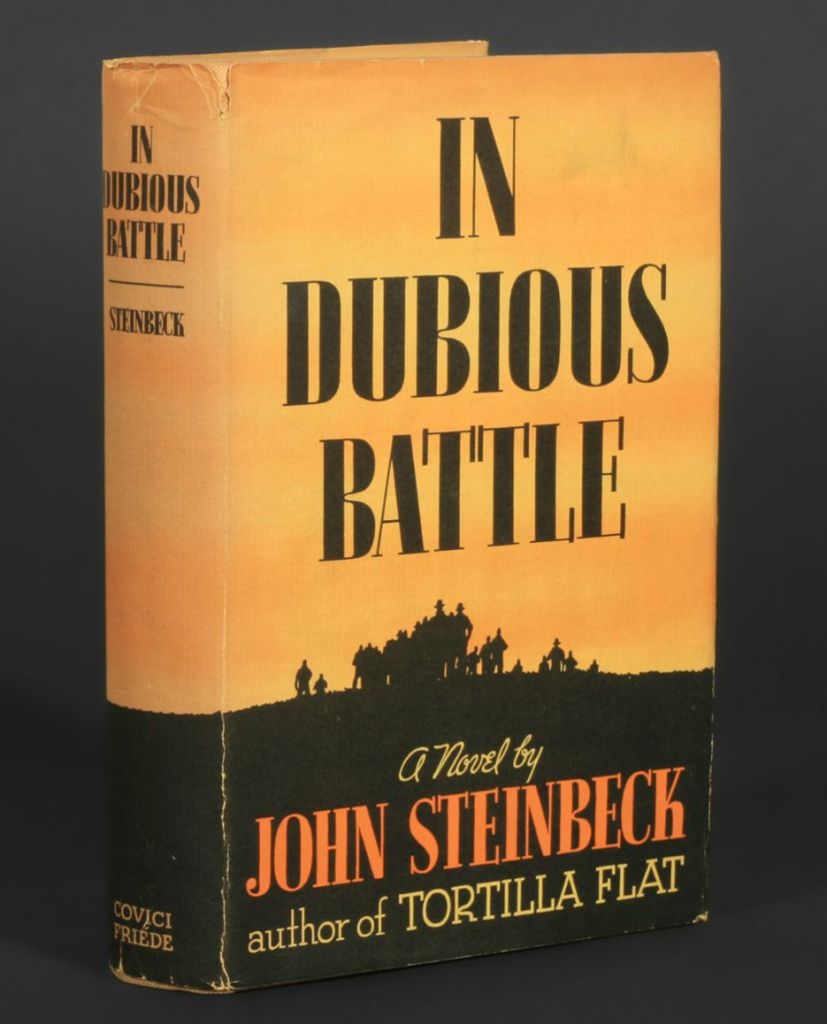
Film Review: “In Dubious Battle,” Directed by James Franco, 1917

Movie Review

“In Dubious Battle,” directed by James Franco, 1917

Prime video still has “In Dubious Battle” for a few more days. It’s an interesting and progressive film with a strong pro-worker attitude.

Jim and Mac are farm worker organizers of the Industrial Workers of the World in 1933. Even though the fighting Wobblies were largely crushed in most industries by the red scare during and after World War I, their Agricultural Department outlasted all their other fine efforts. Pulitzer winner John Steinbeck wrote the book around 1937 based on strikes and labor battles in California. It isn’t as well known as his “Of Mice and Men,” nor “Grapes of Wrath,” but it’s about the same people: itinerant farm workers of the Great Depression.

Mac is the old hand. He’s rather cynical as he teaches the neophyte Jim how to focus on agitating a battle to the exclusion of any other considerations. They take jobs as apple pickers in order to encourage the downtrodden workers to rise up and fight their exploiting bosses. In that regard, the film is quite inspirational and really sounds close to what really happened.

Actually, I kind of hope it isn’t what really happened, because the bosses and their hired terrorists seem to get and keep the upper hand. I watched the film with a genuine union organizer with real experience, and she had severe criticisms of the way the strike was begun and handled.

As art, though, the film is pretty good. I don’t know how the producers were able to do it, but they assembled quite an assortment of headliners in the main speaking parts. We spotted Selena Gomez, Vincent D’Onofrio, Robert Duvall, Sam Shepard, Ed Harris and Bryan Cranston. James Franco directed himself in the main role.

The result is a film that is fine for inspiration, but not for learning organizing tactics. If there were real people like Mac and Jim, they should have learned this: it is not sufficient to fight. It is also necessary to win!

–Gene Lantz

I’m on KNON.org’s “Workers Beat” radio talk show every Saturday at 9 Central Time. If you are curious about what I really think, check out my personal web site

Book Review:

Pearson, Chad E., “Capital’s Terrorists. Klansmen, Lawmen and Employers in the Long Nineteenth Century.” University of North Carolina Press, 2022

Pearson brings us a new understanding of America’s terrorists. From April 9, 1865 to January 6, 2022, our terrorists were not primarily motivated by race hatred or stupidity, as we are usually told. Instead, they were instruments organized, and often physically led, by America’s employer class. Big capital used the most shameful events in all of American history to one end: keeping working families down.

Pearson starts with the Ku Klux Klan. They weren’t just random racists. They were deliberately organized and carefully led to force former slaves to work for little or nothing. They still are. Later organizations may have been called “Law and Order Leagues,” or “Citizens’ Alliances,” but they continued to use vigilantes when it suited them. Their purpose was exactly the same: making sure that working families could not successfully organize.

Even though employers could usually county on judges, local police, national guards and even the U.S. Army to side with them, they also found it expedient to organize illegal terrorist activities. That’s what the book is about.

Pearson organizes his explanation with biographical information on the main ideologues for employer terrorism. One of the worst was a newspaper owner; another was a best-selling author of fiction. Both were expert propagandists justifying all legal and extralegal means available to keep workers down.

For us in Dallas, there are some local angles to the story. Martin Irons was a great union man who was ruined and martyred by the terrorists. He called the 1885 Southwest Railroad Strike during a convention in nearby Sherman. His grave is in Bruceville, halfway to Austin, where he died in poverty.

Except for some very good analysis of the January 6 attack on the nation’s capitol, the book limits itself to the 19th century. If it were brought a few years closer to today, it might have talked about Henry Ford’s “Service Department” of goons and criminals that maimed and murdered union supporters on behalf of the company.  

There are several accounts of Harry Bennett and Henry Ford’s “Service Department” of goons, criminals and murderers. https://www.salon.com/2014/06/01/henry_fords_reign_of_terror_greed_and_murder_in_depression_era_detroit/

Another account mentions a ex-wrestler named Fats Perry in the late 1930s. https://books.google.com/books?id=MJJOl7SMWIoC&pg=PA172&lpg=PA172&dq=Fats+Perry&source=bl&ots=7WajZJonOm&sig=ACfU3U3_OvtR3dgVWul8wuROQxLia1vfBQ&hl=en&sa=X&ved=2ahUKEwiK7bjN5Zz7AhV2lGoFHUs6CZQQ6AF6BAhTEAM#v=onepage&q=Fats%20Perry&f=false.

Perry and a handful of other gangsters were fired from Ford’s East Dallas assembly plant on suspicion of theft. They complained to the newly-formed National Labor Relations Board, where a young attorney named Nat Wells wrote down their testimony. They told Wells about kidnapping, tar and feathering, and whipping suspected union organizers on behalf of Ford. They indicated that they had plenty of help from local police and the Dallas Morning News. Wells wrote it all down and it became part of the United Auto Workers’ legal action against Ford Motor Company – and that played a big role in the UAW’s successful organizing drive in 1941, four years after their triumph at General Motors. Thanks to Joe Wells and Dr George Green for keeping this story in our histories.

Dr Chad Pearson teaches history at University of North Texas in Denton. I intend to interview him for my podcast as soon as I can get his contact information.

–Gene Lantz

I’m on KNON.ORG’s “Workers Beat” talk show at 9AM Central Time every Saturday. If you are curious about what I really think, you might look at my personal web site

Just to boil everything down to its essence, only two slogans are sufficient to mobilize the mass movement and change the world:

Tax the Rich!

Stop the Wars!

Here in the United States, we achieved a relatively high degree of democracy by 1965 when the Voting Rights Act was implemented. I say “relatively” to mean that our democracy was better than it had ever been. It took centuries of struggle to get that good. Since those days, democracy has been chiseled off some, but it’s still a lot better than it was than, say, when lynching was common and accepted.

The big deficiencies in our democracy have to do with 1) economics and 2) foreign policy. The ordinary person has very little say-so about either one, and never has. The bosses who run America reserve economic and foreign policy decisions for themselves. We don’t get a vote about fiscal or monetary policy, and we don’t get a vote about who to bomb next. If we did, we’d be qualitatively better off. “We,” meaning working families. “They,” meaning the bosses, would be worse off. In fact “they” would no longer be the ruling class.

The Russians had three slogans in 1917: “Bread, Land, and Peace.” Those were really good slogans for them in those days and they worked. But “bread” isn’t synonymous with “economic well being” nowadays. “Land” isn’t the dream of modern workers who left their farms generations ago. “Peace” is still a good slogan, but it doesn’t cover the proxy wars that imperialism is sponsoring all over the globe. Many Americans probably think that our nation is at “peace” now.

“Tax the rich” is the solution to economic inequality. Since the relatively “good” economic days of 1935-1947, inequality has steadily worsened. The bosses cut their own taxes, cut our social spending, and raised our taxes. Their money just keeps piling up. The current economic crisis in the United States, a looming recession, could be resolved quickly and easily with a change in fiscal policy, but instead the bosses are using monetary policy to squeeze the job market. In other words, working families are being sacrificed on the altar of capitalist greed. “Tax the rich” would end the threat of recession while ending the headlong rush to total inequality.

“Stop the wars” would give working families some power over the military-industrial complex. That’s power that we do not have today. The bosses like to be able to foment wars whenever they want, because that way they can keep other nations economically subservient to them. Case in point: while Russians and Ukrainians are dying by the thousands, American military producers and American oil companies are enjoying a bonanza. When it’s all over, American oil companies will have a lot of the markets that the Russians used to have, and the Russians and Ukrainians still living will have diddledy squat.

As important as these two slogans are to working families, they are just as important to the bosses who currently enjoy exclusive economic and military power. Making a change would be difficult, but clarity on our side would help.

–Gene Lantz

I’m on KNON.org’s “Workers Beat” program at 9AM Central Time every Saturday. If you are curious about what I really think, check out my personal web site.

Would you help me write a futuristic novel about what happens after the revolution? Help me speculate about what Commissioner Leo Torres does after his election to the World Council chartered to develop a model for future living and human happiness.

Unlike most American Sci-Fi, there is no dystopian end-of-the-world in this one. Thinking people have managed to stop all the current trends toward certain annihilation. A coalition of the Progressive Party and the Green Party has wrested control from the old economic rulers. All the people who are still alive after the devastation caused by our current system have a chance to meet their basic needs.

Leo Torres was a very minor figure in the Progressive Party during the revolutionary days. By a fluke of time and place, he achieved great popularity, or possibly notoriety. In his first novel, the Progressive Party leaders asked him to take on the title of “Commissioner” and resolve a very minor problem in an obscure part of Oklahoma. In the second novel, he gets a somewhat more complicated assignment, but still minor, in the Texas Panhandle.

Because of his undeserved but considerable popularity, and because he has shown himself to be trustworthy, the Progressives decide to make him a candidate for World Council in the third novel. He learns a few things as he travels the country in his successful campaign. All the preceding novels are on-line at http://lilleskole.us.

Should he take his seat on the World Council?

What priorities should he have?

What assignments or committees will he be assigned?

What laws and legislation would YOU want enacted, if you were in Leo’s place?

Help me out by sending your ideas to genelantz19@gmail.com.

Dark money from the U.S. is supporting truck riots in Canada. Can you see why?

Can you see why Republicans block legislation that would benefit their districts? Some Republicans even try to take credit for beneficial legislation that they voted and campaigned AGAINST! Why? Why did the Republican National Convention condone the January 6 insurrectionists? Why are Republican think tanks supplying scripts for crazies who disrupt school board meetings? Why are apparently sane Republicans who get vaccinated arguing that other people shouldn’t? Why take the side of disease over good health? Why underwrite chaos?

The reason that normal Americans can’t understand today’s political events is that nothing like this has ever happened in our country before. It is outside our experience. The only historical precedents are from other countries like, say, Brazil, Argentina, Indonesia, Spain, and Germany. In those countries, chaos was used to help bring down participatory government to benefit autocrats. Possibly the best example for us, because a number of us are old enough to remember it, and because we know more about it, is Chile in 1973.

If you think about it, you might see that, for certain politicians, chaos is a good thing. It worked for the CIA and General Augusto Pinochet in Chile in 1973. Truckers were involved then, too, as some of them are now. Google “Trucks AND Chile.” Read the New York Times article from August 18, 1973, “Chile Calls Truck Strike ‘Catastrophic.'”

It says that a 23-day trucker’s strike has had “catastrophic’ repercussions on Chile’s already ailing economy.

“This is a political strike aimed at overthrowing the Government, with the help of imperialism,” said Gonzalo Martner, Minister of National Planning and one of the chief policy makers for President Salvador Allende Gossens’s socialist government.

I’m not sure how reliable the Times’ account is, because they were probably in on it. But it is well known now that the chaos in Chile was designed and abetted by the CIA, United States of America! For would-be dictators, chaos has its uses, then and now!

–Gene Lantz

I’m on KNON’s “Workers Beat” talk show at 9AM Central Time every Saturday. My podcast, “Workers Beat Extra” is posted on Soundcloud.com every Wednesday. If you are curious about what I really think, check out my personal web site

Every New Years, I’ve tried to get people to make predictions. Hardly any of them will. The best I have received so far is a stock broker who called KNON. After I prodded him, he responded, “The rich will get richer.” That’s about the safest prediction I ever heard.

My 2022 Predictions:

  • Massive evictions will put millions into the ‘homeless’ category.
  • Vigilantes and illegal militias will flourish.
  • Political violence will become commonplace.
  • Police will tend to allow the anti-worker outrages to flame, while suppressing any activity of pro-worker forces. This was the precedent set in Germany in the 1920s and has generally held.
  • Poverty and hunger will grow, especially among children.
  • The formal educational system will continue to deteriorate as Republicans undermine them with schemes like “charter” schools and assaults on officials. More and more parents will begin to seek out internet solutions.
  • Big corporations will try to privatize the internet and everything else, including all utilities and municipal services.
  • Persistent inflation will force the federal reserve to cut back on “quantitative easing” and near-zero interest rates. Stocks and bonds will crumble but the “real economy” won’t be hit so hard.
  • Little if anything will get done about the environmental crisis. Freak weather disasters will increase and worsen.
  • As world economies teeter, governments will advocate new wars.
  • Omicron will hit early and hard. After it peaks early in the year, a solid majority of Americans will have some immunity from vaccination or from having already suffered through COVID. By late summer, it will no longer be the top of every news story
  • The democratic party will continue unraveling while the Republican Party will grow more homogeneous and harder.
  • Independent movements, particularly the women’s movement, will grow. We will see a revival of unemployed and homeless advocacy groups similar to those of the 1930s.
  • These independent movements will be larger, better informed, and better integrated than anything we have ever seen in history. This is because people are better informed and have infinitely better communications.
  • Unions will not initially lead these powerful independent movements. Unions will be drawn into the larger movement. They will play an important role in guiding and financing the movement.
  • The 2022 elections will show people voting increasingly for 3rd or 4th parties, Greens, Working Family, Democrats, and Independents.
  • One thing that the strong progressive organizations will agree on is this: vote for no Republican!
  • Americans will begin to experiment with the kind of political strikes that have been known in other countries.
  • And slowly, the way forward will begin to show itself.

-Gene Lantz

I’m on KNON’s “Workers Beat” talk show at 9AM Central Time every Saturday. The program and a supplemental “Workers Beat Extra” are podcast on Soundcloud.com every Wednesday. My January 5 podcast includes these predictions. If you are curious about what I really think, check out my personal web site