Archive

Tag Archives: workers

My friend Charlotte recently asked, “In an overpopulated world, why are Trump and other national leaders trying to raise birth rates?” I thought it was a profound question and one that deserves careful examination.

Birth rates in various countries get published every now and then. Like record high gold prices, though, they aren’t considered very fundamental to what’s going on. Or maybe, like gold prices, birth rate statistics reveal a lot more than the oligarchs want us to know.

Charlotte’s insightful question generates some other interesting questions:

  • “Why are reactionaries, especially religious reactionaries, opposed to birth control?”
  • “If reactionaries want more children, why don’t they want to take care of them?”
  • ”If they had higher birth rates, wouldn’t they get more unemployment, especially as automation eats our jobs away? Doesn’t rising automation, especially artificial intelligence, argue for our needing fewer workers?”
  • “Trump says he wants more population, so why is he against immigration?”

I got this from a web site:

“Right-wing governments and figures with nationalistic tendencies (including Trump) also want to increase birth rates to maintain a strong military and to counter ethnic, racial, and cultural diversification from immigration. These types of leaders often embrace the “Great Replacement” conspiracy theory which states that white people are being “replaced” with foreign non-white populations that have higher birth rates. As well as opposing immigration, these governments are hostile to reproductive health and rights, especially abortion care.

‘Probably the most influential pronatalist in the Trump administration is the richest man on Earth and father-of-14 Elon Musk, who bought his new position as Trump’s right-hand man with a $288 million campaign donation. Musk has been trying to sow panic over declining birth rates for years, claiming that the human population is on the verge of collapse due to people having small families, and that low birth rates present a “much bigger risk to civilization than global warming.”

Birth rates weren’t much of an issue before hard-fighting women were able to win some control over what happens to their own bodies. Check out the tough life of Margaret Sanger to see more about that long and terrible fight.

In the mid-1960s, it looked like women and progress had finally won in America and some other countries. More recently, the oligarchs have pushed women’s rights way backwards. Again, Charlotte might ask, “Why?”

The answer lies in the economic nature of world capitalism. Each nation is pitted against the others, and the chief way they compete is with cheap labor. Whoever drives down the cost of labor lowest, beats the other competitors. Nations that have more workers, naturally, get lower labor costs.

What we call a “nation” and what more scientific people call a “state” is actually a political subdivision run by its ruling class. For the major nations, that ruling class is the capitalist class, which might also be called the owning class, or the billionaire class, or, in our case, the oligarchs. They compete with each other economically until they’ve vacuumed up every bit of profit possible. Then they go to war against each other.

They need higher birth rates for their wars, too.

Salon has very good news story covering developments 1982-present and the significance of today’s upsurge. Lone Star Project caught it for their daily news summary. I posted it on my FB page. It’s excellent.

https://www.salon.com/2023/09/21/uaws-high-stakes-gambit-this-strike-is-a-potential-paradigm-shift_partner/

My only problem with the article is that, like nearly all liberal analysis of today, it implies that labor’s problems began with Reagan in 1982. All of them, including the most erudite economists, start in 1982 with evil Republicans and recommend, as a solution, voting for liberal Democrats. They say that 1945-1982 was “normal” and that we could “get back” to that era by voting Democrat.

Nobody, except me and a handful of radical economists, especially Pikety, start with 1947, when America’s real troubles began. When the unions, some of them reluctantly, accepted the Taft Hartley law, solidarity ended.

Not only did the CIO separate from 14 of their best unions after Taft Hartley, the remaining unions raided them. What inevitably followed was decades of union isolation from one another and, even worse, from the public at large. The so-called “Treaty of Detroit” in the 1950s was a tragic error, not a wonderful accomplishment by Walter Reuther of the Autoworkers. When the UAW accepted employer-provided pensions and health care, they turned their backs on everybody else. We’re all paying for it now.

The great tragedy marked by Reagan’s firing and blacklisting of PATCO air traffic controllers was only made possible by the failure of the rest of the labor movement, and its public supporters, to respond. PATCO union leaders made several bad mistakes, including among them their having supported Reagan for election, but the historic lesson from the PATCO firing was that nobody helped them.

Once we understand that it was the lack of labor solidarity, not just Reagan, that was the root of our problems, we can see an actual solution — and it’s not just voting for liberal Democrats. It’s building up the movement for working families!

The current labor upsurge, especially the UAW strike, is attempting to rectify a catastrophe decades in the making. It will take all of us to win!

–Gene Lantz

I”m on knon.org “Workers Beat” radio talk show every Saturday at 9AM Central Time. They also post my “Workers Beat Extra” podcasts there and on Soundcloud. If you are curious about what I really think, check out my personal web site

There are at least three ways that the UAW could win against their 3 large corporate opponents without a massive strike:

  1. A rolling strike: The UAW could strike only in the plants where they are strongest, and the strikes could be limited to relatively short periods. The auto industry is interconnected and uses just-in-time inventory; consequently, one facility might shut down several others for lack of components.
  2. A slowdown: My own local, 848 in Grand Prairie, Texas, ran a successful campaign in 1984-5 and defeated a rich and powerful corporation by “running the plant backwards” for 15 months. During that time, only 65 of us were fired and required strike pay. The first 10 months or so were very difficult and not successful, but we learned how to carry out the fight and, eventually, went on strike for only 11 hours before we reached victory. All 65 of us marched back in the plant with back pay in our pockets! I wrote an account that is available on-line.
  3. A Hit-And-Run: Around 1960, my union local invented an entirely novel tactic. Instead of going on strike, they looked through the membership to see which departments were strongest for the union. Those departments alternated one day work stoppages. A lot of the members were entirely unaffected. Some of them did not even know that a battle was going on, but the stronger units were slowing down production.

Because of just-in-time inventory and assembly-line production, the UAW does not need an expensive full-fledged strike to win. Just a few workers can shut down an assembly line; just a small component shortage can shut down a factory.

I’m not a labor lawyer, so I do not know what tactics might run closer or further from the law. Also, I do not know if any of these suggested tactics might result in as much public support as a full fledged strike against all 3 big auto corporations would surely engender. I don’t know which tactics might result in more political support as the 2024 elections loom large. Ultimately, I believe that the key to victory is the support of the American people, and I believe that working families have that support, and will win more of it as time goes by.

I’m just pointing out that there’s more than one way to defeat a greedy corporation.

–Gene Lantz

I’m on knon.org’s “Workers Beat” talk show at 9AM Central Time every Saturday. My “Workers Beat Extra” podcasts are on knon.org and Soundcloud. Lately, my personal web site, http;//lilleskole.us, has picked up some malware, so be careful.

Book Review:

Hochschild, Adam, “American Midnight. The Great War, a Violent Peace, and America’s Great Crisis.” Mariner Books, 2022

I found a free Kindle copy through the Dallas public library’s “Libby” service. Now I wish I had a hard copy because of the facts in this history of America from 1917 to around 1924. You could call it the Red Scare. You could call it the most shameful period after the Civil War. Or you could call it a warning about today and tomorrow.

This book changed my view of the period. Previously, I thought that government had simply allowed vigilantes to run amok — arresting, assaulting, and lynching just about anybody they chose. That was bad enough. Having reach Hochschild, I now realize that government was not just standing aside, they were actually fomenting, cooperating, and leading the nastiest gangs of racists they could find. Nearly all the spying was done by government hires. The worst of the mass acts of repression came directly from government agencies.

One might think that the Justice Department would have stood for justice, but they were probably the worst perpetrators. A lot of the worst assaults were called the Palmer raids, after Attorney General Palmer. After them came, probably, the armed forces; but many government offices were in on it, including the post office! J. Edgar Hoover, notorious race baiter, union hater, and all around sociopath, made his chops in the period. We were stuck with him for another 50 years!

Near the end of the book, Hochschild tries to tote up the numbers of people killed, horsewhipped, imprisoned, deported or otherwise deprived of life and liberty, but it’s a hopeless task. Besides, he’s basically talking only of federal cases. All the nasty things that happened at state and local levels would probably have doubled or tripled the size of the book. Then there’s the non-government participation of anti-union bosses and ideologically-driven racists and nativists to consider!

The rationale for the horrors began when Woodrow “He Kept Us Out of War” Wilson was re-elected in 1916. A lot of Americans, including the growing Socialist Party and some of the members of the Industrial Workers of the World, strongly opposed the war. The repression was originally released against anybody who did not want to join the bloodfest. But why, anyone might ask, did it continue after the end of the war and well into the 1920s? The excuse used most was Bolshevism, but the targets were American working people.

There are a couple of things I would have liked to have found in this account. The Greencorn Rebellion in Southeastern Oklahoma was an early expression of anti-war feelings among sharecroppers, including whites, Blacks, and Natives. I would also have appreciated an attempt to go beyond tallying assaults, deportations, imprisonments, and murders just to find out how many workers lost their jobs during this awful period. Of all the terrible things that government and employers do to workers, the most widely applied, and thus the most effective, is to deprive us of the ability to earn a living.

Hochschild clearly condemns certain government officials. He leaves the final judgement of President Wilson open to debate. He gives some credit to “good guys” such as Emma Goldman, Kate Richards O’Hare and of course Eugene Victor Debs. He mentions Frank Little, one of the first anti-war spokespersons lynched. William Z. Foster, who worked through the whole period to try to bring the labor movement together and develop its fighting potential, remains hidden in our histories.

I have always found it interesting to speculate what might have happened in America if different leaders had headed the Socialist Party, the IWW, or the AFofL. Worldwide, the many socialists capitulated early and supported their governments in World War I. There were only two that didn’t. The other one was Russia.

–Gene Lantz

I’m on KNON.org’s “Workers Beat” radio talk show every Saturday at 9AM Central Time. I have about 150 podcasts under the name “Workers Beat Extra” there, too. If you are curious about what I really think, check out my personal web site

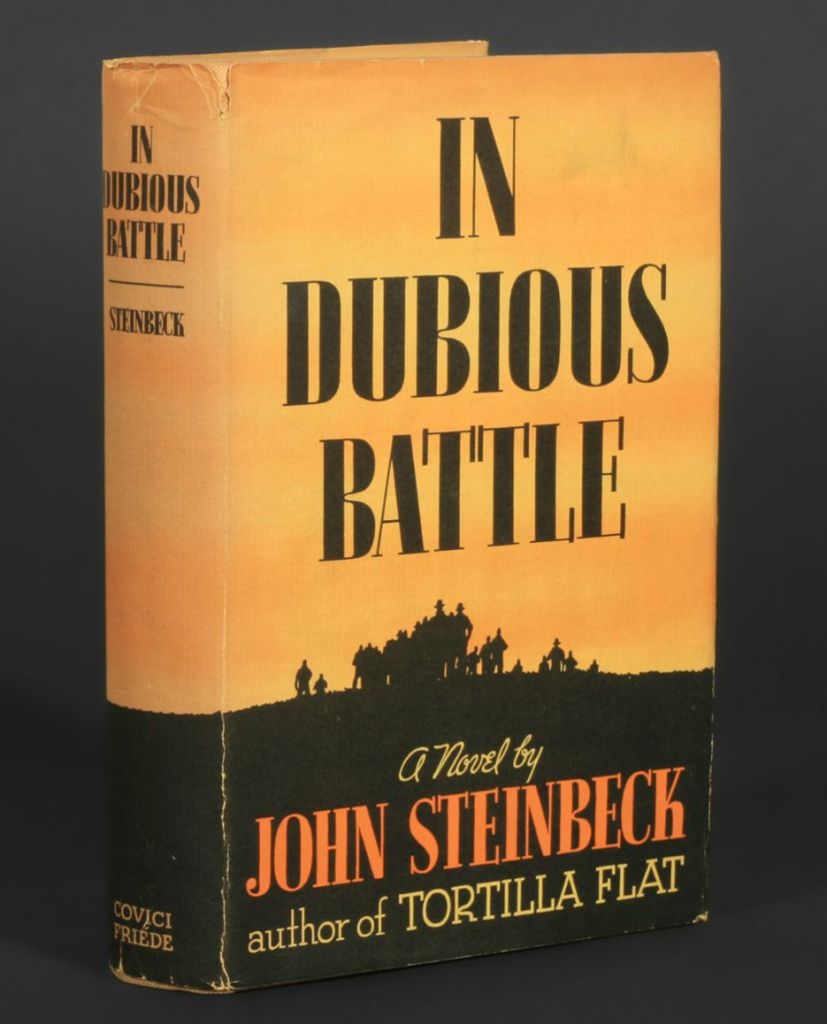
Film Review: “In Dubious Battle,” Directed by James Franco, 1917

Movie Review

“In Dubious Battle,” directed by James Franco, 1917

Prime video still has “In Dubious Battle” for a few more days. It’s an interesting and progressive film with a strong pro-worker attitude.

Jim and Mac are farm worker organizers of the Industrial Workers of the World in 1933. Even though the fighting Wobblies were largely crushed in most industries by the red scare during and after World War I, their Agricultural Department outlasted all their other fine efforts. Pulitzer winner John Steinbeck wrote the book around 1937 based on strikes and labor battles in California. It isn’t as well known as his “Of Mice and Men,” nor “Grapes of Wrath,” but it’s about the same people: itinerant farm workers of the Great Depression.

Mac is the old hand. He’s rather cynical as he teaches the neophyte Jim how to focus on agitating a battle to the exclusion of any other considerations. They take jobs as apple pickers in order to encourage the downtrodden workers to rise up and fight their exploiting bosses. In that regard, the film is quite inspirational and really sounds close to what really happened.

Actually, I kind of hope it isn’t what really happened, because the bosses and their hired terrorists seem to get and keep the upper hand. I watched the film with a genuine union organizer with real experience, and she had severe criticisms of the way the strike was begun and handled.

As art, though, the film is pretty good. I don’t know how the producers were able to do it, but they assembled quite an assortment of headliners in the main speaking parts. We spotted Selena Gomez, Vincent D’Onofrio, Robert Duvall, Sam Shepard, Ed Harris and Bryan Cranston. James Franco directed himself in the main role.

The result is a film that is fine for inspiration, but not for learning organizing tactics. If there were real people like Mac and Jim, they should have learned this: it is not sufficient to fight. It is also necessary to win!

–Gene Lantz

I’m on KNON.org’s “Workers Beat” radio talk show every Saturday at 9 Central Time. If you are curious about what I really think, check out my personal web site

Would you help me write a futuristic novel about what happens after the revolution? Help me speculate about what Commissioner Leo Torres does after his election to the World Council chartered to develop a model for future living and human happiness.

Unlike most American Sci-Fi, there is no dystopian end-of-the-world in this one. Thinking people have managed to stop all the current trends toward certain annihilation. A coalition of the Progressive Party and the Green Party has wrested control from the old economic rulers. All the people who are still alive after the devastation caused by our current system have a chance to meet their basic needs.

Leo Torres was a very minor figure in the Progressive Party during the revolutionary days. By a fluke of time and place, he achieved great popularity, or possibly notoriety. In his first novel, the Progressive Party leaders asked him to take on the title of “Commissioner” and resolve a very minor problem in an obscure part of Oklahoma. In the second novel, he gets a somewhat more complicated assignment, but still minor, in the Texas Panhandle.

Because of his undeserved but considerable popularity, and because he has shown himself to be trustworthy, the Progressives decide to make him a candidate for World Council in the third novel. He learns a few things as he travels the country in his successful campaign. All the preceding novels are on-line at http://lilleskole.us.

Should he take his seat on the World Council?

What priorities should he have?

What assignments or committees will he be assigned?

What laws and legislation would YOU want enacted, if you were in Leo’s place?

Help me out by sending your ideas to genelantz19@gmail.com.

Dark money from the U.S. is supporting truck riots in Canada. Can you see why?

Can you see why Republicans block legislation that would benefit their districts? Some Republicans even try to take credit for beneficial legislation that they voted and campaigned AGAINST! Why? Why did the Republican National Convention condone the January 6 insurrectionists? Why are Republican think tanks supplying scripts for crazies who disrupt school board meetings? Why are apparently sane Republicans who get vaccinated arguing that other people shouldn’t? Why take the side of disease over good health? Why underwrite chaos?

The reason that normal Americans can’t understand today’s political events is that nothing like this has ever happened in our country before. It is outside our experience. The only historical precedents are from other countries like, say, Brazil, Argentina, Indonesia, Spain, and Germany. In those countries, chaos was used to help bring down participatory government to benefit autocrats. Possibly the best example for us, because a number of us are old enough to remember it, and because we know more about it, is Chile in 1973.

If you think about it, you might see that, for certain politicians, chaos is a good thing. It worked for the CIA and General Augusto Pinochet in Chile in 1973. Truckers were involved then, too, as some of them are now. Google “Trucks AND Chile.” Read the New York Times article from August 18, 1973, “Chile Calls Truck Strike ‘Catastrophic.'”

It says that a 23-day trucker’s strike has had “catastrophic’ repercussions on Chile’s already ailing economy.

“This is a political strike aimed at overthrowing the Government, with the help of imperialism,” said Gonzalo Martner, Minister of National Planning and one of the chief policy makers for President Salvador Allende Gossens’s socialist government.

I’m not sure how reliable the Times’ account is, because they were probably in on it. But it is well known now that the chaos in Chile was designed and abetted by the CIA, United States of America! For would-be dictators, chaos has its uses, then and now!

–Gene Lantz

I’m on KNON’s “Workers Beat” talk show at 9AM Central Time every Saturday. My podcast, “Workers Beat Extra” is posted on Soundcloud.com every Wednesday. If you are curious about what I really think, check out my personal web site

Movie Review: “Peterloo,” Written and Directed by Mike Leigh, 2 hours 23 minutes


How strikes were ended

The new British historical epic was released in Dallas on April 19. I imagine they would like to hope it would run until August 16, the 200th anniversary of the slaughter of hopeful worker activists around Manchester. The run time will almost certainly be disappointing, because movies with a solid political message seldom last longer than one week in our town.

My movie buddy and I went to see it because we knew that the writer/director was capable of saying very good things about working families. Nearly all movies are about the affluent or the artistic. We were certainly not disappointed with “Peterloo!”

Another great thing about Leigh is his ability to develop women characters. Even though history only names the men who organized the effort and the men who did the murdering, women must have been very important in the struggle for British reforms. They show up well in “Peterloo.”

Moviegoers who have no interest in improving the condition of humanity are probably going to think that this film is a tad too long, covers too many characters, and includes too many speeches. Those of us who want to learn from history in order to make a better future, a large group that almost certainly includes Mike Leigh, think it was too short.

In 1819, a reform movement was sweeping through the miserable lives of British manufacturing workers. The heroes in this story are the weavers, men and women, in Manchester. The setting alone is fascinating, because Frederich Engels, lifelong collaborator of Karl Marx, wrote his important literary work, “The Condition of the Working Class in England,” about these very Manchester families.

Leigh did not stint on spending for this film. Every frame rings with authenticity. The one or two short scenes of the great mechanical looms in the textile mill must have cost a small fortune. Every set, every costume, every sallow-complexioned worker, convinces us that we are actually watching what happened in that great historical worker upheaval.

Know your constituency

As a lesson in strategies, Peterloo is superb! Leigh establishes exactly what the workers must have been thinking in 1819, and he goes over every painful question they had to answer as they prepared to go on strike and carry out a massive demonstration involving over 60,000 people.

Every moviegoer already knows how successful they are going to be, as history doesn’t say “Peterloo” without saying “massacre.” Discerning activists will be watching to see what might have been done differently so that the workers might have found success. We also watch to see how we can refine our efforts today.

As the lower tactical level, it would be hard to fault the weavers. They did a wonderful job of convincing tens of thousands of exploited people to come together.

Know your enemies

But at the higher strategic level, they made a tragic mistake that all of us must learn and apply to today’s thinking: they were so caught up in their efforts to organize and unify themselves that they did not give proper consideration to their enemy. Class struggle isn’t one sided. There is another class on the other side, fighting against us, and they cannot be ignored. Most important, they cannot be underestimated.

-Gene Lantz

I’m on KNON’s “Workers Beat” program at 9AM Central Time every Saturday. If you are curious as to what I really think, check out my personal web site

tpp-TARA

Unions are doing so many things right nowadays that one hesitates to make any suggestions. I enjoyed a recent posting by the International President of the AFSCME (American Federation of State, County, and Municipal) union. He outlines some of the positive changes they have made.

I’d go so far as to say that the main labor federation, AFL-CIO, has made great strides since the “palace coup” changed the leadership in 1995. I love working with them.

Unions are inherently revolutionary, even though they do everything in their power to not be. They can’t help but oppose capitalism, even though they are solely defensive organizations, because capitalists can’t stop attacking them. Unions will never take power anywhere, but they can’t help trying.

But Unions Face Tremendous Problems

In my opinion, America’s unions could go a long way toward solving their problems if they’d just start with an historical analysis. As long as they continue to ignore the great mistakes they made between 1947 and 1995, they’ll find it harder to go forward. That’s one important thing.

Another one is that unions need to free themselves from being chained to the worst part of their members. Any union official can tell you that they spend most of their time handling petty grievances. The best union members rarely file a grievance, because they are not only the best union members but also the best workers. The worst workers, the ones who can’t show up half the time, the ones who are drunk on the job, the ones who abuse one another — those are the ones that file most of the grievances and , consequently, take up most of the union officers’ time.

In fact the biggest time consumer of all is the termination grievance. Somebody gets fired and the union feels obligated to try to get their job back. Management is not likely to take them back before all options are exhausted — and there are a lot of options in labor/management relations. The best union members, the best workers, rarely get fired.

That’s just the way the job works and nobody is actually complaining. If you don’t take care of the worst workers, you can’t take care of all the workers. If management can get away with abusing some workers, they’ll try to abuse all. So it’s not a waste of time, just a big consumer of time, to deal with grievances.

Union officers would like to spend time organizing, educating, and strengthening the union movement — but they usually don’t because they don’t have time.

There Are Tremendous Solutions

I believe that progressive union leaders are finding and applying solutions to these problems. I heard once that the Service Employees have some kind of centralized national grievance-handling process where grievances are called in by phone. I have no idea if this is true, nor do I know how it works.

But I imagine a big round table with grievance experts sitting at computers all around. Each of them has a headset. Each computer has access to labor law and, more importantly, every pertinent union contract. Members from all over the country call in their grievances. The expert types up a proper report and offers immediate advice. Then they contact management and begin to “handle” the grievance. They use three-way calling when appropriate.

When contracts expire, a complete digital record of the old contract and all grievance settlements is available to the negotiators. One of the experts from the round table I described might even sit in on negotiations to make sure everything is done properly and legally.

 What Is Needed?

Unions need cooperation. The utopian grievance handling proposal I outlined above could be used by the AFL-CIO to handle ALL grievances, not just those of a single union. Or maybe we could have one “grievance center” for public workerfs and one for private workrers. Maybe another one for private workers under the Railway Labor Law, as opposed to the National Labor Relations Law.

Unions are cooperating now more than anytime since 1947. They are not only cooperating with one another, they are even merging with one another. That’s good, but it could go a whole lot further. They could, for example, centralize their organizing departments, their education departments, and maybe some other departments.

Unions need organizers. The best organizers nowadays work with entire communities. The union man standing in front of a plant handing out leaflets, they say, has already lost. People get organized from their homes and communities. I’d go further to say that the best union members are going to be organized through a series of meaningful activities like the “Fight for Fifteen” effort to raise the minimum wage.

The internet, and, especially, social media need to be harnessed in labor’s campaign. We can organize that way and we can educate that way. Unions need educators.

Unions need activists. Every time a union man or woman assists in a community problem, they advertise the importance of joining the union.

None of these ideas is exactly new, except insofar as new technology is applied. My own union, the Autoworkers, wasn’t organized in the plants. It was organized during the frequent periods of plant shut downs in the auto industry. It was organized by the great Unemployed Councils, by marches, rallies, and protests.

And that seems like a good place to stop because it brings me back to my original point: unions need to assess our own history and learn from it!

Leave a Reply