Archive

Tag Archives: unions

I wrote this to Communications Department of Texas AFL-CIO:

Hi Katie and tech-savvy Texans,

As Ed Sills retires, it seems to me that email blasts are on the wane. Someone needs to come up with a new standard for labor communication and start trying to get all labor activists to use it. 

We need to complete the move from our computers to our phones. A standard for labor communications would bring together the energies  presently being thrown this way and that and make a coherent and more effective system.

I think Angi DeFelippo of Tarrant County might have done more work on this. I believe she uses WhatsApp, the most popular texting service. 

It is significant that Action Network now offers free mass texting. The labor radio podcast network now has about 200 podcasters. Heaven knows how many labor bloggers there are.

What I want

For my part, I’m technologically challenged so I may not know very well what the options are, but I know what I want. I want free and open access for everyone with info or an opinion; but at the same time I want one-way, top-down, info from elected leaders. Ideally, the elected leaders would have a person or a method of monitoring the many comments (I call them blabbermouths) and discerning what really needs to go out to all activists. Serious activists don’t have time to chat all day, but some information is vital.

I understand that Telegram offers both channels with full access to chat and one-way top down channels that people can subscribe to. I think they call it “broadcast.”

I also understand that Facebook Messenger has some good features. People can chat away all day on it, but the elected leaders can “broadcast” from official FB pages or Instagram. 

I don’t think encryption matters. In fact, I’m not sure it’s even a good idea, since we want to reach the public as much as possible.

Travis tells me that his union has already developed a special app for their members. A special “Texas labor” app might be the answer we need, but I imagine that some of the free services might be as good. They might be even better because, again, we want to reach the public.

Nearly all proposals, including this one of mine, are free.

If you agree with me that we need to set a standard for labor activist communication, why not convene a meeting of labor communicators with some proposals and try to reach a decision?

In solidarity

Gene in Dallas

I’m on KNON.org and 89.3FM every Saturday at 9AM Central Time. If you are curious about what I really think, visit my personal web site

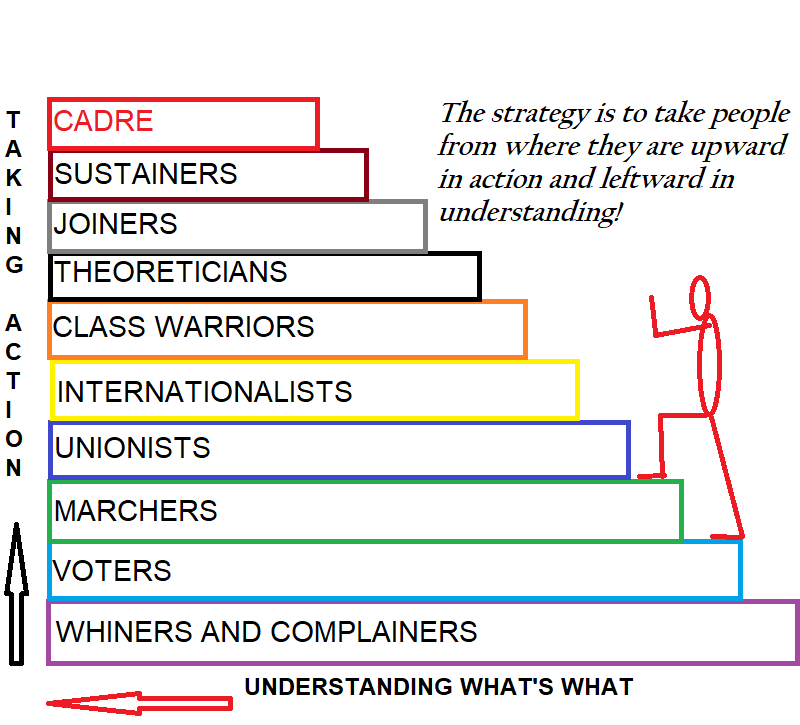
The model that guides all my activities is a picture of a person climbing a staircase from right to left. I try to help that person, or all persons I may be able to influence, make steps upward in their level of activity and leftward in their level of understanding.

At the bottom step are the millions, at least 30% of the adult U.S. population, who don’t seem to do anything nor hold any important opinions. At the top are well-informed and very active people. Just for convenience, I call the ones at the bottom step “Whiners and complainers,” while the ones at the top step are “Cadre.” I also have convenience names for 8 other steps.

The names I attach to the steps may not be important nor meaningful to everyone, but they mean something to me. I don’t think that everyone needs to make each step separately. On real staircases, some people can hop up 3-4 steps at a time. They can also fall backward, but that is rare.

According to Pew Research Center, 30% of eligible voters in America do not vote, even in the highest and most generous estimates. Their idea of “eligible voters” might be the same as “registered voters,” because other estimates say that only 69.1% of eligible adults in America were even registered to vote in 2022. If one had a higher standard — asking if people voted at every opportunity, for example — the proportion of “whiners and complainers” would be far higher and would include the vast majority of the nation.

The terrific news from the Pew researchers is that voting rates are rising to record high levels. In other words, the number of people stuck at the “whiners and complainers” level, is diminishing.

The next step in activity and understanding consists of voters. Voting requires the least thinking and the least energy of all political activity. In the 2020 presidential race, about 65% of registered voters rose to that step. As I work my model, I try to get people to register and to vote. If I succeed, then they have moved upward and to the left one step.

Just getting people to make that first step is challenging, and it’s about as far as most individuals and organizations go. But I have higher aspirations. I want people to make progressive changes in America, so I ask them to take their next step upward and to the left.

I call the third step, “marchers.” People in this category go beyond voting and participate in physical actions such as marching, picketing, sign-carrying, canvassing, rallying, phone banking, petitioning, or any other physical show of commitment. As far as I know, America has had very few mass demonstrations with more than a million people, so the estimate of people at the “marcher” step is a lot smaller than that of “voters.” But they are the ones making a difference. Even though they may not be exactly committed ideologically, a lot of union members find themselves taking such physical action during their contract negotiations.

People at the fourth step have achieved union consciousness. They may not be union members, but they have figured out that organized workers are a powerful force for good, and that they should be supported. It would be really hard if not impossible to tally up the number of people who have demonstrated their union consciousness, but I think all would agree that the number is rising. There are estimates that as high as 80% of Americans approve of unions. By contrast, hardly any politician or political entity can boast of 50%.

By the time a person rises toward the fourth step, they become aware of some strong gravitational forces pushing them backward. America’s rulers hate unions, and they control all the information sources. Consequently, people find themselves pushed mightily against union consciousness. It’s amazing that so many Americans have made this step!

Union consciousness is a mighty achievement. Not even all union members rise so high and leftward. But unions are defensive organizations and rarely act for the general good of people outside their membership. Until recently, very few unions even considered taking any foreign policy position that was not in line with the government. In 2024, the Autoworkers (UAW), then other unions, and finally the AFL-CIO labor federation began to demand a cease fire in the Middle East. By contrast, nearly all unions, and especially the AFL-CIO, supported the American invasion of Vietnam in the 1960s. Most union members, like most Americans, tend to go along with whatever the bosses tell them through their control of all information sources.

A higher step, the fifth in my model, is “internationalists.” These people have already recognized the great importance of organized working families in America and have gone further. They recognize the common interests of working families all over the world. They will face up to mighty force from the bosses, but they will actively work for justice for all nations.

The sixth step is “class warriors.” At this stage of understanding and activity, people support working families as the only category of people capable of standing up to the bosses. They recognize the reactionary nature of the bosses and their system, and they know that our profit-based employer dominating system needs to be changed. They may have, and probably did, start on this staircase with something else in mind.

In my own case, I took my first steps upward and to the left because of school reform. Back in the 1960s, I was an advocate for children and took action to end corporal punishment in the schools. To this day, I still have strong feelings about educational reform and would like to spend my time and energy on that topic — but I realized along the way that school reform is not all that’s needed. I know people who began with gay pride, election reform, civil liberties, and, especially, civil rights before they rose on the staircase to see what is really wrong and what really must be done.

I made “theoreticians” my 7th step. Probably, everybody is a theoretician in one way or another. I just wanted to show that there are good class warriors who aren’t applying all of their best thinking to every task. Those who are doing their best thinking (I might have called them “anguishers” because the term fits me so well) made it to the 7th level.

Joiners, the 8th step, are people who have recognized that the only way to make progressive change is by working together. They’re already doing great activities and thinking, but they have realized that it is going to take a concerted effort with other like-thinking activists to make progressive change.

I made a special step for “sustainers.” The term comes from fund raising and means people who donate regularly. But there are other ways to make sure that a progressive organization thrives. The problem is that some of us think “joining” is a passive verb. The sustainers at the 9th step are members who take responsibility for their organization.

Finally, at the tenth step and top, are “cadre.” It’s not a word that is well understood, but there is no better replacement. To some, it means, “dutiful followers,” and to others it means “outstanding leaders.” In truth it means both and everything in between. Cadre members are the absolute best leaders, and the absolute best followers, depending on what is needed. They are hard to find.

Not a lot of people find their way to the top of my staircase. I encourage them, but my effect is relatively insignificant. What propels them upward and leftward is the truth. Like a wind at our backs, the truth pushes us toward understanding and activity. All an individual needs is a little bit of courage and, sooner or later, all will rise.

–Gene Lantz

I’m on KNON.org and 89.3FM radio every Saturday from 9 to 10 Central Time. If you are curious about what I really think, check out my personal web site at https://www.lilleskole.us.

UAW Local 276 at General Motors in Arlington, Texas, went out on strike this morning. They are the most lucrative GM plant, and they join the strikers at the most lucrative Ford and Stellantis plants who were called out over the last 2 weeks.

Texas AFL-CIO President Rick Levy and Secretary-Treasurer Leonard Aguilar issued the following statement on the expansion of the United Auto Workers strike to the General Motors plant in Arlington:

  “UAW workers at the ‘Big 3’ made tremendous sacrifices to keep the American auto industry afloat when it was in financial trouble. Now, with Texas sized profits as far as the eye can see, it is past time for that sacrifice to be fully recognized.”

  “Strikes like this are hard. They involve risk. They involve sacrifice. But when UAW workers in Arlington, Carrollton and Roanoke walked off the job, they did so to benefit every worker in this country. They did so to make sure the jobs of the future can sustain our families and benefit our communities.”

  “When employers get greedy and refuse to come to a fair agreement, strikes are the way workers get a say in writing the rules of the workplace, how we share the wealth we help to create. Without our brains and muscles, not a single wheel can turn.”

  “That is why the 240,000 members of the Texas AFL-CIO stand in complete solidarity with striking UAW workers. As they stand up for themselves, their families, and their communities, we will always stand with them.” 

    “One day longer, one day stronger.” –texas aflcio

UAW 276 joins smaller Auto Workers locals, Mack Trucks, the actors in SAG-AFTRA, and dozens of smaller union locals on strike in the current upsurge. The outcomes of these strikes will affect wages, health care, pensions, and other job benefits for all Americans for now and in the future. In other words, they affect YOU!

The Question Is

What are you doing about it? How can you help make sure that our side wins? In this form of struggle, the strikers bear the brunt of the battle. They’re the ones in the foxholes, and it’s them and their families who will suffer the most. That doesn’t mean that there’s no role for the rest of us.

Here in North Texas, we have been and continue to be the center of strike activity in the Lone Star State. Dallas has a big SAG-AFTRA local. Two smaller UAW Locals nearby have been on strike since September 22. Many individuals and several organizations are pitching in, including: Dallas AFL-CIO, Tarrant AFL-CIO (Ft Worth), State AFL-CIO, Young Active Labor Leaders, Democratic Socialists of America, and Texas Alliance for Retired Americans. Other unions that have made major contributions include the Bakers and Confectioners (BCTGM) and Local 540 of the United Food and Commercial Workers. The main thing we do is join the picket lines to see how we can help.

Lately, we’ve been finding ways to make sure the strikers’ families can get groceries. Tarrant County AFL-CIO raises money on their web site tcclc.org/uawsupport. They intend to help individual strikers with significant financial problems. The Texas retirees’ group has begun contributing cold weather gear, especially red scarfs. The scarfs make good symbols of strike solidarity.

Probably the biggest contribution from strike supporters has been keeping the issues before the public. Approval of unions, and approval of strikers, is at an all-time high. The indications are that all Americans are drawing together against the ultra-rich corporations that offer us nothing but misery. When we keep talking about the strike issues, especially on social media platforms, we keep building public support.

When I Ask For Help

When I ask individuals or organizations to do something, they do it. I haven’t received a “no” answer yet!

On the Saturday just past, Dallas AFL-CIO held a cookout to honor strikers. Two Democratic State Representatives, Julie Johnson and Johnny Bryant, bought the food and beer. Lou Luckhardt, principal officer, did all the work. The Postal Employees sent a bouncy house and sno-cone machine for the kiddies. The Young Active Labor Leaders brought a karoke machine. We posted videos and a bunch of pictures on the social media platforms we have. We sent out thousands of e-mails and will send thousands more. We got lucky, for a change, with the corporate media. Fox4 and NBC5 both gave us extensive favorable coverage. i’m waiting to see if my letter-to-editor gets published.

Whenever one of the striking unions holds a public event, we do all we can to publicize it. We do all we can to attend every one. It doesn’t mean that we have stopped fighting on the political front. Texas is facing a major challenge to keeping public education and voting rights. We have an important election November 7, and unionists are already gearing up for 2024. To a newcomer, these activities may not sound related, but they are.

We’re standing up for working families, and we welcome you into the movement!

–Gene Lantz

I’m on KNON.org’s “Workers Beat” radio talk show every Saturday at 9AM Central time. They post my podcasts on KNON.org and Soundcloud.com on Wednesdays. If you are curious about what I really think, you could look at my old personal web site

“Here Come the White People!” should have been a warning throughout history. People who had land, or thought they had land, found themselves on tiny reservations while their former lands were taken over by relatively prosperous white people. If the former landowners fought back, they were labeled “terrorists” and killed.

I could be talking about Geronimo, or maybe Pontiac, or Crazy Horse or Sitting Bull. I might be talking about the former occupants of the land known as Palestine, but not necessarily.

I might also be talking about the many enslaved people who followed General Sherman’s army in the Civil War. Sherman actually gave them land and, with it, the possibility of accumulated wealth some day in the future. This is the beginning of the idea of “Forty Acres and a Mule” that we still refer to.

After the shooting was over, President Johnson and the federal government made all the former slaves give up their lands. Title was returned to the slavemasters.

A few Black Americans received land when the Dawes Commission forced the tribes of Oklahoma to divide their communal land. Some of the tribe members were former slaves, and they received allotments. I’m not sure how that went down with every tribe, but I have read that the Chickasaws hired “Alfalfa” Bill Murray as their attorney to get all the land away from Black tribe members. Murray went on to become Oklahoma’s first governor in 1907, and Black people went on being landless and poorer than dirt.

Today on radio, I heard President Biden pledging eternal allegiance to Israel. He painted the Palestinians in the ugliest of colors. When I read the newspaper, I saw that the world is afire with protests. Even on U.S. campuses, people, including young Jews, are speaking up against Zionism and the liklihood of genocide in the Gaza Strip. Last night, an on-line group called “U.S. Labor Against Racism and War” held a webinar with 256 union activists attending. They have another one in two days.

What’s the Real Issue?

I don’t think the issue is the sorry state of Native reservations, nor Little Big Horn, nor the exploded hospital in Gaza, nor the maurauding soldiers from Hamas. The issue is land. The issue is land and it has been gleefully ignored in nearly a century of land-grabbing and settler outposts extending from Tel-Aviv.

I also think that another big issue is arising. For some time, the United States’ domination of world finance has been unchallenged, but the BRICS consortium is beginning to erode it away. Biden’s speech this morning must have accelerated that process.

History tells us that everybody should look out for the white people. Wikipedia tells us that the white people share of the world population is 15% and falling.

–gene lantz

I’m on KNON.org’s “Workers Beat” talk show every Saturday at 9AM Central Time. My “Workers Beat Extra” podcasts are on KNON.org and Soundcloud. If you are curious about what I really think, you might check out my old personal web site.

Salon has very good news story covering developments 1982-present and the significance of today’s upsurge. Lone Star Project caught it for their daily news summary. I posted it on my FB page. It’s excellent.

https://www.salon.com/2023/09/21/uaws-high-stakes-gambit-this-strike-is-a-potential-paradigm-shift_partner/

My only problem with the article is that, like nearly all liberal analysis of today, it implies that labor’s problems began with Reagan in 1982. All of them, including the most erudite economists, start in 1982 with evil Republicans and recommend, as a solution, voting for liberal Democrats. They say that 1945-1982 was “normal” and that we could “get back” to that era by voting Democrat.

Nobody, except me and a handful of radical economists, especially Pikety, start with 1947, when America’s real troubles began. When the unions, some of them reluctantly, accepted the Taft Hartley law, solidarity ended.

Not only did the CIO separate from 14 of their best unions after Taft Hartley, the remaining unions raided them. What inevitably followed was decades of union isolation from one another and, even worse, from the public at large. The so-called “Treaty of Detroit” in the 1950s was a tragic error, not a wonderful accomplishment by Walter Reuther of the Autoworkers. When the UAW accepted employer-provided pensions and health care, they turned their backs on everybody else. We’re all paying for it now.

The great tragedy marked by Reagan’s firing and blacklisting of PATCO air traffic controllers was only made possible by the failure of the rest of the labor movement, and its public supporters, to respond. PATCO union leaders made several bad mistakes, including among them their having supported Reagan for election, but the historic lesson from the PATCO firing was that nobody helped them.

Once we understand that it was the lack of labor solidarity, not just Reagan, that was the root of our problems, we can see an actual solution — and it’s not just voting for liberal Democrats. It’s building up the movement for working families!

The current labor upsurge, especially the UAW strike, is attempting to rectify a catastrophe decades in the making. It will take all of us to win!

–Gene Lantz

I”m on knon.org “Workers Beat” radio talk show every Saturday at 9AM Central Time. They also post my “Workers Beat Extra” podcasts there and on Soundcloud. If you are curious about what I really think, check out my personal web site

There are at least three ways that the UAW could win against their 3 large corporate opponents without a massive strike:

  1. A rolling strike: The UAW could strike only in the plants where they are strongest, and the strikes could be limited to relatively short periods. The auto industry is interconnected and uses just-in-time inventory; consequently, one facility might shut down several others for lack of components.
  2. A slowdown: My own local, 848 in Grand Prairie, Texas, ran a successful campaign in 1984-5 and defeated a rich and powerful corporation by “running the plant backwards” for 15 months. During that time, only 65 of us were fired and required strike pay. The first 10 months or so were very difficult and not successful, but we learned how to carry out the fight and, eventually, went on strike for only 11 hours before we reached victory. All 65 of us marched back in the plant with back pay in our pockets! I wrote an account that is available on-line.
  3. A Hit-And-Run: Around 1960, my union local invented an entirely novel tactic. Instead of going on strike, they looked through the membership to see which departments were strongest for the union. Those departments alternated one day work stoppages. A lot of the members were entirely unaffected. Some of them did not even know that a battle was going on, but the stronger units were slowing down production.

Because of just-in-time inventory and assembly-line production, the UAW does not need an expensive full-fledged strike to win. Just a few workers can shut down an assembly line; just a small component shortage can shut down a factory.

I’m not a labor lawyer, so I do not know what tactics might run closer or further from the law. Also, I do not know if any of these suggested tactics might result in as much public support as a full fledged strike against all 3 big auto corporations would surely engender. I don’t know which tactics might result in more political support as the 2024 elections loom large. Ultimately, I believe that the key to victory is the support of the American people, and I believe that working families have that support, and will win more of it as time goes by.

I’m just pointing out that there’s more than one way to defeat a greedy corporation.

–Gene Lantz

I’m on knon.org’s “Workers Beat” talk show at 9AM Central Time every Saturday. My “Workers Beat Extra” podcasts are on knon.org and Soundcloud. Lately, my personal web site, http;//lilleskole.us, has picked up some malware, so be careful.

The answer is “yes,” but there are powerful caveats.

Why Do Unions Tend to Avoid Commercial Media?

American law protects a union’s right to communicate fully and openly with their members. Unions can even publish their candidate recommendations – but only to their members. Unions have to be much more careful when talking to  any audience that may include people who are not their members. Some unions don’t talk to them at all.

For unions, there are good reasons to avoid the commercial media. The laws are stacked against us, and the “news” sources virtually all belong to giant corporations who are, after all, our worst enemies. Try Googling “Who owns America’s news?”

And you will find that it’s 15 billionaires in 6 mega corporations. Every one of them would fight to the death to keep their own employees and those of their corporate advertisers from organizing.

“Just 37 years ago, there were 50 companies in charge of most American media. Now, 90% of the media in the United States is controlled by just six corporations: AT&T, CBS, Comcast, Disney, Newscorp and Viacom”

Economics and Foreign Policy

Our “news” is most shamefully dishonest when it comes to economic and foreign policy news. They literally sing from the exact same hymnbook, and that hymnbook is written by corporations with no input from working families. One would like to exclude “public” media such as NPR or the BCC, but it would be a mistake. Compare any news item on the economy or on foreign policy over the full spectrum of what is available. Even the phrasing is practically identical!

Exceptions like the all-volunteer community radio station KNON in Dallas are so small as to be almost negligible. The hour-long talk show, “Workers Beat,” which I have proudly hosted for decades, is the only worker-friendly program on the Texas airwaves and one of only 3 or 4 in the entire South!

When labor takes actions big enough to affect the economy, we sometimes get news coverage. But the bosses’ “other side” version generally gets more.

Consider the Vietnam War

In the 1960s, tiny newspapers sprang up with the truth about the war in Vietnam. While the commercial media went on, as they always do on foreign policy questions, raving about the wonderful work that America was doing in Southeast Asia. tiny newspapers like “Space City News,” “Abraxis,” and “Mockingbird” (I worked on Mockingbird) in Houston and many cities were publishing actual accounts from soldiers’ letters.

Consider the pacifists. They carried out dramatic anti-war actions time and again, but could not get favorable news coverage anywhere except in the “underground” press. Singer Joan Baez was arrested almost daily for trying to stop young men from going overseas. Her commercial news coverage consisted of being denigrated as “Joannie Phoney” in one of the most popular comic strips.

The truth, years later, giant demonstrations and the underground press eventually eroded the truth through. After that, it wasn’t the glorified accounts of Vietnam’s battlefields that swayed the public. It was the scenes of coffins and body bags landing at American airports. Since Vietnam, America has preferred to fight its wars with machines and proxy combatants. Journalists are vetted and “embedded” by the military.

Does my condemnation mean that all commercial “news” must be disregarded as untruthful? Certainly not. Corporate bosses insist that their commercial journalists be scrupulously honest on all the smaller issues, the better to fool us on the big ones.

 Public Actions Can Get Good News Coverage

Even though giant corporations monopolize virtually everything we read, hear, or see, democracy still gives us opportunities. The American people believe in democracy and think they have it, even in their news sources. The print trades that once ran the great newspapers may have been broken years ago, but journalists are now joining writers’ unions, especially The Writers Guild formed by the Communication Workers of America. The internet and social media may be spreading innumerable lies, but truth also finds it accessible – and commercial news sources are made wary. More than anything else, handy mobile phones give Americans access to friends and sources they can trust.

The larger and more public our actions are, the more likely they are to get honest coverage. The better that our news conferences and news releases are, the more likely they are to be covered accurately. The more adroitly we use quasi-democratic platforms like talk shows and letters-to-editors, the more likely we are to get our message out.

It is good to understand the corporate media with all its anti-labor proclivities, but it is even more important to take advantage of every possible avenue to reach working families with the truth. We can do that. More and more, we ARE doing it!

–Gene Lantz

I’m on KNON.org’s “Workers Beat” radio talk show every Saturday at 9AM Central time. My “Workers Beat Extra” podcasts are usually published on Wednesdays on KNON and Soundcloud. If you are curious about what I really think, check out my old personal web site.

As long as I have been around the progressive movement, well over 50 years, we have expected to see some kind of American Worker’s Party break the two-party stranglehold over politics. Working families, then, would have a real alternative at the polls, we imagined. But it didn’t happen and isn’t closer to happening today. Maybe it’s time to give up on it!

Take a quick look at the history of 3rd parties. The last successful one was the Republican Party around 1859. What a thrill it must have been for the progressives of those days, most of them abolitionists, to have a new political party that offered real hope of ending the very worst of all ingrained American practices, slavery!

Then, let’s see, there were the Populists, mostly farmers, of the 1890s. They died when they endorsed the Democratic Party candidate for president. Gene Debs and the Socialists were able to get 1 million votes while their candidate was in prison, and it was sensational but not threatening to the system. President Theodore Roosevelt tried to get his career restarted with the Bull Moose Party before WWI, but didn’t get far. In 1947, former Vice President Henry Wallace tried to save the Franklin Roosevelt “New Deal” program. I recently read that he received a paltry 2.8% of the popular vote. Billionaire Ross Perot was effective enough in getting Republican voters to make sure that Democrat Bill Clinton won the presidency. The Greens have made some small inroads on Democrat voters, but were embarrassed when people learned that they were taking money from the Republicans.

In 2016 and 2020, lots and lots of American young people thought Bernie Sanders would either take over the Democratic Party from inside or create a powerful new progressive party, but Bernie has already endorsed Biden/Harris and I don’t know what those young revolutionaries may be thinking. Today, the Democrats are worrying that the “No Label” Party, financed by mysterious dark money, will take some of their votes and throw the 2024 election to Trump. But nobody is worried that we’ll end up with three viable parties nor that one of the two “main” parties will get replaced.

Side note: There is a party in existence called the “Working Families” party. They are interesting in states where they are allowed to endorse Democrats or Republicans, but not so much when they have to run on their own.

When I first heard of it, a Workers Party made sense. The unions still had over 20% of the workforce organized and were much stronger in politics than they are today. There were labor (or labour) parties here and there in other countries that were in and out of power from time to time. It just seemed like a natural intermediate step. But there are several reasons, today, to consider giving up the idea.

For one thing, we were just wrong about labor parties. We didn’t analyze the “winner-take-all” aspect of American politics. Other nations generally have parliamentary systems that allow proportional representation in governing bodies based on their percentage of the popular vote. They might win a few seats one year, add a few the next year, and eventually rise to power.

Not us. With America, nobody cares anything about proportions. It’s winner take all! If a party wins 49.9% of every vote in America, they still get nothing. The party with 50.1% gets everything.

For another thing, the organized unions that we were expecting to move up to the next stage of political power have diminished. We had about 35% of the workforce organized in the early 1950s, and we have about 10.1% now. Even if they wanted to launch a workers party, they might not have the strength.

The Bright Side

The positive way of looking at American electoral politics is to consider that progressives may not need any kind of political party to win power. Stages may not matter. With modern technology, especially mobile phones, smart people with a good program and a winning organizational model could organize almost anything in a matter of days. That’s what happened in the “Arab Spring” countries. They had no need for an interim political stage, but went straight from powerless to empowered!

Did the Labor Party Idea Just Wear Away?

Not so many years ago, I can remember top labor leaders saying that they, too, wanted a workers party. They said that building our political strength year by year within the two-party system would eventually give us the power to move off on our own. Now, I wonder if they were serious. I also wonder if the hope for a labor party is still alive among the top union leaders. I tried to find out this morning (June 16, 2023) when they were getting ready to vote, by a big margin, to endorse the Democratic ticket earlier than ever before in history. I was watching them on a webinar, so I asked innocently in the chat box, “Does this mean we’re giving up on the workers party idea?”

I didn’t get an answer. I was kicked out of the meeting and couldn’t get back in. It might have been an error. People make errors in webinars.

–Gene Lantz

I’m on KNON’s “Workers Beat” radio talk show every Saturday at 9 AM Central Time. They post my podcasts on Soundcloud.com, usually on Wednesdays. If you are curious about what I really think, check out my old personal web site.