Archive

Tag Archives: elections

Will the Democrats save America from fascism or do we need a Workers Party? I think it’s the latter. The former, counting on the Democrats, has been tried over and over without success. Fascism in America has been a long time coming, and the many Democratic Party administrations of the past didn’t stop it.

The Workers Party idea isn’t new. It isn’t even American. Lots of other countries, with parliamentary system instead of two-party winner-take-all elections, have Workers Parties or Labor Parties associated with their union movement and pledged to the interests of the working class.

The Democrats and Republicans both represent the interests of the billionaires. Some of the billionaires may have slightly different opinions that are reflected in their choice of which party to support in a given election, but they own both parties in an overall sense.

Would working families be better off with a Workers Party?

Here are few advantages:

* Independent political voice: A workers’ party would provide a platform for workers to voice their concerns and advocate for policies that directly benefit them, independent of corporate influence and the agendas of major parties.

* Addressing economic inequality: Supporters argue that a workers’ party would focus on issues like raising the minimum wage, creating living-wage jobs, expanding social safety nets, and holding corporations accountable for unfair labor practices, which they believe current parties neglect.

* Democratic accountability: A workers’ party, accountable to its members, would ensure that elected officials prioritize the needs of working people and fight for their interests, rather than being influenced by corporate donors or elite interests.

* Building class unity: A workers’ party can unite different segments of the working class and marginalized groups in a common struggle against the influence of the wealthy and powerful.

* Facilitating social change: Such a party could serve as a vehicle for broader social and political change by mobilizing workers and activists to challenge the status quo and push for a more just society.

Is a Workers Party the Best of the Alternatives?

Probably the prevalent hope for stopping fascism is reforming the oldest political party in the world until it gives up its billionaire base and embraces the working class. This is not a new idea. It has been tested time and time again and always failed.

What about just skipping the whole idea of an electoral party for workers and going straight to socialist revolution? This would be the hope of anarchists and amateurs. It has a lot of appeal for them but isn’t much more than a fantasy. Successful revolutionaries in other countries did not turn up their noses at electoral work, nor any other arena of struggle for that matter.

Is a Workers Party Possible in the Present?

Up to now, the answer to that question has always been “no.” The last successful third party was the Republican Party which grew because the Whigs had no solution to America’s division over slavery. Since then, the two billionaire parties have done everything possible to maintain the status quo. The legal barriers to a third party are formidable.

It takes a lot of money to win elections.

While romanticists imagine a working class that is united in its electoral preferences, practical politics tells us that it isn’t true. American workers are all over the map, and voters make their choices the same way they decide what commodities to buy – by emotion rather than reason.

But is it possible?

For a number of reasons, I think that the American Workers Party may have come into its time:

* A growing number of Americans believe that the Democrats fail to adequately represent the interests of the working class.  Witness the growing protest movement, with five million demonstrators on June 14, 2025 alone.

  • Low turnout in elections shows that people don’t really care for either party.
  • Progressive Democrats like Congresswoman Jasmine Crockett are being passed over for good committee assignments by other Democrats (Dallas Morning News)
  • Independent and third-party voter registration is growing, largely at the expense of Democrats  (NBC News)
  • Two major labor leaders, Randi Weingarten and Lee Saunders, quit the Democratic National Committee, saying it isn’t doing enough to “open the gates” and win back the support of working-class voters. (The Guardian)
  • A democratic socialist won the most votes in the first round of the Democratic Party primary for New York Mayor. He defeated billionaires and union supporters from the traditional wing. So called “moderate” Democrats attacked him during and after the election. They will run their candidate against him as an Independent! (Washington Post).
  • Political winners like Trump, Obama, and AOC have proven that they can raise money without the help of the national political party
  • People no longer get their information from the major parties. They get it from their phones, social media, etc.

Do these facts prove that a Workers Party is feasible? At the very least, the facts show that it is more feasible than it used to be.

Given that Americans are being forced into fascism, it’s time to develop an alternative.

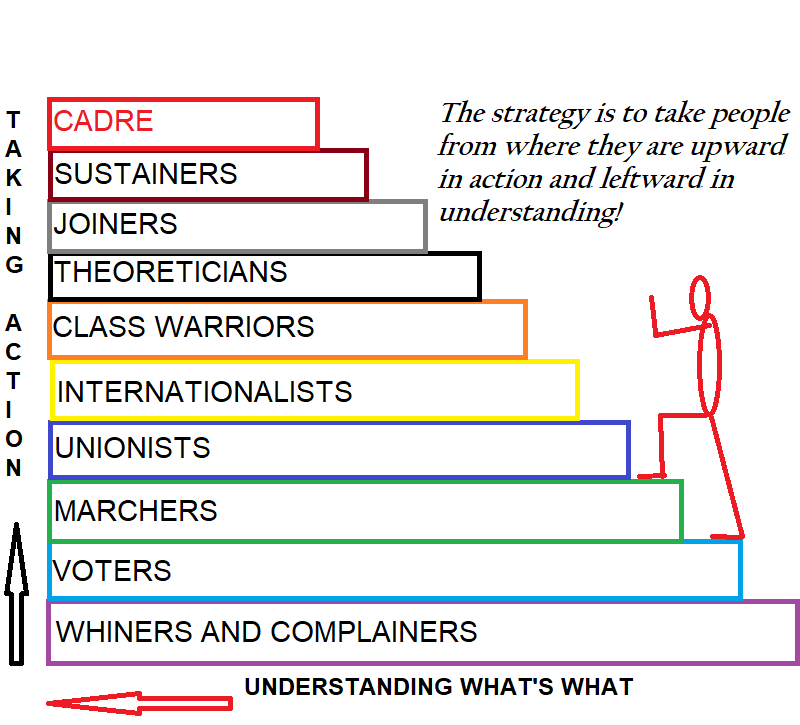
The model that guides all my activities is a picture of a person climbing a staircase from right to left. I try to help that person, or all persons I may be able to influence, make steps upward in their level of activity and leftward in their level of understanding.

At the bottom step are the millions, at least 30% of the adult U.S. population, who don’t seem to do anything nor hold any important opinions. At the top are well-informed and very active people. Just for convenience, I call the ones at the bottom step “Whiners and complainers,” while the ones at the top step are “Cadre.” I also have convenience names for 8 other steps.

The names I attach to the steps may not be important nor meaningful to everyone, but they mean something to me. I don’t think that everyone needs to make each step separately. On real staircases, some people can hop up 3-4 steps at a time. They can also fall backward, but that is rare.

According to Pew Research Center, 30% of eligible voters in America do not vote, even in the highest and most generous estimates. Their idea of “eligible voters” might be the same as “registered voters,” because other estimates say that only 69.1% of eligible adults in America were even registered to vote in 2022. If one had a higher standard — asking if people voted at every opportunity, for example — the proportion of “whiners and complainers” would be far higher and would include the vast majority of the nation.

The terrific news from the Pew researchers is that voting rates are rising to record high levels. In other words, the number of people stuck at the “whiners and complainers” level, is diminishing.

The next step in activity and understanding consists of voters. Voting requires the least thinking and the least energy of all political activity. In the 2020 presidential race, about 65% of registered voters rose to that step. As I work my model, I try to get people to register and to vote. If I succeed, then they have moved upward and to the left one step.

Just getting people to make that first step is challenging, and it’s about as far as most individuals and organizations go. But I have higher aspirations. I want people to make progressive changes in America, so I ask them to take their next step upward and to the left.

I call the third step, “marchers.” People in this category go beyond voting and participate in physical actions such as marching, picketing, sign-carrying, canvassing, rallying, phone banking, petitioning, or any other physical show of commitment. As far as I know, America has had very few mass demonstrations with more than a million people, so the estimate of people at the “marcher” step is a lot smaller than that of “voters.” But they are the ones making a difference. Even though they may not be exactly committed ideologically, a lot of union members find themselves taking such physical action during their contract negotiations.

People at the fourth step have achieved union consciousness. They may not be union members, but they have figured out that organized workers are a powerful force for good, and that they should be supported. It would be really hard if not impossible to tally up the number of people who have demonstrated their union consciousness, but I think all would agree that the number is rising. There are estimates that as high as 80% of Americans approve of unions. By contrast, hardly any politician or political entity can boast of 50%.

By the time a person rises toward the fourth step, they become aware of some strong gravitational forces pushing them backward. America’s rulers hate unions, and they control all the information sources. Consequently, people find themselves pushed mightily against union consciousness. It’s amazing that so many Americans have made this step!

Union consciousness is a mighty achievement. Not even all union members rise so high and leftward. But unions are defensive organizations and rarely act for the general good of people outside their membership. Until recently, very few unions even considered taking any foreign policy position that was not in line with the government. In 2024, the Autoworkers (UAW), then other unions, and finally the AFL-CIO labor federation began to demand a cease fire in the Middle East. By contrast, nearly all unions, and especially the AFL-CIO, supported the American invasion of Vietnam in the 1960s. Most union members, like most Americans, tend to go along with whatever the bosses tell them through their control of all information sources.

A higher step, the fifth in my model, is “internationalists.” These people have already recognized the great importance of organized working families in America and have gone further. They recognize the common interests of working families all over the world. They will face up to mighty force from the bosses, but they will actively work for justice for all nations.

The sixth step is “class warriors.” At this stage of understanding and activity, people support working families as the only category of people capable of standing up to the bosses. They recognize the reactionary nature of the bosses and their system, and they know that our profit-based employer dominating system needs to be changed. They may have, and probably did, start on this staircase with something else in mind.

In my own case, I took my first steps upward and to the left because of school reform. Back in the 1960s, I was an advocate for children and took action to end corporal punishment in the schools. To this day, I still have strong feelings about educational reform and would like to spend my time and energy on that topic — but I realized along the way that school reform is not all that’s needed. I know people who began with gay pride, election reform, civil liberties, and, especially, civil rights before they rose on the staircase to see what is really wrong and what really must be done.

I made “theoreticians” my 7th step. Probably, everybody is a theoretician in one way or another. I just wanted to show that there are good class warriors who aren’t applying all of their best thinking to every task. Those who are doing their best thinking (I might have called them “anguishers” because the term fits me so well) made it to the 7th level.

Joiners, the 8th step, are people who have recognized that the only way to make progressive change is by working together. They’re already doing great activities and thinking, but they have realized that it is going to take a concerted effort with other like-thinking activists to make progressive change.

I made a special step for “sustainers.” The term comes from fund raising and means people who donate regularly. But there are other ways to make sure that a progressive organization thrives. The problem is that some of us think “joining” is a passive verb. The sustainers at the 9th step are members who take responsibility for their organization.

Finally, at the tenth step and top, are “cadre.” It’s not a word that is well understood, but there is no better replacement. To some, it means, “dutiful followers,” and to others it means “outstanding leaders.” In truth it means both and everything in between. Cadre members are the absolute best leaders, and the absolute best followers, depending on what is needed. They are hard to find.

Not a lot of people find their way to the top of my staircase. I encourage them, but my effect is relatively insignificant. What propels them upward and leftward is the truth. Like a wind at our backs, the truth pushes us toward understanding and activity. All an individual needs is a little bit of courage and, sooner or later, all will rise.

–Gene Lantz

I’m on KNON.org and 89.3FM radio every Saturday from 9 to 10 Central Time. If you are curious about what I really think, check out my personal web site at https://www.lilleskole.us.

Last week’s Pew Poll revealed that President Biden’s approval rating has continued to fall and has reached a dismal 33%! If we put some perspective around that figure, we can discover something really worth knowing. Think about it, how could Biden’s approval ratings keep falling while the economy keeps improving?

Compare Biden to Other World Leaders

The Los Angeles Times checked approval ratings of other world leaders of industrialized nations.

Canada’s Justin Trudeau 31%

Britain’s Rishi Sunak 21%

Germany’s Olaf Sholz 17%

Japan’s Fumio Kishida 17%

They added in several more observations. Donald Trump’s approval is harder to measure but they give him a measly 42%. While President Biden started his term with well over 50%, Trump never had over 49%.

Compare Approval Ratings over Time

The Los Angeles newspaper also checked back a few decades and concluded that President Eisenhower (1952-1960) was the last one to keep decent approval ratings all the way. That was in the days of the “American Century” when unions demanded and received 3% raises every year, plus cost-of-living raises, plus pensions, plus free health care. After Eisenhower, every American president started out with over 50% and then fell steadily to the end of their term.

The evidence shows clearly that declining approval ratings can’t be blamed on any of the simple things. It’s not the person’s age, not the state of the economy, not war, not peace, not scandal, not any of the issues of any particular period. It has to be something big, something powerful, and something consistent.

Once You See It, Things Make Sense

People in America and other industrialized countries do not like the system they live under. It’s that simple.

Want to know why Trump won in 2016 in spite of every possible prediction? Voters thought he represented some kind of new system. What they got was tax cuts for the rich and an intensification of everything that was wrong with the old system, but many of them are still desperate for some kind of positive change, and many of them, incredible as it may seem, will continue to hang those hopes on Donald Trump.

The system we live under produces the worst kind of inequality. We could call it the “rich get richer and poor get poorer” system. Just last week, in the same newspapers, we read that the stock market had peaked and, that same week, homelessness in American also reached an all-time historical high! If you read carefully, you would also have seen that the number of young Americans who expect to vote in the 2024 Presidential race is tanking!

It isn’t just Biden, Trump, Trudeau and the rest of them that can’t get high approval ratings. It wouldn’t help much to substitute other Democrats for Biden or other Republicans for Trump. We would still have the same system and approval ratings would continue falling!

Change Will Come, Because It Must

My recent blogs and podcasts have been about the outlook for fascism, for a general strike, and a viable workers’ party. Those are the trends underway, and we’d better be working hard for one of the last two.

–Gene Lantz

I’m on KNON’s “Workers Beat” radio talk show every Saturday at 9AM Central Time. On Wednesdays, they post my “Workers Beat Extra” podcasts on Soundcloud.com. If you are curious about what I really think, try my personal web site at http://lilleskole.us.

Salon has very good news story covering developments 1982-present and the significance of today’s upsurge. Lone Star Project caught it for their daily news summary. I posted it on my FB page. It’s excellent.

https://www.salon.com/2023/09/21/uaws-high-stakes-gambit-this-strike-is-a-potential-paradigm-shift_partner/

My only problem with the article is that, like nearly all liberal analysis of today, it implies that labor’s problems began with Reagan in 1982. All of them, including the most erudite economists, start in 1982 with evil Republicans and recommend, as a solution, voting for liberal Democrats. They say that 1945-1982 was “normal” and that we could “get back” to that era by voting Democrat.

Nobody, except me and a handful of radical economists, especially Pikety, start with 1947, when America’s real troubles began. When the unions, some of them reluctantly, accepted the Taft Hartley law, solidarity ended.

Not only did the CIO separate from 14 of their best unions after Taft Hartley, the remaining unions raided them. What inevitably followed was decades of union isolation from one another and, even worse, from the public at large. The so-called “Treaty of Detroit” in the 1950s was a tragic error, not a wonderful accomplishment by Walter Reuther of the Autoworkers. When the UAW accepted employer-provided pensions and health care, they turned their backs on everybody else. We’re all paying for it now.

The great tragedy marked by Reagan’s firing and blacklisting of PATCO air traffic controllers was only made possible by the failure of the rest of the labor movement, and its public supporters, to respond. PATCO union leaders made several bad mistakes, including among them their having supported Reagan for election, but the historic lesson from the PATCO firing was that nobody helped them.

Once we understand that it was the lack of labor solidarity, not just Reagan, that was the root of our problems, we can see an actual solution — and it’s not just voting for liberal Democrats. It’s building up the movement for working families!

The current labor upsurge, especially the UAW strike, is attempting to rectify a catastrophe decades in the making. It will take all of us to win!

–Gene Lantz

I”m on knon.org “Workers Beat” radio talk show every Saturday at 9AM Central Time. They also post my “Workers Beat Extra” podcasts there and on Soundcloud. If you are curious about what I really think, check out my personal web site

There are at least three ways that the UAW could win against their 3 large corporate opponents without a massive strike:

  1. A rolling strike: The UAW could strike only in the plants where they are strongest, and the strikes could be limited to relatively short periods. The auto industry is interconnected and uses just-in-time inventory; consequently, one facility might shut down several others for lack of components.
  2. A slowdown: My own local, 848 in Grand Prairie, Texas, ran a successful campaign in 1984-5 and defeated a rich and powerful corporation by “running the plant backwards” for 15 months. During that time, only 65 of us were fired and required strike pay. The first 10 months or so were very difficult and not successful, but we learned how to carry out the fight and, eventually, went on strike for only 11 hours before we reached victory. All 65 of us marched back in the plant with back pay in our pockets! I wrote an account that is available on-line.
  3. A Hit-And-Run: Around 1960, my union local invented an entirely novel tactic. Instead of going on strike, they looked through the membership to see which departments were strongest for the union. Those departments alternated one day work stoppages. A lot of the members were entirely unaffected. Some of them did not even know that a battle was going on, but the stronger units were slowing down production.

Because of just-in-time inventory and assembly-line production, the UAW does not need an expensive full-fledged strike to win. Just a few workers can shut down an assembly line; just a small component shortage can shut down a factory.

I’m not a labor lawyer, so I do not know what tactics might run closer or further from the law. Also, I do not know if any of these suggested tactics might result in as much public support as a full fledged strike against all 3 big auto corporations would surely engender. I don’t know which tactics might result in more political support as the 2024 elections loom large. Ultimately, I believe that the key to victory is the support of the American people, and I believe that working families have that support, and will win more of it as time goes by.

I’m just pointing out that there’s more than one way to defeat a greedy corporation.

–Gene Lantz

I’m on knon.org’s “Workers Beat” talk show at 9AM Central Time every Saturday. My “Workers Beat Extra” podcasts are on knon.org and Soundcloud. Lately, my personal web site, http;//lilleskole.us, has picked up some malware, so be careful.

As long as I have been around the progressive movement, well over 50 years, we have expected to see some kind of American Worker’s Party break the two-party stranglehold over politics. Working families, then, would have a real alternative at the polls, we imagined. But it didn’t happen and isn’t closer to happening today. Maybe it’s time to give up on it!

Take a quick look at the history of 3rd parties. The last successful one was the Republican Party around 1859. What a thrill it must have been for the progressives of those days, most of them abolitionists, to have a new political party that offered real hope of ending the very worst of all ingrained American practices, slavery!

Then, let’s see, there were the Populists, mostly farmers, of the 1890s. They died when they endorsed the Democratic Party candidate for president. Gene Debs and the Socialists were able to get 1 million votes while their candidate was in prison, and it was sensational but not threatening to the system. President Theodore Roosevelt tried to get his career restarted with the Bull Moose Party before WWI, but didn’t get far. In 1947, former Vice President Henry Wallace tried to save the Franklin Roosevelt “New Deal” program. I recently read that he received a paltry 2.8% of the popular vote. Billionaire Ross Perot was effective enough in getting Republican voters to make sure that Democrat Bill Clinton won the presidency. The Greens have made some small inroads on Democrat voters, but were embarrassed when people learned that they were taking money from the Republicans.

In 2016 and 2020, lots and lots of American young people thought Bernie Sanders would either take over the Democratic Party from inside or create a powerful new progressive party, but Bernie has already endorsed Biden/Harris and I don’t know what those young revolutionaries may be thinking. Today, the Democrats are worrying that the “No Label” Party, financed by mysterious dark money, will take some of their votes and throw the 2024 election to Trump. But nobody is worried that we’ll end up with three viable parties nor that one of the two “main” parties will get replaced.

Side note: There is a party in existence called the “Working Families” party. They are interesting in states where they are allowed to endorse Democrats or Republicans, but not so much when they have to run on their own.

When I first heard of it, a Workers Party made sense. The unions still had over 20% of the workforce organized and were much stronger in politics than they are today. There were labor (or labour) parties here and there in other countries that were in and out of power from time to time. It just seemed like a natural intermediate step. But there are several reasons, today, to consider giving up the idea.

For one thing, we were just wrong about labor parties. We didn’t analyze the “winner-take-all” aspect of American politics. Other nations generally have parliamentary systems that allow proportional representation in governing bodies based on their percentage of the popular vote. They might win a few seats one year, add a few the next year, and eventually rise to power.

Not us. With America, nobody cares anything about proportions. It’s winner take all! If a party wins 49.9% of every vote in America, they still get nothing. The party with 50.1% gets everything.

For another thing, the organized unions that we were expecting to move up to the next stage of political power have diminished. We had about 35% of the workforce organized in the early 1950s, and we have about 10.1% now. Even if they wanted to launch a workers party, they might not have the strength.

The Bright Side

The positive way of looking at American electoral politics is to consider that progressives may not need any kind of political party to win power. Stages may not matter. With modern technology, especially mobile phones, smart people with a good program and a winning organizational model could organize almost anything in a matter of days. That’s what happened in the “Arab Spring” countries. They had no need for an interim political stage, but went straight from powerless to empowered!

Did the Labor Party Idea Just Wear Away?

Not so many years ago, I can remember top labor leaders saying that they, too, wanted a workers party. They said that building our political strength year by year within the two-party system would eventually give us the power to move off on our own. Now, I wonder if they were serious. I also wonder if the hope for a labor party is still alive among the top union leaders. I tried to find out this morning (June 16, 2023) when they were getting ready to vote, by a big margin, to endorse the Democratic ticket earlier than ever before in history. I was watching them on a webinar, so I asked innocently in the chat box, “Does this mean we’re giving up on the workers party idea?”

I didn’t get an answer. I was kicked out of the meeting and couldn’t get back in. It might have been an error. People make errors in webinars.

–Gene Lantz

I’m on KNON’s “Workers Beat” radio talk show every Saturday at 9 AM Central Time. They post my podcasts on Soundcloud.com, usually on Wednesdays. If you are curious about what I really think, check out my old personal web site.

Would you help me write a futuristic novel about what happens after the revolution? Help me speculate about what Commissioner Leo Torres does after his election to the World Council chartered to develop a model for future living and human happiness.

Unlike most American Sci-Fi, there is no dystopian end-of-the-world in this one. Thinking people have managed to stop all the current trends toward certain annihilation. A coalition of the Progressive Party and the Green Party has wrested control from the old economic rulers. All the people who are still alive after the devastation caused by our current system have a chance to meet their basic needs.

Leo Torres was a very minor figure in the Progressive Party during the revolutionary days. By a fluke of time and place, he achieved great popularity, or possibly notoriety. In his first novel, the Progressive Party leaders asked him to take on the title of “Commissioner” and resolve a very minor problem in an obscure part of Oklahoma. In the second novel, he gets a somewhat more complicated assignment, but still minor, in the Texas Panhandle.

Because of his undeserved but considerable popularity, and because he has shown himself to be trustworthy, the Progressives decide to make him a candidate for World Council in the third novel. He learns a few things as he travels the country in his successful campaign. All the preceding novels are on-line at http://lilleskole.us.

Should he take his seat on the World Council?

What priorities should he have?

What assignments or committees will he be assigned?

What laws and legislation would YOU want enacted, if you were in Leo’s place?

Help me out by sending your ideas to genelantz19@gmail.com.

Tioga is 50 miles north of Dallas. Politically, it may be in another world.

When we made our little road trip, the first thing we noticed were the big campaign signs for Don Huffines hanging on barbed wire fences. He seems to think that Governor Abbott is a liberal. HIs main slogan for getting votes in rural areas, based on an outright lie, seems to be “Stop Giving Our Money to Illegals!”

Our second clue came when we arrived at Tioga and stopped for barbecue. By the way, we liked the food, and apparently lots of other people like it, because the crowd was pretty good for a town with population 803. While we were scarfing it down, though, we noticed that we hadn’t seen a mask anywhere on the trip. Pandemic or not, they just don’t wear them up around Tioga!

Tioga is the birthplace of the great singing cowboy

After the restaurant, we tried to fit in by taking off our masks for our walking tour. We went right down Gene Autry street. We thought there might be some kind of statue, plaque, or other tribute to the great singing cowboy who is, among many other things, who I’m probably named after. The tribute is probably there, because being the birthplace of Gene Autry is Tioga’s only claim to fame, but we couldn’t find it. Right next to the street sign where we paused for a photo, a sign hung from a tree: “Trump: Make America Great!”

By then, we city people had begun to get a little uneasy. A couple of blocks further, we saw our first “Trump 2024” yard sign of this political year. By the time we got to Race Street and saw a certain house, we were downright nervous.

Stars and Bars flies in Tioga

When we saw the confederate flag and the posted threat of violence, we decided that it might be good to get back to the car before anybody noticed my “Bernie” bumper sticker. As soon as we got back to City Hall, where we had parked, we checked the car for possible painted swastikas. Then we got out of Tioga.

Does anybody remember when Adolf and Barack made a joint statement?

On the way home, we wondered if there were any dark-skinned people in Tioga. More importantly, we wondered why people in the rural areas of Texas seem committed to the Republican Party despite all facts and information. We think it might be racism.

–Gene Lantz

I’m on KNON’s “Workers Beat” radio talk show at 9AM Central Time every Saturday. KNON posts my weekly blog “Workers Beat Extra” Wednesdays on http://soundcloud.com. If you are curious about what I really think, check out my personal web site.

Every New Years, I’ve tried to get people to make predictions. Hardly any of them will. The best I have received so far is a stock broker who called KNON. After I prodded him, he responded, “The rich will get richer.” That’s about the safest prediction I ever heard.

My 2022 Predictions:

  • Massive evictions will put millions into the ‘homeless’ category.
  • Vigilantes and illegal militias will flourish.
  • Political violence will become commonplace.
  • Police will tend to allow the anti-worker outrages to flame, while suppressing any activity of pro-worker forces. This was the precedent set in Germany in the 1920s and has generally held.
  • Poverty and hunger will grow, especially among children.
  • The formal educational system will continue to deteriorate as Republicans undermine them with schemes like “charter” schools and assaults on officials. More and more parents will begin to seek out internet solutions.
  • Big corporations will try to privatize the internet and everything else, including all utilities and municipal services.
  • Persistent inflation will force the federal reserve to cut back on “quantitative easing” and near-zero interest rates. Stocks and bonds will crumble but the “real economy” won’t be hit so hard.
  • Little if anything will get done about the environmental crisis. Freak weather disasters will increase and worsen.
  • As world economies teeter, governments will advocate new wars.
  • Omicron will hit early and hard. After it peaks early in the year, a solid majority of Americans will have some immunity from vaccination or from having already suffered through COVID. By late summer, it will no longer be the top of every news story
  • The democratic party will continue unraveling while the Republican Party will grow more homogeneous and harder.
  • Independent movements, particularly the women’s movement, will grow. We will see a revival of unemployed and homeless advocacy groups similar to those of the 1930s.
  • These independent movements will be larger, better informed, and better integrated than anything we have ever seen in history. This is because people are better informed and have infinitely better communications.
  • Unions will not initially lead these powerful independent movements. Unions will be drawn into the larger movement. They will play an important role in guiding and financing the movement.
  • The 2022 elections will show people voting increasingly for 3rd or 4th parties, Greens, Working Family, Democrats, and Independents.
  • One thing that the strong progressive organizations will agree on is this: vote for no Republican!
  • Americans will begin to experiment with the kind of political strikes that have been known in other countries.
  • And slowly, the way forward will begin to show itself.

-Gene Lantz

I’m on KNON’s “Workers Beat” talk show at 9AM Central Time every Saturday. The program and a supplemental “Workers Beat Extra” are podcast on Soundcloud.com every Wednesday. My January 5 podcast includes these predictions. If you are curious about what I really think, check out my personal web site