Archive

Tag Archives: civil rights

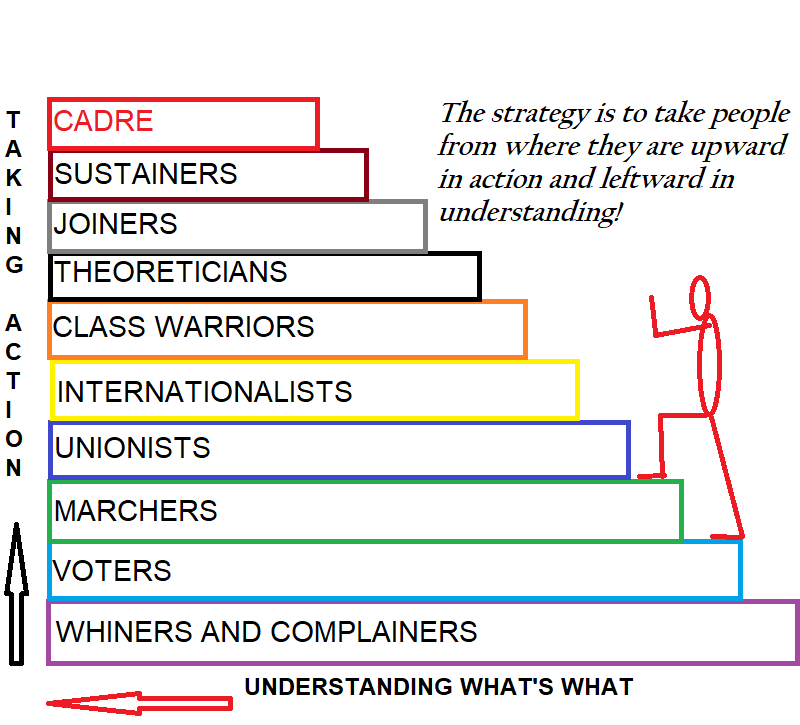
The model that guides all my activities is a picture of a person climbing a staircase from right to left. I try to help that person, or all persons I may be able to influence, make steps upward in their level of activity and leftward in their level of understanding.

At the bottom step are the millions, at least 30% of the adult U.S. population, who don’t seem to do anything nor hold any important opinions. At the top are well-informed and very active people. Just for convenience, I call the ones at the bottom step “Whiners and complainers,” while the ones at the top step are “Cadre.” I also have convenience names for 8 other steps.

The names I attach to the steps may not be important nor meaningful to everyone, but they mean something to me. I don’t think that everyone needs to make each step separately. On real staircases, some people can hop up 3-4 steps at a time. They can also fall backward, but that is rare.

According to Pew Research Center, 30% of eligible voters in America do not vote, even in the highest and most generous estimates. Their idea of “eligible voters” might be the same as “registered voters,” because other estimates say that only 69.1% of eligible adults in America were even registered to vote in 2022. If one had a higher standard — asking if people voted at every opportunity, for example — the proportion of “whiners and complainers” would be far higher and would include the vast majority of the nation.

The terrific news from the Pew researchers is that voting rates are rising to record high levels. In other words, the number of people stuck at the “whiners and complainers” level, is diminishing.

The next step in activity and understanding consists of voters. Voting requires the least thinking and the least energy of all political activity. In the 2020 presidential race, about 65% of registered voters rose to that step. As I work my model, I try to get people to register and to vote. If I succeed, then they have moved upward and to the left one step.

Just getting people to make that first step is challenging, and it’s about as far as most individuals and organizations go. But I have higher aspirations. I want people to make progressive changes in America, so I ask them to take their next step upward and to the left.

I call the third step, “marchers.” People in this category go beyond voting and participate in physical actions such as marching, picketing, sign-carrying, canvassing, rallying, phone banking, petitioning, or any other physical show of commitment. As far as I know, America has had very few mass demonstrations with more than a million people, so the estimate of people at the “marcher” step is a lot smaller than that of “voters.” But they are the ones making a difference. Even though they may not be exactly committed ideologically, a lot of union members find themselves taking such physical action during their contract negotiations.

People at the fourth step have achieved union consciousness. They may not be union members, but they have figured out that organized workers are a powerful force for good, and that they should be supported. It would be really hard if not impossible to tally up the number of people who have demonstrated their union consciousness, but I think all would agree that the number is rising. There are estimates that as high as 80% of Americans approve of unions. By contrast, hardly any politician or political entity can boast of 50%.

By the time a person rises toward the fourth step, they become aware of some strong gravitational forces pushing them backward. America’s rulers hate unions, and they control all the information sources. Consequently, people find themselves pushed mightily against union consciousness. It’s amazing that so many Americans have made this step!

Union consciousness is a mighty achievement. Not even all union members rise so high and leftward. But unions are defensive organizations and rarely act for the general good of people outside their membership. Until recently, very few unions even considered taking any foreign policy position that was not in line with the government. In 2024, the Autoworkers (UAW), then other unions, and finally the AFL-CIO labor federation began to demand a cease fire in the Middle East. By contrast, nearly all unions, and especially the AFL-CIO, supported the American invasion of Vietnam in the 1960s. Most union members, like most Americans, tend to go along with whatever the bosses tell them through their control of all information sources.

A higher step, the fifth in my model, is “internationalists.” These people have already recognized the great importance of organized working families in America and have gone further. They recognize the common interests of working families all over the world. They will face up to mighty force from the bosses, but they will actively work for justice for all nations.

The sixth step is “class warriors.” At this stage of understanding and activity, people support working families as the only category of people capable of standing up to the bosses. They recognize the reactionary nature of the bosses and their system, and they know that our profit-based employer dominating system needs to be changed. They may have, and probably did, start on this staircase with something else in mind.

In my own case, I took my first steps upward and to the left because of school reform. Back in the 1960s, I was an advocate for children and took action to end corporal punishment in the schools. To this day, I still have strong feelings about educational reform and would like to spend my time and energy on that topic — but I realized along the way that school reform is not all that’s needed. I know people who began with gay pride, election reform, civil liberties, and, especially, civil rights before they rose on the staircase to see what is really wrong and what really must be done.

I made “theoreticians” my 7th step. Probably, everybody is a theoretician in one way or another. I just wanted to show that there are good class warriors who aren’t applying all of their best thinking to every task. Those who are doing their best thinking (I might have called them “anguishers” because the term fits me so well) made it to the 7th level.

Joiners, the 8th step, are people who have recognized that the only way to make progressive change is by working together. They’re already doing great activities and thinking, but they have realized that it is going to take a concerted effort with other like-thinking activists to make progressive change.

I made a special step for “sustainers.” The term comes from fund raising and means people who donate regularly. But there are other ways to make sure that a progressive organization thrives. The problem is that some of us think “joining” is a passive verb. The sustainers at the 9th step are members who take responsibility for their organization.

Finally, at the tenth step and top, are “cadre.” It’s not a word that is well understood, but there is no better replacement. To some, it means, “dutiful followers,” and to others it means “outstanding leaders.” In truth it means both and everything in between. Cadre members are the absolute best leaders, and the absolute best followers, depending on what is needed. They are hard to find.

Not a lot of people find their way to the top of my staircase. I encourage them, but my effect is relatively insignificant. What propels them upward and leftward is the truth. Like a wind at our backs, the truth pushes us toward understanding and activity. All an individual needs is a little bit of courage and, sooner or later, all will rise.

–Gene Lantz

I’m on KNON.org and 89.3FM radio every Saturday from 9 to 10 Central Time. If you are curious about what I really think, check out my personal web site at https://www.lilleskole.us.

“Here Come the White People!” should have been a warning throughout history. People who had land, or thought they had land, found themselves on tiny reservations while their former lands were taken over by relatively prosperous white people. If the former landowners fought back, they were labeled “terrorists” and killed.

I could be talking about Geronimo, or maybe Pontiac, or Crazy Horse or Sitting Bull. I might be talking about the former occupants of the land known as Palestine, but not necessarily.

I might also be talking about the many enslaved people who followed General Sherman’s army in the Civil War. Sherman actually gave them land and, with it, the possibility of accumulated wealth some day in the future. This is the beginning of the idea of “Forty Acres and a Mule” that we still refer to.

After the shooting was over, President Johnson and the federal government made all the former slaves give up their lands. Title was returned to the slavemasters.

A few Black Americans received land when the Dawes Commission forced the tribes of Oklahoma to divide their communal land. Some of the tribe members were former slaves, and they received allotments. I’m not sure how that went down with every tribe, but I have read that the Chickasaws hired “Alfalfa” Bill Murray as their attorney to get all the land away from Black tribe members. Murray went on to become Oklahoma’s first governor in 1907, and Black people went on being landless and poorer than dirt.

Today on radio, I heard President Biden pledging eternal allegiance to Israel. He painted the Palestinians in the ugliest of colors. When I read the newspaper, I saw that the world is afire with protests. Even on U.S. campuses, people, including young Jews, are speaking up against Zionism and the liklihood of genocide in the Gaza Strip. Last night, an on-line group called “U.S. Labor Against Racism and War” held a webinar with 256 union activists attending. They have another one in two days.

What’s the Real Issue?

I don’t think the issue is the sorry state of Native reservations, nor Little Big Horn, nor the exploded hospital in Gaza, nor the maurauding soldiers from Hamas. The issue is land. The issue is land and it has been gleefully ignored in nearly a century of land-grabbing and settler outposts extending from Tel-Aviv.

I also think that another big issue is arising. For some time, the United States’ domination of world finance has been unchallenged, but the BRICS consortium is beginning to erode it away. Biden’s speech this morning must have accelerated that process.

History tells us that everybody should look out for the white people. Wikipedia tells us that the white people share of the world population is 15% and falling.

–gene lantz

I’m on KNON.org’s “Workers Beat” talk show every Saturday at 9AM Central Time. My “Workers Beat Extra” podcasts are on KNON.org and Soundcloud. If you are curious about what I really think, you might check out my old personal web site.

There are at least three ways that the UAW could win against their 3 large corporate opponents without a massive strike:

  1. A rolling strike: The UAW could strike only in the plants where they are strongest, and the strikes could be limited to relatively short periods. The auto industry is interconnected and uses just-in-time inventory; consequently, one facility might shut down several others for lack of components.
  2. A slowdown: My own local, 848 in Grand Prairie, Texas, ran a successful campaign in 1984-5 and defeated a rich and powerful corporation by “running the plant backwards” for 15 months. During that time, only 65 of us were fired and required strike pay. The first 10 months or so were very difficult and not successful, but we learned how to carry out the fight and, eventually, went on strike for only 11 hours before we reached victory. All 65 of us marched back in the plant with back pay in our pockets! I wrote an account that is available on-line.
  3. A Hit-And-Run: Around 1960, my union local invented an entirely novel tactic. Instead of going on strike, they looked through the membership to see which departments were strongest for the union. Those departments alternated one day work stoppages. A lot of the members were entirely unaffected. Some of them did not even know that a battle was going on, but the stronger units were slowing down production.

Because of just-in-time inventory and assembly-line production, the UAW does not need an expensive full-fledged strike to win. Just a few workers can shut down an assembly line; just a small component shortage can shut down a factory.

I’m not a labor lawyer, so I do not know what tactics might run closer or further from the law. Also, I do not know if any of these suggested tactics might result in as much public support as a full fledged strike against all 3 big auto corporations would surely engender. I don’t know which tactics might result in more political support as the 2024 elections loom large. Ultimately, I believe that the key to victory is the support of the American people, and I believe that working families have that support, and will win more of it as time goes by.

I’m just pointing out that there’s more than one way to defeat a greedy corporation.

–Gene Lantz

I’m on knon.org’s “Workers Beat” talk show at 9AM Central Time every Saturday. My “Workers Beat Extra” podcasts are on knon.org and Soundcloud. Lately, my personal web site, http;//lilleskole.us, has picked up some malware, so be careful.

Book Review:

Robeson, Paul, “Here I Stand.” Beacon Press, Boston, 1958

I got my copy from the Dallas Library B, R653R. You may have to reserve it and then wait, as I did. I was pleased to put aside the absolutely terrible political book I was trying to read and enjoy some time with one of the greatest men ever produced by our country

It’s not a biography. It’s a statement of beliefs and a strong prescription for action on civil rights. I believe it’s a good book to read for 3 reasons:

  1. It’s very direct and clear about history in Robeson’s lifetime
  2. His prescription for the civil rights movement is valid
  3. It’s a short easy read of only 111 pages

Paul Robeson went to Spain to help the republican nationalists who were fighting fascism. It was a prelude to World War II. Robeson explains, in just a page or two, that the western powers allowed German and Italian fascists to become great military powers because they believed that Hitler and Mussolini would kill all the socialists in Europe and then in the Soviet Union. They were to be nothing more than an exterminator squad for capitalism.

Robeson recommended a great, unified civil rights movement involving all good people but led by African Americans. He had a lot of first hand experience in civil rights and knew what he was talking about. He is very convincing and his recommendations should be taken seriously today.

–genelantz  

Book Review:

Hochschild, Adam, “American Midnight. The Great War, a Violent Peace, and America’s Great Crisis.” Mariner Books, 2022

I found a free Kindle copy through the Dallas public library’s “Libby” service. Now I wish I had a hard copy because of the facts in this history of America from 1917 to around 1924. You could call it the Red Scare. You could call it the most shameful period after the Civil War. Or you could call it a warning about today and tomorrow.

This book changed my view of the period. Previously, I thought that government had simply allowed vigilantes to run amok — arresting, assaulting, and lynching just about anybody they chose. That was bad enough. Having reach Hochschild, I now realize that government was not just standing aside, they were actually fomenting, cooperating, and leading the nastiest gangs of racists they could find. Nearly all the spying was done by government hires. The worst of the mass acts of repression came directly from government agencies.

One might think that the Justice Department would have stood for justice, but they were probably the worst perpetrators. A lot of the worst assaults were called the Palmer raids, after Attorney General Palmer. After them came, probably, the armed forces; but many government offices were in on it, including the post office! J. Edgar Hoover, notorious race baiter, union hater, and all around sociopath, made his chops in the period. We were stuck with him for another 50 years!

Near the end of the book, Hochschild tries to tote up the numbers of people killed, horsewhipped, imprisoned, deported or otherwise deprived of life and liberty, but it’s a hopeless task. Besides, he’s basically talking only of federal cases. All the nasty things that happened at state and local levels would probably have doubled or tripled the size of the book. Then there’s the non-government participation of anti-union bosses and ideologically-driven racists and nativists to consider!

The rationale for the horrors began when Woodrow “He Kept Us Out of War” Wilson was re-elected in 1916. A lot of Americans, including the growing Socialist Party and some of the members of the Industrial Workers of the World, strongly opposed the war. The repression was originally released against anybody who did not want to join the bloodfest. But why, anyone might ask, did it continue after the end of the war and well into the 1920s? The excuse used most was Bolshevism, but the targets were American working people.

There are a couple of things I would have liked to have found in this account. The Greencorn Rebellion in Southeastern Oklahoma was an early expression of anti-war feelings among sharecroppers, including whites, Blacks, and Natives. I would also have appreciated an attempt to go beyond tallying assaults, deportations, imprisonments, and murders just to find out how many workers lost their jobs during this awful period. Of all the terrible things that government and employers do to workers, the most widely applied, and thus the most effective, is to deprive us of the ability to earn a living.

Hochschild clearly condemns certain government officials. He leaves the final judgement of President Wilson open to debate. He gives some credit to “good guys” such as Emma Goldman, Kate Richards O’Hare and of course Eugene Victor Debs. He mentions Frank Little, one of the first anti-war spokespersons lynched. William Z. Foster, who worked through the whole period to try to bring the labor movement together and develop its fighting potential, remains hidden in our histories.

I have always found it interesting to speculate what might have happened in America if different leaders had headed the Socialist Party, the IWW, or the AFofL. Worldwide, the many socialists capitulated early and supported their governments in World War I. There were only two that didn’t. The other one was Russia.

–Gene Lantz

I’m on KNON.org’s “Workers Beat” radio talk show every Saturday at 9AM Central Time. I have about 150 podcasts under the name “Workers Beat Extra” there, too. If you are curious about what I really think, check out my personal web site

“Argentina 1985” is a good film streaming on Amazon Prime. It is about the trial of the dictators who ran Argentina’s Dirty War. If you can get over the fact that it’s dubbed (pretty well) and you like courtroom dramas, you’ll like this one. There’s a lot to be learned, but great questions still need to be answered:

  1. How does fascism come about?

2. How does fascism end, as it clearly can and does

3. Why?

Writers across the world, including me, are warning that fascism is approaching. Even the President of the United States recently joined in the same caution. Such scholarly articles as can be seen at https://pdfs.semanticscholar.org/d9c0/3a042dd7f1bf8ffbd0096c2eed88a0403600.pdf warn us that fascism is approaching on a world-wide basis.

Scholars almost always study the fascism of Italy and Germany that ended in ruins during World War II. That is one way that fascism might end, but not the only way. I’ve seen very little reference to fascist governments since WWII. Undoubtedly, fascism in Germany and Italy owed much to the support of Western Imperialism. In that respect, they are similar to the fascist governments that arose in Spain, Indonesia, Chile, Argentina, Brazil, South Africa and other countries. But those latter nations survived fascism and returned to limited democracy. Why don’t we study them?

I am curious about those latter countries’ experience with fascism because they apparently survived it and returned to the kind of limited capitalist democracy that they had before and, for that matter, is similar to what the United States has had since its inception: limited capitalist democracy. Working people are “free” to vote and to do a good many other things, but not to control the economy nor foreign policy.

And yet we continue to talk about fascism as a one-way street to destruction, as it was in the classic examples of Italy and Germany. Why don’t we know anything about fascism as a transitory form of government as it clearly was in, for example, Chile?

My Best Solution to the Riddle

Fascism In Germany and Italy were created and then destroyed by western imperialism. Their driving force was to overcome the progressive forces, primarily the communists who had been inspired by the Soviet revolution of 1917. Similarly, western imperialism is responsible for initiating fascism in Chile and other countries that, later on, returned to one form or another of limited capitalist democracy.

Fascist Rule is a Conscious Choice

Like almost all riddles concerning social progress, this one can only be solved with class analysis. None of the fascist governments came about by revolutions. That is, there was never a change in the class that ruled. Fascism is just one form of capitalist class rule. In fact, fascism cannot come about without the ruling capitalist class consciously choosing it. That’s the answer to the first question: a necessary requirement for fascism is that the capitalists must choose it as their form of government.

Mussolini defined fascism as “corporatism.” Hitler could never have come to power without the backing of the ruling class of capitalists.

Ending Fascist Rule is Also a Conscious Choice

If a ruling capitalist class can consciously choose to rule with fascism, they can also consciously decide to discontinue it. And that is what happened in Spain, Indonesia, Chile, Argentina, Brazil and the other countries in this discussion. That’s the answer to the second question: fascism ended the same way it began — as a conscious decision of the capitalist class. Why, one might legitimately ask, would they opt for fascism in the first place? The answer is the same as in Germany and Italy: they chose fascism to avoid the extension of democracy under socialism. When democracy threatens to exceed its limits, the ruling class reacts.

Why, then, would they choose, once the immediate democratic threat is lessened, to discontinue fascist rule? Because authoritarian regimes make for inefficient economies. Limited democracy and capitalism worked together to build the most powerful economies that the world had ever known. That’s why they easily conquered all previous forms of government and came to rule the world. Authoritarian governments, where the population is basically forced to work for the state, may be able to build powerful war economies, but only temporarily. To the extent that workers are not enslaved, but “free labor,” or at least if workers believe themselves to be “free,” economies thrive.

Other Considerations

Here, I set out only to answer the question “Why have some nations survived fascism?” I did not set out to discuss the implosion of the Soviet Union. But one might ask if the Soviet Union might have lived up to its potential if it had not been forced by imperialist war threats to adopt an authoritarian stance over its government and, more unfortunately, its economy.

And consider China today. China seems to be balancing a market economy with a socialist government. The economic results, so far, are better than any previous socialist revolution has been able to achieve. One might even argue that the Chinese approach of socialist rule with limited economic democracy is proving itself superior to limited capitalist democracy.

Summary

But understanding the USSR and China are far beyond my ambitions. I simply want to make these two critical points: 1) Fascism is a form of rule that is sometimes chosen by capitalists and 2) Nations have survived fascism, once the threat of “excessive” democracy is past.

–Gene Lantz

I’m on KNON.org “Workers Beat” radio talk show at 9AM Central Time ever Saturday. If you are curious about what I really think, you might look at my personal web site.

Book Review: Horne, Gerald, “The Counter Revolution of 816: Texas Slavery & Jim Crow and the Roots of U.S. Fascism.” International Publishers, 2022. Available through Amazon Books

University of Houston Professor Gerald Horne has created a book that must be read. I wholeheartedly recommend it, but that doesn’t make it an easy read.

I believe there is a long-awaited tendency toward truth in Texas history. Most of us have only seen the bleached and romanticized version. It makes great romantic heroes of all the “revolutionary” “founders” of the state. Everyone who can read knows it isn’t true. If they were really such wonderful people, why did they prominently feature slavery in their first constitution?

As far as I know, though, the new revisionist histories lead up gradually to the truth and don’t actually denounce any of the Texas “heroes” before their conclusions. Gerald Horne starts there. The “founders” of Texas are ratfink landgrabbers devoted to genocide for natives and enslavement for Africans from page one.

“Father of Texas” Austin wasn’t a saint trying to find homes for poor settlers. A slave owner himself, he worked constantly and consistently to overcome his host country’s ban against slavery. He was the slaveocracy’s front man. The ones who followed were no less committed to slavery and even more bloodthirsty in its pursuit.

As for the Natives, there were only two ideological trends in Texas: the few “liberals” wanted to put them all into bantusland reservations as in apartheid South African; the majority, including President Mirabeau Lamar, wanted to kill every last one of them. Mexican Americans received little more consideration. The Texas Rangers were an equestrian version of Murder, Inc.

From the first white settlers until modern times, Texas history is a story of lynching and genocide. For good measure, Horne throws in some little-known truths about Oklahoma and the states that were created after the greatest land grab — usually known as the Mexican War.

Most white Texans supported secession from Mexico. Many of them coveted even more Mexican land and only reluctantly joined the United States when forced by economic circumstances. Nearly all of them supported seceding from the union over the slavery issue in 1860. Their contributions to the Confederacy exceeded every state except, possibly, Virginia. After General Lee surrendered in 1865, many Texans moved to Mexico where they supported the French imperialist forces under “Emperor” Maximillian because they hoped to re-start the Civil War with France on their side.

The total destruction of previous Texas histories is one reason that “The Counter Revolution of 1836” is hard reading. Texas history as we have known it is deservedly turned inside-out! The other reason comes from Horne’s writing style. A few pages into the 575-page opus, the reader starts hoping that Horne will run out of obscure pejoratives to describe early Texans, but he doesn’t. He rarely employs a sentence that wouldn’t diagram as compound/complex. Because he has assembled so many quotes from so many sources, he hop-scotches from one to the other so quickly that it’s not always easy to remember what point he was making.

The book has a tremendous list of resources. Oddly, I did not find Randolph Campbell’s “An Empire for Slavery” among them. Possibly, Campbell may have been too easy on Texas.

–Gene Lantz

I’m still on KNON.org with “Workers Beat” every Saturday at 9 AM Central Time. If you are curious about what I really think, check out my personal web site

Would you help me write a futuristic novel about what happens after the revolution? Help me speculate about what Commissioner Leo Torres does after his election to the World Council chartered to develop a model for future living and human happiness.

Unlike most American Sci-Fi, there is no dystopian end-of-the-world in this one. Thinking people have managed to stop all the current trends toward certain annihilation. A coalition of the Progressive Party and the Green Party has wrested control from the old economic rulers. All the people who are still alive after the devastation caused by our current system have a chance to meet their basic needs.

Leo Torres was a very minor figure in the Progressive Party during the revolutionary days. By a fluke of time and place, he achieved great popularity, or possibly notoriety. In his first novel, the Progressive Party leaders asked him to take on the title of “Commissioner” and resolve a very minor problem in an obscure part of Oklahoma. In the second novel, he gets a somewhat more complicated assignment, but still minor, in the Texas Panhandle.

Because of his undeserved but considerable popularity, and because he has shown himself to be trustworthy, the Progressives decide to make him a candidate for World Council in the third novel. He learns a few things as he travels the country in his successful campaign. All the preceding novels are on-line at http://lilleskole.us.

Should he take his seat on the World Council?

What priorities should he have?

What assignments or committees will he be assigned?

What laws and legislation would YOU want enacted, if you were in Leo’s place?

Help me out by sending your ideas to genelantz19@gmail.com.

Book Review:

Taylor, Clarence “Reds at the Blackboard. Communism, Civil Rights, and the New York City Teachers Union,” Columbia University Press, 2013.

There once existed a powerful teacher organization that fought for every progressive aspect of education in New York City. The American Federation of Teachers today, which has advanced in social unionism far beyond the bad old days of President Albert Shankar, is still miles behind the Teachers Union of New York of 1935-1964.

They represented teachers with grievances, they fought for better pay and working conditions as unions do, but they also challenged the basic racism and corruption of education in their times. They fought hard, for example, to expose the explicit and implicit racism in textbooks. They did everything they could think of to improve school materials. They fought for integration of students and faculty. They fought just as hard for gender equality.

Their greatest accomplishment may have been to make the schools part of the communities they served. These were not nominal PTA’s holding fund drives, but honest hard-working community organizations working for community improvement — especially among the most downtrodden constituencies.

One important aspect of school racism was new to me. After Brown V Topeka in 1954, the main physical change in education was to shut down all the segregated Black schools and lay off their teachers! Most of those teachers stayed laid-off because they couldn’t get jobs in the so-called “integrated” schools. The Teachers Union of New York fought hard to get jobs for Black teachers! If anybody else did, I hadn’t heard of it.

While they were bringing social unionism to its heights, the Teachers Union had to fight off management’s attempts to undermine it. Male chauvinism and anti-semitism were useful tools for the bosses, but their big cudgel was anti-communism. Social unionism was the Communist Party’s program and a some of the Teachers Union leaders were reds.

Management, like bosses everywhere after 1947, were able to get a lot of people fired and a lot of careers destroyed. The American Federation of Labor kicked the Teachers Union out over anti-communism. They joined the Congress of Industrial Organizations and continued to thrive as social unionists. However, after 1947, the CIO joined the anti-communist wave and kicked the Teachers Union out again. The Board of Education managed to have the Teachers Union decertified as representatives of their members, so they could no longer settle grievances nor negotiate for job improvements.

Even then, they didn’t quit. The Teachers Union survived as an important voice for social unionism, especially for civil rights and community cooperation, until 1964. They need to be remembered.

**

I broadcast on “Workers Beat” on KNON.org at 9AM CT every Saturday. If you are curious as to what I really think, check out my personal web site