Book Review:
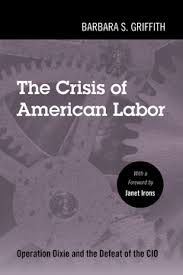
Griffith, Barbara S., The Crisis of American Labor: Operation Dixie and the defeat of the CIO. Temple University Press, Philadelphia, 1988. Borrowed from Longview Texas library through Dallas Public Library inter-library loan. Item barcode: 33053002087591
Working families have a giant hole in our own history. Even though virtually every union has an account of its early days, there is almost nothing about the period from 1947 to present. Union leaders might say that they just haven’t gotten around to covering that period, but I think there’s a truer explanation. I think they’re ashamed of it.
Ms Griffith’s book helps fill that hole. It tells how the brave organizers from the Congress of Industrial Organizations (CIO, before they surrendered to the AFL) tried to unify southern workers along with the industrialized North. It also explains why wages and benefits in the former confederacy continue to lag behind the rest of the nation.
In Spring of 1946, the CIO was less than 11 years old, but they had 4 million members! Their successes had galvanized the rival AFL into industrialized organizing, too. For the first time in American history, organized labor was more than a blip on the body politic. We were a power!
If Operation Dixie had succeeded, Griffiths says, southern workers would today be enjoying a much better standard of living. The civil rights movement would have realized its gains ten years earlier! American labor would have continued to gain membership and power. But it didn’t.
The CIO had overcome the giants of most industries, but they had not organized textile. When unions succeeded in the North, textile owners moved south where they could still get people to work almost as slaves. Griffith, who worked at the Smithsonian, seems to have done most of her research through union correspondence and personal interviews. By way of explaining working conditions in southern textile villages, she offers first hand testimonies. In one of them, a mother complains that her 8-year old daughter was removed from school and forced to go to work in a mill. The mill bosses had switches. The mother is quoted: “The second-hand, the foreman, the loom-fixer or the doffer—anyone they had over the section could whip them.”
The only way to make the union movement truly national was to organize the South. The CIO decided to go into the old Confederacy from Georgia to Texas with a small army of carefully selected organizers. Full of confidence, they gave it the fanciful name “Operation Dixie!”
From the first few months, there were major problems. Post war unions were strong, but so were corporations. Backwardness was a tradition in the South. Union organizers were not always beaten by company goons or corrupt lawmen. Sometimes, they were beaten by mill workers!
Author Barbara Griffiths doesn’t recount the entire history of Operation Dixie from Summer 1946 until it was finally discontinued in 1953. She says it was defeated in the first few months. Page 161: “As a large-scale organizing campaign Operation Dixie died in December 1946 when the organizing staff was cut in half.” Six months into the grand program, it was already a failure!
This is not a happy book. The few bright spots come from successes of the Food & Tobacco Workers and the Packinghouse workers, both left-led unions that were subsequently red-baited and kicked out of the CIO. But Operation Dixie was primarily about textile.
Griffiths correctly places the blame on the textile mill owners. They had almost total economic control over the lives of their subjects as well as the government. Racism was impenetrable. Red baiting was everywhere. In fact, race and red baiting were usually employed together against the CIO.
Were the unions to blame? Griffiths can point to a lot of their problems. They didn’t know the South at all. Most of their organizers didn’t know the textile industry. Anti-communism was already dividing the unions, even though the official witch hunt and expulsion of communists didn’t begin until the next year. But none of these problems had overcome CIO organizing before.
Under the “what if” category of meaningless daydreaming, we might speculate that the CIO might have succeeded if they had understood the period better, if they had done more research, if they had valued internal cohesiveness more, and if they hadn’t taken such a heavy-handed “all or nothing” approach to the entire South. But we’ll never know what might have happened. We only know what did.
The author says that Operation Dixie did not fail primarily because of internal CIO problems. It failed because the entrenched southern textile bosses were stronger than us. It failed because anti-union Republicans won the 1946 elections and began putting the government firmly on the side of the bosses. The CIO organizers were heroic, but it wasn’t enough.
–Gene Lantz
I’m on KNON’s “Workers Beat” radio talk show every Saturday at 9AM Central Time. If you are curious about what I really think, check out my personal web site
MY NOTES FROM THE BOOK:
I believe this is a rare book. On Amazon, it cost $70. Including the index, it’s a small book.
She is a historian at Smithsonian Museum of Natural History. She seems to have gathered her information from the correspondence of the unions involved and from original interviews with organizers and various workers. Several interesting quotes from the participants are used to explain what happened.
Intro: CIO was good on race, but not so much on gender, with exception of Food & Tobacco Workers, who had a lot of Black women organizers and a Southern District Director who was the highest-placed woman union officer of that time.
It lasted 1946-1953
Pgxvi:”…a CIO victory in the South might have hastened the civil rights movement by at least a decade.”
//I note that organizers tried to win over religious leaders, but they didn’t start with them as the 1954 civil rights movement did. Also, people had TV in 1954, but not in 1946, consequently a national movement was not as likely.//
Pg27: FTA held a conclave at the Highlander School to discuss the problems they expected with Operation Dixie. It sounds like FTA was the only successful union involved.
Pg27: In 1946, the CIO was up to 4M members. But they were all experienced and trained in the North. A lot of organizing successes had been handed them by government action during the war. Companies were really rich from war profits.
Lots of anti-communism within the CIO. President Murray appointment Bittner to head the operation. Baldanzi was the sparkplug who carried it out. All were anti-communist. There was a deliberate attempt to try to avoid the inevitable red-baiting by keeping the reds out of Operation Dixie.
Pg28: They charged $1 initiation fee, but veterans were free
Pg29: on setting up initial organizing committees “The recruitment of this core group went slowly in Operation Dixie. Some organizers blamed the weather for the slow development of in-plant committees, while others focused on police hostility, the opposition of ministers, the public pronouncements of elected officials, the harshness of company policies that intimidated workers, the graciousness of company policies that made workers grateful, or the Machiavellian nature of companies that were capable of both.” //this seems like a pretty good list of what they were up against in the South//
Pg34: Humbling defeats in textile. Only successes in tobacco
Pg36: some union members were in the KKK
Pg 59: A lot of textile workers were historically intimidated because they had lost a strike in 1934. It was “organized from below” and had 400,000 participants. But they lost! They had also lost a big one in 1929. //that’s the one where Ella Mae Wiggins was murdered//
Pg60: In “Uncle Charley Cannon’s” mill territory, police arrest records were made in triplicate. One for Cannon!
Pg 65: “The president of the Food, Tobacco, Agricultural and Allied Workers of America (FTA), also a left-wing and heavily black union, issued a similar appeal for funds after a black FTA worker in Arkansas, on strike ‘against 55 cents an hour and a 12-hour day,’ was murdered by a strikebreaker in Little Rock. Although having confessed to stabbing the man, the strikebreaker was set free and, in his place, six union members were rushed to trial under charges of ‘attacking’ a strikebreaker. All were black.”
Pg72: The CIO knew that black union members were better unionists than white
Pg76: Race baiting and red baiting were everywhere, often together.
Pg 78: Organizers felt that they had to organize white first because white workers would never join what they perceived to be a “black union.”
Pg84: Excellent anecdote about Ft Worth Packinghouse Local that refused to carry out CIO’s anti-racist policies. National leaders came down and forced them to do it. Then they stayed around and made sure that a mixed-race slate won the next election! //I can remember some of Roy Evans’ stories concerning Packing House leadership//
Pg92: Paternalism was total in mill villages. One anecdote from a mother tells how her 8-year old daughter was taken out of school to work in the mill. The bosses had switches. “The second-hand, the foreman, the loom-fixer or the doffer—anyone they had over the section could whip them.”
Pg99: In a long list of harassments, she cites a member of the internal organizing committee who could range around his plant. He was reassigned to a stationary position. Exact same thing happened to the Organizer at North American Aviation in Dallas in 1941!
Pg100: Great story of JP Mooney of Mine Mill and Smelter. Beaten, hospitalized, and threatened with death, he signed up “every bloody member of that plant.”
Pg103: “……literally scores of stories of unexpected confrontations with mobs organized by management.”
Pg105: “The CIO was forced to accept a contest on grossly unequal grounds. It never found a way to redress the balance.”
Pg107: Southern churches were a problem. “It’s either Christ or the CIO!”
Pg108: a preacher said on radio, “Luke 3:14 says be content with your wages.”
Pg108: “Militant Truth” was a free newspaper that followed CIO organizing drives around the South.
Pg121: CIO organizers tried to use Ecclesiastes 4:9-10: “Two are better than one because they have good reward for their labor. For if they fall, the one will lift up his fellow: but woe to him that is alone.”
Pg139 “In 1946, the CIO Executive Board included representatives of forty-one internationals.” And their views were diverse
“By the time Operation Dixie was officially launched in May 1946, hairline cracks and fissures in the CIO’s foundation had already become visible.”
Pg140: “To trace Philip Murray’s passage from cooperation with the CIO’s left to hostility and thence to implacable opposition is to trace, first, these national and international pressures, second, their impact on the CIO, and finally, the local ramifications in the South that brought Operation Dixie to a formal end in 1953.”
Steelworker red baiting was underway in 1946. James Carey, CIO national Secretary blasted UE reds.
Election of Nov 1946 was disaster for CIO and Democrats
Pg149: At the Highlander meeting, the FTA decided to work hard to organize within Operation Dixie, but they were afraid that the CIO was stacking it against the left. “The FTA’s fears of the CIO’s use of jurisdictional assignment as a weapon for defeating left-wing unions were well founded, however. By 1947, the CIO was assigning tobacco workers to the United Transport Service Employees’ Association. Such events constituted a form of ‘raiding’ by administrative action. Actual raiding followed soon afterward…”
Pg150: Mid-year 1947, CIO President Murray instructed the Exec to throw out the communists. “The center-left coalition was dead and the isolation of the left was complete.”
Pg152: Baldanzi called for expulsions at the 1947 Convention in Boston
Pg154: CIO and AFL raiding destroyed the FTA union at RJ Reynolds, which remained non-union
Pg155: crisis internal fighting in Ft Worth United Packinghouse Workers Union
Pg 157: AFL had always practiced “sweetheart” contracts to employers who wanted to avoid the CIO. They had done it from the K of L to present, she says.
Pg 157: Americans for Democratic Action established as liberal anti-communism, but wasn’t very effective. She doesn’t mention Hubert Humphrey.
Pg 160: Murray excoriating communists. “in such a manner, the CIO fought its way back into the mainstream of the Democratic Party. Unfortunately for labor, that mainstream represented an accommodation to corporate America that severely circumscribed labor’s influence on national policy. The price of respectability was high.”
Pg 161: “As a large-scale organizing campaign Operation Dixie died in December 1946 when the organizing staff was cut in half.” UAW quit in 1948.
Pg172: ‘No quick fix can be suggested that might have changed the outcome of Operation Dixie.”
Pg176: concluding paragraph: “Operation Dixie happened at the moment of labor’s apogee when hopes were still lofty but when resources had begun to shrink and the corporate opposition had armed itself for a massive counterattack. All the tensions implicit in such a pivotal historical turning point surfaced in Operation Dixie. The legacy has been a bitter one, for within the ranks of the trade union movement, there were no winners, only losers. For American labor, Operation Dixie was, quite simply, a moment of high tragedy from which it has yet to fully recover.”