Archive

strategy

Congress is raising a hullabaloo about what they are now calling “Big Tech” – by which they mean Facebook, Apple, Microsoft, Amazon and Google. They are threatening to break out the old anti-trust laws and scatter each company into smaller ones. Their argument is that it would be more democratic to have smaller, less powerful, tech companies.

Here are my arguments against it.

Us old people saw this before when they broke up Bell Telephone. Does anybody remember their phone bills going down and their phone service improving? Nope. Nobody remembers it because it never happened. If anything, phone service costs went up and landline phone service became, well, what it is today.

Consider China

While American legislators are trying to tear successful enterprises apart, the Chinese are trying to build theirs up. One ought to think about the reasons for this difference, especially because the Chinese have clearly been operating the most successful economy in the world. Do you remember the phrase, “A Chinaman’s chance?” It used to mean no chance at all. In my lifetime, they’ve come from the least respected to the most feared economic machine.

I think that the Chinese want the obvious efficiency of giant enterprises, as almost anybody would. Apparently, the government over there thinks they can control them. Our government over here likes to pretend that they don’t interfere much in the economy. They say “let the market take care of itself,” unless, of course, their wealthy backers want another handout such as the giant tax break they just ripped off.

The pretense that the American economy can get back to some kind of individualistic entrepreneurial spirit is just that, a pretense. A capitalist economy develops the way it does because of its fundamental nature. The big ones eat the small ones. There’s no going back, and there’s actually no reason to go back anyway.

The Chinese government and the American government, both of them, can regulate big business. In fact, they can regulate big business better than they can regulate multiple smaller businesses for the simple reason that there are fewer people to watch and fewer books to audit.

Innovation?

Who can do research and development better than the government? Look at the pharmaceutical industry, for example. The problem with big pharma is not that they don’t take advantage of government research. The problem is that government doesn’t regulate them. Their cadres of lobbyists practically run the government instead of the other way around!

Consider the Postal Service

I’m afraid that the same people who want to break up Google are the same ones who want to break up the Post Office. We used to have the best postal service in the world, and it provided some of the best jobs we could get. Now, the good jobs are mostly gone and “privatization” is in every other paragraph. The same thing is true of what used to be the best school system in the world.

What Kind of Future?

We may daydream about a future that looks like our past. Young entrepreneurs wearing buckskins building up cattle empires on Native-Americans lands? Is that the model? Not likely. In my own sci-fi speculations about the future, revolutionaries try to build on the great accomplishments of capitalism, not tear them down. That’s for hippies.

The American government could regulate giant corporations on behalf of the people. They just don’t.

–Gene Lantz

I’m on KNON”s “Workers Beat” program at 9 AM Central Time every Saturday. 89.3FM in Dallas and podcast on Itunes. If you are curious about what I really think, check out my personal web site.
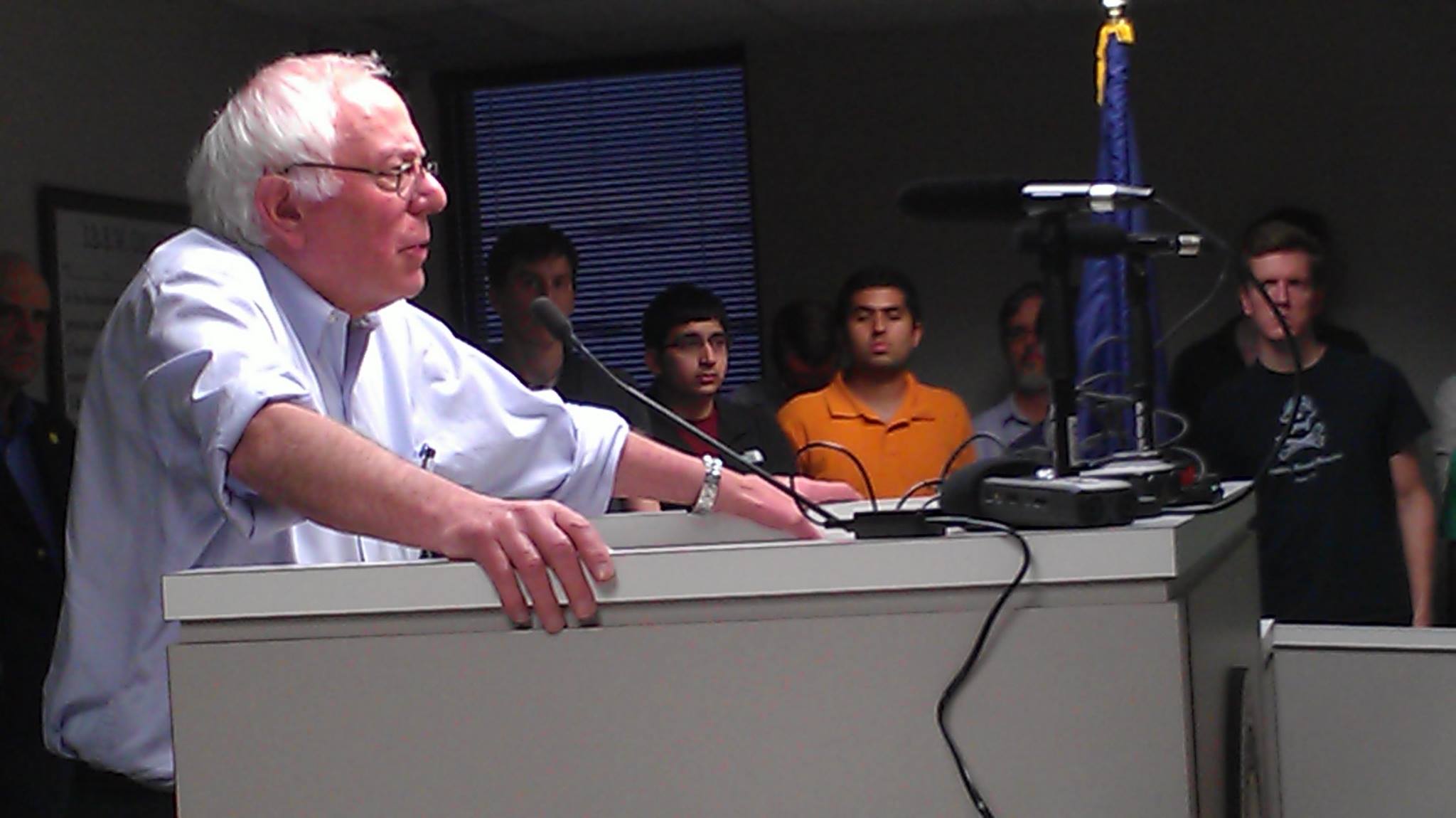
None of the candidates in the 2020 presidential race are going to put things right. Not even Bernie.

My idea is not original. I got it from Bernie Sanders. In every speech and message, Sanders tells us that fundamental change will only come from a great united movement. Not from any candidate.

A good example was Mr Obama. He was elected on a slogan of “change,” and I think he sincerely meant it. As president, I think he did about as well as could be done. Working people certainly benefited.

But my old friend George Meyers was completely correct when he taught me that every victory for working people has to be won over and over as long as the employers are in charge. No matter what we win, they can, and will, always take it away.

So none of the candidates, not even Bernie, can fix what’s wrong.

Learn from history

I think that voters knew that in 2016. I think that some of Bernie’s voters crossed over to Trump in their desperation for anything other than business as usual. If the Democrats nominate another humdrum establishment politician, Trump is likely to win again.

A vote for Trump in 2020 is a vote for fascism, but don’t forget that Hitler was also elected by a population that was desperate for something different.

What needs fixing?

There are two major problems underlying our crisis: 1) America’s waning economic power and 2) Unrestricted capitalism which, by necessity, piles up the wealth for a diminishing few while exploiting the many. In order to continue unrestricted capitalism under these circumstances, the employers find it necessary to erode and, eventually, destroy democracy.

Mr Trump is certainly not going to fix either one of these problems. In fact, by exploiting them for personal power, he’s making them much worse. It may be true that “anybody but Trump” is the right election choice for 2020, but elections are only one part of power politics.

How do we fix them?

Major social changes are not and never have been made by well intentioned individuals or small groups. It takes a united mass movement. That’s what Mr Bernie Sanders is working toward. His presidential campaigns are only a part of building that movement. Even if he loses again in 2020, support for him and his movement is still the right course. In fact, it’s the only positive course.

–Gene Lantz

I’m on KNON radio’s “Workers Beat” program at 9 AM Central Time every Saturday. If you are curious about what I really think, check out my personal web site

Book Review: Woodward, Bob, “Fear. Trump in the White House.” Simon & Schuster, New York, 2018

Most of the people who can read already have a low opinion of Donald J Trump. What they find in Woodward’s careful documentation of White House conversations is not likely to change many opinions. It will confirm, and strongly confirm, those with the opinion that the President of the United States is a lazy, prevaricating, egomaniacal, loose pistol with one finger on his Twitter feed and the other on nuclear war.

The book extensively explains that Trump believes that power is fear. But I don’t think that’s the reason for the book’s title. I think Woodward is talking about the world’s fear for its own safety.

If one wanted to take Trump’s view of things, or if one yearned for the vacuous “neutrality” nonsense to which most journalists pretend, then one could credit Trump with being loyal to his original plan. In other words, he really is against free trade, globalization, immigrants, and foreign entanglements. If those ideas are twisted and spun well, a lot of Americans would agree with him on those fundamentals. In fact, a lot of Americans voted for him and will vote for him again.

The popular idea that any Democrat could beat Trump in 2020 is just as unreliable a belief as the 2016 national conviction, supported by scientific polling, that he didn’t stand a chance against Hillary Clinton. Nobody believed that Trump would take power, even though they had the clear precedent from Nazi Germany.

Understanding Is Needed

It is not enough to dislike Donald J Trump as we prepare for 2020. It is not enough to quote Bob Woodward from this book to convince people to look elsewhere for a president in 2020. If we are to make progress in the 2020 elections, we need to carefully explain what is happening and what must be done.

Certain truths need to be faced and understood. Begin with the clear fact that we are reaching the end of America’s economic dominance. The reasons for that dominance grew out of World War I and World War II. Those reasons are long gone. American continues to dominate the world militarily, but not economically. Donald Trump did not make that happen. He exploits it, but he didn’t make it happen.

Springing directly from America’s waning economic domination and continuing military domination is the growth of immigration numbers. After all, if the United States hadn’t created the Syrian military crisis, millions of people would have stayed home. In other countries, it may take two sentences instead of one to explain why families leave home, but the military and economic factors, both springing largely from the United States, are the root cause. Donald Trump exploits that situation, but he didn’t create it.

Hitler exploited the 25% unemployment rate in Germany and the failure of the social democrats to reform society. He didn’t create the misery, but he exploited it.

Speaking of Hitler and Trump, it is especially important to note that they had a lot more power afterward than they did when they were first elected. Hitler was eventually able to do away with the German legislature entirely. Trump hasn’t gone that far, but Trump and the Trump supporters have eroded the power of the legislative branch. Their control over the judiciary is even more obvious and more scary.

The Solution Goes Far Beyond Personalities

As 2020 draws near, progressive voters are asking, “Which Democrat has the best chance of beating Trump?” That question barely scratches the surface of what is needed. No one person, even a president, will change the underlying problems we face. The president that we elect, and all the down-ballot politicians that we elect, are going to have to contribute to actual solutions: organizing for fundamental change.

Gene Lantz

I’m on KNON’s “Workers Beat” radio program at 9 AM Central Time every Saturday. If you are curious about what I really think, check out my personal web site

Why am I still smiling?

In Dallas, the “business elite,” a euphemism for “unscrupulous greedy rich people,” won the June runoff elections for City Council and School Board. Turnout was among the lowest in the nation.

Elections are absolutely critical, but we always find that the winners we support (think Obama) can’t really save us from everything and the ones we worked against (think Trump) can’t really do as much damage as we feared. So elections are not entirely completely totally about who won and who lost.

To understand politics, we have to look beyond candidates and try to understand trends. For example, the Dallas election turnout was 33% higher than the last comparable election. The runoff election, which should have had a much lower turnout than the first round because there were far fewer candidates, was the same as the first round!

What does it mean? It means that we may have a very low level of political consciousness in Dallas, but that it’s dramatically improving! That’s one thing to smile about!

Another trend worth noting is the humongous amounts of money that rich people are paying to win elections. Positions that they used to buy for a few thousands are now costing them millions! Money still wins elections, but it takes more of it!

Another very good trend sounds like a bad trend: the political stooges of the rich-and-greedy are trying every possible way to end democracy, especialy as it applies to elections. Voter suppression is obvious in many state legislatures, especially ours. If they weren’t running scared, would they be publicly shaming themselves so?

The rule of the rich-and-greedy is becoming precarious, and they know it!

Some other good things are evident in Dallas’ local elections. In the past, it was difficult to pick the candidates to vote for. Nowadays, the Dallas AFL-CIO has perfected the most comprehensive screening process ever available for working families. Many Dallasites haven’t realized it yet, but the information is there for future elections.

And, speaking of information, the Dallas AFL-CIO is steadily improving its ability to inform and activate the progressive population. In the last week of the runoff election, we were finally able to establish a Digital Organizing Committee that will be the beginning of a progressive information network. Our goal is to organize everybody, and, thanks to the farsighted National AFL-CIO leadership, we have the tools to do it!

Thanks for reading this. You’re proving my point! If you share it around, you’ll prove it even more!

-Gene Lantz

I’m on KNON’s “Workers Beat” program 89.3 FM in Dallas at 9 AM Central Time every Saturday. If you are curious about what I really think, check out my personal web site

I had to agree with just about everything that presidential candidate Bernie Sanders said on Facebook Live on June 12. I especially liked his opening remarks.

Sanders said that our nation and the world are facing a choice of two different paths. One goes toward authoritarianism and oligarchy, the other toward socialism. Worse yet, our nation and the world are being forced to choose one or the other. “This is that time,” Sanders said.

Rampant inequality is causing the crisis. In our nation, three families control more wealth than the bottom 160 million. Worldwide, a mere 26 billionaires have more than half the planet’s population. It gets worse every time statistics are discovered.

Sanders correctly compares today’s situation with the one we faced in the 1930s. Europe ended up with the bad path, and Franklin Delano Roosevelt took America on the good path. Sanders says that our task today is to continue Roosevelt’s plan, not Hitler’s.

How? You may properly ask. Sanders says, “The only way we can achieve these goals is through a political revolution.” I agreed with that, too.

When Sanders’ plan gets shaky is when he says that his revolution will be accomplished with no more effort than good electioneering and voting. I’d certainly like to agree with that, but it’s actually going to be considerably harder. After all, F.D. Roosevelt was elected four times and permanent progress still eluded us.

Getting organized with the Bernie Sanders campaign may turn out to be only a first good step, but no one could deny that it’s a darned good first step.

–Gene Lantz

I’m on KNON radio’s http://knon.org/workers-beat “Workers Beat” program 89.3 FM in Dallas at 9 AM Central Time every Saturday. If you are curious about what I really think, check out my personal web site

May 17, 2019, President Jair Bolsonaro of Brazil visited Dallas. Activists here were able to mobilize a hundred or so protesters and get major statements from political and labor leaders against the visit.

What Is Fascism? What Do We Do About it?

Afterward, the conversations are turning toward really important topics such as “What Is Fascism?,” “How Does It Take Hold?,” and “What Do We Do About it?”

“What is fascism but capitalism in its death agony?” —The Journal of Albion Moonlight

To begin with, fascism is not an economic system nor a stage of economic development. It’s not a religion nor an anti-religion. It isn’t cultural tastes or outlook. It is a form of rule.

Do We Have Fascism in America?

The form of rule that we have in America is limited democracy. It is not as limited as it was before, say, the Civil War, nor even as limited as it was before Roe V Wade or Brown V Board of Education. One might notice that it’s more limited now than it was before the Supreme Court ruled in Citizens United. But democracy in America is limited and always has been. We may have fascists in America, but we don’t have fascism. They haven’t taken over. At least not yet.

Democracy Opposes Fascism

When limited democracy just isn’t working well for the people in charge, they are left with fascism as their next option. The only other option would be to stop being the people in charge. In other words, fascism is a choice that desperate rulers make.

From their point of view, fascism is not as efficient as limited democracy because their workers in general willingly support them, but, from the the rulers’ point of view, it’s a lot better than giving up power.

If the corporate rulers of America decide that limited democracy isn’t working well for them any more, they will try to institute fascist rule.

Hitler Made a Deal

In Germany after World War I, the limited democracy imposed by the victors was called the Weimar Republic. It had so much debt and so many problems that it was weak. The communists and socialists, on the other hand, were on a roll. Hitler and his Nazis offered the German ruling class a way to maintain power by killing off the activists and destroying the democratic forces. In desperation, the rulers bought it.

The great powers of the day — United States, England, and France — liked the idea well enough because they had their own problems with socialists and communists. They allowed Hitler to take power, re-arm, and, just for practice, destroy the Spanish Republic.

Bolsonaro Made a Deal

Recently in Brazil, forces based on the trade union movement brought a flourishing democracy to replace the military dictatorship. It was working out great for the working people, but not so well for the capitalists. Using their control over the judiciary, they were able to jail the leaders of the democratic movement and put Jair Bolsonaro into power. Like fascists before him, he spews a lot of very divisive hatred.

They call him the Tropical Trump, and he’s a special friend of the White House here.

What’s All the Confusion?

The confusion about fascism is deliberate.

Ronald Reagan said that liberals were fascists. In one of the greatest examples of doublespeak of all time, Winston Churchill said that anti-fascists are fascists!

The Underlying Reason for Fascism

Capitalists do not prefer fascism. They prefer the efficiency of limited democracy for their rule. But they are doing something that they cannot help doing — piling up wealth for themselves at the expense of working people. Since the end of the Vietnam War, rich capitalists have taken an astonishing percentage of the world’s wealth. This year, 24 capitalists own more wealth than half the people on the planet!

It should be obvious that they can’t count on the cooperation of the people on the losing end. If we aren’t cooperating with them, then limited democracy isn’t working. The capitalists see that even better than we do.

Incipient Fascism At Home

A lot of really nasty people with billions of dark dollars are already working to establish fascism in the United States. Like their co-thinkers in Europe, they have seized on immigrants as their “threat from the other,” just the same way that Hitler and Mussolini used Jews.

In order to keep the democratic forces divided, they also throw in a lot of homophobia, religious intolerance, nationalism, and racism. The institutions of democracy such as freedom of information and the right to organize are their special targets. It worked for Hitler and it works for them. Since 1980, when the capitalists recognized that their hold was slipping, they have made a lot of progress. Mr. Trump makes a fairly good figurehead for them.

How Close Are We to Facism?

As this is written, the fascist forces have already provoked a phony constitutional crisis by refusing to recognize American law and democracy. In our ignorance, a lot of Americans support them. What they need now is the same thing that Hitler and Mussolini needed to smash democracy and establish fascist rule — a war.

Iranians are being demonized. There is an aircraft carrier task force in the Persian Gulf….

-Gene Lantz

I’m on KNON’s “Workers Beat” program 89.3 FM in Dallas at 9 AM Central Time every Saturday. If you are curious about what I really think, check out my personal web site.
Considering the number of churches and mosques burnt or bombed lately, the number of worshipers of different faiths murdered by those of some other faith, and the rise in persecutions carried out in the name of religion abroad and at home; it’s time to try to understand what is wrong.

The one thing that all these atrocities have in common is obvious: religion itself.

The Problem is Religion

I make no secret of the fact that I am afraid of all religious people. I may respect them, I may even esteem some of them for their courage or for their compassion or for their oratorical ability or for the breadth of their knowledge. But I’m still afraid of them.

I’m afraid of them because they can be convinced of anything. It may be harmless that some of them think they can fly, or walk on water, or live forever, but religious people can also be convinced to put on an exploding vest and murder a crowd of people they don’t know. They can be convinced to burn people alive. They can be convinced to carry out great wars that slaughter millions.

“On the dogmas of religion, as distinguished from moral principles, all mankind, from the beginning of the world to this day, have been quarreling, fighting, burning and torturing one another, for abstractions unintelligible to themselves and to all others, and absolutely beyond the comprehension of the human mind.” –Thomas Jefferson

Who’s Responsible?

Right now in 2019, a lot of people are blaming President Trump for the upsurge in religious hatred and violence. He’s certainly guilty and deserves blame.

Trump may be the least religious president in history, but he knows how to stir up the nastiest people to carry out the nastiest program. But Trump isn’t the crux of the problem. If religion were not such a handy tool, politicians like Trump wouldn’t use it. Religion itself is the problem.

Religion may be promulgated by very intelligent and capable people, but its true province is among the ignorant and easily misled. Religion is the enemy of reason, the enemy of knowledge, the enemy of understanding, and the enemy of fairness to all.

What Are You Gonna Do?

In general, one cannot argue people out of religion. They don’t believe in facts or evidence. You can’t convince them emotionally either. Even religious people can’t convince other religious people of anything.

“When has one religion triumphed over another by debate, experiment and observation?” – Isaac Asimov

“The truths of religion are never so well understood as by those who have lost the power of reasoning.”  — Voltaire

One cannot persecute people out of their religion. Historically, they have thrived on persecution.

The antidote for ignorance is knowledge. The antidote for superstition is science. If we promote science and knowledge, we are helping relieve our brothers and sisters of the burden of religion. The process may be painfully slow, but it’s the only way forward to a better future for all.

–Gene Lantz

I’m on KNON’s “Workers Beat” program at 9 AM Central Time every Saturday. If you are curious as to what I really think, check out my personal web site

RANDOM NOTES:

When I was in the military, there was a chaplain on every warship. It might have cannons, fighter planes, torpedoes or missiles, but it also had a chaplain!

Bertrand Russell: “The Christian religion, as organized in its churches, has been and still is the principal enemy of moral progress in the world.”

(William Penn, Quaker leader) “To help mend this world is true religion.”

“Woe to him who makes neighbors work for nothing and does not give them their wages.” Jeremiah 22:13

You cannot serve God and mammon. Matthew 6:24

Marx: “Religious suffering is at one and the same time, the expression of real suffering and a protest against real suffering. Religion is the sigh of the oppressed creature, the heart of a heartless world and the soul of soulless conditions. It is the opium of the people. The abolition of religion as the illusory happiness of the people is the demand for their real happiness. To call on them to give up their illusions about their condition is to call on them to give up a condition that requires illusions. The criticism of religion is, therefore, in embryo, the criticism of that vale of tears of which religion is the halo.” (1844. Quoted in Dallas Morning News 10/12/08 by Gregory Rodriguez making the point that Marx was against oppression, not against religion which is only a symptom of oppression)

Edwards, David: “The suggestion seems to emerge that man’s maturity coincides with his abandonment of religion.”

Patiently explain.

It makes sense that everybody who works would want to study successes and failures of those who struggle to make things better for our side. But do we?

Author Eric Blanc talked about the recent wave of successful school employees’ strikes to a small group gathered at Alliance/AFT (school employees) union hall on April 30, 2019.

Blanc, Eric, ‘Red State Revolt. The Teachers’ Strikes and Working-Class Politics.” Verso, London, 2019

The book is available on Amazon and elsewhere on-line. Blanc said that all money gained from book sales will go to “the national strike fund.” Apparently, he’s not just reporting on developments in the working class; he’s pulling for us!

The strike wave actually began a few years back with the Chicago Teachers, but the West Virginia wildcat strike of 2018 was the immediate inspiration for the successes that followed. Blanc emphasized that strikes in the American labor movement had become quite rare, and successes were threatened with extinction before a small group, Blanc mentioned that there were two or three of them, started things moving.

Another important aspect of the school employees’ strikes was the high degree of unity showed between different job groups, different ethnicities, and different communities. Blanc said that it is no coincidence that the other two industries that had large numbers on strike in 2018 were health care and hotels.

What’s the connection?

Women.

In all three industries, women dominate. “Really, these strikes were led by women,” Blanc said. It makes perfect sense. Women, especially women of color, are also winning elections right and left!

What Were the Main Issues?

Blanc said that none of the strikes were about wages. They were about changing the national dialog, created by the dark money manipulators, that schools are failing and the solution is privatization. There was never any evidence to support the idea, but it was the only thing being said prior to the strikes. Blanc said, “The reality is that privatizing is being tried and it isn’t working. All it does is hurt workers and students.”

Teachers struck against privatizing. They struck against divisive school policies such as merit pay. They struck in order to be able to teach instead of spending their entire day filling out forms. They struck over class sizes.

“You Can’t Do It Here”

Just about all I’ve heard here in Texas since the West Virginia strike is that such an activity would be impossible in Texas. Blanc pointed out that West Virginia, Oklahoma, and Arizona are just as Republican-dominated as Texas. School strikes were just as illegal in West Virginia as they are in Texas. The way to keep from getting fired for striking, all seasoned unionists know, is to win the strike.

What’s Next?

Blanc wound up his opening remarks by pointing out that the strike wave is continuing. He said that there will be one-day walkouts in South Carolina and North Carolina. Tennessee and Oregon may have actions coming up. “That should give us hope in our opportunity to seize this moment.”

Who Is Learning These Lessons?

Only 18 of us gathered to hear Eric Blanc. I was the only one from the private sector. Virtually all of the questions thrown at Eric Blanc were about obstacles that school employees had faced and how the Texas situation might compare. I was almost last when I asked how we can get the entire labor movement to realize that the school employees won because they curried broad-based support.

Blanc responded that other kinds of workers could develop broad support for strikes and other progressive activities. “The majority of the workplaces have a relationship with the public that can be leveraged, but it’s not being leveraged right now.”

When somebody finds a winning combination, it makes sense that the rest of us would study their tactics. We might start by reading Eric Blanc’s book.

–Gene Lantz

I’m on KNON radio’s “Workers Beat” program at 9 AM Central Time every Saturday. If you are curious about what I really think, check out my personal web site

Movie Review: “Peterloo,” Written and Directed by Mike Leigh, 2 hours 23 minutes


How strikes were ended

The new British historical epic was released in Dallas on April 19. I imagine they would like to hope it would run until August 16, the 200th anniversary of the slaughter of hopeful worker activists around Manchester. The run time will almost certainly be disappointing, because movies with a solid political message seldom last longer than one week in our town.

My movie buddy and I went to see it because we knew that the writer/director was capable of saying very good things about working families. Nearly all movies are about the affluent or the artistic. We were certainly not disappointed with “Peterloo!”

Another great thing about Leigh is his ability to develop women characters. Even though history only names the men who organized the effort and the men who did the murdering, women must have been very important in the struggle for British reforms. They show up well in “Peterloo.”

Moviegoers who have no interest in improving the condition of humanity are probably going to think that this film is a tad too long, covers too many characters, and includes too many speeches. Those of us who want to learn from history in order to make a better future, a large group that almost certainly includes Mike Leigh, think it was too short.

In 1819, a reform movement was sweeping through the miserable lives of British manufacturing workers. The heroes in this story are the weavers, men and women, in Manchester. The setting alone is fascinating, because Frederich Engels, lifelong collaborator of Karl Marx, wrote his important literary work, “The Condition of the Working Class in England,” about these very Manchester families.

Leigh did not stint on spending for this film. Every frame rings with authenticity. The one or two short scenes of the great mechanical looms in the textile mill must have cost a small fortune. Every set, every costume, every sallow-complexioned worker, convinces us that we are actually watching what happened in that great historical worker upheaval.

Know your constituency

As a lesson in strategies, Peterloo is superb! Leigh establishes exactly what the workers must have been thinking in 1819, and he goes over every painful question they had to answer as they prepared to go on strike and carry out a massive demonstration involving over 60,000 people.

Every moviegoer already knows how successful they are going to be, as history doesn’t say “Peterloo” without saying “massacre.” Discerning activists will be watching to see what might have been done differently so that the workers might have found success. We also watch to see how we can refine our efforts today.

As the lower tactical level, it would be hard to fault the weavers. They did a wonderful job of convincing tens of thousands of exploited people to come together.

Know your enemies

But at the higher strategic level, they made a tragic mistake that all of us must learn and apply to today’s thinking: they were so caught up in their efforts to organize and unify themselves that they did not give proper consideration to their enemy. Class struggle isn’t one sided. There is another class on the other side, fighting against us, and they cannot be ignored. Most important, they cannot be underestimated.

-Gene Lantz

I’m on KNON’s “Workers Beat” program at 9AM Central Time every Saturday. If you are curious as to what I really think, check out my personal web site