Archive

history

Movie Review

“Bisbee 17,” Directed by Robert Greene. 124 minutes

bisbee17

My movie buddy and I ordered tickets as soon as we heard there was a documentary on the Bisbee Deportation. Good thing we did, because they only scheduled three showings in our town. Most towns won’t get to see it at all. I wonder if they will show it in Bisbee, Arizona?

People who like artsy, independent movies for their own sake might like the film. People who judge movies on their effectiveness probably won’t. People who just want to see some honest working people’s history revealed at last will be glad they made “Bisbee 17,” but even then, I’m not sure they will like it.

The Wikipedia version, just telling the story straight, is a better way to find out about the forced deportation of 1,300 striking miners on July 12, 1917. I have always wondered how they carried it out, but the movie explains that very well.

The Phelps Dodge Mining company and its stooge sheriff deputized over 2,000 men. They made sure to get the Anglo-Saxons because they were targeting virtually every man who wasn’t. They armed those deputies and then started arresting all strikers and anybody who might support them, even people who only attended one meeting “just to listen.” One deputy arrested and deported his own brother, according to the movie, and never saw him again.

Then they marched everybody down to the railroad and loaded them on cars to nowhere. The sheriff announced that he would kill any who returned to Bisbee. The compliant (complicit) railroad company took them out into the desert and stranded them there.

The strikers were with the Industrial Workers of the World (IWW). They were supposed to have been represented by the Mine, Mill, and Smelter Workers but union complacence gave the energetic IWW a chance to move in. It’s not in the movie, but one of the main IWW organizers was my personal hero, Frank Little. Little ducked the deportation and went on to another copper miners’ strike in Montana, where he was lynched less than 3 weeks after the Bisbee Deportation.

The artistic movie man took advantage of the centennial re-enactment of the Bisbee Deportation to film the local people preparing for and carrying out their re-enactment roles. As they were all Bisbee people, most of them were also the descendants of the perpetrators. Many of them still held the same racist, chauvinist, jingoistic beliefs of their forebearers and said so in the movie.

Maybe the best scene is when one outraged man speaks to a planning meeting of Bisbee citizens and says, roughly, “Some of you are saying we have to tell ‘both sides’ of the story! That’s like telling ‘both sides’ of the holocaust!” He made a good point, but the re-enactors didn’t listen. The movie man didn’t, either. That’s the problem with “Bisbee 17.”

–Gene Lantz

I’m on KNON 89.3 FM “Workers Beat” talk show every Saturday at 9 Central Time. If you are curious about what I really think, check out my personal web site


My summary of history in Texas is that it’s mostly junk. But here’s a great exception:

Book Review:

“The WPA Dallas Guide and History” written and compiled from 1936 to 1942 by the workers of the Writers Program of the Works Projects Administration. Published in 1992 by the Dallas Library

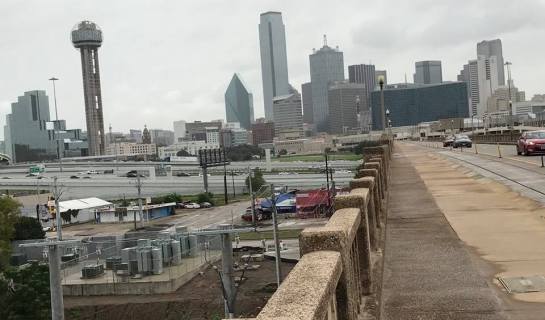
houstonviaduct

In 1912, the Houston Viaduct was the longest concrete bridge in the world

Congressman Martin Dies, the Joseph McCarthy of his day, was able to kill the WPA Writers Project before this book was published. He said that the Writers Project was “doing more to spread Communist propaganda than the Communist Party itself.” Fortunately, he died. Scholars used the manuscript as a primary resource, but hardly anyone else saw this wonderful history book for decades.

Years later, the good people associated with the Administration in the City of Dallas were able to get it published by the Dallas Public Library Texas Center for the Book, University of North Texas Press in 1992. I believe the Dallas library owns five copies. I read it in 2010, but it’s such a compelling book that I read it again in September, 2018. All of these WPA Guides are terrific! I just ordered the “WPA Guide to Texas.”

WPA Guide to Dallas is the most comprehensive history of the city. It includes names, dates, and exact places (on a 1940 map) of everything of importance here.

The Writers Project wrote dozens of historical guides. They intended to bring them all together into a comprehensive history of the United States. Martin Dies and the bureaucrats of 1940 were able to stop a lot of the publications. Every one of the “Guides” that I have seen is better than anything else on their subject. This one is certainly no exception.

During the Great Depression:

“Mellon pulled the whistle,

Hoover rang the bell

Wall Street gave the signal

And the country went to hell.”

The Roosevelt administration, faced with much criticism, changed the name from Works Progress Administration to Work Projects Administration and cancelled the writers project. Dallasites had to find a sponsor that would contribute at least 25% of the cost of the program. The Bureau of Research in the Social Sciences at the UT of Austin sponsored the Texas project.

Here are some of my notes from the book:

John Neely Bryan settled, by himself, on the banks of the Trinity 1841. The Beeman family soon came from Mustang Branch (Farmers Branch) to join him and he married one of them. He eventually sold out to Alexander Cockrell, who got killed in a gun fight. Sarah Cockrell then played a big role in developing the town.

Page 50: Jane Elkins was hanged for murdering a man named Wisdom in Farmers’ Branch, May 27, 1853.

Page 50: April 26, 1854 came the advance guard of the La Reunion colonists. They were followers of Charles Francois Fourier. French and Belgians bought 1,200 acres of land on the western side of the Trinity. “The whole population of Dallas turned out to celebrate the arrival June 16, 1855, of the main body of these idealistic European immigrants, and they were welcomed by a committee headed by their fellow countryman, Maxime Guillot, who acted as interpreter. Guillot had remained in the area after the failure of an earlier utopian community. //This was probably the Icarians of 1846//

P54 Account of the downtown 1860 fire, hanging of 3 slaves, exile of 1. Flogging of all the others.

Back in those days, there were so few men in Dallas that they had to take turns on the jury condemning themselves for gambling. Each would defend himself, then return to the jury box after being found guilty.

Dallas was the center of the buffalo hide trade, then a central cotton factoring area.

Mayor Ervay was jailed in 1872 for refusing to leave office after being ordered by carpetbag governor EJ Davis. By 1875 Reconstruction was over in Dallas.

P67 Really good narrative on Belle Starr, who had a livery stable “somewhere near Camp Street” specializing in stolen horses. (1875). She was shot in Eufala area, Feb 1889.

P68 romantic tale of Sam Bass

P90 1918 effort to start fireman’s union failed. In 1919 a widespread sympathy strike involving inside electricians, then building trades, and garment workers. Resulted in a walkout by linemen.

P 97 “The early months of 1934 were marked by agitation among the unemployed, organized by the Workers Cooperative League for rent, fuel, and clothes allowances in addition to groceries. The fight of local initiative against the depression continued unabated, resulting in the launching of an extensive public works program including the $1,000,000 Triple Underpass at the foot of Elm, Main and Commerce Streets .By the end of the year the Works Progress Admministration had also given employment to 3,000 workers in the city.”

P98 “…wave of mob violence and labor disorders in the summer of 1937 which culminated in the sending of Rangers to Dallas by Governor James V Allred, despite protests of local officials.”

P103: list of Mayors

P157: comprehensive list of labor organizing and troubles. Knights of Labor were here before April 1882. Typographers were the first AFofL union: April 6, 1885.

Carpenters had a successful strike May 6, 1890, for a 9 hour working day. “By 1896 there were twenty labor unions with an aggregate membership of about 2,000. On Nov 20, 1899, a charter was granted by the AFofL to the trades assembly of Dallas, the original central organization in the local labor movement. This assembly lasted until 1910, when on January 8 a charter was issued to the Central labor council, which still functions.” (1940)

P158 in 1919 the linemen struck Dallas Power & Light. “On June 11 a pitched battle with clubs and shotguns occurred at Routh Street and Cedar Springs Road, in which AJ Fisher, a former deputy sheriff employed as a guard for a crew of nonunion workmen, was killed and four men wounded, three of them strikers. Seven union members were arrested and on June 24 the grand jury returned indictments for murder against four: Al Shrum, WT butcher, Robert Roy, and WF Bohannon. Al Shrum was convicted of manslaughter October 27 and sentenced to three years imprisonment.”

ILGWU struck early 1935. Strike abandoned Jan 1936.

Just about all the labor actions listed failed.

In 1940, there were 52 local AFofL unions. //The CIO was largely unsuccessful until 1941 when Ford was organized//

Labor Temple at Young & St Paul was formally dedicated by Governor James E Ferguson, Jan 8, 1916.

Dallas [anti-union] Open Shop Association started 1918.

Pgs 157-160 have the best possible coverage of early Dallas labor organizations.

But the book goes on and covers everything of interest in the city and county. It has sections on Negroes and Hispanics.

P286 good account of La Reunion, the socialist colony that contributed so much to Dallas culture, including a good account of its final days at the beginning of the Civil War. There was a standoff with authorities and one man was wounded.

P296 words to “deep ellum blues” Good account of Leadbelly and Blind Lemon Jefferson

P311 Jack Johnson worked as a dishwasher in a Dallas restaurant, Delgado’s at 248 Main. He held local fights against other Blacks. This apparently was before he became champion in 1910.

Buy a used copy from Amazon:

https://www.amazon.com/gp/offer-listing/0929398319/ref=sr_1_1_olp?s=books&ie=UTF8&qid=1538072737&sr=1-1&keywords=WPA+guide+to+Dallas

–Gene Lantz

I am on KNON radio’s “Workers Beat” 89.3 FM in Dallas at 9 AM Central Time every Saturday. If you are curious about what I really think, check out my personal web site


We always assume that Lizzie Borden was guilty of the axe murders of her father and stepmother.

Movie Review:

“Lizzie,” Directed by Craig Macneill. 105 minutes

Chloe Sevigny produced this film and carries almost every scene as the central character. She does a fine job of acting, but Kristen Stewart deserves tremendous credit not only for a fine acting job but also because she keeps stretching her capabilities by taking on more and more diverse roles. In this one, the vivacious star of all those “Twilight” movies plays a mousy little immigrant housekeeper.

The real Lizzie Borden was never convicted of all that whacking, but the literary Lizzie, it seems, will forever be guilty until proven innocent.  Recently, she’s also become a feminist trailblazer. She wouldn’t have acted out so murderously, we are given to understand in the movie, if she hadn’t been repressed in the 1890’s. I think this movie makes that point very well through the drama itself, through the tension we in the audience feel on Lizzie’s behalf, and decidedly not because of sermonizing.

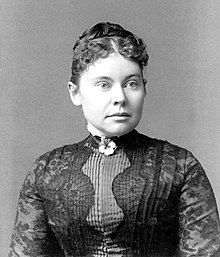
lizzieborden

After the movie, you might want to decide about Lizzie’s culpability and motivations on your own. Wikipedia has a good treatment. You might also want to check out the 1975 made-for-TV version starring another very good and versatile actress named Elizabeth Montgomery. It’s free on YouTube. It’s also very good.

We liked the movie. It had a lot of tension and, all the way through, seemed very honest. Also, there were three union logos in the last frame.

–Gene Lantz

I’m on KNON’s “Workers Beat” program 89.3 FM at 9 AM every Saturday Central Time. They podcast them on Itunes. If you are curious about what I really think, check out my personal web site.

Reverend L. Charles Stovall needed a ride home from the Dallas Labor Day Breakfast, and I was happy to get to spend time with him.

Stovall and Hickman at the Labor Day Breakfast in 2011

Almost as soon as he got in the car, he called Reverend Holsey Hickman to tell him that the annual breakfast is getting better and better. I wholeheartedly agreed.

The hard data showed that ticket sales were way over the 500 mark that we strived for over the last decade. Participation from labor, political, religious, and community leaders was far better. The three of us could remember when area unions had to scramble to even find even one religious leader to open the ceremonies. There were no community groups. Civil rights and immigrant rights weren’t mentioned.

National Unions Are Watching Dallas

This year, we had two national union leaders speaking: UFCW International President Marc Perrone and ATU International Secretary-Treasurer Oscar Owens. Perrone told the crowd, “We are the labor movement. We are the last and only hope for America.” He also said, “The fight for justice will go on forever as long as there are greedy bastards out there!” My favorite quote was one word repeated three times, “Organize! Organize! Organize!”

Texas AFL-CIO President Rick Levy was in the audience and trying to listen while admirers hustled him into one photo opportunity after another. Louis Malfaro, leader of Texas’ biggest union, the Federation of Teachers, presented the Linda Bridges award for outstanding union women to the Dallas AFL-CIO Political Director, Lorraine Montemayor. The applause showed how much everyone agreed with the choice. Montemayor said, “You are the backbone of this country!” Then, true to form, she began outlining some of the hard work planned for this election season.

The award for “Hero of Labor” deservedly went to DJ Garza of the UAW. As an organizer for the Workers’ Defense Project, Garza has made a difference in winning rights for Dallas workers. The “Community Champion” award went to Faith in Texas. They turned out many volunteers for the recent petitioning campaign to win paid sick time.

Political Leaders Know the Value of Union Support

I don’t know if Mark York, principal officer of the Dallas AFL-CIO and emcee for the breakfast, was able to mention every office holder and candidate in the audience. It seemed to me that they were all there. Texas governor candidate Lupe Valdez put it this way: “I work with unions because we want to do the right thing for every working Texan.”

Colin Allred, candidate for Congress in District 32 — one of the most closely watched races in America — wowed the crowd. Like many candidates this year, he is also a union member. Also on the dais were Congresspersons Eddie Bernice Johnson and Marc Veasey. The Texas Democratic Party Chair, Gilberto Hinojosa, came to speak, as did  Senator Royce West, State Rep Victoria Neave, County Judge Clay Jenkins, Commissioner John Wiley Price, and Councilman Scott Griggs. Out in the audience, there were many more.

Look Back, Look Forward!

Us old timers can remember when the annual breakfast petered out for a couple of years. It was expensive back in the 1990s, and sometimes it just didn’t seem like it was worth the trouble. During those two years without the annual AFL-CIO breakfast, our little Jobs with Justice group seized the opportunity. We didn’t have the money for a banquet, so we fell back on time-tested labor tactics. We did car caravans to labor’s “hot spots” around North Texas. News reporters liked it, and we more than kept up the Labor Day tradition.

When the breakfast started again, Jobs with Justice worked to get faith leaders, especially Stovall and Hickman — because they were also major civil rights leaders — to come. We had to raise the money, but we soon had a table of ten religious and community leaders. Stovall and Hickman reflected the new, broader and more inclusive AFL-CIO that would extend its influence throughout the progressive movement.

This trend is extending. In 1999, the AFL-CIO began to reach out to undocumented workers for the first time in its history. Today, there are no barriers between the Dallas AFL-CIO and every aspect of the progressive movement. The Labor Day breakfast showed that we have made tremendous progress, and it points the way toward a future in which the progressive movement is truly focused on working families. In that future, nothing can stop us!

–Gene Lantz

I’m on KNON radio’s “Workers Beat” program at 9AM Central Time every Saturday. They podcast it on Itunes. If you are curious about what I really think, check out my personal web site.

On this 125th Labor Day, there’s good news for our side:

winning-kid

The statistics recently shared by the AFL-CIO are pretty good:

  • 48% of unorganized Americans would join a union if they could. If you add the ones that already have a union, we’re a majority!
  • 262,000 new members joined last year
  • Union approval is at 62%, an all-time high

And you can add some local things that are impressive:

  • The Dallas Labor Day Breakfast has already sold more tickets than ever
  • The Dallas AFL-CIO has more staff and more participation than I’ve ever seen, and I’ve been watching for a long, long time
  • The Dallas AFL-CIO is playing a central role in several critical coalitions
  • My own local union has about 375 new members!

Look at the Trend

To really understand anything, don’t just look at what it is. Look at what it was, and look at what it is becoming. If you go back to the period between 1947 and 1995, you’ll see an American labor movement that was conservative, timid, and isolated. It was also losing two-thirds of its membership and most of its political clout.

The ice began to break in 1987 when five of the more progressive industrial unions formed Jobs with Justice to consolidate the movement and take new initiatives. In 1992, as part of Jobs with Justice, I attended a special conference on low-wage workers. In 1995, for the first time in 100 years, there was a disruption in the succession of leadership. The outgoing leaders of the AFL-CIO did not get to pick their own successors.

After 1995, things really began to happen. In 1997, they removed the anti-communist clause from their constitution and started trying to work with more people. In 1999, they stopped calling for deportations of immigrants and committed themselves to organizing everybody that works.  Since then they’ve greatly improved their outreach to women, to minorities, to gays, to environmentalists, to retirees, to workers in other nations, and anybody else that might help American working people.

And through that period, from 1995 to now, the progressive leadership from the top has sifted down into the affiliated unions, the Central Labor Councils, the rank and file, and the many other kinds of organizations that can make up a united progressive movement.

We’re Not Done

There’s a lot more to do. Way to many union members still think of themselves as superior because they have better jobs than ordinary Americans. Way too many ordinary Americans still think that the labor movement doesn’t share their interests. Way too many people don’t see the crisis we’re in and don’t see that organizing is the only way out of it. Way too many old habits persist.

But if you think of employers and employees as two different sides of a war, and if you realize that you belong on the employee side, you begin to appreciate the fact that our side is better informed and better organized than ever in American history. The employer side may have the option of destroying the world, that may be in their power to do.

But defeating our side is not one of their options.

–Gene Lantz

I’m on KNON radio’s “Workers Beat” program in Dallas 89.3 FM at 9 AM Central Time every Saturday. If you are curious about what I really think, check out my personal web site

Movie Review: “The Captain (Der Haptmann)”.  Directed by Robert Schwentke. 1 hour, 58 minutes.

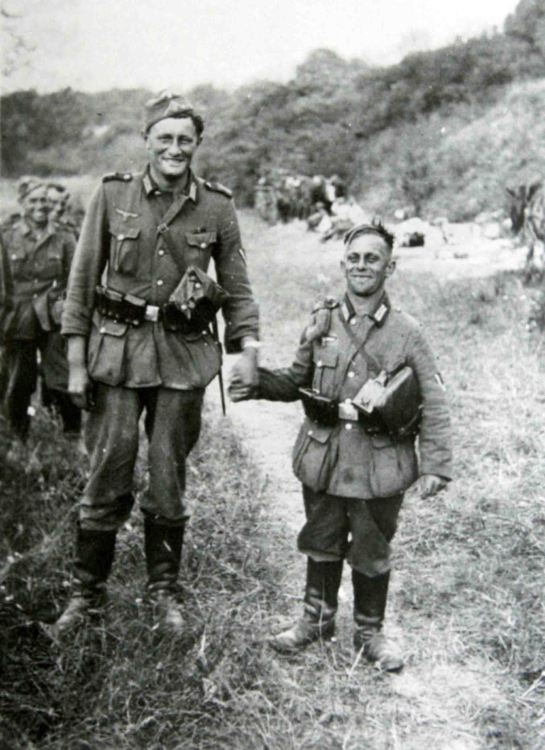
germansoldiers2

Just as you learned from the trailer, the movie is about a low-level German deserter who masquerades as an officer during the final two weeks of World War II. Toward the end of the movie, one learns that it’s a true story about a young man named Willi Herold.

Before that, you spend nearly two hours wondering and watching Willi pull off his incredible masquerade. Not only does he convince everybody he meets that he really is a high-level German officer with direct instructions from Hitler; but he convinces everybody watching the movie that he is one of the worst stereotypes of a monstrous Nazi in a monstrous war.

And we are never actually told his motivations. We really don’t know where to put Willi Herold, and he doesn’t tell us. Is he doing everything he does because he knows he is close to death and is living in a state of panic? Or is he just a terrible person who sees a chance to do something awful?

Also, we are never actually told whether we are watching a farce or a horror movie. Some scenes are as grim as any war movie ever filmed, maybe worse. Other scenes are so downright wacky that they might be some kind of movie tribute to Federico Fellini, the great Italian film maker who used realism only part of the time.

My movie buddy and I agreed that the movie was well made and that it is important. A work of art is defined as something that changes you, but it recognizes no obligation to guarantee the nature of the change.

The actors in “The Captain,” all of them set free to portray the far extremes of human emotion, are simply wonderful. The music and the shiny black and white cinematography melt the audience into the screen. My movie buddy and I agreed that we felt the need to seek out someone who would explain what we had just seen. Or maybe what we really need is somebody to sit us down and carefully explain Nazi Germany and World War II.

–Gene Lantz

I’m on KNON radio’s “Workers Beat,” 89.3FM in Dallas, at 9 AM Central Time every Saturday. They podcast it on Itunes. If you are curious about what I really think, check out my personal web site

The outlook for working families is far worse than usually noted.
inequality-europe-US

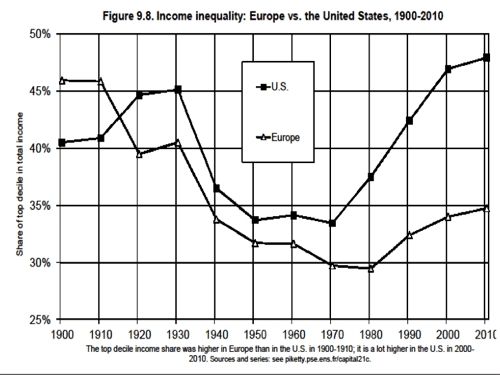
The graph above is one of those used in the best selling, world-shaking economics book “Capital in the 21st Century” by Thomas Piketty.

Like many graphs in the book, this one shows that income inequality dropped during the middle part of the 20th century. Then it began to rise again and continues to rise toward conditions that Monsieur Piketty and others describe as “intolerable.”

Popular economics books of today such as “Runaway Inequality,” a book broadly used in the American labor movement, only look at the later half of the graph – from 1945 to present. Most of the economic analysis used by the AFL-CIO is based on a “return to normal” which they define as 1945-1973. Most of us grew up in that period and consequently it is natural that we would think of it as “normal.”

In 1973, the United States and the world dropped the gold standard and began floating their currencies. After those great economic changes of the Nixon Administration, and even more so under the trickle-down “Reaganomics” of 1980, we say that really bad people distorted American economics to the detriment of working families. Since the bad people took power, inequality has continually grown much worse.

The world owes its gratitude to the Occupy Movement for having focused our attention on rising inequality. They saw that the 1% was growing in wealth and power to the detriment of the 99%, and they forced the rest of us to see it. The unfortunate inadequacy of their solution grew from the shortcomings of their analysis. They didn’t look deeply enough into the data.

Bernie Sanders took this growing consciousness much further. His analysis included the nuts and bolts of inequality, the ways that the 1% keeps the flow of wealth moving upward toward them. Sanders’ prescriptions for new nuts and bolts were much more useful than what the Occupy Movement had offered. Sanders and his followers are converging with the American labor movement today, and both are being strengthened. For that, too, the world must be grateful. I am grateful.

At the same time, during the fiery height of the Bernie Sanders campaign in 2016, even while I was campaigning for him, I often said, “Bernie Sanders will never live to see his program implemented. They would kill him first.”

The solution being put forward by almost everyone in the labor movement and by progressives at large, Bernie Sanders included, is to stop electing bad people and start electing good people who will return to the good policies that reduced inequality during 1914-1973. It’s a simple and seductive solution.

It Won’t Work

I would truly like to think that elections, elections in general and specifically the ones we’re about to have, will elect those good people, with those good solutions, and we will return to the policies that lowered instead of raising inequality in the United States and in the world. But they won’t.

I want to tell you why, even though I supported the Occupy Movement, and even though I support the Bernie Sanders socialists, and even though I am completely devoted to the AFL-CIO and the American labor movement, I want to tell you why I think their analysis is incomplete. Not only is their analysis incomplete, but their prescription, what to do about our situation, is inadequate. One cannot arrive at successful tactics without first understanding the present situation.

Look at the Whole Graph

The popular analysis, and the prescriptions that come from it, are wrong. Look at the whole graph. In fact, look at the entire history of capitalism. Piketty and his associates have accumulated data and anecdotal records going back to the early days of capitalism. Those data show incontrovertibly that increasing inequality is fundamental to capitalism. The 60-year drop in inequality, roughly from World War I until 1973, a small part of capitalism’s history, was never normal. It was completely abnormal and, in fact, antithetical to normal capitalism. What we had before 1914, and what we have now, rising inequality, is “normal.”

Didn’t Work in 2008, Won’t Work in 2018

If one realizes that we are now living in a “normal” period, then one should be able to see that there is no single simple solution. Even if we have great election victories in 2018, as we did in 2008 by the way, inequality is not going to diminish. We’re going to have to work a lot harder than that.

What we are living in now, and what we lived in before World War I, is normal. In an article titled “Who Will Be the Winners of the Crisis?”, Piketty himself explains: “Left to itself, capitalism, because it is profoundly unstable and inegalitarian, leads naturally to catastrophes.” “Inegalitarian” means what you think it does.

So the period of my youth was abnormal. What we are suffering under today is normal.

Why Did Inequality Diminish in the Abnormal Period?

Monsieur Piketty points out that the crises of the 20th century did not cause inequality to go down. As he says in the article I just quoted, “The historical data… shows unambiguously that that financial crises, as such, have no lasting effect on inequality; it all depends on the political response to them.”

So the political responses to the two world wars and to the great depression were what lowered inequality. It was the progressive taxation that lowered inequality. But why did these progressive policies get selected? Why not let the rich continue getting richer and the poor get poorer? Piketty says that the system received “shocks” with two world wars and a great depression.

Look At the Graph Again

Piketty is wrong about the “why” of diminished inequality 1914-1973. It wasn’t “shocks.” It was the success of the working class. We may not know much about the 23 countries that Piketty studied, but we do know what happened in the United States in the middle of the 20th century.

Workers Power Grew

In 1914, when Piketty says inequality began to get lower, the Socialist Party was riding high in America. Even out here, in Texas and in Oklahoma, many people were openly socialists. They voted socialist. There were socialists elected here and there and everywhere. There were socialists in Congress! The Industrial Workers of the World was terrifying employers from the textile mills of New England to the timber forests of Oregon. In 1917, socialists took power in the Russian empire! In 1919, Eugene Debs got a million votes for President while he was in prison!

The great depression hit hard in the capitalist countries, but the socialists were able to point to the Soviet Union and say “They aren’t having a depression!” Socialism, and the workers movement, was growing in popularity while inequality was falling. During World War II, it was the socialists who led the resistance movements. Many of them were so popular that they took power when the Germans and Japanese were finally defeated. Look at Marshall Tito in Yugoslavia, Enver Hoxha in Albania. Look at Mao Tse Tung in China and Ho Chi Minh in Vietnam!

In 1935 in America, the Committee for Industrial Organization took over where the Industrial Workers of the World left off. The progressive movement grew like crazy. By 1947, they had gone from a small part of the labor movement to approximately 1/3 of the American workforce! The actual numbers of people in unions continued to rise until the mid-1950s. Then it started to drop off. In that same period, socialists were red-baited into virtual obscurity.  The Soviet Union was probably at the height of its world popularity when it sent up Sputnik in 1957, but its popularity sagged after that. By the time Reagan declared war against the progressive movement, the steam had gone out of the workers’ movement, both internationally and here.

I saw one book, sold by the AFL-CIO, that says the American labor movement died in 1972 because they failed to support McGovern for President. We didn’t actually die, but we lost a lot of blood.

However one may analyze it, no matter what statistics one uses, one still has to conclude that the workers’ movement does not have the power that it enjoyed in the middle of the century, when inequality was at its lowest.

After 1980, the power of American employers waxed while ours waned. Inequality grew. Inequality is still growing.

While Employers Rule, Workers Can Make No Permanent Gains

The greatest person I ever knew personally was named George Meyers. He had been a leader of the CIO before he joined the army in World War II. George used to say, ‘There are no permanent gains for workers under capitalism.” No matter what you win, you will always have to fight for the same things again.

I had a personal experience with that. My union carried out an incredible fight in 1984-5, and we emerged with the best contract in the aerospace industry. Better than Boeing’s contract, and we were just little LTV in Grand Prairie, Texas. But nobody hangs on to those gains. You have to win them over again, the same things, win them over and over and over, every contract.

With Understanding, We Can Prescribe Solutions

The solution to the rising inequality caused today by normal capitalism is to fight with everything we can find. We have to fight to win these elections, of course, and we really need to win. But that’s not all. We need economic struggle as well as political struggle. We need boycotts, we need petitioning campaigns, we need militant contract fights, and above all we need to organize. We need to bring the entire progressive movement together and focus it on fighting the employers, the 1%.

It’s easy to say these things but not so easy to do. Contract fights are rare today, because the legalities have become so rigorous against us and our leaders have lost their edge while our members are confused. Even a simple idea like organizing is really really hard. Most union staffers and officers are far too busy to organize. There’s very little money for organizing, and there are very few unpaid volunteers in today’s labor movement.

But There’s Good News

We are in the biggest and most general progressive upsurge in American history. It isn’t focused, it isn’t united, but it’s big and it’s enthusiastic. The most exciting news of the 21st century came from the teachers of West Virginia and a few other states this year. They carried out victorious political strikes. Political strikes are common in Europe, but almost unheard of in America. That kind of planning, that kind of volunteering, and that kind of militancy is what we have to have.

I won’t say it’s easy to do what has to be done, but I will say that it has to be done. There is no other way.

–Gene Lantz

I’m on KNON radio 89.3FM in Dallas at 9 AM Central time every Saturday. They podcast it on Itunes. If you are curious about what I really think, see my personal web site. I intend to present the ideas in this article at 6:30PM Central Time on September 1 at Romo’s Restaurant, 7033 Greenville Av in Dallas. Come down and discuss it!

In my lifetime (1940-so far, so good) the biggest historical question has always been, “Why didn’t the German people stop fascism?”

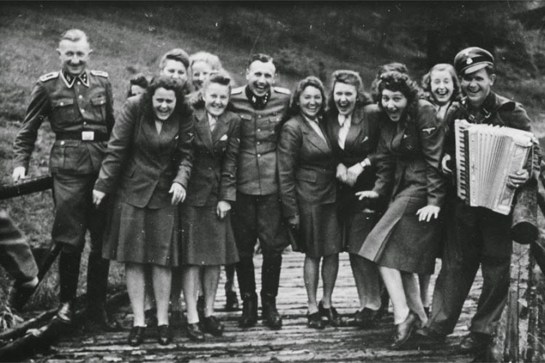
nazis-people2

Book Review: Erik Larson, “In the Garden of Beasts,” Crown, New York, 2011

When we meet people from Germany, we start looking for the right opportunity to, politely, ask them. When we read the histories, it’s what we want to know. “In the Garden of Beasts” relates the personal histories of the four family members of Professor William E Dodd, Ambassador to Germany 1933-37.

Worldwide attitudes toward the Nazis ranged from admiration to revulsion when Dodd moved to Berlin. Like most people, his family fell somewhere in between. Dodd felt that his role was to be an intermediary without strong bias. That changed over time and the course of this book.

Probably the most detailed account comes from vivacious daughter Martha Dodd. That may be because she wrote the most and lived the longest. It may also have been because she was more involved with more people and with people of more disparate political views. One of her lovers was a communist who worked in the Soviet Embassy; another headed the Gestapo, and there were several in-between.

Hitler had already been elected to high office before the Dodd’s arrived, and his popularity was already rising to fanatic levels. But he didn’t really consolidate all his power until the period that the Dodd’s experienced up close and personally. While they were there, he murdered some of his rivals and outlasted General Hindenberg, the only single person who could have stopped him.

Interestingly, Dodd had his detractors within the State Department all along. Especially after he began to condemn the Nazis, powerful Americans wanted him removed and finally had their way. His successor was still apologizing for Hitler at the end of the book. According to this author’s account, President Roosevelt supported Dodd’s view, but was forced to acquiesce in getting rid of him.

After Dodd returned to the United States, he toured the country to warn about fascism. Martha, too, worked against the fascists, but, like many others, she had to seek exile during the post-war witch hunt.

So, why didn’t the Germans stop Hitler? The best answer I got by asking came from a World War II veteran (their side, not ours) living in Dallas. He said, “The Nazis got people jobs.” Hitler came to power during the great worldwide depression. German unemployment was 25%. That’s why it was so easy for the relatively wealthy National Socialist Party to recruit young men into their Stormtroopers. After they took power, the Nazis started their great military building, which eventually overcame the worst of their unemployment problem. That’s a partial answer to the question, but not a fully satisfying one.

The real answer may never be found by asking individual Germans or reading history books. The real answer has to do with comfort zones, lack of understanding, lack of organization, miseducation, and lack of will. The reasons the German people didn’t stop fascism, even though they could see it, are the same reasons that the people of the United States have not yet stopped the trend toward fascism here. Let’s start asking about that!

–Gene Lantz

I am on KNON radio’s “Workers Beat” program every Saturday at 9 AM Central Time. Podcasts are on Itunes. If you want to know what I really think, check out my personal web site


Book Review:

Galbraith, James K “The End of Normal. The Great Crisis and the Future of Growth.” Simon & Schuster, New York, 2014. Dallas library 330.90511 G148E 2014

Some economists, and certainly those dominating the thinking in the labor movement, believe that the period 1945-1973 was “normal” and that our subsequent problems came about because of bad policies. Most notably, we blame Reagan, Reaganomics, and “trickle down” economics. Our intentions are the best, but our economic analysis is way wrong according to the last few economics books I’ve read, especially this one.

The postwar boom was not normal. It was an extremely unusual period of capitalist history during which the United States dominated the economic world. Capitalists reluctantly shared some of their largesse with a powerful and demanding labor movement. By 1973, it was pretty well over. What happened before and what is now happening afterward is normal capitalism: slow growth, rising inequality, international competition, and inevitable crises.

Some economists treat their discipline like a religion. In religion, God has a purpose for everything. He/She tends to restore balance in a world that makes sense. When things seem to go terribly wrong, God is just moving a few things around with balance and purpose His/Her ultimate goal. Religious people think that the universe has some kind of stasis, and everything within it has a natural balance that we will understand someday after we’re dead. “Farther along, we’ll know all about it. Farther along, we’ll understand why” as the song says.

This religious commitment to balance and purpose is contradicted by everything that happens. The universe has no balance: some stars collide with others, planets come and go. Our lives have no balance: we may be growing cancer cells right alongside the healthy ones.

Things aren’t balanced and purposeful. In fact, things aren’t even whatever we think they are. Everything is changing from one type of thing to another. The only “normal” is change. That’s true of economic systems as well. It’s not a religion, and there is no balance and purpose to be “restored.”

galbraithquote

Galbraith seems to know that, and he lashes the many conventional economists whose conclusions are tailored to suit the desires of their employers. You really have to appreciate Galbraith for that.

The author teaches at UT Austin. He’s a wonderful writer. Whether or not he’s a great economist, I suppose, will be revealed over the next few years because, unlike most, he does not believe that America will ever return to the growth period from around 1945 to the 1970s. He recommends that we adjust our policies for an extended period of slow growth. His recommendations are a lot like those of Bernie Sanders.

I wonder what he said two weeks ago when President Trump announced that growth in the 2nd quarter of 2018 had exceeded 4%? If they are able to sustain that kind of growth, then Galbraith was simply wrong, but that one quarter could easily be a fluke. I wrote him an email to ask.

Some of his more contemporary remarks, from January 2018, are on-line:

https://www.marketwatch.com/story/economist-james-k-galbraith-isnt-celebrating-dow-25000-2018-01-08 He correctly predicted that corporations would not invest their ill-gotten gains from the December, 2017 tax giveaway. He says they will just buy back their own stock and drive up stock prices, and that is certainly what happened over the next 8 months.

This is a good book well worth reading.

OTHER REVIEWS:

‘The End of Normal: The Great Crisis and the Future of Growth’ reviewed by Hans G Despain

Reviewed by Hans G Despainent

View comments

James K Galbraith’s The End of Normal, recently published, is a spectacular achievement in political economy generally, as a philosophical critique of the practice of economics and public policy in particular, and for its comprehensive and totalizing explanation of global monopoly-finance capitalism.

…Galbraith contends that not only does financialization generate massive inequality and instability (see Galbraith 2012), but generates opportunities for colossal fraud. Galbraith contends we must “stipulate that the Great Financial Crisis was rooted in a vast scheme of financial fraud”

https://www.goodreads.com/book/show/18144111-the-end-of-normal

Today, four factors impede a return to normal. They are the rising costs of real resources, the now-evident futility of military power, the labor-saving consequences of the digital revolution, and the breakdown of law and ethics in the financial sector.


MY NOTES:

Pg10: That bastard Richard Fisher

17 He begins his tale in 1945

21 Effect of communism. At the last chapter, he gives an interesting summary of the economic collapse of the Soviet Union from being a great power to being a total bust

57 Financialization

64 Economists are like monks in a monastery. He handles metaphors very adeptly

67 Capitalism = perfection

68 Stochastic – it means “random”

99 Could this be an error? He says that no gain results from variable costs. Does he think profit comes from fixed costs?

100: Does he think surplus value is produced from energy? Business cycles are caused by technology. Tractors basically caused the great depression by supplanting all the farmers, mules, and horses. Anyway, he thinks resource costs are a big problem. He thinks technology is not going to save us.

164 Explaining the Great Recession: “…fraud took over the financial system because it was expedient to allow it.” The basis for growth ended in the 1970s.

Somewhere in here, he mentions that nobody cares if people move from California to Colorado. I think he’s pointing out that immigration within the Economic Union is a really big problem, but it’s easy within the United States.

222 Cutting Social Security would not help the economy, as they are just transfer payments redistributing wealth but not creating or destroying any

238 There are four obstacles to achieving high growth and full employment:

  1. Energy markets remain high cost and uncertain (this was 2014)
  2. World economy is no longer under the effective financial and military control of the United States and its allies.
  3. Digital technology replaces a lot more jobs than it creates
  4. The private financial sector has ceased to serve as a motor of growth

Pg 241: Why not live in a “no growth” world? He says that our store of capital would not get replenished so productivity would fall continuously

The Soviets were a great powerhouse by the 1960s, but they did not rebuild and replenish their productive abilities and, eventually, lost the technology race. Their production got more and more costly and less and less quality. After the government collapses, the economy really went to hell. GNP dropped by half, life expectancy dropped from 72 down to 58 (pg 259).

He doesn’t think cutting the working hours would be as good as just letting people retire earlier.