Archive

democracy

Movie Review, “Viceroy’s House,” Directed by Gurinder Chadha, 106 minutes.

Like most useful political movies, “Viceroy’s House” is showing in a very limited run. In Dallas, it’s at the Inwood, but showing only twice each day and sure to disappear on Friday.

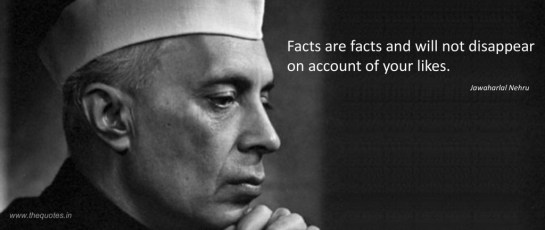
nehru-quote

Critics compare the movie to “Upstairs Downstairs” or “Downton Abbey,” partly because it stars Hugh Bonneville, who was the Earl for years on “Downton Abbey.” Actually, it compares much more with “Doctor Zhivago” or “The Year of Living Dangerously,” because it’s an epic historical movie with a tangentially related movie-type love story in the foreground, while great events are going on behind.

Lord Mountbatten, a British war hero, arrives to take over as the last viceroy in imperial India. The weakened empire wants to free its millions of subjects and, for most of the movie, the problems seem fairly realistic. The Lord and his very able wife and daughter try to deal with them as well as possible. But there’s dirty business afoot and tens of thousands of Hindus and Muslims will kill each other before the film ends. In Kashmir and other parts of India today, they are still at it.

I don’t want to give away who the real dirty s.o.b. villain is, but his initials are Sir Winston Churchill, about whom I have already delivered some opinions.

As you know, the British didn’t just turn India over to Nehru and his democratic government. Instead, they partitioned it along religious lines as they had earlier with Palestine and Ireland — two other places where a lot of people have died. The entire scheme of partitioning at the end of World War II merits some scrutiny. Why, for example, did we end up with East and West Berlin, North and South Korea, Iraq/Iran/Kurdistan, and one of our old favorites, North and South Indo-China (Vietnam).,

Come to think of it, we might look through a lot of histories and consider what governments really intended when they partitioned geographic areas. I live in Texas, for example, which was partitioned away from Mexico along with California and the entire Southwestern United States.

The movie’s director is no novice She has put together a very satisfying movie with some real political and historical significance. Her own family members were among the victims of the period. The acting is superb at every level, from Lord Mountbatten to his least servants. There are hundreds of extras in wide-lens shots that must have cost a fortune. BTW, Mountbatten’s daughter served as a consultant on the film.

Don’t miss it!

Gene Lantz

Catch me on KNON radio 89.3 FM Saturdays 9-10 AM CST


Book Review: Gaddis, John Lewis, “The Cold War. A New History.” Penguin Press, NY. 2005.

khruschev

I got the book from the Oak Cliff Dallas library. Gaddis had already written several earlier books on the period, so this one is sort of a compilation, he says.

What I liked about it was that he included some of the significant events of the Cold War period. It’s not chronological. He presents events in the order he wants in order to make the point he wants to make: that the Cold War was not so much a part of the long confrontation between labor and capital, but rather an historically isolated one of democracy versus totalitarianism. From the first, in his detached academic way, he cheers the American side.

Although it’s presented way out of order, he does talk about the 1948 CIA intervention to keep the Italian Communist Party from winning their national elections. He talks, a little bit, about America’s overthrow of the elected government of Chile and the installation of fascist terror. He mentions the CIA overthrows of the elected governments of Guatemala and Iran.

Like a lot of post-Soviet Union books, he gives his explanation for the failure of that government. He seems to think that Premier Gorbachev was confused and easily swayed by that smooth-talking Ronald Reagan. He says that the Soviets erred by trying to live up to their commitment to worldwide revolution by supporting the Cubans, the Angolans, the Vietnamese, and the many other peoples that tried to advance beyond capitalism and called to the Soviets for help. He says the Soviets couldn’t afford them.

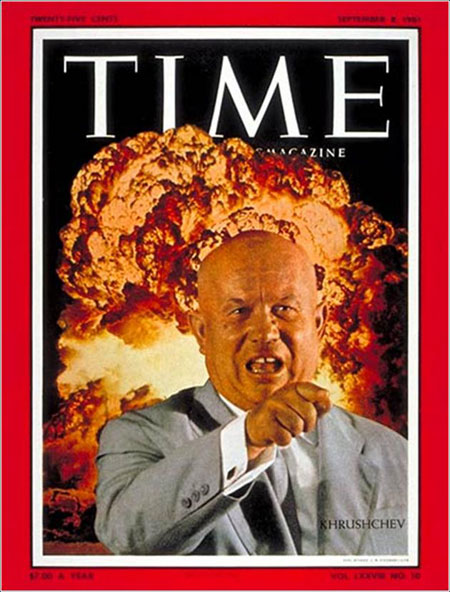
But the fundamental problem, he says, was that the Soviets could not provide the standard of living that their people had been promised. When Khruschev said “We will bury you,” no matter how that was interpreted here, he meant that the Soviets had a superior economic system.

Over the years, I’ve heard a number of smart people talking about the mistakes of the Soviet Union. Some of them imply that those mistakes were also made by the worldwide socialist movement and, especially, by CPUSA here. I think this book nudges us toward an idea of what those mistakes might have been:

1) They mistakenly thought they could extend cooperation with the United States and other capitalist nations after Hitler was defeated.

2) They mistakenly thought that capitalist economies would resume their desperate pre-war economic depression after the war

3) They mistakenly thought that no single capitalist nation could unite the others against them

4) They underestimated the post-war prosperity phase.

Having lived through the Cold War, and after visiting the Soviet Union twice and doing some of my own studying, I have to agree with the book’s author on this important main point: I don’t know if the Soviets could have provided a superior standard of living for their citizens, but I am convinced that they didn’t.

Gaddis, the author, says that a market economy is fundamentally superior to a planned economy because it is more flexible. The Chinese economy, he says, succeeds because they embraced capitalism.

Certainly, the Korean War, the Missile Crisis, and the Vietnam war are covered.  But some things were not.

I just glanced at the book’s index to see if he included some of what I considered the most important aspects of the Cold War: The Taft-Hartley law that put America’s unions into a long downward spiral, the trial and execution of the Rosenbergs, Senator Joe McCarthy’s hearings, the McCarran Anti-Subversive Act(s) that sent American activists to prison, and the House Unamerican Activities Committee which destroyed so many lives. None of them are mentioned; none even made the index. If he had mentioned such things, I might have given more credibility to his thesis that the Soviets and Americans were equally to blame for having started and perpetuated the Cold War.

I don’t think that this “equal blame” idea can stand the test of history, because the wealthy capitalist countries opposed the Soviet Union in every possible way from its inception, 100 years ago. World War II provided only a brief interruption in attacks against the Soviets, and they did that only because Hitler had become such a threat to all of them. From 1917 to 1941, and again immediately after the war, the United States and the other imperialist nations did all they could to undermine and overthrow the Soviets.

I think that the Soviet Union fell as the result of an attack. The frontal attacks, although there were plenty of them, could not bring the Soviets down. But the long siege did.

World War II ended with a gigantic Soviet and American victory in 1945. The declaration of Cold War came from Winston Churchill, sharing a podium with President Truman,  in Fulton, Missouri, March 5, 1946 – less than a year after the hot war ended.

–Gene Lantz

I’m on KNON radio 89.3 FM from 9 to 10 every Saturday. Call in your opinions!

For the past several weeks, I’ve been hosting on-line meetings on digital organizing.

digital-organization-computer

It’s not that I know a lot about it. I do these meetings because they need doing. Our progressive movement is exploding like an adolescent in a growth spurt. But, like an adolescent, it isn’t very well coordinated and doesn’t seem to know where it’s going.

The on-line part of the work could bring us together, it could coordinate our activities, and it could help turn this strong but clumsy adolescent into the soldier we need.

Techies Don’t Usually Set Organizational Policy

I have been around computers since 1963. In business and in politics, the techies usually get called into strategy meetings, but only to provide a general idea of what is possible. The overall goals of each organization are set by somebody else, and the techies shoehorn their abilities into someone else’s parameters.

It’s still like that within most organizations. Some glaring exceptions are  MoveOn and Facebook — where the techies created and ran the entire operation.

Today’s Techies Run Wild

Almost everybody with a computer, or even with a smart phone, has the potential today to play a big role in politics — for good or for evil. In our mish-mosh progressive movement, the techies create their own strategies, if they have any at all, and they tend to go every which-a-way.

There are a lot of classes, some excellent ones are on-line, about digital organizing, but they are primarily concerned with HOW to implement various technologies. I see very little about WHY?

That’s why I freely admit that I’ve been doing this for thirty years and still don’t know what I’m doing.

Disseminating Information Is Not Enough

If we know a lot about communications and social media, we can reach a lot of people with a lot of information. So what? If we aren’t working together to build a progressive movement that can stand up to the challenges from the other side, the 1%, the enemy, then why throw out all this info?

Organizing, even the segment of organizing called digital, means joining people together for a common purpose. It isn’t how many people we can reach, it’s how many we can move!

Organizations Often Work Against One Another

Who doesn’t dream of unity? But it’s just a dream if we don’t take stock of the very real reasons that disunity persists in the progressive movement. We have to recognize obstacles if we are to overcome them.

One big obstacle, probably the biggest, is how the “progressive” organizations are funded. In general, we beg for donations from the people who have money. Often as not, they are, as a class, the very people we are trying to overcome. The donor class keeps all of us begging and, far worse, competing against each other for contributions.

If we asked individuals about the need for unity, almost all of them will agree. But those same individuals, working in “progressive” organizations, are primarily competitors for money, not co-operators. As a movement, we’re killing ourselves with our own opportunism!

There are other reasons for disunity, of course. Big egos get in the way. Deliberate saboteurs and agent provocateurs are among us all the time.  Our adolescent obsessions with one part of the progressive movement over the others disunites us. Arguments over tactics are often a source of friction. Putting aside tactics, we don’t really even agree on our major goals.

Unity Requires Agreed-Upon Principles

The first thing the progressive movement should agree on is what we are trying to do. That goal is to overcome those who are now running the world (into the ground) and implement a better, more democratic, system.

The second is an overall strategy based on empowering working families, as opposed to bosses. The bosses are running things now, for their own benefit, and their employees have very little say-so about the important things. Unions, because they represent working families, are especially important.

Then comes tactics. Progressives should be taking part in every arena of political struggle that benefits working people and disadvantages our bosses. Everything we do that makes our side stronger and their side weaker is a good tactic.

Our resources vary, and some tactics are better than others. That’s why we need democratic discussion among ourselves to sort out the best immediate activities. But the guideline, the first thing, always has to be uppermost in our thinking.

So, What Do We Do Right Now?

Figure out which activities are best moving us toward our goal. Use our digital magic to boost those progressive activities. Participate in the ideological discussion around those actions so that participants will get all possible value from being part of it. Agitate, educate, and organize!

–Gene Lantz

I invite your opinions. I’m on http://knon.org 89.3FM in Dallas every Saturday at 9 Central Time

It’s incredible, but lots of people don’t know the difference between right and wrong!

mecivilrightssupper

It’s evident from today’s discussions around Confederate monuments, white supremacy marches, and free speech. President Trump, that fountain of wisdom, says that we have to take down the Washington monument if we’re opposing Jefferson Davis. Some of my liberal friends, gritting their teeth, say they will defend white supremacists’ right to march and speak out “to the death.”

The racists in Boston today say they aren’t rallying for bigotry, but for “free speech.” They’re trying to frame the argument so that anybody opposed to their disgusting views is against freedom.

There’s a good explanation for the confusion

The confusion over right and wrong today has the same root cause as a tremendous lot of confusion — people have no standard of measurement. With no actual standard, they are going by their feelings. No one would admit that, but it’s true. People are trying to decide very important questions simply by the way they happen to be feeling.

All philosophies are branches of idealism versus materialism. Idealists believe that the standards for everything exist only in their minds — in their ideal world. All the stuff that we see, touch, and smell, is only an approximation of the perfect ideal.

Materialists believe in the real world. We believe that any concept of a perfect ideal would have to be generalized from all the stuff we can sense. The material world comes first, and perfection is just something to talk about when we have extra time.

What standard would work?

The good of humanity is an excellent standard. “Good,” then, is what helps humanity. “Evil” detracts from us. “Right” advances us and “wrong” pushes us backward.

If everyone used that simple standard, the arguments would be over.

Getting back to the present situation, tax dollars should no longer be used to honor the Confederacy. Racism should be suppressed. It’s not a moral issue nor a difficult philosophical problem. It’s just knowing the difference between right and wrong.

–Gene Lantz

You can hear me on “Workers Beat” on KNON.org or 89.3FM in the Dallas area, 9AM central time every Saturday

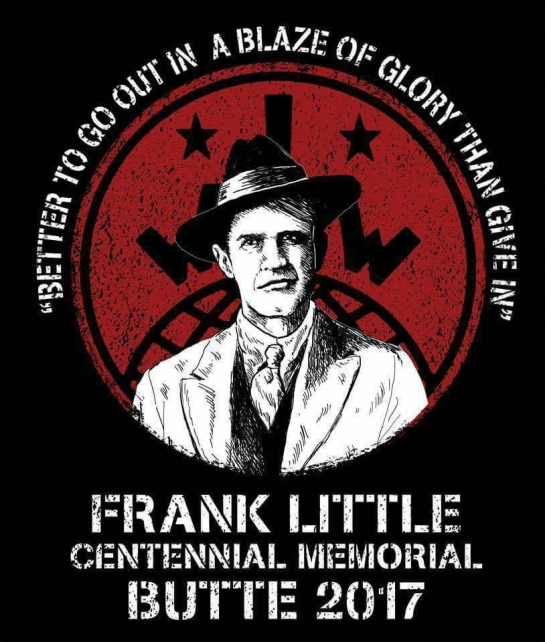
Botkin, Jane Little, Frank Little and the IWW. The Blood that Stained an American Family. University of Oklahoma Press, Norman, 2017

19990476_10213796116440546_8070776055463485877_n

The author will speak in Butte, Montana, on August 1

A giant hole in American labor history has been filled.

Frank Little’s Great Grand Niece has explained every known detail of the great union organizer’s life. 125 pages of careful notations testify to her ability as an historian of the first rank, but she also reveals family records hidden for a century. She has written not only the best biography of Frank Little possible, but she also put the events of his life and times in context so that a reader can, from this one book, draw the important lessons of the missing chapters, 1905-1919, of American history.

Why Frank Little and His Times Matter

Frank Little was a top organizer for the Industrial Workers of the World, the IWW, the Wobblies, the One Big Union, the OBU. At the time he was lynched, one hundred years ago on August 1, he was Chairman of the General Executive Board. Not all details are known, but his legacy probably includes:

1. Implementation of passive resistance tactics decades before Gandhi or MLK
2. Implementation of organizing itinerant farm workers decades before Cesar Chavez
3. Implementation of Industrial Organizing (as opposed to craft organizing) decades before the CIO
4. Champion of the argument that workers should stay out of World War I
If Frank Little had survived his 39th year, and if his ideas had survived, civil rights would have been greatly advanced. Labor would have put aside all arguments against minorities and immigrants long ago. Itinerant farm workers would have been organized far earlier. Divisions in the ranks of organized labor would have melted away. Thousands of soldiers’ lives would have been saved and American workers would have had a far better understanding of capitalism, imperialism, and socialism than they do now or have ever had. This last point is based on Frank Little’s adamant opposition to World War I. He was one of the two most outspoken labor leaders in the world on this point. The other one was V.I. Lenin in Russia.
In our spare time, my wife and I have tried to collect what little we could find out about Frank Little. I posted it years ago at http://labordallas.org/hist/little.htm.
The new book shows that I was wrong on several small details, but my only general mistake was to have underestimated the man and his importance.

Why Didn’t We Already Know All This?

Within a month of Frank Little’s lynching at the hands of the copper bosses of Montana, The United States government launched the fiercest attack against the working class in our history. Free speech, one of Frank Little’s greatest accomplishments, was trampled. Unionists were hunted down and deported or arrested and tortured. Heavy jail sentences were laid on any of the hundreds railroaded for having “conspired with Frank H. Little” to undermine war production.

Union halls were raided and all records were confiscated. History, especially any history associated with Frank Little, was wiped clean. Fear was so great that even Frank Little’s relatives dared not remember him. Fear was so great that the silence lasted almost 100 years, until now.

–Gene Lantz

You can still find me every Saturday at 9AM Central Time on http://knon.org

I write on http://tx.aflcio.org/dallas and http://texasretiredamericans.org


Movie review, “Churchill,” Directed by Jonathan Teplitzk, 110 minutes

churchillquote

I can only think of one good reason to go and see the new biopic, “Churchill.” It’s an opportunity to see the great Miranda Richardson, who plays his wife.

The movie takes place in the last few days before June 6, 1944, when Allied forces invaded Normandy. Sir Winston is portrayed as a greatly flawed hero, but a hero all the same. It’s all dialogue with, it seems, millions of closeups of the old gentleman’s kindly and concerned face. The real Churchill looked exactly like a bulldog. Compassion is the last thing one would associate with him.

But in this movie, he tries to stop Generals Eisenhower and Montgomery from invading France out of his overwhelming compassion for young soldiers. The reason given is his sense of guilt over the massacre at Gallipoli during World War I. He has been blamed for that and it’s inferred in this movie.

To give credit where it is due, Sir Winston’s rhetoric helped inspire and organize the Britons through extreme duress. We still listen to his speeches, and one of them is the high point of this film effort. But that is no excuse for boring moviegoers for nearly two hours and presenting one of the least-admirable characters of British history as someone to love.

Far from compassion, Churchill burned with elitism and anti-semitism. He helped make anti-communism a world religion. Among the many world figures who allowed Hitler to gain enough power to threaten the entire world, Churchill is a standout. Hitler came to power in Germany because he was seen as the best way to overcome German communism, and Churchill was a co-thinker. Instead of stopping the fascists in Spain, or earlier or later, the “great powers” allowed him to build his great war machine in hopes that he would throw it against the Soviet Union first.

I find it impossible to associate Churchill with compassion for soldiers for one main reason: he advocated for war after World War II was over and done. It was Churchill’s “Iron Curtain” speech that popularized the cold war.

Try an internet search for “Churchill and anticommunism.” Here are a few of the things that pop up:

“…His deep early admiration of Benito Mussolini was rooted in his shrewd appreciation of what Mussolini had accomplished (or so he thought). In an Italy teetering on the brink of Leninist revolution, Il Duce had discovered the one formula that could counteract the Leninist appeal: hypernationalism with a social slant. Churchill lauded “Fascismo’s triumphant struggle against the bestial appetites and passions of Leninism,” claiming that “it proved the necessary antidote to the Communist poison.” From “Churchill Extols Fascismo for Italy” New York Times, January 21, 1927. Churchill even had admiring words for Hitler; as late as 1937, he wrote: “one may dislike Hitler’s system and yet admire his patriotic achievement. If our country were defeated, I hope we should find a champion as indomitable to restore our courage and lead us back to our place among the nations.” James, “Churchill the Politician,” p. 118. On the conditions of the Fascist takeover in Italy, see Ralph Raico, “Mises on Fascism and Democracy,” Journal of Libertarian Studies 12, no 1 (Spring 1996): 1-27.  https://mises.org/library/rethinking-churchill

Churchill is credited with having begun the cold war:

http://www.theimaginativeconservative.org/2014/05/winston-churchills-iron-curtain.html

He is credited with helping the Nazis take power outside Germany:  http://azvsas.blogspot.com/2015/01/winston-churchill-anti-communist-who.html

He is credited with sharing Hitler’s anti-semitism:

https://jodebloggs.wordpress.com/2015/05/29/winston-churchill-and-the-rise-of-bolshevism-1917-1927/

If you think I say outrageous things, you might check out my weekly radio show on KNON.org or 89.3FM in Dallas.  –Gene Lantz


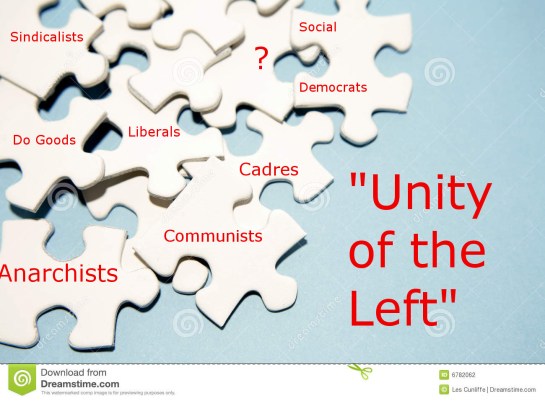
Typically today, “unity of the left” means “everybody must follow me!”
jigsaw

But a lot of activists would sincerely like to see honest unification and are frustrated when unsuccessful. The truth is that the so-called “left” is not united for terrible reasons such as personal egotism, but also for a more solid reason: we operate under different theories.

The “Do Good” Theory

If you are nice to other people, they will be nice to you. This will spread and, before too long, everybody will be nice to everybody else and we’ll have a nice world.

The first socialists, usually held to be affluent Frenchmen, were do good thinkers and theorists. They projected that we need societies that are operated for the benefit of the people within those societies. We should expand the democracy we have into a complete and total democracy where everyone has an equal chance at happiness.

In a world run, at that time, by cruel aristocrats, these early socialists made a wonderful and worthwhile contribution, but they didn’t put a whole lot of thinking into how their vision could become reality.

Liberals

To be good, one should oppose the current system and the bad people who run it.

Was it the chicken or the egg that came first, or did they evolve together? As those who ruled societies began to develop a theoretical justification for their pillage, others reacted by developing their own organizations and ideas. Today we think of the two sides as “conservatives” who want to conserve the policies of the past and “liberals” who have a vague idea of some kind of forward motion in society.

Both terms are distorted beyond recognition today, especially because the same person or group may be “liberal” on some issues and “conservative” on others.  The terms weren’t very clear to begin with. The worst example of semantic confusion today is probably the term “neo-liberal” which means someone who supports imperialism in foreign affairs because they want “liberal” foreign policies that won’t restrict transnational corporations. The worst “conservatives” on domestic policies are “neo-liberals” on foreign affairs!

Worse, it’s probably true that no one person fits neatly into any of the categories of this essay. We may be able to separate ideas to an extent, but people are always changing and don’t willingly shoehorn.

The Progressive peoples outside the United States hate neo-liberals. They probably aren’t too crazy about ordinary American liberals either, because their good intentions don’t usually extend outside their own immediate sphere.

Liberals don’t really operate from a strong theoretical base, which is why they are sometimes called “knee-jerk liberals.” But they are generally on the side of progress.

Social Democrats

Good people should organize together in opposition to bad people

Liberals tend to resist organizing. “Organizing liberals is like herding cats,” one great liberal commentator used to say. But the more serious ones recognize the struggle for power and organize. Many of them become social democrats.  The first socialist political parties called themselves social democrats. That was true of the one in America and the one in Russia. They organized to combat the status quo.

Historically, the Americans and the Russians had a lot in common before 1917. They were the only socialist parties in the world, among the many, that did not support their own capitalists during World War I. The split came later.

The social democrats were and are the largest groups of organized socialist-thinking liberals. In America today, we still have the old Socialist Party, several of its splits and variants including Democratic Socialists of America, and the Bernie Sanders “Our Revolution” movement. Many leading American unionists have been unspoken social democrats. In general, social democrats believe that their consistent political activities will gradually convince everyone to vote them into office and keep them there. Then they will they transform the society that exists into the brave new world.

In Europe, social democrats are indeed elected into power over and over again, but have never been able to stay in power and effect any kind of long-term transformation. American social democrats have seldom tasted significant power, but they have high hopes of transforming the Democratic Party to meet their ends.

Anarchists

We need militant action to destroy the bad people, then the good people will take over

While liberals more or less ignore the theory and organizations of rulers, anarchists think that destroying the other side is prerequisite to building ours. Some of the best labor heroes and heroines in America styled themselves anarchists. Although violence is not necessarily part of their ideology, they tend to be susceptible to it, and it is relatively easy for the reactionaries to paint anarchists with the brush of violence.

Another big problem for the anarchists is their tendency to spend so much time and energy arguing with the social democrats.

I purposely put the anarchists as being more developed than the social democrats because they recognize that enemies must be overcome if progress is to be made. The anarchists may not have been very effective, and aren’t effective today, but they knew that there are two sides to the struggle for progress, just as in any other war.

Nationalists and Other Forms of Identity Politics

The meek, properly organized and motivated, shall inherit the Earth

Capitalists oppress everybody, even each other if they get the chance. The capitalists of the United States, would crush those of China if they could, and vice versa.

But all oppression is not the same. The historic and ongoing oppression of African Americans in America is one striking example, but it doesn’t mean that American women weren’t oppressed, nor does it mean that Latinos, homosexuals, and, yes, white working men aren’t oppressed as well.

All oppressed people, which means all of us, are oppressed in different ways and tend to have different ideologies and organizations trying to represent us. Those organizations and ideologies do not usually try very hard to work together, but some of them do. Malcolm X and Dr Martin Luther King Jr both come to mind as great leaders of a particular national ideology who eventually recognized the need for broader unity. It is not a coincidence that they were both murdered before they went very far with their thinking.

The general idea that the exploited peoples should fight back, while very progressive in itself, has been elevated into a theory of socialists struggle. Certain ideologists and groups believe that the “most exploited,” having the most reason, are the most likely to rise up against capitalism and create a socialist world. It sounds good.

It sounds so good that hundreds, probably thousands, of college-educated activists go into America’s ghettos to recruit, train, and motivate those revolutionaries that they know are there.

Does it sound patronizing? Yes, it is. Will it work? No. One reason it won’t work is that it lacks recognition of the enemy, which even the anarchists knew about. The enemy knows it won’t work and cheerfully provides, through their philanthropy and churches, funding for these patronizing projects. During the 1960s and 1970s, the U.S. government funded its own organizations that worked on this theory. Vista Volunteers was more effective than they intended, and has been toned down. I think they call it Americorps now.

Saul Alinsky and Dorothy Day were the patron saints of identity politics, Several organizations still find plenty of funding and continue today.

Sindicalists

Organize all workers, and boss rule shall wither

While I’m oversimplifying everything, I may as well over-simplify sindicalism. Wikipedia has a really good essay on it. They say that it’s both a system to overcome capitalism and an economic system to run things afterward.

The Industrial Workers of the World always denied being sindicalists. They denied being anarchists. They denied being anarcho-sindicalists. But they are usually put forward as the best American example of all three.

Sindicalists, including some very good trade union leaders, believe that the entire working class can be organized by their workplaces and categories of work. Once that is done, a general strike can be called and the bosses will capitulate. Political work, especially elections, are confusing and not important. Elections are particularly to be avoided because they tend to cause workers to collaborate with non-workers and even with bosses.

After the bosses are brushed aside, according to the sindicalists, workers will already be organized to operate the economy for the good of all.

Communists

Workers Arise!

A lot of sindicalists and a lot of social democrats became communists, especially after the Russian Social Democratic Labor Party demonstrated that it was possible to organize workers politically, form alliances with other progressives, and do away with the capitalists.

Karl Marx and Frederich Engels, German student activists, said that they had to combine the rosy hopes of the French socialists with solid historical analysis and the scientific method to suggest a path to progress. Vladimir Lenin convinced the majority (Russian word: bolshevik) of the Russian socialists to follow that path to victory.

There was jubilation on the workers’ side, but the bosses side was extremely unhappy —  and they had most of the weaponry; consequently the 1917 revolution was contained and its supporters knew great difficulties. Amazingly, Lenin’s revolution endured 70 years and continues to appeal to many thinking activists around the world.

Cadres and Vanguards

All the revolution really needs is us!

The communists committed themselves to the world working class in all arenas of struggle. “The communists have no interests outside of the working class” was their guiding principle.

But some groups saw something different in Lenin’s example. They saw his success as having built a revolutionary, combative political party as key to the win in Russia, rather than his commitment to the ideas of Marx and Engels. To some groups, building a party of deeply committed cadre revolutionary soldiers who could act as an example to less advanced workers was more important than an actual commitment to the working class in all things.

These parties were meant to be the vanguard of all revolutionary struggle. They would set such a good example that other working people would follow them into successful revolutionary action. They tended to avoid electoral politics because it was tainted. Since they were clearly the chosen ones, they tended to argue with everybody else in the progressive movement, and were usually thought of as “splitters.”  I used to be one of them.

Who’s Who Today?

The pressures on the Soviet Union resulted in cracks and fissures throughout the world. The social democrats in America kicked the communists out. The IWW blamed and defamed them. The Trotskyites and the Maoists split them. When the Soviet Union eventually collapsed, individuals and ideologies ran helter-skelter every which-a-way.

Today the old Communist Party USA has largely drifted backward into social democracy. The Maoists are and always were nationalists. The IWW was and is sindicalist and anarchistic. Those who haven’t really thought it out, or don’t want to, are social democrats, liberals and do-goods. Since they split so often, there are too many vanguardist parties to try to name, and more are forming during this wonderful current upsurge.

There are wonderful, well-intentioned, thoughtful people in every category I’ve named. From the softest do-goods to the bitterest vanguard, we belong together.

That’s our “left” today, struggling toward the unity that it must achieve. The key word here is “must.” Progressives in America will unite because, eventually, we will realize collectively that we have to.

–Gene Lantz

I’m on KNON.org 89.3 FM in Dallas every Saturday at 9AM Central Time

I welcome your comments and ideas, in fact I really need them

I have two reasons why we aren’t fit to govern, one reason why we are, and a firm belief as to whether or not we ever will.

voteclass

Why Americans Can’t Govern Themselves

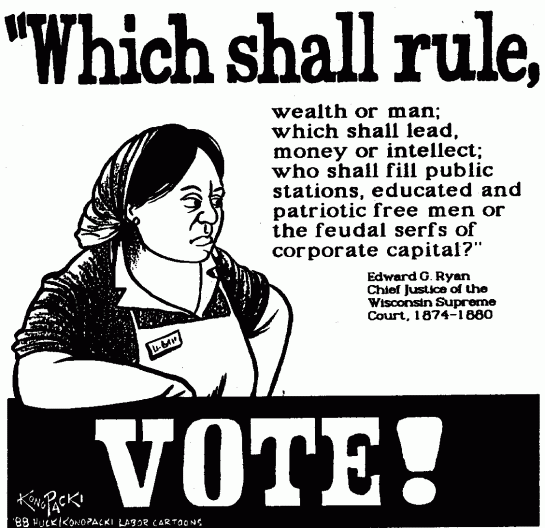
The first reason is obvious: Americans aren’t even trying to govern ourselves. In my town, we just finished critical local elections with about 5% turnout of eligible voters. “Eligible voters” is the electorate plus the large percentage who didn’t even register.

The issues were really big and really clear. The establishment was lined up on one side and the people on the other. Everybody had a big stake, but hardly anybody responded.

The other thing against our ability to govern ourselves is the crippling divisions between those few of us who have shown that we give a damn. Example: my group called a rally last Friday, then had to try to reconcile with two other groups calling conflicting activities. We were able to come together with one of them, but the other wouldn’t budge. Here’s a laugh for you, the two groups most divided, most sectarian, least concerned about building a unified movement, were factions of “Indivisible!”

The divided progressive organizations make little effort to work together. They may call for “unity” all the time, and they do, but their idea of “unity” is “everybody follow me!” Very few of our disparate groups have a coherent strategy that makes any sense.

Hardly any of us recognize the central role of the working class in any effort to make progress against the 1%. If we did, we’d be working hard to stop Congress and the State Legislatures from undermining organized labor, but we aren’t.

Why Americans Can Govern Themselves

It’s all relative. I just made a couple of points explaining why the American people can’t govern ourselves, but I didn’t mention that we are far better prepared than the people who are running things now. One could start clicking the days off the calendar before the rich capitalists destroy all of us, including themselves, with their wars and pollution!

So the American people may not be very fit to govern, but we’re miles better than the present rulers!

Who Will Win the Contest?

Our side will win. It’s only a matter of time. Human history can be thought of as a struggle between knowledge and ignorance, between reason and superstition. In the long arc of history, knowledge and reason are the winning side.

In my fifty years of activism, I’ve seen extremely hopeful trends developing. People are better educated,  smarter, and more capable than before. Much more! Major organizations like the AFL-CIO have re-invented themselves and now promote progressive unity. Old divisions like racism and homophobia are much less effective than they were.

Folks worry today that the capitalists will soon choose to govern through fascism rather than the time-honored American method of limited democracy. I’m one of those worried people, but even a dreadful period of fascism would be temporary. The capitalists cannot solve the problems they caused that way or any other way.

Given time, the people will prevail. I just hope we live that long.

–Gene Lantz

I’m still broadcasting on http://www.knon.org/workers-beat/ at 9 Central Time every Saturday. Join me and call in 972-647-1893.

A lot of Republicans in the Texas Legislature and the editors of the Dallas Morning News have teamed up to oppose “straight party ticket” voting.

ballot

By now, everybody in the United States, and especially the Texans, should begin to worry when Republicans talk about “electoral reform.” They’ve already deformed our elections beyond recognition with crazy redistricting, outright voter suppression, and opening the floodgates for big money to buy every candidate.

Now they want Texas to join the states that have already outlawed “straight ticket” voting. I laughed out loud when I read the Dallas editors’ reasons. The main one was that the change wouldn’t make any difference because people could still vote straight ticket, they would just have to put a bunch more marks by each candidate on the ballot.

If it doesn’t make any difference, why do it?

And, anybody could turn the argument right around on the editors. If it’s true that people could still vote straight ticket AFTER this “deform,” then isn’t it also true that they could NOT vote straight ticket NOW? They aren’t offering to give people another choice, they’re offering to take one away!

Straight Ticket Voting Makes Sense

I’m not sure what it’s like in other states, but in Texas we have to elect almost everybody that has anything to do with government, from dogcatcher through all the judges and on up (or down, as the case may be) to the Governor and President. Nobody can keep track of all these candidates — then they throw in a bunch of undecipherable propositions and amendments at the end of the ballot. A person is supposed to have all this clear in his/her head before we enter the voting booth, but everybody knows we can’t.

Party Polarity Is On the Grow

The growing polarity between the two capitalist parties makes them more distinct than ever before. When I was a kid, I used to hear people say that they couldn’t tell the difference between the two capitalist parties. Nobody says that now.

For working families, the Democrats’ party platforms sound like Hollywood dreams, and the Republican party platforms come straight from the hallways of Hell.

Like the “local control” issue, the “straight ticket” issue is a smoke screen to hide the intentions of big money as they rob the workers and deform our democracy in order to undermine our ability to fight back.

–Gene Lantz

Find me Saturdays at 9 Central Time at http://knon.org